The world has a window of about 12 years left – to act on climate change

The Story of Sustainability in 2018: “We Have About 12 Years Left” Harvard Business Review 27th Dec 2018 Andrew Winston, – We have about 12 years left. That’s the clear message from a monumental study from the Intergovernmental Panel on Climate Change (IPCC).
To avoid some of the most devastating impacts of climate change, the world must slash carbon emissions by 45% by 2030, and completely decarbonize by 2050 (while, in the meantime, emissions are still rising).
The IPCC looked at the difference between the world “only” warming two degrees Celsius (3.8°F) — the agreed upon goal at global climate summits in Copenhagen and Paris — or holding warming to just 1.5 degrees. Even the latter, they say, will require a monumental effort “unprecedented in terms of scale.”
We face serious problems either way, but every half degree matters a great deal in human, planetary, and economic losses.
It wasn’t just the IPCC that told a stark story. Thirteen U.S. government agencies issued the U.S. National Climate Assessment, which concluded that climate change could knock at least 10% off of GDP. Other studies tell us that sea
level rise is going to be worse than we thought, Antarctica is melting three times faster than a decade ago, and Greenland is losing ice quickly as well. If both those ice sheets go, sea level rise could reach 200-plus feet, resulting in utter devastation, including the loss of the entire Atlantic seaboard (Boston, New York, D.C., etc.), all of Florida, London,
Stockholm, Denmark, Paraguay, and land now inhabited by more than 1 billion Asians). https://hbr.org/2018/12/the-story-of-sustainability-in-2018-we-have-about-12-years-left
Donald Trump and our imperilled planet
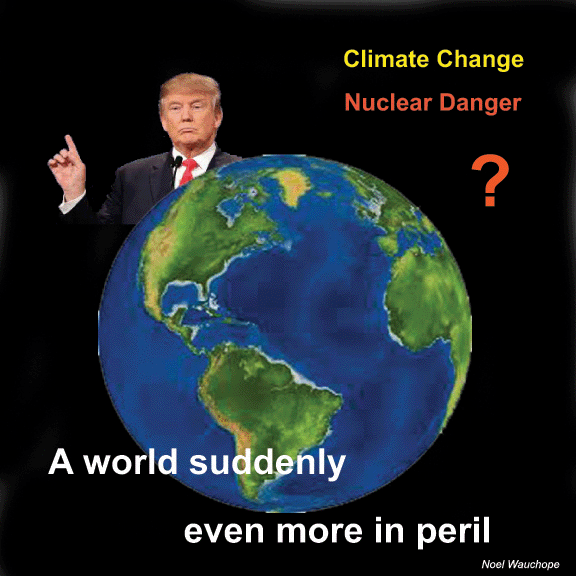
Trump Imperils the Planet https://www.nytimes.com/2018/12/26/opinion/editorials/climate-change-environment-trump.html
Endangered species, climate change — the administration is taking the country, and the world, backward.
By The Editorial Board The editorial board represents the opinions of the board, its editor and the publisher. It is separate from the newsroom and the Op-Ed section. Dec. 26, 2018
It’s hard to believe but it was only three years ago this month — just after 7 p.m., Paris time, Dec. 12, to be precise — that delegates from more than 190 nations, clapping and cheering, whooping and weeping, rose to celebrate the Paris Agreement — the first genuinely collective response to the mounting threat of global warming. It was a largely aspirational document, without strong legal teeth and achieved only after contentious and exhausting negotiations. But for the first time in climate talks stretching back to 1992, it set forth specific, numerical pledges from each country to reduce emissions so that together they could keep atmospheric temperatures from barreling past a point of no return.
- Two weeks ago, delegates met at a follow-up conference in Katowice, Poland, to address procedural questions left unsettled in Paris, including common accounting mechanisms and greater transparency in how countries report their emissions. In this the delegates largely succeeded, giving rise to the hope, as Brad Plumer put it in The Times, that “new rules would help build a virtuous cycle of trust and cooperation among countries, at a time when global politics seems increasingly fractured.”
- But otherwise it was a hugely dispiriting event and a fitting coda to one of the most discouraging years in recent memory for anyone who cares about the health of the planet — a year marked by President Trump’s destructive, retrograde policies, by backsliding among big nations, by fresh data showing that carbon dioxide emissions are still going up, by ever more ominous signs (devastating wildfires and floods, frightening scientific reports) of what a future of unchecked greenhouse gas emissions is likely to bring.
- The conference itself showcased the very fossil fuels that scientists and most sentient people agree the world must rapidly wean itself from. Poland’s president, Andrzej Duda, set the tone by declaring he had no intention of abandoning coal, which provides nearly four-fifthsof Poland’s electricity. The United States and three other major oil producers — Saudi Arabia, Kuwait and Russia — refused to endorse an alarming report issued in October by the United Nations scientific panel on climate change calling for swift reductions in fossil fuel use by 2030 to avoid the worst consequences of climate change, which it said were approaching much faster than anyone had thought.
Wells Griffith, Mr. Trump’s international energy and climate adviser, managed in one quote to summarize the dismissiveness of the American delegation and its fealty to the president’s apparently unshakable conviction that anything that helps the environment must inevitably hurt the economy. “The United States has an abundance of natural resources and is not going to keep them in the ground,” he said. “We strongly believe that no country should have to sacrifice their economic prosperity or energy security in pursuit of environmental sustainability.” The administration is full of zero-sum philosophers like Mr. Griffith. The idea that sustainability may be a necessary condition of future economic growth appears never to have crossed their minds.
Further depressing the proceedings were recent defections and political troubles in countries that, along with the United States, had been expected to lead the way to a low-carbon energy future. Germany, which long ago walked away from carbon-free nuclear power, is having a hard time cutting back on coal because of political opposition. In Australia, a prime minister was kicked out of officebecause he wanted to reduce the use of coal, which Australia produces in abundance. China, despite admirably aggressive investments in wind and solar power, has yet to get a firm grip on its emissions from coal-fired plants. The new president-elect of Brazil, Jair Bolsonaro, not only named an outspoken climate-change denier as his foreign minister but also, reversing his predecessors’ policy, pledged to open up the Amazon to mining and farming. This will threaten biodiversity in one of the world’s great rain forests while crippling its ability to act as a sink for carbon emissions.
No country’s backsliding, of course, compares with Mr. Trump’s. Determined to demolish President Barack Obama’s entire climate strategy, Mr. Trump has in the past year replaced Mr. Obama’s clean-power plan, which was aimed at reducing carbon dioxide emissions from power plants, with an essentially useless substitute that would emit 12 times the pollution envisaged by the Obama plan. He has proposed weakening a major Obama regulation requiring automakers to nearly double the fuel economy of passenger vehicles by 2025. (This rollback, The Times reported this month, came after a lot of whining by oil interests, not, as one might suspect, from the auto companies, which had accepted the challenge.) And the Environmental Protection Agency and the Interior Department have taken multiple steps to roll back Obama-era efforts to control emissions of methane, a greenhouse gas many times more powerful than carbon dioxide. These three programs formed the basis of Mr. Obama’s pledge at the 2015 Paris meeting to reduce America’s greenhouse gas emissions by 26 percent to 28 percent below 2005 levels by 2025.
The health and environmental effects of the Trump rollbacks, as documented by a Times investigation published this week, are far-reaching and potentially devastating.
This holiday season has brought more gifts to fossil fuel interests; every day is Christmas Day for the likes of Murray Energy and ExxonMobil. This month, the E.P.A. proposed killing an Obama rule that would effectively block the construction of new coal-fired power plants. The Interior Department relaxed restrictions on oil and gas drilling in areas inhabited by the sage grouse, a threatened bird. Also in December, the department released an environmental-impact statement that would open all or part of the 1.5 million-acre coastal plain of the Arctic National Wildlife Refuge to leasing and exploration. The area had been off limits to drilling for decades until Congress, late last year, approved an amendment sponsored by Senator Lisa Murkowski, an Alaska Republican, to open it up.
All this is fundamentally Mr. Trump’s doing. A series of early executive orders established the pro-fossil fuel policy framework; Scott Pruitt, the E.P.A. administrator, and Ryan Zinke, the interior secretary, filled in the details. Mr. Pruitt has left Washington and Mr. Zinke is in his final days, both finishing under ethical clouds. They will deserve, along with Mr. Trump, history’s censure for doing virtually nothing to move to a more responsible energy future — and for not doing so at just the moment when the world needed the kind of leadership that Mr. Obama and his secretary of state, John Kerry (and Bill Clinton and Al Gore before them), tried to provide.
The numbers are not great. The goal in Paris was to keep warming from exceeding 2 degrees Celsius over preindustrial levels, and if possible to hold the line at 1.5 degrees, thresholds that scientists deemed unacceptably risky. Delegates knew that even if every country managed to fulfill its individual pledges, the world would be on pace for 3 degrees of warming in this century. So they agreed to tighten the targets as time went on, but instead they’ve slid backward. Many large emitters are not on track to meet their self-imposed goals. That includes America, despite the retirement of many coal-fired plants in favor of cleaner natural gas, the increasing cost competitiveness of renewable fuels like wind and solar power, and the valiant efforts of states like California to sharply reduce their own emissions and lead where Mr. Trump will not.
The bottom line, according to the Global Carbon Project, is that after three years in which emissions remained largely flat, global levels of carbon dioxide increased by 1.6 percent in 2017 and are on pace to jump by 2.7 percent this year. Some scientists have likened the increase in emissions to a “speeding freight train.” That has a lot to do with economic growth. It also has a lot to do with not moving much faster to less carbon-intensive ways of powering that growth. Or in Mr. Trump’s case, moving in the opposite direction.
Some good news in the climate battle – over 1000 institutions to divest from fossil fuels
 Climate change: More than 1000 institutions pledge to withdraw investment from fossil fuels https://www.independent.co.uk/environment/fossil-fuels-divest-climate-change-global-warming-emissions-campaign-a8681931.html ‘This is a moral movement as well as a financial one,’ campaigners say Josh Gabbatiss Science Correspondent @josh_gabbatiss 14 Dec 18, Governments, universities and banks have quit fossil fuels in their hundreds after a global campaign to convince institutions to pull their investments.
Makoma Lekalakala: ‘There should be no nuclear in climate financing’

https://www.dw.com/en/there-should-be-no-nuclear-in-climate-financing/a-46740978-14 Dec 18, Prize-winning South African activist Makoma Lekalakala’s successful legal battle to stop a secret nuclear power deal in her homeland won her international acclaim. She tells DW about defending the environment in court.
Makoma Lekalakala: My major campaigning issue, it’s mitigation against climate change and with a specific focus on electricity generation in the country [South Africa] — it’s almost 90 percent from coal. And we know that coal is a major contributor of greenhouse gas emissions, so our campaign has been for a just transition towards a low carbon development.
We’re demanding a greater investment in renewable energy technologies, particularly that we can have a decentralized electricity system where solar and wind would play a major role.
The technology, we need a lot of investment in that so that we can be able to eradicate energy poverty. Local people can have their own socially-owned and community-owned renewable energy projects and co-operatives so that they can have access to electricity.
For us to be able to do that, a just transition for us would mean phasing out coal electricity generation and having no nuclear at all as part of the energy mix, and having wind and solar being increased as part of our energy mix.
Our main mission is for me to ensure that, or to advocate that, there should be no nuclear in climate financing.
Why are you against nuclear power?
Earth Life is an anti-nuclear organization, because we believe that nuclear, it’s not safe. It’s an old technology that comes from the war era and it’s not even safe for us to be able to use for various reasons. It’s not economic, it’s quite expensive, it’s not safe, it’s quite dangerous.
We can remember all the accidents that have taken place, from Fukushima, from Three Mile Island, and nuclear also leaves a legacy of radioactiveness for hundreds and hundreds of years to come.
South Africa has got a principal policy on having an energy mix as part of the energy supply of the country. However, that legislation and regulations imply that if we have an energy mix we should also decide what kind of energy we would want to be part of the mix.
What we have in South Africa, which is written in the legislation, is that the energy choice should be least cost. That is having less externalized costs to the environment, to the atmosphere.
This is not the case around nuclear. And what we’ve seen is that the government also had flouted regulations and legislation by forcing some Africans to accept nuclear power.
Can you tell us more about your legal battle against the controversial secret nuclear power deal between South Africa and Russia?
In 2015 October, Earth Life Africa filed papers against the state president, against the Department of Energy, against the National Energy Regulator of South Africa, because we felt that these three institutions were supposed to be able to forward the information that was public information. It was suspected that the political elites in the country were actually the drivers of the nuclear deal.
We went to the court based on the legislative and regulatory processes in the country that were flouted, not followed, because all the other agreements were done in secret. That’s how the nuclear industry operates.
So we were vindicated that all the processes in the constitution, our regulations, were not followed at all in favor of the Russians to get to build or to construct the nuclear reactors.
One of the main issues why we opposed, or why we are opposing nuclear energy, is that we don’t want to turn our country, our continent and the world as a radioactive zone where life cannot exist.
What are the main environmental issues in South Africa?
The main environmental issue in South Africa, it’s pollution. As we speak now, South Africans, particularly in hotspot pollution areas, are unable to breathe. In Mpumalanga, where there’s almost about 11 coal-fired power stations and coal mines, this is an area that is very highly polluted and it’s one of the most polluted areas in the world.
Makoma Lekalakala is director of Earthlife Africa’s Johannesburg branch, an environmental non-profit organization. Together with Liziwe McDaid, she won the Goldman Environmental Prize for 2018 for stopping a controversial nuclear power deal between South Africa and Russia.
This interview was conducted by Louise Osborne and edited by Melanie Hall.
Nuclear power is no answer to global heating – even if only because nuclear power is unaffordable
 Want to solve climate problem? Nuclear isn’t the answer https://www.downtoearth.org.in/blog/energy/want-to-solve-climate-problem-nuclear-isn-t-the-answer-62428
Alternatives to nuclear energy, in particular renewable sources of electricity like wind and solar energy, have become drastically cheaper. By M V RamanaL 10 December 2018 “It is nuclear power that will be the main tool to reduce emissions” said Poland’s Minister of Energy, Krzysztof Tchórzewski, in keynote remarks at a meeting during the 24th Conference of Parties to the United Nations Framework Convention on Climate Change (COP 24) being held in Katowice, Poland. There is more than a little irony in that statement.
To start with, Poland, which is invested heavily in coal, has no nuclear power plants; its current plans call for starting nuclear power generation in 2030. That projection has to be taken with more than a pinch of salt. In 2002, even the International Atomic Energy Agency (IAEA), whose official objective is “to accelerate and enlarge the contribution of atomic energy”, concluded that nuclear power in Poland was not viable because of “insufficient economic competitiveness of nuclear plants, availability of cheaper alternatives and the absence of environmental motivation”.
The second irony was that Tchórzewski was speaking at an event organised by an initiative called Nuclear Innovation: Clean Energy Future, that was set up in May 2018 by the country that is withdrawing from the Paris climate accord, the United States of America. The United States, under the Trump administration, has been engaged in the perverse pursuit of various efforts that will result in increased emissions. Such an administration touting nuclear power suggests a basis for scepticism about nuclear energy being a tool to reduce emissions.
The final, and the most important, irony is that nuclear energy is fading in importance globally. The peak in nuclear power’s share of global electricity generation was 17.5 percent in 1996. Since then this fraction has steadily declined, reaching 10.3 percent in 2017. For a variety of reasons, the downward trend is expected to continue.
Although nuclear energy’s share of electricity generation has been continuously declining, expectations for how nuclear energy will fare in the future went up in the first decade of this millennium, thanks to propaganda from nuclear advocates about an impending nuclear renaissance. That supposed resurgence came to a crashing halt after multiple devastating accidents at the Fukushima Daiichi nuclear plant in Japan that started in 2011, which reminded the world about the hazardous technology involved in the generation of nuclear power. Even the IAEA’s average projections for nuclear power for the year 2050 have decreased from 1,002 gigawatts (GW) as laid out in 2010 to 552 GW in its 2018 publication.
This decline reflects the corresponding declines in future projections of nuclear power in many individual countries as exemplified by India and China. In 2010, the secretary of India’s Department of Atomic Energy (DAE) announced a target of 35 GW by 2020. The DAE is nowhere near that target and, as of December 2018, the current capacity is only 6.8 GW. If all the currently under-construction plants are ready in time, the total installed capacity will reach 13.5 GW by 2024-25, a far cry from earlier projections.
In China, the country constructing the largest number of nuclear plants, the official target as of 2010 was 70 GW by 2020, and the expectation was that “reaching 70GW before 2020 will not be a big problem”. That proved not to be the case and China’s current target for 2020 is only 58 GW and it is unlikely to meet that target.
India and China are often considered the poster children for nuclear energy growth—and even there the picture is quite dismal. The outlook in other countries is worse. Operating nuclear capacity in the two countries with the largest deployments of nuclear power plants, the United States and France, is expected to decline.
What is behind this trend? Fukushima is only a minor part of the story. The primary reason is that nuclear power is no longer financially viable. Because they are hugely expensive, it has been known for a while that building new nuclear power plants makes little economic sense. What has changed in the last decade is that it is not just constructing new reactors, but just operating one, even one that is old and has its capital costs paid off, that has ceased to make economic sense.
This is because alternatives to nuclear energy, in particular renewable sources of electricity like wind and solar energy, have become drastically cheaper. In contrast, just about every nuclear plant that was constructed in the last decade has proven more expensive than initially projected.
This economic reality adds to the other well-known problems associated with nuclear energy—the absence of any demonstrated solutions to managing radioactive waste in the long run, the linkage with nuclear weapons, and the potential for catastrophic accidents. The bottom line is that nuclear power cannot be a tool to decrease emissions. If we want to solve the climate problem, we will have to look elsewhere.
The drying of soils due to climate change is shrinking the world’s water supply
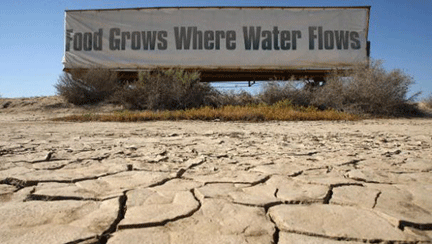
 The long dry: why the world’s water supply is shrinking, EurekAlert, : 13-DEC-2018
Global water supplies are shrinking, even as rainfall is rising; the culprit? The drying of soils due to climate change
UNIVERSITY OF NEW SOUTH WALES A global study has found a paradox: our water supplies are shrinking at the same time as climate change is generating more intense rain. And the culprit is the drying of soils, say researchers, pointing to a world where drought-like conditions will become the new normal, especially in regions that are already dry.
The study – the most exhaustive global analysis of rainfall and rivers – was conducted by a team led by Professor Ashish Sharma at Australia’s University of New South Wales (UNSW) in Sydney. It relied on actual data from 43,000 rainfall stations and 5,300 river monitoring sites in 160 countries, instead of basing its findings on model simulations of a future climate, which can be uncertain and at times questionable
“This is something that has been missed,” said Sharma, an ARC Future Fellow at UNSW’s School of Civil and Environmental Engineering. “We expected rainfall to increase, since warmer air stores more moisture – and that is what climate models predicted too. What we did not expect is that, despite all the extra rain everywhere in the world, is that the large rivers are drying out.
“We believe the cause is the drying of soils in our catchments. Where once these were moist before a storm event – allowing excess rainfall to run-off into rivers – they are now drier and soak up more of the rain, so less water makes it as flow.
“Less water into our rivers means less water for cities and farms. And drier soils means farmers need more water to grow the same crops. Worse, this pattern is repeated all over the world, assuming serious proportions in places that were already dry. It is extremely concerning,” he added.
For every 100 raindrops that fall on land, only 36 drops are ‘blue water’ – the rainfall that enters lakes, rivers and aquifers – and therefore, all the water extracted for human needs. The remaining two thirds of rainfall is mostly retained as soil moisture – known as ‘green water’ – and used by the landscape and the ecosystem.
As warming temperatures cause more water to evaporate from soils, those dry soils are absorbing more of the rainfall when it does occur – leaving less ‘blue water’ for human use.
“It’s a double whammy,” said Sharma. “Less water is ending up where we can store it for later use. At the same time, more rain is overwhelming drainage infrastructure in towns and cities, leading to more urban flooding.”
Professor Mark Hoffman, UNSW’s Dean of Engineering, welcomed Sharma’s research and called for a global conversation about how to deal with this unfolding scenario, especially in Australia, which is already the driest inhabited continent (apart from Antarctica).
“It’s clear there’s no simple fix, so we need to start preparing for this,” he said. “Climate change keeps delivering us unpleasant surprises. Nevertheless, as engineers, our role is to identify the problem and develop solutions. Knowing the problem is often half the battle, and this study has definitely identified some major ones.”
The findings were made over the past four years, in research that appeared in Nature Geoscience, Geophysical Research Letters, Scientific Reports and, most recently, in the American Geophysical Union’s Water Resources Research………..
Sharma said the answer was not just more dams. “Re-engineering solutions are not simple, they have to be analysed on a region-by-region basis, looking at the costs and the benefits, looking at the change expected into the future, while also studying past projects so mistakes are not repeated. There are no silver bullets. Any large-scale re-engineering project will require significant investment, but the cost of inaction could be monstrous.”
In urban areas, the reverse will be needed: flooding is becoming more common and more intense. Global economic losses from flooding have risen from an average of $500 million a year in the 1980s to around $20 billion annually by 2010; by 2013, this rose to more than US$50 billion. The Intergovernmental Panel on Climate Change expects this to more than double in the next 20 years as extreme storms and rainfall intensify and growing numbers of people move into urban centres.
Adapting to this is possible, but will require large-scale re-engineering of many cities, says Sharma. “Tokyo used to get clobbered by floods every year, but they built a massive underground tank beneath the city that stores the floodwater, and releases it later. You never see floods there now.” https://www.eurekalert.org/pub_releases/2018-12/uons-tld121118.php
Global nuclear industry aggressively lobbying climate negotiators
NIRS (accessed) 10th Dec 2018 , The nuclear industry is aggressively lobbying global climate negotiators to promote nuclear power as a solution to the climate crisis. Pro-nuclear organizations are petitioning the United Nations COP24 Global Climate Summit in Katowice, Poland, to write nuclear power into the rulebook that will be used to implement the Paris Climate Treaty.http://org2.salsalabs.com/o/5502/p/dia/action4/common/public/?action_KEY=26593
The EU, Canada, New Zealand, and scores of developing countries to strengthen their climate change commitments
 Climate change talks result in renewed pledge to cut emissions, EU, Canada, New Zealand and developing countries to keep global warming below 1.5C Guardian, Fiona Harvey, Ben Doherty and Jonathan Watts in Katowice, 13 Dec 2018
The promise, which follows increasingly dire scientific warnings, was the most positive message yet to come from the ongoing talks in Poland.
The announcement came at the end of a day in which the UN secretary general made an impassioned intervention to rescue the talks, which have been distracted by US, Russian and Saudi moves to downgrade scientific advice.
“We’re running out of time,” António Guterres told the plenary. “To waste this opportunity would compromise our last best chance to stop runaway climate change. It would not only be immoral, it would be suicidal.”
The talks have centred on devising a rulebook for implementing the 2015 Paris agreement and raising countries’ level of ambition to counter climate change, but progress has been slow on several key issues and divisions have emerged between four fossil fuel powers – the US, Russia, Saudi Arabia and Kuwait – and the rest of the world.
The UN believes China could play a stronger role in the absence of leadership from the US. Sources said Guterres would make a telephone call to Xi to ask for his help in nudging talks forward.
The EU also wants China, which is a key member of the block of 77 developing countries, to step up to ensure that countries all follow the same rules in being transparent over their greenhouse gas emissions.
Campaigners praised the decision by the High Ambition Coalition group of countries, made up of the EU and four other developed countries, including Canada and New Zealand, as well as the large grouping of least developed countries and several other developing nations, to scale up their emissions-cutting efforts in line with a 1.5C temperature rise limit.
Wendel Trio, director of the Climate Action Network Europe, said: “The spirit of Paris is back. The statement will boost greater ambition at the crunch time of these so far underwhelming talks. For the EU this must mean a commitment to significantly increase its 2030 target by 2020, even beyond the 55% reduction some member states and the European parliament are calling for. We call upon the countries that have not signed the statement so far to stop ignoring the science.”
Guterres, in a pointed criticism aimed at the four countries that have been refusing to “welcome” the Intergovernmental Panel on Climate Change’s special report on 1.5-degree warming, said rejecting climate science was indefensible.
He added: “The IPCC special report is a stark acknowledgment of what the consequences of global warming beyond 1.5 degrees will mean for billions of people around the world, especially those who call small island states home. This is not good news, but we cannot afford to ignore it.”
Frank Bainimarama, the prime minister of Fiji and the outgoing chair of COP23, amplified Guterres’ message. He told delegates they risked going down in history as “the generation that blew it – that sacrificed the health of our world and ultimately betrayed humanity because we didn’t have the courage and foresight to go beyond our short-term individual concerns: craven, irresponsible and selfish”.
The former US vice-president Al Gore told delegates they faced “the single most important moral choice in history of humanity”.
Behind the scenes, delegates said there had been strong progress on finance thanks to a doubling of commitments by Germany and Norway to help poorer nations adapt to climate change and build institutions capable of monitoring emissions. Nicholas Stern, the author of a landmark review on the economics of climate change, praised “the level of ideas and cooperation”.
But others said there were still many disputed brackets in the negotiating text on transparency and other elements of the rulebook……..
“The window for action is closing fast. We need to do more and we need to do it now,” said the document, which would form part of the official statement from this conference. https://www.theguardian.com/environment/2018/dec/12/un-chief-antonio-guterres-attempts-to-revive-flagging-climate-change-talks
Scientists warn about international inaction on climate change
Window is narrowing’: scientists urge action at UN climate talks, Guardian, Jonathan Watts in Katowice, Wed 12 Dec 2018Gilet jaunes protests cast shadow as concerns raised over backlash against rapid change Scientists have laid down the gauntlet for political leaders as the UN climate summit in Katowice, Poland, wrestles with the challenge of cutting emissions without sparking social tensions like those seen recently in France.The UN climate talks – known as COP24 and the most important since the Paris agreement was signed in 2015 – aim to set a new rulebook for governments to reduce greenhouse gases and to raise ambitions, after warnings of dire consequences if global warming rises more than 1.5C above pre-industrial levels.
The climate crisis is already here and the risks are growing, said Hoesung Lee, chair of the UN Intergovernmental Panel on Climate Change, who led a study by thousands of scientists on ways to avoid 1.5C of warming via accelerated transition from fossil fuels.
“The IPCC made a tremendous collective effort to bring you the best scientific knowledge on the subject. We tell you limiting warming to 1.5C is possible but the window is narrowing,” Lee told a plenary on Tuesday. “The scientific community has delivered, now it is up to governments to take action.”
There has been fierce debate about what to do with the study. All but four of the world’s governments want to formally welcome the 1.5C report to spur a more ambitious shift towards renewable energy. However, four oil producing nations – the US, Russia, Saudi Arabia and Kuwait – said the study should merely be “noted”.
This issue has overshadowed the past few days of the talks in Poland. Saudi Arabia has claimed there are “gaps and uncertainties” in the study. The US held a long-planned event promoting coal, gas, oil and nuclear power.
In a thinly veiled criticism of such tactics, Laurent Fabius, a former prime minister of France and president of the 2015 Paris climate talks, told the plenary that political leaders would play a negative role if they were “not only somnambulists but spoilers”.
He noted that global emissions rose by 2% this year, when they need to decline if warming is to be kept to a less dangerous level.
“Let us be clear, the real world is not on track. We need to do more and to do it faster,” Fabius said. “The IPCC 1.5C report shows the tremendous importance of every half degree and the disastrous consequences of missing that boundary.”……..https://www.theguardian.com/environment/2018/dec/11/the-window-is-narrowing-scientists-urge-action-at-un-climate-talks
Degrading permafrost puts Arctic infrastructure at risk by mid-century
https://www.sciencedaily.com/releases/2018/12/181211113030.htm
- Date:
- December 11, 2018
- Source:
- University of Alaska Fairbanks
- Summary:
- Seventy percent of the current infrastructure in the Arctic has a high potential to be affected by thawing permafrost in the next 30 years. Even meeting the climate change targets of the Paris Agreement will not substantially reduce those projected impacts, according to a new study.
-
Seventy percent of the current infrastructure in the Arctic has a high potential to be affected by thawing permafrost in the next 30 years. Even meeting the climate change targets of the Paris Agreement will not substantially reduce those projected impacts, according to a new study published in Nature Communications.
“Much more needs to be done to prepare Alaska and Alaskans for the adverse consequences of coming changes in permafrost and climate,” said Vladimir Romanovsky, a scientist with the University of Alaska Fairbanks Geophysical Institute who has been monitoring permafrost across Alaska for 25 years.
Permafrost is ground that is frozen year-round for a minimum of two years. When it thaws, it can change from solid earth into mud. In many cases, the ground will slump, leading to destructive failure in any structures erected there.
“These observations have led me to believe that the global warming is not a ‘fake’ but the reality,” Romanovsky said. “And here, in Alaska, we are dealing already and will be dealing even more in the near future with this reality.”
Romanovsky is one of the study’s authors, along with researchers from Finland, Norway, Russia and Michigan. The research is the first to explicitly show the amount of fundamental infrastructure across the Northern Hemisphere that is at risk of structural failure from permafrost thaw caused by climate change.
- The paper reports that by 2050, about three-quarters of the population now living on permafrost, about 3.6 million people, will be affected by damage to infrastructure from permafrost thaw. In Alaska, about 340 miles of the trans-Alaska oil pipeline traverses ground where near-surface permafrost may thaw by 2050.
“The results show that most fundamental Arctic infrastructure will be at risk, even if the Paris Agreement target is achieved,” the authors write. However, after 2050, attaining the Paris Agreement goals would make a clear difference in potential damage to infrastructure.
The authors looked at measurements of ground temperature, annual thaw depth and other data to make their projections. They note that because of the uncertainties, the amount of infrastructure at risk from permafrost thaw is probably not much smaller than their estimate, but could be substantially larger.
Damage to industrial facilities such as pipelines could lead to major ecosystem disruption if it results in spills. Energy supplies, national security and general economic activity could be adversely affected as well, the authors write. The Yamal-Nenets region in northwestern Siberia is the source of more than one-third of the European Union’s pipeline imports of natural gas, for example.
Many parts of the Arctic’s infrastructure have relatively short lifespans. Planners and engineers need to know in detail where permafrost is most likely to thaw as they plan for replacements, upgrades and maintenance. This study mapped such areas at a resolution of 0.6 miles, allowing them to target mitigation where it is most needed.
Mayor of London has plan to tackle the climate emergency

 London mayor unveils plan to tackle ‘climate emergency’https://www.theguardian.com/uk-news/2018/dec/11/london-mayor-sadiq-khan-city-climate-emergency, – Matthew Taylor, Sadiq Khan accuses government of dragging its feet and calls for investment to avert catastrophe London’s mayor, Sadiq Khan, has declared a climate emergency and urged the UK government to do more to avert an ecological breakdown that he says poses an existential threat to future generations.
Speaking as City Hall outlined its new climate change plan, Khan said he was implementing measures to protect people from floods, fires and the political upheaval caused by climate change. He accused central government of “dragging its feet” on dealing with these issues.
“We are in the midst of a climate emergency which poses a threat to our health, our planet and our children and grandchildren’s future,” Khan told the Guardian. “City Hall is doing everything in our power to mitigate the risk in London but the stark reality is that we need urgent government action and funding.”
The acknowledgement of the scale and nature of the ecological crisis by the leader of one of the world’s major cities comes amid growing concern about the impact of climate change. A succession of scientific reports have laid bare the scale of the unfolding disaster, including one from the UN that said there were only 12 years left to avert the most extreme consequences of climate breakdown.
On Sunday 100 academics, philosophers and authors wrote to the Guardian to back a new civil disobedience group – Extinction Rebellion – and called for people around the world to rise up and organise against the “paralysis” of political leaders.
Khan’s intervention follows that of civic leaders in the UK and around the world. Last month Bristol declared a climate emergency and set a goal of becoming carbon neutral by 2030, while Manchester said it would become “carbon zero” by 2038. Both are more ambitious than the UK’s national target of an 80% reduction in emissions by 2050. It follows similar moves by several US cities.
London’s existing plan, unveiled by Khan in May, was for the city to be carbon neutral by 2050. But last week the London Assembly passed a motionsaying that target should be brought forward to 2030 and called on Khan to draw up “a specific emergency plan”.
Caroline Russell from the Green party, who proposed the motion, said it was crucial Khan backed a more radical target and called on the government to give him the appropriate powers and funding.
“Catastrophic climate breakdown might be as little as 12 years away,” she said. “This would have profound impacts on every aspect of our lives in London from flooding and overheating in summers, disruption in our food supply chains as well as in the wider natural world.
“The mayor needs to be at the forefront of this challenge, declaring a climate emergency and an urgent updating of his carbon reduction targets to make London carbon neutral by 2030, decades ahead of his current plans, setting a precedent for other major and world cities.”
Khan said he had already introduced a series of measures to tackle climate breakdown – from investing £500m in low carbon technologies to divesting pension funds from fossil fuels.
But he said a City Hall analysis due to be published on Wednesday showed London would need a huge programme of investment as well as new powers to bring forward its zero-carbon target to 2030. The cash would be used to:
• Retrofit hundreds of thousands of homes and offices to make them more energy efficient.
• Decarbonise the national grid.
• Install low-carbon heating systems, such as heat pumps.
• Move private and public transport away from diesel and petrol, and towards electric.
Khan said: “My message to ministers is clear – stop dragging your feet and gambling with our future and give London and cities across the UK the real powers and funding needed to protect our future generations.”
The Green party welcomed Khan’s move and backed his call for more help from central government. But Russell said there was more that could be done now. “Sadiq should start this mission by cancelling the Silvertown road tunnel and fighting harder against things that will make the climate crisis worse.
“He should call right now for a halt to climate-wrecking aviation expansion, including at Gatwick, and ask his C40 [global green city network] counterparts to join him.”
Australia’s Environment Ambassador, Patrick Suckling, promotes fossil fuels at UN Climate Summit
|
One must ask was Ambassador Suckling’s presence sanctioned at Ministerial level? His attendance on the panel is hardly good diplomacy for Australia, even given the Liberal Government support for coal and weak climate targets and climate policy. After about 9 minutes the first speaker was disrupted and youth and civil society delegates unfurled a banner and made their own testimonies on the disruptive and dangerous nature of coal for health and climate. They chanted “Keep it in the ground” and “Shame on you”, before leaving the session. After they left, there were very few people to listen to the myths being spouted of clean coal. Watch the Facebook Livestream video of young delegates taking over the side event about 9 minutes in and making their own testimony on the fossil fuel industry. The Australia Institute Director of Climate & Energy Program Richie Merzian was there to document the session in the tweets below. “How could this be good for Australia? The Ambassador finding himself in the middle of the largest cultural battle at #COP24” remarks Richie Merzian…… https://www.facebook.com/groups/859848424161990/ Anger, protests as Australia supports US fossil fuels event at UN climate talkshttps://reneweconomy.com.au/anger-protests-as-australia-supports-us-fossil-fuels-event-at-un-climate-talks-17843/, 11 December 2018 , Think Progress |
|
|


Pacific island countries accuse USA of obstructing talks at UN climate change summit
Vanuatu’s foreign minister says worst offenders on global warming are blocking progress, Guardian, Ben Doherty in Katowice@bendohertycorro, Wed 12 Dec 2018
The United States and other high carbon dioxide-emitting developed countries are deliberately frustrating the UN climate summit in Katowice, Poland, Vanuatu’s foreign minister has said. His warning came as Pacific and Indian ocean states warned they faced annihilation if a global climate “rule book” could not brokered.In a bruising speech before ministers and heads of state, Vanuatu’s foreign minister, Ralph Regenvanu, singled out the US as he excoriated major CO2-emitting developed countries for deliberately hindering negotiations.
“It pains me deeply to have watched the people of the United States and other developed countries across the globe suffering the devastating impacts of climate-induced tragedies, while their professional negotiators are here at COP24 putting red lines through any mention of loss and damage in the Paris guidelines and square brackets around any possibility for truthfully and accurately reporting progress against humanity’s most existential threat,” he said.
Regenvanu said the countries most responsible for climate change were now frustrating efforts to counter it.
The UN’s climate change talks in Poland have been distracted by a semantic debate over whether the conference should “welcome” or “note” the IPCC’s special report warning of dire consequences if global warming rises more than 1.5C above pre-industrial levels, with a bloc of four oil-producing countries – the US, Saudi Arabia, Russia, and Kuwait – insisting the report be only “noted”.
Documents from the conference presidency, seen by the Guardian, indicate the issue of how to acknowledge the report will be returned to later in the week and is likely to further slow progress on negotiating a final outcome. Negotiators said they are growing increasingly pessimistic that talks can be concluded by their deadline on Friday…….
As 193 countries at the climate talks seek to establish a “rule book” on how to implement the commitments made in the Paris agreement three years ago, Regenvanu condemned a two-tier system that exempted high-emissions countries from reductions obligations, saying the world needed “one common rule book, in which rules apply to all”.
The US state department declined to comment on his remarks……https://www.theguardian.com/environment/2018/dec/11/us-accused-of-obstructing-talks-at-un-climate-change-summit
Fossil fuel panel, of Americans plus Australia’s ambassador for environment, Patrick Suckling, scorned in Ploand
 The only non-American was Patrick Suckling, the ambassador for the environment in Australia’s coal-enthusiast government.
A Trump administration presentation extolling the virtues of fossil fuels at the UN climate talks in Poland has been met with guffaws of laughter and chants of “Shame on you”.Monday’s protest came during a panel discussion by the official US delegation, which used its only public appearance to promote the “unapologetic utilisation” of coal, oil and gas. Although these industries are the main source of the carbon emissions that are causing global warming, the speakers boasted the US would expand production for the sake of global energy security and planned a new fleet of coal plants with technology it hoped to export to other countries.
The event featured prominent cheerleaders for fossil fuels and nuclear power,including Wells Griffith, Donald Trump’s adviser on global energy and climate, Steve Winberg, the assistant secretary for fossil energy at the energy department, and Rich Powell, the executive director of the ClearPath Foundation, a non-profit organisation focused on “conservative clean energy”. The only non-American was Patrick Suckling, the ambassador for the environment in Australia’s coal-enthusiast government.
None of the US participants mentioned climate change or global warming, focusing instead of “innovation and entrepreneurship” in the technological development of nuclear power, “clean coal” and carbon capture and storage.
Ten minutes into Griffith’s opening speech, he was interrupted by a sudden, sustained, loud volley of laughter by several dozen protesters that was then followed by a single shout of “It’s not funny”, and then a series of chants of “Keep it in the ground” and “Shame on you”.
Several campaigners read statements. “There is no such thing as clean coal. Coal is deadly from the beginning to the end. They talk about the life cycle of coal, I talk about it as a death march. My father died of black lung, and I am in this struggle with others whose fathers and husbands are dying of black lung right now,” said Teri Blanton of Kentuckians for the Commonwealth, which represents Appalachian coal workers in North America.
After the protesters were led away by security guards, Griffiths said: “In the US our policy is not to keep it in the ground, but to use it as cleanly and efficiently as possible”.
This statement was contradicted by climate analysts, who noted the US environment agency estimates that 1,400 more deaths per year will result from Trump’s proposal to replace the Clean Power Act.
“It’s ludicrous for Trump officials to claim that they want to clean up fossil fuels, while dismantling standards that would do just that,” said Dan Lashof, the director of the World Resources Institute. “Since taking office, this administration has proposed to roll back measures to cut methane leaks from oil and gas operations, made it easier for companies to dump coal ash into drinking water, and just days ago proposed easing carbon pollution rules for new coal-fired power plants.” …….
Echoing a claim often made by Trump, Griffiths said the US would not be subject to agreements that hamstrung domestic growth, while allowing China to operate with high emissions.
This was the second consecutive year that the Trump team was heckled after promoting fossil fuels and nuclear power at the climate talks, underscoring how the US position has shifted since the president took power in 2017………
An alternative, non-official US delegation has backed a faster transition to renewables. Made up of city- and state-level governments, business executives and religious leaders, the “We’re still in” group is staging dozens of events in a bid to show action is still possible without White House support.
Nonetheless, many observers at the official US panel were ashamed at the position of their federal government. “I was completely embarrassed to be an American”, said Leo McNeil Woodberry of the Climate Action Network. “Everything they proposed was absolutely wrong. I can’t believe they are putting profits over the planet, and profits over people.” https://www.theguardian.com/environment/2018/dec/10/protesters-disrupt-us-panels-fossil-fuels-pitch-at-climate-talks
The worst performing countries for climate action- USA and Saudi Arabia
 US, Saudi Arabia back-of-the-pack on curbing climate change, Researchers have identified the United States and Saudi Arabia as the climate change laggards. https://www.sbs.com.au/news/us-saudi-arabia-back-of-the-pack-on-curbing-climate-changeThe United States and Saudi Arabia rank last when it comes to curbing climate change among the 56 nations accounting for 90 percent of planet-warming greenhouse gas emissions, researchers said Monday.A large number of laggards means the world is dangerously off-track when it comes to slashing the carbon pollution that has already amplified droughts, flooding and deadly heatwaves worldwide, they reported on the margins of UN climate talks in Katowice, Poland.
Only a few countries have started to implement strategies to limit global warming well below 2 degrees Celsius (3.6 degrees Fahrenheit),” the cornerstone target of the 2015 Paris climate treaty, according to NewClimate Institute and Germanwatch, an NGO.
Most governments “lack the political will to phase out fossil fuels with the necessary speed.” Continue reading
1 This Month
26 September – International Day for the Total Elimination of Nuclear Weapons





PLEASE OPPOSE HR 8255 AND S.3639 – bills would accelerate satellite deployment, with no environmental review or safeguards – https://ncstd5li.quorum.us/campaign/169331/
To see nuclear-related stories in greater depth and intensity – go to https://nuclearinformation.wordpress.com
-
Archives
- September 2026 (305)
- August 2026 (330)
- July 2026 (355)
- June 2026 (287)
- May 2026 (306)
- April 2026 (356)
- March 2026 (251)
- February 2026 (267)
- January 2026 (308)
- December 2025 (358)
- November 2025 (359)
- October 2025 (375)
-
Categories
- 1
- 1 NUCLEAR ISSUES
- business and costs
- climate change
- culture and arts
- ENERGY
- environment
- health
- history
- indigenous issues
- Legal
- marketing of nuclear
- media
- opposition to nuclear
- PERSONAL STORIES
- politics
- politics international
- Religion and ethics
- safety
- secrets,lies and civil liberties
- spinbuster
- technology
- Uranium
- wastes
- weapons and war
- Women
- 2 WORLD
- ACTION
- AFRICA
- Atrocities
- AUSTRALIA
- Christina's notes
- Christina's themes
- culture and arts
- Events
- Fuk 2022
- Fuk 2023
- Fukushima 2017
- Fukushima 2018
- fukushima 2019
- Fukushima 2020
- Fukushima 2021
- general
- global warming
- Humour (God we need it)
- Nuclear
- RARE EARTHS
- Reference
- resources – print
- Resources -audiovicual
- Weekly Newsletter
- World
- World Nuclear
- YouTube
-
RSS
Entries RSS
Comments RSS

