Australia’s opportunity to lead on climate action, and rejection of nuclear power
Australia is now a divided society. The Adani coal mine dispute is symbolic of this division. The majority see climate change as an urgent issue. But others see coal mining as a lifeline for rural communities.
It is now the job of the environmental movement to explain to those communities, how clean energy is economic – provides jobs, can revitalise rural areas, can play a role in conserving water, and bring this society together, in positive action.
We also need to revive Australia’s role as a good global citizen. It takes a comedian to work this out. Charlie Pickering of the ABC’s “The Weekly” pointed out that Australia emits less than 2% of global greenhouse gases. The big emitters, like China and USA emit far more. (graph – not perfectly accurate, adjusted from Charlie Pickering’s Facebook) https://www.facebook.com/officialcharliepickering/videos/295306311406255/?v=295306311406255 )

However, the countries like Australia, that emit 2% or less of the total, together make up 41% of the global total, the largest contributor. If these countries together took action on climate change, they would make a major difference. But if each decides that they’re too small to matter, – the world is in trouble,
Australia used to be a leader in so many humanitarian and environmental areas. What Australia does IS WATCHED by the world. Australia has the opportunity to act on global warming, and show itself once again to be a good global citizen.
Australia needs also to retrieve its former international respectability , by giving REAL help to Pacific Islanders, as sea levels rise. (We also might want help from other countries when we have an environmental crisis, e.g bushfires.)
The Greens get it. Labor might get it. The COALition have shown that their loyalty is to the fossil fuel industries, not to the Australian public.
In working to deal with the climate crisis, we must not fall prey to the blandishments of the nuclear industry. Their shills will be coming out from under their rocks, touting nuclear power as the cure. It’s like how the tobacco lobby might recommend smoking as a cure for obesity, ( a thought first expressed by Dr Helen Caldicott)
‘New Nuclear Is off the Table” as far as action on climate change is concerned
|
Former U.S. Nuclear Safety Chief: ‘New Nuclear Is off the Table https://www.ecowatch.com/nuclear-safety-chief-climate-crisis-2637882298.html?rebelltitem=1#rebelltitem1 ‘ “Nuclear power was supposed to save the planet,” Jaczko wrote in a recent op-ed for The Washington Post. As an atomic physicist, he once endorsed that view. But his years on the NRC changed his mind:
Jaczko describes how his experience revealed the pervasive political influence of the nuclear power industry in Congress and among his fellow commissioners. Their opposition derailed much of the safety measures he proposed in the wake of the Fukushima nuclear disaster in Japan. In 2011 an investigative series by the Associated Press detailed the collusion between regulators and the industry to weaken safety standards to keep existing plants economically viable. Jaczko’s efforts to protect the American public likely cost him his career at the NRC. He now leads an offshore wind power startup and is speaking out at an important juncture for the nation’s energy future. Electric utilities that operate nuclear plants are boasting of being “carbon free” by mid-century. They insist that their aging nuclear plants must be part of the equation to keep costs down. But even though Japan closed most of its reactors after Fukushima, carbon emissions went down, because the Japanese ramped up energy efficiency and solar investments. “It turns out that relying on nuclear energy is actually a bad strategy for combating climate change,” Jaczko wrote. “One accident wiped out Japan’s carbon gains. Only a turn to renewables and conservation brought the country back on target.” Jaczko’s heightened concern for a nuclear accident in the U.S. is also well founded. The former director of the nuclear safety project at Union of Concerned Scientists, David Lochbaum, determined that the industry’s efforts to continue to run aging nuclear plants 20 to 30 years or even longer than their initial licenses allowed for is akin to playing Russian roulette. Since Fukushima, Germany has ordered the shutdown of all nuclear plants by 2022. Japan has reopened only a few reactors. Even France, long a champion of nuclear power, is ramping down its nuclear fleet because of safety concerns. But in the U.S., the Trump administration and lawmakers in some states continue to support taxpayer-financed subsidies to bail out money-losing nuclear plants. On grounds of both economics and safety, that’s a fool’s bet. |
|
Wildfires rage in Israel during heatwave
 24 May 19, JERUSALEM (Reuters) – Firefighters on Thursday battled wildfires that scorched swathes of forests in central Israel, forcing some small towns to be evacuated, during a heatwave that brought record temperatures to parts of the country.
Rescue efforts focused on a wooded area between Jerusalem and Tel Aviv, where ground teams and airplane tankers fought back the flames for hours. By nightfall, the fires were mostly under control, according to police……. https://www.reuters.com/article/us-israel-wildfires/wildfires-rage-in-israel-during-heatwave-idUSKCN1ST2F1
A devastating threat to the marine ecosystem – the Impact of Ocean Acidification
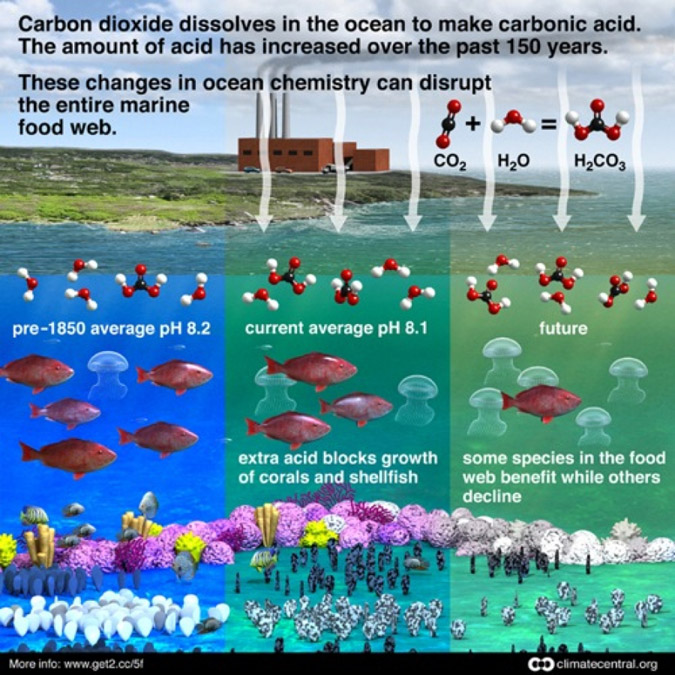
What Is the Impact of Ocean Acidification? https://www.envirotech-online.com/news/water-wastewater/9/breaking-news/what-is-the-impact-of-ocean-acidification/49250 Ocean acidification could have a massively damaging impact on millions of people all over the world in the coming years and decades, according to a new study from the University of Plymouth. By concentrating on heavily acidified hotspots in Japan and the Mediterranean, the study’s authors claim they can predict what may happen on a global scale if carbon continues to seep into the sea.The study is just latest in a growing body of work from its two authors, who have demonstrated that acidification can have a potentially devastating effect on marine ecosystems, with reefs under particular threat. This not only endangers the coral and oysters which comprise the reefs themselves, but also the myriad fish, crustaceans and other marine organisms which call them home.
What is ocean acidification?
Ocean acidification can be defined by a fall in pH levels in the water, caused primarily by carbon seeping into their vicinity. This can be caused naturally by volcanic fissures, such as at the two sites monitored by the study’s authors, but is becoming more and more commonplace through anthropomorphic activity, given that we release around a million tonnes of CO2 into the atmosphere every hour.
Roughly one quarter of that amount finds its way into the ocean and dissolves; once that happens, it reacts with the salty seawater to create a weak acidic substance. This causes surface ocean water to experience a fall in pH levels of approximately 0.002 units per year. That might not sound like much, but cumulatively it could have a sizable impact on the harmony of the water upon which so many marine creatures depend to survive and thrive.
Reefs at risk
The warming temperatures of the world’s oceans have already done significant damage to marine reefs; one only need to look at what’s happened to the Great Barrier reef for confirmation. As if that wasn’t bad enough, the acidification studied by Professor Jason Hall-Spencer and Dr Ben Harvey has been found to further jeopardise their longevity, especially for those composed of oysters or corals, which are particularly sensitive to the acidic effect.
The degradation of reefs not only spells trouble for the corals themselves, but also for the more than 25% of all marine animals which use them as a habitat. As well as being a hammer blow for biodiversity, this could also deplete stocks of many varieties of fish and shellfish which are popular for human consumption. Finally, reefs also provide an important breakwater for coastal communities; losing them would mean reduced protection against extreme weather events at sea.
What can be done?
In a world in which our seas and oceans are already suffering from myriad different problems, such as plastic pollution, dangerous blue green algae, habitat disruption from shipping, oil spills and many more, the last thing that the Earth’s waterways need right now is another threat in the form of increased oceanic temperatures and acidification. As a result, the lead author of the study Professor Hall-Spencer has called for immediate action.
“The Paris Agreement on climate change was welcome, but it does not mention ocean acidification, nor the fact that this rapid change in surface ocean chemistry undermines the social, economic and environmental pillars of sustainable development,” he remarked. “The time is ripe for a ‘Paris Agreement for the oceans’, with the specific target to minimise and address the impacts of ocean acidification, including through enhanced scientific cooperation at all levels.”
New nuclear power is not competitive, and not a viable way to deal with climate change
 Former U.S. Nukes Chief: “New nuclear is off the table” https://www.ewg.org/energy/22657/former-us-nukes-chief-new-nuclear-tableFrom 2009 to 2012, Gregory Jaczko was chairman of the Nuclear Regulatory Commission, which approves nuclear power plant designs and sets safety standards for plants. But he now says that nuclear power is too dangerous and expensive – and not part of the answer to the climate crisis. Former U.S. Nukes Chief: “New nuclear is off the table” https://www.ewg.org/energy/22657/former-us-nukes-chief-new-nuclear-tableFrom 2009 to 2012, Gregory Jaczko was chairman of the Nuclear Regulatory Commission, which approves nuclear power plant designs and sets safety standards for plants. But he now says that nuclear power is too dangerous and expensive – and not part of the answer to the climate crisis.
“Nuclear power was supposed to save the planet,” Jaczko wrote in a recent op-ed for The Washington Post. As an atomic physicist, he once endorsed that view. But his years on the NRC changed his mind:
Jaczko describes how his experience revealed the pervasive political influence of the nuclear power industry in Congress and among his fellow commissioners. Their opposition derailed much of the safety measures he proposed in the wake of the Fukushima nuclear disaster in Japan. In 2011 an investigative series by The Associated Pressdetailed the collusion between regulators and the industry to weaken safety standards to keep existing plants economically viable. Jaczko’s efforts to protect the American public likely cost him his careerat the NRC. He now leads an offshore wind power startup and is speaking out at an important juncture for the nation’s energy future. Electric utilities that operate nuclear plants are boasting of being “carbon free” by mid-century. They insist that their aging nuclear plants must be part of the equation to keep costs down. But even though Japan closed most of its reactors after Fukushima, carbon emissions went down, because the Japanese ramped up energy efficiency and solar investments. “It turns out that relying on nuclear energy is actually a bad strategy for combating climate change,” Jaczko wrote. “One accident wiped out Japan’s carbon gains. Only a turn to renewables and conservation brought the country back on target.” Jaczko’s heightened concern for a nuclear accident in the U.S. is also well founded. The former director of the nuclear safety project at Union of Concern Scientists, David Lochbaum, determined that the industry’s efforts to continue to run aging nuclear plants 20 to 30 years or even longer than their initial licenses allowed for is akin to playing Russian roulette. Since Fukushima, Germany has ordered the shutdown of all nuclear plants by 2022. Japan has reopened only a few reactors. Even France, long a champion of nuclear power, is ramping down its nuclear fleet because of safety concerns. But in the U.S., the Trump administration and lawmakers in some states continue to support taxpayer-financed subsidies to bail out money-losing nuclear plants. On grounds of both economics and safety, that’s a fool’s bet. |
|
Responsible journalism would be covering the climate chaos like we did the start of the second world war
 What if we covered the climate crisis like we did the start of the second world war? In the war, the purpose of journalism was to awaken the world to the catastrophe looming ahead of it. We must approach our climate crisis the same way
I have been asked to bring this gathering to a close by summing up how we can do better at covering the possible “collapse of our civilizations and the extinction of much of the natural world,” to quote the noted environmentalist David Attenborough, speaking at the recent United Nations climate summit in Poland.
I don’t come with a silver bullet ……
Many of us have recognized that our coverage of global warming has fallen short. There’s been some excellent reporting by independent journalists and by enterprising reporters and photographers from legacy newspapers and other news outlets. But the Goliaths of the US news media, those with the biggest amplifiers—the corporate broadcast networks—have been shamelessly AWOL, despite their extraordinary profits. The combined coverage of climate change by the three major networks and Fox fell from just 260 minutes in 2017 to a mere 142 minutes in 2018—a drop of 45%, reported the watchdog group Media Matters.
Meanwhile, about 1,300 communities across the United States have totally lost news coverage, many from newspaper mergers and closures, according to the University of North Carolina School of Media and Journalism. Hundreds of others are still standing only as “ghost newspapers.” They no longer have resources for even local reporting, much less for climate change. ……
he networks put their reporters out in raincoats or standing behind police barriers as flames consume far hills. Yet we rarely hear the words “global warming” or “climate disruption” in their reports. The big backstory of rising CO2 levels, escalating drought, collateral damage, cause and effect, and politicians on the take from fossil-fuel companies? Forget all that. Not good for ratings, say network executives.
But last October, the UN Intergovernmental Panel on Climate Change, a scientifically conservative body, gave us 12 years to make massive changes to reduce global greenhouse-gas emissions 45 percent below 2010 levels and to net zero by 2050. On his indispensable site, TomDispatch.com, Tom Engelhardt writes that humanity is now on a suicide watch.
Soon, some of you will be traveling to the ends of the earth to report on this Great Disruption. To Indonesia, where oil-palm growers and commodities companies are stripping away forests vital to carbon storage. To the Amazon, where President Bolsonaro’s government plans to open indigenous reserves to industrial exploitation, threatening the lungs of the Earth. To India, where President Modi pretends to be an environmentalist even as he embraces destructive development. To China, where President Xi’s Belt and Road initiative, the biggest transportation-infrastructure program in the history of the world, threatens disaster for earth systems. You will go to the Arctic and the Antarctic to report on melting ice, and to the shores of African cities, Pacific atolls, and poor Miami neighborhoods being swallowed by rising oceans. And to Nebraska, and Iowa, and Kansas, and Missouri, where this spring’s crop is despair as farmers and their families grieve their losses.
And some of you will go to Washington, to report on the madness—yes, I said madness—of a US government that scorns reality as fake news, denies the truths of nature, and embraces a theocratic theology that welcomes catastrophe as a sign of the returning Messiah.
Madness! Superstition! Destruction and death.
Can we get this story right? Can we tell it whole? Can we connect the dots and inspire people with the possibility of change?
What’s journalism for? Really, in the war, what was journalism for, except to awaken the world to the catastrophe looming ahead of it?
Here’s the good news: While describing David Wallace-Wells’s stunning new book The Uninhabitable Earth as a remorseless, near-unbearable account of what we are doing to our planet, The New York Times reports it also offers hope. Wallace-Wells says that “We have all the tools we need…to aggressively phase out dirty energy…”; [cut] global emissions…[and] scrub carbon from the atmosphere…. [There are] ‘obvious’ and ‘available,’ [if costly,] solutions.”
What we need, he adds, is the “acceptance of responsibility.”
Our responsibility as journalists is to tell the story so people get it…….. https://www.theguardian.com/commentisfree/2019/may/22/climate-crisis-ed-murrow-bill-moyers
Climate change action is a top priority for UK’s moderate Conservatives
Guardian 19th May 2019 , Moderate Conservatives including Nicky Morgan and Amber Rudd are urging contenders for their party’s leadership to put the battle against the climate emergency at the forefront of the contest.
The 60-strong One Nation group of senior Tories, created as a bulwark against what they perceive as their party’s lurch to the right, is calling for the environment to form a central part of the leadership debate. The heat is on over the climate crisis. Only radical measures will work.
France’s Citizens’ Convention for the Climate
for the Climate is being organised in an attempt to meet yellow-vest protesters’ demands for MPs to be bypassed in a move towards direct democracy.
Yet the initiative is fraught with dangers for Mr Macron, who risks losing control of the political agenda. Some of his supporters fear that far from appeasing the campaigners, the process could inflame their anger by reintroducing the fuel duty rises that ignited the protest movement in November.
Advertising industry is urged to use its power for good
Extinction Rebellion urges ad industry to use its power for good, Guardian, Seth Jacobson, 19 May 2019 Letter to senior figures urges them to use their power to influence public opinion on climate change Environmental activists Extinction Rebellion have turned their fire on the advertising industry in a public letter, encouraging it to use its expertise in manipulating public opinion for good or risk mass public protests against it.
Speaking to the Guardian, one of the authors of the letter, which was written by Extinction Rebellion members with decades of experience of the advertising industry, said the group was not “singling out advertising, as we previously disrupted fashion week and are systematically challenging all industries who have the platform, influence and skills to tackle this epoch-defining crisis but are failing to do so in any meaningful way”.
“Though our letter is addressed to the boardroom, we ask everyone within the industry to ‘Tell the Truth’ about the climate and ecological emergency,” he continued. “This is the first of Extinction Rebellion’s demands, to business and governments; the vital step required to wake everyone up and drive action to deal with this crisis……. https://www.theguardian.com/environment/2019/may/19/extinction-rebellion-urges-ad-industry-to-use-its-power-for-good
UK’s Committee on Climate Change makes an urgent call for action

Sussex Energy Group 17th May 2019 , Another climate report and another urgent call for action, along with a dizzying array of graphs and figures. The Committee on Climate Change (CCC), who advise the UK government on policies and planning for a low carbon economy, have produced their analysis and recommendations on how to stop UK’s contribution to global warming by 2050.
This follows the “Paris Agreement” signed in December 2015 where the UK, along with 196 other countries, agreed to reduce their nation’s greenhouse gas emissions in efforts to limit global warming to 1.5°C above pre-industrial levels.
The CCC’s excellent and thorough report makes for some tough reading; not for its 277 pages and plethora of statistics and figures, but for the scale of collective effort required. The benign-sounding estimate of costs – 1-2% of GDP – disguises the extent of system change and efforts required, not only of government and businesses, but households as well. http://blogs.sussex.ac.uk/sussexenergygroup/2019/05/17/net-zero/
Scotland increasing its commitment to act on Climate Emergency
Business Green 17th May 2019 Scotland stepped up its response to the ‘climate emergency’ earlier this
week as Glasgow and Edinburgh adopted zero-carbon targets in swift
succession and the Scottish Parliament provided further details on how it
plans to meet its new target of building a net zero emission economy by
2045.
ScottishPower pledged on Monday to help make Glasgow the first UK
city to reach net-zero carbon emissions, setting a target for meeting the
goal of 2045. In related news, SSE announced this week that the last of 84
offshore wind turbines was commissioned this week at Beatrice, Scotland’s
largest offshore wind farm. The company said the project – which is a joint venture development led by SSE Renewables, Copenhagen InfrastructurePartners and Red Rock Power Limited – has been completed on time and under
budget after three years of construction. The final 7MW Siemens Gamesa
turbine was installed in the Outer Moray Firth, around 13km off the coast
of Caithness, bringing the site’s total installed capacity to 588MW –
enough to provide clean, low carbon energy to over 450,000 homes.
Distress in Pacific Island governments, over climate change, and Australia’s inaction on this
UN secretary-general meets Pacific leaders to discuss ‘global catastrophe’ of climate change ABC By foreign affairs reporter Stephen Dziedzic , 15 May 19
- UN secretary-general Antonio Guterres said the Pacific is on the “front line of climate change”
- Pacific leaders have voiced frustration over Australia’s failure to curb its emissions
- Australian politicians say rapidly cutting emissions would be “ruinous” for Australia
Regional heavyweights had gathered at an historic climate change summit convened with the UN secretary-general Antonio Guterres.
Mr Guterres is intent on building global momentum for sharper cuts to emissions, arguing that drastic action is necessary to stave off ecological disaster.
The Pacific is on the “front line of climate change”, Mr Guterres told the meeting.
“It has a unique moral authority to speak out. It’s time for the world to listen.”
Senior Australian officials at the meeting could do little else; sent in the place of Prime Minister Scott Morrison only days before the federal election, they were bound to observer status by the caretaker conventions.
As a result, Australia did not sign up to the final statement by Pacific leaders, which declared climate change a “global catastrophe” and called for “transformative action” to stop it……
while Pacific leaders have praised New Zealand’s announcement that it wants to go carbon neutral by 2050, many are frustrated that Australia has failed to curb its emissions.
One Pacific official told the ABC the meeting’s call for radical action on climate change “really was aimed at the whole globe” but “for those in the room [it] was a message for one country”.
“Of course no-one said Australia. No-one needed to say Australia,” the official said. “What other country in the room could we be referring to?”
The outspoken Prime Minister of Samoa, Tuilaepa Sailele, went much further, wading straight into Australia’s election campaign during the post-summit press conference…….
decision makers in Canberra also know that the Pacific is increasingly impatient about Australia’s long and painful debate on climate policy.
The argument will flare up again in only months when regional leaders gather for the Pacific Islands Forum on tiny Tuvalu, which has long been a vocal champion for drastic climate action.
And this time, Australia will not be sitting on the sidelines. https://www.abc.net.au/news/2019-05-16/guterres-antonio-un-pacific-meeting-climate-change/11115816
UN chief Antonio Guterres to Pacific islands, warning rich nations about climate impacts
|
UN chief Antonio Guterres hits out at climate change ‘paradox’ ahead of historic Pacific trip https://www.abc.net.au/news/2019-05-13/un-chief-antonio-guterres-talks-climate-historic-pacific-trip/11106622, Pacific Beat 13 May 19, The trip marks the first time a sitting UN secretary-general will meet with Pacific Islands Forum (PIF) leaders in the region. Key points:
“Climate change is running faster than what we are … the last four years have been the hottest registered,” Mr Guterres said yesterday alongside New Zealand’s Prime Minister Jacinta Ardern.
Under the Paris Agreement, many countries agreed to a long-term commitment to keep the rise of global temperatures well below two degrees Celsius above pre-industrial levels in a bid to substantially reduce the effects of climate change. After New Zealand, Mr Guterres will travel to Tuvalu, Vanuatu, and Fiji to meet with leaders who have for years been warning that many of the Pacific’s small island nations face being washed away by rising sea levels due to global warming. Mr Guterres added to those sentiments yesterday warning that Pacific nations are on the frontlines of climate change.
“We need to protect the lives of our people and we need to protect our planet.” However, he praised the efforts of Ms Ardern’s Government who just last week, introduced an ambitious bill that aims to make New Zealand mostly carbon neutral by 2050 while giving some leeway to farmers. ‘With America or Australia — Sydney could go down’In Fiji, Mr Guterres will meet with PIF leaders and senior government officials from the region. Samoa’s Prime Minister Tuilepa Sailele, a leading critic against nations who he believes are ignoring the threats of climate change, told the ABC’s Pacific Beat program that he had a message for Mr Guterres. To impress on him the importance of the smallness of our islands, and the quicker moves that our vulnerable islands would like to see from the bigger countries responsible for all these problems that we are facing today,” he said. Mr Sailele, who has previously blasted countries for ignoring the warnings, added that rising sea levels is not just an issue for the Pacific, but for those very same “bigger countries” as well.
His comments follow a controversial withdrawal from the Paris Agreement’s commitments by United States President Donald Trump in 2017, a move that was praised by former Australian prime minister Tony Abbott who last year said that Canberra should do the same. The secretary-general’s Pacific trip comes ahead of an anticipated Climate Action Summit that he plans to convene in September in New York. |
|
|
Majority of UK voters want to slash greenhouse gases to nearly zero by 2050
Independent 12th May 2019 A majority of voters would support radical action to slash greenhouse gases
to nearly zero by 2050 at a cost of tens of billions of pounds, a new poll
has found. The public has thrown its weight overwhelmingly behind calls by
the government’s independent climate change advisers to make a legally
binding commitment to achieving net zero carbon emissions by the middle of
the century. The exclusive survey by BMG Research found 59 per cent of
voters would support such action, with only 8 per cent opposing it and 34
per cent who had no view.
UK’s Committee on Climate Change urged to consider a carbon tax
FT 13th May 2019 Nick Butler: There is a very simple measure the UK’s Committee on Climate
Change could have flagged. We need a carbon tax to change consumer
behaviour. Introduced at a level designed to alter behaviour (perhaps £50
a tonne), a carbon tax would encourage consumers of all kinds – from
manufacturers to domestic customers – to switch to lower-carbon energy
supplies and encourage the development of technology to make that possible.
Charged at this level a tax would be far more effective than the current
EU-based measures and would allow energy users to identify low-cost
alternatives, or where necessary develop them. In the process, it would
demonstrate whether the most expensive options, such as carbon capture and
the reconstruction of the way we heat buildings, are really necessary.
https://www.ft.com/content/2c5f19d6-7245-11e9-bf5c-6eeb837566c5
1 This Month
26 September – International Day for the Total Elimination of Nuclear Weapons





PLEASE OPPOSE HR 8255 AND S.3639 – bills would accelerate satellite deployment, with no environmental review or safeguards – https://ncstd5li.quorum.us/campaign/169331/
To see nuclear-related stories in greater depth and intensity – go to https://nuclearinformation.wordpress.com
-
Archives
- September 2026 (291)
- August 2026 (330)
- July 2026 (355)
- June 2026 (287)
- May 2026 (306)
- April 2026 (356)
- March 2026 (251)
- February 2026 (267)
- January 2026 (308)
- December 2025 (358)
- November 2025 (359)
- October 2025 (375)
-
Categories
- 1
- 1 NUCLEAR ISSUES
- business and costs
- climate change
- culture and arts
- ENERGY
- environment
- health
- history
- indigenous issues
- Legal
- marketing of nuclear
- media
- opposition to nuclear
- PERSONAL STORIES
- politics
- politics international
- Religion and ethics
- safety
- secrets,lies and civil liberties
- spinbuster
- technology
- Uranium
- wastes
- weapons and war
- Women
- 2 WORLD
- ACTION
- AFRICA
- Atrocities
- AUSTRALIA
- Christina's notes
- Christina's themes
- culture and arts
- Events
- Fuk 2022
- Fuk 2023
- Fukushima 2017
- Fukushima 2018
- fukushima 2019
- Fukushima 2020
- Fukushima 2021
- general
- global warming
- Humour (God we need it)
- Nuclear
- RARE EARTHS
- Reference
- resources – print
- Resources -audiovicual
- Weekly Newsletter
- World
- World Nuclear
- YouTube
-
RSS
Entries RSS
Comments RSS

