Erica Cirino is a science photojournalist, covers stories about wildlife and the environment, most often related to biology, conservation and policy. She is based in New York and Copenhagen.
Trump administration to create a “climate review panel” led by climate denialist William Happer
Trump administration’s attack on climate science goes full-Orwell https://thebulletin.org/2019/05/trump-administrations-attack-on-climate-science-goes-full-orwell/?utm_source=Bulletin%20Newsletter&utm_medium=iContact%20email&utm_campaign=FullOrwell_05282019
By John Mecklin, May 28, 2019 The US political divide on climate change couldn’t be starker: Democrats argue over differences on a Green New Deal that would remake the US energy mix and quickly reduce the carbon dioxide emissions that are heating the planet; the Trump administration denies that human-caused climate change exists and tries to ridicule those silly ducks who believe the overwhelming global scientific consensus on the crisis. That divide has, however, taken on a new and ominous dimension with the Trump administration’s decision to attack the methods by which government climate science is produced.
In a ground-breaking piece, the New York Times reports that the federal government will no longer engage in “what scientists say is one of the most urgent jobs of climate science studies: reporting on the future effects of a rapidly warming planet and presenting a picture of what the earth could look like by the end of the century if the global economy continues to emit heat-trapping carbon dioxide pollution from burning fossil fuels.”
This effort to defang official US climate reporting appears aimed at making sure the government does not reproduce anything like the recent National Climate Assessment, which projected drastic results—”higher sea levels, more devastating storms and droughts, crop failures, food losses and severe health consequences”—unless quick action to counteract climate change is taken. If followed through, the administration’s anti-science effort would limit the time frame allowed in government climate projections, so that, in the case of the US Geological Survey, those projections could not extend beyond 2040, even though the most severe effects of climate change are expected to occur in the decades beyond that arbitrary deadline.
In addition to hamstringing climate assessment methodology to make climate change seem a less serious problem than it is, the Trump administration is trying to create a climate review panel that would examine government regulations from, it seems clear, a climate change-denialist vantage. The effort to create the panel is led by 79-year-old physicist William Happer, a deputy assistant on the National Security Council “who had a respected career at Princeton but has become better known in recent years for attacking the science of man-made climate change and for defending the virtues of carbon dioxide—sometimes to an awkward degree,” the Times says, perhaps understating by use of the word “awkward.”
Among other things, Happer has said, “The demonization of carbon dioxide is just like the demonization of the poor Jews under Hitler.”
I have searched my mind to find a proper description of the administration’s most recent, genuinely Orwellian efforts to distort rational truth-seeking on climate change and cannot come up with anything better than the quote given to the Times by Philip B. Duffy, the president of the Woods Hole Research Center, who served on a National Academy of Sciences panel that reviewed the government’s most recent National Climate Assessment: “What we have here is a pretty blatant attempt to politicize the science—to push the science in a direction that’s consistent with their politics.
“It reminds me of the Soviet Union.”
As USA lawsuit approaches, young climate activists ready for a day of action
 Youth climate activists set for nationwide rallies ahead of landmark case, Guardian, Lee van der Vooin Oregon, 2 June 19 Young people to hold day of action on Saturday highlighting lawsuit as youth-driven climate movement grows, Students in Austin, Texas, want you to veg out. Kids in Westport, Connecticut will screen a film. And in rural North Carolina, activists will draw on a toxic spill to commemorate the environmental justice movement.
All of these rallies will be part of an international campaign on Saturday to spotlight environmental issues. Their message: I Am Juliana.
The slogan refers to the landmark court case in Oregon in which 21 youths are suing the United States government over climate change.
Named for Kelsey Juliana, a 23-year-old activist and college student, the case was filed in 2015 and is headed back to court on Tuesday. The campaign to raise its profile – dubbed #IAmJuliana or #AllEyesOnJuliana – is the brainchild of Our Children’s Trust, the organization behind the lawsuit, and Future Coalition, the not-for-profit network forged to empower youth after the Parkland shooting.
What’s unique about the campaign is what it signals: the infrastructure behind the youth climate movement is growing, decentralizing, and gaining momentum, all while activists set sights on the 2020 election. ….. https://www.theguardian.com/environment/2019/may/31/i-am-juliana-climate-protests-youth-activism
Study in National Academy of Sciences proceedings shows that seas are rising faster than expected
 Sea-level rise could be even worse than we’ve been led to expect, WP, By Editorial Board
ONE THING scientists are sure will happen as the world warms is that the seas will rise, putting millions of people at risk of land erosion, flooding and permanent displacement. But ask experts exactly how far oceans will advance, and their answer gets far more qualified. A study published May 20 in the Proceedings of the National Academy of Sciences found that previous estimates of how bad sea-level rise could get were too conservative — and that coastal communities must contemplate more severe, long-term impacts from humans’ addiction to fossil fuels.
Researchers asked leading experts on the Greenland and Antarctic ice sheets to provide their best updated estimates for the future of these frozen masses as temperatures spike. Aggregating these, the researchers concluded that the range of outcomes scientists now consider possible has shifted markedly toward more melting and, therefore, higher seas. ……
President Trump and those in his administration ignore scientists’ increasingly dire warnings to the peril of their children, grandchildren and the rest of humanity. https://www.washingtonpost.com/opinions/sea-level-rise-could-be-even-worse-than-weve-been-led-to-expect/2019/05/30/7eb5a7f8-7d9f-11e9-8ede-f4abf521ef17_story.html?noredirect=on&utm_term=.89ffbe
To the Trump administration, fossil fuels are “Molecules Of U.S. Freedom”
|
In a statement announcing an increase of natural gas exports, energy officials used the surprising new terms. The statement announces the expansion of a facility in Quintana, Texas, that produces liquefied natural gas (LNG) for worldwide export.…… https://www.forbes.com/sites/jamesellsmoor/2019/05/30/trump-administration-rebrands-carbon-dioxide-as-molecules-of-u-s-freedom/#2e2073ff3a24 |
|
Merkel urges world to do all ‘humanly possible’ on climate change
 SBS, 1 June 19 In her commencement address delivered at Harvard University in the United States, German Chancellor Angela Merkel has urged the world to join together to combat climate change.
German Chancellor Angela Merkel on Thursday urged the world to do “everything humanly possible” to combat climate change and pledged to do her part.
“Climate change poses a threat to our planet’s natural resources,” Ms Merkel said in her commencement address delivered at Harvard University in the United States.
“It and the resulting crises are caused by humans.”,……. https://www.sbs.com.au/news/merkel-urges-world-to-do-all-humanly-possible-on-climate-chang
Volcanoes not the major cause of global warming
Humans and volcanoes caused nearly all of global heating in past 140 years, Guardian, Dana Nuccitelli 30 May 19
New study confirms natural cycles play little role in global temperature trends and tackles discrepancies in previous models, Emissions from fossil fuels and volcanoes can explain nearly all of the changes in Earth’s surface temperatures over the past 140 years, a new study has found.
The research refutes the popular climate denial myth that recent global warming is merely a result of natural cycles….. https://www.theguardian.com/environment/2019/may/30/humans-and-volcanoes-caused-nearly-all-of-global-heating-in-past-140-years
A new way to remove CO2 from the air – (perhaps – or too good to be true?)
Scientists Have Found A Way To Remove CO2 From Air, Which May Reverse Global Warming, https://www.indiatimes.com/technology/science-and-future/scientists-have-found-an-easy-way-to-remove-co2-from-air-reduce-global-warming-368327.html A number of research teams around the world are currently working towards scrubbing all the excess carbon dioxide from the air. It’s one of the prime reasons we are seeing record breaking rise in temperature across India this summer.Not only could this do wonders to push back global warming, but we can also put all of that CO2 to good use in other applications. Take this research team from the University of Toronto Engineering for instance. They’ve developed a new electrochemical path to transform carbon dioxide that’s been pulled from the atmosphere into valuable products like jet fuel or plastics.
“Today, it is technically possible to capture CO2 from the air and, through a number of steps, convert it to commercial products,” says Professor Ted Sargent who led the research team. “The challenge is that it takes a lot of energy to do so, which raises the cost and lowers the incentive. Our strategy increases the overall energy efficiency by avoiding some of the more energy-intensive losses.”
The previous direct-air carbon capture method does so by forcing air through an alkaline liquid solution. The CO2 dissolves in the liquid, forming a carbonate. To use that captured CO2 however, it has to be turned back into a gas, which is the convoluted part. It requires adding chemicals to the carbonate to turn it into a solid salt, and then heat that powder to a whopping 900-degrees Celsius to regain CO2 gas. That heating method is what’s responsible for the energy wastage that makes this sub-optimal.
This team’s new method instead uses an electrolyzer, a device that uses electricity to power a chemical reaction. Electrolyzers are sometimes used to produce hydrogen fuel from water, and this team realised they can also use it to release the CO2 from dissolved carbonate, skipping the heating entirely.
The electrolyzer also has a silver-based catalyst that immediately converts the CO2 into a gas mixture known as syngas. Syngas can be easily turned into a wide variety of products, including jet fuel and plastic precursors.
“This is the first known process that can go all the way from carbonate to syngas in a single step,” says Sargent.
According to the team’s reports, their method has an overall energy efficiency of 35 percent, much higher than current methods. They do believe there’s scope to improve that, and it can of course be scaled up to an industrial level given enough time.
When that happens, we might actually be able to set up giant plants, the sole purpose of which is to scrub carbon dioxide from our air, and turn it into products we can use, helping reverse climate change in the process.
Climate change is already gravely threatening American nuclear reactors
 Jon Tidon 30 May 19 Hate to say it. It is true though. Expect a nuclear accident in the United States soon.
Trump has deregulated supervision of the 97 old nuclear reactors, in America.
Sixty of the old, beat-up, reactors are in flood zones and hurricane zones. The others are so old and decrepit, that any inclement-unpredictable weather, could cause a nuclear accident.
The soil in much of the Midwestern United States, Southeastern USA, and in the Southern United States is saturated with water from flooding, this year. That is the way it is now, in May 2019.
The soil is saturated from atmospheric rivers of rain, moving in quickly and, dumping their massive loads of water. The atmospheric-river phenomenon has been going on, for more than 10 years now, in the United States.
Atmospheric rivers of rain that come put of nowhere.
Hurricanes have grown progresssively worse and more numerous, in the past 10 years .
A deadly one-two punch of spring floods and later, Tropical storms and hurricanes, is upon us again.
The combination of flooding-saturation and then serial Hurricanes, cause Mega Climate Disasters. It also increases the probability of a Nuclear Accident in these regions, where there are numerous reactors.
We saw it with Hurricane Florence in Carolina, Harvey in Texas, Maria in Florida and Puerto Rico.
Paces like Tennessee, Arkansas, Louisiana, Texas are saturated with water now. The water in the Atlantic and Gulf Of Mexico is hotter and higher, than it has ever been. People could not go to the beach, along much of the Gulf of Mexico on Memorial day because, the surf flooded the beaches. The beaches were flooded, from high winds and storming in the Gulf of Mexico. Similar phenomenon preceded the Horrendous Hurricane seasons, of the past few years. The surface of the Gulf is warmer than ever.
Nuclear power, useless against climate change, is itself threatened by climate change’s weather extremes
|
Nuclear power is not the answer in a time of climate change, https://aeon.co/ideas/nuclear-power-is-not-the-answer-in-a-time-of-climate-change Heidi Hutner, Erica Cirino-November 2018, In the Woolsey Fire scorched nearly 100,000 acres of Los Angeles and Ventura counties, destroying forests, fields and more than 1,500 structures, and forcing the evacuation of nearly 300,000 people over 14 days. It burned so viciously that it seared a scar into the land that’s visible from space. Investigators determined that the Woolsey Fire began at the Santa Susana Field Laboratory, a nuclear research property contaminated by a partial meltdown in 1959 of its failed Sodium Reactor Experiment, as well as rocket tests and regular releases of radiation. The State of California’s Department of Toxic Substances Control (DTSC) reports that its air, ash and soil tests conducted on the property after the fire show no release of radiation beyond baseline for the contaminated site. But the DTSC report lacks sufficient information, according to the Bulletin of Atomic Scientists. It includes ‘few actual measurements’ of the smoke from the fire, and the data raises alarms. Research on Chernobyl in Ukraine following wildfires in 2015 shows clear release of radiation from the old nuclear power plant, calling into question the quality of DTSC’s tests. What’s more, scientists such as Nikolaos Evangeliou, who studies radiation releases from wildfires at the Norwegian Institute for Air Research, point out that the same hot, dry and windy conditions exacerbating the Woolsey Fire (all related to human-caused global warming) are a precursor to future climate-related radioactive releases.
With our climate-impacted world now highly prone to fires, extreme storms and sea-level rise, nuclear energy is touted as a possible replacement for the burning of fossil fuels for energy – the leading cause of climate change. Nuclear power can demonstrably reduce carbon dioxide emissions. Yet scientific evidence and recent catastrophes call into question whether nuclear power could function safely in our warming world. Wild weather, fires, rising sea levels, earthquakes and warming water temperatures all increase the risk of nuclear accidents, while the lack of safe, long-term storage for radioactive waste remains a persistent danger.
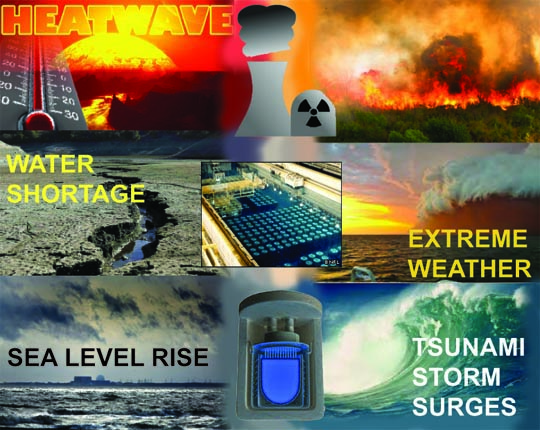 The Santa Susana Field Laboratory property has had a long history of contaminated soil and groundwater. Indeed, a 2006 advisory panel compiled a report suggesting that workers at the lab, as well as residents living nearby, had unusually high exposure to radiation and industrial chemicals that are linked to an increased incidence of some cancers. Discovery of the pollution prompted California’s DTSC in 2010 to order a cleanup of the site by its current owner – Boeing – with assistance from the US Department of Energy and NASA. But the required cleanup has been hampered by Boeing’s legal fight to perform a less rigorous cleaning. Like the Santa Susana Field Lab, Chernobyl remains largely unremediated since its meltdown in 1986. With each passing year, dead plant material accumulates and temperatures rise, making it especially prone to fires in the era of climate change. Radiation releases from contaminated soils and forests can be carried thousands of kilometres away to human population centres, according to Evangeliou. Kate Brown, a historian at the Massachusetts Institute of Technology and the author of Manual for Survival: A Chernobyl Guide to the Future (2019), and Tim Mousseau, an evolutionary biologist at the University of South Carolina, also have grave concerns about forest fires. ‘Records show that there have been fires in the Chernobyl zone that raised the radiation levels by seven to 10 times since 1990,’ Brown says. Further north, melting glaciers contain ‘radioactive fallout from global nuclear testing and nuclear accidents at levels 10 times higher than elsewhere’. As ice melts, radioactive runoff flows into the ocean, is absorbed into the atmosphere, and falls as acid rain. ‘With fires and melting ice, we are basically paying back a debt of radioactive debris incurred during the frenzied production of nuclear byproducts during the 20th century,’ Brown concludes. Flooding is another symptom of our warming world that could lead to nuclear disaster. Many nuclear plants are built on coastlines where seawater is easily used as a coolant. Sea-level rise, shoreline erosion, coastal storms and heat waves – all potentially catastrophic phenomena associated with climate change – are expected to get more frequent as the Earth continues to warm, threatening greater damage to coastal nuclear power plants. ‘Mere absence of greenhouse gas emissions is not sufficient to assess nuclear power as a mitigation for climate change,’ conclude Natalie Kopytko and John Perkins in their paper ‘Climate Change, Nuclear Power, and the Adaptation-Mitigation Dilemma’ (2011) in Energy Policy. Proponents of nuclear power say that the reactors’ relative reliability and capacity make this a much clearer choice than other non-fossil-fuel sources of energy, such as wind and solar, which are sometimes brought offline by fluctuations in natural resource availability. Yet no one denies that older nuclear plants, with an aged infrastructure often surpassing expected lifetimes, are extremely inefficient and run a higher risk of disaster. ‘The primary source of nuclear power going forward will be the current nuclear fleet of old plants,’ said Joseph Lassiter, an energy expert and nuclear proponent who is retired from Harvard University. But ‘even where public support exists for [building new] nuclear plants, it remains to be seen if these new-build nuclear plants will make a significant contribution to fossil-emissions reductions given the cost and schedule overruns that have plagued the industry.’ Lassiter and several other energy experts advocate for the new, Generation IV nuclear power plants that are supposedly designed to deliver high levels of nuclear power at the lowest cost and with the lowest safety risks. But other experts say that the benefits even here remain unclear. The biggest critique of the Generation IV nuclear reactors is that they are in the design phase, and we don’t have time to wait for their implementation. Climate abatement action is needed immediately. ‘New nuclear power seemingly represents an opportunity for solving global warming, air pollution, and energy security,’ says Mark Jacobson, director of Stanford University’s Atmosphere and Energy Programme. But it makes no economic or energy sense. ‘Every dollar spent on nuclear results in one-fifth the energy one would gain with wind or solar [at the same cost], and nuclear energy takes five to 17 years longer before it becomes available. As such, it is impossible for nuclear to help with climate goals of reducing 80 per cent of emissions by 2030. Also, while we’re waiting around for nuclear, coal, gas and oil are being burned and polluting the air. In addition, nuclear has energy security risks other technologies don’t have: weapons proliferation, meltdown, waste and uranium-worker lung-cancer risks.’ Around the world, 31 countries have nuclear power plants that are currently online, according to the International Atomic Energy Agency. By contrast, four countries have made moves to phase out nuclear power following the 2011 Fukushima disaster, and 15 countries have remained opposed and have no functional power plants. With almost all countries’ carbon dioxide emissions increasing – and China, India and the US leading the pack – the small Scandinavian country of Denmark is an outlier. Its carbon dioxide emissions are decreasing despite it not producing any nuclear power. Denmark does import some nuclear power produced by its neighbours Sweden and Germany, but in February, the country’s most Left-leaning political party, Enhedslisten, published a new climate plan that outlines a path for the country to start relying on its own 100 per cent renewable, non-nuclear energy for power and heat production by 2030. The plan would require investments in renewables such as solar and wind, a smart grid and electric vehicles that double as mobile batteries and can recharge the grid during peak hours. Gregory Jaczko, former chairman of the US Nuclear Regulatory Commission and the author of Confessions of a Rogue Nuclear Regulator (2019), believes the technology is no longer a viable method for dealing with climate change: ‘It is dangerous, costly and unreliable, and abandoning it will not bring on a climate crisis.’ Edited by Pam Weintraub |
–
|
Young voters supported Europe’s Greens – big winners in European elections
 Guardian 28th May 2019 Europe’s Greens, big winners in Sunday’s European elections, will use
their newfound leverage in a fractured parliament to push an agenda of urgent climate action, social justice and civil liberties, the movement’s leaders say. “This was a great outcome for us – but we now also have a great responsibility, because voters have given us their trust,” Bas Eickhout, a Dutch MEP and the Greens’ co-lead candidate for commission president, told the Guardian.
“Our voters, especially the younger generation, for many of whom we are now their first choice, are deeply
concerned about the climate crisis, and they are pro-European – but they feel the EU is not delivering. They want us to change the course of Europe.”https://www.theguardian.com/environment/2019/may/28/greens-eu-election-mandate-leverage-climate-policy
concerned about the climate crisis, and they are pro-European – but they feel the EU is not delivering. They want us to change the course of Europe.”https://www.theguardian.com/environment/2019/may/28/greens-eu-election-mandate-leverage-climate-policy
Scotland the first country to set legally binding annual emission reduction targets
Scotsman 29th May 2019 , Scotland is leading way by being first country to set legally binding annual emission reduction targets, writes Jamie Livingstone, head of Oxfam Scotland. Earlier this month, Environment Secretary Roseanna Cunningham reaffirmed in the Scottish Parliament the First Minister’s declaration that we are facing a “climate emergency”.
It’s a phrase that’s suddenly in vogue among political leaders from Edinburgh to Cardiff, London, Dublin and
beyond. It’s not hard to see why. Politicians are feeling the climate heat after schoolchildren went on strike and campaigners brought prominent locations, including in Edinburgh, to a standstill.
A recent poll by Stop Climate Chaos Scotland shows 70 per cent of people in Scotland support further action on climate change. It follows dire warnings by climate scientists that we have until 2030 to avert a climate catastrophe.
Political language is, it seems, catching up with reality. And not before time. When I hear the words “climate emergency”, I picture Jenipher, a young woman from the Mulanje district of southern Malawi. When I met her in 2016, Malawi was suffering from the worst drought the country had experienced in over 30 years, one made worse by climate change. Jenipher’s crops had withered; her family was starving; her life depended on the rain
coming next season.
Wide swathe of USA affected by major tornadoes -to the alarm of climate scientists
 Tornadoes Cut Across Unusually Wide Swaths of US, Raising Alarm for Climate Scientistshttps://www.commondreams.org/news/2019/05/27/tornadoes-cut-across-unusually-wide-swaths-us-raising-alarm-climate-scientists “There’s reason to believe major outbreak days are getting worse.” by Julia Conley, staff writer,
As the death toll in Oklahoma rose to six Monday amid an outbreak of nearly 200 tornadoes across the Midwest in recent days—as well as in areas far less accustomed to them—climate scientists said such patterns may carry warnings about the climate crisis and its many implications for extreme weather events.
In Oklahoma, tornadoes touched down in at least two cities, including El Reno and Sapulpa, over the weekend, injuring dozens and leveling a number of homes. The tornado that hit El Reno, a suburb of Oklahoma City, was given an EF3 rating, with wind speeds up to 165 miles per hour. Only about five percent of tornadoes are given an EF3 rating or higher.
Outside the Midwest, at least one twister touched down near Washington, D.C., with reports of tornadoes in Texas and Colorado, and Chicago facing a tornado watch on Monday.
While tornadoes have long been a fixture in the Midwest, meteorologist Eric Holthaus tweeted last week that there is “reason to believe major outbreak days…are getting worse,” while climate scientists are examining links between the storms and the climate crisis.
The so-called “Tornado Alley,” which covers parts of Texas and Kansas as well as Oklahoma, appears to be growing, according to a study published in Nature last year—making tornadoes more frequent in states that rarely saw them previously including Arkansas, Mississippi, and eastern Missouri.
“What all the studies have shown is that this particular part of the U.S. has been having more tornado activity and more tornado outbreaks than it has had in decades before,” Mike Tippett, a mathematician who studies the climate at Columbia University told PBS Newshour earlier this year.
As the Kansas City Star reported on Sunday, scientists believe the warming of the globe—fueled by human activities like fossil fuel extraction—is contributing to higher amounts of water vapor in the atmosphere, causing heavier rainfalls which can spawn tornadoes.
The increase in destructive tornadoes across wider swaths of the country than in previous decades “may be suggestive of climate change effects,” Purdue University researcher Ernest Agee told the Star. And the unusual occurrence of tornadoes in far more densely-populated areas than those that frequently see such weather events has led to concerns that tornadoes will become more deadly and destructive than they’ve been in the past
Record -breaking carbon dioxide now in the atmosphere

Carbon dioxide soars to record-breaking levels not seen in 800,000 years, Fox News, 26 May 19, There is more carbon dioxide in the atmosphere than there has been for 800,000 years — since before our species evolved.
On Saturday (May 11), the levels of the greenhouse gas reached 415 parts per million (ppm), as measured by the National Oceanic and Atmospheric Administration’s Mauna Loa Observatory in Hawaii. Scientists at the observatory have been measuring atmospheric carbon dioxide levels since 1958. But because of other kinds of analysis, such as those done on ancient air bubbles trapped in ice cores, they have data on levels reaching back 800,000 years. [8 Ways Global Warming Is Already Changing the World]
But every story has its villains: Humans are burning fossil fuels, causing the release of carbon dioxide and other greenhouse gases, which are adding an extra blanket on an already feverish planet. So far, global temperatures have risen by about 1.8 degrees Fahrenheit (1 degree Celsius) since the 19th century or pre-industrial times, according to a special report released last year by the United Nation’s Intergovernmental Panel on Climate Change……
“We keep breaking records, but what makes the current levels of CO2 in the atmosphere most troubling is that we are now well into the ‘danger zone’ where large tipping points in the Earth’s climate could be crossed,” said Jonathan Overpeck, the dean of the School for Environment and Sustainability at the University of Michigan. “This is particularly true when you factor in the additional warming potential of the other greenhouse gases, including methane, that are now in the atmosphere.”
The last time atmospheric carbon dioxide levels were this high, way before Homo sapienswalked the planet, the Antarctic Ice Sheet was much smaller and sea levels were up to 65 feet (20 meters) higher than they are today, Overpeck told Live Science.
“Thus, we could soon be at the point where comparable reductions in ice sheet size, and corresponding increases in sea level, are both inevitable and irreversible over the next few centuries,” he said. Smaller ice sheets, in turn, might reduce the reflectivity of the planet and potentially accelerate the warming even more, he added…….. https://www.foxnews.com/science/carbon-dioxide-soars-to-record-breaking-levels-not-seen-in-800000-years
Climate change protest action growing
Climate change protests held worldwide to call for government action
A fight for the future as climate change school strikes grow for fourth month running An estimated 4,000 teenagers and young people turn out in Manchester – and another 1.5m around the world – to demand they inherit a planet that is not dying, The Independent, 27 May 19, Colin Drury, Manchester
Torres Strait Islanders take their human rights case to UN against Australia, on climate change.

Torres Strait Islanders ask UN to hold Australia to account on climate ‘human rights  abuses’ The Conversation, Professor Environment and Development Sociology, The University of Queensland. May 27, 2019 Climate change threatens Australia in many different ways, and can devastate rural and urban communities alike. For Torres Strait Islanders, it’s a crisis that’s washing away their homes, infrastructure and even cemeteries.The failure to take action on this crisis has led a group of Torres Strait Islanders to lodge a climate change case with the United Nations Human Rights Committee against the Australian federal government.
It’s the first time the Australian government has been taken to the UN for their failure to take action on climate change. And its the first time people living on a low lying island have taken action against any government.
This case – and other parallel cases – demonstrate that climate change is “fundamentally a human rights issue”, with First Nations most vulnerable to the brunt of a changing climate.
The group of Torres Strait Islanders lodging this appeal argue that the Australian government has failed to take adequate action on climate change. They allege that the re-elected Coalition government has not only steered Australia off track in meeting globally agreed emissionsreductions, but has set us on course for climate catastrophe.
In doing so, Torres Strait Islanders argue that the government has failed to uphold human rights obligations and violated their rights to culture, family and life………
Torres Straight Islanders are on the frontlines
Some Torres Strait Islands are less than one metre above sea level and are already affected by climate change.
Rising tides have delivered devastating effects for local communities, including flooding homes, land and cultural sites, with dire flooding in 2018 breaking a sea wall built to protect local communities…….
Parallel threats across the Pacific
While the Torres Strait appeal to the UN is groundbreaking, the challenges facing Torres Strait Islanders are not unique.
Delegates at the Pacific Islands Forum in Fiji last week described climate change as the “single greatest threat” to the region, with sea level rise occurring up to four times the global average in some countries in the Pacific.
Climate change is already causing migration across parts of the Pacific, including relocation of families from the Carteret Islands to Bougainville with support from local grassroots organisation Tulele Peisa.
The Alliance of Small Island States, an intergovernmental organisation, has demanded that signatories to the Paris Agreement, including through the Green Climate Fund, recognise fundamental loss and damages communities are facing, and compensate those affected.
The growing wave of climate litigation
Across the Torres Strait, the Pacific, and other regions on the frontline of climate change, there are a diversity of responses in defence of land and seas. These are often grounded in local and Indigenous knowledge……https://theconversation.com/torres-strait-islanders-ask-un-to-hold-australia-to-account-on-climate-human-rights-abuses-117262?
1 This Month
26 September – International Day for the Total Elimination of Nuclear Weapons





PLEASE OPPOSE HR 8255 AND S.3639 – bills would accelerate satellite deployment, with no environmental review or safeguards – https://ncstd5li.quorum.us/campaign/169331/
To see nuclear-related stories in greater depth and intensity – go to https://nuclearinformation.wordpress.com
-
Archives
- September 2026 (291)
- August 2026 (330)
- July 2026 (355)
- June 2026 (287)
- May 2026 (306)
- April 2026 (356)
- March 2026 (251)
- February 2026 (267)
- January 2026 (308)
- December 2025 (358)
- November 2025 (359)
- October 2025 (375)
-
Categories
- 1
- 1 NUCLEAR ISSUES
- business and costs
- climate change
- culture and arts
- ENERGY
- environment
- health
- history
- indigenous issues
- Legal
- marketing of nuclear
- media
- opposition to nuclear
- PERSONAL STORIES
- politics
- politics international
- Religion and ethics
- safety
- secrets,lies and civil liberties
- spinbuster
- technology
- Uranium
- wastes
- weapons and war
- Women
- 2 WORLD
- ACTION
- AFRICA
- Atrocities
- AUSTRALIA
- Christina's notes
- Christina's themes
- culture and arts
- Events
- Fuk 2022
- Fuk 2023
- Fukushima 2017
- Fukushima 2018
- fukushima 2019
- Fukushima 2020
- Fukushima 2021
- general
- global warming
- Humour (God we need it)
- Nuclear
- RARE EARTHS
- Reference
- resources – print
- Resources -audiovicual
- Weekly Newsletter
- World
- World Nuclear
- YouTube
-
RSS
Entries RSS
Comments RSS

