German climate activists storm open cut coal mine
western Germany to campaign against fossil fuels. https://www.bbc.co.uk/news/world-europe-48734321
To comply with Paris climate agreement, France could switch to 100% renewables
Le Point 18th June 2019 “France could switch to 100% renewable energy” INTERVIEW. According to Rana
Adib, head of the network of experts REN21, the effort in favor of
renewable energies must be relaunched to comply with the Paris agreement.
No justice for Marshall islands, with rising seas and nuclear trash
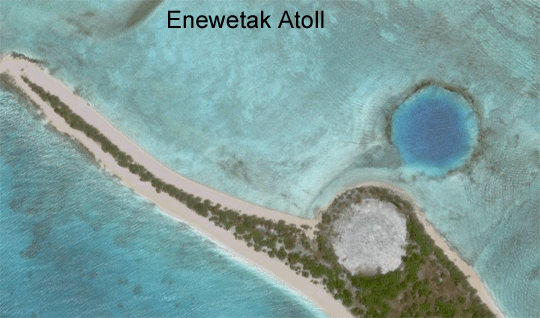
Nuclear waste, rising seas and Trump: Marshall Islands struggles to stay above water, Yahoo News, Marshall Islands President Heine speaks with Reuters in Geneva By Tom Miles, 21 June 19, GENEVA (Reuters) – The Marshall Islands is literally struggling to stay above water but its President Hilda Heine told Reuters she had saved her breath rather than try to persuade U.S. President Donald Trump to hear its climate change message.
Heine met Trump at the White House last month, along with the presidents of Palau and the Federated States of Micronesia, both of which are also under threat from rising sea levels.
But they did not talk about climate change.
“We made a conscious decision to discuss those things that we think we could accomplish, rather than spend time talking about something that we know is not going to happen,” she said.
“We know that we’re not going to be able to change his mind in 30 minutes about climate change.”
The Marshall Islands, comprising 31 tropical atolls between Australia and Hawaii, risks being underwater in 10-20 years.
“If that’s not scary enough, I don’t know what is. For us, it’s of course an existential issue,” said Heine, who was in Geneva to open a diplomatic mission, address the International Labour Organization and press her country’s case for a seat on the U.N. Human Rights Council.
The scene of massive U.S. nuclear tests in the 1950s, it is also at risk of disaster from radioactive debris the U.S. military left behind.
Her government has put a line item in its budget to cope with environmental costs, with about 5% of spending set aside to fund sea walls to save at least its two most populated areas.
On climate change, Heine said she had a simple message for the world: “Get real. Climate change is here. It’s not anything to just talk about and think, that is going to happen. It’s happening.”
The official statement from the White House meeting cited “the region’s most pressing issues, including responding to natural disasters”, but not climate change or rising sea levels.
The main topic was renewal of U.S. financial grants and the rollover of a Cold War-era defence and security agreement.
The Marshall Islands was occupied by Allied forces in 1944 and placed under U.S. administration in 1947. Between 1946 and 1958, the United States detonated 23 atomic and hydrogen bombs on Bikini and Enewetak atolls, debris from which was left buried under a shallow concrete dome on Enewetak.
“We’re told it’s seeping into the lagoon,” Heine said, adding that the government wanted help to assess the damage and impact on marine life and potential costs of making it safe.
Asked if it was potentially a nuclear disaster on top of a climate emergency, she said: “It could be.”
NUCLEAR JUSTICE
The Marshall Islands gained independence in 1986 and later tried in vain to sue nuclear powers in a David-and-Goliath case at the International Court of Justice.
It now has a “nuclear justice strategy” to cope with displacement and higher cancer rates, but cannot back a treaty banning nuclear weapons because of one provision that would force it to take care of its own clean-up, Heine said.
“The United States would be … off the hook.”…… https://news.yahoo.com/nuclear-waste-rising-seas-trump-120225579.html
The world’s societies on the brink of unmanageable climate chaos

|
No System of Government Designed by Human Beings Can Survive What the Climate Crisis Will Bring https://www.esquire.com/news-politics/politics/a28102591/india-drought-chennai-climate-change-five-years-transform/, The window to prevent the worst of it is closing. Fast. BY CHARLES P. PIERCE, JUN 19, 2019 It is a long held belief here in the shebeen that, thanks to those clever Chinese climate hoaxsters, the next world wars are going to be fought not over oil, but over water. This is especially true in places like India, which is currently in the middle of a murderous heat wave in which temperatures regularly top out at 120 degrees Fahrenheit, and where hugely populated cities are running out of water.
From the BBC: Residents have had to stand in line for hours to get water from government tanks, and restaurants have closed due to the lack of water. “Only rain can save Chennai from this situation,” an official told BBC Tamil. The city, which, according to the 2011 census, is India’s sixth largest, has been in the grip of a severe water shortage for weeks now. As the reservoirs started to run dry, many hotels and restaurants shut down temporarily. The Chennai metro has turned off air conditioning in the stations, while offices have asked staff to work from home in a bid to conserve water.. The water crisis has also meant that most of the city has to depend solely on Chennai’s water department, which has been distributing water through government trucks across neighborhoods. “The destruction has just begun,” an official said. “If the rain fails us this year too, we are totally destroyed.” And, as the Times of London reports, the combination of heat and drought not only is killing people, but also is emptying villages in the northern part of India. (Gee, I wonder where everyone will go and how welcome they’ll be when they get there?) And things among the people who have stayed so far are getting ugly. In the worst-hit areas many villages starved of water have been abandoned until the arrival of the monsoon brings relief, after weeks of temperatures topping 50 degrees. In the northern states of Uttar Pradesh, Bihar and Rajasthan fighting has broken out over scarce water supplies, with police deployed to protect water trucks and wells. People have the misapprehension that we can recover from this state just by reducing carbon emissions, Anderson said in an appearance at the University of Chicago. Recovery is all but impossible, he argued, without a World War II-style transformation of industry—an acceleration of the effort to halt carbon pollution and remove it from the atmosphere, and a new effort to reflect sunlight away from the earth’s poles. This has to be done, Anderson added, within the next five years. “The chance that there will be any permanent ice left in the Arctic after 2022 is essentially zero,” Anderson said, with 75 to 80 percent of permanent ice having melted already in the last 35 years. This is a part of the new normal, and it’s coming soon to a theater near you. But, not to worry. According to this guy, if we don’t turn things around on those clever Chinese climate hoaxsters in the next half-decade, we’re all screwed anyway. From those noted tree-hugging libs at Forbes: “We have exquisite information about what that state is, because we have a paleo record going back millions of years, when the earth had no ice at either pole. There was almost no temperature difference between the equator and the pole,” said James Anderson, a Harvard University professor of atmospheric chemistry best known for establishing that chlorofluorocarbons were damaging the Ozone Layer. “The ocean was running almost 10ºC warmer all the way to the bottom than it is today,” Anderson said of this once-and-future climate, “and the amount of water vapor in the atmosphere would have meant that storm systems would be violent in the extreme, because water vapor, which is an exponential function of water temperature, is the gasoline that fuels the frequency and intensity of storm systems.”… No system of government devised by human beings can withstand what’s coming, any more than overbuilt coastal enclaves can. |
|

Devastating future for Himalayan region, as melting of glaciers has doubled since year 2000
 Himalayan glacier melting doubled since 2000, spy satellites show, Ice losses indicate ‘devastating’ future for region and 1 billion people who depend on it for water, Guardian, Damian Carrington Environment editor, @dpcarrington
Thu 20 Jun 2019 The melting of Himalayan glaciers has doubled since the turn of the century, with more than a quarter of all ice lost over the last four decades, scientists have revealed. The accelerating losses indicate a “devastating” future for the region, upon which a billion people depend for regular water.
The scientists combined declassified US spy satellite images from the mid-1970s with modern satellite data to create the first detailed, four-decade record of ice along the 2,000km (1,200-mile) mountain chain.
The analysis shows that 8bn tonnes of ice are being lost every year and not replaced by snow, with the lower level glaciers shrinking in height by 5 meters annually. The study shows that only global heating caused by human activities can explain the heavy melting. In previous work, local weather and the impact of air pollution had complicated the picture……. https://www.theguardian.com/environment/2019/jun/19/himalayan-glacier-melting-doubled-since-2000-scientists-reveal
Nuclear wastes and other poisons are being released by melting Arctic ice
|
THE MELTING ARCTIC IS RELEASING POISON, DISEASE AND NUCLEAR WASTE https://futurism.com/the-byte/melting-arctic-releasing-poison-disease-nuclear-waste JUNE 17TH 19__DAN ROBITZSKI_Wakey Wakey As rising temperatures cause Arctic ice to melt, it’s freeing many things that we would be better off keeping trapped. Alongside the ancient fossils now peeking up from the disappearing permafrost lie frozen toxins, nuclear waste, and enough sequestered carbon to double the amount of greenhouse gases in the atmosphere today, according to BBC News. It’s a dire situation — failing to address global climate change has turned the Arctic into a ticking time bomb. Based on current fossil fuel usage, 70 percent of Arctic ice will be gone by 2100, but there will be more immediate effects as it thaws, according to the BBC story. Swedish Nuclear Waste Management, which stores nuclear waste for Sweden, Finland, and Canada, depends on permafrost to safely trap its spent fuel. The Doomsday Vault, a giant repository for plant seeds, also relies on a frozen Arctic. Dangerous diseases such as the Spanish flu, smallpox, and even the bubonic plague also lie dormant in the permafrost ready to spring back to life as temperatures rise. The solutions to the melting Arctic problem are the same as for the rest of climate change — decarbonize and cut emissions as quickly as possible. “The actions taken by the international community will have a substantial impact on just how much carbon will be released and how much of the permafrost will thaw,” Woods Hole Research Center scientist Sue Natali told the BBC. “We need to keep as much of the permafrost as we can frozen. And we do have some control of that.” |
|
|
Nuclear power is far from “emissions free”

Gregory Jazcko, former Nuclear Regulatory Commission chairman, warned, “I oversaw the U.S. nuclear power industry. Now I think it should be banned. The danger from climate change no longer outweighs the risks of nuclear accidents.”
Perry and Davis Besse cost a whopping $8.7 billion to build and billions more in maintenance, repairs, and subsidies. Grid operator PJM has determined that closing Perry and Davis-Besse would not destabilize the grid.
The nuclear power life cycle produces copious carbon and other greenhouse gases from uranium mining, milling, refining, conversion, and enrichment; fuel fabrication; transportation; reactor construction, maintenance, decommissioning; and radioactive waste management.
While nuclear generated electricity is low in carbon, it has never been zero emissions. Reactors emit methane, a greenhouse gas, and radioactive Carbon-14, with a 5,700-year half-life. The scientific and medical communities have determined that there is no safe dose of radiation exposure.
Ingested or inhaled radioactive strontium-90 and cesium-137 replace calcium and potassium respectively, irradiating bones and muscles for decades. Carcinogenic radioactive iodine-131 is absorbed by the thyroid which is why potassium iodide is provided to residents near reactors. Cobalt-60 is a liver, kidney, and bone carcinogen. Specks of inhaled plutonium-239, with a half-life of 24,000 years, can cause lung cancer. Miles of buried, inaccessible, deteriorating pipes have leaked tritium, which is radioactive hydrogen; no technology can remove it from contaminated water.
Over 32 years, disasters occurred at Three Mile Island, Chernobyl, and Fukushima. The U.S. has 23 Fukushima-type reactors at 16 sites. The NRC and other researchers postulate a 50 percent chance of another catastrophic accident in approximately the next 20 years.
 To limit utility liability, Congress passed the 1957 Price Anderson Act which caps accident compensation at $12.6 billion; a 1982 NRC study calculated a severe accident could cause 50,000 fatalities and $314 billion in property damage which is $720 billion today.
A 1,000-megawatt reactor contains as much long-lived radiation as 1,000 Hiroshima-sized bombs from which humans and the environment must be protected forever, but the NRC admits that no engineered structure can last the time required to isolate these wastes and that leakage will occur.
Early warnings to resolve radioactive waste before licensing new reactors were ignored. There are 88,000 tons of irradiated fuel “temporarily” stored in problematic pools and casks at 75 environmentally unsuitable reactor sites in 33 states because no permanent repository exists.
In 2012, Ohio was 13th in the U.S. for wind capacity and investment; this virtually ceased due to a 2014 law which mandated the country’s most restrictive wind turbine setbacks and severely impeded Ohio’s 2008 renewable energy and efficiency standards. HB 6 will finish the job.
Even conservative voters prefer solar, wind, and efficiency and oppose fees to keep old nuclear plants operating. Conservative groups testified against HB 6, as corporate welfare and a glorified slush fund.
Ohio needs to strengthen renewable energy and efficiency standards, stop throwing good money after bad, close Perry and Davis Besse as scheduled, and retrain workers in renewable energy jobs.
The writer is past chairman, Ohio Sierra Club Nuclear-Free Committee, of Willoughby Hills, Ohio.
Climate change denier makes big donations to Boris Johnson and Jeremy Hunt.
 Open Democracy 12th June 2019 Revealed: Climate change denier makes big donations to Boris Johnson and
Jeremy Hunt. Tory hopefuls under fire for accepting cash from company
linked to major ‘climate science denial’ group. Johnson has yet to
declare the funding, ‘raising questions about who else is bankrolling
him’.
each to both Boris Johnson and Jeremy Hunt’s leadership campaigns,
openDemocracy has discovered. Foreign Secretary Jeremy Hunt’s largest
donation was £25,000 on May 22 from First Corporate Shipping, according to
the register of MPs’ interests.
name of Bristol Port, which is co-owned by Tory donors Terence Mordaunt and
Sir David Ord. Mordaunt is a director of the Global Warming Policy Forum,
the advocacy arm of the climate sceptic Global Warming Policy Foundation.
USA court deliberates on whether or not global warming violates children’s rights
 US court weighs if climate change violates children’s rights Business Mirror, By The Associated Press, June 10, 2019 PORTLAND, Oregon—In a courtroom packed with environmental activists, federal judges wrestled last week with whether climate change violates the constitutional rights of young people who have sued the US government over the use of fossil fuels.
Mike Pompeo thinks that climate change is not really a serious problem, could be good for trade
“The climate’s been changing a long time. There’s always changes that take place,” Pompeo said during an interview with the Washington Times published Friday, when asked whether he thought climate change was man-made and how best to address it. He did not mention anything about man-made pollution in his remarks…..
The comments aren’t Pomepo’s first foray into controversial climate assessments.
In May, Pompeo praised the Arctic’s rapidly shrinking sea levels for their subsequent economic opportunities, despite continued warnings about the catastrophic effects of climate change….. https://myfox8.com/2019/06/09/pompeo-downplays-climate-change-suggests-people-move-to-different-places/
Theresa May will ignore cost warnings and bring in net zero emissions goal
Business Green 7th June 2019 Theresa May will ignore cost warnings and bring in net zero emissions goal before her successor takes over in Downing Street, reports suggest. The Prime Minister will set in law a target for the UK to reach net zero
greenhouse gas emissions by 2050 before she leaves office, although she is
unlikely to bring forward any new policy or detailed action plan for
achieving the goal, according to reports.
As recommended by the Committee
on Climate Change (CCC) in its landmark report last month, Theresa May is
set to announce a net zero goal for 2050 and could do so as soon as next
week, in a move the government expects to garner broad parliamentary
support, reports The Independent.
Extreme heat and humidity a killer combination now affecting one third of the African urban population
 Extreme heat to hit one third of the African urban population, Science Daily
- Date:
- June 5, 2019
- Source:
- Université de Genève
- Summary:
- An international team of researchers has combined demographic projections and climate scenarios across Africa for the first time. Their results reveal the number of people who will potentially be exposed to extreme temperatures.
- Climate change, population growth and urbanisation are instrumental in increasing exposure to extreme temperatures. Researchers at the University of Geneva (UNIGE), Switzerland, — in collaboration with the University of Twente (Netherlands) and the EU Joint Research Centre in Ispra (Italy) — assessed a range of possible scenarios regarding the rate of climate change and socio-economic development in 173 African cities for the years 2030, 2060 and 2090. Their results, which are published in the journal Earth’s Future, show that a third of African city-dwellers could be affected by deadly heat waves in 2090. The projections also highlight the influence of socio-economic development on the impact of climate change.
The effects of climate change are felt specifically in countries with tropical climates, which are characterised by high humidity and very high temperatures. Furthermore, countries in these regions — especially in Africa — are experiencing heavy urbanisation and socio-economic development, leading to an explosion in the size of urban populations. A combination of these two factors is having a major impact on the living conditions of city-dwellers in Africa, especially in terms of exposure to extreme — or even lethal — temperatures. “We consider the critical threshold to be 40.6°C in apparent temperature, taking humidity into account,” says Guillaume Rohat, a researcher at UNIGE’s Institute for Environmental Sciences (ISE). In fact, high outdoor humidity levels disrupt our ability to thermoregulate, with potentially fatal consequences………
https://www.sciencedaily.com/releases/2019/06/190605100340.htm
It is absurd to question whether we can afford to keep our planet liveable
Guardian Fiona Harvey 7 June 19, The chancellor has warned against cutting UK emissions to net zero. But failing to act will have dire consequences.
The chancellor, Philip Hammond, has written to the prime ministerto warn against adopting the strict targets on greenhouse gas emissions recommended by the government’s advisers.
His intervention, first reported by the Financial Times (£), raises the important question of whether or not it makes economic sense to save the planet.
If the question sounds absurd, that’s because it is. If we fail to move to a low-carbon economy, the consequences will be dire. According to the Intergovernmental Panel on Climate Change, the body of the world’s leading climate scientists convened by the UN, we must drastically reduce our emissions in the next decade to avoid a catastrophic situation in which droughts, floods, heatwaves and extreme weather across the globe devastate lives, destroy agriculture, lay waste to wildlife and force millions to flee.
Set against that, the costs – of £50bn a year in investment, according to the Committee on Climate Change(CCC), which set out the case last month for a target of net-zero emissions by 2050, or £70bn a year, according to the Department for Business, Energy and Industrial Strategy – of maintaining our current lifestyles and orderly existences are trivial. The UK’s economy is worth roughly £2tn a year at present, so Hammond’s estimate of a £1tn cumulative cost by 2050 amounts to less than half of one year’s GDP in three decades.
Doug Parr, the chief scientist for Greenpeace UK, said: “The Treasury is putting their ideology before our wellbeing, and trying to shape the public debate for political ends. If you want to know whether a policy is good, include the benefits as well as the costs. In this case, the benefits include an economy fit for the 21st century, cleaner air, warmer homes, and maximising the chances of civilisation surviving. If reality doesn’t fit with the Treasury models, it’s the models that need to change.”…….
When we ask whether we can afford to tackle climate change, we are really asking – as the IPCC report and decades of climate science show us – whether we want humanity to survive in anything like our current structures. If our economic system stands in the way of doing so, perhaps it is the economics that are at fault. And economics, like politics, are just a human construct. The physics of the earth’s atmosphere are not. https://www.theguardian.com/environment/2019/jun/06/it-is-absurd-question-whether-we-can-afford-keep-our-planet-liveable
Arctic is thawing ever faster: permafrost collapse is further accelerating the release of carbon
 Arctic Is Thawing So Fast Scientists Are Losing Their Measuring Tools BY Dahr Jamail, Truthout, June 3, 2019
We’ve never experienced anything like this: We are living with the full knowledge of our collapsing biosphere and watching huge portions of it vanishing before our very eyes. Meanwhile, the industrial growth society (as eco-philosopher, author and Buddhist scholar Joanna Macy calls it) continues to grind on, and this veneer of normalcy persists one more day.
Yet simultaneously, a great awakening is occurring. Millions of people around the world are rising to protect what remains, working to mitigate the damage and to adapt to the drastically changing world. They are working to hold space for that which, despite seemingly overwhelming odds, may continue in the wake of this great collapse……….
dear reader, I urge you to find your own work that reconnects — or to find another way to ground yourself, as you read on, and as we each travel through another crises-ridden day into an increasingly bleak future.
That future is perhaps most visible at the poles. Greenland is melting much faster than previously understood, as melting has increased six-fold in recent decades, according to a study published in the Proceedings of the National Academy of Sciences. “We wanted to get a long precise record of mass balance in Greenland that included the transition when the climate of the planet started to drift off natural variability, which occurred in the 1980s,” study co-author Eric Rignot told CNN. “The study places the recent (20 years) evolution in a broader context to illustrate how dramatically the mass loss has been increasing in Greenland in response to climate warming.” Rignot added, “As glaciers will continue to speed up and ice/snow melt from the top, we can foresee a continuous increase in the rate of mass loss, and a contribution to sea level rise that will continue to increase more rapidly every year.”
The study also shows how sea level rise is accelerating, and will continue to do so with each passing year, as the effects compound upon themselves.
On that note, Indonesia recently announced it will be moving its capital city of Jakarta, partly due to the sinking of the land and sea level rise. This is a city of 10 million people.
Permafrost in the Arctic is now thawing so fast that scientists are literally losing their measuring equipment. This is due to the fact that instead of there being just a few centimeters of thawing each year, now several meters of soil can become destabilized in a matter of days.
Adding insult to injury, another study revealed that this permafrost collapse is further accelerating the release of carbon into the atmosphere, possibly even doubling the amount of warming coming from greenhouse gases released from the tundra.
Already in Greenland, the ice sheet’s melt season began about a month early while in Alaska, several rivers saw winter ice break up on their earliest dates on record.
The recent U.N. report showing that one million species are now in danger of going extinct has grave implications for the future of humanity…..
Earth
Disconcertingly, since 2001 forests in Canada have released more carbon than they have sequestered. This is due largely to climate disruption-fueled drought, higher temperatures and wildfires. ………
Meanwhile, the refugee crisis from rising seas and extreme weather events continues apace in Bangladesh. Already one of the most vulnerable countries in the world to sea level rise, it is now estimated that more than 10 million people there are estimated to lose their livelihoods in the next decade. The larger cities are already overwhelmed with the number of people streaming into them from the submerging coastal areas.
Water
Climate disruption-amplified, flood-inducing extreme weather events continue to make their mark around the planet………….
Fire
Just four months into 2019, the U.K. had already had more large wildfires than it had during the entirety of 2018……….
Air
A recent report shows how much warmer cities across the U.S. will be within one generation (by 2050).
“Every season in every city and town in America will shift, subtly or drastically, as average temperatures creep up, along with highs and lows,” reported Vox, which released the report. “Some of those changes — like summers in the Southwest warming by 4°F on average — will mean stretches of days where it’s so hot, it’ll be dangerous to go outside. Heat waves around the country could last up to a month.”
Denial and Reality
The U.S. is now one of the world’s leaders when it comes to climate change denial………. With the ongoing acceleration of the climate crisis, it is clear that even if we believe the best-case scenarios, governments are not reacting according to the gravity of the situation at hand. Each one of us, knowing what we now know, must take full responsibility for preparing ourselves for the adaptation required to live on this increasingly warming, melting world as civilizations and societies continue to disintegrate. https://truthout.org/articles/arctic-is-thawing-so-fast-scientists-are-losing-their-measuring-tools/
A harrowing scenario analysis of how human civilization might collapse due to climate change
New Report Suggests ‘High Likelihood of Human Civilization Coming to an End’ in 2050 https://www.vice.com/en_us/article/597kpd/new-report-suggests-high-likelihood-of-human-civilization-coming-to-an-end-in-2050 3 June 19
The climate change analysis was written by a former fossil fuel executive and backed by the former chief of Australia’s military. A harrowing scenario analysis of how human civilization might collapse in coming decades due to climate change has been endorsed by a former Australian defense chief and senior royal navy commander.
The analysis, published by the Breakthrough National Centre for Climate Restoration, a think-tank in Melbourne, Australia, describes climate change as “a near- to mid-term existential threat to human civilization” and sets out a plausible scenario of where business-as-usual could lead over the next 30 years.
On our current trajectory, the report warns, “planetary and human systems [are] reaching a ‘point of no return’ by mid-century, in which the prospect of a largely uninhabitable Earth leads to the breakdown of nations and the international order.”
The only way to avoid the risks of this scenario is what the report describes as “akin in scale to the World War II emergency mobilization”—but this time focused on rapidly building out a zero-emissions industrial system to set in train the restoration of a safe climate.
The scenario warns that our current trajectory will likely lock in at least 3 degrees Celsius (C) of global heating, which in turn could trigger further amplifying feedbacks unleashing further warming. This would drive the accelerating collapse of key ecosystems “including coral reef systems, the Amazon rainforest and in the Arctic.”
The results would be devastating. Some one billion people would be forced to attempt to relocate from unlivable conditions, and two billion would face scarcity of water supplies. Agriculture would collapse in the sub-tropics, and food production would suffer dramatically worldwide. The internal cohesion of nation-states like the US and China would unravel.
Even for 2°C of warming, more than a billion people may need to be relocated and in high-end scenarios, the scale of destruction is beyond our capacity to model with a high likelihood of human civilization coming to an end,” the report notes.
The new policy briefing is written by David Spratt, Breakthrough’s research director and Ian Dunlop, a former senior executive of Royal Dutch Shell who previously chaired the Australian Coal Association.
In the briefing’s foreword, retired Admiral Chris Barrie—Chief of the Australian Defence Force from 1998 to 2002 and former Deputy Chief of the Australian Navy—commends the paper for laying “bare the unvarnished truth about the desperate situation humans, and our planet, are in, painting a disturbing picture of the real possibility that human life on Earth may be on the way to extinction, in the most horrible way.”
Barrie now works for the Climate Change Institute at Australian National University, Canberra.
Spratt told Motherboard that a key reason the risks are not understood is that “much knowledge produced for policymakers is too conservative. Because the risks are now existential, a new approach to climate and security risk assessment is required using scenario analysis.”
Last October, Motherboard reported on scientific evidence that the UN’s summary report for government policymakers on climate change—whose findings were widely recognized as “devastating”—were in fact too optimistic.
While the Breakthrough scenario sets out some of the more ‘high end’ risk possibilities, it is often not possible to meaningfully quantify their probabilities. As a result, the authors emphasize that conventional risk approaches tend to downplay worst-case scenarios despite their plausibility.
Spratt and Dunlop’s 2050 scenario illustrates how easy it could be to end up in an accelerating runaway climate scenario which would lead to a largely uninhabitable planet within just a few decades.
“A high-end 2050 scenario finds a world in social breakdown and outright chaos,” said Spratt. “But a short window of opportunity exists for an emergency, global mobilization of resources, in which the logistical and planning experiences of the national security sector could play a valuable role.”
1 This Month
26 September – International Day for the Total Elimination of Nuclear Weapons





PLEASE OPPOSE HR 8255 AND S.3639 – bills would accelerate satellite deployment, with no environmental review or safeguards – https://ncstd5li.quorum.us/campaign/169331/
To see nuclear-related stories in greater depth and intensity – go to https://nuclearinformation.wordpress.com
-
Archives
- September 2026 (291)
- August 2026 (330)
- July 2026 (355)
- June 2026 (287)
- May 2026 (306)
- April 2026 (356)
- March 2026 (251)
- February 2026 (267)
- January 2026 (308)
- December 2025 (358)
- November 2025 (359)
- October 2025 (375)
-
Categories
- 1
- 1 NUCLEAR ISSUES
- business and costs
- climate change
- culture and arts
- ENERGY
- environment
- health
- history
- indigenous issues
- Legal
- marketing of nuclear
- media
- opposition to nuclear
- PERSONAL STORIES
- politics
- politics international
- Religion and ethics
- safety
- secrets,lies and civil liberties
- spinbuster
- technology
- Uranium
- wastes
- weapons and war
- Women
- 2 WORLD
- ACTION
- AFRICA
- Atrocities
- AUSTRALIA
- Christina's notes
- Christina's themes
- culture and arts
- Events
- Fuk 2022
- Fuk 2023
- Fukushima 2017
- Fukushima 2018
- fukushima 2019
- Fukushima 2020
- Fukushima 2021
- general
- global warming
- Humour (God we need it)
- Nuclear
- RARE EARTHS
- Reference
- resources – print
- Resources -audiovicual
- Weekly Newsletter
- World
- World Nuclear
- YouTube
-
RSS
Entries RSS
Comments RSS

