|
 Sanders and Ocasio-Cortez move to declare climate crisis official emergency Sanders and Ocasio-Cortez move to declare climate crisis official emergency
Guardian, Emily Holden in Washington, 9 Jul 2019 Democrats to introduce resolution in House on Tuesday in recognition of extreme threat from global heating A group of US lawmakers including the 2020 Democratic presidential contender Bernie Sanders are proposing to declare the climate crisis an official emergency – a significant recognition of the threat taken after considerable pressure from environment groups.
Alexandria Ocasio-Cortez, the Democratic congresswoman from New York, and Earl Blumenauer, a Democratic congressman from Oregon, plan to introduce the same resolution in the House on Tuesday, their offices confirmed.
A Sanders spokesperson said: “President Trump has routinely declared phony national emergencies to advance his deeply unpopular agenda, like selling Saudi Arabia bombs that Congress had blocked.
“On the existential threat of climate change, Trump insists on calling it a hoax. Senator Sanders is proud to partner with his House colleagues to challenge this absurdity and have Congress declare what we all know: we are facing a climate emergency that requires a massive and immediate federal mobilization.”
Climate activists have been calling for the declaration, as data shows nations are not on track to limit the dangerous heating of the planet significantly enough. The UN has warned the world is experiencing one climate disaster every week. A new analysis from the economic firm Rhodium Group today finds the US might achieve less than half of the percentage of pollution reductions it promised other countries in an international agreement……. https://www.theguardian.com/environment/2019/jul/08/climate-crisis-sanders-ocasio-cortez-emergency
|
|
July 9, 2019
Posted by Christina Macpherson |
climate change, politics, USA |
Leave a comment
 Nuclear Power, Once Seen as Impervious to Climate Change, Threatened by Heat Waves
The nuclear power sector is often portrayed as resistant to unpredictable weather associated with climate change. Heat waves, however, are punching holes in that narrative. US News, By Alan Neuhauser, Staff Writer July 1, 2019, THERE’S A REASON nuclear plants are built close to water.
Harnessing the enormous power of nuclear fission, plants generate steam, which shoots through pipes to spin a turbine that generates massive amounts of electricity. To keep from getting dangerously hot, the plants suck up surrounding water from the nearby rivers, lakes or oceans around which they’re built to cool the steam.
Now, increasingly, more frequent heat waves and hotter average temperatures are making those waters so warm that engineers are concerned that it can’t do the job. Analysts say climate change is to blame.
In little-noticed but publicly available reports to regulators, nuclear plant owners revealed that unusually hot temperatures last year forced them to reduce the plants’ electricity output more than 30 times – most often in the summer, when demand from nuclear plants is at its highest. In 2012, such incidents occurred at least 60 times. At one plant in Connecticut a reactor was taken offline for nearly two weeks when temperatures in the Long Island Sound surged past 75 degrees.
The incidents, submitted to the Nuclear Regulatory Commission, reflect a sharp uptick from even a decade ago, when plants appear to have submitted only nine such reports in 2009. In 1988, 1989 and 1991, there was just one such report. The dramatic increase mirrors the rise in average U.S. and global temperatures spurred by climate change.
“I’ve heard many nuclear proponents say that nuclear power is part of the solution to global warming,” says David Lochbaum, a retired nuclear engineer who compiled the reports based on data submitted to the NRC, and former director of the Nuclear Safety Project at the Union for Concerned Scientists. “It needs to be reversed: You need to solve global warming for nuclear plants to survive.”
Regulations set strict temperature limits for the water around each plant: 75 degrees for Millstone Generating Station in Connecticut, 85 degrees for Braidwood Generating Station outside Chicago, as high as 90 degrees for Turkey Point Generating Station south of Miami. Nuclear plants are now more regularly bumping up against those limits.
And even when water temperatures only approach those thresholds, plants can still be forced to dial down their output if the water used to cool their reactors will cause the temperatures in surrounding waterways to rise so much that it will endanger the habitats of fish and plants.
Limerick Generating Station outside Philadelphia, for example, reported turning down its output 79 times between 2008 and 2016……..
 Climbing temperatures are not the first climate impact to strike nuclear power plants: The sector has also faced challenges from periodic but increasingly frequent droughts that can cause local water sources to run low.
And it’s not just water temperatures that plants have to contend with. Air temperatures can also cause conditions inside the plant to get too hot to operate. So desperate was a power plant in France during last year’s heat wave that it began spraying water on the outside of the building to keep the interior from overheating. Plants in the U.S., meanwhile, have regularly slashed their output by anywhere from 3% to 60%.
Such dynamics could cause output from nuclear plants to fall by as much as 16% in the coming decades, according to a 2012 analysis. Moreover, climate concerns threaten to pierce nuclear’s carefully constructed – and increasingly embattled – narrative that it’s the only reliable source of zero-emissions power. Already, the country’s aging fleet of nuclear plants is facing stiff competition from cheap natural gas and, more recently, falling prices for solar and wind paired with battery storage.
Rising temperatures, by forcing nuclear plants to reduce their output, have “made this already problematic resource even less viable in the current energy environment and economy, says Dan Kammen, a professor of nuclear engineering at the University of California-Berkeley…… https://www.usnews.com/news/national-news/articles/2019-07-01/nuclear-power-once-seen-as-impervious-to-climate-change-threatened-by-heat-waves
July 4, 2019
Posted by Christina Macpherson |
2 WORLD, climate change |
Leave a comment
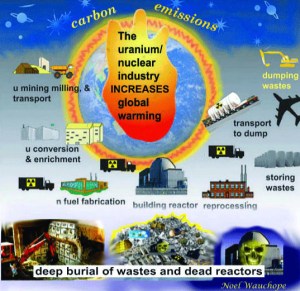 Nuclear power is helping to drive the climate crisis, Guardian, 3 July 19 Linda Rogers says the CBI has its head in the sand over nuclear reactors and Iain Climie wants politicians prepared to fund action to combat the climate emergency
Has the Confederation of British Industry got its head in the sand, or in the record levels of carbon-intensive concrete just poured at the Hinkley C nuclear site (
Build more nuclear reactors to help climate crisis, says CBI, 28 June)? Nuclear power, apart from destroying biodiversity throughout its life cycle, produces up to 37 times the CO2 emissions of renewable energy sources, owing partly to the mining and refining of uranium. The impact of this process on people and the environment is not included in the rationale for nuclear power in the UK.
As the CBI looks for investment from abroad, UK taxpayers will pick up the bill for the likely time and cost overruns of new nuclear build under the regulated asset-based funding proposals so welcomed by the CBI. Nuclear has failed to achieve the investment needed so far because it is no longer seen as economically viable. Even Hitachi (one of the world’s largest multinationals) cannot magic Wylfa Newydd into a commercially viable business. In January this year, Hitachi announced it had failed to squeeze the UK government for the very high levels of subsidies desired by large investors upfront for Wylfa. Nobody can afford the costs or the many risks attached to building new nuclear power stations.
Linda Rogers
July 4, 2019
Posted by Christina Macpherson |
business and costs, climate change, politics, UK |
Leave a comment
David Lowry’s Blog 2nd June 2019 Climate change was the only issue where consensus failed to be reached at the G20 meeting of leaders of the globe’s biggest economies, held in in
Osaka, Japan at the end of last week. Nuclear still is seen as having a
place in the energy mix, but without any real enthusiasm. http://drdavidlowry.blogspot.com/2019/07/g20-in-osaka-blows-hot-and-cold-over.html
July 4, 2019
Posted by Christina Macpherson |
climate change, politics international |
Leave a comment
 ‘Worst is still to come’: Sizzling Europe battles wildfires, health risks, New records are being set as Europe swelters, sparking forest fires – and debates over public nudity. SBS News, 29 June 19, Wildfires raged across Catalonia and French authorities stepped up restrictions on water use and driving in cities as swathes of western Europe remained in the grip of an intense heatwave.Temperatures climbed towards 44 degrees Celsius (111 degrees Fahrenheit) in parts of northern Spain and southern France, driving many people to seek relief in the sea, rivers, lakes, fountains and swimming pools.
Grid operator RTE said French electricity demand on Thursday was close to a summer record seen two years ago, as people turned on fans and coolers to full blast for relief from the scorching temperatures……….
The stifling heat has elsewhere prompted traffic restrictions in France and fanned debate in Germany over public nudity as sweltering residents stripped off. …….
Exceptional for arriving so early in summer, the heatwave will on Thursday and Friday likely send thermometers above 40 degrees in France, Spain and Greece.
In Spain, hundreds of firefighters and soldiers, backed by water-dropping aircraft, battled on Wednesday to put out a wind-fuelled forest fire that erupted in Torre del Espanol in the northeastern region of Catalonia…….
Scientists warn that global warming linked to human fossil fuel use could make such scorchers more frequent.
“Global temperatures are increasing due to climate change,” said Len Shaffrey, professor of climate science at the University of Reading.
“The global rise in temperatures means the probability that an extreme heatwave will occur is also increasing.”……… European heatwave could be the norm in a climate change affected world…….. https://www.sbs.com.au/news/worst-is-still-to-come-sizzling-europe-battles-wildfires-health-risks
July 2, 2019
Posted by Christina Macpherson |
climate change, EUROPE |
Leave a comment

Air conditioning is the world’s next big  threat https://www.smh.com.au/business/markets/air-conditioning-is-the-world-s-next-big-threat-20190629-p522hd.html , By Chris Bryant, June 29, 2019 The vast majority of Americans and many Australians have air conditioning, but in Germany almost nobody does. At least not yet.
So when temperatures in Berlin rose to an uncomfortable 37 Celsius this week – a record for the month of June – I was uncommonly delighted to go to the Bloomberg office, where it’s artificially and blissfully cool.
By letting people in overheated climates concentrate on their work and get a good night’s sleep, air conditioning has played a big part in driving global prosperity and happiness over the past few decades – and that revolution has still barely begun.
About half of Chinese households have this modern tool, but of the 1.6 billion people living in India and Indonesia, only 88 million have access to air conditioning at home, Bloomberg New Energy Finance noted in a recent report.
For many, relief is in sight. Because of the combination of population growth, rising incomes, falling equipment prices and urbanisation, the number of air-conditioning units installed globally is set to jump from about 1.6 billion today to 5.6 billion by the middle of the century, according to the International Energy Agency.
That’s encouraging news for US manufacturers of cooling systems such as Carrier (United Technologies Corp), Ingersoll-Rand and Johnson Controls International.
And because much of this growth will happen in Asia, Chinese companies such as Gree Electric Appliances, Qingdao Haier, Midea Group and Japan’s Daikin Industries Ltd should be big beneficiaries.
There’s just one glaring problem: What will all this extra demand for electricity do to the climate?
Vicious cycle
Carbon dioxide emissions rose another 2 per cent in 2018, the fastest pace in seven years. That increase was alarming in its own right, given what we know about the unfolding climate emergency.
But the proximate cause was especially troubling: Extreme weather led to more demand for air conditioning and heating in 2018, BP explained in its annual review of energy sector.
It’s not too hard to imagine a vicious cycle in which more hot weather begets ever more demand for air conditioning and thus even more need for power. That in turn means more emissions and even hotter temperatures.
That negative feedback loop exists at a local level too. Air-conditioning units funnel heat outside, exacerbating the so-called “urban heat island” effect, which makes cities warmer than the countryside.
BNEF expects electricity demand from residential and commercial air conditioning to increase by more than 140 per cent by 2050 – an increase that’s comparable to adding the European Union’s entire electricity consumption. Air conditioning will represent 12.7 per cent of electricity demand by the middle of the century, compared to almost 9 per cent now, it thinks.
Thankfully, much of that extra demand will be met by solar power (the need for cooling is highest during daylight hours). But because temperatures don’t always return to comfortable levels when the sun goes down, there’s a danger some will be supplied by fossil power.
‘Passivhaus’ and LED revolution
Buildings have long been a blind spot in climate discussions even though they account for about one-fifth of global energy consumption. The inefficiency of air-conditioning systems or badly designed homes and offices simply aren’t as eye-catching as electric cars and making people feel ashamed about flying.
At least Germany’s “passivhaus” movement, a way of building homes that require very little heating or cooling, voluntary standard for energy efficiency in buildings, shows some people are starting to recognise the danger.
There are lessons to be learned from the world of lighting too. The LED revolution was spurred by innovation but also by better energy efficiency labelling on products and the phasing out of out-of-date technology. Something similar needs to happen with air conditioning.
There was a big step forward in January when the Kigali Amendment to the Montreal Protocol came into force. Though not well known, its aim is to phase out the use of potent greenhouse gases called hydrofluorocarbons, which are used widely in air conditioning systems. Unless substituted, these alone could cause 0.4C of additional warming by the end of the century.
Yet true to form, President Donald Trump’s administration hasn’t yet submitted Kigali to the Senate for ratification, even though American manufacturers would benefit from demand for the new technologies that it would spawn.
Trump knows all about the importance of good air con. He spends much of his time at his Palm Beach country club, a place that couldn’t exist without it.
So he’d do well to remember this: You can air condition the clubhouse but not the golf course. And it’s starting to get awfully hot outside.
Chris Bryant is a Bloomberg Opinion columnist covering industrial companies. He previously worked for the Financial Times.
July 1, 2019
Posted by Christina Macpherson |
2 WORLD, climate change, ENERGY, Reference |
Leave a comment

Heatwave may force nuclear power shutdown in France as cooling water runs out, https://www.telegraph.co.uk/news/2019/06/30/heatwave-may-force-nuclear-power-shutdown-france-cooling-water/ David Chazan, Paris 30 JUNE 2019
Drought and overheating of river water may force some of the nuclear power plants that supply two-thirds of France’s electricity to shut down temporarily in the wake of the European heatwave.
The extreme temperatures are beginning to abate, but shortages and excessive temperatures of river water needed to cool reactors are worrying EDF, the largely state-owned electricity company.
If the hot weather continues, households, offices and factories will require large quantities of electricity for air conditioning and ventilation.
River levels have fallen in eastern, central and southern France, the Journal du Dimanche newspaper reported on Sunday.
The Civaux nuclear plant is cooled by water from the River Vienne, now close to a historic low following the heatwave.
EDF uses two dams to augment the river water, but the local authority has complained that the company uses the river almost exclusively for its power station, jeopardising farming, drinking water supplies, leisure activities and tourism.
Residents of areas near the River Loire have made similar criticisms.
The Loire has four nuclear plants on its banks, but the local authority has reported water levels close to the historic lows registered during France’s terrible 2003 heatwave, blamed for 15,000 deaths, mostly elderly people affected by dehydration.
Last year, hot weather forced EDF to temporarily shut down three reactors in eastern France, at the Bugey power plant near the Swiss border, at its Saint-Alban plant on the Rhône, and at the Fessenheim plant near the German border.
The heatwave has revealed that France is ill-prepared to face extreme temperatures, according to green party leaders. The government is to unveil new measures to manage water resources this week.
A record high of 45.9 degrees Celsius was reached in the southern village of Gallargues-le-Montueux, near Montpellier, on Friday.
Three swimmers died of “thermic shock” from plunging into cool water, and a cyclist died after collapsing in the heat in the southern Vaucluse département.
In Spain, a British mountaineer was airlifted to hospital after suffering heatstroke.
The unnamed 48-year-old collapsed in the Western Pyrenees’ Baztan Valley and was taken to hospital in a serious condition.
July 1, 2019
Posted by Christina Macpherson |
climate change, France |
1 Comment
 Guardian 29th June 2019
 Theresa May has urged countries to be more ambitious in tackling the climate crisis after Donald Trump reiterated his determination to ditch the
Paris accord.
The prime minister led a session on the environment at the
G20 summit in Osaka, which will be one of her final appearances on the
world stage. In the G20 communique, which was agreed after many hours of
wrangling among the “sherpas”, who represent the group’s member states, 19
of the 20 reiterated their commitment to the Paris accord.
The final wording echoed a statement from the last G20 summit, in Buenos Aires, but
government sources suggested some countries, including the US, India and
China, had tried to water it down. The US president had sought to excise
the reference to the Paris agreement from the communique altogether, with
the help of several other countries, reportedly including Brazil and
Turkey. May said she was pleased there was a communique at all.
https://www.theguardian.com/politics/2019/jun/29/g20-theresa-may-urges-countries-to-raise-climate-ambitions
July 1, 2019
Posted by Christina Macpherson |
2 WORLD, climate change |
1 Comment
 Our Future || Caring for planet is a moral responsibility https://www.canberratimes.com.au/story/6244511/caring-for-planet-is-a-moral-responsibility/?cs=14246 Thea Ormerod, 30 June 19
I am a grandmother with eight grandchildren. Sometimes I lie awake at night worrying about how our changing climate is going to affect their future.
Seeing those little faces looking up at you, I feel we’re betraying the trust of these future generations by not taking care of this beautiful planet.
I attend the church of Our Lady of Fatima at Kingsgrove.
And while I pray for the Earth’s future, I also know that we must stand and act together. Our leaders must be persuaded to take moral responsibility. That’s why last week the organisation I’m involved with, the Australian Religious Response to Climate Change, released an open letter to the Prime Minister asking him to make the climate the No.1 priority.
It was signed by 153 religious leaders from across the spectrum, many of them in very senior roles.
Climate change and the burning of fossil fuels is a moral issue. Saving the world is a spiritual matter. I don’t interpret spiritual as “other worldly”.
Spirituality for me is about being responsible and reasonable, which shows in healthy relationships.
You see the fruits in laughter, peace and kindness towards each other. In his time on earth, Jesus himself was less interested in rules and who was or wasn’t praying.
He was interested in who was caring about people, especially people who are suffering.
Today, the people who have been hit hardest by climate change are mostly in developing countries, and they’ve done nothing to contribute to the problem.
Those suffering most in Australia are largely people in rural and regional areas. They are on the frontline of droughts, bushfires, intense heat and flooding, left grieving for lost herds and ruined crops.
But people in these areas are being sold short by politicians who are not planning for a more sustainable future, which includes an orderly transition away from the mining and burning of fossil fuels.
Many other nations are making big commitments to reduce emissions but Australia is out of step.
Our elected representatives may think politics is not about religion or spirituality. But it is about morality and caring about people.
July 1, 2019
Posted by Christina Macpherson |
AUSTRALIA, climate change, Religion and ethics |
Leave a comment
EDF to curb Bugey nuclear reactor output as Rhone river flow slows https://www.reuters.com/article/us-france-weather-nuclearpower/edf-to-curb-bugey-nuclear-reactor-output-as-rhone-river-flow-slows-id Reporting by Bate Felix; Editing by Geert De Clercq, PARIS (Reuters) 29 June 19 – French utility EDF said on Friday that power generation at its 3,600 megawatt (MW) Bugey nuclear power plant in eastern France could be curbed from Tuesday July 2 due to a lower flow rate of the Rhone river.The plant near the Swiss border has four 900 MW reactors and uses water from the river for cooling.
EDF’s use of water from rivers as coolant is regulated by law to protect plant and animal life. It is obliged to reduce output during hot weather when water temperatures rise, or when river levels and the flow rate are low.
France saw new all-time record temperatures about 45 degrees Celsius in the south of the country on Friday afternoon as a sweltering heatwave engulfed much of southern and central Europe.
June 29, 2019
Posted by Christina Macpherson |
climate change, France |
Leave a comment
 ‘Worst is still to come’: Sizzling Europe battles wildfires, health risks, New records are being set as Europe swelters, sparking forest fires – and debates over public nudity. SBS News, 28 June 19 Wildfires raged across Catalonia and French authorities stepped up restrictions on water use and driving in cities as swathes of western Europe remained in the grip of an intense heatwave.
Temperatures climbed towards 44 degrees Celsius (111 degrees Fahrenheit) in parts of northern Spain and southern France, driving many people to seek relief in the sea, rivers, lakes, fountains and swimming pools.
Grid operator RTE said French electricity demand on Thursday was close to a summer record seen two years ago, as people turned on fans and coolers to full blast for relief from the scorching temperatures……….
The stifling heat has elsewhere prompted traffic restrictions in France and fanned debate in Germany over public nudity as sweltering residents stripped off. …….
Exceptional for arriving so early in summer, the heatwave will on Thursday and Friday likely send thermometers above 40 degrees in France, Spain and Greece.
In Spain, hundreds of firefighters and soldiers, backed by water-dropping aircraft, battled on Wednesday to put out a wind-fuelled forest fire that erupted in Torre del Espanol in the northeastern region of Catalonia…….
Scientists warn that global warming linked to human fossil fuel use could make such scorchers more frequent.
“Global temperatures are increasing due to climate change,” said Len Shaffrey, professor of climate science at the University of Reading.
“The global rise in temperatures means the probability that an extreme heatwave will occur is also increasing.”……… European heatwave could be the norm in a climate change affected world…….. https://www.sbs.com.au/news/worst-is-still-to-come-sizzling-europe-battles-wildfires-health-risks
June 29, 2019
Posted by Christina Macpherson |
climate change, EUROPE |
Leave a comment
The Guardian view of the Osaka G20 summit: bad as he is, Trump is not the only problem, Editorial, Guardian 268 June 19 The climate crisis underlines the need for effective global economic leadership. The US president makes this harder, but so do China and several others.Ever since the G20 of leading global economies was founded, its summits have mostly been convergent occasions, marked by attempts to find common ground and remembered for nothing more unseemly than a bit of jostling among the heads of government to be on the front row of the group photograph. Japan’s prime minister Shinzō Abe clearly takes this traditional view about the G20 summi twhich he will host in Osaka on Friday and Saturday. “We want to make it a meeting that focuses on where we can agree and cooperate rather than highlighting differences,” he said recently.
But there is a balloon-puncturing problem with Mr Abe’s approach, and it answers to the name of Donald Trump. If there is one issue on which this year’s summit clearly ought to be showing global leadership, it is the climate crisis. The subject is indeed on the Osaka agenda but, in spite of efforts by countries including France, there is no prospect of serious or effective action. That is no surprise from a group of nations which almost tripled the subsidies they gave to coal-fired power plants between 2013 and 2017, with China, India and Japan itself leading the way. But it is Mr Trump’s decision to walk away from climate accords and to back fossil fuels that creates the wider permission for these other terrible derelictions.
Mr Trump’s disruptions do not end there. The US president uses these gatherings not to build alliances to solve common problems but to knock his adversaries – and sometimes his supposed allies – off their stride. He is not looking for general agreement, which he thinks is for wimps. He is looking for American advantage over friend and foe. That’s the reason why the summit is already overshadowed by the increasingly serious trade war between the United States and China (Mr Trump will have an all-smiles bilateral with Xi Jinping on Saturday). And it is certainly the reason why Mr Trump has used the run-up to Osaka to have a pop at his hosts, whom he claimed would respond to an attack on the US by watching it “on a Sony television”, attacking India for raising tariffs and then, inventing false figures, berating Germany as a “security freeloader”.
Since Mr Trump’s Friday schedule involves one-on-ones with Mr Abe, India’s Narendra Modi and Germany’s Angela Merkel, it seems these mind games are part of a deliberate strategy of disruption. This is not a novel conclusion. Mr Trump used the same approach before his recent visit to Britain, when he praised Boris Johnson and attacked Sadiq Khan and the Duchess of Sussex. If Mr Johnson becomes prime minister and Britain were to back off from supporting European opposition to the White House’s Iran strategy, Mr Trump would count this a job well done.
Mr Trump’s bullying is also selective. Among the world leaders whom Mr Trump has not attacked in advance – but with whom he will also be meeting in Osaka bilaterals – are Vladimir Putin of Russia, whose country systematically interfered in the 2016 US election, and Mohammed bin Salman of Saudi Arabia, who has just been accused by the United Nations of orchestrating the murder and dismemberment of the opposition journalist Jamal Khashoggi……… https://www.theguardian.com/commentisfree/2019/jun/27/the-guardian-view-of-the-osaka-g20-summit-bad-as-he-is-trump-is-not-the-only-problem
|
|
|
June 29, 2019
Posted by Christina Macpherson |
climate change, Japan, politics international |
Leave a comment

 French nuclear to suffer after exclusion from EU’s green investment label, by Romain Thomas | EURACTIV.fr | translated by Daniel Eck 26 June 19, The European Parliament’s decision to exclude the nuclear energy sector from the list of investments that can benefit from the EU’s green investment label will have consequences for the sector, particularly in France. EURACTIV France reports.
Financing the energy transition is undoubtedly one of the major challenges of our century. To give itself the means to achieve its ambition, “the European Parliament recently voted in favour of a sustainable finance taxonomy project that defines a framework for activities considered environmental or green,” explained Nicolas Redon, Novethic’s green finance expert.
Directing capital flows towards a low-carbon economy
Investments in fossil fuels and nuclear energy are no longer part of sustainable finance and hence kept away from the financing needs of the transition.
In the same vein, the European Commission is working on a “European green investment label that would make it easier to channel investment funds into clean energy by the end of 2020”, added Nicolas Redon………. https://www.euractiv.com/section/energy-environment/news/french-nuclear-will-suffer-following-its-exclusion-from-eus-green-investment-label/
June 27, 2019
Posted by Christina Macpherson |
climate change, EUROPE |
Leave a comment
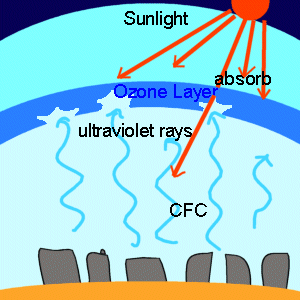 Damage to the ozone layer and climate change forming feedback loop
New report finds that impacts of ozone-driven climate change span the ecosystem https://www.sciencedaily.com/releases/2019/06/190624111536.htm June 24, 2019 Rensselaer Polytechnic Institute
- Summary:
- Increased solar radiation penetrating through the damaged ozone layer is interacting with the changing climate, and the consequences are rippling through the Earth’s natural systems, effecting everything from weather to the health and abundance of sea mammals like seals and penguins.
- Increased solar radiation penetrating through the damaged ozone layer is interacting with the changing climate, and the consequences are rippling through the Earth’s natural systems, effecting everything from weather to the health and abundance of sea mammals like seals and penguins. These findings were detailed in a review article published today in Nature Sustainability by members of the United Nations Environment Programme’s Environmental Effects Assessment Panel, which informs parties to the Montreal Protocol.
What we’re seeing is that ozone changes have shifted temperature and precipitation patterns in the southern hemisphere, Continue reading →
June 25, 2019
Posted by Christina Macpherson |
2 WORLD, climate change |
Leave a comment
The 7 reasons why nuclear energy is not the answer to solve climate  change, https://www.leonardodicaprio.org/the-7-reasons-why-nuclear-energy-is-not-the-answer-to-solve-climate-change/, Mark Z. Jacobson , Professor of Civil and Environmental Engineering, Director, Atmosphere/Energy Program, Stanford University, 21 June 19
There is a small group of scientists that have proposed replacing 100% of the world’s fossil fuel power plants with nuclear reactors as a way to solve climate change. Many others propose nuclear grow to satisfy up to 20 percent of all our energy (not just electricity) needs. They advocate that nuclear is a “clean” carbon-free source of power, but they don’t look at the human impacts of these scenarios. Let’s do the math…
One nuclear power plant takes on average about 14-1/2 years to build, from the planning phase all the way to operation. According to the World Health Organization, about 7.1 million people die from air pollution each year, with more than 90% of these deaths from energy-related combustion. So switching out our energy system to nuclear would result in about 93 million people dying, as we wait for all the new nuclear plants to be built in the all-nuclear scenario.
Utility-scale wind and solar farms, on the other hand, take on average only 2 to 5 years, from the planning phase to operation. Rooftop solar PV projects are down to only a 6-month timeline. So transitioning to 100% renewables as soon as possible would result in tens of millions fewer deaths.
This illustrates a major problem with nuclear power and why renewable energy — in particular Wind, Water, and Solar (WWS)– avoids this problem. Nuclear, though, doesn’t just have one problem. It has seven. Here are the seven major problems with nuclear energy:
1. Long Time Lag Between Planning and Operation
The time lag between planning and operation of a nuclear reactor includes the times to identify a site, obtain a site permit, purchase or lease the land, obtain a construction permit, obtain financing and insurance for construction, install transmission, negotiate a power purchase agreement, obtain permits, build the plant, connect it to transmission, and obtain a final operating license.
The planning-to-operation (PTO) times of all nuclear plants ever built have been 10-19 years or more. For example, the Olkiluoto 3 reactor in Finland was proposed to the Finnish cabinet in December 2000 to be added to an existing nuclear power plant. Its latest estimated completion date is 2020, giving it a PTO time of 20 years.
The Hinkley Point nuclear plant was planned to start in 2008. It has an estimated completion year of 2025 to 2027, giving it a PTO time of 17 to 19 years. The Vogtle 3 and 4 reactors in Georgia were first proposed in August 2006 to be added to an existing site. The anticipated completion dates are November 2021 and November 2022, respectively, given them PTO times of 15 and 16 years, respectively.
The Haiyang 1 and 2 reactors in China were planned to start in 2005. Haiyang 1 began commercial operation on October 22, 2018. Haiyang 2 began operation on January 9, 2019, giving them PTO times of 13 and 14 years, respectively. The Taishan 1 and 2 reactors in China were bid in 2006. Taishan 1 began commercial operation on December 13, 2018. Taishan 2 is not expected to be connected until 2019, giving them PTO times of 12 and 13 years, respectively. Planning and procurement for four reactors in Ringhals, Sweden started in 1965. One took 10 years, the second took 11 years, the third took 16 years, and the fourth took 18 years to complete.
Many claim that France’s 1974 Messmer plan resulted in the building of its 58 reactors in 15 years. This is not true. The planning for several of these nuclear reactors began long before. For example, the Fessenheim reactor obtained its construction permit in 1967 and was planned starting years before. In addition, 10 of the reactors were completed between 1991-2000. As such, the whole planning-to-operation time for these reactors was at least 32 years, not 15. That of any individual reactor was 10 to 19 years.
2. Cost
The levelized cost of energy (LCOE) for a new nuclear plant in 2018, based on Lazard, is $151 (112 to 189)/MWh. This compares with $43 (29 to 56)/MWh for onshore wind and $41 (36 to 46)/MWh for utility-scale solar PV from the same source.
This nuclear LCOE is an underestimate for several reasons. First, Lazard assumes a construction time for nuclear of 5.75 years. However, the Vogtle 3 and 4 reactors, though will take at least 8.5 to 9 years to finish construction. This additional delay alone results in an estimated LCOE for nuclear of about $172 (128 to 215)/MWh, or a cost 2.3 to 7.4 times that of an onshore wind farm (or utility PV farm).
Next, the LCOE does not include the cost of the major nuclear meltdowns in history. For example, the estimated cost to clean up the damage from three Fukushima Dai-ichi nuclear reactor core meltdowns was $460 to $640 billion. This is $1.2 billion, or 10 to 18.5 percent of the capital cost, of every nuclear reactor worldwide.
In addition, the LCOE does not include the cost of storing nuclear waste for hundreds of thousands of years. In the U.S. alone, about $500 million is spent yearly to safeguard nuclear waste from about 100 civilian nuclear energy plants. This amount will only increase as waste continues to accumulate. After the plants retire, the spending must continue for hundreds of thousands of years with no revenue stream from electricity sales to pay for the storage.
3. Weapons Proliferation Risk
The growth of nuclear energy has historically increased the ability of nations to obtain or harvest plutonium or enrich uranium to manufacture nuclear weapons. The Intergovernmental Panel on Climate Change (IPCC) recognizes this fact. They concluded in the Executive Summary of their 2014 report on energy, with “robust evidence and high agreement” that nuclear weapons proliferation concern is a barrier and risk to the increasing development of nuclear energy:
Barriers to and risks associated with an increasing use of nuclear energy include operational risks and the associated safety concerns, uranium mining risks, financial and regulatory risks, unresolved waste management issues, nuclear weapons proliferation concerns, and adverse public opinion.The building of a nuclear reactor for energy in a country that does not currently have a reactor allows the country to import uranium for use in the nuclear energy facility. If the country so chooses, it can secretly enrich the uranium to create weapons grade uranium and harvest plutonium from uranium fuel rods for use in nuclear weapons. This does not mean any or every country will do this, but historically some have and the risk is high, as noted by IPCC. The building and spreading of Small Modular Reactors (SMRs) may increase this risk further.
4. Meltdown Risk
To date, 1.5% of all nuclear power plants ever built have melted down to some degree. Meltdowns have been either catastrophic (Chernobyl, Russia in 1986; three reactors at Fukushima Dai-ichi, Japan in 2011) or damaging (Three-Mile Island, Pennsylvania in 1979; Saint-Laurent France in 1980). The nuclear industry has proposed new reactor designs that they suggest are safer. However, these designs are generally untested, and there is no guarantee that the reactors will be designed, built and operated correctly or that a natural disaster or act of terrorism, such as an airplane flown into a reactor, will not cause the reactor to fail, resulting in a major disaster.
5. Mining Lung Cancer Risk
Uranium mining causes lung cancer in large numbers of miners because uranium mines contain natural radon gas, some of whose decay products are carcinogenic. A study https://www.cdc.gov/niosh/pgms/worknotify/uranium.html of 4,000 uranium miners between 1950 and 2000 found that 405 (10 percent) died of lung cancer, a rate six times that expected based on smoking rates alone. 61 others died of mining related lung diseases. Clean, renewable energy does not have this risk because (a) it does not require the continuous mining of any material, only one-time mining to produce the energy generators; and (b) the mining does not carry the same lung cancer risk that uranium mining does.
6. Carbon-Equivalent Emissions and Air Pollution
There is no such thing as a zero- or close-to-zero emission nuclear power plant. Even existing plants emit due to the continuous mining and refining of uranium needed for the plant. Emissions from new nuclear are 78 to 178 g-CO2/kWh, not close to 0. Of this, 64 to 102 g-CO2/kWh over 100 years are emissions from the background grid while consumers wait 10 to 19 years for nuclear to come online or be refurbished, relative to 2 to 5 years for wind or solar. In addition, all nuclear plants emit 4.4 g-CO2e/kWh from the water vapor and heat they release. This contrasts with solar panels and wind turbines, which reduce heat or water vapor fluxes to the air by about 2.2 g-CO2e/kWh for a net difference from this factor alone of 6.6 g-CO2e/kWh.
In fact, China’s investment in nuclear plants that take so long between planning and operation instead of wind or solar resulted in China’s CO2 emissions increasing 1.3 percent from 2016 to 2017 rather than declining by an estimated average of 3 percent. The resulting difference in air pollution emissions may have caused 69,000 additional air pollution deaths in China in 2016 alone, with additional deaths in years prior and since.
7. Waste Risk
Last but not least, consumed fuel rods from nuclear plants are radioactive waste. Most fuel rods are stored at the same site as the reactor that consumed them. This has given rise to hundreds of radioactive waste sites in many countries that must be maintained and funded for at least 200,000 years, far beyond the lifetimes of any nuclear power plant. The more nuclear waste that accumulates, the greater the risk of radioactive leaks, which can damage water supply, crops, animals, and humans.
Summary
To recap, new nuclear power costs about 5 times more than onshore wind power
per kWh (between 2.3 to 7.4 times depending upon location and integration issues). Nuclear takes 5 to 17 years longer between planning and operation and produces on average 23 times the emissions per unit electricity generated (between 9 to 37 times depending upon plant size and construction schedule). In addition, it creates risk and cost associated with weapons proliferation, meltdown, mining lung cancer, and waste risks. Clean, renewables avoid all such risks.
Nuclear advocates claim nuclear is still needed because renewables are intermittent and need natural gas for backup. However, nuclear itself never matches power demand so it needs backup. Even in France with one of the most advanced nuclear energy programs, the maximum ramp rate is 1 to 5 % per minute, which means they need natural gas, hydropower, or batteries, which ramp up 5 to 100 times faster, to meet peaks in demand. Today, in fact, batteries are beating natural gas for wind and solar backup needs throughout the world. A dozen independent scientific groups have further found that it is possible to match intermittent power demand with clean, renewable energy supply and storage, without nuclear, at low cost. Finally, many existing nuclear plants are so costly that their owners are demanding subsidies to stay open. For example, in 2016, three existing upstate New York nuclear plants requested and received subsidies to stay open using the argument that the plants were needed to keep emissions low. However, subsidizing such plants may increase carbon emissions and costs relative to replacing the plants with wind or solar as soon as possible. Thus, subsidizing nuclear would result in higher emissions and costs over the long term than replacing nuclear with renewables.
Derivations and sources of the numbers provided herein can be found here – https://web.stanford.edu/group/efmh/jacobson/Articles/I/NuclearVsWWS.pdf
June 24, 2019
Posted by Christina Macpherson |
2 WORLD, business and costs, climate change, health, Reference, weapons and war |
Leave a comment








