The woman who was first to scientifically show, in 1856, how atmospheric C02 caused global warming
 Climate-science sexism reheated, Canberra Times, Ian Warden 11 Oct 19
One of my favourite obscure journals, The Public Domain Review, in touch with our climate-debating times, has just dusted off Eunice Foote’s paper Circumstances Affecting the Heat of the Sun’s Rays. It was published in the November 1856 American Journal of Art and Science.
“Foote’s seminal experiment was ingeniously homemade. Using four thermometers, two glass cylinders, and an air pump, she isolated the component gases that make up the atmosphere and exposed them to the sun’s rays … Measuring the change in their temperatures, she discovered that carbon dioxide and water vapour absorbed enough heat that this absorption could affect climate.”
“Entirely because she was a woman, Foote was barred from reading the paper describing her findings at the 1856 meeting of the American Association for the Advancement of Science held in Albany, New York. Instead, Professor Joseph Henry of the Smithsonian had the honour of introducing her, announcing that science was ‘of no country and of no sex. The sphere of woman embraces not only the beautiful and the useful, but the true.’ Perhaps this was Henry’s attempt to shield Foote and her findings from sexist criticism .”
It would not surprise if, just as Greta Thunberg is so often accused of only reading speeches written for her by some grown-up Green Svengali (for she is surely too much of a girly flibbertigibbet to really be as knowledgeable and articulate as she pretends) Eunice Foote was suspected of having lots of (unacknowledged by her) cerebral male help with her paper.
Likell thinking Australian atheists/agnostics I am both appalled and fascinated by our prime minister’s extreme religiosity……https://www.canberratimes.com.au/story/6430152/climate-science-sexism-reheated/?cs=14246
Ex-generals aim to shift conservative resiliency dialogue away from coal, nuclear subsidies
https://www.utilitydive.com/news/ex-generals-aim-to-shift-conservative-resiliency-dialogue-away-from-coal-n/564815/ The project aims to educate stakeholders on the possibilities of competitive contracts to promote resilience. “There’s an element within the country that says we can’t reveal” engineering improvements for the critical substations and nodes “for causes classified…and so there’s no competition in the pricing of those repairs,” Handy told reporters on Thursday.
“What we’re suggesting, from a national security standpoint is … companies know how to compete in a classified area or a confidential area, and not just about the grid, about anything,” Hagee said. “These competitive forces can in fact be brought to bear even when you have information that is sensitive.”
by Iulia Gheorghiu Oct. 11, 2019
Dive Brief:
- Securing America’s Future Energy (SAFE) launched a project this month to direct conservative discussions on energy and national security toward market-based approaches, leveraging the knowledge and experience of three former U.S. generals.
- The Grid Security Project will focus on federal-level policy, as well as Ohio, Illinois and Pennsylvania, where state subsidy efforts are underway to aid power plants that SAFE has deemed unnecessary for reliability or security, based on a technical analysis from grid operator PJM Interconnection.
-
On Thursday, General Michael Hagee and General John Handy, two leaders of the Grid Security Project, met with energy and defense committees on Capitol Hill to discuss infrastructure legislation, the defense authorization bill and transportation electrification.
Dive Insight:
The new group aims to shift “the narrative in the conservative community away from subsidizing coal and nuclear plants toward one that emphasizes real grid security and resilience,” following proposals from several states and the Trump administration to subsidize power plants with baseload capacity, according to SAFE’s statement.
The Grid Security Project’s fuel-neutral message would target Ohio, Illinois and Pennsylvania, with education efforts extending to legislators, public utility commissioners and other thought leaders.
n Ohio, coal and nuclear subsidy legislation could go into effect in mid-October. The Grid Security Project is publishing information and working to oppose the subsidies because, according to SAFE, state legislators and First Energy Solutions have contradicted PJM’s assessment by maintaining certain coal and nuclear plants were important to reliability and national security.
On a national level, the Federal Energy Regulatory Commission is pursuing a docket on resilience, and the Grid Security Project wants to help steer discussions toward market-based approaches.
“We want a reliable, resilient and affordable grid,” Hagee said. “The best way to get to that… [is] with our ingenuity and our competitiveness.”
The project aims to educate stakeholders on the possibilities of competitive contracts to promote resilience. “There’s an element within the country that says we can’t reveal” engineering improvements for the critical substations and nodes “for causes classified…and so there’s no competition in the pricing of those repairs,” Handy told reporters on Thursday.
“What we’re suggesting, from a national security standpoint is … companies know how to compete in a classified area or a confidential area, and not just about the grid, about anything,” Hagee said. “These competitive forces can in fact be brought to bear even when you have information that is sensitive.”
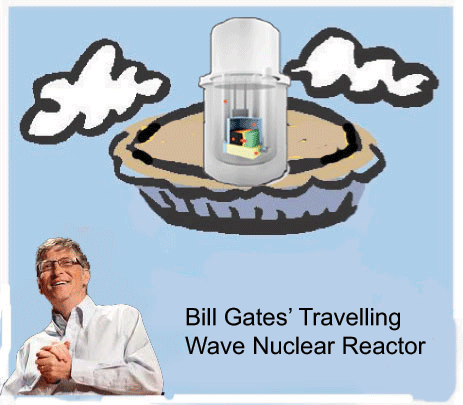
Bill Gates is wrong. Nuclear power will not save the climate.
according to the International Energy Agency (IEA), the largest share of this  [needed greenhouse gas] reduction – almost 40 percent – could come from improved energy efficiency….One third of that could be covered by renewable energies, while in this scenario, nuclear power would account for
  five percent.
..Indeed, in order to actually deliver on such a contribution, hundreds of new reactors would have to be built. “It would involve a gigantic nuclear dimension just to make a minimal contribution to the climate,”
One of the questions that has received very little attention so far is how reliable nuclear power plants will be in a warmer world……This year, reactors were again disconnected from the grid in Europe as a result of heat waves.
|
Bill Gates is wrong. Nuclear power will not save the climate. Beyond Chernobyl and Fukushima, there’s too much speaking against it, German Times, By Christoph von Eichhorn, October 2019 Nuclear power? No, thank you! “That chapter is over,” a spokesperson recently proclaimed. Nuclear power isn’t even a topic anymore, she argued. And this spokesperson wasn’t from some environmental organization or the like; she was representing RWE, one of three large corporations in Germany that still produces electricity from nuclear energy. The two other companies, EnBW and Eon, have issued similar sentiments, pointing to the fact that their priority is now the decommissioning of nuclear power plants and the switch to renewable energies.Just prior to those comments, members of Germany’s industrial community had joined up with the WerteUnion – a group of conservative parliamentarians from the CDU – to suggest longer running times for the remaining German nuclear power plants. But this suggestion was greeted with a unanimous negative response from electricity corporations: the use of nuclear energy in Germany was over, they argued. Period……..
One of the most prominent advocates of a nuclear renaissance is Bill Gates. Late last year, in an open letter to employees, the Microsoft founder wrote: “Nuclear is ideal for dealing with climate change, because it is the only carbon-free, scalable energy source that’s available 24 hours a day.” The problems associated with today’s reactors, he argued, “can be solved through innovation.” In the United States, the question of what to do with nuclear energy is particularly acute. Nuclear fission currently accounts for roughly 11 percent of global electricity, and for around 20 percent in the United States. As the Union of Concerned Scientists (UCS) points out in a recent study, one in every three of the approximately 60 nuclear power plants in the US might have to be shut down in the next few years because they are either too old or are already losing money today…… The decline in the price of renewables is seen as one of the major reasons why nuclear energy is less and less viable. Some states in the US, including Illinois, New Jersey and New York, have nonetheless subsidized unprofitable nuclear power plants in order to secure their operations. This is by all means a daring investment. The UCS estimates that it takes an average of $4 billion to make an unprofitable power plant profitable again. Equipping nuclear reactors to continue running only 20 years longer than planned usually requires expensive modernization measures designed to keep the aging technology in good condition, says Frank Peter, co-head of the think tank Agora Energiewende. “These investments often make no economic sense.” UCS researchers advise against the construction of any new power plants due to the high investment costs. “The fundamental problem is the cost,” says a recent report by the Massachusetts Institute of Technology on the future of nuclear energy. While technologies such as photovoltaics and wind power have consistently become cheaper, new nuclear power plants have become more expensive. The MIT researchers calculated the costs of nuclear energy for several regions and came up with very clear results: In terms of the cost of generating energy, wind and photovoltaics always beat nuclear power. In order to make nuclear competitive again, there would have to be massive changes in the way the technology is developed and managed. To this end, the MIT experts suggest producing components on an assembly line and testing innovative new reactor prototypes in huge “reactor parks” as quickly as possible. They even mention the idea of simplifying regulations for nuclear power plants. In the face of disasters such as those in Chernobyl and Fukushima, it is unlikely that the regimen of having lower safety standards and test sites for non-mature reactors will be able to be enforced in many countries. Even the standardization of reactors has not yet brought the savings many had hoped for. For example, European Pressurized Water Reactors are currently being built in Finland, France and the UK, and in all three cases, the costs and construction time have long since moved beyond the original scope. Construction on the third unit of the nuclear power plant in the Finnish city of Olkiluoto has already taken 10 years longer than planned. According to calculations by Greenpeace, the British plant Hinkley Point C is set to cost €108 billion in subsidies over a period of 35 years. There is one question above all that dominates the discussion, and it revolves around whether or not nuclear energy can even contribute to reducing greenhouse gas emissions. This issue has been investigated by the International Energy Agency, among others. In order to limit global warming to two degrees higher than pre-industrial levels by 2100, world emissions would have to drop from 37 billion tons today to less than five billion tons by 2050. And, according to the International Energy Agency (IEA), the largest share of this reduction – almost 40 percent – could come from improved energy efficiency. One third of that could be covered by renewable energies, while in this scenario, nuclear power would account for five percent. That would involve a reduction of more than one billion tons a year, but it would still not be enough to fundamentally shift the direction in climate policy. Indeed, in order to actually deliver on such a contribution, hundreds of new reactors would have to be built. “It would involve a gigantic nuclear dimension just to make a minimal contribution to the climate,” says Manfred Fischedick, energy expert at the Wuppertal Institute for Climate, Environment and Energy. One of the questions that has received very little attention so far is how reliable nuclear power plants will be in a warmer world. In the drought-plagued summer of 2018, several reactors in Germany and France had to be shut down because the surrounding rivers had overheated. Plant operators were no longer allowed to feed in cooling water so as not to endanger the already stressed ecosystems. This year, reactors were again disconnected from the grid in Europe as a result of heat waves. All we can do now is hope for new reactors, such as the traveling wave reactor sponsored by Bill Gates. Similar to the very slow burn of a glowing cigar, this type of reactor would produce its own fuel and consume it for decades. As it would use old fuel rods from light-water reactors and depleted uranium, this reactor type would be able to eliminate high-level nuclear waste, for which there are still no good solutions – even seven decades after the beginning of the nuclear age. If this concept were to actually work, it would certainly be a blessing. But we would be well-advised not to actually rely on this approach in our efforts to stop global warming. The concept for this type of reactor dates back to the 1950s, and the basic foundations have yet to be fully researched. For example, nuclear engineers would have to deal with enormous amounts of material that is generated in reactions involving temperatures exceeding 500 degrees Celsius. TerraPower is aiming for a prototype by the mid-2020s, and it would most likely take another 10 years to achieve a reactor that actually produces electricity. This is a very important timeframe – one in which we will have to have already shifted gears and set a course for a climate-neutral energy supply. Christoph von Eichhorn is a science editor at the Süddeutsche Zeitung. http://www.german-times.com/bill-gates-is-wrong-nuclear-power-will-not-save-the-climate-beyond-chernobyl-and-fukushima-theres-too-much-speaking-against-it/?fbclid=IwAR3CJIEaecAlk05MgeVsPCuBSCJPEDDweL9RzCxzsVRCeso5_vQPRVjiyy8 |
|
Australian government ‘doesn’t give a damn’about rest of the world

David Attenborough says Australian government ‘doesn’t give a damn’about rest of the world, Telegraph, UK, Giovanni Torre, perth
24 SEPTEMBER 2019
Sir David Attenborough slammed the Australian government’s response to
climate change as the country’s prime minister Scott Morrison skipped
the United Nations Climate Summit in favour of a rally for President Donald
Trump.
While the United Kingdom has reduced its carbon emissions over the past 12
years, emissions from Australia have increased and the country is among the
worst polluters per capita.
Sir David said the current Australian government had departed from the
previous government’s commitment to tackling climate change.
“(They had been) saying all the right things… then you suddenly say, ‘No it
doesn’t matter… it doesn’t matter how much coal we burn… we don’t give a
damn what it does to the rest of the world’,” he said.
Sir David noted that Mr Morrison brought a lump of coal into one of
Australia’s houses of Parliament in 2017, calling out to the opposition:
“Don’t be scared, it won’t hurt you”.
“If you weren’t opening a coal mine okay I would agree, it’s a joke. But you
are opening a coal mine,” he said.
Sir David noted that Mr Morrison had campaigned for re-election on a
platform of support for new coal mines.
Speaking from Chicago, Mr Morrison defended his government’s record on
climate change…… https://www.telegraph.co.uk/news/2019/09/24/david-attenborough-says-australian-government-doesnt-give-damn/?WT.mc_id=tmg_share_fb&fbclid=IwAR0GancZNjQW1CgrE7UF2WExXW2B4HvkM9brL0huaFKom6msYAz79qtjjd0
Pacific Island nations urge action on climate change at UN
Pacific Island nations urge action on climate change at UN, Pacific leaders want to remind the world what’s at stake for the most vulnerable – low lying nations – if nothing is done to combat climate change. (video) https://www.sbs.com.au/news/pacific-island-nations-urge-action-on-climate-change-at-un
Nuclear energy too slow, too expensive to save climate: report
 Nuclear energy too slow, too expensive to save climate: report https://uk.reuters.com/article/us-energy-nuclearpower-idUKKBN1W909J, Marton Dunai, Geert De Clercq, BUDAPEST/PARIS, 26 Sept 19 (Reuters) – Nuclear power is losing ground to renewables in terms of both cost and capacity as its reactors are increasingly seen as less economical and slower to reverse carbon emissions, an industry report said.
In mid-2019, new wind and solar generators competed efficiently against even existing nuclear power plants in cost terms, and grew generating capacity faster than any other power type, the annual World Nuclear Industry Status Report (WNISR) showed.
“Stabilizing the climate is urgent, nuclear power is slow,” said Mycle Schneider, lead author of the report. “It meets no technical or operational need that low-carbon competitors cannot meet better, cheaper and faster.”
The report estimates that since 2009 the average construction time for reactors worldwide was just under 10 years, well above the estimate given by industry body the World Nuclear Association (WNA) of between 5 and 8.5 years.
The extra time that nuclear plants take to build has major implications for climate goals, as existing fossil-fueled plants continue to emit CO2 while awaiting substitution.
“To protect the climate, we must abate the most carbon at the least cost and in the least time,” Schneider said.
The WNA said in an emailed statement that studies have shown that nuclear energy has a proven track record in providing new generation faster than other low-carbon options, and added that in many countries nuclear generation provides on average more low-carbon power per year than solar or wind.
It said that reactor construction times can be as short as four years when several reactors are built in sequence.
Nuclear is also much more expensive, the WNISR report said.
The cost of generating solar power ranges from $36 to $44 per megawatt hour (MWh), the WNISR said, while onshore wind power comes in at $29–$56 per MWh. Nuclear energy costs between $112 and $189.
Over the past decade, the WNISR estimates levelized costs – which compare the total lifetime cost of building and running a plant to lifetime output – for utility-scale solar have dropped by 88% and for wind by 69%.
For nuclear, they have increased by 23%, it said.
Capital flows reflect that trend. In 2018, China invested $91 billion in renewables but just $6.5 billion in nuclear.
In the United States, renewable capacity is expected to grow by 45 GW in the next three years, while nuclear and coal are set to retire a net 24 GW.
China, still the world’s most aggressive nuclear builder, has added nearly 40 reactors to its grid over the last decade, but its nuclear output was still a third lower than its wind generation.
Although several new nuclear plants are under construction, no new project has started in China since 2016.
Global nuclear operating capacity has increased 3.4% in the past year to 370 gigawatts, a new historic maximum, but with renewable capacity growing quickly, the share of nuclear in the world’s gross power generation has stayed at just over 10%.
In the decade to 2030, 188 new reactors would have to be connected to the grid to maintain the status quo, which is more than three times the rate achieved over the past decade, the WNISR estimates.
In May, the International Energy Agency warned reut.rs/2mqcG8j that a steep decline in nuclear capacity will threaten climate goals, as advanced economies could lose 25% of their nuclear capacity by 2025.
Reporting by Marton Dunai in Budapest and Geert De Clercq in Paris; Editing by Jan Harvey and Emelia Sithole-Matarise
Climate Action summit: Greta Thunberg rips into leaders over ‘mass extinction’
Climate Action summit: Greta Thunberg rips into leaders over ‘mass extinction’ https://www.news.com.au/technology/environment/climate-change/climate-action-summit-greta-thunberg-rips-into-leaders-over-mass-extinction/news-story/2c8d4aac13cb60507a41b48c2ef3d8f2
A teen has ripped into world leaders at a UN summit and stared down US President Donald Trump as they crossed paths in a surprise encounter.
Megan Palin@megan_palinA schoolgirl has stared down Donald Trump during a chance encounter in New York before she went on to give the world’s most powerful leaders a sensational serve.
Climate activist Greta Thunberg, 16, crossed paths with the US President in the United Nations foyer on Monday. She was there to speak at the Climate Action Summit.
Mr Trump – who has denied climate change, called it a Chinese hoax and repealed US carbon-reduction policies – was not scheduled to attend but made the surprise visit before leaving to attend a religious freedoms meeting.
Video footage of the frosty exchange shows Mr Trump appearing to ignore Ms Thunberg as he walks straight past her with his entourage. She can be seen with her eyes fixed on him, holding her steely gaze as he moves through the corridor.
Later, Ms Thunberg made an emotional appeal at the summit in which she chided the leaders with the repeated phrase, “How dare you”.Heads of state from around the world, including French President Emmanuel Macron and German Chancellor Angela Merkel, have descended on the Big Apple this week to make new pledges to curb global-warming emissions.
Ms Thunberg accused them of ignoring 30 years of “crystal clear” science behind the climate crisis, saying: “We are in the beginning of a mass extinction and all you can talk about is money and fairy tales of eternal economic growth — how dare you.”
The Swedish schoolgirl, who travelled from Europe to New York for the summit on a zero-emissions sailboat, first came to worldwide attention when she started a lone protest outside her country’s parliament more than a year ago. It was that very decision which culminated in Friday’s global climate strikes.
“This is all wrong. I shouldn’t be up here,” she told the international heads of state.
“I should be back in school on the other side of the ocean.
“Yet you have come to us young people for hope. How dare you. You have stolen my dreams and my childhood with your empty words, and yet I’m one of the lucky ones. People are suffering. People are dying. Entire ecosystems are collapsing.
“You say you hear us, and that you understand the urgency…I do not want to believe that. “Because if you really understood the situation, and still kept on failing to act, then you would be evil. And that I refuse to believe.”
She told the UN that even the strictest emission cuts being talked about only gives the world a 50 per cent chance of limiting future warming to another 0.4C from now, which is a global goal. Those odds are not good enough, she said.
“We will not let you get away with this,” Ms Thunberg continued. “Right now is where we draw the line.”
Following Ms Thunberg’s speech, she and 15 other children filed a complaint with the UN alleging that five of the world’s major economies have violated their human rights by not taking adequate action to stop the unfolding climate crisis.
The 2019 Climate Action Summit kicked off at the UN on Monday, where world leaders gathered to discuss serious strategies to mitigate climate change. Representatives of participating nations were told by UN Secretary General Antonio Guterres to come up with “concrete, realistic plans” to further their commitments to reducing greenhouse gas emissions and get to net zero emissions by 2050.
Leader after leader told the UN that they will do more to prevent a warming world from reaching even more dangerous levels. But as they made their pledges, they conceded it was not enough.
Sixty-six countries have promised to have more ambitious climate goals and 30 swore to be carbon neutral by midcentury, said Chilean President Sebastian Pinera Echenique, who is hosting the next climate negotiations later this year. Heads of nations such as Finland and Germany promised to ban coal within a decade. Several also mentioned goals of climate neutrality — when a country is not adding more heat-trapping carbon to the air than is being removed by plants and perhaps technology — by 2050.
Mr Trump dropped by, listened to German Chancellor Angela Merkel make detailed pledges, including going coal-free, and left without saying anything.
The US did not ask to have someone speak at the summit, UN officials said. And the UN Secretary-General had told countries they couldn’t be on the agenda without making bold new proposals. Even though there was no speech by Mr Trump, he was repeatedly referenced.
In a none-too-subtle gibe at Mr Trump’s plans to withdraw the US from the 2015 Paris climate agreement, Chinese state councillor Wang Yi said countries “must honour our commitments and follow through on the Paris Agreement”.
“The withdrawal of certain parties will not shake the collective goal of the world community,” Mr Wang said to applause.
Former New York City Mayor Michael Bloomberg, the UN’s special climate envoy, thanked Mr Trump for stopping by, adding that it might prove useful “when you formulate climate policy”, drawing laughter and applause on the floor of the General Assembly.
Hilda Heine, president of the Marshall Islands, said she represented “the most climate vulnerable people on Earth”.
Her tiny country has increased its emission cut proposals in a way that would limit warming to that tight goal of 1.5C since pre-industrial times. “We are now calling on others to join us,” Ms Heine said.
UN Secretary-general Antonio Guterres opened the summit Monday by saying: “Earth is issuing a chilling cry: Stop.” “Time is running out,” Mr Guterres said. “But it is not too late. megan.palin@news.com.au | @Megan_Palin
Climate change makes nuclear waste even more of a deadly threat
Can Nuclear Power’s Deadly Waste Be Contained in a Warming World? PART OF THE SERIES Covering Climate Now, Truthout. Karen Charman 23 Sept 19, ‘…………Nuclear Energy Is Not “Clean”
Ever since the nuclear industry became a global pariah following Three Mile Island and the much more severe accident at Chernobyl in 1986, it has been desperately trying to make a comeback.
In the late 1980s, then-chairman of the International Atomic Energy Agency Hans Blix began touting the idea that nuclear power should play a significant role in combating climate change because it does not release carbon while generating electricity, a position he continues to promote.
Several prominent advocates for addressing the climate crisis have taken up this call, some of the latest being Democratic presidential hopefuls Cory Booker and Andrew Yang.
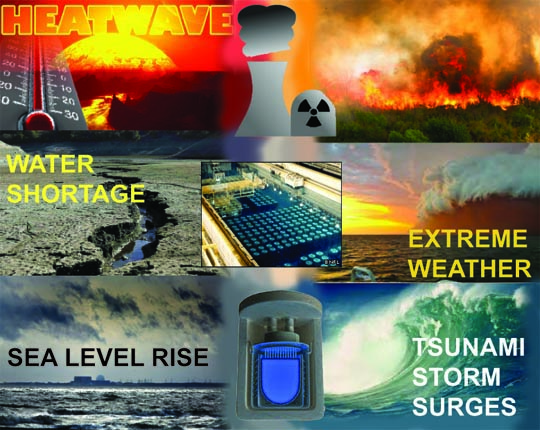
……… Because of the huge volume of deadly poisons that the nuclear fission process creates, nuclear reactors need an uninterrupted electricity supply to run the cooling systems that keep the reactors from melting down, a requirement that may be increasingly difficult to guarantee in a world of climate-fueled megastorms and other disasters.
The ongoing accident at the Fukushima Daiichi plant in Japan following the 9.0 earthquake and tsunami in March 2011 demonstrates the vulnerability of nuclear power plants to such disasters.
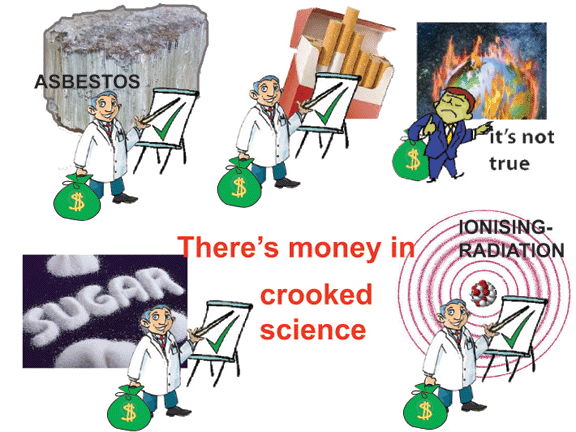 Nuclear boosters have been remarkably successful in ignoring and erasing the health effects of radiation exposure, enabling them to downplay the impacts of serious accidents. In truth, reactor meltdowns, depending on where they occur, can kill and injure enormous numbers of people and contaminate the air, water, land and food supply over thousands of miles with radiation. A 1982 study by the Sandia National Laboratory, one of the labs run by the U.S. Department of Energy, calculated deaths and injuries within a year of a core meltdown and subsequent cancer deaths at 76 different nuclear power plant sites, many of which were only proposed at that time. According to this study, the Salem nuclear plant outside Philadelphia could kill 100,000 people within a year, result in 40,000 subsequent cancer deaths and give another 70,000-75,000 people a range of radiation-related injuries. A 1997 report by Brookhaven National Laboratory on the potential consequences of a spent fuel accident also forecasted large numbers of fatalities.
Fission 101
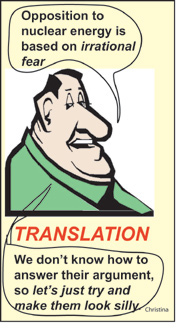 The risks of radiation exposure are downplayed and easily dismissed as “irrational fear” because the physics and chemistry of the fission process and the radioactive elements it produces are complex and not understood by the general public and also because, except in cases of acute radiation poisoning, radiation is invisible.
Radioactive fission products are “variant forms of the ordinary chemicals which are the building blocks of all material and living things,” explains Dr. Rosalie Bertell in her book, No Immediate Danger: Prognosis for a Radioactive Earth. The difference is that stable, non-radioactive atoms have an equal number of protons and electrons.
Nuclear fission creates an imbalance between protons and electrons, producing enormous quantities of hundreds of different radioactive elements — the high-level waste and activation products — all of which seek to return to a stable state. These unstable atoms become stable by knocking out the extra particles fission created, a process she says takes hundreds of thousands of years.
“Every such release of energy is an explosion on the microscopic level,” Bertell says. Radiation exposure is particularly damaging to the structure of cells, which is why it is necessary to keep these radioactive elements, known as radionuclides or radioisotopes, out of the bodies of humans, other living beings and the environment.
 As climate models have long predicted, our warming world is now experiencing much larger and stronger storms with significantly more rainfall in the Earth’s wetter areas and more sustained and severe drought and wildfires in the drier regions. In 2019, the hottest June on record triggered an unprecedented fire season in the Arctic, with over 100 intense fires. The summer of 2019 also saw 55 billion tons of water melt off Greenland’s ice sheet in just five days, a rate scientists hadn’t expected for 50 years.
A month before the massive ice loss in Greenland, scientists predicted sea levels could rise 6.5 feet by the end of the century, submerging nearly 700,000 square miles of land.
Most nuclear power plants are located beside rivers, lakes, dams or oceans because they need a continuous source of water to cool the reactors. In August 2018, Ensia reported that at least 100 nuclear power plants built a few meters above sea level in the U.S., Europe and Asia would likely experience flooding due to sea level rise and storm surges.
Though nuclear reactors vary in generating capacity, 1,000 megawatts is common. A reactor of that size contains 100 metric tons of enriched uranium fuel, roughly a third of which needs to be replaced with fresh fuel each year. According to radioactive waste expert Dr. Marvin Resnikoff, the spent fuel, also known as high-level waste, becomes 2.5 million times more radioactive after undergoing nuclear fission in the reactor core.
 In a May 2011 report, Institute for Policy Studies (IPS) senior scholar Robert Alvarez, a top official at the U.S. Department of Energy from 1993 to 1999, described the danger of high-level waste this way: “Spent fuel rods give off about 1 million rems (10,000 sieverts) of radiation per hour at a distance of one foot — enough radiation to kill people in a matter of seconds.”
The intense radioactivity the fission process creates is why reactor cores are surrounded by five-feet thick reinforced concrete containment structures and spent fuel must be shielded by at least 20 feet of water in pools for several years after it leaves the reactor.
As of September 2019, 444 nuclear reactors are operating in the world, with 54 under construction, 111 planned and 330 more proposed.https://truthout.org/articles/can-nuclear-powers-deadly-waste-be-contained-in-a-warming-world/?eType=EmailBlastContent&eId=a5fbaf3b-857d-46f7-9571-6774775ad709
Leaders of world’s largest emitting economies do not have real plans to meet goal of net zero emissions
The UN asked for climate plans. Major economies failed to answer Climate Change News, 24/09/2019, Delivering on a goal of net zero emissions is a ‘daunting’, ‘civilisational’ task, which a summit on Monday showed leaders do not have plans to meet, By Chloé Farand
World leaders were asked to come to the UN with concrete plans to cut emissions to net zero.
But on Monday, the presidents and prime ministers of the world’s largest emitting economies stumbled. Signalling just how difficult the work of removing CO2 will be compared to setting targets.
The tougher 1.5C goal of the Paris Agreement, backed by UN chief António Guterres and the majority of the world’s nations, requires achieving net zero global emissions by 2050.
Guterres asked leaders to come to UN headquarters in New York and tell the world how they would meet that goal.
A coalition of 77 smaller countries said they were committed to achieve net zero emissions by 2050 and 70 countries expressed their intention to set a more ambitious climate plan next year, evidence of “a boost of momentum and ambition,” Guterres said in his closing remarks.
While there were “inspiring signs of progress”, with “the private sector and subnational actors moving faster than national governments”, “most of the major economies fell woefully short” of enhancing their ambition, said Andrew Steer, president and CEO of the World Resources Institute.
“Much more it still needed to reach carbon neutrality by 2050,” Guterres warned.
The “how” of the question, which requires countries to integrate climate action into economy-wide policies, was left unanswered. Fully decarbonising the world economy is a gargantuan task, even for the world’s richest countries.
The path to net zero emissions “is something we are just discovering,” former French climate ambassador and CEO of the European Climate Foundation Laurence Tubiana told CHN. But the top levels of government are not yet engaged.
“I haven’t met any leaders who know… how to get there. Most [countries] haven’t started really seriously” and most leaders “don’t have a clue” how they will meet a 1.5C compatible target.
According to Elina Bardram, head of unit for climate action at the EU Commission, while “numbers and slogans are very easy to go by but the hard work of actually implementing is what drives the process forward”.
Both the UK and France, which have already legislated to become carbon neutral by 2050, have been warned by their climate advisors that without new and robust carbon-cutting measures, they won’t be on track to meet the 2050 goal……….https://www.climatechangenews.com/2019/09/24/un-asked-climate-plans-major-economies-failed-answer/
Nuclear power is on the skids: it’s really not going to help address climate change
some of the groups advocating for strong action to address climate change question whether more nuclear energy is necessary. Over the past 20 years, as nuclear power generation has declined, renewable sources have expanded by some 580 GW—more than the output of all the world’s nuclear power plants—to make up the difference.Globally, nuclear power is on the skids. Its contribution to electricity generation is in a free fall, dropping from a mid-1990s peak of about 18% of worldwide electricity capacity to 10% today, according to the International Energy Agency (IEA). The agency expects the downward spiral to continue, hitting 5% by 2040 unless governments around the world intervene…….
In the US, the European Union, and Russia, plants average 35 years or more in age, nearing their designed lifetimes of 40 years.
There is more potential for nuclear energy expansion in developing nations with state-controlled, centralized economies. China is the world’s third-largest nuclear generator, with 45 reactors capable of producing 46 GW of electricity. China also has the biggest plans for new power plants, with 11 at various stages of construction, the IEA says. India is building 7; Russia, 6; and the United Arab Emirates, 4, with a sprinkling of other new plants coming throughout the rest of the world. All will be state owned, the IEA says.
In the US, the Nuclear Regulatory Commission (NRC) has already renewed and extended the operating licenses from 40 to 60 years for 90 of the 98 operating reactors. The industry is now focusing on renewals to operate for up to 80 years. Similarly, other countries are considering extending existing reactor operations but for shorter periods, the IEA reports.
Aging nuclear plants
Underlying the debates about power plant costs and operating lifetimes are questions of safety and risks—real and perceived—of nuclear reactors and radioactivity. These concerns have made nuclear power unpopular in the US, Germany, Japan, and elsewhere.
The San Onofre Nuclear Generating Station (SONGS), resting on the US West Coast north of San Diego, provides an example of why. Seven million people live within 80 km of the plant.
A stormy relationship between SONGS and its surrounding community goes back decades. Most recently, the facility was completely shut down in 2013 after two nearly new steam generators failed. The replacements were part of a $670 million overhaul that was supposed to provide 20 more years of life for the plant.
Then, during decommissioning operations last year, contractor Holtec International mishandled and nearly dropped a 50-metric-ton spent fuel canister. Neither Holtec nor plant owner Southern California Edison reported the incident. Instead, the NRC and the public learned about the slipup from a whistle-blower speaking at a community meeting. As a result, the NRC froze cleanup operations that are just now restarting. ……..
some of the groups advocating for strong action to address climate change question whether more nuclear energy is necessary. Over the past 20 years, as nuclear power generation has declined, renewable sources have expanded by some 580 GW—more than the output of all the world’s nuclear power plants—to make up the difference. Consequently, the overall share of low-carbon electricity sources—hydropower, nuclear, solar, and wind—has stayed even at about 36%…….
energy researchers at the World Resources Institute and the UCS, speaking at a recent US congressional hearing, say renewable sources will continue to expand, and major increases in energy efficiency are on the horizon. In addition, the researchers expect that as more renewable energy facilities come on line, new technologies will be developed to address the challenge of variable output from renewable energy sources, such as with solar on an overcast day.
Overreliance on nuclear might in fact stall development and installation of technologies needed for a transition to a low-carbon future, Cleetus argues. Her modeling shows that capital investment needed for renewable energy development—building high-voltage power lines, advanced batteries and other storage systems, and of course, renewable resources themselves—could be funneled off to build and retrofit more nuclear power plants. And then there are those who question whether nuclear energy can even be called low carbon if greenhouse gas emissions are considered for the full energy cycle, including plant construction, uranium mining and enrichment, fuel processing, plant decommissioning, and radioactive waste deposition……. https://cen.acs.org/energy/nuclear-power/nuclear-power-help-save-us/97/i37
Nature is being exterminated. The Climate Strikes are just the beginning of our fight back.

This isn’t extinction, it’s extermination: the people killing nature know what they’re doing, The climate strike must be a beginning and not an end. Warming won’t be stopped by symbolism, Guardian, @Jeff_Sparrow, 21 Sep 2019 “………. an international rebellion led by the young against generations of betrayal. We know that, as far back as the late 50s, researchers for the oil industry understood the effects of carbon on the atmosphere but did nothing about it.
In 1988 George HW Bush promised on the campaign trail to fight climate change. “I am an environmentalist,” he declared. “Those who think we are powerless to do anything about the greenhouse effect are forgetting about the White House effect.”
There was, of course, no White House effect.
In 1997 the world’s leaders signed the Kyoto protocol, with Bill Clinton declaring “a commitment from our generation to act in the interests of future generations”. More emissions have been released since that agreement than in all of previous history.
How petty, how small, how childish do those politicians with the temerity to attack Greta Thunberg look! She speaks for science, idealism and hope; they embody an ignorance or cynicism so deep as to constitute depravity.
The ecological disaster that confronts us today extends way beyond climate. Some scientists speak of the “sixth extinction event” – but, as Justin McBrien argued, that phrase isn’t accurate.
We might less euphemistically discuss a “first extermination event”. Nature is not dying so much as being killed, by people who know perfectly well what they’re doing.
The need for protests could not be more urgent – and, at last, they’re happening. The global strike provides a perfect antidote to the despair so many of us have felt for so long.
There’s a nightmarishness to the isolated experience of climate change: a sense of paralysis and horror at a world sleepwalking into disaster. By coming together on the streets, we shake that off, and we grasp something of our collective strength.
In day-to-day life, there are few sections of society more powerless than schoolchildren. And yet, despite teachers and parents and politicians, they’ve spurred a movement that’s growing in almost every nation.
If they can do that, what else could be possible? What might the rest of us do, if we all act together?
Fairly obviously, the strike must be a beginning and not an end. This is not an issue where you can express your disapproval in a single rally and then go back to your daily life.
Atmospheric physics doesn’t care if we’re tired of marching or we feel that “done our bit”. Warming won’t be stopped by symbolism or fervent hopes: we need, as, the Intergovernmental Panel on Climate Change argues, “rapid, far-reaching and unprecedented changes in all aspects of society”.
That’s no small task, especially given the vested interests in the status quo. It would be foolish not to expect difficult times ahead……… https://www.theguardian.com/environment/commentisfree/2019/sep/20/this-isnt-extinction-its-extermination-the-people-killing-nature-know-what-theyre-doing?CMP=share_btn_tw
Surface melting causes Antarctic glaciers to slip faster towards the ocean
Direct link between surface melting and short bursts of glacier acceleration in Antarctica
- Date:
- September 20, 2019
- Source:
- University of Sheffield
- Summary:
- Study shows for the first time a direct link between surface melting and short bursts of glacier acceleration in Antarctica. During these events, Antarctic Peninsula glaciers move up to 100% faster than average. Scientists call for these findings to be accounted for in sea level rise predictions…….
https://www.sciencedaily.com/releases/2019/09/190920111355.htm
Climate Emergency – ‘We’re losing the race’
‘We’re losing the race’: UN secretary general calls climate change an ’emergency’
António Guterres cites ‘fantastic leadership’ of young activists and is counting on public pressure to compel governments to honor the 2015 Paris Agreement Guardian Mark Hertsgaard, @markhertsgaard 18 Sep 2019 The UN secretary general says that he is counting on public pressure to compel governments to take much stronger action against what he calls the climate change “emergency”.
“Governments always follow public opinion, everywhere in the world, sooner or later,” António Guterres, said on Tuesday in an interview with Covering Climate Now, a global collaboration of more than 250 news outlets, led by Columbia Journalism Review and the Nation, in partnership with the Guardian. Guterres, a former prime minister of Portugal, added: “And so … we need to keep telling the truth to people and be confident that the political system, especially democratic political systems, will in the end deliver.”
Guterres refused to comment on Donald Trump and the Trump administration’s hostility to climate action, but a CBS News poll released on 15 September found that 69% of Americans want the next president to take action, while 53% say such action is needed “right now”. Guterres said that “it would be much better” if the US was “strongly committed to climate action”, just as it would be better if Asian countries [notably, China and Japan] stopped exporting coal plants. Until then, he said, “what I want is to have the whole society putting pressure on governments to understand they need to run faster. Because we are losing the race.”
With five days remaining before the UN climate action summit on 23 September, the secretary general cited the “fantastic leadership” of young activists as a leading example of how civil society can pressure governments to honor the 2015 Paris Agreement to limit temperature rise to “well below” 2C and preferably to 1.5C. Recent election results across Europe – where green parties gained significant public backing – also left Guterres optimistic that at next Monday’s summit the European Union will announce that it promises to be “carbon neutral” by 2050, as the Paris Agreement mandates……… https://www.theguardian.com/environment/2019/sep/18/un-secretary-general-climate-crisis-trump
The ozone layer is repairing – international co-operation pays off
|
BY MAANI TRUU, 17 Sept 19, The world’s ozone layer is on track to be completely healed by the 2060s, according to modelling by the UN’s environmental agency (UNEP).
In the past 19-years, parts of the ozone layer have recovered at a rate of one to three per cent every ten years, UNEP has found. If this continues, the Northern Hemisphere’s ozone layer is set to heal completely by the 2030s, the Southern Hemisphere by the 2050s, and the polar regions in the following decade. As we rightly focus our energies on tackling climate change, we must be careful not to neglect the ozone layer and stay alert to the threat posed by the illegal use of ozone-depleting gases,” UN Secretary-General António Guterres said in a statement on Monday. “The recent detection of emissions of one such gas, CFC-11, reminds us that we need continued monitoring and reporting systems, and improved regulations and enforcement.” The ozone layer, made up of three types of oxygen atoms, is located approximately 15 kilometres above the earth and helps to protect the planet from ultraviolet rays that cause skin cancer, crop damage, eye cataracts and other issues. But since the late 1970s, the ozone layer had been consistently thinning due to the overuse of chemicals called chlorofluorocarbons, reaching a crisis point in the 1990s when about 10 per cent of the layer had been eroded. n 1987, UN members signed a treaty – known as the Montreal Protocol – aimed at phasing out ozone-depleting substances and developed replacements. According to the UNEP, the Montreal Protocol has successfully led to the removal of 99 per cent of chlorofluorocarbons, which previously existed in refrigerators, air-conditioners and other consumer products. “The Montreal Protocol is both an inspirational example of how humanity is capable of cooperating to address a global challenge and a key instrument for tackling today’s climate crisis,” Mr Guterres said. “Under this international treaty, nations have worked for 32 years to slash the use of ozone-depleting chemicals, used largely by the cooling industry. As a result, the ozone layer that shields us from the sun’s harmful ultraviolet radiation is healing.” The ozone layer is also instrumental in curbing the effects of climate change, with the barrier stopping approximately 135 billion tonnes of carbon dioxide emissions from entering the atmosphere between 1990 to 2010, UNEP said. Earlier this year, China came under fire for allegedly releasing large quantities of banned chemical Chlorofluorocarbon-11 (CFC-11) into the atmosphere, in violation of the UN treaty. |
|
|

New York City supports students’ climate protest
More than one million New York students allowed to skip school for climate protest, Public school students in New York are allowed to skip class to join the youth climate strikes.
SBS NEWS, BY ANNE BARNARD 18 Sep 19 When New York City announced that public school students could skip classes without penalties to join the youth climate strikes planned around the world on Friday, you could almost hear a sigh of relief.Before the announcement, the protests, to be held three days ahead of the United Nations Climate Action Summit, had thrown a new complication into the usual back-to-school chaos: With the protests framed as a cry to protect their futures from climate disaster, should students heed the call?
Parents had wondered how to word emails to principals requesting excused absences. Teachers had been wondering how to react. Some students had been vowing to protest no matter what, but others had worried about possible repercussions.
Most of all, the decision last week by the nation’s largest school district buoyed national protest organisers, who are hoping that the demonstrations will be the largest on climate in US history, with at least 800 planned across the 50 states. They expressed hope that other districts around the country would follow suit.
“Holy smokes, this thing could get HUGE,” Jamie Henn, a founder of the climate action organisation 350.org, said on Twitter after the decision was announced by New York City’s Department of Education………
Demonstrators as young as nine had already turned up to greet the 16-year-old Swedish climate activist Greta Thunberg when she arrived last month by an emissions-free yacht in New York Harbour. Greta has inspired Friday student protests in at least 100 countries.
Larger crowds, mostly of high school students, have demonstrated with her on two recent Fridays at the United Nations………
Some 600 medical professionals across the country have also signed a virtual “doctor’s note” encouraging teachers to excuse students on the grounds that climate change is dangerous to their and others’ health. HTTPS://WWW.SBS.COM.AU/NEWS/MORE-THAN-ONE-MILLION-NEW-YORK-STUDENTS-ALLOWED-TO-SKIP-SCHOOL-FOR-CLIMATE-PROTEST
1 This Month
26 September – International Day for the Total Elimination of Nuclear Weapons





PLEASE OPPOSE HR 8255 AND S.3639 – bills would accelerate satellite deployment, with no environmental review or safeguards – https://ncstd5li.quorum.us/campaign/169331/
To see nuclear-related stories in greater depth and intensity – go to https://nuclearinformation.wordpress.com
-
Archives
- September 2026 (281)
- August 2026 (330)
- July 2026 (355)
- June 2026 (287)
- May 2026 (306)
- April 2026 (356)
- March 2026 (251)
- February 2026 (267)
- January 2026 (308)
- December 2025 (358)
- November 2025 (359)
- October 2025 (375)
-
Categories
- 1
- 1 NUCLEAR ISSUES
- business and costs
- climate change
- culture and arts
- ENERGY
- environment
- health
- history
- indigenous issues
- Legal
- marketing of nuclear
- media
- opposition to nuclear
- PERSONAL STORIES
- politics
- politics international
- Religion and ethics
- safety
- secrets,lies and civil liberties
- spinbuster
- technology
- Uranium
- wastes
- weapons and war
- Women
- 2 WORLD
- ACTION
- AFRICA
- Atrocities
- AUSTRALIA
- Christina's notes
- Christina's themes
- culture and arts
- Events
- Fuk 2022
- Fuk 2023
- Fukushima 2017
- Fukushima 2018
- fukushima 2019
- Fukushima 2020
- Fukushima 2021
- general
- global warming
- Humour (God we need it)
- Nuclear
- RARE EARTHS
- Reference
- resources – print
- Resources -audiovicual
- Weekly Newsletter
- World
- World Nuclear
- YouTube
-
RSS
Entries RSS
Comments RSS

