Extinction Rebellion: One Year On
Extinction Rebellion: One Year On, As their one-year anniversary approaches, Felicity Graham reviews the successes and failures of Extinction Rebellion. Cherwell, By Felicity Victoria Graham, 27th October 2019
For the climate’s sake, the $multibillion nuclear industry bailouts must stop
|
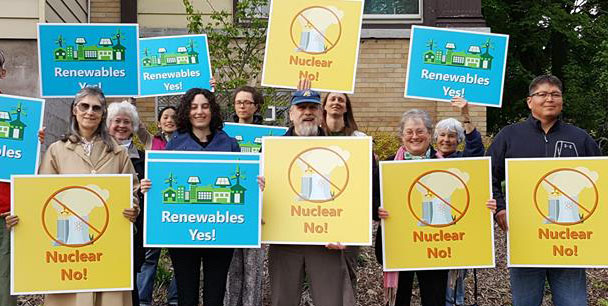
Nuclear Industry’s $23 Billion Bailout Request Shows Why It Should Have ‘No Role to Play’ in Solving Climate Crisis: Study “For the sake of taxpayers, electricity consumers and the climate, Congress must stop this endless nuclear boondoggle.” by Eoin Higgins, staff writer A proposed bailout of the U.S. nuclear power industry that could cost taxpayers $23 billion over the next 10 years is a perfect example of why the climate crisis needs solutions that focus on renewable resources, green advocacy group Friends of the Earth said Thursday.”The dying nuclear industry wants a massive bailout at the expense of taxpayers and the climate,” the group’s senior policy analyst Lukas Ross said in a statement. Friends of the Earth commissioned a study (pdf) on the Nuclear Powers America Act of 2019, a nuclear industry-backed bill making its way through Congress that would continue subsidies for the industry for decades. Vermont Law School fellow Mark Cooper, who authored the study, wrote that the consequences of continuing tax credits for the industry would have the effect of making other potential technologies unviable for reducing emissions. “Subsidizing nuclear keeps reactors on-line and crowds out the alternatives,” said Cooper. “It slows the transition to an electrical grid based on low-carbon distributed resources.” While renewables are a major part of the push from climate activists and advocates to solve the climate crisis, using nuclear power to reduce emissions has been floated as a potential piece of the Green New Deal. The technology was notably left out of the legislation by Rep. Alexandria Ocasio-Cortez (D-N.Y.) and Sen. Ed Markey (D-Mass.), a decision that Popular Mechanics writer Avery Thompson hailed in February as a “great idea.” “Reactors are gigantic beasts, and sustaining a nuclear reaction while drawing power from it requires an absurd level of engineering,” wrote Thompson. “Reactors are expensive, bulky, and complicated, to say nothing of the waste products they produce or the fear of a catastrophe like Chernobyl or Fukushima.” The proposed nuclear industry bailout, warns Cooper in the new report, is an attempt to reverse economic trends that have never been favorable to nuclear power standing by itself. The industry, Cooper said, hasn’t earned the right to be considered as a realistic solution to the climate crisis or U.S. energy needs. “Nuclear has failed for over 50 years to control its costs, even with help from massive subsidies, and alternatives are available to reduce greenhouse gas emissions at a much lower cost,” wrote Cooper. Time is of the essence, said Friends of the Earth’s Ross. “With just a decade left to prevent the worst of the climate crisis, we shouldn’t dump more money into ancient nuclear reactors at the expense of cleaner and much cheaper renewables,” he said. |
|
Desertification and Drought – Sahara

|
COMBATING DESERTIFICATION AND DROUGHT
Displaced by the Desert: An expanding Sahara leaves Broken Families and Violence in its Wake, IPS News By Issa Sikiti da Silva 25 Oct 19, “……… In 2012, various groups of Tuareg rebels grouped together to form and administer a new northern state called Azawad. The civil strife that resulted drove many from their homes, with communities often fleeing with their livestock, only to compete for scarce natural resources in vulnerable host communities, according to the United Nations.
After the security situation began to improve in 2013, many returned home to rebuild their lives and livelihoods. But soon it was the turn of the expanding Sahara Desert, drought and land degradation that became the next driver of their displacement. “As time went by, the land became useless and we found ourselves having no more land to work on. Nothing would come out that could feed us, and our livestock kept dying due the lack of water and grass to eat, ” Abdoulaye recalls. “Drought across the Sahel region, followed by conflict in northern Mali, caused a major slump in the country’s agricultural production, reducing household assets and leaving many of Mali’s poor even more vulnerable,” FAO says. “We used to move up and down with our livestock, looking for water and grass, but most of the times we found none. Life was unliveable. The Sahara is coming down, very fast,” Abdoulaye says emotionally……….. Threatened with creeping desertification …The U.N. says nearly 98 percent of Mali is threatened with creeping desertification, as a result of nature and human activity. Besides, the Sahara Desert keeps expanding southward at a rate of 48 km a year, further degrading the land and eradicating the already scarce livelihoods of populations, Reuters reported. The Sahara, an area of 3.5 million square miles, is the largest ‘hot’ desert in the world and home to some 70 species of mammals, 90 species of resident birds and 100 species of reptiles, according to DesertUSA. And it is expanding, its size is registered at 10 percent larger than a century ago, LiveScience reported. The Sahel, the area between The Sahara in the north and the Sudanian Savanna in the south, is the region where temperatures are rising faster than anywhere else on Earth. The cost of land degradation is currently estimated at about $490bn per year, much higher than the cost of action to prevent it, according to UNCCD recent studies on the economics of land desertification, land degradation and drought. Roughly 40 percent of the world’s degraded land is found in areas with the highest incidence of poverty and directly impacts the health and livelihoods of an estimated 1.5 billion people, according to the U.N. In a country where six million tonnes of wood is used per year, reports say Malians are mercilessly smashing their already-fragile landscape, bringing down 4,000 square kilometres of tree cover each year in search for timber and fuel……….. What is being done?Projects such as the U.N. Convention to Combat Desertification’s Land Degradation Neutrality project aimed at preventing and/or reversing land degradation are some of the interventions to stop the growing desert.
Everyone, including terrorists are equal in the face of the expanding SaharaBut there remain gaps and many in Mali still remain affected. Community leader Hassan Badarou spent several years teaching Islam in rural Mali and Niger. He tells IPS Mali has a very complex situation. “It is not easy to live in these areas. People there face double threats. It is double stress to flee from both armed conflict and desertification. And such people need to be welcomed and assisted, and not be seen as a threat to locals livelihoods……….. http://www.ipsnews.net/2019/10/displaced-desert-expanding-sahara-leaves-broken-families-violence-wake/?utm_source=English+-+IPS+Weekly&utm_campaign=2391e81e36-EMAIL_CAMPAIGN_2019_10_24_01_01&utm_medium=email&utm_term=0_eab01a56ae-2391 |
|
No such thing as a zero- or close to zero-emission nuclear power plant.
 David Lowry, Guardian 21st Oct 2019: in the analysis
 of MPs’ voting record on bills to combat climate change (Tories five times more likely than other MPs to vote against bills to tackle climate crisis, 12 October), both Jeremy Corbyn and Caroline Lucas are marked as 92% supportive on the basis they voted to
“keep nuclear power subsidies relatively low”.
Proposed Solution to Global Warming, Air Pollution, and Energy Security, in
his forthcoming book, 100% Clean, Renewable Energy and Storage for
Everything, Jacobson argues: “There is no such thing as a zero- or close to
zero-emission nuclear power plant. Even existing plants emit due to the
continuous mining and refining of uranium needed for the plant. Overall
emissions from new nuclear are 78 to 178g of CO2/kWH, not close to 0.”
https://www.theguardian.com/environment/2019/oct/21/tory-boasts-on-climate-action-are-full-of-hot-air
Climate change: Permafrost is now becoming a carbon emitter
|
Climate change has turned permafrost into a carbon emitter, Tundra plants can’t absorb enough carbon in summer to make up for carbon released in winter, CBC, Bob Weber · The Canadian Press Oct 22, 2019 Research has found Arctic soil has warmed to the point where it releases more carbon in winter than northern plants can absorb during the summer.
The finding means the extensive belt of tundra around the globe — a vast reserve of carbon that dwarfs what’s held in the atmosphere — is becoming a source of greenhouse gas emissions responsible for climate change. “There’s a net loss,” said Dalhousie University’s Jocelyn Egan, one of 75 co-authors of a paper published in Nature Climate Change. “In a given year, more carbon is being lost than what is being taken in. It is happening already.” The research by scientists in 12 countries and from dozens of institutions is the latest warning that northern natural systems that once reliably kept carbon out of the atmosphere are starting to release it………. Emissions speeding upWhat’s more, the pace of the emissions is likely to increase. Under a business-as-usual scenario, emissions from northern soil would be likely to release 41 per cent more carbon by the end of the century. But the Arctic is already warming at three times the pace of the rest of the globe. Even if significant mitigation efforts are made, those emissions will increase by 17 per cent, said the report. Egan notes the research didn’t measure methane, a greenhouse gas about 30 times more potent than carbon dioxide that is also released from soil. Her findings echo previous studies. Last summer, research suggested that larger, hotter wildfires are turning boreal forests into carbon sources. Another paper found that instead of melting slowly and steadily, permafrost is subject to sudden collapses that speed up the rate of carbon release. Mitigation won’t stop the problem any more, said Egan, but it will help.https://www.cbc.ca/news/technology/permafrost-climate-change-1.5330144 |
|
|
The “water footprint”of solar and wind power is far less than for coal and nuclear
 Solar, wind power can alleviate water stress https://www.businesstimes.com.sg/energy-commodities/solar-wind-power-can-alleviate-water-stress, MON, OCT 21, 2019 – Solar, wind power can alleviate water stress https://www.businesstimes.com.sg/energy-commodities/solar-wind-power-can-alleviate-water-stress, MON, OCT 21, 2019 –
SOLAR and wind power could be in for another boost once policy makers begin accounting for the vast volumes of water needed to keep the lights on.
That’s the conclusion of research published this week by the European Union’s Joint Research Centre, which is urging the bloc’s leaders to pay closer attention to the amount of water used by traditional coal, natural gas and nuclear power plants. It takes more than 1,300 litres of water – enough to fill four bathtubs – to generate the electricity each European resident uses each day. “For the EU, to decarbonise and increase the share of renewables of its energy supply, it needs to formulate policies that take the water use of energy sources into account,” wrote water and energy researchers led by Davy Vanham. Solar, wind, geothermal and run-of-river hydropower account for a “small fraction” of water used compared with what is consumed by biofuels and traditional thermal plants, they said. The findings focus attention on the rising competition for water resources among households, industry and agriculture, exacerbated by a string of heatwaves and lower rainfall levels that have prompted shutdowns at power plants across the continent during periods of peak strain. Some of those incidents have been traced back to climate change. The issue has been replicated in the US, India and China, underscoring how policies that touch on water, energy and food supplies tend to have impacts in all three spheres. Coal, oil and nuclear plants account for about 30 per cent of the water needed to produce the electricity that Europeans consume. That compares with a 1.7 per cent share for all renewables combined, including solar, wind, geothermal and hydropower combined. “The choice of which renewables to promote is essential to alleviate water stress and maintain ecosystems and their services,” the peer-reviewed paper said. “Policies on future energy investments therefore need to consider which renewables have low unit water footprints.” Thermal power plants need water to cool reactions and use the steam to turn giant turbines for electricity. Solar panels and wind turbines can turn sunshine and air currents directly into electricity without producing the residual heat. The researchers looked at energy consumption and generation data from the 28 EU nations, overlayed with information on climate change and water resources. They pinpointed areas in France, Poland and Spain where big power plants rely on large volumes of water. “Recent summer droughts and heatwaves, such as in 2003, 2006, 2015 and 2018, which will only become more frequent due to climate change, have already led to water being a limiting resource for energy production throughout the EU,” they wrote. BLOOMBERG |
|
|
David Attenborough says humans have made ‘tragic, desperate mess’ of planet
David Attenborough says humans have made ‘tragic, desperate mess’ of planet, Broadcaster urges people to look after natural world as he launches new series with conservation ‘at its heart’ , Independent UK, Chris Baynes 21 Oct 19, Humanity has made a “tragic, desperate mess” of the planet, Sir David Attenborough has said.
The veteran broadcaster urged people to “look after the natural world” and waste nothing, as he prepared for his latest series to air this week.
Seven Worlds, One Planet, breaks with the tradition of previous BBC Natural History Unit programmes by putting a conservation message “at its heart”, instead of being tagged on at the end of each episode.
The series, which has been four years in the making, features wildlife firsts and has already been bought by broadcasters around the world.
Producers took drones over “volcanoes, waterfalls, icebergs and underground into caves” to shoot heart-wrenching “animal dramas” in all seven continents, the BBC said.
Dramatic scenes include a lone, grey-headed albatross chick in Antarctica being blown off its nest as a result of increasingly intense storms in the region.
Speaking at the launch, Sir David, who presents the programme, said: “We are now universal, our influence is everywhere. We have it in our hands, and we made a tragic, desperate mess of it so far. But, at last, nations are coming together and recognising that we all live on the same planet … and we are dependent on it for every mouthful of food we eat and every breath of air we take.”
Asked what we can do to save the planet, Sir David, 93, said: “The best motto … is not to waste things.
“Don’t waste electricity, don’t waste paper, don’t waste food – live the way you want to live, but just don’t waste.”
The broadcaster added: “Look after the natural world, the animals in it and the plants in it too. This is their planet as well as ours. Don’t waste.”
The seven-part series will reveal “new species and behaviours,” producers said……..
Antarctica, North America, South America, Europe, Africa, Asia and Australia will feature over different episodes in the seven-part series.
Seven Worlds, One Planet begins on Sunday 27 October at 6.15pm on BBC One. https://www.independent.co.uk/news/media/tv-radio/david-attenborough-new-series-seven-worlds-one-planet-climate-change-a9161866.html?fbclid=IwAR1hZAJJwhms9zcQNCCcn-PP4-D3vAjhHLZxHL9lFGUTmL1I1IWN5q3u4KE
Jane Fonda arrested with Sam Waterston in climate change protest
“We can do this!” Waterston, 78, said during the protest. “We need something to push for that’s as big as the problem.”
“This is an ongoing action to draw attention and a sense of urgency to the climate crisis,” Fonda said before her arrest. “Make no mistake, change is coming, whether we like it or not. Change is coming by disaster, or change is coming by design.”
The actors were seen with zip ties around their wrists by police following a demonstration in Washington, D.C, in front of the Library of Congress.
“We can do this!” Waterston, 78, said during the protest. “We need something to push for that’s as big as the problem.”
“This is an ongoing action to draw attention and a sense of urgency to the climate crisis,” Fonda said before her arrest. “Make no mistake, change is coming, whether we like it or not. Change is coming by disaster, or change is coming by design.”
The actors were seen with zip ties around their wrists by police following a demonstration in Washington, D.C, in front of the Library of Congress. …… https://www.msn.com/en-au/news/world/jane-fonda-arrested-with-sam-waterston-in-climate-change-protest/ar-AAIZPb1?ocid=spartandhp
Climate and nuclear threats join in Japan’s multibillion-dollar typhoon disaster.
|
………….As the core of the storm pulled away from Tokyo Sunday, it dumped heavy rains across Toshigi as well as Fukushima Prefecture. Floodwaters there have raised concerns about radioactive contamination following the 2011 Fukushima nuclear disaster.
Typhoon Hagibis will go down in Japanese history as a multibillion-dollar disaster. The storm’s widespread impacts and high death toll are unusual for Japan, since the country is one of the best-prepared in the world for natural disasters
Climate studies suggest that the Japanese Archipelago could see more frequent and stronger typhoons in the future, due in large part to warming seas as a result of human-caused global warming. There is evidence showing that tropical cyclones in the Northwest Pacific Ocean Basin are reaching their maximum intensities further north than they used to, a trend some scientists attribute in part to climate change. This could send more intense storms into areas that typically see weaker storms, such as Honshu and other parts of northern and northeastern Japan.
One trend that is especially clear is that damage costs from typhoons in Japan are escalating, with three of the top 10 most expensive Japanese typhoons since 1950 occurring in the past 2 years alone. Typhoon Faxai, which affected Tokyo in early September. Typhoon Hagibis is extremely likely to increase this number to four. https://www.theage.com.au/world/asia/why-typhoon-hagibis-packed-such-a-deadly-devastating-punch-in-japan-20191015-p530o7.html
|
|
|

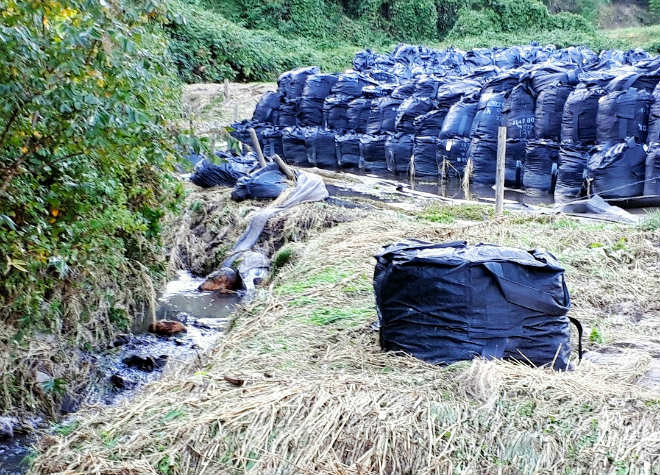
Bags of debris from Fukushima disaster swept away in typhoon
|
Bags of debris from Fukushima disaster swept away in typhoon http://www.asahi.com/ajw/articles/AJ201910140036.htmlBy TARO KOTEGAWA/ Staff Writer, October 14, 2019 Flexible bulk bags containing waste produced from decontamination work around the Fukushima No. 1 nuclear power plant were swept away in flooding during Typhoon No. 19 in Tamura, Fukushima Prefecture. (Hideyuki Miura) TAMURA, Fukushima Prefecture–Bulk bags filled with greenery collected during decontamination efforts after the nuclear disaster at the Fukushima No. 1 nuclear power plant were swept into a river during Typhoon No. 19 on Oct. 12. According to the Tamura city government, the bags were among 2,667 that have been stored temporarily at a site in the Miyakoji-machi district here. The facility was flooded after heavy rains brought by the typhoon, and the water carried an unknown number of the bags to a river about 100 meters away. A city government official received a phone call at around 9:20 p.m. on Oct. 12 from a nearby civil engineering firm, saying six of the bulk bags had been recovered from the river. Each of the bulk bags was 1 cubic meter in size. No sheets had been placed over the bags as a precaution against the rain and wind from the typhoon. A city official said consultations will be held with the Environment Ministry to determine possible effects on the environment. The decontamination effort involved removing debris, such as soil, leaves and plants, containing radioactive substances released after the 2011 triple meltdown at the Fukushima No. 1 plant. |
|
Climate Scientists urge protestors to keep on going with Extinction Rebellion
|
Hundreds of climate scientists call on protesters to step up efforts to save the planet, https://thenewdaily.com.au/news/world/2019/10/13/climate-scientists-call-for-more-protests/ More than 300 scientists have endorsed a civil disobedience campaign aimed at forcing governments to take rapid action to tackle climate change, warning that failure could inflict “incalculable human suffering”.In a joint declaration made in London, climate scientists, physicists, biologists, engineers and others from at least 20 countries, including Australia, broke with the caution traditionally associated with academia to side with peaceful protesters from The Netherlands to Australia. Wearing white laboratory coats to symbolise their research credentials, a group of about 20 of the signatories gathered on Saturday to read out the text outside London’s Science Museum. “We believe that the continued governmental inaction over the climate and ecological crisis now justifies peaceful and non-violent protest and direct action, even if this goes beyond the bounds of the current law,” said Emily Grossman, a science broadcaster with a PhD in molecular biology, who read the declaration on behalf of the group. “We therefore support those who are rising up peacefully against governments around the world that are failing to act proportionately to the scale of the crisis,” she said. The declaration was co-ordinated by a group of scientists who support Extinction Rebellion, a civil disobedience campaign that formed in Britain a year ago and has since sparked offshoots in dozens of countries. The group launched a fresh wave of international actions on Monday, aiming to get governments to address an ecological crisis caused by climate change and accelerating extinctions of plant and animal species. A total of 1,307 volunteers had since been arrested at various protests in London by Saturday, Extinction Rebellion said. A further 1,463 volunteers have been arrested in the past week in another 20 cities, including Brussels, Amsterdam, New York, Sydney and Toronto, according to the group’s tally. More protests in this latest wave are due in the coming days. While many scientists have tended to shun overt political debate, preferring to confine their public pronouncements within the parameters of their research, the academics backing Extinction Rebellion say they feel compelled to speak out. “The urgency of the crisis is now so great that many scientists feel, as humans, that we now have a moral duty to take radical action,” Grossman told Reuters. Other signatories included several scientists who contributed to the UN-backed Intergovernmental Panel on Climate Change, which has produced a series of reports underscoring the urgency of dramatic cuts in carbon emissions. Extinction Rebellion has electrified supporters who said they had despaired at the failure of conventional campaigning to spur action. But its success in paralysing parts of London has also angered critics who complained the movement has inconvenienced thousands of people and diverted police resources. The group said more than half the signatories of the declaration are experts in the fields of climate science and the loss of wildlife. Although British universities and institutes were well represented, signatories also worked in countries including Australia, the United States, Spain and France. |
The impossibility of nuclear power solving climate change
|
Eric Peters, 14 Oct 19, “…………According to a very interesting analysis by professor Roger Pielke of the University of Colorado published recently by Forbes, [to reach zero carbon emissions] it would entail putting at least one new nuclear reactor online every week until 2030 or 2050 (the number of new reactors needed to get to “net zero” carbon-dioxide emissions depending on how soon we want to get there). Leaving aside the regulatory hurdles involved in permitting a single new plant — and the money that would be have to be found to finance the construction of scores of new plants.
Pielke is a mathematician who has done the math, and the numbers are daunting. ……
Pielke, who is also a climate scientist who worked at the National Center for Atmospheric Research, says the only way to replace that much fossil fuel energy with “carbon-neutral” energy using actually feasible technology would be to use nuclear energy. A lot of it. In his Forbes article, Pielke explains that one nuclear power plant like the Turkey Point reactor complex in Homestead, Florida, generates the equivalent of about 1 million metric tons (1 mteo) of fossil-fueled energy each year. That’s a lot of juice but it hardly puts a dent in the problem………..
Pielke cites International Energy Projections about world energy demand tomorrow. The IEA estimates that “global energy consumption will increase by at least 1.25 percent per year to 2040.”
This will mean a lot more mteos and reactors (or some other carbon-neutral way) to produce them.
“To achieve net-zero carbon dioxide emissions by 2050, the world would need to deploy three Turkey Point nuclear plants’ worth of carbon-free energy every two days, starting tomorrow and continuing to 2050,” Pielke writes. “And at the same time,” he adds, the fossil-fueled equivalent of one Turkey Point plant would have to be “decommissioned every day, starting tomorrow and continuing to 2050.” This isn’t just a tall order. It’s an impossible one……. https://www.nwitimes.com/opinion/columnists/guest-commentary/guest-commentary-two-nuclear-power-plants-a-week/article_a206346c-d2f9-55d7-b935-6782b4001cd5.html |
|

Marshall Islands, victim of nuclear testing, now declares a Climate Emergency
 Marshall Islands, low-lying US ally and nuclear testing site, declares a climate crisis https://www.heraldmailmedia.com/news/nation/marshall-islands-low-lying-us-ally-and-nuclear-testing-site/article_4b37cc0d-040d-5b2a-b83e-1df6d71dfb74.html, By Susanne Rust Los Angeles Times (TNS), Oct 11, 2019
-
- The Marshall Islands, a low-lying chain of atolls and key U.S. ally in the Central Pacific, has declared a national climate crisis because of the mounting risk of sea-level rise, the nation’s president announced this week.
The nation’s parliament, the Nitijela, overwhelmingly supported a measure that calls upon the international community to step up its efforts to mitigate global warming and provide aid to nations unable to finance safeguards against rising seas.
“As one of only four low-lying coral atoll nations in the world, the failure of the international community to adequately respond to the global climate crisis of its own making holds particularly grave consequences,” wrote President Hilda Heine in a tweet Wednesday.
Low-lying coral atoll nations such as the Marshall Islands, Kiribati and Tuvalu in the Pacific and the Maldives in the Indian Ocean are particularly vulnerable to rising oceans, averaging just a few feet above sea level. There have already been episodes of “King Tide” flooding in the Marshall Islands, which consists of 29 coral atolls, located about 5,000 miles from Los Angeles and 2,000 from Hawaii.
A recent Intergovernmental Panel on Climate Change report warned that sea level could rise by 1 to 4 feet by 2100, potentially submerging many of these nations, and by 2050, making many uninhabitable.
The report echoes research sponsored by the Department of Defense, which found Kwajalein Atoll, where the U.S. leases a strategic military base, could become unlivable by 2030, if the Antarctic ice sheet were to melt. Mid-century inhabitability due to flooding, storm waves and ground water contamination by salt water was predicted in a more conservative model.
The resolution calls upon the Nitijela to “unite fully and unequivocally behind the science” and to recognize the rights of the Marshallese youth to grow up in a “climate safe future.”
It asks the international community to “consider additional ways to respond to and support the extreme vulnerability and special circumstances” unique to low-lying coral atoll islands, such as the Marshall Islands.
“Prolonged and unseasonal droughts are hitting us real hard, and saltwater is creeping into our freshwater lands,” said Heine last month at the United Nations Climate Action conference in New York. “We are on the very front line of climate change.”
The United States used the Marshall Islands as a nuclear testing ground during the Cold War, detonating 67 nuclear bombs on the nation between 1946 and 1958.
The U.S. is committing $10 million to the Pacific region for disaster resilience, weather forecasting and “to address environmental challenges,” said a U.S. State Department spokesperson Friday. “The United States recognizes that addressing environmental degradation and climate change is a priority in the Pacific — especially for the Marshall Islands — due to the threat posed by sea level rise and the region’s vulnerability to natural disasters.”
Google publicly decries climate change, privately donates to climate denialism
 Google and other companies were engaged in a “functional greenwashing” given the contradiction in their public pronouncements and private donations.
Revealed: Google made large contributions to climate change deniers https://www.theguardian.com/environment/2019/oct/11/google-contributions-climate-change-deniers
Firm’s public calls for climate action contrast with backing for conservative thinktanks. The obscure law that explains why Google backs climate deniers, Stephanie Kirchgaessner in Washington @skirchy Email 11 Oct 2019
Google has made “substantial” contributions to some of the most notorious climate deniers in Washington despite its insistence that it supports political action on the climate crisis.
Among hundreds of groups the company has listed on its website as beneficiaries of its political giving are more than a dozen organisations that have campaigned against climate legislation, questioned the need for action, or actively sought to roll back Obama-era environmental protections.
The list includes the Competitive Enterprise Institute (CEI), a conservative policy group that was instrumental in convincing the Trump administration to abandon the Paris agreement and has criticised the White House for not dismantling more environmental rules.
Google said it was disappointed by the US decision to abandon the global climate deal, but has continued to support CEI.
Google is also listed as a sponsor for an upcoming annual meeting of the State Policy Network (SPN), an umbrella organisation that supports conservative groups including the Heartland Institute, a radical anti-science group that has chided the teenage activist Greta Thunberg for “climate delusion hysterics”.
SPN members recently created a “climate pledge” website that falsely states “our natural environment is getting better” and “there is no climate crisis”.Google has defended its contributions, saying that its “collaboration” with organisations such as CEI “does not mean we endorse the organisations’ entire agenda”
It donates to such groups, people close to the company say, to try to influence conservative lawmakers, and – most importantly – to help finance the deregulatory agenda the groups espouse.A spokesperson for Google said it sponsored organisations from across the political spectrum that advocate for “strong technology policies”.“We’re hardly alone among companies that contribute to organisations while strongly disagreeing with them on climate policy,” the spokesperson said.
Amazon has, like Google, also sponsored a CEI gala, according to a programme for the event reported in the New York Times.CEI has opposed regulation of the internet and enforcement of antitrust rules, and has defended Google against some Republicans’ claims that the search engine has an anti-conservative bias.
But environmental activists and other critics say that, for a company that purports to support global action on climate change, such tradeoffs are not acceptable.“You don’t get a pass on it. It ought to be disqualifying to support what is primarily a phoney climate denying front group. It ought to be unacceptable given how wicked they have been,” said Sheldon Whitehouse, a Democratic senator from Rhode Island who is one of the most vocal proponents of climate action in Congress.“What all of corporate America should be doing is saying if you are a trade organisation or lobby group and you are interfering on climate, we are out. Period,” he added.On its website, Google says it is committed to ensuring its political engagement is “open, transparent and clear to our users, shareholders, and the public”.
Bill McKibben, a prominent environmentalist who has been on the frontline of the climate crisis for decades, said Google and other companies were engaged in a “functional greenwashing” given the contradiction in their public pronouncements and private donations. He said Google and other technology companies had also not used their own lobbyists to advocate for change on climate.
“Sometimes I’ll talk to companies and they will be going on and on about their renewable server farm or natural gas delivery, and I say thank you, but what we really need is for your lobbying shop in Washington to put serious muscle behind it. And they never do,” McKibben said. “They want some tax break or some regulations switch and they never devote the slightest muscle behind the most important issue of our time or any time.”A spokesperson for Google said: “We’ve been extremely clear that Google’s sponsorship doesn’t mean that we endorse that organisation’s entire agenda – we may disagree strongly on some issues.“Our position on climate change is similarly clear. Since 2007, we have operated as a carbon neutral company and for the second year in a row, we reached 100% renewable energy for our global operations.”The company said it called for “strong action” at the climate conference in Paris in 2015 and helped to sponsor the Global Climate Action summit in San Francisco last year.But that position is at odds with the support it gives to CEI.The group’s director of energy and environment policy, Myron Ebell, helped found the Cooler Heads Coalition 20 years ago, a group of libertarian and rightwing organisations that have sowed the seeds of climate denial with funding from the fossil fuel industry.
When Donald Trump was elected to the White House in 2016, Ebell joined the transition team and advised the new president on environmental issues, successfully lobbying Trump to adhere to a campaign promise and abandon the Paris agreement.
Kert Davies, the founder of the Climate Investigations Center, a research group that examines corporate campaigning, said Ebell had led the anti-climate-action crusade for decades.
“They’re extremists,” he said, referring to the Cooler Heads Coalition. “They are never finished,” he said. “Myron has taken a lot of credit for Trump’s actions and is quite proud of his access.”
Recently, however, Ebell – who declined a request for an interview – has criticised the White House for not rolling back environmental protections aggressively enough, even though the Trump administration has gutted every major environmental act established under Obama.
His wishlist now includes reversing a 2009 finding by the Environmental Protection Agency that CO2 and other greenhouse gases endanger the health and welfare of Americans.
CEI said it “respects the privacy of its donors” and declined to answer questions about Google. A CEI spokesperson told the Guardian: “On energy policy, CEI advances the humanitarian view that abundant and affordable energy makes people safer and economies more resilient. Making energy accessible, especially for the most vulnerable, is a core value.”
One source who is familiar with Google’s decision-making defended the company’s funding of CEI.
“When it comes to regulation of technology, Google has to find friends wherever they can and I think it is wise that the company does not apply litmus tests to who they support,” the source said.
Massive Carbon Tax is needed- International Monetary Fund
 The world needs a massive carbon tax in just 10 years to limit climate change, IMF says The international organization suggests a cost of $75 per ton by 2030, WP, By Chris Mooney and Andrew Freedman, October 10A global agreement to make fossil fuel burning more expensive is urgent and the most efficient way of fighting climate change, an International Monetary Fund study found on Thursday.
The group found that a global tax of $75 per ton by the year 2030 could limit the planet’s warming to 2 degrees Celsius (3.6 degrees Fahrenheit), or roughly double what it is now. That would greatly increase the price of fossil-fuel-based energy — especially from the burning of coal — but the economic disruption could be offset by routing the money raised straight back to citizens.
“If you compare the average level of the carbon tax today, which is $2 [a ton], to where we need to be, it’s a quantum leap,” said Paolo Mauro, deputy director of the fiscal affairs department at the IMF.
In the United States, a $75 tax would cut emissions by nearly 30 percent but would cause on average a 53 percent increase in electricity costs and a 20 percent rise for gasoline at projected 2030 prices, the analysis in the IMF’s Fiscal Monitor found.
But it would also generate revenue equivalent to 1 percent of gross domestic product, an enormous amount of money that could be redistributed and, if spread equally, would end up being a fiscally progressive policy, rather than one disproportionately targeting the poor.
The impact of a $75-per-ton tax would also hit countries differently depending on burning or exporting coal, which produces the most carbon emissions per unit of energy generated when it is burned.
In developing nations such as China, India and South Africa, a $75 carbon tax reduces emissions even more — by as much as 45 percent — and generates proportionately more revenue, as high as 3.5 percent of GDP in South Africa’s case, the IMF found………
the latest science suggests the world will sustain massive damage, such as the loss of nearly all coral reefs, even if it holds warming to, or just under, 2 degrees Celsius. To keep warming to just 1.5 degrees Celsius, the carbon tax would have to be even higher, the IMF’s Mauro noted, though he said he is not sure how high because the group did not do that analysis.
“The climate crisis is so dire, and public/popular determination to attack it is suddenly so strong and unquenchable, that even $75/ton by 2030 seems far too moderate a target,” wrote Charles Komanoff, director of the Carbon Tax Center, in an emailed response to the IMF study…….. https://www.washingtonpost.com/climate-environment/2019/10/10/world-needs-massive-carbon-tax-just-years-limit-climate-change-imf-says/
1 This Month
26 September – International Day for the Total Elimination of Nuclear Weapons





PLEASE OPPOSE HR 8255 AND S.3639 – bills would accelerate satellite deployment, with no environmental review or safeguards – https://ncstd5li.quorum.us/campaign/169331/
To see nuclear-related stories in greater depth and intensity – go to https://nuclearinformation.wordpress.com
-
Archives
- September 2026 (281)
- August 2026 (330)
- July 2026 (355)
- June 2026 (287)
- May 2026 (306)
- April 2026 (356)
- March 2026 (251)
- February 2026 (267)
- January 2026 (308)
- December 2025 (358)
- November 2025 (359)
- October 2025 (375)
-
Categories
- 1
- 1 NUCLEAR ISSUES
- business and costs
- climate change
- culture and arts
- ENERGY
- environment
- health
- history
- indigenous issues
- Legal
- marketing of nuclear
- media
- opposition to nuclear
- PERSONAL STORIES
- politics
- politics international
- Religion and ethics
- safety
- secrets,lies and civil liberties
- spinbuster
- technology
- Uranium
- wastes
- weapons and war
- Women
- 2 WORLD
- ACTION
- AFRICA
- Atrocities
- AUSTRALIA
- Christina's notes
- Christina's themes
- culture and arts
- Events
- Fuk 2022
- Fuk 2023
- Fukushima 2017
- Fukushima 2018
- fukushima 2019
- Fukushima 2020
- Fukushima 2021
- general
- global warming
- Humour (God we need it)
- Nuclear
- RARE EARTHS
- Reference
- resources – print
- Resources -audiovicual
- Weekly Newsletter
- World
- World Nuclear
- YouTube
-
RSS
Entries RSS
Comments RSS

