Australia’s bushfires could stay out of control for months
 Australia fires could be out of control for months, says fire chief, Concern grows over wind changes and high temperatures forecast for later this week, Guardian, Ben Doherty in Sydney @bendohertycorro
Wed 13 Nov 2019 It could be months before eastern Australia has more than a million hectares of bushfires under control, the New South Wales fire chief has warned, as the country faces one of its worst bushfire outbreaks.After relief that no further lives were lost on Tuesday, concern was growing over unpredictable winds worsening fires in the neighbouring state of Queensland on Wednesday, with much hotter temperatures also predicted for the Sydney area in the coming days.
Gusty winds changing direction are predicted to fan flames in new directions and widen “catastrophic” fire fronts in Queensland and northern NSW, where more than 100 fires – one more than 150,000 hectares (370,000 acres) in size – are burning.
Forecasters warned that “dry lightning” strikes could ignite new blazes, with fires worsening when hotter temperatures arrive over the weekend. Temperatures in Queensland are currently up to 8C higher than average.
Shane Fitzsimmons, the commissioner of the NSW rural fire services, said: “The real challenge is we have an enormous amount of country that is still alight. They won’t have this out for days, weeks, months. Unfortunately the forecast is nothing but above-average temperatures and below-average rainfall over the next few months and we’ve still got summer around the corner.”
The current fires in NSW cover four times the land area that burned during the whole of 2018, according to Fitzsimmons. There are also fires in Western Australia, South Australia and the Northern Territory.
While the extent of the bushfires is less than those in New South Wales in 1974-75 , which destroyed 4.5m hectares (11m acres), forecasters and fire chiefs are concerned that so many fires are already under way before high summer………
Bushfires are a regular occurrence during Australian summers, but the intensity of this year’s fires, and how early in the season they have arrived, have unleashed an acute political debate over the impact of climate change in exacerbating Australia’s fire vulnerability.
The prime minister, Scott Morrison, whose conservative coalition government has been consistently criticised over its support for coal-mining and power plants, inaction on climate change, and Australia’s rising carbon emissions, has refused to answers questions on climate change worsening fires………
In one of the largest peacetime mobilisations of Australian forces, the defence minister, Linda Reynolds, is preparing to send army, navy and air force reserve forces – the equivalent of the UK’s Army Reserve – into the fire zone to assist with evacuations and logistics.
The military intervention might even include an unprecedented compulsory call-up of reserve forces, such is the scale of the fire damage. https://www.theguardian.com/australia-news/2019/nov/12/australia-fires-rage-out-of-control-catastrophic-day
The climate crisis is tied up in the dangers of nuclear weapons in ways that nobody predicted
The Climate Crisis Just Went Nuclear https://www.esquire.com/news-politics/politics/a29760935/marshall-islands-nuclear-waste-climate-change/ In the Marshall Islands, local residents are reaping what the United States sowed—which includes tons and tons of nuclear and biological waste from Cold War testing.BY CHARLES P. PIERCE
The climate crisis is the one issue that touches all the other issues. For example, the climate crisis is tied up in the dangers of nuclear weapons in ways that nobody predicted, but that the Los Angeles Times spent some time and money examining. Back in the 1950s and 1960s, the United States set off 67 nuclear bombs in and around the Marshall Islands. This had predictable results: there were now lagoons where there were none before; some islands simply aren’t there any more, and there was a lot of deadly stuff left behind. Which brings us to the climate crisis.
Here in the Marshall Islands, Runit Dome holds more than 3.1 million cubic feet — or 35 Olympic-sized swimming pools — of U.S.-produced radioactive soil and debris, including lethal amounts of plutonium. Nowhere else has the United States saddled another country with so much of its nuclear waste, a product of its Cold War atomic testing program.
U.S. authorities later cleaned up contaminated soil on Enewetak Atoll, where the United States not only detonated the bulk of its weapons tests but, as The Times has learned, also conducted a dozen biological weapons tests and dumped 130 tons of soil from an irradiated Nevada testing site. It then deposited the atoll’s most lethal debris and soil into the dome. Now the concrete coffin, which locals call “the Tomb,” is at risk of collapsing from rising seas and other effects of climate change. Tides are creeping up its sides, advancing higher every year as distant glaciers melt and ocean waters rise.
When people talk about environmental justice, this is what they’re talking about.
Officials in the Marshall Islands have lobbied the U.S. government for help, but American officials have declined, saying the dome is on Marshallese land and therefore the responsibility of the Marshallese government. “I’m like, how can it [the dome] be ours?” Hilda Heine, the president of the Republic of the Marshall Islands, said in an interview in her presidential office in September. “We don’t want it. We didn’t build it. The garbage inside is not ours. It’s theirs.” … They blame the United States and other industrialized countries for global climate change and sea level rise, which threaten to submerge vast swaths of this island nation’s 29 low-lying atolls.
The history behind all this is as tawdry as you might have expected it to be—an endless litany of lies, deception, and bureaucratic three-card monte, all of it designed to dodge any responsibility for the nightmares past, present, and future.
Over the last 15 months, a reporting team from the Los Angeles Times and Columbia University’s Graduate School of Journalism made five trips to the Marshall Islands, where they documented extensive coral bleaching, fish kills and algae blooms — as well as major disease outbreaks, including the nation’s largest recorded epidemic of dengue fever. They interviewed folk singers who lost their voices to thyroid cancers and spent time in Arkansas, Washington and Oregon, where tens of thousands of Marshallese have migrated to escape poverty and an uncertain future.
Over the last 15 months, a reporting team from the Los Angeles Times and Columbia University’s Graduate School of Journalism made five trips to the Marshall Islands, where they documented extensive coral bleaching, fish kills and algae blooms — as well as major disease outbreaks, including the nation’s largest recorded epidemic of dengue fever. They interviewed folk singers who lost their voices to thyroid cancers and spent time in Arkansas, Washington and Oregon, where tens of thousands of Marshallese have migrated to escape poverty and an uncertain future.
One example: The United States did not tell the Marshallese that in 1958, it shipped 130 tons of soil from its atomic testing grounds in Nevada to the Marshall Islands. U.S. authorities also didn’t inform people in Enewetak, where the waste site is located, that they’d conducted a dozen biological weapons tests in the atoll, including experiments with an aerosolized bacteria designed to kill enemy troops. U.S. Department of Energy experts are encouraging the Marshallese to move back to other parts of Enewetak, where 650 now live, after being relocated during the U.S. nuclear tests during the Cold War. But many Marshallese leaders no longer trust U.S. assurances of safety.
Can’t imagine why they’d think that.
Adding to the alarm is a study published this year by a team of Columbia University scientists showing levels of radiation in some spots in Enewetak and other parts of the Marshall Islands that rival those found near Chernobyl and Fukushima. Such discoveries could give Marshallese leaders fresh ammunition to challenge the 1986 compact, which is up for renegotiation in 2023, and also to press the United States to honor property and
health claims ordered by an international tribunal. The tribunal, established by the two countries in 1988, concluded the United States should pay $2.3 billion in claims, but Congress and U.S courts have refused. Documents show the U.S. paid just $4 million.
And what in the hell was this?
A decade later, in 1968, teams from the Department of Defense set up a new experiment. This time, they were testing biological weapons — bombs and missiles filled with bacteria designed to fell enemy troops. According to a 2002 military fact sheet and Ed Regis, the author of “The Biology of Doom,” U.S. government scientists came to Enewetak with “their boats and monkeys, space suits and jet fighter planes” and then sprayed clouds of biologically enhanced staphylococcal enterotoxin B, an incapacitating biological agent known to cause toxic shock and food poisoning and considered “one of the most potent bacterial superantigens.” The bacteria were sprayed over much of the atoll — with ground zero at Lojwa Island, where U.S. troops were stationed 10 years later for the cleanup of the atoll.
I don’t know what happens when the dome gives way, but I feel confident in saying a) it won’t be good, and b) we won’t hear about it for a couple of years, at least.
One small nation shows how to be nuclear- free and climate friendly – theme for November 19

Citizen Advocacy: The Achievements of New Zealand`s Peace Activism, Asia Pacific Journal Pinar Temocin and Noriyuki Kawano, October 1, 2019 Volume 17 | Issue 19 | Number 2Abstract
Aotearoa New Zealand provides an important example of successful citizen activism in the form of anti-nuclear peace advocacy. The collective efforts by peace actors over several decades resulted in the successful demand for a nuclear-free nation. This paper highlights the widespread participation and political support that facilitated the process and assesses its achievements.
Introduction New Zealand, a small and isolated country, is a rare example of a nation achieving nuclear-free status. The peace-seeking nation unified around an anti-war narrative, and moved from activism based on public awareness and engagement to the passage of laws that eliminated nuclear weapons through a number of stages: from the first generation of movements against the atomic bomb after 1945 to the response to French nuclear testing in the late 60`s to US and UK nuclear warship visits in the 70`s and the early 80`s. As part of this shift, the US-led military alliance with Australia and New Zealand (ANZUS) was redefined by New Zealanders from a guarantee of security to a threat that posed a security dilemma. As this essay shows, social consciousness and activism was ultimately successful in bringing fundamental change. The Labor Party, in particular, played a critical role in translating strong public participation on the part of a broad section of the population into a significant policy outcome: `the creation of a peaceful and nuclear-free nation`.
This mobilization involved persistent and substantial public pressure over decades. Public pressure to change the nation’s foreign policy also included opposition to involvement in the United States-led coalition in the Korean and Vietnam wars. As these wars came to an end, the matter of nuclear testing became a hot-button election issue forcing each political party to adopt a policy on nuclear weapons. The anti-nuclear argument was placed within a broader moral vision. New Zealand peace advocates problematized the threatening conditions and demanded a solution under the narratives of a `democratic, egalitarian, decolonized, independent, non-violent, non-militarist nation which is intrinsically based on `a peaceful nation`. A peaceful nation for them required a nuclear-free approach in its domestic and foreign policies. To achieve this, they organized actively, coordinated professionally, sustained effective campaigns, and engaged in the policy-formation and shaping process.
Since the end of the 60s, successful protest movements have established new modes of political participation in advanced democracies.1 In some democratic societies including New Zealand, social movements have benefitted from tolerant political structures. Their success depends further on specific configurations of resources, trustworthy institutional arrangements, and historical precedents for social mobilization that facilitate the development of protest movements.2
Strong democracies are conducive to positive engagements and interactions between citizen and the state. The strengthening of practices of participation, responsiveness to a majority, and the development of inclusive and cohesive societies are powerful components of the democratic decision-making process. Therefore, citizen participation in governance with a responsive, open, and tolerant state can produce positive effects based on popular consensus……https://apjjf.org/2019/19/Temocin.html
 New Zealand passes historic zero carbon bill with near unanimous bipartisan support – The New Zealand parliament has passed landmark legislation that enshrines the country’s commitment to the Paris Agreement into law, and will see the country achieve zero net carbon dioxide emissions by 2050 ….. https://reneweconomy.com.au/new-zealand-passes-historic-zero-carbon-bill-with-near-unanimous-bipartisan-support-33500/
Planet in peril as world leaders ignore global heating’s catastrophes

|
Ignoring Climate Catastrophes, Counter Punch, by ROBERT HUNZIKER NOVEMBER 8, 2019, The planet is coming apart at the seams right before the eyes of scientists at work in remote fringe areas of the North where permafrost crumbles and collapses. It’s abrupt climate change at work in real time, but the governing leaders of the world either don’t care or don’t know. If they did, there would already be a worldwide Climate Marshall Plan to save civilization from early warning signals of utter chaos.“Across 9 million square miles at the top of the planet, climate change is writing a new chapter. Arctic permafrost isn’t thawing gradually, as scientists once predicted. Geologically speaking, it’s thawing almost overnight.” (Source: Arctic Permafrost Is Thawing Fast. That Affects Us All, National Geographic, September 2019 Issue) After all, collapsing permafrost is the leading edge of cataclysmal global warming as it precedes additional catastrophes that follow one after another, and then another. All of which happen unannounced, known as abrupt climate change events. The modern world’s First Near-Catastrophe, the Ozone Hole (1980s), was luckily avoided 40 years ago, more on this fascinating story later. It was the planet’s closest brush with nearly total extinction ever since the Permian-Triassic event took down 95% of all life 252 million years ago. Meanwhile, the concern is whether cascading permafrost will end up as the world’s Second Near-Catastrophe, meaning it gets attended to, or will it lead to something much worse, as in “catastrophes that follow one after another, and then another?” Cherskiy, Russia, which is home to the Northeast Science Station at 69°N, far above the Arctic Circle, is a year-round base for an international research station that studies Arctic biology and climate change. It is 60 miles inland from the East Siberian Sea (another high risk area in the Arctic). In January of 2018 something unheard of happened at Cherskiy. The topsoil that has maintained frozen permafrost for eons was not refreezing like it had every year for as long as records were kept. Whereas, January in Siberia is normally so brutally cold that human breath can freeze with a “tinkling sound” that locals refer to as “the whisper of stars.” “Three years ago, the temperature in the ground above our permafrost was minus 3 degrees Celsius (-27 degrees Fahrenheit),’ Sergey Zimov (an ecologist) said, ‘Then it was minus 2. Then it was minus one. This year, the temperature was plus 2 degrees,” Ibid. The aforementioned example of abrupt climate change in Siberia is a beckoning out of the North, warning that the past 10,000 years of the Holocene era, earmarked by a Goldilocks Wonder World “not too hot, not too cold,” has ended, as excessive heat tears apart regions of the planet, piece by piece. Thereby sounding the alarm and threatening comfy lifestyles in every country in existence today, but is it a warning signal with a short fuse or a long fuse? Human-generated greenhouse gases have kicked nature into high gear, competing with humanity by emitting tons of methane and carbon dioxide into the atmosphere, even in the winter in Siberia above the Arctic Circle. It’s earth-shattering news that should cause sleepless nights for world leaders, but it doesn’t alarm them. Otherwise, they’d already be taking emergency measures. They’re not! As it happens, world leadership is sacrificing their constituencies on the altar of fossil fuel profits and a brand of capitalism that recklessly consumes everything in site. Therefore emphasizing consequences such as, Alaska’s North Slope has seen temperatures spike 11°F in 30 years as temperatures hit 90°F 240 miles above the Arctic Circle, challenging Florida’s balmy weather. As the Intergovernmental Panel on Climate Change struggles to keep up with ever-faster climate change disaster scenarios that unfold right under their noses, the world’s leadership looks like a herd of deer frozen in headlights. Meanwhile, the risks of excessive global warming, or heat, is not properly understood by the public in the following ‘double-scary’ context:……. https://www.counterpunch.org/2019/11/08/ignoring-climate-catastrophes/?fbclid=IwAR2yyAMaH3W5EXqznrms5qWqG_Uku5YkE0ij8Qu93HvTnMZ6jyS2lff9CsE |
|
Frozen nuclear city to ‘seep radiation into environment’ as ice melts
CAMP CENTURY: CLIMATE AND ICE MONITORING
Next Chernobyl? Frozen nuclear city to ‘seep radiation into environment’ as ice melts
A FROZEN underground city could be threatening to seep radioactive materials into the environment as climate change forces the ice to melt. Express UK By CALLUM HOARE Nov 8, 2019
Project Icework was a top secret United States Army programme of the Cold War, aimed at building a network of mobile nuclear missile launch sites below the Greenland ice sheet due to its strategic location near the Soviet Union. To study the feasibility of working under the ice, a highly publicised “cover” project, known as Camp Century, was launched in 1960, but six years later it was cancelled due to unstable conditions. The nuclear reactor was removed before the site was abandoned, but hundreds of tonnes of toxic waste remain buried beneath the ice.
Now, climate change is threatening to expose it, as the ice melts at an alarming rate.
YouTube channel Seeker spoke to William Colgan, who is currently running The Camp Century Climate Monitoring Programme, in the hope of preventing the radioactive material from reaching the surface.
He said in 2018: “The people working at Camp Century did not have an understanding of climate change. “They didn’t have solid records, global climate models, these big data sets so you can see an overview of what’s happening to Earth’s climate.
The moving ice sheet started to destabilise the underground tunnels, prompting the US Army to abort Project Iceworm.
“When Camp Century was decommissioned, only the nuclear reactor was taken out for destructive testing, and the rest of the camp was left in place, and they closed the doors.
“It was abandoned on the assumption that climate wouldn’t change, and it would continue to snow at Camp Century forever and the perpetual snowfall would entomb all of the base infrastructures and eventually bury it.”
The narrator of the series explained why Dr Colgan is so invested in the project.
He said: “The climate has changed and temperatures have reached record highs in the Arctic and Greenland’s ice sheet is melting at an unprecedented rate, which could turn Camp Century’s abandoned waste into a major environmental risk.
So a team of scientists, including William, went back to the site.”
Dr Colgan explained what his team is doing.
He added: “In 2017, the government of Denmark, at the request of the government of Greenland, started the Camp Century Climate Monitoring Programme.
“We set up a bunch of instruments that are erected on the ice sheet surface and then we drill in and we put probes into the ice sheet.
“It keeps a real-time data stream coming from the Camp Century site where we monitor a bunch of things, mainly the temperature of the snow, the temperature of the ice and the air temperature…….https://www.express.co.uk/news/science/1201199/nuclear-warning-cold-war-camp-century-project-iceworm-radiation-climate-change-spt
Australia’s out of control bushfires (all along the region where the nuclear lobby wants to put reactors!)
‘Uncharted territory’: Dozens of out of control bushfires burn across  New South Wales and Queensland, https://www.sbs.com.au/news/uncharted-territory-dozens-of-out-of-control-bushfires-burn-across-new-south-wales-and-queensland Hot, windy conditions are wreaking havoc across New South Wales and Queensland.
Australian firefighters warned they were in “uncharted territory” as they struggled to contain dozens of out-of-control bushfires across the east of the country on Friday.
Around a hundred blazes pockmarked the New South Wales and Queensland countryside, around 19 of them dangerous and uncontained.
“We have never seen this many fires concurrently at emergency warning level,” New South Wales Rural Fire Service Commissioner Shane Fitzsimmons told the ABC. “We are in uncharted territory.”The RFS said on Friday afternoon it received multiple reports of people being trapped in their homes at several locations.
Homes have also been destroyed, the RFS added.
A mayor on New South Wales’ mid-north coast said on Friday the bushfires ripping through the region were “horrifying and horrendous beasts”.
MidCoast Council mayor David West said a fire near Forster threatened a council building on Thursday night.
“It was literally a wall of yellow, horrible, beastly, tormenting flames,” the mayor said.
The mayor was particularly concerned about an out-of-control fire burning near Hillville south of Taree.
Katharine Hayhoe: the religious duty to act on climate change

I’m a Climate Scientist Who Believes in God. Hear Me Out.
Global warming will strike hardest against the very people we’re told to love: the poor and vulnerable. NYT, 3 Nov 19, By Katharine Hayhoe
Dr. Hayhoe is a professor and co-directs the Climate Center at Texas Tech University. I’m a climate scientist. I’m also an evangelical Christian.
And I’m Canadian, which is why it took me so long to realize the first two things were supposed to be entirely incompatible.
I grew up in a Christian family with a science-teacher dad who taught us that science is the study of God’s creation. If we truly believe that God created this amazing universe, bringing matter and energy to life out of a formless empty void of nothing, then how could studying his creation ever be in conflict with his written word?
I chose what to study precisely because of my faith, because climate change disproportionately affects the poor and vulnerable, those already most at risk today. To me, caring about and acting on climate was a way to live out my calling to love others as we’ve been loved ourselves by God.
I realized, distantly, that there were people on both “sides” who fundamentally believed and were even dedicated to promoting the idea that faith and science were in conflict. But it wasn’t until after I’d moved to the United States for graduate school that it dawned on me, to my disbelief, that divisions within the science-faith arena, originally focused on questions of human origins and the age of the universe, were expanding to include climate change.
Now, this discrepancy is pointed out to me nearly every day: often by people with Bible verses in their social media profiles who accuse me of spreading Satan’s lies, or sometimes by others who share my concerns about climate change but wonder why I bother talking to “those people.” The attacks I receive come via email, Twitter, Facebook comments, phone calls and even handwritten letters.
I track them all, and I’ve noticed two common denominators in how most of the authors choose to identify themselves: first, as political conservatives, no matter what country they’re from; and second, in the United States, as conservative Christians, because the label “evangelical” has itself been co-opted as shorthand for a particular political ideology these days.
But I refuse to give it up, because I am a theological evangelical, one of those who can be simply defined as someone who takes the Bible seriously. This stands in stark contrast to today’s political evangelicals, whose statement of faith is written first by their politics and only a distant second by the Bible and who, if the two conflict, will prioritize their political ideology over theology.
I’m not a glutton for punishment and I don’t thrive on conflict. So why do I keep talking about climate change to people who are disengaged or doubtful? Because I believe that evangelicals who take the Bible seriously already care about climate change (although they might not realize it). Climate change will strike hard against the very people we’re told to care for and love, amplifying hunger and poverty, and increasing risks of resource scarcity that can exacerbate political instability, and even create or worsen refugee crises.
Then there’s pollution, biodiversity loss, habitat fragmentation, species extinction: climate change makes all those worse, too. In fact, if we truly believe we’ve been given responsibility for every living thing on this planet (including each other) as it says in Genesis 1, then it isn’t only a matter of caring about climate change: We should be at the front of the line demanding action………
I explained that climate change is not a belief system. We know that the earth’s climate is changing thanks to observations, facts and data about God’s creation that we can see with our eyes and test with the sound minds that God has given us. And still more fundamentally, I went on to explain why it matters: because real people are being affected today; and we believe that God’s love has been poured in our hearts to share with our brothers and sisters here and around the world who are suffering. ……https://www.nytimes.com/2019/10/31/opinion/sunday/climate-change-evangelical-christian.html
Heat deaths in India will increase greatly, if greenhouse emissions increase
 If Emissions Continue, India Could See 1 Million Heat Deaths a Year, https://www.scientificamerican.com/article/if-emissions-continue-india-could-see-1-million-heat-deaths-a-year/?utm_medium=social&utm_content=organic&utm_source=twitter 3 Nov 19,
Premature deaths from extreme heat next century could top those from infectious diseases today, A new study predicts there’ll be more than 1 million deaths a year from extreme heat in India by the next century if greenhouse gas emissions continue at their current level.Research by the Climate Impact Lab with the University of Chicago’s Tata Centre for Development projects India’s average annual temperature will rise 4 degrees by 2100.
When broken down by location, 16 of India’s 36 states and union territories will become hotter than Punjab, which is currently the hottest state, with an average annual summer temperature around 90 degrees Fahrenheit (32 degrees Celsius).
As temperatures rise, the number of extremely hot days is expected to rise, as well.
The state of Odisha will see the highest increase, with an average of 48.05 hot days by 2100 compared with 1.62 in 2010. Delhi is projected to experience 22 times as many days with extreme heat, and Haryana is estimated to see 20 times as many days.
The study estimates the combination of hotter summers and more high-heat days will contribute to more than 1.5 million deaths each year by 2100.
The projected death rate is as high as the current death rate from all infectious diseases in India today. Six states—Uttar Pradesh, Bihar, Rajasthan, Andhra Pradesh, Madhya Pradesh and Maharashtra—are expected to contribute to more than half of the excess death rate from rising temperatures.
“Having already seen 2,500 deaths due to a heat wave in 2015, the future is projected to be even more worrying if India—and the world—does not change course to mitigate the harmful effects of climate change,” said Amir Jina of the Climate Impact Lab.
If the world commits to the Paris Agreement and regularly updates its commitments, the study estimates India’s excess death rate from high heat will drop more than 80%.
The study comes as India’s energy use is expected to more than double by 2040, with fossil fuels serving as the main source.
The country’s 5% increase in coal demand last year contributed to a nearly equal percentage in its carbon emissions. India is currently the world’s third-largest carbon emitter (Climatewire, Aug. 14).
Michael Greenstone, faculty director at the Tata Centre and a co-founder of the Climate Impact Lab, said the continued reliance on fossil fuels will harm India in the years to come. The need to balance cheap and reliable energy sources while managing climate risks, he said, is “perhaps the defining challenge of our generation.”
Climate change driving California’s wildfires to worse levels
California wildfires: Climate change driving ‘horror and the terror’ of devastating blazes, say scientists
Fires are not new, but their severity is, The Independent, Andrew Buncombe, Seattle @AndrewBuncombe 3 Nov 19,
The words from California’s former governor could barely have been more stark.
“I said it was the new normal a few years ago,’’ says Jerry Brown. “This is serious, but this is only the beginning. This is only a taste of the horror and the terror that will occur in decades.”
As firefighters in California continue to confront a three-week spate of blazes that has reached across the state, attention has also turned to why this year’s wildfires have been so severe. The reason, according to scientists, is climate change.
“It’s warmer weather, more evaporation, and drier conditions. They just burn more,” says Park Williams, a bioclimatologist at Columbia University. The words from California’s former governor could barely have been more stark.
“I said it was the new normal a few years ago,’’ says Jerry Brown. “This is serious, but this is only the beginning. This is only a taste of the horror and the terror that will occur in decades.”
As firefighters in California continue to confront a three-week spate of blazes that has reached across the state, attention has also turned to why this year’s wildfires have been so severe. The reason, according to scientists, is climate change.
“It’s warmer weather, more evaporation, and drier conditions. They just burn more,” says Park Williams, a bioclimatologist at Columbia University. “And we expect this trend to continue. We can’t say if it will happen every year – there are natural variations as well. But we know that when things are drier, a larger area burns.”
Speaking from New York, Williams adds: “We’ve always had the fires. But things are now two or three degrees hotter. That’s enough to make a major difference.”
As Donald Trump continues to refuse to acknowledge the existence of man-made climate change, and as Jay Inslee, the only Democrat running for president on a ticket to address climate change, dropped out of the race this autumn, residents of California and other western states are trying to figure out how to confront the challenge, not just this year but in the years and decades ahead.
The editorial writers at the Los Angeles Times have echoed the words of the former governor, who spoke to Politico, by declaring: “Climate change has set California on fire. Are you paying attention?”
“Nobody can honestly say this is a surprise, given the devastating fires of recent years. Yet it feels surprising all the same. How did things get so bad in California, so quickly,” they write. “The answer is climate change. It is here and our communities are not ready for it.”……..
Michael Mann, a climate expert and professor of Earth sciences at Penn State University, says in the American west climate change has increased the risk of fire weather fivefold and doubled how much land has burned. Wildfire frequency, he says, has quadrupled since the 1980s……..
Asked how such fires could be countered, he replies: “As long as we continue to emit carbon into the atmosphere, and create warmer, drier conditions in California, there is little question that we’ll see a worsening of wildfires.
“The only true solution is to stop burning fossil fuels, generating greenhouse gases, and warming the planet.”
Last year, the world’s leading climate scientists said the world had barely a dozen years to act to make massive changes to global energy infrastructure to limit global warming to moderate levels. “There is no documented historic precedent,” said the United Nations’ Intergovernmental Panel on Climate Change……. https://www.independent.co.uk/news/world/americas/california-wildfire-climate-change-evacuation-santa-ana-winds-devil-diablo-a9181886.html
The first New Deal inspires the Living New Deal Project

THE FIRST “NEW DEAL” CAN HELP US AGAIN, Radio Ecoshock , October  30, 2019,
Huge crowds of young people are rebelling against climate extinction. They have been promised a “Green New Deal” for 11 years. Opponents say a Green New Deal isn’t possible and government planning is always evil. This is partly what caused Gray Brechin to create the Living New Deal Project. But he was also looking for good news in our past ability to act together – to help his own sanity in the face of our rush toward catastrophe.
I think we need citizens to document their surroundings, so we can remember changes. Things change so fast we lose our memory. Or is it because the machine and the media compete to replace our memory with something that benefits the oligarchy?
Gray Brechin chronicles, literally from the San Francisco Chronicle newspaper “the murder of the public sector” – which is going on every day. There are signs and victims of that war against the public good. We privatize things and then make them too expensive for the common person.
Brechin is creating a new memory bank, with maps of what can be done when a government and a people are ready to be doers. His map of New Deal accomplishments shows the basis of American highways, power systems, public buildings, refurbished National Parks and so much more. Maybe President Roosevelt’s New Deal from 90 years ago can help America with the Green New Deal she needs so badly now.
I encourage people to visit the interactive map of more than 15,000 sites across America built by the New Deal. Find it at livingnewdeal.org. And check out Gray’s master work “Imperial San Francisco: Urban Power, Earthly Ruin”.

Greta Thunberg and Leonardo Di Caprio join forces in climate crusade

|
Greta Thunberg, Leonardo DiCaprio unite in climate crusade, SBS News, 3 Nov 19 The Hollywood star said the pair has made a commitment to support one another in their fight for climate action.
UPDATEDUPDATED 1 DAY AGO
BY CHARLOTTE LAM Two of the world’s biggest voices in the fight for climate action have joined forces, sending fans into meltdown.
Hollywood A-lister Leonard DiCaprio met Swedish teen activist Greta Thunberg in California, capturing the moment on DiCaprio’s Instagram. He posted that the pair have joined forces “in hopes of securing a brighter future for our planet”. DiCaprio, who recently pledged $7 million to preserve the Amazon rainforest yet is widely criticised for his use of private jets, said he was honoured to meet the young climate activist. “There are few times in human history where voices are amplified at such pivotal moments and in such transformational ways but Greta Thunberg has become a leader of our time,” he wrote on Instagram. …… DiCaprio said he hoped the 16-year-old’s message was a wake-up call to leaders everywhere that “the time for inaction is over”. “It is because of Greta, and young activists everywhere that I am optimistic about what the future holds,” he wrote on Instagram. HTTPS://WWW.SBS.COM.AU/NEWS/GRETA-THUNBERG-LEONARDO-DICAPRIO-UNITE-IN-CLIMATE-CRUSADE |
|
UK launches review of net zero emissions
Treasury 2nd Nov 2019, The Net Zero Review, the first of its kind, will assess how the UK can maximise economic growth opportunities from its transformation to a green economy. At its heart is a priority to ensure a fair balance of contributions from all those that will benefit, including considering how to reduce costs for low income households. This review is a major step
towards the UK achieving net zero emissions by 2050, after becoming the
world’s first major economy to legislate to do so earlier this year.
UN climate talks to take place in Madrid December 2-13.
UN climate talks to take place in Madrid https://www.heraldsun.com.au/news/breaking-news/un-climate-talks-to-take-place-in-madrid/news-story/49630507277946754406e42af4685d2c, Australian Associated Press
UN Climate Change head Patricia Espinosa said in a statement that the conference, known as COP25, will now take place in Madrid on the same dates – December 2-13.
Weeks of violent unrest led Chile to cancel the COP25 and its hosting of the APEC trade talks that Prime Minister Scott Morrison was due to attend in mid-November.
The high-profile climate summit is slated to finalise negotiations around rules for the Paris emissions reduction targets – to which Australia has agreed.
Countries were going to be encouraged to improve their pollution reduction goals.
Climate change – more costly than we expected
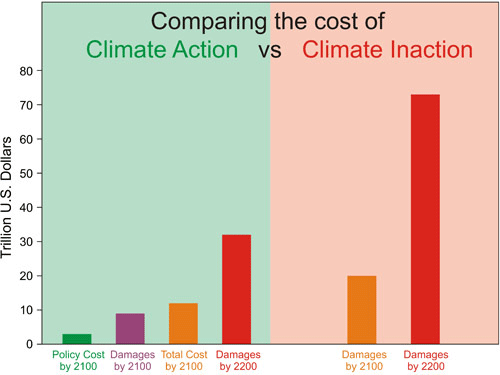
The result of this failure by economists is that world leaders understand neither the magnitude of the risks to lives and livelihoods, nor the urgency of action. How and why this has occurred is explained in a recent report by scientists and economists at the London School of Economics and Political Science, the Potsdam Institute for Climate Impact Research and the Earth Institute at Columbia University. One reason is obvious: Since climate scientists have been underestimating the rate of climate change and the severity of its effects, then economists will necessarily underestimate their costs.
- But it’s worse than that. A set of assumptions and practices in economics has led economists both to underestimate the economic impact of many climate risks and to miss some of them entirely. That is a problem because, as the report notes, these “missing risks” could have “drastic and potentially catastrophic impacts on citizens, communities and companies.”One problem involves the nature of risk in a climate-altered world. Right now, carbon dioxide is at its highest concentration in the atmosphere in three million years (and still climbing). The last time levels were this high, the world was about five degrees Fahrenheit warmer and sea level 32 to 65 feet higher. Humans have no experience weathering sustained conditions of this type……..
A second difficulty involves parameters that scientists do not feel they can adequately quantify, like the value of biodiversity or the costs of ocean acidification. Research shows that when scientists lack good data for a variable, even if they know it to be salient, they are loath to assign a value out of a fear that they would be “making it up.”……A third and terrifying problem involves cascading effects. One reason the harms of climate change are hard to fathom is that they will not occur in isolation, but will reinforce one another in damaging ways. In some cases, they may produce a sequence of serious, and perhaps irreversible, damage…….
The urgency and potential irreversibility of climate effects mean we cannot wait for the results of research to deepen our understanding and reduce the uncertainty about these risks. This is particularly so because the study suggests that if we are missing something in our assessments, it is likely something that makes the problem worse.
This is yet another reason it’s urgent to pursue a new, greener economic path for growth and development. If we do that, a happy ending is still possible. But if we wait to be more certain, the only certainty is that we will regret it. https://www.nytimes.com/2019/10/23/opinion/climate-change-costs.html
Bushfires rage in California- 940.000 without power
 Power shut off to 940,000 Californians as major bushfires rage, SBS, 27 Oct 19,Nearly a million people in California will be blacked out as powerful winds threaten to knock down electric wires and spark further fires.
A California power company says it will shut off power to around 940,000 customers across the north of the US state as powerful winds threatened to knock down electric wires and spark further fires.
“Winds of this magnitude pose a higher risk of damage and sparks on the electric system and rapid wildfire spread.”
California Governor Gavin Newsom said the outages were “unacceptable.”
“We are going to do our best to get through these high-wind events and work through Saturday, Sunday into Monday and get these lights back on and do everything in our power to make sure PG&E is never in a position where they’re doing this to us again,” Newsom said in a video posted on Twitter.
The largest wildfire is currently raging in northern California’s Sonoma County, where 50,000 residents were ordered to evacuate on Saturday.
‘Story about greed’
A number of bushfires are also raging in the northern part of the state. The most serious – the Kincade Fire – broke out late Wednesday in the Sonoma wine region, also prompting evacuations.
The state’s largest utility, Pacific Gas & Electric Co., warned that millions of people in northern and central parts of the state could have their power cut off during the weekend given the high risk of fire.
The same type of equipment was responsible for the state’s deadliest bushfire ever – the Camp Fire in 2018 which killed 86 people.
1 This Month
26 September – International Day for the Total Elimination of Nuclear Weapons





PLEASE OPPOSE HR 8255 AND S.3639 – bills would accelerate satellite deployment, with no environmental review or safeguards – https://ncstd5li.quorum.us/campaign/169331/
To see nuclear-related stories in greater depth and intensity – go to https://nuclearinformation.wordpress.com
-
Archives
- September 2026 (281)
- August 2026 (330)
- July 2026 (355)
- June 2026 (287)
- May 2026 (306)
- April 2026 (356)
- March 2026 (251)
- February 2026 (267)
- January 2026 (308)
- December 2025 (358)
- November 2025 (359)
- October 2025 (375)
-
Categories
- 1
- 1 NUCLEAR ISSUES
- business and costs
- climate change
- culture and arts
- ENERGY
- environment
- health
- history
- indigenous issues
- Legal
- marketing of nuclear
- media
- opposition to nuclear
- PERSONAL STORIES
- politics
- politics international
- Religion and ethics
- safety
- secrets,lies and civil liberties
- spinbuster
- technology
- Uranium
- wastes
- weapons and war
- Women
- 2 WORLD
- ACTION
- AFRICA
- Atrocities
- AUSTRALIA
- Christina's notes
- Christina's themes
- culture and arts
- Events
- Fuk 2022
- Fuk 2023
- Fukushima 2017
- Fukushima 2018
- fukushima 2019
- Fukushima 2020
- Fukushima 2021
- general
- global warming
- Humour (God we need it)
- Nuclear
- RARE EARTHS
- Reference
- resources – print
- Resources -audiovicual
- Weekly Newsletter
- World
- World Nuclear
- YouTube
-
RSS
Entries RSS
Comments RSS

