Global climate tipping point is getting near – researchers say
|
By Helen Regan, CNN, November 28, 2019 , The Earth is heading toward a “global tipping point” if the climate crisis continues on its current path, scientists have warned, as they called for urgent action to avoid “an existential threat to civilization.”
The group of researchers, who published a commentary in the journal Nature, say there is growing evidence to suggest that irreversible changes to the Earth’s environmental systems are already taking place, and that we are now in a “state of planetary emergency.”
A global tipping point is a threshold when the planet’s systems go beyond the point of no return — such as the loss of the Amazon rainforest, accelerated melting of ice sheets, and thawing of permafrost — the authors of the commentary say.
Such a collapse could lead to “hothouse” conditions that would make some areas on Earth uninhabitable.
“We argue that the intervention time left to prevent tipping could already have shrunk towards zero, whereas the reaction time to achieve net zero emissions is 30 years at best,” the authors said.
Active problem areasLed by Timothy Lenton, professor of climate change and Earth system science at the University of Exeter, in southwest England, the team identified nine areas where they say tipping points are already underway.
Those include widespread destruction of the Amazon, reduction of Arctic sea ice, large-scale coral reef die-offs, melting of the Greenland and West Antarctic ice sheets, thawing of permafrost, destabilizing of boreal forests — which contain vast numbers of trees that grow in freezing northern climes — and a slowdown of ocean circulation.
The team claims that these events are interconnected and change in one will impact another, causing a worsening “cascade” of crises………
.
The UN Environment Program (UNEP) 2019 Emissions Gap report said at the current rate, temperatures are expected to rise 3.2 C by 2100.
Greenhouse gases reached a record high in 2018 with no sign of peaking, according to a recent World Meteorological Organization report. Carbon dioxide levels reached 407.8 parts per million, a unit used to measure the level of a contaminant in the air.
Hope is not lost, however. Researchers say that mitigating greenhouse gas emissions could still slow down the accumulation of these climate impacts.
What is needed, they say, is urgent international action to cut emissions, slow sea level rise, and to keep warming to 1.5 C.
“A saving grace is that the rate at which damage accumulates from tipping — and hence the risk posed — could still be under our control to some extent,” they said.
“The stability and resilience of our planet is in peril. International action — not just words — must reflect this.” https://edition.cnn.com/2019/11/28/health/climate-crisis-global-tipping-point-intl-hnk/index.html?utm_source=twCNN&utm_content=2019-11-30T05%3A01%3A06&utm_term=link&utm_medium=social
|
|
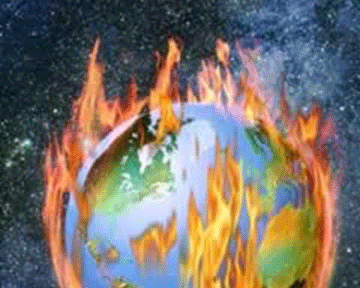
Prominent Americans to wage ‘World War Zero’ against climate change
 John Kerry Launches Star-Studded Climate Coalition, NYT, By Lisa Friedman, Nov. 30, 2019 WASHINGTON — John Kerry, the former senator and secretary of state, has formed a new bipartisan coalition of world leaders, military brass and Hollywood celebrities to push for public action to combat climate change.
The name, World War Zero, is supposed to evoke both the national security threat posed by the earth’s warming and the type of wartime mobilization that Mr. Kerry argued would be needed to stop the rise in carbon emissions before 2050.
The star-studded group is supposed to win over those skeptical of the policies that would be needed to accomplish that.
Former presidents Bill Clinton and Jimmy Carter are part of the effort. Moderate Republican lawmakers like Arnold Schwarzenegger, the former governor of California, and John Kasich, the former governor of Ohio, are on the list. Stars like Leonardo DiCaprio, Sting and Ashton Kutcher round out the roster of more than 60 founding members.
The star-studded group is supposed to win over those skeptical of the policies that would be needed to accomplish that.
Former presidents Bill Clinton and Jimmy Carter are part of the effort. Moderate Republican lawmakers like Arnold Schwarzenegger, the former governor of California, and John Kasich, the former governor of Ohio, are on the list. Stars like Leonardo DiCaprio, Sting and Ashton Kutcher round out the roster of more than 60 founding members.
“We’re going to try to reach millions of people, Americans and people in other parts of the world, in order to mobilize an army of people who are going to demand action now on climate change sufficient to meet the challenge,” Mr. Kerry said in an interview.
The launch of the new group on Sunday comes as diplomats gather in Madrid on Monday for global climate negotiations aimed at strengthening the 2015 Paris Agreement, from which President Trump has vowed to withdraw next year. Earlier this week the United Nations found that the world’s richest countries, responsible for emitting more than three-fourths of planet-warming pollution, are not doing enough to keep Earth’s temperature from rising to dangerously high levels. Net carbon emissions from the two largest polluters, the United States and China, are expanding……….. https://www.nytimes.com/2019/11/30/climate/john-kerry-climate-change.html?smid=tw-nytclimate&smtyp=cur
USA will send no senior government official to COP25 climate conference
 US will ‘protect its interests’ at COP25 climate conference, No senior members of Donald Trump’s administration will attend COP25. https://www.sbs.com.au/news/us-will-protect-its-interests-at-cop25-climate-conference 2 Dec 19, The US will send a diplomatic team but no senior members of Donald Trump’s administration to a global climate change conference starting in Spain on Monday, according to a statement.However, in an effort to raise the US profile in Madrid, House speaker Nancy Pelosi will led a 15-member congressional delegation to “reaffirm the commitment of the American people to combating the climate crisis”.
The US, at Mr Trump’s direction, is withdrawing from the Paris climate accord, which set a goal of limiting global temperature rises to well within two degrees Celsius from pre-industrial levels.
Spain stepped in to host the COP25 meeting, which seeks to boost commitments to fight climate change, after Chile pulled out due to civil unrest.
“The United States will continue to participate in ongoing climate change negotiations and meetings – such as COP25 – to ensure a level playing field that protects US interests,” the US State Department said Saturday.
The US team will be headed by ambassador Marcia Bernicat, principal deputy assistant secretary of state for oceans and international environmental and scientific affairs.
Ms Pelosi, calling climate change “the existential threat of our time,” announced a delegation of Democrats drawn from both the House and the Senate, with no members of Mr Trump’s Republican party.
The president has cast the Paris climate accord as elitist and unfair to the US, saying when announcing his decision to withdraw that he was “elected to represent the citizens of Pittsburgh, not Paris”.
But scientists say the accord is vital to check the worst damage from global warming, such as increasing droughts, rising floods and intensifying storms.
The US is the world’s second biggest emitter of greenhouse gases after China, and is the only country to pull out of the Paris agreement.
The final US withdrawal from the landmark accord is scheduled for 4 November, 2020, a day after the next presidential election.
Several Democratic presidential aspirants have said that, if elected, they would immediately return to the agreement.
Catastrophic weather in Australia does not influence its climate denialist government
 Time is running out for a climate adaptation plan, Independent Australia
THE POSSIBILITY that the effects of climate change could be more extreme and materialise much sooner than expected was never hypothetical. At the end of the last ice age, it is estimated that temperatures in some regions of the world spiked between five and 15 degrees celsius in just a few decades.
Catastrophic climate conditions have already arrived in Australia. With a growing sense that the events of the last few weeks could be the new normal, dealing with the immediate effects of climate change may take increasing priority over historically unsuccessful emissions reduction efforts.
It is striking that Australia has no unified climate adaptation plan.
Our bushfires are escalating in number and intensity. Given this reality, leaving individuals to enact their own bushfire survival plans again and again seems inadequate. In light of successive governments upholding policies designed to discourage asylum seekers from risking their lives at sea, where is the plan to permanently move residents out of areas surrounded by highly flammable material? …..
These are just a few matters of relevance, before we even get to responses to heat stress (cooler living spaces), or the erratic intensity of droughts (innovative measures to ensure food and water security), storms (systematic storm-proofing of property) and floods (moving communities to higher ground where necessary).
All of this will require a great deal of resources and coordination. While governments, both State and Federal, have been much too slow to act, politicians interested in keeping their jobs could conceivably be motivated to do so by increasingly engaged voters.
At the same time, the market has failed to respond anywhere near adequately and it is hard to see it doing so. The private sector-led installation of the flood-proofing infrastructure Brisbane needs is nowhere to be seen.
When warmer temperatures melt arctic ice, sun-reflecting white layers on that ice disappear, causing more heat to be absorbed by darker surfaces, a further rise in temperature and a further melting of ice. A number of chain reactions operate like this in the climate system. There could be many more that have not yet been discovered and that could behave in unanticipated ways.
Under some scenarios, changes could be so rapid that even attempts to adapt could become impractical. We haven’t a moment to lose. https://independentaustralia.net/politics/politics-display/time-is-running-out-for-a-climate-adaptation-plan,13365
Sir David Attenborough shocked at Australian government’s disdain for climate action
Sir David Attenborough hits out at the federal government over climate position,
https://www.sbs.com.au/news/sir-david-attenborough-hits-out-at-the-federal-government-over-climate-position Sir David Attenborough has taken another swipe at the Australian government’s climate policies, expressing his shock at the government’s hesitation to link recent extreme weather with global warming.
UK’s Labour and Greens parties have highly prioritised climate change action
 David Lowry’s Blog 29th Nov 2019, A letter writer in today’s Times newspaper complained that politicians have not prioritized climate change in their manifestos.
Your correspondent Lesley Boase asks “why isn’t urgent action climate
change at the top of [political parties’] manifestos”? The day before
the letter appeared, the Labour Party launched its 48-page manifesto for
the environment ‘A Plan for the Environment. At its launch in
Southampton, Mr Corbyn stressed” The reality is this election is our last
chance to tackle the climate and environment emergency,” in setting out
“Labour’s plan for real change to protect our planet and restore our
natural world.” He added: “We have no time to waste…we have a choice.
We can shut our eyes, cross our fingers and entrust our fate to a system
that has already driven our planet to the brink of catastrophe. Or we can
do everything possible to tackle the biggest threat we face.
http://drdavidlowry.blogspot.com/2019/11/political-parties-prioritise-climate.html
The negotiations in Madrid for COP 25 Climate Change Conference
WHAT TO EXPECT FROM THE UN’S COP 25 CLIMATE CHANGE CONFERENCE, https://ensia.com/notable/cop-25-un-climate-talks/ Andrew Urevig @aurevig November 26, 2019 — In 2015, 195 countries adopted an international treaty aiming to limit global warming to less than 2 °C (3.6 °F) above average preindustrial temperatures in order to avert the worst of Earth’s climate emergency.
How exactly will these countries implement that treaty, the Paris agreement? That’s a key question for the thousands of people set to attend the COP 25 negotiations, the 25th annual Conference of Parties to the United Nations Framework Convention on Climate Change. Despite a last-minute change of location from Chile to Spain, the talks are still slated for December 2–13.
Representatives of countries around the world are preparing to negotiate rules for international carbon markets, finalize details on climate finance and ready the world for the crucial next decade of action on the climate crisis. Chilean environmental minister Carolina Schmidt will preside over the negotiations.
Double Counting Strikes Back
According to Schmidt, “COP 25 will be the COP of implementation.” The main goal is to fill in the legal and technical details of the Paris agreement. That work began at COP 24, which was held last year in Poland.
Left unresolved last year were the rules for voluntary carbon emissions markets, which would let nations meet their pledged emissions cuts by trading reductions with other countries. In a June interview, Schmidt said that these rules, covered under Article 6 of the Paris treaty, would be a major focus of COP25.
Finishing the work of COP 24, this year’s negotiations should finalize the details of the Paris agreement. But consensus could be difficult to reach. During the last climate talks, according to Carbon Brief, draft rules for the carbon markets would have prohibited double counting of emissions, a scenario in which reductions would be counted by both the country that achieved them and the country purchasing those reductions as emissions offsets. But the delegation from Brazil rejected that prohibition, pushing the conversation off to this year.
Other Issues
Other issues will be on the table, too. Countries at COP 25 will discuss details for climate finance to support countries designated as developing as they adapt to climate change and mitigate their carbon emissions.
Outside the halls of power, COP 25 could see street demonstrations and other protests. Last year’s talks coincided with protests worldwide, including 3,000 who marched in Katowice, Poland, where the talks were held.
U.S. diplomats will be among the negotiators — but potentially for the last time. President Donald Trump notified the U.N. Framework Convention on Climate Change (UNFCCC) on Nov. 4, 2019, that the U.S. would withdraw from the Paris agreement. The U.S. is scheduled be officially out of the deal by Nov. 4, 2020, less than a week before COP 26 will begin in Glasgow, Scotland. A U.S. delegation will still be invited to attend the conference — but not to negotiate, in an official capacity, the future of the Paris accord.
Global heating: greenhouse gases now at a record high level

Climate-heating greenhouse gases hit new high, UN reports https://www.theguardian.com/environment/2019/nov/25/climate-heating-greenhouse-gases-hit-new-high-un-reports
Head of World Meteorological Organization says ‘no sign of a slowdown, let alone a decline’ Damian Carrington Environment editor @dpcarrington, Mon 25 Nov 2019 The concentration of climate-heating greenhouse gases has hit a record high, according to a report from the UN’s World Meteorological Organization.The jumps in the key gases measured in 2018 were all above the average for the last decade, showing action on the climate emergency to date is having no effect in the atmosphere. The WMO said the gap between targets and reality were both “glaring and growing”.
The rise in concentration of greenhouses gases follows inevitably from the continued surge in global emissions, which was described as “brutal news” for 2018. The world’s scientists calculate that emissions must fall by half by 2030 to give a good chance of limiting global heating to 1.5C, beyond which hundreds of millions of people will suffer more heatwaves, droughts, floods and poverty.
But Petteri Taalas, the WMO secretary-general, said: “There is no sign of a slowdown, let alone a decline, despite all the commitments under the Paris agreement on climate change. We need to increase the level of ambition for the sake of the future welfare of mankind.
“It is worth recalling that the last time the Earth experienced a comparable concentration of carbon dioxide was 3-5m years ago. Back then, the temperature was 2-3C warmer and sea level was 10-20 metres higher than now.”
Three-quarters of the emissions cuts pledged by countries under the Paris agreement of 2015 are “totally inadequate”, according to a comprehensive expert analysis published earlier in November, putting the world on a path to climate disaster. Another report has found that nations are on track to produce more than double the fossil fuels in 2030 than could be burned while keeping heating under 1.5C.
“The [CO2 concentration] number is the closest thing to a real-world Doomsday Clock, and it’s pushing us ever closer to midnight,” said John Sauven, head of Greenpeace UK. “Our ability to preserve civilisation as we know it, avert the mass extinction of species, and leave a healthy planet to our children depend on us urgently stopping the clock.”
The WMO report, published on Monday, found the global average concentration of CO2 reached 407.8 parts per million in 2018, up from 405.5ppm in 2017. It is now 50% higher than in 1750, before the industrial revolution sparked the widespread burning of coal, oil and gas.
Since 1990, the increase in greenhouse gas levels has made the heating effect of the atmosphere 43% stronger. Most of that – four-fifths – is caused by CO2. But the concentrations of methane and nitrous oxide, the two other key greenhouse gases, also surged in 2018 by a higher amount than the annual average over the past decade.
Methane, which is produced by cattle, rice paddies and fossil fuel exploitation, is responsible for 17% of the heating effect. Its concentration is now more than double pre-industrial levels.
Nitrous oxide, which comes from heavy fertiliser use and forest burning, is now 23% higher than in 1750. The observations are made by the Global Atmosphere Watch network, which includes stations in the Arctic, high mountains and tropical islands.
“The record rise in greenhouse gas concentrations is a cruel reminder that for all the real progress in clean technology, we have yet to even stop global emissions increases,” said Nick Mabey, chief executive of think tank E3G. “The climate system cannot be negotiated with. Until we stop new investment in fossil fuels and massively scale up green power the risks from catastrophic climate change will continue to rise.”
When the world’s nations agreed the Paris deal in 2015, they pledged to ramp up their promised emissions cuts by the annual UN climate summit in 2020, which will be hosted by the UK in Glasgow. This year’s summit needs to do vital preparatory work and begins on 2 December in Madrid, Spain. Chile had been due to host but cancelled because of civil unrest.
Richard Black, director of the Energy and Climate Intelligence Unit in the UK, said: “This record level of greenhouse gases should act as a sobering reminder to governments that so far they are collectively reneging on the pledge they made at the Paris summit, of attempting to keep global warming to 1.5C. That window is closing, and Chile, Italy and the UK [must] use all the diplomatic tools they have to put emissions on a trajectory closer to what science recommends and the public want.”
USA’s “Senate Climate Caucus” full of climate deniers, funded by dirty industries
 New Senate Climate Caucus Is Filled With Climate Deniers and Climate “Delayers”, BY Sharon Zhang, Truthout, 14 Nov 19, What’s climate change to a senatorial non-believer? The new Senate Climate Solutions Caucus might soon answer that question.
Formed late last month, the caucus’s aim is to hold hearings with climate experts, educate fellow senators and introduce unanimously agreed-upon legislation. The caucus’s founders — Delaware Democrat Christopher Coons and Indiana Republican Mike Braun — boast of the mandated bipartisanship of the caucus. For every Democrat, there must be a Republican, and vice versa.
Floridian Sen. Marco Rubio, a former hardline climate denier, is the group’s latest addition. He joins fellow Republicans Lisa Murkowski, Mitt Romney (a former climate waffler) and Lindsey Graham, who once said that greenhouse gas emissions are bad but probably don’t warm the planet all that much.
“In its current state, our national conversation on this issue is too polarized, toxic, and unproductive,” Braun and Coons said in an op-ed about the caucus for The Hill. “Our caucus seeks to take the politics out of this important issue.”
Setting aside that the climate conversation isn’t as polarized among voters as Coons and Braun might think — in fact, an overwhelming majority of voters agree that global warming is happening — it’s strange that they think that bipartisanship on climate can be apolitical. For the last couple of decades, the Republican Party has been nearly united on the climate change denial front, and, in the name of compromise, Democrats have largely been hesitant to move to the left on climate — or make any moves at all.
RL Miller, political director of Climate Hawks Vote, a grassroots climate super PAC, calls bipartisanship in the caucus “a joke.”………
the biggest threat to any progress for the caucus isn’t necessarily the Republicans on it. The biggest threat may be the amount of fossil fuel money accepted by members on both sides of the aisle. Only one member so far has signed the No Fossil Fuel Money Pledge: Colorado’s Michael Bennet, a Democratic presidential candidate, non-supporter of the Green New Deal, and recipient of over $320,000 worth of oil and gas money in his time in Congress, according to the Center for Responsive Politics. The other three Democrats in the caucus – Jeanne Shaheen, Angus King and Coons — have received over $200,000 combined. Meanwhile, the Republican members of the caucus have received over $9.5 million combined, $7 million of which went to Romney alone.
the biggest threat to any progress for the caucus isn’t necessarily the Republicans on it. The biggest threat may be the amount of fossil fuel money accepted by members on both sides of the aisle. Only one member so far has signed the No Fossil Fuel Money Pledge: Colorado’s Michael Bennet, a Democratic presidential candidate, non-supporter of the Green New Deal, and recipient of over $320,000 worth of oil and gas money in his time in Congress, according to the Center for Responsive Politics. The other three Democrats in the caucus – Jeanne Shaheen, Angus King and Coons — have received over $200,000 combined. Meanwhile, the Republican members of the caucus have received over $9.5 million combined, $7 million of which went to Romney alone.
A starting point for bipartisan legislation would be some sort of carbon fee — an idea legislators on both sides of the aisle have been bouncing around for a while –which environmental experts consider to be a bare minimum requirement for the path to net-zero emissions. Considering all of the members of the caucus have to agree on any policy they write, however, even a carbon fee will likely be an uphill battle. Rubio derides the idea of a carbon tax and conflates it with the Green New Deal in a recent op-ed for USA Today; Murkowski has refused to endorse a carbon tax; and Graham has supported one in the past, but reneged on that view earlier this year. Even Braun says that he doesn’t want a carbon fee to be a focus of the caucus.
To say that the country needs to act on climate and then reject the most basic policy to address climate change appears to be a new form of climate denial among centrists and the right — they may not outright deny the existence of climate change, but refuse to acknowledge the all-encompassing scale of the problem. In March, when a video clip of Sen. Dianne Feinstein shows her dismissing Sunrise Movement activists circulated, Rep. Alexandria Ocasio-Cortez tweeted that Feinstein was a “climate delayer.”……..
Even if the caucus does produce legislation, “the very existence of something like this, with so many senators that have taken money from the fossil fuel industry — it risks locking us into inadequate policies,” Billings says. For instance, not only would a carbon tax alone be insufficient climate policy, but it may also contain covert fossil fuel riders. There’s a reason that ExxonMobil, BP and Shell have been pushing for the passage of a carbon tax; Exxon’s carbon tax proposal last year contained a liability waiver, granting the company immunity for any climate change lawsuits brought against it.
Most of the Republicans in the caucus and at least one of the Democrats have shown to be susceptible to fossil fuel industry messaging that’s disguised as “climate-friendly.” Climate plans with an emphasis on carbon capture are a dead giveaway on this. In the current political sphere, carbon capture primarily refers to a technology that, yes, captures carbon as it’s emitted, but also sequesters that carbon in depleted oil wells, helping the fossil fuel companies to extract more oil. Funding carbon capture research is bipartisan, too, but as its used currently, it’s as useful for the climate as using kerosene to put out a fire.
Some may hail the bipartisanship of this climate caucus as a step forward. But as long as the majority of the committee is taking fossil fuel money, any supposed progress is dubious at best, and stifling at worst. After all, there’s no way of telling what’s happening behind closed doors. https://truthout.org/articles/new-senate-climate-caucus-is-filled-with-climate-deniers-and-climate-delayers/?eType=EmailBlastContent&eId=5dfc1357-c5ab-4a92-a995-92190dbe348e
Global heating is shrinking and accelerating the jet stream
Times 24th Nov 2019, The jet stream – the powerful transatlantic wind that dominates British weather – is being shrunk by climate change, scientists say. It means that Britain is at growing risk of more violent storms in winter and searing heatwaves in summer.
Tim Woollings, associate professor of atmospheric physics at Oxford University, who has published a new book, Jet Stream,
said: “The planet is warming rapidly due to humanity’s greenhouse gases. It
means the whole of the Earth’s tropical belt is likely to expand, pushing
the jet stream north so it shrinks in size and accelerates.”
https://www.thetimes.co.uk/article/e154bfe6-0e24-11ea-93be-ccf3f2ed7d1d
For UK elections, top issue is climate change

 Climate crisis topping UK election agenda is ‘unprecedented’ change
 Environmentalists say such political focus on green issues ‘unthinkable’ just five years ago, Guardian, Fiona Harvey Environment correspondent, Fri 22 Nov 2019 The climate emergency has risen to the top of the UK’s election agenda in a way that would have been “unthinkable” even five years ago, leading environmentalists have said, predicting that it augurs a permanent change in British politics.On Wednesday, Labour took the unprecedented move of putting green issues as the top section of its manifesto, the first time one of the UK’s two major parties has done so. Jeremy Corbyn led the appeal to voters with policies including an £11bn windfall tax on oil and gas companies, a million new jobs in a “green industrial revolution” and commitments on moving to a net-zero carbon economy.“Such focus on climate and the environment would have been almost unthinkable five years ago,” said Shaun Spiers, executive director of the Green Alliance. “Tackling climate change runs through this manifesto in a way that is unprecedented from either of the main parties ahead of a UK general election.”
“It would not have been possible five years ago,” said Tom Burke, chairman of environmental thinktank E3G and former adviser to several governments, who said the move marked a permanent change in British politics, as younger voters in particular were “energised” over the environment. Public anxiety had been fuelled by people seeing extreme weather around the world, and the rise of climate activism in movements such as Extinction Rebellion and the school climate strikes reflected that. “The politicians are following the public on this, not the other way round.”
…….. The Liberal Democrats, while focusing on Brexit, have also made the climate emergency a key priority, promising to generate 80% of the UK’s electricity from renewable sources by 2030, to bring forward to 2045 the deadline for net-zero carbon, and to expand electric vehicles and ban fracking. The Green party wants to spend £100bn a year for the next decade on the climate crisis, replacing high-carbon infrastructure and creating jobs…. https://www.theguardian.com/environment/2019/nov/21/climate-crisis-topping-uk-election-agenda-is-unprecedented-change
Nuclear wastes and other problems – nuclear power not low carbon, not safe
We beg to differ with Jonathan Ford’s view on nuclear waste, that decommissioning and storage should be manageable problems (“Nuclear liabilities need to be put into a clearer perspective”, Inside Business, November 18). As the recent World Nuclear Waste Report 2019, states, no country in the world has a deep geological repository for spent nuclear fuel in operation, and there remain significant scientific uncertainties associated with the deep disposal concept. Moreover, with costs of both interim and permanent storage of spent nuclear fuel ramping, no country has either securely estimated costs nor closed the gap between secured funds and cost estimates. The report adds that there is a lack of comprehensive, quantitative and qualitative information on risks associated with nuclear waste, with meta-analyses on the health impacts of nuclear waste notable for their virtual absence.
 We also take issue with Mr Ford’s claim that “nuclear power remains one of the few technologies the world has for reliably generating zero-carbon electricity”. The evidence base concludes that, taking account of the nuclear fuel cycle (uranium mining, fuel enrichment, construction of power stations and the waste stream), nuclear has CO2 emissions between 10 and 18 times those of renewables. And, in the light of major accidents, incidents, technical failures and outages, it is difficult to comprehend how the world’s ageing nuclear fleet can conceivably be described as reliable. Dr Paul Dorfman Senior Research Associate, UCL Energy Institute, University College London Prof Andy Blowers Author, ‘The Legacy of Nuclear Power’ Prof Keith Barnham Emeritus Professor of Physics, Imperial College London Paul Brown Co-Editor, Climate News Network Prof Tom Burke Founder and Chair, E3G Prof Steve Thomas Emeritus Professor of Energy Policy, University of Greenwich Dr David Toke Reader in Energy Policy, University of Aberdeen Prof Andy Stirling Science Policy Research Unit, Sussex Energy Group, University of Sussex Prof Brian Wynne Professor Emeritus of Science Studies, Lancaster University
Nuclear power allows climate change to speed up, while renewables are faster, cheaper, and more efficient
In sum, the nuclear industry seeks its own sales arrangements protected from competition, its own prices determined by political processes rather than markets, and diminished opportunities for its carbon-free competitors to express their value, reach their customers, and discover their own prices. This could be good for compliant legislators’ campaign contributions, but hardly in the national interest or helpful for climate protection.
If you haven’t heard this view before, it’s not because it wasn’t published in reputable venues over several decades, but rather because the nuclear industry, which holds the microphone, is eager that you not hear it. Many otherwise sensible analysts and journalists have not properly reported this issue. Few political leaders understand it either. But by the end of this article, I hope you will.
to protect the climate, we must save the most carbon at the least cost and in the least time, counting all three variables—carbon and cost and time. Costly options save less carbon per dollar than cheaper options. Slow options save less carbon per year than faster options. Thus even a low- or no-carbon option that is too costly or too slow will reduce and retard achievable climate protection.
anti-market monkeybusiness cannot indefinitely forestall the victory of cheaper competitors, but it can delay and diminish climate protection while transferring tens of billions of unearned dollars from taxpayers and customers to nuclear owners.
Does Nuclear Power Slow Or Speed Climate Change? Forbes Amory B. Lovins-18 Nov 19, Most U.S. nuclear power plants cost more to run than they earn. Globally, the World Nuclear Industry Status Report 2019 documents the nuclear enterprise’s slow-motion commercial collapse—dying of an incurable attack of market forces. Yet in America, strong views are held across the political spectrum on whether nuclear power is essential or merely helpful in 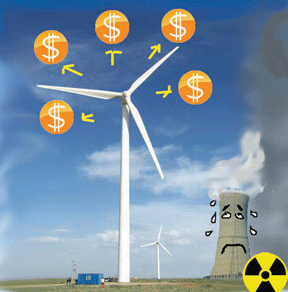 protecting the Earth’s climate—and both those views
  are wrong.
The “Plutocene” danger – nuclear war, radioactive pollution, global heating
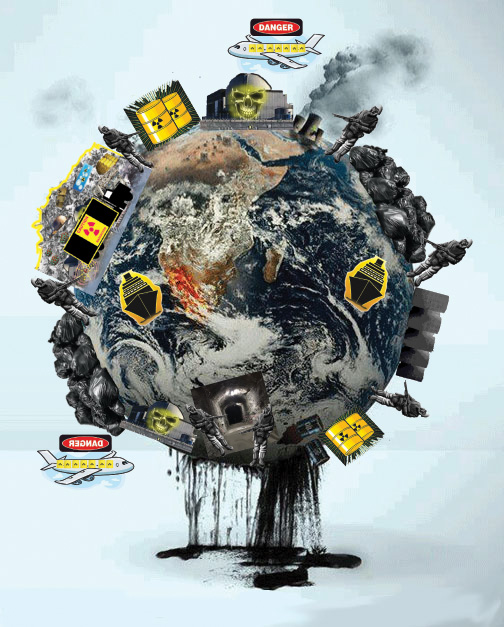
Why are these two facts related? Because they illustrate the two factors that could transport us beyond the Anthropocene—the geological epoch marked by humankind’s fingerprint on the planet—and into yet another new, even more hostile era of our own making.
My new book, titled The Plutocene: Blueprints for a post-Anthropocene Greenhouse Earth, describes the future world we are on course to inhabit, now that it has become clear that we are still busy building nuclear weapons rather than working together to defend our planet.
have coined the term Plutocene to describe a post-Anthropocene period marked by a plutonium-rich sedimentary layer in the oceans. The Anthropocene is very short, having begun (depending on your definition) either with the Industrial Revolution in about 1750, or with the onset of nuclear weapons and sharply rising greenhouse emissions in the mid-20th century. The future length of the Plutocene would depend on two factors: the half-life of radioactive plutonium-239 of 24,100 years, and how long our CO2 will stay in the atmosphere—potentially up to 20,000 years.
During the Plutocene, temperatures would be much higher than today. Perhaps they would be similar to those during the Pliocene (2.6 million to 5.3 million years ago), when average temperatures were about 2℃ above those of pre-industrial times, or the Miocene (roughly 5.3 million to 23 million years ago), when average temperatures were another 2℃ warmer than that, and sea levels were 20 to 40 meters (65-131ft) higher than today.
Under these conditions, population and farming centres in low coastal zones and river valleys would be inundated, and humans would be forced to seek higher latitudes and altitudes to survive—as well as potentially having to contend with the fallout of nuclear conflict. The most extreme scenario is that evolution takes a new turn—one that favors animals best equipped to withstand heat and radiation.
Climates past
While we have a range of tools for studying prehistoric climates, including ice cores and tree rings, these methods do not of course tell us what the future holds.
However, the basic laws of physics, the principles of climate science, and the lessons from past and current climate trends, help us work out the factors that will dictate our future climate.
Broadly speaking, the climate is shaped by three broad factors: trends in solar cycles; the concentration of atmospheric greenhouse gases; and intermittent events such as volcanic eruptions or asteroid impacts.
Solar cycles are readily predicted, and indeed can be seen in the geological record, whereas intermittent events are harder to account for. The factor over which we have the most control is our own greenhouse emissions.
CO2 levels have previously climbed as high as 2,000 parts per million (ppm), most recently during the early Eocene, roughly 55-45 million years ago. The subsequent decline of CO2 levels to just a few hundred parts per million then cooled the planet, creating the conditions that allowed Earth’s current inhabitants (much later including humans) to flourish.
But what of the future? Based on these observations, as reported by the Intergovernmental Panel on Climate Change (IPCC), several projections of future climates indicate an extension of the current interglacial period by about 30,000 years, consistent with the longevity of atmospheric CO2.
If global warming were to reach 4℃, as suggested by Hans Joachim Schellnhuber, chief climate advisor to the German government, the resulting amplification effects on the climate would pose an existential threat both to nature and human civilization.
Barring effective sequestration of carbon gases, and given amplifying feedback effects from the melting of ice sheets, warming of oceans, and drying out of land surfaces, Earth is bound to reach an average of 4℃ above pre-industrial levels within a time frame to which numerous species, including humans, may hardly be able to adapt. The increase in evaporation from the oceans and thereby water vapor contents of the atmosphere leads to mega-cyclones, mega-floods and super-tropical terrestrial environments. Arid and semi-arid regions would become overheated, severely affecting flora and fauna habitats.
The transition to such conditions is unlikely to be smooth and gradual, but may instead feature sharp transient cool intervals called “stadials.” Increasingly, signs of a possible stadial are being seen south of Greenland.
A close analogy can be drawn between future events and the Eocene-Paleocene Thermal Maximum about 55 million years ago, when release of methane from Earth’s crust resulted in extreme rise in temperature. But as shown below, [ diagram on original] the current rate of temperature rise is far more rapid—and more akin to the planet-heating effects of an asteroid strike.
Mounting our defense
Defending ourselves from global warming and nuclear disaster requires us to do two things: stop fighting destructive wars, and start fighting to save our planet. There is a range of tactics we can use to help achieve the second goal, including large-scale seagrass cultivation, extensive biochar development, and restoring huge swathes of the world’s forests.
Space exploration is wonderful, but we still only know of one planet that supports life (bacteria possibly excepted). This is our home, and there is currently little prospect of realising science fiction’s visions of an escape from a scorched Earth to some other world.
Yet still we waver. Many media outlets operate in apparent denial of the connection between global warming and extreme weather. Meanwhile, despite diplomatic progress on nuclear weapons, the Sword of Damocles continues to hang over our heads, as 14,900 nuclear warheads sit aimed at one another, waiting for accidental or deliberate release.
If the clock does strike nuclear midnight, and if we don’t take urgent action to defend our planet, life as we know it will not be able to continue. Humans will survive in relatively cold high latitudes and altitudes. A new cycle would begin.
Andrew Glikson is an Earth and paleo-climate scientist at the Australian National University.
Climate change is a health emergency – physicians
Visionary Leaders Symposium: ‘Our planet is our patient.’ http://publichealthnewswire.org/?p=physicians-for-social-responsibility-visionary-leaders-symposium#.XdARGW8_6rw.twitter by Louise Dettman on 11/8/2019 Nearly 200 organizations representing medical, health care and public and environmental health professionals, including APHA, have so far endorsed the 2019 U.S. Call to Action on Climate Change, Health and Equity: A Policy Agenda.It challenges government, business, civil society and the health sector to recognize climate change as a public health emergency and to act now for climate, health and equity.
 “Being health professionals, it’s important for us to realize that our planet is our patient, and it’s in the intensive care unit. We’re doctors to a dying planet and we have a job to do,” said Helen Caldicott, MD, keynote speaker at yesterday’s Physicians for Social Responsibility Visionary Leaders Symposium in Washington, D.C.
A PSR founder and former president, anti-nuclear activist, author and pediatrician from Australia, Caldicott has spent her life educating world leaders and the public about the medical hazards of the nuclear age. She urged those gathered at the Ronald Reagan Building for the symposium to “stop being polite and speak the truth loudly and clearly” about the need for action on climate change. As one of the drafters of the U.S. Call to Action, PSR is using it to mobilize and give voice to more health professionals.
It advocates for policies that promote a just transition to clean, safe renewable energy and energy efficiency; sustainable food production and diets; clean water; active transportation; and green cities. Such policies can lower climate pollution, reduce the incidence of communicable and non-communicable disease, improve mental health and realize significant cost savings in health care.
“I’m not being radical. I’m being a physician,” Caldicott said as she stressed the urgency of the situation; challenged attendees to question the role of politicians, corporations and the military in the production of greenhouse gases; and told everyone to contact members of Congress. “If you don’t use your democracy, they’ll swoop in and use it for you — for their own political and financial gain,” she said.
The U.S. Call to Action urges the health sector itself to reduce greenhouse gas emissions and — as a trusted voice — to effectively communicate the health threats of climate change and the health benefits of climate action. The symposium focused specifically on the role of women in the climate, health and equity movement and the importance of economic justice for the most vulnerable communities.
Heidi Hutner, PhD, a filmmaker, writer and professor at Stony Brook University, moderated an expert panel of women advocates discussing the health hazards of and solutions to nuclear power and climate change. Hutner opened the program with a trailer of her upcoming documentary about the women of Three Mile Island and, along with the other participants, questioned nuclear power as the answer for a just transition to clean energy.
Following the symposium, at the 2019 Visionary Leadership Awards, PSR presented Caldicott with a Lifetime Achievement Award for her work. It also recognized other individuals and organizations for their efforts in advancing nuclear weapons abolition and addressing environmental risks to human health, including the consequences of climate change.
1 This Month
26 September – International Day for the Total Elimination of Nuclear Weapons





PLEASE OPPOSE HR 8255 AND S.3639 – bills would accelerate satellite deployment, with no environmental review or safeguards – https://ncstd5li.quorum.us/campaign/169331/
To see nuclear-related stories in greater depth and intensity – go to https://nuclearinformation.wordpress.com
-
Archives
- September 2026 (281)
- August 2026 (330)
- July 2026 (355)
- June 2026 (287)
- May 2026 (306)
- April 2026 (356)
- March 2026 (251)
- February 2026 (267)
- January 2026 (308)
- December 2025 (358)
- November 2025 (359)
- October 2025 (375)
-
Categories
- 1
- 1 NUCLEAR ISSUES
- business and costs
- climate change
- culture and arts
- ENERGY
- environment
- health
- history
- indigenous issues
- Legal
- marketing of nuclear
- media
- opposition to nuclear
- PERSONAL STORIES
- politics
- politics international
- Religion and ethics
- safety
- secrets,lies and civil liberties
- spinbuster
- technology
- Uranium
- wastes
- weapons and war
- Women
- 2 WORLD
- ACTION
- AFRICA
- Atrocities
- AUSTRALIA
- Christina's notes
- Christina's themes
- culture and arts
- Events
- Fuk 2022
- Fuk 2023
- Fukushima 2017
- Fukushima 2018
- fukushima 2019
- Fukushima 2020
- Fukushima 2021
- general
- global warming
- Humour (God we need it)
- Nuclear
- RARE EARTHS
- Reference
- resources – print
- Resources -audiovicual
- Weekly Newsletter
- World
- World Nuclear
- YouTube
-
RSS
Entries RSS
Comments RSS

