Global sea levels have been underestimated due to poor modelling, research suggests
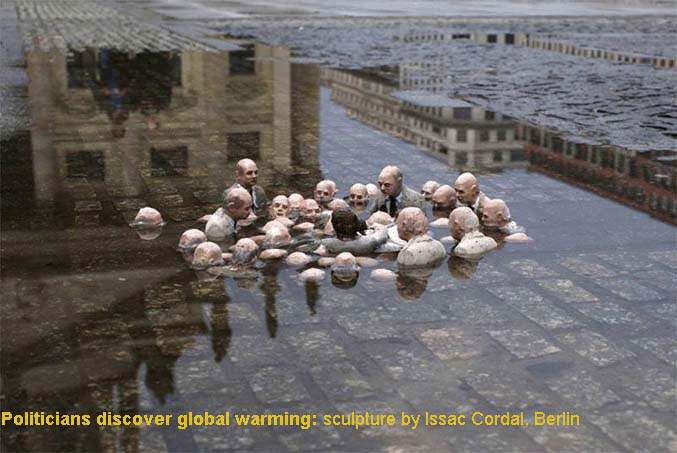
Sea levels around the world have been underestimated due to inaccurate
modelling, with research suggesting ocean levels are far higher than
previously understood. The finding could significantly affect assessments
of the future impacts of global heating and the effects on coastal
settlements.
Globally, the research found ocean levels are an average of
30cm higher than previously believed, but in some areas of the global
south, including south-east Asia and the Indo-Pacific, they may be
100-150cm higher than previously thought.
Rising sea levels are a major
threat to coastal communities across the world, and the UN
Intergovernmental Panel on Climate Change (IPCC) estimates that by 2100
levels may rise by 28-100cm. The latest research, published in Nature,
combined the analysis of 385 pieces of peer-reviewed scientific literature
released between 2009 and 2025 with calculations of the difference between
the commonly assumed and actual measured coastal sea levels.
The new
calculations reveal that following a relative sea level rise of 1 metre, it
is estimated that 37% more coastal areas will fall below sea level,
affecting up to 132 million individuals. “If sea level is higher for your
particular island or coastal city than was previously assumed, the impacts
from sea level rise will happen sooner than projected before,” said
Minderhoud.
Guardian 4th March 2026, https://www.theguardian.com/environment/2026/mar/04/global-sea-levels-underestimated-poor-modelling-research
Rapid UK coastal erosion throws spotlight on £40bn nuclear plant
More than 27 metres of cliff lost over a year in area just 2km from Sizewell C.

Swaths of the eastern UK coastline are eroding faster than expected,
forcing the demolition of homes and putting the spotlight on the risks
surrounding a £40bn nuclear power plant being built at Sizewell.
The coast
around Norfolk and Suffolk is one of the fastest eroding in Europe but the
disintegration has intensified in several parts in recent months including
an area just 2km from the Sizewell C construction site.
More than 27 metres
of cliff at the village of Thorpeness has been lost since December 2024,
compared with an erosion rate of 2 metres a year on average, according to
East Suffolk Council, which said the “sudden and significant pace”
meant safety levels were breached far more quickly than expected. Ten homes
in the upmarket area, including two flats that sold within the last few
years for more than £600,000, have been knocked down since October.
FT 24th Feb 2026,
https://www.ft.com/content/7f093296-41cd-498c-ba81-f3707204eca9
The Apocalyptic President

a science fiction novel with a distinctly bizarre premise: that, at some future moment, thanks to the endless burning of fossil fuels, we humans would essentially threaten to burn ourselves off planet Earth. And when the voters of the world’s largest democracy heard that such a thing might, sooner or later, actually happen to us, they would respond by freely electing a genuine madman — who ran his second candidacy in 2024 on the all-too-bluntly apocalyptic slogan “drill, baby, drill” — to “lead” us into a literal hell on earth.
the American people elected as president, twice, a man who, as a businessman, had either four or more likely six bankruptcies to his name,
Our planet is melting in a climate broiler that we control and we’re not only not turning down the heat fast enough, but we Americans elected someone (twice!) determined to turn it up ever higher.
The Personification of an Imperial Power (and Planet) in Decline
February 18, 2026 , By Tom Engelhardt, https://tomdispatch.com/the-apocalyptic-president/
Once upon a time, if you had described Donald Trump’s America to me (the second time around), I would have thought you mad as Alice in Wonderland‘s proverbial hatter — or, if you were a fiction writer, I would have considered your plot so ludicrous that, after reading a few pages, I would undoubtedly have tossed your book in the trash.
And yet here we are, not once (yes, all of us can make a mistake once, can’t we?) but twice!
And the one thing you should take for granted is that Donald Trump in the White House a second time around is the all-too-literal personification of imperial decline. In fact, decline is hardly an adequate word for it. We just don’t happen to have another word or phrase that would describe him and his crew aptly enough in all their eerie strangeness. Yes, this country, even in the best of (imperial) times, certainly had its problems. (Remember the Vietnam War, for instance, or President “Tricky Dick” Nixon and the Watergate scandal.) Still, nothing was ever quite like this, was it? Never.
The First American King?
A literal Mad Hatter in command in Washington, D.C. Once upon a time, who would have believed it? In fact, if we could indeed travel into the past and I were able to take you back to 1991 when the Soviet Union collapsed, ending the Cold War, while China had not yet faintly “risen,” the world of that moment might essentially have been considered American property, lock, stock, and proverbial barrel.
This planet could have been thought of then as the property of just one great power — my country, of course — that, in imperial terms, had essentially been left alone on planet Earth in a fashion that might never have happened before in the history of humanity. And if I had then been able to see into our future and had tried to fill you in on the Trumpian world we’re now living through a mere three decades later, you would have quite literally laughed me off the planet (and, believe me, that’s putting it politely).
Truly, who could have ever (ever!) imagined this bizarre Trumpian era of ours in which the joker (in the worst sense of the term) in the ultimate deck of cards is indeed sitting in the White House. Yes, unbelievably enough, he was elected a second time in 2024 by a “sweeping,” “landslide,” “historic” 49.7% of American voters. It’s true, not even 50% of us voted to make him the first American king a second time around.
And if that made you chuckle just a little, well, stop doing so right now! Yes, what happened to us in Trumpian terms was and remains genuinely absurd. Still, given this deeply endangered world of ours, it should be anything but funny. Just imagine for a moment, a president who, before entering the White House, was essentially known for only one thing: being the host of the TV show The Apprentice (“You’re fired!”). Once upon a time, if you had described the (ir)reality we’re now living through, you would have been laughed not just out of the room but off this planet. You would, in short, have been fired.
In fact, if what we’re now experiencing were a novel, it would be considered to have the most ludicrous plot imaginable and, a few pages in, you would undoubtedly have tossed it into — yes, again! — the trash. (Unfortunately, it’s not just you or me but this planet itself that Donald Trump now threatens to toss into that garbage pail.)
So here we are in February 2026 and, like it or not, we’re all apprentices to one Donald J. Trump — oops, sorry, one President Donald J. Trump. And the ongoing TV show he emcees these days from the White House is undoubtedly the wackiest one in our history, as he fires not just everyone but everything that rubs him the wrong way from the Kennedy Center (gone!) to the East Wing of the White House (now rubble) to the U.S. Agency for International Development (once upon a time…).
One way to think about all of this is to go back in time and imagine that, long, long ago, Isaac Asimov or Ray Bradbury wrote a science fiction novel with a distinctly bizarre premise: that, at some future moment, thanks to the endless burning of fossil fuels, we humans would essentially threaten to burn ourselves off planet Earth. And when the voters of the world’s largest democracy heard that such a thing might, sooner or later, actually happen to us, they would respond by freely electing a genuine madman — who ran his second candidacy in 2024 on the all-too-bluntly apocalyptic slogan “drill, baby, drill” — to “lead” us into a literal hell on earth. Now, of course, that “president” is insisting that he be given the largest iced island on this planet, Greenland, that, were all its ice to melt (as indeed is already beginning to happen), could send global sea levels up by 23 feet and quite literally drown this world’s coastal cities. Imagine that!
And now, try to imagine this: in 2026, such terrible fiction is, in fact, our reality and one thing is guaranteed (excuse the colons inside colons but this is a strange, strange world to try to sum up): it’s only going to get worse in the three years to come before Donald Trump’s presidency is officially ended, if, of course, it ever does end. (As he typically said at one point last year, “Based on what I read, I guess I’m not allowed to run. So we’ll see what happens,” and he’s now talking about “nationalizing” — think “Trumpifying” — our elections!)
Given him and everything that’s gone on so far in his second term in office, including the way he recently had Director of National Intelligence Tulsi Gabbard accompany FBI agents to an election voting hub in Fulton County, Georgia, where they “seized hundreds of boxes containing ballots and other documents related to the 2020 election,” I wouldn’t count on anything Trumpian ending according to plan. Whew! That was one long sentence!
Continue readingThe challenges in projecting future global sea levels
It is well understood that human-caused climate change is causing sea
levels to rise around the world. Since 1901, global sea levels have risen
by at least 20cm – accelerating from around 1mm a year for much of the
20th century to 4mm a year over 2006-18.
Sea level rise has significant
environmental and social consequences, including coastal erosion, damage to
buildings and transport infrastructure, loss of livelihoods and ecosystems.
The Intergovernmental Panel on Climate Change (IPCC) has said it is
“virtually certain” that sea level will continue to rise during the
current century and beyond.
But what is less clear is exactly how quickly
sea levels could climb over the coming decades. This is largely due to
challenges in calculating the rate at which land ice in Antarctica – the
world’s largest store of frozen freshwater – could melt. In this
article, we unpack some of the reasons why projecting the speed and scale
of future sea level rise is difficult.
Carbon Brief 17th Feb 2026, https://www.carbonbrief.org/guest-post-the-challenges-in-projecting-future-global-sea-levels/
Excruciating tropical disease can now be transmitted in most of Europe, study finds.

An excruciatingly painful tropical disease called chikungunya can now be
transmitted by mosquitoes across most of Europe, a study has found. Higher
temperatures due to the climate crisis mean infections are now possible for
more than six months of the year in Spain, Greece and other southern
European countries, and for two months a year in south-east England.
Continuing global heating means it is only a matter of time before the
disease expands further northwards, the scientists said. The analysis is
the first to fully assess the effect of temperature on the incubation time
of the virus in the Asian tiger mosquito, which has invaded Europe in
recent decades. The study found the minimum temperature at which infections
could occur is 2.5C lower than previous, less robust, estimates,
representing a “quite shocking” difference, the researchers said.
Guardian 18th Feb 2026, https://www.theguardian.com/science/2026/feb/18/tropical-disease-chikungunya-transmitted-europe-study
Brace for Trump’s brave new world of 1.7°C global warming.
If you have stopped paying attention to global warming, you may soon be in
for a nasty surprise. A paper by Columbia University predicts that we will
have our first taste of a 1.7C world as soon as next year – a shock big
enough to intrude on everybody’s consciousness. One cause is the
reversion from the current cooling weather pattern of La Niña in the South
Pacific to the opposite El Niño pattern of cyclical warmth. A less
understood cause is that aerosol pollution has masked the latent heat
effect of past CO2 emissions by around 0.5C and possibly more. Carbon
lingers in the atmosphere for several hundred years. This aerosol effect is
going into rapid reverse as the world cuts toxic particulates from coal
plants, industry, cars and shipping. The Columbia estimate of 1.7C above
1880-1920 levels is at the high end of the scientific spectrum but the Met
Office, Europe’s Copernicus service and others also expect a
record-shattering year in 2027.
Telegraph 17th Feb 2026,
https://www.telegraph.co.uk/business/2026/02/17/trump-is-pushing-the-world-closer-to-climate-catastrophe/
These US states want polluters to pay for the rising insurance costs of climate disasters.
As climate disasters drive up the price of home insurance, three US states
are considering empowering their state prosecutors to sue major polluters
for their role in those rising costs.
Lawmakers in California, Hawaii and
New York have introduced measures which would authorize their attorneys
general to sue fossil fuel companies on behalf of residents whose insurance
premiums have soared amid climate disasters. “The cost of home insurance
in California is an absolute crisis,” said state senator Scott Wiener,
lead author of his state’s bill, speaking at a press conference
announcing the measure on Thursday.
“We know that the years ahead are
going to be dramatically more dangerous, tragically, when it comes to
climate disasters, and we can’t allow Californians, our residents, our
small businesses, to be left holding the bag.” The proposals aim to hold
the fossil fuel industry, the top contributor to global warming,
accountable for soaring insurance rates driven by climate-fueled extreme
weather.
Guardian 8th Feb 2026, https://www.theguardian.com/us-news/2026/feb/08/proposal-fossil-fuel-companies-insurance-costs
What Trump’s plans for the Arctic mean for the global climate crisis

With plans to sell off over a million acres of natural habitat for oil and
gas development, the Trump administration is ignoring the dire impact on
its fragile ecosystem.
Guardian 6th Feb 2026, https://www.theguardian.com/environment/2026/feb/05/what-trumps-plans-for-the-arctic-mean-for-the-global-climate-crisis
Europe feels the impact of weeks of wet weather and freezing cold.
Hundreds of thousands of people have been evacuated in Spain, Portugal and
Morocco after Storm Leonardo caused widespread flooding. Emergency services
and the military have been helping rescue people from their homes with
residents who remain warned to leave immediately. The Portuguese government
have extended a state of emergency due to what it describes as the
“devastating crisis” caused by a wave of storms. Saturday will see the
arrival of Storm Marta which will bring more rain to the region.
BBC 6th Feb 2026, https://www.bbc.co.uk/weather/articles/cwy8450qkwwo
How climate change is threatening the future of Winter Olympics
The 2026 Winter Olympics will rely on millions of cubic metres of artificial snow. Climate crisis is threatening the future of the Winter Olympics, with warming winters already forcing heavy reliance on artificial snow at the upcoming games in Italy and raising questions about long-term viability of traditional skiing venues.
The 2026 Winter Olympics, co-hosted by Milan and the Alpine town of Cortina d’Ampezzo, will rely on millions of cubic metres of artificial snow…………………………..(Registered readers only)
Independent 21st Jan 2026 https://www.independent.co.uk/climate-change/news/winter-olympics-italy-milan-cortina-2026-snow-b2904611.html
Anti-climate opinion columns becoming a regular feature in UK newspapers.

Sidhi Mittal, 21st January 2026, https://www.edie.net/anti-climate-opinion-columns-becoming-a-regular-feature-in-uk-newspapers/
Nearly 100 UK newspaper editorials were published opposing climate action in 2025, a record figure that shows the scale of the backlash against net-zero policies in the right-leaning press.
Carbon Brief examined editorials published since 2011. These included those written by external columnists and those acting as a publication’s official editorial ‘voice’.
In 2025, it identified 98 editorials rejecting climate action, compared with 46 in support. This was the first year in which opposition overtook support across the 15 years of data.
All 98 editorials opposing climate action appeared in right-leaning titles. The largest contributors were the Sun, the Daily Mail and the Daily Telegraph, followed by the Times and the Daily Express.
By contrast, almost all of the editorials pushing for more climate action were published in the Guardian and the Financial Times, which have far smaller circulations than several of the conservative papers.
Overall, 81% of climate-related editorials in right-leaning newspapers in 2025 rejected climate action – either overall, or due to specific policy interventions.
Carbon Brief said this marked a sharp change from a few years earlier, when many of the same papers showed increased enthusiasm for climate policy as Conservative governments under Theresa May and Boris Johnson introduced the net-zero by 2050 target and backed measures to deliver it.
Right-leaning press drives opposition
The media shift has coincided with political changes on the UK right, according to the research.
Over the past year, the Conservative party has distanced itself from the net-zero target it legislated for in 2019 and from the Climate Change Act.
Tory Leader Kemi Badenoch has stated that she would scrap the Act altogether if elected. This would spell the end of the UK Government’s official climate advisory body and all future carbon budgets.
Reform UK has also been rising in the polls while pledging to “ditch net-zero”. Carbon Brief said the positions taken by right-leaning newspapers tend to reflect and reinforce the politics of the parties they support.
None of the editorials opposing climate action questioned the existence of climate change or the science behind it. Instead, they criticised the policies designed to address it, a position Carbon Brief describes as “response scepticism”.
In many cases, newspapers attacked “net-zero” without mentioning climate change at all.
The report links this to earlier research by Dr James Painter of the University of Oxford, which found that UK newspaper coverage has been “decoupling net-zero from climate change”. This comes despite polling showing majority public support for many of the policies that underpin net-zero and for the 2050 target itself.
Economic arguments dominated the opposition. Carbon Brief found that more than eight in ten of 2025’s editorials rejecting climate action cited cost as a reason, describing net-zero as “ruinous” or “costly” and blaming it for driving up energy bills.
Earlier this month, several national newspapers also gave prominent coverage to a pamphlet from the Institute of Economic Affairs (IEA) on the “cost of net-zero” that misrepresented the work of the National Energy Systems Operator (NESO).
The IEA claimed net-zero costs could exceed £7.6trn, but the figures were based on the flawed assumption that no investment would be made in energy systems if the UK did not have its 2050 climate target.
Critics also say the IEA mischaracterised NESO’s analysis. Regardless, the pamphlet appeared on the front page of the Daily Express and was reported by political correspondents at the Express, Daily Mail and Daily Telegraph without scrutiny of the underlying energy data.
Miliband under sustained attack
Alongside criticism of policy, newspapers also targeted the Labour Government’s energy security and net-zero secretary, Ed Miliband.
In 2025, UK newspapers published 112 editorials taking personal aim at him, nearly all in right-leaning titles. The Sun alone published 51.
Six in ten editorials opposing climate action used criticism of climate advocates as part of their justification, and almost all of these mentioned Miliband.
Miliband was described as a “loon”, a “zealot” and the “high priest of net-zero”, and accused of “eco insanity” and “quasi-religious delusions”.
Newspapers frequently framed policies as “Ed Miliband’s net-zero agenda”, “Mr Miliband’s swivel-eyed targets” or “Mr Miliband’s green taxes”, presenting climate measures as being imposed on the public by the energy secretary. This is despite the fact that many targets and initiatives were kick-started under the Tories.
Renewables, nuclear and fossil fuels
Carbon Brief additionally analysed editorials on specific energy technologies.
There were 42 editorials criticising renewable energy in 2025. For the first time since 2014, anti-renewables editorials outnumbered those supporting them.
Cost was the dominant argument, with 86% of critical editorials using economic justifications.
The Sun referred to “chucking billions at unreliable renewables”, while the Daily Telegraph warned of an “expensive and intermittent renewables grid”.
At the same time, right-leaning newspapers continued to support nuclear power despite its high costs. There were 20 editorials backing nuclear energy in 2025, nearly all in conservative titles, and none opposing it.
The Times was the only right-leaning newspaper to publish any editorials backing renewables.
Support for fracking also reappeared. After falling away in 2023 and 2024, there were 15 editorials in 2025 arguing that fracking would be economically beneficial, even as the Government plans to ban the practice permanently.
North Sea oil and gas remained a major focus. Thirty editorials, all in right-leaning newspapers, mentioned the issue, with most arguing for increased extraction while also opposing climate action or renewable expansion.
Related article: Tories invoke fears of electricity blackouts to criticise renewable energy roll-out
Who Needs CO2 to Heat the Planet When You Have Nuclear?

Letter in Westmorland Gazette January 15th 2026, https://lakesagainstnucleardump.com/2026/01/19/who-needs-co2-to-heat-the-planet-when-you-have-nuclear/?page_id=1745
Dear Editor
EDF is brazenly heralding the new year with their hype about how much CO2 Heysham’s dodgy old reactors have “saved.’ What they don’t say is that Heysham’s old reactors with their cracked graphite cores have used a vanishingly small amount of the vicious ongoing heat they have produced.
A vicious radioactive heat that will continue to be produced for thousands of years with the proposal to use the Lake District geology as a giant heat sink for this nuclear heat which cannot be turned off. Who needs CO2 to heat the planet when the nuclear industry is heating it up directly at great expense to the public in every way.
Yours sincerely,
Marianne Birkby
Lakes Against Nuclear Dump (a Radiation Free Lakeland campaign)
Flamanville nuclear plant to remain offline to 1 Feb following storm
(Montel) Units 1 (1.3 GW) and 3 (1.6 GW) of French utility EDF’s Flamanville nuclear plant will remain offline until 1 February due to the damage caused by storm Goretti last week.
by: Elise Wu12 Jan 2026, https://montelnews.com/news/2d1b9548-51d9-41fa-932f-6d42f4c4d017/flamanville-nuclear-plant-to-remain-offline-to-1-feb-following-storm
Results are in for one of the clearest measures of global heating in 2025. It should be raising alarm bells
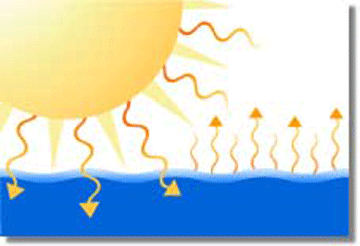
The world’s oceans absorbed more heat in 2025 than in any year since
modern records began, according to a major international analysis. Ocean
heat content rose by 23 zettajoules – the equivalent of detonating
hundreds of millions of Hiroshima atomic bombs, or roughly 200 times
humanity’s global electricity consumption in 2023 – according to the
analysis published in Advances in Atmospheric Sciences. Unlike sea surface
temperatures, ocean heat content is a measure of how much excess energy the
world’s oceans are storing over time, including at depth.
Independent 9th Jan 2026,
https://www.independent.co.uk/climate-change/news/ocean-heat-record-2025-b2895936.html
Trump Abandonment of Global Treaties, Including Landmark Climate Deal, ‘Threatens All Life on Earth’

“Trump cutting ties with the world’s oldest climate treaty is another despicable effort to let corporate fossil fuel interests run our government.”
Jake Johnson, Jan 08, 2026, https://www.commondreams.org/news/trump-withdraws-global-treaties
President Donald Trump on Wednesday withdrew the United States from dozens of international treaties and organizations aimed at promoting cooperation on the world’s most pressing issues, including human rights and the worsening climate emergency.
Among the treaties Trump ditched via a legally dubious executive order was the United Nations Framework Convention on Climate Change (UNFCCC), making the US—the world’s largest historical emitter of planet-warming greenhouse gases—the first country to abandon the landmark agreement.
President Donald Trump on Wednesday withdrew the United States from dozens of international treaties and organizations aimed at promoting cooperation on the world’s most pressing issues, including human rights and the worsening climate emergency.
Among the treaties Trump ditched via a legally dubious executive order was the United Nations Framework Convention on Climate Change (UNFCCC), making the US—the world’s largest historical emitter of planet-warming greenhouse gases—the first country to abandon the landmark agreement.
The US Senate ratified the convention in 1992 by unanimous consent, but lawmakers have repeatedly failed to assert their constitutional authority to stop presidents from unilaterally withdrawing from global treaties.
Jean Su, energy justice director at the Center for Biological Diversity, said in a statement that “Trump cutting ties with the world’s oldest climate treaty is another despicable effort to let corporate fossil fuel interests run our government.”
“Given deeply polarized US politics, it’s going to be nearly impossible for the U.S. to rejoin the UNFCCC with a two-thirds majority vote. Letting this lawless move stand could shut the US out of climate diplomacy forever,” Su warned. “Withdrawing from the world’s leading climate, biodiversity, and scientific institutions threatens all life on Earth.”
Trump also pulled the US out of the International Institute for Justice and the Rule of Law, the International Union for Conservation of Nature, the UN International Law Commission, the UN Democracy Fund, UN Oceans, and dozens of other global bodies, deeming them “contrary to the interests of the United States.”
The president’s move came as he continued to steamroll domestic and international law with an illegal assault on Venezuela and threats to seize Greenland with military force, among other grave abuses.
Below is the full list of international organizations that Trump abandoned with the stroke of a pen:
(a) Non-United Nations Organizations:
(i) 24/7 Carbon-Free Energy Compact;
(ii) Colombo Plan Council;
(iii) Commission for Environmental Cooperation;
(iv) Education Cannot Wait;
(v) European Centre of Excellence for Countering
Hybrid Threats;
(vi) Forum of European National Highway Research Laboratories;
(vii) Freedom Online Coalition;
(viii) Global Community Engagement and Resilience Fund;
(ix) Global Counterterrorism Forum;
(x) Global Forum on Cyber Expertise;
(xi) Global Forum on Migration and Development;
(xii) Inter-American Institute for Global Change Research;
(xiii) Intergovernmental Forum onMining, Minerals, Metals, and Sustainable Development;
(xiv) Intergovernmental Panel on Climate Change;
(xv) Intergovernmental Science-Policy Platform on Biodiversity and Ecosystem Services;
(xvi) International Centre for the Study of the Preservation and Restoration of Cultural Property;
(xvii) International Cotton Advisory Committee;
(xviii) International Development Law Organization;
(xix) International Energy Forum;
(xx) International Federation of Arts Councils and Culture Agencies;
(xxi) International Institute for Democracy and Electoral Assistance;
(xxii) International Institute for Justice and the Rule of Law;
(xxiii) International Lead and Zinc Study Group;
(xxiv) InternationalRenewable Energy Agency;
(xxv) International Solar Alliance;
(xxvi) International Tropical Timber Organization;
(xxvii) International Union for Conservation of Nature;
(xxviii) Pan American Institute of Geography and History;
(xxix) Partnership for Atlantic Cooperation;
(xxx) Regional Cooperation Agreement on Combatting Piracy and Armed Robbery against Ships in Asia;
(xxxi) Regional Cooperation Council;
(xxxii) Renewable Energy Policy Network for the 21st Century;
(xxxiii)Science and Technology Center in Ukraine;
(xxxiv) Secretariat of the Pacific Regional Environment Programme; and
(xxxv) Venice Commission of the Council of Europe.
(b) United Nations (UN) Organizations:
(i) Department of Economic and Social Affairs;
(ii) UN Economic and Social Council (ECOSOC) — Economic Commission forAfrica;
(iii) ECOSOC — Economic Commission forLatin America and the Caribbean;
(iv) ECOSOC — Economic and Social Commission for Asia and the Pacific;
(v) ECOSOC — Economic and Social Commission for Western Asia;
(vi) International Law Commission;
(vii) International Residual Mechanism for Criminal Tribunals;
(viii) InternationalTrade Centre;
(ix) Office of the Special Adviser on Africa;
(x) Office of the Special Representative of the Secretary General forChildren in Armed Conflict;
(xi) Office of the Special Representative of the Secretary-General on Sexual Violence in Conflict;
(xii) Office of the Special Representative of the Secretary-General on Violence Against Children;
(xiii) Peacebuilding Commission;
(xiv) Peacebuilding Fund;
(xv) Permanent Forum on People of African Descent;
(xvi) UN Alliance of Civilizations;
(xvii) UN Collaborative Programme on Reducing Emissions fromDeforestation and Forest Degradation in Developing Countries;
(xviii) UN Conference on Trade and Development;
(xix) UN Democracy Fund;
(xx) UN Energy;
(xxi) UN Entity for Gender Equality and the Empowerment of Women;
(xxii) UN Framework Convention on Climate Change;
(xxiii) UN Human Settlements Programme;
(xxiv) UN Institute for Training and Research;
(xxv) UN Oceans;
(xxvi) UN Population Fund;
(xxvii) UN Register of Conventional Arms;
(xxviii) UN System Chief Executives Board for Coordination;
(xxix) UN System Staff College;
(xxx) UNWater; and
(xxxi) UN University.
Rachel Cleetus, policy director and lead economist for the Climate and Energy Program at the Union of Concerned Scientists, said Trump’s withdrawal from the world’s bedrock climate treaty marks “a new low and yet another sign that this authoritarian, anti-science administration is determined to sacrifice people’s well-being and destabilize global cooperation.”
“Withdrawal from the global climate convention will only serve to further isolate the United States and diminish its standing in the world following a spate of deplorable actions that have already sent our nation’s credibility plummeting, jeopardized ties with some of our closest historical allies, and made the world far more unsafe,” said Cleetus. “This administration remains cruelly indifferent to the unassailable facts on climate while pandering to fossil fuel polluters.”
1 This Month
10 March A LIVE WEBINAR THE REAL EFFECTS OF NUCLEAR POWER
What the Industry Isn’t Telling Us
1:00 PM Mountain, 2 pm Central, 3 pm Eastern. Live on the Keepers of the Water Facebook page



18 March Webinar @ 1 PM EST: An Assessment of SMR Projects: The Case of Canada
register for the zoom:
https://us02web.zoom.us/webinar/register/WN_o8BIIOUvQ2ONJR1nta65DQ#/registration


of the week – STOP SMALL MODULAR REACTORS IN CANADA
To see nuclear-related stories in greater depth and intensity – go to https://nuclearinformation.wordpress.com
-
Archives
- March 2026 (99)
- February 2026 (268)
- January 2026 (308)
- December 2025 (358)
- November 2025 (359)
- October 2025 (376)
- September 2025 (258)
- August 2025 (319)
- July 2025 (230)
- June 2025 (348)
- May 2025 (261)
- April 2025 (305)
-
Categories
- 1
- 1 NUCLEAR ISSUES
- business and costs
- climate change
- culture and arts
- ENERGY
- environment
- health
- history
- indigenous issues
- Legal
- marketing of nuclear
- media
- opposition to nuclear
- PERSONAL STORIES
- politics
- politics international
- Religion and ethics
- safety
- secrets,lies and civil liberties
- spinbuster
- technology
- Uranium
- wastes
- weapons and war
- Women
- 2 WORLD
- ACTION
- AFRICA
- Atrocities
- AUSTRALIA
- Christina's notes
- Christina's themes
- culture and arts
- Events
- Fuk 2022
- Fuk 2023
- Fukushima 2017
- Fukushima 2018
- fukushima 2019
- Fukushima 2020
- Fukushima 2021
- general
- global warming
- Humour (God we need it)
- Nuclear
- RARE EARTHS
- Reference
- resources – print
- Resources -audiovicual
- Weekly Newsletter
- World
- World Nuclear
- YouTube
-
RSS
Entries RSS
Comments RSS
 nuclear-news