Who should take on the costs and risks of nuclear power?
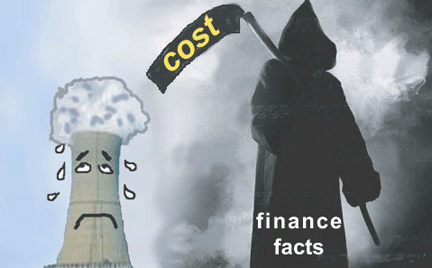
There are, of course, other alternatives that may or may not turn out to be cheaper: gas (with or without carbon capture), renewables (assuming some form of affordable energy storage can be found) or letting the market itself decide how our electricity should be generated. If nuclear really is the future you might expect investors to be more interested in it without subsidies. And of course, you don’t get something for nowt: if consumers do end up paying less for Sizewell than they will for Hinkley it will be because they have taken on more risk.
Who should pay for nuclear? Spectator, Ross Clark, 29 Oct 21, ”……………… the funding of nuclear power stations that was unveiled yesterday in the form of the Nuclear Energy Finance Bill. The proposed legislation will impose levies on energy bills in order to subsidise the construction of new nuclear power stations. The new model of funding — called Regulated Asset Base — will replace the model by which Hinkley C is being constructed: the contracts for difference, or CfD, model which was used to entice EDF to undertake the project. The carrot is a guaranteed ‘strike’ price for electricity generated by the plant as soon as it starts generating electricity.
………… it will inevitably transfer risk to the consumer — should, say, the proposed new plant at Sizewell in Suffolk end up being abandoned before it begins generating power, taxpayers will already have paid towards the plant through their bills.
With his characteristic optimism, Kwarteng claims that the new funding model will ‘save’ energy consumers £30 billion on each nuclear project. Can that really be true? It rather depends on your definition of saving money.
Kwarteng’s claim is based on the presumption that the only alternative to new nuclear power stations funded by the new model is for nuclear power stations to be funded like Hinkley by the CfD model. But Hinkley was itself horrendously expensive: EDF has been guaranteed a minimum price of £92.50 per MWh (at 2012 prices) over 35 years, the expected lifetime of the power station — around twice as high as wholesale electricity prices at the time the deal was signed.
……… it is somewhat dubious to replace a very expensive form of subsidy with one that promises to be merely expensive — and then claim that you have ‘saved’ money.
There are, of course, other alternatives that may or may not turn out to be cheaper: gas (with or without carbon capture), renewables (assuming some form of affordable energy storage can be found) or letting the market itself decide how our electricity should be generated. If nuclear really is the future you might expect investors to be more interested in it without subsidies. And of course, you don’t get something for nowt: if consumers do end up paying less for Sizewell than they will for Hinkley it will be because they have taken on more risk…………. https://www.spectator.com.au/2021/10/who-should-pay-for-nuclear/
Jacobs joint venture wins $8bn nuclear clean-up contract in US.
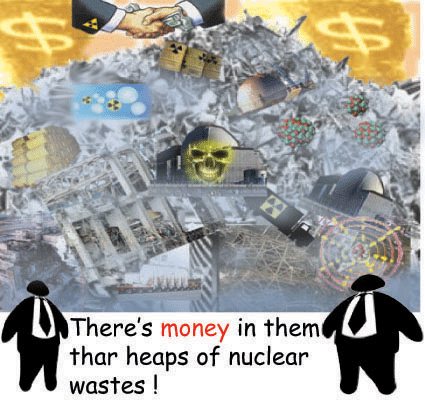
Jacobs joint venture wins $8bn nuclear clean-up contract in US, GCR, Joe Quirke, 29.10.21
The United Cleanup Oak Ridge (UCOR) consortium has landed a 10-year contract worth $8.3bn to remediate the Oak Ridge Reservation site in Tennessee.
UK pension funds and other investors not keen to invest in Sizewell nuclear power project?
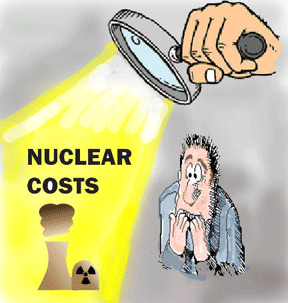
UK government to invest £1.7bn in Sizewell C nuclear power station. British taxpayers will make a final investment in the planned Sizewell C nuclear power plant project over the next three years as the government is resuming its struggling efforts to replace the country’s aging reactors. Funding is included in Wednesday’s budget, following the minister’sannouncement this week to review the new nuclear power plant funding model.
Prime Minister Rishi Sunak did not mention Sizewell C in his budget speech Wednesday. However, an accompanying Treasury document has “active negotiations” with EDF on the plant and “up to £ 1.7 billion in direct government funding to help reach a final investment decision before the next election. State funding accounts for a significant proportion of the estimated £ 20 billion.
The government hopes that its financial involvement in Sizewell C will help encourage outside investors to provide
additional funding as expected. The minister wants to attract investors from the UK, the United States, etc. to help finance nuclear reconstruction before the existing reactors retire by 2035, but analysts are questioning how pension funds and others are enthusiastic about investing.
FT 27th Oct 2021
https://www.ft.com/content/73ec90ad-8942-4daf-af01-429d7b3aa948
Electricite de France (EDF) will not proceed with Sizewell nuclear project unless the UK govt institutes tax – the Regulated Asset Base

Stop Sizewell C denounces the government’s announcement today of legislation for a new tax on consumer energy bills to help build nuclear power stations such as Sizewell C. The Regulated Asset Base (RAB) model would transfer substantial upfront costs, and considerable risk, onto consumers already struggling with rising energy bills and other tax
increases.
Developer EDF Energy estimates Sizewell C – which does not have planning consent and may never get it – would cost at least £20 billion and has made no secret that the project could not proceed without a RAB. The announcement is clearly earmarked for large-scale nuclear projects, as Rolls Royce says it doesn’t anticipate using RAB for Small
Modular Reactors. The government is moving with extreme haste, with the second reading of the bill tomorrow.
Stop Sizewell C 26th Oct 2021
https://stopsizewellc.org/category/news/
UK government pledges Government pledges £1.7bn of public money to new nuclear plant

By making a direct investment in a nuclear plant through the new financial framework, known as a Regulated Asset Base (RAB) model, the government could effectively put both taxpayers and energy bill payers on the hook for costly construction delays.………
Government pledges £1.7bn of public money to new nuclear plant
The Guardian understands the funding is likely to be used to back the planned £20bn Sizewell C, Guardian, Jillian Ambrose Energy correspondentThu 28 Oct 2021 The government will make its first direct investment in a large-scale nuclear reactor since 1995 after pledging to plough up to £1.7bn of taxpayers’ money into a new power plant.
Treasury documents published alongside the autumn statement did not name which nuclear project would be in line for the public funds, but the Guardian understands it is most likely to be the planned £20bn Sizewell C plant in Suffolk.
Government officials are locked in talks with Sizewell C’s developer, the French state-backed energy company EDF, about how to finance its successor to the Hinkley Point C plant in Somerset………..
The government set out new legislation earlier this week for a financial support framework for nuclear plants which would make the projects more attractive to investors by piling part of the upfront cost on to household energy bills before the plants start generating electricity.
By making a direct investment in a nuclear plant through the new financial framework, known as a Regulated Asset Base (RAB) model, the government could effectively put both taxpayers and energy bill payers on the hook for costly construction delays……….
A spokesperson for the Treasury was not immediately available to comment.
The government’s nuclear ambitions are also backed by £385m for research and development of ‘advanced nuclear’ technologies, and it has set aside £120m to address the nuclear industry’s barriers to entry….. https://www.theguardian.com/environment/2021/oct/27/government-pledges-17bn-of-public-money-to-new-nuclear-plant
Georgia nuclear reactors delayed again as costs mount

Georgia nuclear reactors delayed again as costs mount, https://apnews.com/article/business-environment-and-nature-georgia-atlanta-augusta-05a297d661a9048eb1db5a50c89aeef1
By JEFF AM ATLANTA (AP) — Georgia Power Co. is pushing back the startup date for its two new nuclear reactors near Augusta, saying it’s still redoing sloppy construction work and that contractors still aren’t meeting deadlines.
The unit of Atlanta-based Southern Co. now says the third reactor at Plant Vogtle won’t start generating electricity until sometime between July and September of next year. Previously the company said it would start in June at the latest. The fourth reactor won’t come online until sometime between April and June of 2023.
The delay will mean more costs for a project already estimated to exceed $27.8 billion overall. Georgia Power, which owns 46% of the project, had already estimated it would spend $9.2 billion, with another $3.2 billion in financing costs.
Besides Georgia Power, most electrical cooperatives and municipal utilities in Georgia own shares of the plants. Also obligated to buy power from Vogtle are Florida’s Jacksonville Electric Authority and some cooperatives and municipal utilities in Alabama.
$6000 a day to one US advisor to Australia on getting nuclear submarines. How much to the 3 new ones?

American-dominated panel advising government on submarines as Defence eyes US and UK choices for nuclear fleet, By defence correspondent Andrew Greene, ABC, 25Oct 21.
Three senior American shipbuilding executives are being paid to advise Australia on submarines, but the defence department and government are refusing to say what their work involves or how much they are costing.
Key points:
- Defence is refusing to discuss the role or salaries of the American officials on the Submarine Advisory Committee
- Senators are expected to examine the work of the submarine committee during Senate Estimates hearings this week
- Industry insiders believe the submarine committee needs a British official given the UK’s role in AUKUS
Senators are this week expected to grill officials over the role of the Submarine Advisory Committee, which was formed by the Turnbull government in 2017, a year after a French company was selected for the now dumped $90 billion Attack-class program.
……… Over the next year and a half, the defence department’s Nuclear-Powered Submarine Task Force will work with Australia’s British and American AUKUS partners to identify the best way to acquire a fleet to replace the scrapped French project……. Retired Admiral Donald Kirkland, Jim Hughes and Donald McCormack are all veterans of the US shipbuilding sector and their current three-year appointments to the committee are due to end in May 2024.
Admiral Kirkland is the chairman of American company Huntington Ingalls Industries (HII), which builds US Virginia-class submarines, Mr Hughes has also worked for HII, and Mr McCormack is an executive director at the US military’s Naval Sea Systems Command.
Questions sent by the ABC to the defence department last week concerning how much Submarine Advisory Committee members are paid, and what interactions they now have with the Nuclear-Powered task force, remain unanswered.
While Defence is yet to respond to questions about remuneration, an 18-month contract from 2018 uncovered by the ABC, shows Admiral Kirkland was paid $675,000 for his advisory services.
Earlier this month, Vice Admiral Jonathan Mead confirmed his secretive “Capability Enhancement Review” completed ahead of the Morrison government’s nuclear submarine announcement had not worked with the advisory committee.
Jostling between British and American companies for Australia’s future nuclear-powered fleet is well underway with early debate emerging over whether a US Virginia-class or UK Astute-class submarine is the best base model
Defence industry insiders are now privately questioning whether the government will appoint any British experts to the Submarine Advisory Panel given the United Kingdom’s membership of AUKUS and the country’s extensive experience with nuclear boats.
Last month, it was revealed former US Navy Secretary Donald Winter was being paid $US6,000 a day as an advisor to the federal government on shipbuilding matters.Defence industry insiders are now privately questioning whether the government will appoint any British experts to the Submarine Advisory Panel given the United Kingdom’s membership of AUKUS and the country’s extensive experience with nuclear boats.
Last month, it was revealed former US Navy Secretary Donald Winter was being paid $US6,000 a day as an advisor to the federal government on shipbuilding matters. https://www.abc.net.au/news/2021-10-26/american-dominated-panel-advising-nuclear-submarine-fleet/100567052
Campaign to get NatWest bank to stop investing in nuclear weapons

Campaign criticises Natwest nuclear arms firms’ investments, The National, By Greg Russell @National_Greg 24 Oct 21, WITH the eyes of the world on Glasgow for the COP26 climate conference, a campaign group aimed at raising the profile of the health and humanitarian impacts of the use of nuclear weapons has highlighted a major sponsor’s investment in firms that produce nuclear weapons.
Scotland’s biggest bank, Natwest, is a major sponsor of the event, which will bring together representatives of almost 200 countries aimed at agreeing measures to address the global climate emergency.
However, Medact Scotland said the bank’s ongoing investments in companies that make nuclear weapons contradicts its climate and environmental commitments.
“The detonation of just one nuclear bomb would generate a fireball and shockwave that would destroy everything within the blast zone and spread radioactive contamination far beyond it”, said retired GP Dr Guy Johnson, of Medact Scotland.
“A nuclear exchange using less than 1% of the world’s nuclear weapons would alter the Earth’s climate, leading to widespread famine, while the climate impacts of a full-scale nuclear war could make human existence impossible.”
According to pressure group Don’t Bank on the Bomb Scotland, NatWest Group held investments worth £2 billion in 15 nuclear weapons producers over a two-year period, which included investments in major arms companies BAE Systems, Thales and General Dynamics.
Linda Pearson, from the campaign group, said: “NatWest Group cannot claim to be a leader in addressing climate change while continuing to finance the nuclear weapons industry.
“Nuclear weapons production is energy intensive and environmentally damaging.
“Ultimately, any efforts to address the climate crisis will be in vain if the world is destroyed by nuclear war.”
In March this year, Don’t Bank on the Bomb Scotland and its partners sent an open letter to NatWest CEO, Alison Rose, calling on the bank to comprehensively exclude nuclear weapons producers from investment.
The letter was co-signed by 42 organisations including the International Campaign to Abolish Nuclear Weapons, Church of Scotland, Unison Scotland and Friends of the Earth Scotland.
Don’t Bank on the Bomb Scotland is also encouraging individuals to contact the bank directly.
“We want NatWest to live up to its climate commitments”, Johnson said.
“That means the bank must recognise the catastrophic consequences of nuclear weapons and cut all financial ties with the companies that make them.”………. https://www.thenational.scot/news/19669192.campaign-criticises-natwest-nuclear-arms-firms-investments/
Rolls Royce being urged to do nuclear testing in UK, not in Italy
Rolls-Royce being urged to carry out nuclear testing in UK after it emerged company was considering using site in northern Italy, This Is Money,
By ALEX LAWSON, FINANCIAL MAIL ON SUNDAY 24 October 2021 Rolls-Royce is being urged to carry out nuclear testing in the UK after it emerged that the company was considering using a site in northern Italy.
The engineering giant has shortlisted the SIET institute in Piacenza for testing work as part of its plan to build small nuclear reactors.
Domestic options for the tests include a proposed site on Anglesey, north Wales.
MPs and unions have spoken out since The Mail on Sunday revealed last week that some of the work could take place in Piacenza. Mike Clancy, general secretary of the Prospect trade union, said: ‘To justify taking these jobs offshore there should be a high bar and proof that there is not sufficient capacity or time to do the work indigenously.
‘You would hope that it is not just about cost. In the current climate any major UK corporate should be asking questions about what would look like offshoring.’
The Conservative MP for Anglesey, Virginia Crosbie – a nuclear advocate known as the ‘Atomic Kitten’ – hopes to persuade the Government to fund a thermal hydraulic testing facility on the island.
She said: ‘We should absolutely see this work done here. It is clearly in our national interest.’
A Rolls-Royce spokesman said: ‘We have committed to source 80 per cent of this project by value in the UK and the priority for this business is to maximise UK content.’ … https://www.thisismoney.co.uk/money/markets/article-10123765/Rolls-Royce-urged-carry-nuclear-testing-UK.html
Insurance industry not convinced that nuclear power is ”green”, and is wary of nuclear as an investment risk.
INSURANCE ASSET RISK
IAR 2021 EMEA conference: highlights from day 2
”…………what constitutes a ‘green’ asset is not yet universally accepted, and this became apparent during a panel on infrastructure investing. The question of nuclear financing crept in the debate, and although politicians may have their ideas on the topic, the jury is still out for investors.….. https://www.insuranceassetrisk.com/content/news/iar-2021-emea-conference-highlights-form-day-2.html
The nuclear industry might get taxpayers money by calling itself ”amber”, if it’s too hard to appear ”green”
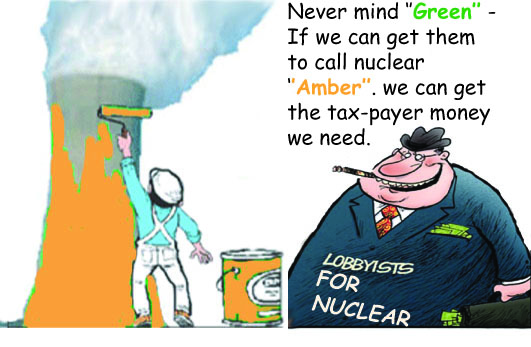
possible compromises included creating an “amber” label for activity that did not win the green label but would still secure a place in the bloc’s transition and not discourage private sector investment. ………..
Brussels to delay decision on how to classify nuclear power for green finance. Debate over energy has been supercharged by surging electricity costs, Ft.com Mehreen Khan and Sam Fleming in Brussels, 20 Oct 21
Brussels will delay long-awaited proposals on how to classify nuclear power and natural gas under the EU’s landmark labelling system for green finance, as member states demand looser rules to help counteract the continent’s energy crisis. EU financial services commissioner Mairead McGuinness told the Financial Times that Brussels would take more time before deciding how to deal with the controversial energy sources under the so-called “taxonomy on sustainable finance” that had been due this autumn.
The debate about how to classify low carbon natural gas and nuclear energy, which produces no CO2 [ ed.except in its long complex fuel and waste chains] but whose waste byproducts are toxic for the environment, has been supercharged by surging electricity costs that have prompted EU governments into emergency financial action to protect households. European leaders are due to debate the taxonomy and how to mitigate soaring prices at a summit in Brussels on Thursday.
“As we come to the end of the year there will be more pressure to resolve this,” said McGuinness. “We don’t have a ready-made solution because this is, both technically but politically . . . one of those issues where you have very divided views.” Europe’s pro-nuclear countries, led by France, and pro-gas member states in the south and east, are demanding the taxonomy rules do not penalise technologies they say are vital in securing the transition to net zero emissions. Environmental groups, however, want the system to abide by scientific criteria to ensure the rules stamp out, rather than encourage, so-called “greenwashing” in the investment industry. ………..
Europe’s energy crisis is the latest challenge to the credibility of the EU’s green labelling system which was designed to be a “gold standard” for investors to know what counts as truly sustainable economic activity. But the rules have been mired in controversy as Brussels struggles to balance science with sensitive political decisions about whether to award some activities the highest green label — penalising those that do not. Ten countries, including France, Finland, Poland and Hungary this week said it is “absolutely necessary that nuclear power was included in the taxonomy framework”.
McGuinness said it remained an “open question” as to whether the green label would be expanded to “accommodate nuclear and gas”. She said possible compromises included creating an “amber” label for activity that did not win the green label but would still secure a place in the bloc’s transition and not discourage private sector investment. ………..
The rules are being closely watched by investors and regulators in the US and UK, who have also said they will come up with their own classification systems. Within the EU, the taxonomy will be used to judge whether investments made by member states are truly green and will form the basis for an EU “green bond standard” that will be used to issue €250bn in sustainable debt under the bloc’s recovery fund. https://www.ft.com/content/898e6c53-8e85-4cfc-b00b-16a09d50b462
Clyde nuclear base emergency staff to strike from tomorrow over safety fears
Clyde nuclear base emergency staff to strike from tomorrow over safety fears, Herald Scotland, By Martin Williams @Martin1Williams, Senior News Reporter 18 Oct 21, EMERGENCY workers at the home of Britain’s nuclear weapons on the Clyde are set to strike over “major safety concerns” after managers slashed firefighter numbers.
Action has been previously been given the go-ahead following a ballot of workers after managers proceeded with cuts to eight posts from the specialist fire safety crew at HM Naval Base Clyde, a reduction in strength of 15 per cent, with the a union describing it as an “an accident waiting to happen”.
Unite members working for outsourcing services firm Capita Business Services will now start strike action from Tuesday in a dispute over cuts to fire and rescue crew levels, and a lack of consultation………………
Workers believe the cuts impair the abilities of the onsite fire crews to do their jobs properly, particularly, in relation to incidents that would involve wearing breathing apparatus.
Capita has previously stated that they intend to mitigate safety risks due to the cuts through an investment in new technology to reduce fire risk”.
But workers have said they are not aware of any new technology which would address ongoing safety concerns…………………………… https://www.heraldscotland.com/news/homenews/19655524.clyde-nuclear-base-emergency-staff-strike-tomorrow-safety-fears/
UK to push for nuclear power: households to pay up long before the reactors are built
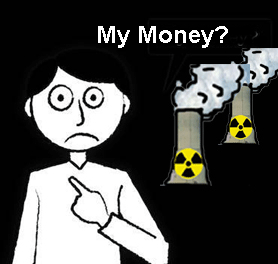
UK to put nuclear power at heart of net zero emissions strategy. British
ministers will put nuclear energy at the heart of Britain’s strategy to
reach net zero carbon emissions by 2050 in government documents due as
early as next week, along with new details on its funding model.
Kwasi Kwarteng, business secretary, is due to unveil the “Net Zero Strategy”,
as well as a “Heating and construction strategy” and an assessment of
the Treasury of the cost to reach the 2050 target. The main strategy will
be heavily focused on the long overdue and slow British nuclear program.
The country’s existing reactors are expected to be phased out by 2035,
with construction of a single large plant, Hinkley Point C, already
underway.
The creation of a “regulated asset base” (RAB) model will be
the key to the delivery of a future fleet of large nuclear power plants.
Under this program, households will be billed for the cost of the plant via an energy
tax long before it starts producing electricity, which could take a decade
or more from the time. where the final investment decision is made.
FT 16th Oct 2021
https://www.ft.com/content/e6426194-21e6-49c4-9520-97c337b350fd
French President Macron now goes for small nuclear reactors – with vision of an exporting bonanza
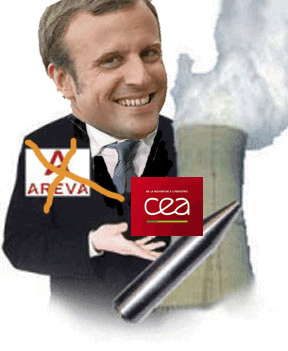
France unveils nuclear power overhaul – with an eye on China, French President Emmanuel Macron announced a shift to small modular nuclear reactors on Tuesday as he unveiled his €30 billion, five-year strategy to bolster France’s high-tech sectors, building on the country’s history as a pioneer of nuclear energy. France 24, 17 Oct 21,
Macron announced that the “number one priority” for his industrial strategy was for France to develop “innovative small-scale nuclear reactors” by 2030.
This marks a sea change in France’s approach to nuclear energy……………“The small modular reactors each generate less than 300 megawatts (MW) of energy; far less than most reactors currently in service, which tend to produce between 950 and 1300 MW, with some of them including the Flamanville plant [on the English Channel] capable of as much as 1600 MW,” said Giorgio Locatelli, an expert on the engineering of nuclear power stations at Milan Polytechnic.
……… In the grand sweep of the history of French nuclear power, the shift towards smaller reactors looks like a step back, Locatelli suggested, because France “started with small reactors in the 1960s before switching to larger ones to develop economies of scale”.However, this trend has now reached its limited, he continued. “Reactors like the one at Flamanville are not only very expensive, but also it’s a long and complex process to build them.” It takes billions to create such plants, and often it is difficult for governments to find investors willing to wait up to a decade before their returns start coming in.
Competition with China
Most countries lack the means to pull of these massive reactors, noted Nicolas Mazzucchi, an energy specialist at France’s Foundation for Strategic Research: “The financing models they require – not to mention the capacity to really mobilise a country’s savoir-faire in this domain – are increasingly rare, except in nations like Russia and China where energy companies have total state backing.”
Consequently, switching to small modular reactors is a strategic pivot to allow France to deal with competition from countries like China, which has increasingly big ambitions when it comes to nuclear power.
France’s change of approach could also allow it to win lucrative new markets. “By 2025, nearly a quarter of the world’s existing nuclear capacity will be exhausted because the reactors will have become too old,” Mazzucchi continued……………..
‘Lack of experience’………. The people in charge of reactors using cutting-edge technology “will have to justify their safety”, Herviou said. So far, the theoretical advantages of small modular reactors have not been confirmed in practice. Some 70 such reactors are currently in development throughout the world – and the vast majority of these projects are still in the early stages. “The main concern with this technology is the lack of a track record,” said Locatelli. What is more, he continued, nuclear power’s “chicken-and-egg problem is still there: Is it better to start building reactors first to win over buyers or is it best to find the investors first?” …………. https://www.france24.com/en/france/20211013-france-unveils-nuclear-power-overhaul-with-eye-on-china
France – a new Bill calls for transparency on costs of nuclear power
A bill calls for more transparency on French nuclear power “There are not
enough figures, today we do not know how much it costs!”, Laments a member
of the Meuse. Émilie Cariou denounces the opacity in the sector.
France Inter 13th Oct 2021
1 This Month



26 September – International Day for the Total Elimination of Nuclear Weapons


PLEASE OPPOSE HR 8255 AND S.3639 – bills would accelerate satellite deployment, with no environmental review or safeguards – https://ncstd5li.quorum.us/campaign/169331/
To see nuclear-related stories in greater depth and intensity – go to https://nuclearinformation.wordpress.com
-
Archives
- September 2026 (245)
- August 2026 (330)
- July 2026 (355)
- June 2026 (287)
- May 2026 (306)
- April 2026 (356)
- March 2026 (251)
- February 2026 (267)
- January 2026 (308)
- December 2025 (358)
- November 2025 (359)
- October 2025 (375)
-
Categories
- 1
- 1 NUCLEAR ISSUES
- business and costs
- climate change
- culture and arts
- ENERGY
- environment
- health
- history
- indigenous issues
- Legal
- marketing of nuclear
- media
- opposition to nuclear
- PERSONAL STORIES
- politics
- politics international
- Religion and ethics
- safety
- secrets,lies and civil liberties
- spinbuster
- technology
- Uranium
- wastes
- weapons and war
- Women
- 2 WORLD
- ACTION
- AFRICA
- Atrocities
- AUSTRALIA
- Christina's notes
- Christina's themes
- culture and arts
- Events
- Fuk 2022
- Fuk 2023
- Fukushima 2017
- Fukushima 2018
- fukushima 2019
- Fukushima 2020
- Fukushima 2021
- general
- global warming
- Humour (God we need it)
- Nuclear
- RARE EARTHS
- Reference
- resources – print
- Resources -audiovicual
- Weekly Newsletter
- World
- World Nuclear
- YouTube
-
RSS
Entries RSS
Comments RSS
 nuclear-news