Georgia Power customers to pay up even more for Vogtle nuclear project
$224M Georgia Power Rate Hike Likely for Nuclear Plant
Georgia Power Co. customers will likely pay another $224 million a year for the first of two nuclear reactors near Augusta.U.S. Oct. 14, 2021, By JEFF AMY, Associated Press
ATLANTA (AP) — Georgia Power Co. customers are likely to pay another $224 million a year for the first of two nuclear reactors near Augusta.
…… The rate increase would start after Unit 3 at Plant Vogtle begins generating electricity. The reactor is now supposed to go into service in June. Customers could be asked to pay substantially more once the fourth reactor begins generating power, now scheduled for sometime in 2023.
A $157 million rate hike, costing a typical residential customer $2.87 a month, is also set to begin on Jan. 1. That’s part of a three-year $1.77 billion plan approved by commissioners in 2019. Customers also are likely to see a third separate rate hike, to allow Georgia Power to cover higher fuel costs.
……….. Georgia Power owns 46% of the two new reactors at Plant Vogtle. The unit of Atlanta-based Southern Co. currently projects it will spend $9.2 billion, with another $3.2 billion in financing costs. Those numbers could rise as construction delays continue to mount.
The Vogtle reactors are currently projected to cost more than $27.8 billion overall, not counting the $3.68 billion that original contractor Westinghouse paid back to the owners after going bankrupt. When approved in 2012, the estimated cost was $14 billion, with the first electricity being generated in 2016.
Other owners include most Georgia electric cooperatives and municipal utilities. Florida’s Jacksonville Electric Authority and some other municipal utilities and cooperatives in Florida and Alabama are also obligated to buy the nuclear power. The Georgia Public Service Commission controls rates only for Georgia Power.
In a Thursday hearing, several witnesses called for delaying or reducing the proposed rate increase.
“Rate increases are never welcome, but the timing of Vogtle 3 could not be worse,” said Jeffry Pollock, a rate consultant who testified on behalf of the Georgia Association of Manufacturers. He proposed delaying part of the increase until the beginning of 2023.
Georgia Power’s 2.6 million customers have already paid more than $3.5 billion toward the cost of Vogtle units 3 and 4 under an arrangement that’s supposed to hold down borrowing costs. But rates are still projected to rise more as the nuclear reactors are completed. Public Service Commission staff members earlier estimated that the typical customer will have paid $854 in financing costs alone by the time the Vogtle reactors are finished…………………. https://www.usnews.com/news/politics/articles/2021-10-14/224m-georgia-power-rate-hike-likely-for-nuclear-plant
Rebranded – ROLLS-ROYCE SMR , a new conglomerate of 9 groups (to spread the risks of uneconomic small nuclear reactors?)
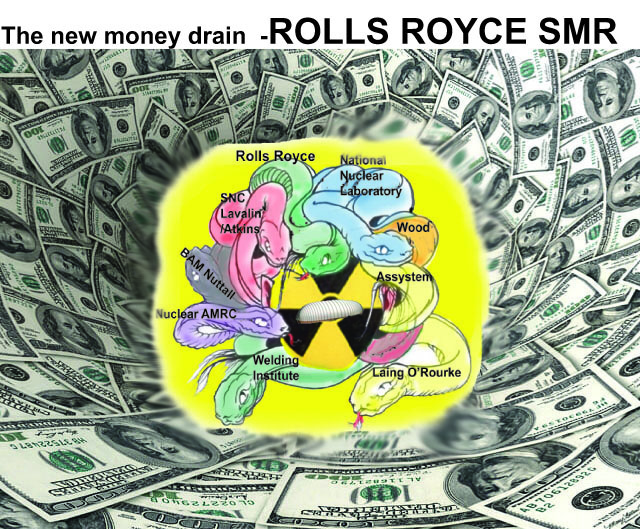
The nine-strong consortium also includes the National Nuclear Laboratory and Laing O’Rourke, the construction firm, alongside Assystem, SNC Lavalin/Atkins, Wood, BAM Nuttall, the Welding Institute and Nuclear AMRC.
UK poised to confirm funding for mini nuclear reactors for carbon-free energy Guardian,
Rolls-Royce-led consortium already has £210m in private backing for plans to build 16 reactors across the country, The government is poised to approve funding for a fleet of Rolls-Royce mini nuclear reactors that the prime minister hopes will help the UK reach his target of zero-carbon electricity by 2035.
A consortium led by the British engineering firm had already secured £210m in backing from private investors for the small modular reactor (SMR) project, a sum that the government is expected to match or better. Confirmation is expected before the spending review on 27 October, according to well-placed sources.
The consortium, known as UK SMR, will rebrand as Rolls-Royce SMR to coincide with Westminster’s blessing.
Tom Greatrex, the chief executive of the Nuclear Industry Association (NIA), said: “Match-funding for Rolls-Royce would be a huge signal to private investors that the government wants SMRs alongside new large-scale stations to hit net zero. It would also show investors that the government believes in nuclear as a green technology.”
Backing from the government will pave the way for the consortium’s multibillion-pound plan to build 16 SMRs around the country, the first of which could be plugged into the grid by 2031…………..
Confirmed support for SMRs could signal a concerted effort within government to reverse the scheduled decline in the UK’s nuclear power capacity. About 20% of the nation’s electricity comes from 13 nuclear reactors capable of producing 7.8GW of power. But more than half of that capacity comes from reactors due to retire by 2025, and plans to replace them have stalled.
Toshiba pulled out of a plant at Moorside in Cumbria in 2020, and Hitachi withdrew planning consent for a project at Wylfa Newydd, on Anglesey, this year. While Hinkley Point C is due to start generating electricity from 2026, only one new project, Sizewell C, is now in the works, with no final investment decision yet made.
Britain’s ability to build new nuclear reactors has been further complicated by the government’s unwillingness to allow any further involvement from the state-backed China General Nuclear. CGN has a 20% stake in Sizewell C but ministers have been looking into ways to remove it from the project before it moves to the construction phase. The Chinese company was due to take a lead role in the Bradwell reactor in Suffolk, which is now highly unlikely to go ahead.
Industry players are keen to see the government legislate to approve the regulated asset base (RAB) model, which allows private investors a more reliable stream of revenues from nuclear power plants – which typically require tens of billions of pounds to build – by piling costs on to household energy bills……..
The nine-strong consortium also includes the National Nuclear Laboratory and Laing O’Rourke, the construction firm, alongside Assystem, SNC Lavalin/Atkins, Wood, BAM Nuttall, the Welding Institute and Nuclear AMRC. https://www.theguardian.com/business/2021/oct/15/uk-poised-to-confirm-funding-for-mini-nuclear-reactors-for-green-energy
Crypto currency and nuclear power – a worrying partnership

Why Crypto Mining Needs Nuclear Power, Yahoo Finance Florent Heidet, Milos Atz (both writers employed at USA’s Dept of Enegy Argonne National Laboratory) Thu, October 14, 2021
”………Cryptocurrencies are digital currencies secured by cryptography. Unlike physical money, like dollars, cryptocurrencies are not minted by national institutions. Instead, they are created through complex algorithms that take place over computer networks. While not all crypto currencies have a specific function, the most valuable ones, such as BTC and ETH, exist primarily to carry financial transactions embedded in the blockchain – the cryptographic transaction record.
……….. The incredible rise in cryptocurrency value, associated with the ease to contribute to the cryptocurrency mining process with common computer hardware, has resulted in an ever-larger number of miners joining cryptocurrency networks. Increasing the number of miners benefits the system by further decentralizing, and therefore securing, the cryptocurrency.
……… Total power consumption used by mining across the major cryptocurrencies is tens of gigawatts electrical, or GWe, based on current network size and average mining equipment power. That is about the same as the power demand of Sweden or Montana. New generations of computing hardware are more efficient and progressively reduce power consumption per hashrate, but the high profitability of mining attracts more participants, yielding a net increase of the overall power used by the network. In fact, as long as the combined costs of electricity and hardware remain lower than the value of the generated cryptocurrency, the networks and their power consumption will continue growing and will soon surpass that of most countries.
Although cryptocurrency mining requires huge amounts of energy, the process itself is not directly polluting. The natural resource requirement is limited to what is needed to manufacture computer hardware and to generate electricity for the mining operations. Cryptocurrency mining is a 24/7 process using constant power with minimal downtime. Additionally, larger mining operations can require in excess of 100 megawatts of power for facilities with the footprint of a medium-size factory. Mining operations need a highly reliable and dense power supply.
………. To guarantee a share of carbon-free electricity, cryptocurrency mining operations may seek agreements with local grid operators or electricity generators. Some larger cryptocurrency mining operations may choose to own and operate their own electricity generation facilities.
………….The power demands of the cryptocurrency mining industry create a unique opportunity for synergizing with nuclear power. Nuclear reactors harness energy from fissioning elements such as uranium
………… Engaging with the burgeoning cryptocurrency industry is advantageous for the nuclear industry,…….. the cryptocurrency industry specifically demands the unique benefits of nuclear power, making partnerships an ideal opportunity…….. Cryptocurrency network growth will only further propel energy cost increases.
…………. Partnerships between the crypto-mining and the nuclear industries have already started to blossom. Recent reporting has showcased agreements forged between cryptocurrency mining operations and both nuclear utilities and nuclear reactor vendors. Given the synergies between cryptocurrency energy demands and nuclear power, we hope that these industries continue to engage with each other to explore mutually beneficial opportunities for growth and collaboration.
‘Profiteers of Armageddon’: Report Reveals Who Benefits From US ‘Nuclear Modernization’ Plan
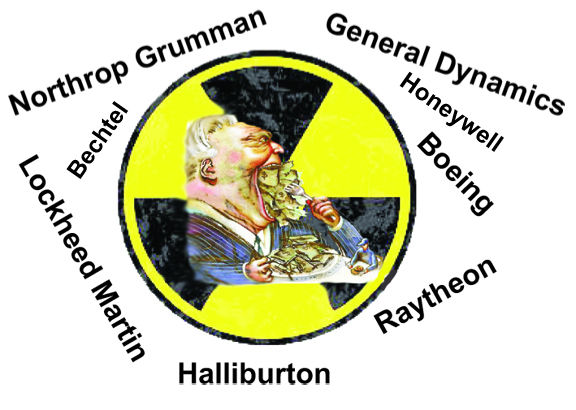
While “a handful of prime contractors” are the initial recipients and main beneficiaries of public money spent on bombers, missiles, and submarines, “the funds trickle down to subcontractors” that often include other prominent companies. The report names firms such as Bechtel, General Dynamics, Honeywell, Lockheed Martin, Northrop Grumman, and Raytheon.
Hartung directs attention to the millions of dollars in political activities by key contractors, writing that “while not all of this spending is devoted to lobbying on nuclear weapons programs, these expenditures are indicative of the political clout they can bring to bear on Congress as needed to sustain and expand the budgets for their nuclear weapons-related programs.”

They also spent $57.9 million on lobbying last year, employing 380 lobbyists, over two-thirds of whom “passed through the ‘revolving door’ from top positions in Congress, the Pentagon, and the Department of Energy to work for nuclear weapons contractors as executives or board members.”
And it should be noted that the revolving door swings both ways,” the report adds, noting that “three of the past five secretaries of defense worked as lobbyists or board members of major nuclear weapons contractors before taking up their positions in the Pentagon: James Mattis (General Dynamics); Mark Esper (Raytheon); and Lloyd Austin (Raytheon).”
‘Profiteers of Armageddon’: Report Reveals Who Benefits From US ‘Nuclear Modernization’ Plan, While taking aim at special interest lobbying and corporate profits that impede “sensible” policy, the author argues the “only way to be truly safe from nuclear weapons is to eliminate them altogether.” https://www.commondreams.org/news/2021/10/12/profiteers-armageddon-report-reveals-who-benefits-us-nuclear-modernization-plan
JESSICA CORBETT A short list of contractors that pour large sums of money into campaign contributions, lobbying, and industry-friendly think tanks benefits from the U.S. government’s ongoing, decadeslong “nuclear modernization” plan worth up to $2 trillion, according to a report out Tuesday.

The issue brief—entitled Profiteers of Armageddon: Producers of the next generation of nuclear weapons—was authored by William Hartung, director of the Arms and Security Program at the Center for International Policy, who also outlined his report in Inkstick.
Hartung details how the U.S. departments of Defense (DOD) and Energy (DOE) are ramping up a plan to build the next generation of nuclear-armed bombers, missiles, and submarines as well as warheads, and the beneficiaries are major contractors along with operators of the National Nuclear Security Administration’s (NNSA) nuclear weapons complex.
The brief notes the U.S. nuclear weapons budget has climbed in recent years to over $43 billion in the Biden administration’s proposed budget for fiscal year 2022, and warns that “this figure will grow dramatically,” pointing to a Congressional Budget Office (CBO) estimate that parts of the Pentagon’s plan “will cost tens of billions each over the next decade, including $145 billion for ballistic missile submarines, $82 billion for the new Intercontinental Ballistic Missile (ICBM), and $53 billion for the new nuclear-armed bomber.”
“And the costs will not end there,” the report continues, noting that “the estimated lifetime cost of building and operating the new ICBM is $264 billion.”
While “a handful of prime contractors” are the initial recipients and main beneficiaries of public money spent on bombers, missiles, and submarines, “the funds trickle down to subcontractors” that often include other prominent companies. The report names firms such as Bechtel, General Dynamics, Honeywell, Lockheed Martin, Northrop Grumman, and Raytheon.
Hartung directs attention to the millions of dollars in political activities by key contractors, writing that “while not all of this spending is devoted to lobbying on nuclear weapons programs, these expenditures are indicative of the political clout they can bring to bear on Congress as needed to sustain and expand the budgets for their nuclear weapons-related programs.”
From 2012 to 2020, campaign contributions from contractors mentioned in the brief topped $119 million, more than a quarter of which was in the 2020 cycle alone. They also spent $57.9 million on lobbying last year, employing 380 lobbyists, over two-thirds of whom “passed through the ‘revolving door’ from top positions in Congress, the Pentagon, and the Department of Energy to work for nuclear weapons contractors as executives or board members.”
And it should be noted that the revolving door swings both ways,” the report adds, noting that “three of the past five secretaries of defense worked as lobbyists or board members of major nuclear weapons contractors before taking up their positions in the Pentagon: James Mattis (General Dynamics); Mark Esper (Raytheon); and Lloyd Austin (Raytheon).”
The brief also pushes back against “routinely exaggerated” claims about job creation that both companies and lawmakers use to promote nuclear weapons programs, and points out that contractors pump millions into supporting think tanks that opine on relevant policy.
Continued lobbying for the modernization plan “ignores the fact that building a new generation of nuclear weapons at this time will make the world a more dangerous place and increase the risk of nuclear war while fueling the new arms race,” Hartung argues. “It’s long past time that we stopped allowing special interest lobbying and corporate profits stand in the way of a more sensible nuclear policy.”
While asserting that “the only way to be truly safe from nuclear weapons is to eliminate them altogether,” in line with a global treaty that states with such weapons continue to oppose, Hartung also highlights that “the organization Global Zero has outlined an alternative nuclear posture that would eliminate ICBMs, reduce the numbers of bombers and ballistic missile submarines, and implement a policy of no first use of nuclear weapons as part of a ‘deterrence-only’ strategy that would reduce the danger of a nuclear conflict.”
Global Zero CEO Derek Johnson welcomed Hartung’s brief in a tweet Tuesday.
Earlier this year, Sen. Elizabeth Warren (D-Mass.) and Rep. Adam Smith (D-Calif.) led the reintroduction of legislation (S.1219/H.R. 2603) to establish that “it is the policy of the United States to not use nuclear weapons first,” but the bill has not advanced in Congress, despite pressure from progressive lawmakers and campaigners.
Peace Action of Wisconsin’s Pamela Richard said in August that while activists encourage the passage of Warren and Smith’s bill as well as a related one (S. 1148/H.R. 669) from Sen. Ed Markey (D-Mass.) and Rep. Ted Lieu (D-Calif.), “our long-term goal is total nuclear disarmament.”
Nuclear power is too expensive for Australia.

Australian Submarines May Go Nuclear But Our Power Stations Never Will, SOLARQUOTES, October 11, 2021 by Ronald Brakels
Australia recently decided to buy nuclear-powered submarines as part of the AUKUS pact with the UK and United States.
Assuming it goes ahead, the first sub may be ready around 2040. But while our submarines may have nuclear reactors, our power stations never will.
There is a simple reason Australia will never have nuclear power despite deciding to get reactors that wander around under the ocean. The reason is…
- Nuclear power is too expensive for Australia.
- Every other concern — whether it’s safety, waste disposal, decommissioning, insurance, or location — is irrelevant because nuclear energy can’t clear the first and vital hurdle of making economic sense. Some suggest building nuclear power in addition to renewables because the threat from global roasting is so great we should fight emissions using every means at our disposal. But this would be counterproductive because:
- Nuclear power consumes resources that would result in greater emission cuts if used for solar and wind generation plus energy storage.
- In other words, $1 spent on solar power will cut greenhouse gas emissions far more than $1 spent on nuclear energy.Finally, some people say we need nuclear power to provide a steady source of low emission baseload generation, but this suggestion is completely nuts. Even if we built nuclear power stations, they would soon be driven out of the market in the same way coal power is because:
- Nuclear power has exactly the wrong characteristics to be useful in a grid with a high penetration of solar and wind.Australia currently doesn’t have a nuclear power industry, and building submarines with American made sealed reactors that are never refuelled will do next to nothing to make nuclear power more cost-effective. In this article, I’ll explain why nuclear power makes no economic sense in Australia, and at the end, I’ll also whinge a bit about nuclear submarines. ………..
- Nuclear Power Is Ridiculously Expensive The cost of energy from new nuclear isn’t just expensive; it’s ridiculously expensive. Here are examples of reactors under construction in developed countries, using Australian dollars at today’s exchange rate:
Finland’s Olkiluoto #3 reactor: So far, this 1.6 Gigawatt reactor has cost about $14 billion, which is around $8,750 per kilowatt of power output. Construction started in 2005 and was scheduled to be completed in 2009. Due to delays, it’s now scheduled to commence normal operation in February 2022 for a total construction time of 17 years.- France’s Flammanville #3 reactor: The cost of this 1.6 gigawatt reactor is approximately $31 billion. That’s $19,400 per kilowatt. Normal operation is scheduled for 2023 — 16 years after construction began.
- UK’s Hinkley Point C: These two reactors will provide 3.2 gigawatts of power and cost around $42 billion. That’s $13,100 per kilowatt. Construction began in 2018, and they’re currently scheduled to come online in 2026.
- US Vogtle 3 & 4: These two reactors in Georgia (the US state, not where Stalin was born) will total 3.2 gigawatts and, by the time they are complete, may cost over $38 billion. That’s around $12,000 per kilowatt. Construction started in 2013, and they’re expected to come online next year. These are the only commercial reactors being built in the United States.
- As you can see, new nuclear isn’t cheap. Note these aren’t the most expensive reactors under construction in Western Europe and North America, they’re the only ones under construction. If you think these reactors are expensive to build but provide cheap electricity, that’s not the case. The Hinkley Point C reactors under construction will receive a minimum of 21 cents per kilowatt-hour they supply for 35 years after they come online. If the wholesale electricity price goes above 21 cents, they’ll receive that instead. The 21 cents is indexed to inflation, so it will remain ridiculously expensive for the full 35 years. In the US, households in Georgia will have paid around $1,200 each towards the new Vogtle reactors by the time they come online. After that, their electricity bills will increase by around 10% to pay for the new nuclear electricity. For another nuclear power station to be constructed in the US would require a payment per kilowatt-hour similar to or higher than Hinkley Point C. ………………..
………….. Poor Choice For Emission Reductions. Some people ask…“Why not build both nuclear and renewable capacity to reduce CO2 emissions as rapidly as possible?”
The answer is…“Because every dollar invested in nuclear will cut emissions by much less than a dollar spent on renewables.”
If the goal is to cut emissions rapidly, it’s counterproductive to invest in nuclear. Australia doesn’t have existing nuclear capacity or a half-built reactor, so whether it makes sense to keep old reactors operating or complete construction doesn’t come into it.Nuclear capacity isn’t quick to build. Some notable examples:
Olkiluoto 3 — 17 years- Flammanville 3 — 16 years
- Watts Bar 2 — 43 years
- Because Australia has no nuclear power industry, it would take more than five years to build a nuclear power station even if we could start construction today1. But Australia can increase its solar energy generation almost immediately. Extra wind power will take months to arrange, as wind turbine purchases are more complex than just ordering extra solar panels and inverters. Firming the grid with energy storage is also fast. The world’s largest battery, the Hornsdale Power Reserve or “Tesla Big Battery”, was built in 100 days.Whether cost or time are considered, nuclear energy is a poor choice for reducing emissions.
- Nuclear Energy Not Needed For Baseload GenerationOne of the craziest reasons given for building nuclear power in Australia is we need low emission baseload generators. This idea is nuttier than a lumpy chocolate bar because:
- No baseload generators are required.
- Like coal, nuclear power has the wrong characteristics to support a grid with high solar and wind generation.It’s impossible to argue that we need baseload generators that run continuously (except for maintenance). This is because South Australia has none. The state doesn’t continuously import electricity either.
- Despite having no baseload generators, SA still manages to meet demand as well as other states. South Australia had coal baseload generators in the past, but as wind and solar power capacity expanded, there were increasing periods of low or zero wholesale electricity prices2 resulting from solar and wind having zero fuel costs. Because their fuel is free, they have little or no incentive not to provide electricity even if they receive next to nothing for it.
- Because coal power is expensive to start and stop and saves very little money by shutting down because its fuel cost is low — but not zero — it often had no choice other than to keep operating during periods when it was losing money on every kilowatt-hour generated. In 2016 South Australia shut down its last remaining coal power station because it was no longer profitable. This same process is happening throughout Australia as solar, wind, and energy storage capacity increases. In a (hopefully) short period of time, renewables will drive coal power out of the market.
- If it doesn’t make economic sense to keep existing coal power stations around to supply baseload power, it definitely makes no sense to replace them with more expensive nuclear reactors with the same problem – that shutting down saves little money because their fuel cost is low. Building a nuclear power station and then only using it half its potential capacity almost doubles the cost of energy it produces.
………………. Other Nuclear Energy IssuesThere are many issues associated with nuclear power that are often discussed but are irrelevant. I’ll quickly mention and dismiss half a dozen or so:……….https://www.solarquotes.com.au/blog/submarines-nuclear-not-power-stations/
US and UK begin jostling to supply Australia with nuclear submarine fleet
US and UK begin jostling to supply Australia with nuclear submarine fleet, ABC By defence correspondent Andrew Greene‘ 10 Oct 21, ‘……….In 2021, the Australian Defence Force is again considering what role the Royal Navy could play in developing its next submarines, or whether like many modern acquisitions, it will focus on interoperability with American technology.
Under the AUKUS partnership struck in September, the leaders of the United Kingdom and the United States have agreed to work with Australia on how to build a new class of nuclear-powered submarines.
Over the next 18 months, the Nuclear-Powered Submarine Task Force inside the Department of Defence will lead a study into the numerous regulatory issues involved in the ownership and operation of nuclear-powered boats.
While the design is not yet known, or what the criteria will be, for many commentators the existing British Astute-class is emerging as an early favourite for Australia to replace the Collins-class fleet
Others inside the defence industry believe any nuclear-powered Australian submarine will need to be an American boat, based on the Virginia-class so that it can be serviced at nearby US bases in Guam or Japan.
Both the British and US options have various advantages and disadvantages, which highlight the extraordinarily complex process the ADF faces to select a nuclear-powered submarine — which may never actually eventuate.
Already the regulatory challenges appear significant, as nothing is more complex and costly in the military world than nuclear-powered submarines, particularly for a country with no domestic nuclear industry.
In the United States, an eminent group of former officials and experts has written to President Joe Biden warning the AUKUS deal could threaten national security by encouraging hostile nations to obtain highly enriched uranium (HEU).
Australia insists it will uphold its commitments under the Nuclear Non-Proliferation Treaty, but the engineering sector warns it will be a steep learning curve for the Defence Department.
The now dumped Attack class submarine being designed by France’s Naval Group was based on the Barracuda class, which lost three years in development because of less complex regulatory issues associated with low enriched uranium (LEU).
“This is a very long-term effort that’ll be decades, I think, before a submarine goes in the water,” US Chief of Naval Operations Admiral Mike Gilday predicted last month………… https://www.abc.net.au/news/2021-10-10/us-and-uk-begin-jostling-for-nuclear-submarine-contract/100525756
Swedish insurance group Länsförsäkringar cuts off investment to nuclear weapons.
ICAN. 9 Oct 21, Last week, Swedish insurance group Länsförsäkringar, which has over $40 billion in assets, named the TPNW in its policy as a reason not to invest in nuclear weapons business. Our work to cut off funding for weapons of mass destruction is starting to pay off and we expect more financial institutions to follow suit.
UK government to generate a colossal public sector loss in building more nuclear power station at Sizewell C
Drunk on the latest fossil fuel energy crisis, the UK Government has handed
the British public a giant nuclear hangover that will leave the country
scrabbling for renewable energy solutions. Boris Johnson has promised 40 GW
of offshore wind by the end of the decade, which, when added to other
renewable energy sources, will generate over three-quarters of current
levels of UK electricity consumption.
But this growth could be threatened
by the nuked-up knee jerk reaction to the current natural gas price crisis
that will plunge the energy budget into a massive deficit and leave the
electricity system dangerously unbalanced. After fossil fuel prices subside
back towards their more usual levels, this will constitute a giant
hangover.
The last time we had an energy crisis, in 2008 and 2011 when oil
prices spiked, the UK ended up with what was regarded as a bad deal to pay
(in today’s money) over £110 per MWh for Hinkley C over 35 years. That
was the hangover after the last crisis. This time it is likely to be worse
as the Government recycles its own half-truths to generate a colossal
public sector loss in building more nuclear power plant at Sizewell C and,
then, it hopes, at Wylfa. These plans would, eventually, ensure that around
20 percent of UK electricity comes from nuclear power, but also ensure that
efforts to balance the much cheaper renewable energy will be poorly
developed at best, and ignored at worst.
100% Renewables 4th Oct 2021
https://100percentrenewableuk.org/how-the-governments-drunken-nuclear-binge-will-threaten-renewables
Renewables winning bigtime, as nuclear power stagnates.

“We simply don’t have the time to waste attention, intelligence, manpower and funding for fantasy technologies that might or might not work, more likely, some time in the 2030s or 2040s, while affordable concepts from efficiency to renewables are readily available,” Schneider said, referring to the fourth-generation of nuclear power plants that several governments across the planet are presenting as a viable option. “Gen IV designs are PowerPoint reactors – they don’t exist. And the best example is Bill Gates, who started a company in 2006 to develop and promote a new design. Fifteen years later, he has nothing to show – no licensed design anywhere, no site, no prototype.”
Renewables vs. Nuclear: 256-0 PV Magazine, SEPTEMBER 28, 2021 EMILIANO BELLINI
The latest World Nuclear Industry Status Report shows that the world’s operational nuclear capacity grew by just 400 MW in 2020, with generation falling by 4%. By contrast, renewables grew by 256 GW and clean energy production rose by 13%. “Nuclear power is irrelevant in today’s electricity capacity market,” the report’s main author, Mycle Schneider, told pv magazine.
Global nuclear power capacity including grew by just 400 MW in 2020, according to the latest annual edition of the World Nuclear Industry Status Report, published by French nuclear consultant Mycle Schneider. The lackluster results for nuclear compare to 256 GW of newly deployed renewable energy capacity last year, including 127 GW of PV and 111 of wind power.
Continue readingClimate solutions must be assessed on cost and speed of operation – nuclear fails on both, while reduced demand is a winner.

Renewables displace 3–13 times more fossil-fueled generation per dollar than nuclear
“Low-carbon” misses the point — Beyond Nuclear International
https://wordpress.com/read/feeds/72759838/posts/3585195410 3 Oct 21
The view that climate protection requires expanding nuclear power has a basic flaw in its prevailing framing: it rarely if ever relates climate-effectiveness to cost or to speed—even though stopping climate change requires scaling the fastest and cheapest solutions. By focusing on carbon but only peripherally mentioning cost and speed, and by not relating these three variables, this approach misframes what climate solutions must do.
The climate argument for using nuclear power assumes that since nuclear power generation directly releases no CO2, it can be an effective climate solution. It can’t, because new (or even existing) nuclear generation costs more per kWh than carbon-free competitors—efficient use and renewable power—and thus displaces less carbon per dollar (or, by separate analysis, per year): less not by a small margin but by about an order of magnitude (factor of roughly ten). As I noted in an unpublished 17 Aug letter to The New York Times:
…[The Times’s 14 August] editorial twice extols “wind, solar and nuclear power” as if all three had equal climate benefits. They don’t. New electricity costs 3–8 (says merchant bank Lazard) or 5–13 (says Bloomberg New Energy Finance) times less from unsubsidized wind and solar than from nuclear power. Renewables thus displace 3–13 times more fossil-fueled generation per dollar than nuclear, and far sooner. Efficiency is even cheaper, beating most existing reactors’ operating costs. Competing or comparing all options…saves more carbon.
Thus nuclear power not only isn’t a silver bullet, but, by using it, we shoot ourselves in the foot, thereby shrinking and slowing climate protection compared with choosing the fastest, cheapest tools. It is essential to look at nuclear power’s climate performance compared to its or its competitors’ cost and speed. That comparison is at the core of answering the question about whether to include nuclear power in climate mitigation.
The “pro” discussion is also almost invariably focused entirely on the supply-side. Yet the International Energy Agency notes that, in 2010–2016, three-fourths of the world’s decarbonization came from energy savings. IEA also says renewables in 2010–20 decarbonized the world five times as much as nuclear growth did, but when the “pros” compare nuclear only with renewables, they are leaving out the cheapest half (or more) of the solution space—using energy more efficiently.
For example, the US in 2020 used 60% less energy per dollar of GDP than in 1975, and during that period, cumulative savings were 27 times the cumulative increase in supply from nuclear plus renewables. Looking forward, RMI’s Reinventing Fire (2011) rigorously showed how to quadruple the efficiency of using US electricity by 2050, at historically reasonable speed, and at an average cost one-tenth the cost of buying electricity today. That study’s findings have nicely tracked the decade of market evolution since, while the efficiency potential has considerably increased.
These views are explained and documented in my March 30, 2021 Energy & Environmental Study Institute 20-minute brief to Congressional members and staff. Its slides and narrative, plus a data-rich Appendix, can be found here. The content is also reflected in an earlier and more popular article in Forbes. The underlying technical analysis—including the timing of renewable substitution after a nuclear shutdown—is on pp 228–256 of the World Nuclear Industry Status Report 2019, consistent with emerging examples from California and New York.
A common myth often repeated is that renewables use far more land than nuclear power. This is corrected in my technical paper — Renewable Energy’s ‘Footprint’ Myth. Solar land-use is actually comparable to, or somewhat less than, nuclear’s if you properly include the nuclear fuel cycle, not just the power plant it supports.
Windpower’s land use in turn is 1–2+ orders of magnitude smaller than solar’s. A recent Bloomberg report, though it provides a more nuanced treatment, surprisingly botched this comparison, having been misled by a report from a Koch-funded “think tank” whose dodgy provenance Bloomberg may not have realized and did not mention.
The “pro” discussion is further confused by muddled mentions of batteries and hydrogen—just two of ten proven carbon-free resources for balancing largely or wholly renewable grids. Widely cited studies purporting to show that largely or wholly renewable power supply is impossible or at best very costly generally omit most or all of the other eight options. My recent article, Twelve energy and climate myths, dispels the common misconceptions implicit in this point of view, and should also help to dispel a common mischaracterization of what happened in Germany and Japan. Two slides from my EESI brief tell that story from the official data:
If the question of whether or not there is a nuclear “option” for stopping climate change continues to be debated (as it was in Spencer Bokat-Lindell’s August 26, 2021 column in the New York Times), then it must frame this correct and important question in a way that actually addresses it, by comparing both demand- and supply-side options in cost, speed, and hence climate-effectiveness.
And if this debate includes the question of using new sizes or types of reactors to answer the climate challenge, it won’t have a happy answer. This is both for the basic economic reasons summarized in slide 18 of my EESI brief, and because such reactors can’t scale significantly until at least the late 2030s, and by then the US power sector should already have been fully decarbonized.
Physicist Amory B. Lovins is Adjunct Professor of Civil and Environmental Engineering, and Scholar, Precourt Institute for Energy, Stanford University.
French company EDF getting anxious and urgent about UK getting funding for Sizewell C nuclear project.
EDF chief urges UK to clarify future of nuclear power station
French group wants ‘urgent” decision by British government on whether China’s CGN has a role, Ft.com Nathalie Thomas in Edinburgh and Jim Pickard in London, 3 Oct 21,
EDF has warned that it is now “urgent” for the UK government to decide on the future of the £20bn Sizewell C nuclear power station, including whether China’s CGN should remain involved in the project.
Simone Rossi, head of the French utility’s UK arm, is hoping to take a final investment decision by the end of 2022 on the nuclear plant earmarked for Suffolk on England’s east coast, which would generate enough electricity for 6m homes but is strongly opposed by environmental groups.
Before EDF could commit to building the plant, Rossi said it needed UK ministers to settle matters such as which partners were involved and legislation on the preferred funding model.
……………all but one of Britain’s current fleet of nuclear power stations will close by the end of the decade. The first new nuclear plant in a generation, Hinkley Point C in Somerset, which is being built by EDF, will not start electricity production until 2026, while questions remain over the future of several other proposed sites.
EDF is keen for a swift government decision on Sizewell so it can transfer workers from Hinkley. Sizewell will use the same reactor design as Hinkley. State-owned CGN holds a 20 per cent stake in Sizewell, and has an option to participate in the construction. EDF holds the remaining 80 per cent. Rossi said CGN’s continued participation in the project was “a matter for the UK government to decide”.
. EDF has warned that it is now “urgent” for the UK government to decide on the future of the £20bn Sizewell C nuclear power station, including whether China’s CGN should remain involved in the project. Simone Rossi, head of the French utility’s UK arm, is hoping to take a final investment decision by the end of 2022 on the nuclear plant earmarked for Suffolk on England’s east coast, which would generate enough electricity for 6m homes but is strongly opposed by environmental groups.
Before EDF could commit to building the plant, Rossi said it needed UK ministers to settle matters such as which partners were involved and legislation on the preferred funding model. “I think really the time is now for all those decisions to coalesce together and say right: ‘Do we want to do it or not?’ And if we want to do it how are we going to do it?” Rossi told the Financial Times. “This is all now urgent.”
………. while questions remain over the future of several other proposed sites. EDF is keen for a swift government decision on Sizewell so it can transfer workers from Hinkley. Sizewell will use the same reactor design as Hinkley. State-owned CGN holds a 20 per cent stake in Sizewell, and has an option to participate in the construction. EDF holds the remaining 80 per cent. Rossi said CGN’s continued participation in the project was “a matter for the UK government to decide”. The Financial Times reported in July that ministers were examining ways to remove CGN from UK nuclear projects following a deterioration in relations between London and Beijing over issues including the clampdown on dissent in Hong Kong. UK officials are considering plans for the government to take on CGN’s 20 per cent stake in Sizewell and either sell the shareholding on to institutional investors or float it on the stock market. ……… https://www.ft.com/content/7c3a4e77-9889-43b4-a7fa-1bbb5b6bd985
UK’s nuclear tax – who is going to pay for Sizewell C nuclear station?
The French have a saying: “Le malheur des uns fait le bonheur des autres”, which essentially means that there’s always someone who will benefit from the misfortune of others. EDF, the French-owned energy
company, will certainly know this, and the nuclear industry is cheerfully demonstrating it. Soaring gas and electricity prices, along with the panic caused by the long queues outside empty petrol stations, have led to a predictable knee-jerk reaction in government and the media. Nuclear is the answer!
As someone who has been a regular visitor to the Suffolk coast for 30 years, I, along with thousands of others, have been opposing the £20 billion reactors that are being planned at Sizewell C. They will cause
untold damage to Minsmere, one of Europe’s best-loved nature reserves, which is right next door. There aren’t the roads in Suffolk to cope with the extra 10,000 cars and HGVs heading their way.
Who is going to pay for Sizewell C? Until recently EDF was in bed with CGN (China General Nuclear),
which might have taken a 20 per cent share in the project, but because of national security issues having China as a business partner has become politically unacceptable.
Unfortunately, very few pension funds have shown any inclination to invest. This puts more emphasis on the regulated asset base (RAB), which the protest group, Stop Sizewell C, has termed “the nuclear tax”. RAB will pile the upfront costs of construction on to consumers’ bill years ahead of it becoming operational. Is this the best time to be considering another stealth tax on electricity bills . . . particularly as the amount will almost certainly rise with the cost overruns and overspends for which the nuclear industry is notorious?
Times 3rd Oct 2021
Fake ”green” investment fund – a front for the nuclear industry – pushes small nuclear reactors

IP3 has been sounding out pension funds and institutional investors about pouring cash into a multi-billion pound fund to invest in small nuclear infrastructure. It is also advising energy providers and governments on developing nuclear power projects.
Rolls-Royce to land ‘billions of pounds’ worth of orders for mini nuclear power stations from Eastern European nations. Rolls-Royce is poised to land ‘billions of pounds’ worth of orders for mini nuclear power stations from Eastern European nations, the boss of a major investor has said.
A consortium led by the engineering giant has secured £210million of funding from private investors for its small modular reactors (SMRs) programme in the UK. That is set to unlock the same amount of funding from the Government, allowing Rolls-Royce to kick-start the project.
An announcement is expected imminently and green (?) investment fund IP3 said an endorsement by
the Government should pave the way for the technology to be exported to other countries. IP3 has been sounding out pension funds and institutional investors about pouring cash into a multi-billion pound fund to invest in small nuclear infrastructure. It is also advising energy providers and governments on developing nuclear power projects.
IP3 chief executive Mike Hewitt, a retired US Navy rear admiral, told The Mail on Sunday that
eastern European nations – including Poland, the Czech Republic, Latvia,Hungary, Estonia and Bulgaria – are developing ‘aggressive plans’ for nuclear.
Mail on Sunday 2nd Oct 2021
Elon Musk , world’s richest man, pays no tax, likes nuclear power

A flippant Elon Musk takes shots at Biden, the SEC and anti-nuclear sentiment , SEP 29 2021 Lora Kolodny Kolodny@lorakolodny
- At an appearance Tuesday at the Code Conference in Beverly Hills, California, Elon Musk criticized Joe Biden for not inviting Tesla to a White House summit on electric vehicles.
- He also poked at the SEC and explained his point of view on taxation practices.
- In addition, he said he didn’t quite understand why renewable energy supporters are against nuclear power.
- SpaceX and Tesla CEO Elon Musk criticized President Joe Biden on Tuesday, deeming his administration “biased” against Tesla and saying it appears to be “controlled” by unions during a speech on stage at the Code Conference in Beverly Hills, California.Musk, in his typically irreverent form, also repeated several of his prior taunts against federal financial regulators at the Securities and Exchange Commission, reiterated his support for cryptocurrency and nuclear energy, and said he is optimistic about Tesla and tech in China despite recent antitrust and cryptocurrency crackdowns there
…………….On taxes. Swisher asked Musk — who is currently the wealthiest person in the world, according to Bloomberg — to respond to criticism that while his companies have received a good deal of government contracts and subsidies, the CEO has avoided paying some taxes personally in the U.S. through creative, if legal, accounting practices.
In June, the investigative news site ProPublica reported on Musk’s tax bill as part of a massive analysis of billionaires’ finances. They found that Musk’s income tax bill amounted to zero in 2018.
- Musk insulted ProPublica’s reporting, calling it “tricky” and “misleading.”Then he said that the number was so low because he does not draw a salary, so his cash compensation is basically zero. Musk borrows money against stock options that vest over time instead.As he has amassed more and more shares in Tesla and SpaceX, he said, he has “not really bothered” to take money off the table by selling a stake……….
- When asked for comment by CNBC, ProPublica responded with the following statement from Editor-in-Chief Stephen Engelberg:
“Elon Musk’s remarks confirm the accuracy of our reporting, which disclosed that he paid no federal income taxes in 2018. As we pointed out in our story, Musk has supported his lifestyle by borrowing money against his stockholdings, a textbook example of the strategy known as ‘buy, borrow and die.’ We noted in our story that his tax payments to the government in recent years were a tiny portion of his multi-billion dollar gains in wealth.”………….
In 2018, the SEC sued Tesla and Musk for securities fraud after the CEO wrote on Twitter that he was considering taking Tesla private for $420 per share and had funding secured.They ultimately settled that lawsuit, with Musk and Tesla each paying a $20 million fine to the feds and Musk relinquishing his role as chairman of the board at Tesla. Musk also agreed to have his tweets reviewed by a compliance officer at Tesla before he posts them if they contain any material company information.
…………….. Crypto and China
Tesla made waves in February when it revealed it had purchased about $1.5 billion worth of bitcoin. After it disclosed the holdings, the price of bitcoin skyrocketed. In May, when Musk said on Twitter that Tesla would stop accepting bitcoin as a payment for its electric cars, the price of bitcoin plummeted.
When Musk tweets an endorsement of a particular coin — as he has done with dogecoin — its price tends to increase, at least temporarily.
When Swisher asked about cryptocurrency regulation, Musk said that the SEC should back off.
“Just let it fly,” he suggested.The People’s Bank of China recently declared all cryptocurrency-related activities illegal. …………
Space and energy Swisher and Musk discussed SpaceX, its competitors, plans to expand satellite internet service Starlink, and ambitions to make humanity a “multi-planet species” at length. During the course of their SpaceX discussion, Musk took the opportunity to mock the phallic shape of Blue Origin’s rocket and berate Jeff Bezos for his aerospace company’s litigiousness.……
…. “I’m also kind of pro-nuclear. And I’m sort of surprised by the public sentiment against nuclear. https://www.cnbc.com/2021/09/29/elon-musk-takes-shots-at-biden-sec-anti-nuclear-sentiment-at-code.html
1 This Month



26 September – International Day for the Total Elimination of Nuclear Weapons


PLEASE OPPOSE HR 8255 AND S.3639 – bills would accelerate satellite deployment, with no environmental review or safeguards – https://ncstd5li.quorum.us/campaign/169331/
To see nuclear-related stories in greater depth and intensity – go to https://nuclearinformation.wordpress.com
-
Archives
- September 2026 (245)
- August 2026 (330)
- July 2026 (355)
- June 2026 (287)
- May 2026 (306)
- April 2026 (356)
- March 2026 (251)
- February 2026 (267)
- January 2026 (308)
- December 2025 (358)
- November 2025 (359)
- October 2025 (375)
-
Categories
- 1
- 1 NUCLEAR ISSUES
- business and costs
- climate change
- culture and arts
- ENERGY
- environment
- health
- history
- indigenous issues
- Legal
- marketing of nuclear
- media
- opposition to nuclear
- PERSONAL STORIES
- politics
- politics international
- Religion and ethics
- safety
- secrets,lies and civil liberties
- spinbuster
- technology
- Uranium
- wastes
- weapons and war
- Women
- 2 WORLD
- ACTION
- AFRICA
- Atrocities
- AUSTRALIA
- Christina's notes
- Christina's themes
- culture and arts
- Events
- Fuk 2022
- Fuk 2023
- Fukushima 2017
- Fukushima 2018
- fukushima 2019
- Fukushima 2020
- Fukushima 2021
- general
- global warming
- Humour (God we need it)
- Nuclear
- RARE EARTHS
- Reference
- resources – print
- Resources -audiovicual
- Weekly Newsletter
- World
- World Nuclear
- YouTube
-
RSS
Entries RSS
Comments RSS
 nuclear-news