France’s Court of Audits demands information on the costs of future EPR nuclear reactors, and cost implications for waste management.

The Court of Auditors called on Monday to take into account the uncertainties surrounding the cost of future EPR2 nuclear reactors, and to foresee the implications for waste management, as President Macron
announced the launch of a new construction program. “Regarding the cost of future EPR 2, uncertainty ranges on construction costs should be systematically tested, given the lack of maturity of this new reactor”, note the magistrates in their conclusions.
Le Figaro 13th Dec 2021
Buyer beware: NuScale tries a new way to get funding for its small nuclear reactor plan

An Oregon company is going public to raise money for nuclear power ambitions, OPD, 15 Dec 21,
……………NuScale, headquartered in the Portland suburb of Tigard, will go public by merging with what’s known as a special purpose acquisition company, or SPAC. The company, Spring Valley Acquisition Corporation, is already publicly traded. Such mergers have recently gained popularity on Wall Street by allowing private companies the option to go public without the costs or risks associated with the more conventional initial public offering, or IPO.
Other Oregon businesses like the vacation rental company Vacasa and battery manufacturer ESS Tech have also gone public by merging with so-called “blank check” companies. In each of those cases, some investors pulled out when news of the mergers dropped, leaving each company with less money than they’d initially hoped……………
Dr Jim Green dissects the hype surrounding Small ”Modular” Nuclear Reactors

Nuclear power’s economic failure, Ecologist, Dr Jim Green, 13th December 2021 Small modular reactors
Small modular reactors (SMRs) are heavily promoted but construction projects are few and far between and have exhibited disastrous cost overruns and multi-year delays.
It should be noted that none of the projects discussed below meet the ‘modular’ definition of serial factory production of reactor components, which could potentially drive down costs.
Using that definition, no SMRs have ever been built and no country, company or utility is building the infrastructure for SMR construction.
In 2004, when the CAREM SMR in Argentina was in the planning stage, Argentina’s Bariloche Atomic Center estimated a cost of US$1 billion / GW for an integrated 300 MW plant (while acknowledging that to achieve such a cost would be a “very difficult task”).

Now, the cost estimate for the CAREM reactor is a mind-boggling US$23.4 billion / GW (US$750 million / 32 MW). That’s a truckload of money for a reactor with the capacity of two large wind turbines. The project is seven years behind schedule and costs will likely increase further.
Russia’s floating plant
Russia’s floating nuclear power plant (with two 35 MW reactors) is said to be the only operating SMR anywhere in the world (although it doesn’t fit the ‘modular’ definition of serial factory production).
The construction cost increased six-fold from 6 billion rubles to 37 billion rubles (US$502 million).
According to the OECD’s Nuclear Energy Agency, electricity produced by the Russian floating plant costs an estimated US$200 / MWh, with the high cost due to large staffing requirements, high fuel costs, and resources required to maintain the barge and coastal infrastructure.

The cost of electricity produced by the Russian plant exceeds costs from large reactors (US$131-204) even though SMRs are being promoted as the solution to the exorbitant costs of large nuclear plants.
Climate solution?
SMRs are being promoted as important potential contributors to climate change abatement but the primary purpose of the Russian plant is to power fossil fuel mining operations in the Arctic.
A 2016 report said that the estimated construction cost of China’s demonstration 210 MW high-temperature gas-cooled reactor (HTGR) is about US$5 billion / GW, about twice the initial cost estimates, and that cost increases have arisen from higher material and component costs, increases in labour costs, and project delays.
The World Nuclear Association states that the cost is US$6 billion / GW.
Those figures are 2-3 times higher than the US$2 billion / GW estimate in a 2009 paper by Tsinghua University researchers.
China reportedly plans to upscale the HTGR design to 655 MW but the Institute of Nuclear and New Energy Technology at Tsinghua University expects the cost of a 655 MW HTGR will be 15-20 percent higher than the cost of a conventional 600 MW pressurised water reactor.
HTGR plans dropped
NucNet reported in 2020 that China’s State Nuclear Power Technology Corp dropped plans to manufacture 20 HTGR units after levelised cost of electricity estimates rose to levels higher than a conventional pressurised water reactor such as China’s indigenous Hualong One.
Likewise, the World Nuclear Association states that plans for 18 additional HTGRs at the same site as the demonstration plant have been “dropped”.
In addition to the CAREM reactor in Argentina and the HTGR in China, the World Nuclear Association lists just two other SMR construction projects.
In July 2021, China National Nuclear Corporation (CNNC) New Energy Corporation began construction of the 125 MW pressurised water reactor ACP100.
According to CNNC, construction costs per kilowatt will be twice the cost of large reactors, and the levelised cost of electricity will be 50 percent higher than large reactors.
Fast reactor
In June 2021, construction of the 300 MW demonstration lead-cooled BREST fast reactor began in Russia.
In 2012, the estimated cost for the reactor and associated facilities was 42 billion rubles; now, the estimate is 100 billion rubles (US$1.36 billion).
Much more could be said about the proliferation of SMRs in the ‘planning’ stage, and the accompanying hype.
For example a recent review asserts that more than 30 demonstrations of different ‘advanced’ reactor designs are in progress across the globe.

In fact, few have progressed beyond the planning stage, and few will. Private-sector funding has been scant and taxpayer funding has generally been well short of that required for SMR construction projects to proceed.
Subsidies

Large taxpayer subsidies might get some projects, such as the NuScale project in the US or the Rolls-Royce mid-sized reactor project in the UK, to the construction stage.

Or they may join the growing list of abandoned SMR projects:
* The French government abandoned the planned 100-200 MW ASTRID demonstration fast reactor in 2019.
* Babcock & Wilcox abandoned its Generation mPower SMR project in the US despite receiving government funding of US$111 million.
* Transatomic Power gave up on its molten salt reactor R&D in 2018.
* MidAmerican Energy gave up on its plans for SMRs in Iowa in 2013 after failing to secure legislation that would require rate-payers to partially fund construction costs.
* TerraPower abandoned its plan for a prototype fast neutron reactor in China due to restrictions placed on nuclear trade with China by the Trump administration.
* The UK government abandoned consideration of ‘integral fast reactors’ for plutonium disposition in 2019 and the US government did the same in 2015.
Hype
So we have a history of failed small reactor projects.
And a handful of recent construction projects, most subject to major cost overruns and multi-year delays.
And the possibility of a small number of SMR construction projects over the next decade.
Clearly the hype surrounding SMRs lacks justification.
Moreover, there are disturbing, multifaceted connections between SMR projects and nuclear weapons proliferation, and between SMRs and fossil fuel mining.
Hype cycle
Dr Mark Cooper connects the current SMR hype to the hype surrounding the ‘nuclear renaissance’ in the late 2000s:
“The vendors and academic institutions that were among the most avid enthusiasts in propagating the early, extremely optimistic cost estimates of the “nuclear renaissance” are the same entities now producing extremely optimistic cost estimates for the next nuclear technology. We are now in the midst of the SMR hype cycle.
* Vendors produce low-cost estimates.
* Advocates offer theoretical explanations as to why the new nuclear technology will be cost competitive.
* Government authorities then bless the estimates by funding studies from friendly academics.” ………………. https://theecologist.org/2021/dec/13/nuclear-powers-economic-failure
Australian taxpayers up for $170 Billion, for American nuclear submarines. No problem?

Australia’s Aukus nuclear submarines could cost as much as $171bn, report finds
Australian Strategic Policy Institute report calls project ‘most complex endeavour Australia has embarked upon’ Guardian, Tory Shepherd, Tue 14 Dec 2021
Australia’s eight planned nuclear submarines will cost $70bn at an “absolute minimum” and it’s “highly likely” to be more than that, defence analysts say.
With inflation, the cost could be as high as $171bn, according to a new report from the Australian Strategic Policy Institute.
The thinktank’s report contained a series of estimates ranging from low to high and conceded that estimating the final cost of the project is necessarily an “extremely assumption-rich activity”…………
The prime minister, Scott Morrison, has said the planned nuclear-powered submarines, part of the Aukus deal with the United States and the United Kingdom, would likely cost more than the scrapped plan for conventional submarines, which would have cost $90bn……..
Australia will partner with either the US or the UK to buy their boat designs, and a nuclear-powered submarine taskforce is working through the details
“We haven’t determined the specific vessel that we will be building, but that will be done through the rather significant and comprehensive program assessment that will be done with our partners over the next 12 to 18 months,” Morrison said in September.
“Now, that will also inform the costs that relate to this, and they are yet to be determined.”
The authors of the Aspi report, Implementing Australia’s Nuclear Submarine Program, wrote that while the Aukus deal has seemed to move fast, the enterprise would still be “a massive undertaking and probably the largest and most complex endeavour Australia has embarked upon”.
“The challenges, costs and risks will be enormous. It’s likely to be at least two decades and tens of billions of dollars in sunk costs before Australia has a useful nuclear-powered military capability…….
The Aspi report co-author Dr Marcus Hellyer told Guardian Australia the government needed to work out its priorities and would need to balance capability needs, scheduling and the Australian industry content. He emphasised that picking which submarine to build was “secondary” to picking a strategic partner.
The US is building submarines at a rate 10 times higher than the UK, he said……….
The report canvasses other issues that will need to be resolved.
There are likely to be legislative changes needed to allow nuclear reactors in Australia. The government should consider appointing an internal nuclear regulator, an inspector general of nuclear safety, and how it will responsibly dispose of radioactive waste once the reactors that power the submarines reach the end of their useful lives……..https://www.theguardian.com/world/2021/dec/14/australias-aukus-nuclear-submarines-estimated-to-cost-at-least-70bn
Nuclear power’s economic failure – a ”renaissance in reverse”

China is said to be the industry’s shining light but nuclear growth is modest ‒ an average of 2.1 reactor construction starts per year over the past decade.
Moreover, nuclear growth in China is negligible compared to renewables ‒ 2 gigawatts (GW) of nuclear power capacity were added in 2020 compared to 135 GW of renewables.
Nuclear power’s economic failure, Ecologist, Dr Jim Green, 13th December 2021
A new report from Friends of the Earth Australia details the catastrophic cost overruns with nuclear power projects.
Despite the abundance of evidence that nuclear power is economically uncompetitive compared to renewables, the nuclear industry and some of its supporters continue to claim otherwise.
Those claims are typically based on implausible cost projections for non-existent reactor concepts. Moreover, the nuclear lobby’s claims about the cost of renewables are just as ridiculous.
Claims about ‘cheap’ nuclear power certainly don’t consider the real-world nuclear construction projects detailed in a new report by Friends of the Earth Australia.
Every power reactor construction project in Western Europe and the US over the past decade has been a disaster.
The V.C. Summer project in South Carolina (two AP1000 reactors) was abandoned after the expenditure of at least US$9 billion leading Westinghouse to file for bankruptcy in 2017.
Criminal investigations
Criminal investigations and prosecutions related to the V.C. Summer project are ongoing ‒ and bailout programs to prolong operation of ageing reactors in the US are also mired in corruption.
The only remaining reactor construction project in the US is the Vogtle project in Georgia (two AP1000 reactors). The current cost estimate of US$27-30+ billion is twice the estimate when construction began (US$14-15.5 billion).
Costs continue to increase and the Vogtle project only survives because of multi-billion-dollar taxpayer bailouts. The project is six years behind schedule…..
In 2006, Westinghouse said it could build an AP1000 reactor for as little as US$1.4 billion, 10 times lower than the current estimate for Vogtle.
The Watts Bar 2 reactor in Tennessee began operation in 2016, 43 years after construction began. When construction resumed in 2008 after a long hiatus, the cost estimate to complete the reactor was US$2.5 billion but the final completion cost was US$4.7 billion.
US nuclear renaissance in reverse
The previous reactor start-up in the US was Watts Bar 1, completed 20 years earlier (1996) after a 23-year construction period. Thus Watts Bar 1 and 2 are the only power reactor start-ups in the US over the past quarter-century.
In 2021, TVA abandoned the unfinished Bellefonte nuclear plant in Alabama, 47 years after construction began and following the expenditure of an estimated US$5.8 billion.
There have been no other power reactor construction projects in the US over the past 25 years other than those listed above.
Numerous other reactor projects were abandoned before construction began, some following the expenditure of hundreds of millions of dollars. Twelve reactors have been permanently shut down over the past decade with many more closures in the pipeline.
Western Europe
The only current reactor construction project in France is one EPR reactor under construction at Flamanville. The current cost estimate of €19.1 billion is 5.8 times greater than the original estimate.
The Flamanville reactor is 10 years behind schedule.
The only current reactor construction project in the UK comprises two EPR reactors under construction at Hinkley Point. In the late 2000s, the estimated construction cost for one EPR reactor in the UK was £2 billion.
The current cost estimate for two EPR reactors at Hinkley Point is £22-23 billion, over five times greater than the initial estimate.
In 2007, EDF boasted that Britons would be using electricity from an EPR reactor at Hinkley Point to cook their Christmas turkeys in 2017, but construction didn’t even begin until 2018.
Is China a shining light for nuclear power?
One EPR reactor (Olkiluoto-3) is under construction in Finland. The current cost estimate of about €11 billion is 3.7 times greater than the original estimate. Olkiluoto-3 is 13 years behind schedule.
Nuclear power is growing in a few countries, but only barely. China is said to be the industry’s shining light but nuclear growth is modest ‒ an average of 2.1 reactor construction starts per year over the past decade.
Moreover, nuclear growth in China is negligible compared to renewables ‒ 2 gigawatts (GW) of nuclear power capacity were added in 2020 compared to 135 GW of renewables.
There were only three power reactor construction starts in Russia in the decade from 2011 to 2020, and only four in India.
Nuclear vs renewables costs
Continue readingIndustrial action set to ”cripple” the effective running of UK’s nuclear submarine base.
SPECIALIST staff are to escalate industrial action in a dispute which a
union has said is expected to “cripple” the effective running of UK’s
nuclear submarine base on the Clyde. Unite Scotland has confirmed that its
pay dispute with the ABL Alliance at the Royal Naval Armaments Depot (RNAD)
Coulport is to escalate with around 70 workers set to take strike action
from next week.
Herald 9th Dec 2021
British pensioners funding France’s ”nuclear renaissance” with white elephant nuclear projects?
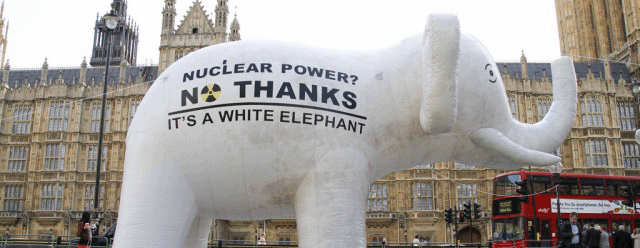
According to Gérard Magnin, a former EDF director, the French company sees Hinkley as ‘a way to make the British fund the renaissance of nuclear in France’. He added: ‘We cannot be sure that in 2060 or 2065, British pensioners, who are currently at school, will not still be paying for the advancement of the nuclear industry in France.’ ..……….
White elephant energy projects that are tomorrow’s HS2, The Conservative Woman, 10 Dec 21, -December 10, 2021AS someone who has in a small way been opposing the climate catastrophe narrative* and has had to study the government’s energy plans, I’m beginning to wonder why Suffolk has been chosen for not one but two white elephant energy projects. What have we done to deserve this? An even more pertinent question is ‘What the hell does this technologically-illiterate government think it is doing?…….
The proposed Sizewell C will house a pair of French-designed nuclear fission reactors of 1600MW output each which are slated to be built next to the decommissioned Sizewell A. …………
Superficially (i.e. as assessed by a typical minister who has the same knowledge of science, technology, engineering and mathematics as the average 12-year-old) Sizewell seems an obvious place to dump a pair of the new generation large nuclear reactors, that is if you ignore the fact that it will take a big bite out of the Suffolk Coastal Area of Outstanding Natural Beauty, ruin the tourist trade for decades and require the building of a temporary town to house the thousands of workers who will be imported to build it. More to the point, they’ll come in late while costing far more than the estimate.
It seems no one in government has noticed that European Pressurised Water Reactors (EPRs) like the two planned for Sizewell C are proving extremely difficult to build. For example, the Finnish Olkiluoto Nuclear Power Plant already had two reactors of a different design, so they are not nuclear tyros. They applied for planning permission for the third, the first Finnish EPR, in 2000. It was due to begin feeding power to the grid in 2010. The latest estimate is June 2022. That’s 22 years between application and delivery of electricity instead of ten. It comes as no surprise that Finland has cancelled plans for a second EPR. Another example: the Hinkley C EPRs in Somerset have a strike price of £106/MWh at 2021 prices and will, unless there are further delays, be contributing to the grid in 2026 after approval in 2008. As well as being late it is over budget: the cost estimate was £18billion in 2016, but by 2019 it was up to £22,500,000,000 and the electricity it produces will cost more than forecast.
The deadline for the UK Planning Inspectorate to submit their recommendation for Sizewell C is January 14, 2022. The minister then has three months to think it over. It will be interesting to see what he or she decides if, as is perfectly possible, we are then in the middle of a fuel and energy crisis.
Working on the Olkiluoto timescale, Sizewell C would begin to power UK homes in 2044, by which time climate hysteria may well have abated. And of course there is the matter of cost. Initial estimate for Olkiluoto was €3billion for the single reactor. Latest and nearly final estimate is €11,000,000,000. It makes HS2 look a bargain.
According to the Financial Times Her Majesty’s Government has noticed that China General Nuclear (CGN) may not be the ideal partner to be involved in building nuclear reactors in the UK: like all Chinese firms it is the tool of its owner, the Chinese State, and as such has strategic interests which may not chime with those of the UK. Permitting any foreign state-controlled company to have its hand on the off switch of the National Grid is obviously undesirable – which is unfortunate as there’s another foreign state-owned ‘partner’ in the car crash that is the UK’s nuclear development plan. Électricité de France (EDF) owns 75 per cent of Framatome, the firm responsible for the disastrous EPR design. There are various subsidies, name changes and takeovers that complicate matters but here is the underlying reality: Framatome designs, manufactures, and installs components, fuel and instrumentation and control systems. It is involved in Hinkley C, the Chinese reactors at Taishan where there have recently been safety concerns, and has recently bagged a contract to supply control and support equipment for a Russian reactor. So this foreign firm is supplying Russia and China with duplicates of the equipment which is being installed in the UK…………
And while we’re on the subject of EDF, here’s a report from the Guardian in 2017: According to Gérard Magnin, a former EDF director, the French company sees Hinkley as ‘a way to make the British fund the renaissance of nuclear in France’. He added: ‘We cannot be sure that in 2060 or 2065, British pensioners, who are currently at school, will not still be paying for the advancement of the nuclear industry in France.’ …………
Nuclear power is a failure – former French Environment Minister

Yves Cochet: “The nuclear failure” Former Minister of the Environment. Against the recent projects announced by the President of the Republic for the revival of nuclear power in France, Yves Cochet, former Minister of the Environment, recalls how the history of this energy sector is marked by a
succession of setbacks.
Despite seventy years of nuclear energy research and development, nuclear energy remains a failure caused by a list of setbacks such that one is enough to destroy any prospect of lasting success. Nuclear power today only contributes 5% of global energy supply and 10% of electricity production, this share has been steadily declining for twenty-five years, while the share of renewable electricity has now surpassed that of nuclear power.
Le Monde 4th Dec 2021
https://www.lemonde.fr/idees/article/2021/12/04/yves-cochet-l-echec-du-nucleaire_6104683_3232.html
More delays and extra $1 billion expected for Georgia nuclear plant
More delays and extra $1 billion expected for Georgia nuclear plant, https://newschannel9.com/news/local/more-delays-and-extra-1-billion-expected-for-georgia-nuclear-plant by JEFF AMY Associated PressMonday, December 6th 2021–ATLANTA (AP) — Monitors say even the most recent pushback of completion dates for two new nuclear reactors in Georgia isn’t enough to account for all the delays and increased costs they see coming.
An engineer paid by the Georgia Public Service Commission predicts that the third reactor at Plant Vogtle near Augusta won’t the most recent deadline of September 2022 set by Georgia Power Co. Don Grace instead says ongoing delays suggest a range of November 2022 to February 2023.
Grace says the fourth reactor might not come online until sometime in late 2024.
Grace says more delay could mean $1 billion more in spending on a project already set to cost $28.7 billion.
Crypto currency mining is rampant, so Kazakhstan looks to nuclear energy, despite its dreadful history there.
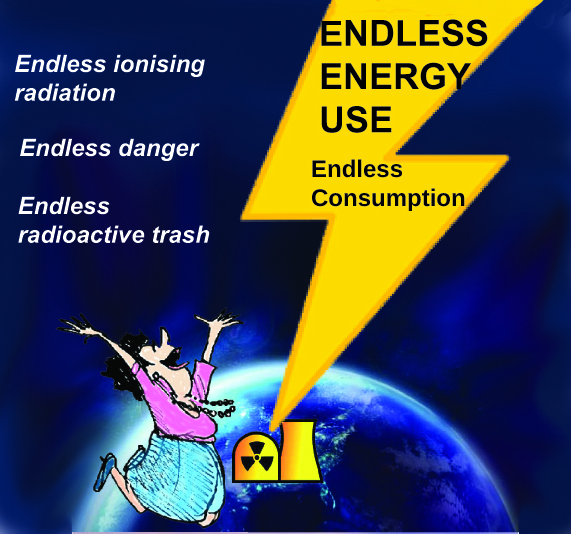
Kazakhstan is now home to 50 registered and an unknown number of unregistered crypto mining companies. The decision to build new nuclear power plants is a serious one for a country that suffered severe nuclear fallout from weapons testing during the Soviet occupation. Kazakhstan’s last nuclear power plant closed in 1999.
Bitcoin mining power crunch: Kazakhstan looks toward nuclear solution, CoinTelegraph, 25 Nov 21
The country saw a great influx of miners this year, but it might have to sacrifice the immense tax revenue from Bitcoin miners if power grid issues are not resolved.
–The exodus of Bitcoin miners from China into Kazakhstan has contributed to an energy crunch that the central Asian country’s president has proposed solving with nuclear energy.
Kazakhstan’s Ministry of Energy has attributed the 8% increase in domestic electricity consumption throughout 2021 to Bitcoin miners. The country received at least 87,849 Bitcoin mining machines from Chinese companies so far this year, following China’s crackdown on crypto mining, according to data from the Financial Times.
The substantial increase in demand has led to a deficit in the domestic power supply and contributed to unreliable electricity services, according to the Kazakhstan Electricity Grid Operating Company. President Tokayev told bankers at a Friday meeting that he thinks building a nuclear power plant will help ease the stress on his country’s electrical infrastructure:………………
Kazakhstan is now home to 50 registered and an unknown number of unregistered crypto mining companies. The decision to build new nuclear power plants is a serious one for a country that suffered severe nuclear fallout from weapons testing during the Soviet occupation. Kazakhstan’s last nuclear power plant closed in 1999……..https://cointelegraph.com/news/bitcoin-mining-power-crunch-kazakhstan-looks-toward-nuclear-solution
26 UK investment funds pouring money into nuclear weapons companies: some have links to UK government.
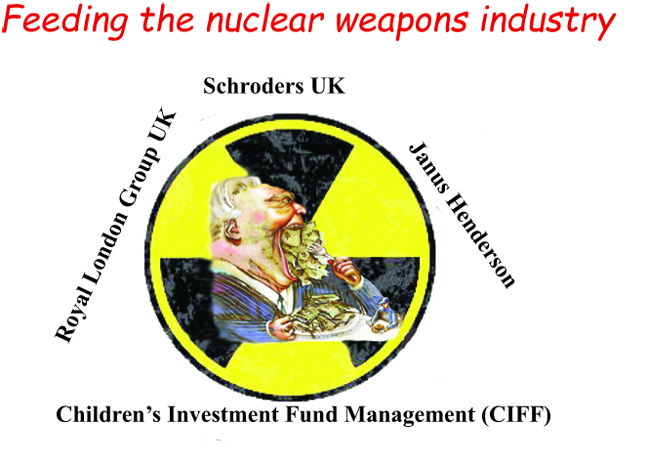
“It is unsurprising that the same financial institutions who continue to pour funding into companies like BAE Systems also have close links with senior Conservative party members and is yet another example of the cosy relationship between the arms industry and the UK government,”
The Ferret, November 28, 2021 Twenty-six financial firms in London have been accused of funding a “new nuclear arms race” including investment funds with links to the UK Government, The Ferret can reveal.
The Ferret found that 26 were based in London and six have links to the Conservative Party, which plans to increase Britain’s nuclear weapons arsenal.
They include Schroders UK which holds shares in the arms giant, BAE Systems. Schroders chair is Lord Geidt, who was an advisor to BAE Systems until April this year. He is now an advisor to Prime Minister Boris Johnson, whose plan to produce more nuclear weapons has been condemned by peace organisations.
Netherlands-based peace group, PAX, produced the study with the International Campaign to Abolish Nuclear Weapons (ICAN). Their report warns that financial institutions continuing to invest in companies involved with the nuclear weapons industry could face “regulatory risks” because of the Treaty on the Prohibition of Nuclear Weapons, which came into force in January 2021.
The treaty – which the UK has not ratified – bans nuclear weapons and has been signed by 86 states so far.
The UK Government — which claims it is “committed to the long-term goal of a world without nuclear weapons” — said in March it would lift the cap on its nuclear arsenal by 40 per cent, from 180 to 260 warheads. In a statement in November the government claimed it had “played a leading role by pioneering work in nuclear disarmament”.
Perilous Profiteering says that Schroders UK had investments in 2020 worth $125.3 million (£93.97m) in BAE Systems which is building new Dreadnought submarines that will be armed with nuclear missiles. The company also provides logistics support for the US Trident and Minuteman missiles. BAE Systems stressed that it does not make nuclear warheads.
The report also names Royal London Group UK which had shares in 2020 worth $98.6m (£74m) in BAE Systems. In June the insurance company appointed Ruth Davidson, former leader of the Scottish Tories , as a non-executive director. Davidson is now a peer.
Others with links to the Tories include the Children’s Investment Fund Management (CIFF) which has shares in Safran, a French firm. Safran owns 50 per cent of ArianeGroup which has contracts for French nuclear weapon production.
Emma Cockburn, Scotland co-ordinator for Campaign Against Arms Trade
CIFF’s investment assets are managed by TCI Fund Management, where Rishi Sunak MP, chancellor of the exchequer, was a partner from 2006 to 2009.
Investment firm Janus Henderson, which has shares in General Dynamics, L3 Harris and Leidos, gave the Tories £3,500 in 2018, a payment which was registered in the House of Commons as required. General Dynamics, L3 Harris and Leidos all operate within the nuclear sector, says the new report.
According to the new report, the entry into force of the Treaty on the Prohibition of Nuclear Weapons in January 2021, is an “historic shift” in the way the world “deals with nuclear weapons”. It points out that while nuclear weapons are controlled by governments, their production is often contracted to private companies. “They (nuclear weapons) are now comprehensively outlawed, as is any assistance with producing, manufacturing or developing them,” the report says.
“Financial institutions that continue investing in companies building nuclear weapons face regulatory risks as more countries join the treaty. They also face an increased reputational risk as clients learn of their support for weapons of mass destruction and terminate their relationships.”
The report also reveals that 338 institutions have financing or investment relationships with the 25 nuclear weapon producing companies, down from 390 the previous year – a fall of 52, which the authors welcomed……….
Other critics of the nuclear weapons industry include Emma Cockburn, Scotland co-ordinator for Campaign Against Arms Trade (CAAT). She said the report provides a “damning insight to the endless billions available for the nuclear and arms manufacturers.”
“It is unsurprising that the same financial institutions who continue to pour funding into companies like BAE Systems also have close links with senior Conservative party members and is yet another example of the cosy relationship between the arms industry and the UK government,” she added……………………….. https://theferret.scot/revealed-27-london-companies-funding-nuclear/
Energy consumers are likely to spend over £1000 each to complete Sizewell C Nuclear …..and then pay a high price for the electricity it produces.
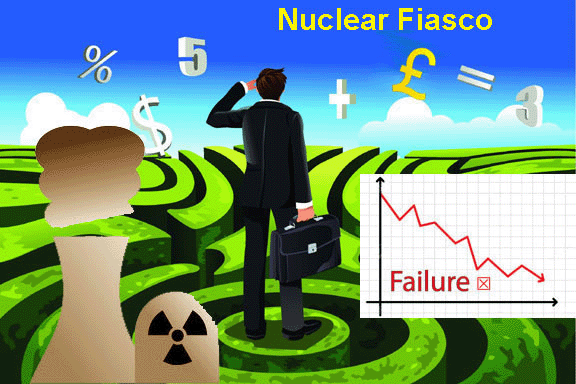
The Government’s new nuclear power construction financing mechanism the so-called ‘Regulatory Asset Base’ (RAB) is likely to cost energy consumers an average of well over £1000 each added onto their electricity bills.
On top of that energy consumers will have carry on paying on top of this for an as-yet undecided amount for each kWh generated by Sizewell C.
According to EDF planning figures the cost of Sizewell C will be £20 billion. Experience suggests that there is little faith to be placed inEDF’s claims. For example, the actual cost of the Flamanville nuclearpower plant being built by EDF (the same EPR model) has cost upwards of 5 times as much as their original estimate.
So we can probably expect a bill of at least £30 billion to be paid by consumers through their electricity
bills. That is because the RAB mechanism will ensure that consumers pay the cost overruns, which are certain to occur when building these nuclear power plant. Given that there are around 26 million domestic electricity consumerbills to be paid in the UK, this means each consumer will be paying over
£1000 each to build the power plant.
100% Renewables 27th Nov 2021
Environmental Social and Governance investors have upset polluting and tobacco industries – now they’re coming for nuclear.

Something curious happened this time last year when Serco lost its deal to run the Atomic Weapons Establishment, which manages Britain’s nuclear warheads. The outsourcer’s shares crashed. But after the news, its rating on several ESG indices — which measure compliance with environmental, social and governance metrics — shot up. The message was clear.
While financial investors were worried about the loss of some £17 million a year in underlying trading profits, ESG analysts were delighted that Serco would no longer have anything to do with making the missiles carried on the Royal Navy’s four Vanguard-class submarines. ESG investors have shaken up the
oil and gas and tobacco industries, and now they’re coming for defence.
Concerns that weapons manufacturing could become unpalatable for a broad swathe of shareholders are weighing on share prices. In April, analysts at BNP Paribas pointed out that defence valuations had fallen in line with those for tobacco companies since 2018 — even though, unlike with cigarettes, victims of war are unlikely to sue for damages, and sales of planes and tanks aren’t going to end.
Times 28th Nov 2021
Costs of electricity from Flamanville nuclear power station will be three times higher than from the most competitive renewable sources

The production costs of nuclear electricity from the Flamanville EPR will be three times higher than those of the most competitive renewable sources, says Greenpeace in a report published Wednesday.
The environmental organization, which calls for a 100% renewable electricity mix by 2050-2060, highlights “a difference of the order of EUR 100 to 110 / MWh” between nuclear power from the pressurized European reactor (EPR ), the cost of which is estimated at EUR 164 / MWh, and ground-based photovoltaicand onshore wind power. It assesses the production of the historical park at EUR 72 / MWh, against EUR 52 / MWh according to EDF and EUR 48 / MWh according to the Energy Regulatory Commission (CRE).
Montel News 24th Nov 2021
UK Parliament debates Nuclear Energy (Financing) Bill, with anxiety over the Government’s big nuclear plans.

“…successive Governments seem to have developed a groupthink, following lobbying from the nuclear industry, that somehow nuclear is a prerequisite for our future.”
…… … there is currently no economic or environmental case for the construction of any further nuclear stations in the UK.”
Of course, consumers who have signed up to buy 100% renewable electricity could quite rightly feel aggrieved at having to pay the “nuclear tax” as well.
SafeEnergy E Journal No.92. December 21, Large New Nuclear Update The UK Government has said it wants to secure a final investment decision on at least one largescale nuclear plant by the end of this Parliament. It is also supporting the development of Small Modular Reactors.
The Government is putting nuclear power at heart of its net zero strategy. Kwasi Kwarteng, business secretary, unveiled the “Net Zero Strategy”, as well as a “Heat and Buildings Strategy” in October. The creation of a “regulated asset base” (RAB) model will be the key to the delivery of a future fleet of large nuclear power plants. The RAB funding model is already being used for other infrastructure projects, such as London’s Thames Tideway super sewer. Under this program, GB electricity consumers, including those in Scotland (but not Northern Ireland) will be billed for the cost of the plant via a “nuclear tax” long before it starts producing electricity, which could take a decade or more from the time the final investment decision is made.
On Wednesday 3rd November, MPs debated the second reading of the Nuclear Energy (Financing) Bill. The Liberal Democrats and the SNP, both put forward amendments, but neither was accepted for debate by the Speaker
The Lib Dem Motion said the Bill does nothing to address concerns about costs around nuclear waste disposal and decommissioning and fails to bring forward meaningful reforms to accelerate the deployment of renewable power. The SNP Motion said there is no longer a justification for large nuclear power stations to provide baseload energy, because large scale nuclear is too inflexible to counter to the intermittency of renewables. It called on the Government to spend more money on energy efficiency measures and targeted support for those who suffering from fuel poverty.
During the debate in the House of Commons (1), the Minister of State for Business, Energy and Industrial Strategy, Gregg Hands, said that we need a new funding model to support the financing of large-scale and advanced nuclear technologies. He said the lack of alternatives to the funding model used for Hinkley Point C has led to the cancellation of recent potential projects, at Wylfa Newydd and Moorside in Cumbria. He said the Bill was intended to get new projects off the ground, including, potentially, Sizewell C, which is the subject of ongoing negotiations between EDF and the Government, as well as further projects, such as on Wylfa.
He said the Bill would add, on average less than £1 per month to consumers’ bills during the construction phase of a nuclear project. But compared with the CfD model used to fund Hinkley Point C this could produce a cost saving for consumers of more than £30 billion.
Regarding Scottish Consumers being forced to pay for new reactors he said:
“…the Scottish Government have a different position with regard to new nuclear projects. To be clear: this Bill will not alter the current approval process for new nuclear, nor the responsibilities of the devolved Governments. Nothing in this Bill will change the fact that Scottish Ministers are responsible for approving applications for large-scale onshore electricity-generating stations in Scotland. The steps taken in this Bill will mean that Scottish consumers will benefit from a cheaper, more resilient and lower-carbon electricity system, so it is right that Scottish consumers should contribute towards the construction of new projects.”
Labour’s Alan Whitehead disappointed many when he said: “We need to support the need to finance new nuclear.”
The SNPs Energy Spokesperson Alan Brown said: “…successive Governments seem to have developed a groupthink, following lobbying from the nuclear industry, that somehow nuclear is a prerequisite for our future.”
He went on to say: “…it was stated … the new funding model could potentially save the taxpayer £30 billion to £80 billion. How much money do the Government estimate has been wasted on Hinkley?”
For the Liberal Democrats, Sarah Olney said “our position is very much that there should not be new nuclear power stations … there is currently no economic or environmental case for the construction of any further nuclear stations in the UK.”
On the £30 billion savings the NFLA UK & Ireland Steering Committee Chair Councillor David Blackburn said:
“The Minister is comparing one expensive environmentally unsustainable project with another expensive environmentally unsustainable project. If he really wanted to save consumers money he would introduce a National Homes Retrofit Scheme as quickly as possible having learned the lessons from its failed Green Homes Scheme, and introduce a scheme to support flexibility, demand management and smart grids so that we can use more of our cheap, sustainable renewable electricity.”
On Scottish Consumers paying this “nuclear tax” because they “will benefit from a cheaper, more resilient and lower-carbon electricity system,” Scottish NFLA Chair, Cllr. Feargal Dalton said:
“Renewables met 97% of Scotland’s electricity demand in 2020. The Scottish electorate has consistently voted for Governments opposed to building new nuclear power stations. With wind and solar now the cheapest forms of electricity Scottish consumers shouldn’t have to pay for the Tories’ failed energy policies.” (2)
Of course, consumers who have signed up to buy 100% renewable electricity could quite rightly feel aggrieved at having to pay the “nuclear tax” as well. https://www.no2nuclearpower.org.uk/wp/wp-content/uploads/2021/11/SafeEnergy_No92.pdf
1 This Month



26 September – International Day for the Total Elimination of Nuclear Weapons


PLEASE OPPOSE HR 8255 AND S.3639 – bills would accelerate satellite deployment, with no environmental review or safeguards – https://ncstd5li.quorum.us/campaign/169331/
To see nuclear-related stories in greater depth and intensity – go to https://nuclearinformation.wordpress.com
-
Archives
- September 2026 (245)
- August 2026 (330)
- July 2026 (355)
- June 2026 (287)
- May 2026 (306)
- April 2026 (356)
- March 2026 (251)
- February 2026 (267)
- January 2026 (308)
- December 2025 (358)
- November 2025 (359)
- October 2025 (375)
-
Categories
- 1
- 1 NUCLEAR ISSUES
- business and costs
- climate change
- culture and arts
- ENERGY
- environment
- health
- history
- indigenous issues
- Legal
- marketing of nuclear
- media
- opposition to nuclear
- PERSONAL STORIES
- politics
- politics international
- Religion and ethics
- safety
- secrets,lies and civil liberties
- spinbuster
- technology
- Uranium
- wastes
- weapons and war
- Women
- 2 WORLD
- ACTION
- AFRICA
- Atrocities
- AUSTRALIA
- Christina's notes
- Christina's themes
- culture and arts
- Events
- Fuk 2022
- Fuk 2023
- Fukushima 2017
- Fukushima 2018
- fukushima 2019
- Fukushima 2020
- Fukushima 2021
- general
- global warming
- Humour (God we need it)
- Nuclear
- RARE EARTHS
- Reference
- resources – print
- Resources -audiovicual
- Weekly Newsletter
- World
- World Nuclear
- YouTube
-
RSS
Entries RSS
Comments RSS
 nuclear-news