French nuclear capacity low in February, need for vigilance remains
French nuclear capacity low in February, need for vigilance remains – RTE Nasdaq, Forrest Crellin Reuters PARIS, Feb 4 (Reuters) – French power grid operator RTE said France’s nuclear capacity in February was expected to remain around the relatively low level recorded last winter, but there was little risk to power supply as mild weather was expected in the coming weeks.
The current maintenance schedule now allows between nine and 13 reactors to be shut down during the month of February depending on the week, either for standard maintenance or following identification of additional corrosion defects, RTE said…………
In January, the nuclear fleet reached its lowest level ever with an average of around 48 GW of available capacity for the month………
State-controlled power group EDF EDF.PA and the French nuclear safety authority ASN are expected to implement a strategy to control the corrosion that took five nuclear reactors offline, which will have consequences in terms of supply beyond this winter, added the RTE.
The effect of the outages will be reported in coming seasonal analyses and balance sheet forecasts, RTE said.
The outages at the five reactors that were taken offline following the detection of welding faults were extended in mid-January……… https://www.nasdaq.com/articles/french-nuclear-capacity-low-in-february-need-for-vigilance-remains-rte-0
Raytheon and Lockheed Martin boast to investors that Ukraine-Russia crisis is a boon for their business

The statements come from leaders of an industry that exerts tremendous influence in Washington, employing an average of 700 lobbyists per year over the past five years, or more than one lobbyist per member of Congress, according to Brown University’s Costs of War project.
Everyone in D.C. knows that weapons manufacturers are helping skew U.S. policy towards militarism
WEAPONS COMPANIES BOAST UKRAINE-RUSSIA TENSIONS ARE BOON FOR BUSINESS , Popular Resistance, By Sarah Lazare, In These Times., January 31, 2022
In Calls With Investors, Raytheon And Lockheed Martin Boasted That The Worsening Conflict Is Helping Profits.As the United States weighs more involvement in the growing conflict between Ukraine and Russia, some of the largest weapons companies in the world — Raytheon and Lockheed Martin — are openly telling their investors that tensions between the countries are good for business. And General Dynamics, meanwhile, is boasting about the past returns the company has seen as a result of such disputes.
The statements come as the U.S. government escalates arms shipments to Ukraine, among them the Javelin missiles that are a joint venture between Raytheon and Lockheed Martin. House Democrats, meanwhile, are trying to quickly push through a bill that would significantly increase U.S. military assistance to Ukraine, and impose new sanctions on Russia.
Anti-war campaigners warn that U.S. escalation, amid renewed tensions between Ukraine and Russia, could bring dire consequences, and spill into a much larger and more protracted war. “As we are shipping advanced weaponry to the Ukrainian military, the Biden administration has signaled that U.S. military advisors will continue to stay in the country,” Cavan Kharrazian, progressive foreign policy campaigner for the advocacy organization Demand Progress, tells In These Times. “Who will most likely set up and teach the Ukrainian army how to use these weapons systems? The U.S. military.”
Among those openly discussing the boon to profits is Raytheon CEO Greg Hayes. During a January 25 appearance on CNBC’s “Squawk on the Street,” he was asked, “Do we have anything that would make it so if you inserted 8,000 American soldiers into Ukraine, they can stop 103,000 Russian soldiers?”
In his reply, Hayes touted the role the company could play in arming U.S. allies. “Obviously we have some defensive weapons systems that we could supply which could be helpful, like the patriot missile system.” He went on to add, “We’ve got the technologies to help in these engagements, whether it’s patriot systems, some of the radar systems.”………
If it sounds like Hayes is using mounting tensions as an advertising opportunity for his company, this may not be far fetched. On a January 25 earnings call (which was noted on Twitter by Nick Cleveland-Stout of the Quincy Institute), Hayes included “tensions in Eastern Europe” among the factors that Raytheon stands to benefit from. He said: “We just have to look to last week where we saw the drone attack in the UAE, which have attacked some of their other facilities. And of course, the tensions in Eastern Europe, the tensions in the South China Sea, all of those things are putting pressure on some of the defense spending over there. So I fully expect we’re going to see some benefit from it.”
Raytheon isn’t alone in its projections. Among those noting the likely boost to profits is Jim Taiclet, the chairman, president and CEO of Lockheed Martin. In a January 25 earnings call, he told investors, “If you look at the evolving threat level and the approach that some countries are taking, including North Korea, Iran and through some of its proxies in Yemen and elsewhere, and especially Russia today, these days, and China, there’s renewed great power competition that does include national defense and threats to it.”
This “great power competition,” he suggested to investors, bodes more business for the company. Taiclet says, “And the history of the United States is when those environments evolve, that we do not sit by and just watch it happen. So I can’t talk to a number, but I do think, and I’m concerned personally that the threat is advancing, and we need to be able to meet it.”
The statements come from leaders of an industry that exerts tremendous influence in Washington, employing an average of 700 lobbyists per year over the past five years, or more than one lobbyist per member of Congress, according to Brown University’s Costs of War project.
Everyone in D.C. knows that weapons manufacturers are helping skew U.S. policy towards militarism, but they usually try to be less obvious,” Erik Sperling, executive director of Just Foreign Policy, an anti-war organization, told In These Times. “They are cashing in on tensions over Ukraine as the U.S. pours weapons into the region.”……..
Everyone in D.C. knows that weapons manufacturers are helping skew U.S. policy towards militarism, but they usually try to be less obvious,” Erik Sperling, executive director of Just Foreign Policy, an anti-war organization, told In These Times. “They are cashing in on tensions over Ukraine as the U.S. pours weapons into the region.”
But Kharrazian warns, “While it may not be profitable for arms manufacturers, engagement in good-faith, realistic diplomacy is what will benefit the region as a whole and mitigate unnecessary and potentially catastrophic conflict.” https://popularresistance.org/top-weapons-companies-boast-ukraine-russia-tensions-are-a-boon-for-business/
Fukushima Daiichi Nuclear Power Plant “debris” storage method to be reconsidered – Chairman of the Regulatory Commission, Mr. Sarada
February 2, 2022
The chairman of the Nuclear Regulation Authority (NRA), Mr. Toyoshi Sarada, has asked Tokyo Electric Power Company (TEPCO) to reconsider the storage method of concrete debris with a very small amount of radioactive materials from the Fukushima Daiichi Nuclear Power Plant, with a view to temporarily burying it underground.
It has been 11 years since the accident at the Fukushima Daiichi Nuclear Power Plant occurred in March 2011. The decommissioning of the nuclear power plant involves the removal of nuclear fuel that has cooled down after melting down. The biggest challenge is to remove the fuel debris. On the other hand, the disposal of low-level radioactive waste, which is generated in large quantities every day at the decommissioning site, is also a major issue.
As a result of the hydrogen explosions in the three reactor buildings, concrete fragments were scattered.
At a meeting of the Nuclear Regulation Authority held on the 2nd, Mr. Sarada said, “Even if we assume that the waste will be transferred in the future, there are some areas where it would be much more advantageous to bury and store the waste,” and expressed his desire to ask TEPCO to reconsider the storage method with a view to temporarily burying it underground.
The amount of waste from the decommissioning of the nuclear power plant is increasing, but the management at the site is not up to the task, so a realistic storage method must be considered with an eye to the future, he said.
Decommissioning of the AGR nuclear power stations: National Audit Office UK
 |
The decommissioning of the AGR nuclear power stations, National Audit Office
| Published | January 28, 2022 |
|---|---|
| Full report | The decommissioning of the AGR nuclear power stations |
The government has entered into new arrangements to decommission seven AGR nuclear power stations. While the arrangements could deliver savings, their success will ultimately depend on the relevant parties working collaboratively to overcome risks, according to the National Audit Office (NAO).
The UK has eight second generation nuclear power stations, accounting for around 16% of UK electricity generation in 2020. Seven of the eight stations are Advanced Gas-cooled Reactors (AGRs), which are all due to stop generating electricity by 2028.
The Nuclear Liabilities Fund (the Fund) was established to meet the costs of decommissioning these eight stations, but significant additional taxpayer support has been required with more likely to be necessary. The UK government has provided a guarantee to underwrite the Fund in the event that its assets are insufficient to meet the total costs of decommissioning. In 2020, government contributed £5.1 billion to strengthen the Fund’s position and the Fund has recently requested a further £5.6 billion. The Fund’s assets were valued at £14.8 billion at the end of March 2021. The aim is that growth in the Fund’s investments will be sufficient to meet the long-term costs of decommissioning (£23.5 billion). However, cost estimates have doubled in real terms since 2004-05. If this upward trend is maintained and investment growth is not sufficient, there is a risk that the taxpayer will have to make further contributions.
In June 2021, the AGR stations’ owner EDF Energy (EDFE) agreed to defuel each of the stations in an arrangement that the Department for Business Energy & Industrial Strategy (the Department) estimates could save the taxpayer around £1 billion.2 Once defueling is completed, ownership of the stations will transfer to the government’s Nuclear Decommissioning Authority (NDA) for its subsidiary Magnox Ltd to complete the rest of the decommissioning process, which is likely to take several decades.
The rate at which stations can be defueled will impact on overall costs. The estimated cost of defueling could be between £3.1 billion and £8.0 billion. A bottleneck at any point between EDFE removing fuel, and the NDA transporting the fuel to safely store at Sellafield, could have repercussions across the programme. The costs to be borne by the Fund are therefore dependent on how quickly defueling begins once a station stops generating electricity, as well as the rate of defueling. Early unexpected closures of stations may increase costs……………………
“Government needs to maintain a clear view of how the nuclear decommissioning programme is performing as a whole, and given the large amounts of public money at stake it must act decisively should performance begin to lag.”
Gareth Davies, head of the NAO………………
Contact
NAO Press Office
+44 (0)20 7798 7400 or email pressoffice@nao.org.uk https://www.nao.org.uk/press-release/the-decommissioning-of-the-agr-nuclear-power-stations/
What’s plan B if the government can’t attract investors willing to fund Sizewell C?
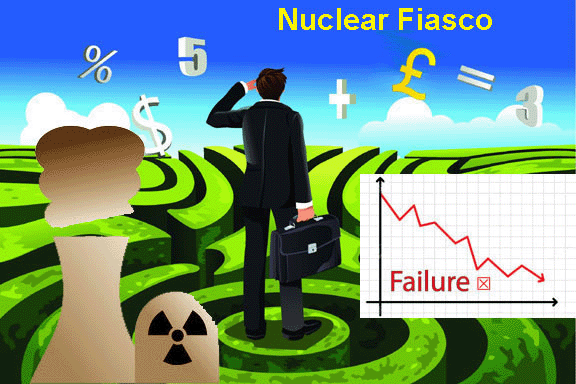
What’s plan B if the government can’t attract investors willing to fund Sizewell C? Guardian Nils Pratley 27 Jan 22. Development money for nuclear power station is an attempt to draw in investors that could replace China’s CGN sum of £100m is peanuts in the expensive world of nuclear power stations, so regard the business secretary Kwasi Kwarteng’s funding for a round of development work on Sizewell C as a form of advertising. The cash is intended to send a message that the government is serious about getting the plant built in Suffolk. And it is an appeal for outside investors to volunteer to sit alongside developer EDF, the French state-backed group.
There was also a definition of a desirable investor: “British pension funds, insurers and other institutional investors from like-minded countries”. Note the nationality test. It is the closest we have come to official confirmation that China General Nuclear (CGN), originally slated for a 20% stake in Sizewell, will be kicked off the project. It remains to be seen how, legally, the government will rip up the 2015 deal with CGN signed by David Cameron’s government, but the intention is clear.
So, too, is the intended funding mechanism. It will be a regulated asset base (RAB) model, a version of the formula used at Heathrow Terminal 5 and the Thames Tideway giant sewer. The key point for investors is that they will see some income before Sizewell is built, unlike at Hinkley Point C where EDF and CGN earn their princely cashflows only when the electricity starts to flow.
What, though, if those British and like-minded institutions still refuse to play? Nuclear represents unknown territory for most of them. What if competition to invest, which is meant to be the other way in which RAB lowers financing costs, doesn’t materialise? What’s the government’s plan B?
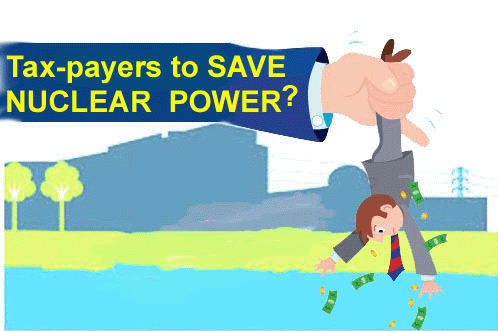
The only possible solution is for the state to invest directly. If that is so, wouldn’t it be better to run an upfront benchmarking exercise at the outset to compare the numbers? Sizewell, unfortunately, is probably inevitable given the current panic over high gas prices and long-term energy security. But taxpayers, on the hook anyway via household bills, deserve to know that the odd billion or three isn’t being diverted unnecessarily to intermediaries.
By the time Sizewell’s sums become enormous, transparency will be essential…….https://www.theguardian.com/business/nils-pratley-on-finance/2022/jan/27/whats-plan-b-if-the-government-cant-attract-investors-willing-to-fund-sizewell-c
The escalating costs of decommissioning UK’s nuclear reactors pose a warning about new nuclear reactors.
The history of the AGR fleet provides lessons for other long-term programmes carrying significant end‑of‑life liabilities, including new nuclear energy programmes.
| The government has entered into new arrangements to decommission seven AGR nuclear power stations. While the arrangements could deliver savings, their success will ultimately depend on the relevant parties working collaboratively to overcome risks, according to the National Audit Office (NAO). The Nuclear Liabilities Fund (the Fund) was established to meet the costs of decommissioning these eight stations, but significant additional taxpayer support has been required with more likely to be necessary. The UK government has provided a guarantee to underwrite the Fund in the event that its assets are insufficient to meet the total costs of decommissioning. In 2020, government contributed £5.1 billion to strengthen the Fund’s position and the Fund has recently requested a further £5.6 billion. The Fund’s assets were valued at £14.8 billion at the end of March 2021. The aim is that growth in the Fund’s investments will be sufficient to meet the long-term costs of decommissioning (£23.5 billion). However, cost estimates have doubled in real terms since 2004-05. If this upward trend is maintained and investment growth is not sufficient, there is a risk that the taxpayer will have to make further contributions. In June 2021, the AGR stations’ owner EDF Energy (EDFE) agreed to defuel each of the stations in an arrangement that the Department for Business Energy & Industrial Strategy (the Department) estimates could save the taxpayer around £1 billion. Once defueling is completed, ownership of the stations will transfer to the government’s Nuclear Decommissioning Authority (NDA) for its subsidiary Magnox Ltd to complete the rest of the decommissioning process, which is likely to take several decades. Initial ambitions that the existence of the Nuclear Liabilities Fund would help eliminate taxpayers’ exposure are being tested, with rapid increases in the estimates of decommissioning costs outstripping investment returns. The history of the AGR fleet provides lessons for other long-term programmes carrying significant end‑of‑life liabilities, including new nuclear energy programmes. National Audit Office 28th Jan 2022 https://www.nao.org.uk/report/the-decommissioning-of-the-agr-nuclear-power-stations/ |
Nuclear not competitive’ and too late for energy transition: Enel Green Power CEO.
Nuclear not competitive’ and too late for energy transition: Enel Green Power CEO, Italian renewables giant ‘obviously’ won’t invest in nuclear due to long construction times and high costs, Salvatore Bernabei says https://www.rechargenews.com/energy-transition/nuclear-not-competitive-and-too-late-for-energy-transition-enel-green-power-ceo/2-1-1155407 By Bernd Radowitz 26 Jan 22,
Enel Green Power has no intention to invest in nuclear power despite the European Commission’s plan to label the technology as sustainable, the Italian renewables supermajor’s chief executive Salvatore Bernabei said.
Construction times of conventional nuclear power plants are far too long in relation to the need to get the energy transition done within the next 20 to 30 years, the CEO explained.
“If you think about the current technology and the current timing of development and construction of nuclear plants, it is much bigger than 10 years (from the moment) you take the initial investment decision,” Bernabei said at a press briefing.
You have the permitting, then you have the construction,” he said, adding that all projects currently being built have exceeded their planned construction time, and their completion takes “two to three times more than initially expected.”
“They are (also) out of budget. So, saying that nuclear could help in the transition with the current technology – I leave you to (make) the conclusion.”
His comments came after the EU Commission had proposed to include nuclear power and fossil gas under certain circumstances in its taxonomy that labels energy projects as sustainable and thus facilitates financing. The taxonomy proposal enjoys the backing by France, Finland and several Eastern European EU states that want to build or expand atomic power, but the inclusion of nuclear has been strongly opposed by Germany, Austria, Spain and Luxembourg.
Despite its stated wish to build new nuclear reactors and revamp existing ones to extend their operational life, France has suffered severe setbacks during the construction of the Flamanville 3 reactor, one of the few nuclear plants being built in Europe. The country this winter also had to switch off a series of atomic power stations, forcing it to import large volumes of electricity from neighbouring countries.
French state-owned utility EDF earlier this month has said the plant of the novel European Pressurised Reactor (EPR) type at Flamanville will cost another €300m more than forecast and fuel loading is being pushed back by up to six month, the Reuters news agency had reported. The 1.65GW reactor according to French media will then have cost French taxpayers a record €19.1bn ($21.5bn) instead of the €3.4bn originally budgeted, and have taken 15 years to build, ten years longer than originally planned.
Similar construction time and cost overruns have been experienced in Finland, where operator Teollisuuden Voima (TVO) has recently started to commission the Olkiluoto 3 reactor, also an EPR reactor.
Germany’s government last weekend issued a statement rejecting the inclusion of nuclear power into the EU’s taxonomy.
“It is risky and expensive. New reactor concepts such as mini-reactors also entail similar problems and cannot be classified as sustainable,” economics and climate minister Robert Habeck and environment minister Steffi Lemke said in a joint reaction.
It is clear to everyone that the levelised cost of electricity (LCOE) of nuclear is much bigger than €100 per megawatt hour, Bernabei agreed.
Small nuclear reactors (SMRs), which by some investors such as Bill Gates are touted to be a quick solution helping the energy transition, and supposedly are safer, may not be such a quick fix either, the EGP CEO pointed out.
“Then you talk of the next generation (of nuclear power). But in the next generation, you have this word ‘next’, (which) has to be defined yet. We are speaking about something that could be ready in 2040 – perhaps,” Bernabei said.
The first SMR reactor is slated to be built in China by 2026, “and they are the first mover,” the CEO added.
“So, whatever the taxonomy would say, the question will be ‘is there anyone available to invest in a technology that would need more than 10 years to become a reality? And perhaps when it becomes reality, the market has completely changed its dynamic with a cost that today is not competitive.”
“As Enel we don’t intend to invest in nuclear obviously.”
Italy after a referendum following the Chernobyl nuclear disaster had switched off nuclear power in the by 1990, but the far right Lega party of Matteo Salvini lobbies for it renaissance.
Striking workers reduced France’s nuclear power generation by 2.2gigawatts (GW)
Striking workers reduced France’s nuclear power generation by 2.2
gigawatts (GW) and hydropower by a further 1.3 GW, data from power utility
EDF (EDF.PA) showed early on Wednesday. EDF workers began protests on
Sunday over a government plan to increase the amount of cheap energy EDF
must sell to rivals at under-market prices, and to call for higher pay and
pensions.
Reuters 26th Jan 2022
https://www.reuters.com/business/energy/french-power-output-reduced-by-ongoing-strike-2022-01-26/
Call to stop the unfair Vogtle nuclear construction surcharge

Now they want US to pay for THEIR mistakes, botched work & do-overs, delays, and retesting. NO…THEY SHOULD PAY!
REPEAL THE UNFAIR VOGTLE CONSTRUCTION SURCHARGE
5 Repeal Reasons Below
It is simply wrong and disgraceful for the state of Georgia to continue to have
elderly, schools, food banks, mom & pop restaurants, churches, tire stores, car repair shops, households, gas stations, doctors offices, renters, dentists, synagogues, beauty parlors, dry cleaners, shoe stores, insurance offices, meals-on-wheels, homeless shelters, colleges and universities, Salvation Army stores, drug stores, police stations, nursing homes, car washes, pet stores, fast-food restaurants, veterinarian offices, county governments, small manufacturing businesses, hospitals, recycling centers, animal shelters, hardware stores, grocery stores, YMCA & YWCA, bookstores, healthfood stores, consignment stores, rehab centers, phone stores, barbershops, grocery stores, warehouses, franchise businesses, clothing stores…
all paying month after month an extra surcharge amount on their Georgia Power electric bill to finance, without compensation, someone else’s years overdue for-profit venture.
The nuclear finance surcharge law was for construction, not for costly, continuing re-dos, re-testing, and delays after delays.
The surcharge is clearly failing to benefit customers, as the 2009 legislature was led to believe.
STOP The Surcharge Fee On Georgia Power Customers’ Electric Bills
Repeal the Unfair 2009 Nuclear Energy Finance Act
1. The original controversial nuclear finance act of 2009 anticipated that Georgians would pay a surcharge for five years. However, Georgia Power has collected the nuclear tax for SIX YEARS LONGER than anticipated with no end in sight.
2. The original finance act DID NOT anticipate making people pay for expensive construction mistakes, costly delays, and expensive do-overs.
3. The company testifies that construction is 99% complete. Most of the current work is fixing mistakes and do-over work. Customers should not keep paying surcharges if the project is so near completion as claimed, yet so late.
4. Extensive ITAAC testing (Nuclear Regulatory Commission: Inspections, Tests, Analyses, and Acceptance Criteria) is far from complete. Numerous problems found by testing will push startup much later than the present startup claim of late 2022, and thus continue the surcharges even longer. Note: NRC reports that, of the 399 tests, about 150, or 38% remain to be done. All tests must be complete before fuel is loaded.
5. The surcharge unfairly burdens the small and medium size residential and commercial customers, including schools, elderly, non-profit services, while it unfairly gives a pass to very large customers. These very large customers get to use rates that avoid much of the surcharge. (See Reference 1)
Surcharges started on Georgia Power bills in 2011
In 2019, they hit a high of 10.76 %
In 2020, they were 9.46 % (The NCCR-10 rate)
In 2021, they are 9.46 %
In January, 2022, they will be 3.81 % (The NCCR-11)
Background For Repealing the 2009 Georgia Nuclear Energy Financing Act:
The nuclear surcharge finances the new power plant Vogtle “Vortex” 3 & 4 nuclear reactors. The surcharge is money given to a private for-profit endeavor.
The surcharge takes money from Georgia electric power customers, and there is nothing in return.
The average Georgia residential customer has already paid over $ 850.00 in Vogtle surcharges. So far, Georgia Power has collected over $ 3.6 Billion from Georgians via this nuclear tax!
The nuclear finance surcharge goes on and on, month after month, years longer than proposed. This was not intended by legislators, more than half of whom have retired, when they enacted the 2009 Georgia Nuclear Energy Financing law.
The surcharge began when Vogtle nuclear construction started in 2011 and went to a high of 10.76% in 2019. Under the current law, the nuclear surcharge will stay on Georgians’ power bills until the reactor is operating and selling electricity. Ongoing massive construction delays and cost overruns make that date uncertain………… http://stopvogtlesurcharge.org/
Electricite de France has become a nightmare for investors, and a danger to regional energy security.
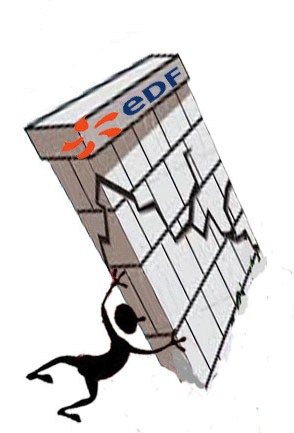
The long decline of Electricite de France SA isn’t only a political
crisis for the government in Paris, it’s a growing economic threat for
much of Europe
The giant nuclear operator, once a source of national pride
and reliable low-cost electricity, has become a nightmare for investors and
an increasingly wobbly pillar of regional energy security.
Technical problems at some of its largest reactors mean EDF is set to produce the
smallest amount of atomic power in three decades, slashing France’s
exports to neighboring countries. It’s a one-two punch for a region
that’s already reeling from record natural gas prices, and shows little
sign of abating.
Instead of helping EDF deal with its problems, the French
government is extracting billions of dollars from the company to shield
households from high energy costs. “The generic issue with EDF’s
reactors is leading to an unprecedented decline in production, which starts
being worrying,” said Nicolas Goldberg, a senior manager in charge of
energy at Colombus Consulting in Paris. “We’re going to have high
prices on the European market for a while. Everybody’s going to pay
more.”
Bloomberg 23rd Jan 2022
Difficulties at Orano nuclear elements site adds to France’s nuclear woes.
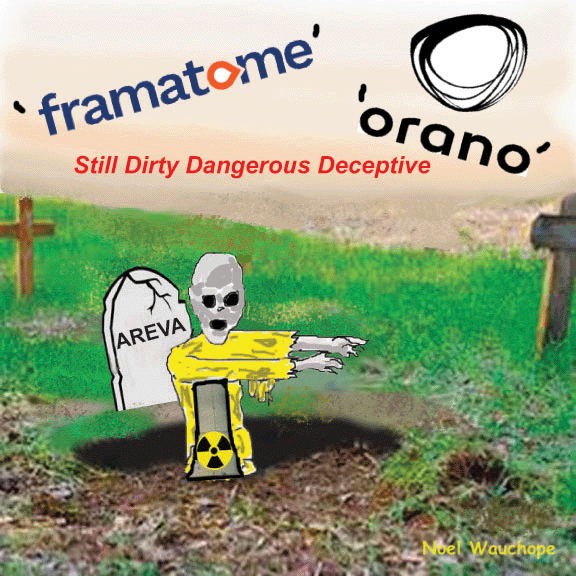
France’s nuclear sector, which lately came under additional pressure due
to newly discovered corrosion problems at some EDF (EDF.PA) sites, may need
a “Marshall plan” to survive, said the head of France’s ASN nuclear
watchdog. Difficulties also increased at Orano’s Melox site which produces
nuclear elements for plants, adding to EDF’s problems, ASN President
Bernard Doroszczuk told reporters.
Reuters 19th Jan 2022
In Georgia, Bloated Costs Take Over a Nuclear Power Plant and a Fight Looms Over Who Pays,
In Georgia, Bloated Costs Take Over a Nuclear Power Plant and a Fight Looms Over Who Pays,
Vogtle’s two new nuclear reactors are six years late and at least $16 billion over their original budget. The plant will have no direct carbon footprint, but critics say there are much cheaper ways to reduce emissions.
Inside Climate News, By James Bruggers, January 21, 2022 Ballooning cost overruns and construction delays at Georgia Power Co.’s Vogtle nuclear project threaten to cost the state’s electricity consumers billions of dollars in the decades to come, a new think tank report concludes.
The report, from the Institute for Energy Economics and Financial Analysis, a nonprofit advancing a sustainable energy economy, builds a case that stockholders of the company should take the lead on construction and carry much of the financial load, rather than ratepayers.
Once estimated to cost $14 billion, the price tag for two new reactors at Georgia Power’s Plant Vogtle property has climbed past $30 billion, and both units will be more than six years late in coming online, the institute reported after combing through public records including testimony at a Georgia Public Service Commission hearing in December. The plant already has two existing nuclear power units that began producing electricity in the 1980s.
Public Service Commission staff and consultants have blamed the project’s high costs and construction delays on Georgia Power, which is the lead partner in its construction and eventual operation, and a subsidiary of Southern Company, the energy policy institute found.
Georgia Power was warned in 2008 that using an unproven reactor design would likely cause overruns and delays, said David Schlissel, the report’s author and the institute’s director of resource planning and analysis. “However, the company challenged and the commission disregarded these warnings,” said Schlissel, a lawyer who has been a frequent expert witness in legal proceedings.
Commission spokesman Tom Krause said he could not comment directly on the institute’s report or the commission’s ongoing quasi-judicial proceedings that are designed to monitor the construction, which the Atlanta Journal Constitution has described as the largest project in Georgia history. The commission regulates Georgia Power, and as such, has a major say in Georgia energy policy.
Krause said future hearings, when the project is farther along, will be held to help the commission, made up of five members who are elected statewide, determine which of the Vogtle costs should be allocated to ratepayers, as opposed to shareholders.
“That will be a very significant docket before the PSC,” Krause said.
“I imagine it will be a knock-down, drag-out fight,” Schlissel said. “I have heard a fair amount of the documentation, and just reading what the PSC staff has been saying, clearly this project has been mismanaged.”
The institute, based in Lakewood, Ohio, is not an official party in those proceedings and its report was not prepared for any organization that is directly participating in them, Schlissel said.
Georgia Power’s customers have already paid more than $3.5 billion for the two units through a rider on their electric bills intended to cover financing charges, the report found.
“Our new Vogtle units will be clean energy sources and produce zero air pollution,” said Jeff Wilson, Georgia Power spokesman. “That’s why we remain fully committed to getting the job done, and getting it done right, with safety and quality our top priority.”
He also minimized the plant’s impact on customers’ rates.
The two units were originally to be placed in service in 2016 and 2017. The owners now estimate commercial operation will not begin until 2022 and 2023, according to the report. They are to be the first new commercial nuclear power units in the United States in the last three decades.
The institute’s report quoted a commission hearing in December at which an independent monitor of the project, Don Grace, told the commission that Georgia Power had on more than one occasion used low forecasts as a way to “try and continue to justify the project.”………….
Grace, in his testimony, described developing the plant as similar to driving “uphill in the snow.”
And the wheels are turning. Money is being spent and you’re trying to get to the goal of getting to the top of the hill,” he said. “But in some cases you’re making slow progress, but not at the rate you expected. And in some cases you’re actually slipping backwards somewhat.”……………………… https://insideclimatenews.org/news/21012022/georgia-power-vogtle-nuclear/
Rolls Royce aims to market its Small Nuclear Reactors to Saudi Arabia (a good step towards nuclear weapons?)
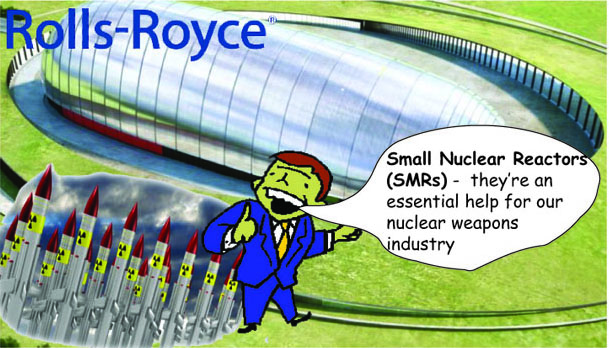
Rolls-Royce heads to Middle East as Saudi Arabia plots £74bn nuclear investment,
ROLLS-ROYCE is looking to the Middle East to export its new [so-called] green technology while Saudi Arabia is reportedly eyeing up a £74billion nuclear investment.
Express UK By JACOB PAUL, Wed, Jan 19, 2022………….. Rolls-Royce looks set to bring its SMR technology to the World Future Energy Summit. This is a global conference showcasing green energy technology. Mr Samson said the company is hoping to start talks with government representatives and large industrial in the Middle East……
And this comes as Saudi Arabia is reportedly exploring options of investing $100 billion (£73.55billion) in several nuclear plants with a combined capacity of 22 gigawatts………
It comes as Rolls-Royce looks set to bring its SMR technology to the World Future Energy Summit.
This is a global conference showcasing green energy technology.
Mr Samson said the company is hoping to start talks with government representatives and large industrial in the Middle East.
And this comes as Saudi Arabia is reportedly exploring options of investing $100 billion (£73.55billion) in several nuclear plants with a combined capacity of 22 gigawatts……..
Mtr Samson – “We have opened up a whole spectrum of customers.”
And Rolls-Royce has already been looking for opportunities to sell its technology to potential UK customers.
But the first SMR units are not expected to come online before the early 2030s. Mr Samson said the company needs to first go through the regulatory processes in Britain. It also needs time to build factories, certify its designs and move on to the production process………… https://www.express.co.uk/news/science/1552184/rolls-royce-middle-east-Saudi-arabia-smr-nuclear-world-future-energy-summit
Contradictory demands on EDF
“Neither its organization nor its finances allow EDF to meet all then challenges it faces”. Ensuring the country’s energy security, promoting French know-how internationally, producing ever greener products and serving as a financier of last resort: EDF is subject to contradictory political injunctions, underlines in his column Jean-Michel Bezat, journalist Le Monde.
Let’s face it, we would not like to be in the place of the CEO of EDF. At the controls of the energy giant since 2014, Jean-Bernard Lévy is not the type to let his arm be twisted without afight. But after tough negotiations, the state shareholder (83.9%) ended up imposing its views on it: within the framework of the mechanism for regulated access to historical nuclear electricity (Arenh), imposed byBrussels in 2011 in the name of the competition, he will have to sell to his competitors – at a sale price, it’s in season – 20% more power than usual.
Le Monde 17th Jan 2022
President Macron’s plan for electricity price cut could cost EDF €8 billion
President Macron’s plan to avoid a politically explosive electricity price rise in France could cost EDF €8 billion, the French state-controlled energy group warned yesterday. The alert prompted a sharp sell-off in shares of EDF, which tumbled by 14.6 per cent, or €1.51, to close at €8.84 last night, as investors reacted with dismay to an order from the French government that the company must increase the amount of
cut-price electricity it sells to rivals to hold down prices for consumers.
EDF further spooked the markets by saying that it was extending the shutdowns of five nuclear reactors because of safety concerns, leading to a fresh cut to its electricity production forecasts. The group, which is leading the project to build Britain’s only new nuclear plant at Hinkley Point in Somerset, said that it was unable to calculate the exact financial consequences of the last salvo of bad news and withdrew its profit guidance for the year. It said that it would “consider appropriate measures to strengthen its balance sheet structure and any measure to protect its interests”.
Times 15th Jan 2022
1 This Month



26 September – International Day for the Total Elimination of Nuclear Weapons


PLEASE OPPOSE HR 8255 AND S.3639 – bills would accelerate satellite deployment, with no environmental review or safeguards – https://ncstd5li.quorum.us/campaign/169331/
To see nuclear-related stories in greater depth and intensity – go to https://nuclearinformation.wordpress.com
-
Archives
- September 2026 (245)
- August 2026 (330)
- July 2026 (355)
- June 2026 (287)
- May 2026 (306)
- April 2026 (356)
- March 2026 (251)
- February 2026 (267)
- January 2026 (308)
- December 2025 (358)
- November 2025 (359)
- October 2025 (375)
-
Categories
- 1
- 1 NUCLEAR ISSUES
- business and costs
- climate change
- culture and arts
- ENERGY
- environment
- health
- history
- indigenous issues
- Legal
- marketing of nuclear
- media
- opposition to nuclear
- PERSONAL STORIES
- politics
- politics international
- Religion and ethics
- safety
- secrets,lies and civil liberties
- spinbuster
- technology
- Uranium
- wastes
- weapons and war
- Women
- 2 WORLD
- ACTION
- AFRICA
- Atrocities
- AUSTRALIA
- Christina's notes
- Christina's themes
- culture and arts
- Events
- Fuk 2022
- Fuk 2023
- Fukushima 2017
- Fukushima 2018
- fukushima 2019
- Fukushima 2020
- Fukushima 2021
- general
- global warming
- Humour (God we need it)
- Nuclear
- RARE EARTHS
- Reference
- resources – print
- Resources -audiovicual
- Weekly Newsletter
- World
- World Nuclear
- YouTube
-
RSS
Entries RSS
Comments RSS
 nuclear-news