France’s nuclear company EDF in trouble, and with election looming
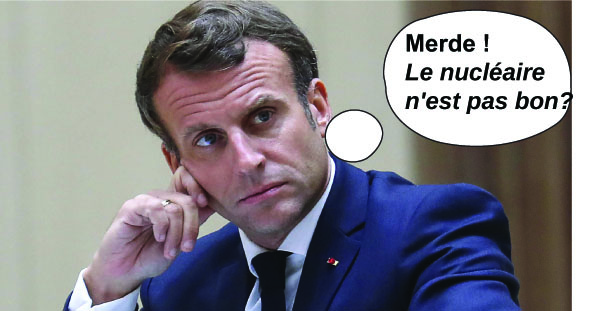
Emmanuel Macron facing the EDF and energy bomb. With the blocking of
regulated tariffs, to limit price increases to 4%. EDF will have to sell a
larger quantity of cheap nuclear electricity to its competitors. Panic wins
the company whose stock price has collapsed.
CEO Jean-Bernard Lévy has
just convened for Monday the “top 200”, the 200 highest executives of EDF.
We are already talking about a necessary recapitalization of EDF. Will the
state back to pot again? Or does the executive imagine calling on outside
investors? The question will be explosive three months before the
presidential election.
La Tribune 14th Jan 2022
Big fall in EDF’s shares
EDF’s shares fell by 14.6 per cent after Macron ordered the company to
sell cut price energy to its rivals to stave off price hikes. The scheme
will cost EDF €8bn (£6.7bn), the French state-controlled energy group
warned yesterday, forcing the company to revise annual earning estimates.
French President Macron promised in September to cap power price increases
at four per cent this year, passing the cost of a 44 per cent rise in
energy prices onto suppliers in order to protect households. The
announcement compounded the woes of EDF investors, who have seen shares
shed 25 per cent of their value in a month.
City AM 15th Jan 2022
https://www.cityam.com/edf-shares-plummet-as-macron-shields-public-from-soaring-energy-bills/
Scotland’s electricity consumers will pay up for UK’s Hinkley nuclear plant, though it’s not even built
The UK Government’s commitment to new nuclear power stations in England
will push up energy bills for consumers in Scotland. Although Scotland has
used planning laws to prevent any new nuclear south of the border, the UK
Government has pressed ahead with projects like Hinkley Point, which will
charge bill payers upfront to subsidise nuclear power stations that
haven’t even been built yet.
The issue was raised in the Scottish
parliament this week by Scottish Greens energy spokesperson Mark Ruskell,
prompting the Net Zero secretary Michael Matheson to confirm that “in
2030 alone Hinkley could add almost £40/year to a consumer bill whereas an
equivalent offshore wind farm would reduce bills by £8/year.”
Commenting, Mark Ruskell said: “As well as leaving a toxic legacy for
generations to come, nuclear power is a bad deal for consumers now, at a
time when energy bills are pushing more and more households into fuel
poverty.
“Renewable energy is far cheaper, and since it doesn’t result
in toxic waste which will remain deadly for hundreds of thousands of years,
better for the environment too. That’s why with Greens in government
Scotland is doubling our onshore wind capacity and investing in offshore
wind and marine renewables too. “The UK Government’s energy policy is
more about helping its friends than following the science or tackling fuel
poverty. It’s important we do things differently in Scotland, which would
be helped with the greater powers of independence.”
Scottish Greens 14th Jan 2022
Drop in EDF’s 2022 production target due to nuclear outages because of cracks

EDF has cut its 2022 nuclear production target by almost 10% to 300-330 TWh following outages extensions at five of its 56 nuclear reactors (7.3 GW). Previously, the French utility aimed to generate 330-360 TWh of atomic output this year.
The firm attributed the reduced production figure to outage extensions of up to nine months at its Civaux 1,2, Chooz 1,2 (1.5 GW each) and Penly 1 (1.3 GW) units due to ongoing checks on the pipes of their safety injection system (SIS) circuit, it said in a statement late on Thursday.
Last month, the firm unexpectedly shut down both its Chooz reactors for inspections following the discovery of cracks close to welding on the pipes at the Civaux plant. EDF said that preventive checks at Penly 1 revealed “similar defects on the SIS circuit”.
Montel News 14th Jan 2022
https://www.montelnews.com/news/1292773/edf-cuts-2022-nuclear-output-target-by-10-amid-outages
‘Nuclear obsession’: Tory bill to let firms charge customers to build plants
‘Nuclear obsession’: Tory bill to let firms charge customers to build plants https://www.thenational.scot/news/19837771.nuclear-obsession-tory-bill-let-firms-charge-customers-build-plants/?fbclid=IwAR2qOsgM6f-vP8Y1Ieh4N2fAPD-00KK5j2I8Megxd7BEfa0hlLs-FmBI2ss
Gregor Young, 14 Jan 22, ONLY independence will rid Scotland of Westminster’s nuclear obsession ahead of a bill that will allow energy companies to increase consumer bills to build nuclear plants, the SNP have warned.
The Tories’ Nuclear Energy (Financing) Bill, which received its third reading in the House of Commons yesterday, would allow energy companies to pass the cost of a future nuclear power station to their current consumers.
The bill comes amidst a Tory-made cost-of-living crisis as energy bills and food prices continue to soar, after a £1000 cut to Universal Credit, and ahead of a regressive National Insurance hike.
The SNP Scottish Government has made it clear that it is committed to opposing new nuclear power plants and prioritising renewable and low carbon sources of energy, with Scotland producing nearly all of its electricity from renewable sources.
SNP energy spokesperson Alan Brown MP said: “Scotland has made it clear time and again that we do not want nuclear power stations – yet we will foot the bill for them anyway as the Tory government hammer on with their nuclear obsession.
“It is madness that during a cost of living crisis, the Tories are pushing through a bill that could see energy bill consumers forced to pay for another Tory vanity project.
“We do not need nuclear energy to decarbonise and there are better, and cheaper, ways to produce energy. The experts have made this clear.
“The only way for Scotland to escape the Tories’ costly nuclear obsession is through independence.”
UK’s Nuclear Financing Bill – very strange logic – with £40 billion to £60 billion for a new nuclear power station seen as a good thing.
Last week Tim Farron MP sent the following reply to Radiation Free Lakeland when we urged him to vote NO to the public paying for new nuclear build in the Nuclear Financing Bill yesterday. Our MP’s opposition to new nuclear is heartening. But this opposition was not reflected in the vote of
458 for to 53 against (how many others opposed did not vote?) the Bill at third reading.
The Bill will now be considered in the House of Lords. This vote is truly shocking. Alan Brown MP said during the debate Government “has been very good at telling us about the mythical savings that will
accrue via the regulated asset base funding model introduced by this Bill—they are estimated at between £30 billion and £70 billion. What the Government are not so good at is telling us what money they want to commit for the likes of Sizewell C. In effect, they are telling us, ”Let’s save money for bill payers by signing up to a less bad deal for a new nuclear project.”
According to the impact assessment, the capital and financing cost is going to be in the region of £40 billion to £60 billion for a new nuclear power station.
It is a strange logic to tell us that £50 billion being added to our energy bills at the time of a cost of living energy crisis is somehow a good thing. By default, the Government are also confirming just how much of a stinking, rotten deal Hinkley Point C was for bill payers if we are saying that we can save that much money compared with the contracts for difference model for Hinkley C.”
Radiation Free Lakeland 11th Jan 2022
UK’s Nuclear Energy (Financing) Bill passes in House of Commons

New funding plan for Sizewell C station clears final hurdle in Commons https://www.eadt.co.uk/news/business/funding-plan-sizewell-c-suffolk-clears-commons-8612482
Matthew Earth January 10, 2022
Plans for a new way of funding nuclear power plants – including Sizewell C on the Suffolk coast – have cleared their final hurdle in the House of Commons.
Business Secretary Kwasi Kwarteng described the passing of the Nuclear Energy (Financing) Bill on Monday evening as the “path to leadership and innovation”.
The Bill creates a new framework for funding nuclear power plants, after worries from investors have led to current projects stalling.
It would allow pension funds and other institutional investors to provide cash for power stations through a regulated asset base funding model.
Energy bill payers would contribute towards the cost of new power stations during construction through their bills, with the aim of giving investors greater certainty after projects such as Sizewell C faced delays due to concerns over the financial risks of construction.
However, Labour has said bill payers could be exploited as a “milk cow” under the new scheme if power stations face delays during building work.
MPs voted 458 to 53 in favour of the Bill at third reading, and it will now be considered in the House of Lords.
The government has recently agreed a six-week delay to the final decision A final decision on whether the station will be built is expected later this year.
The desperate nuclear industry now looks to get its claws into electric cars.

US Nuclear January 2022 Shareholder Letter, US Nuclear Corp.Thu, January 13, 2022”……………………..Looking forward to electric cars and trucks: As a group Solar System Resources, Grapheton, and Four Point, with the encouragement of US Nuclear, were one of 20 EV innovators, judged and selected by ‘Charge On Innovation Challenge’ out of 350 of the best engineering companies in this global competition under the patronage of BHP, RioTinto, and Vale mining companies. Competing to electrify huge fleets of ultra-class mining trucks, our group proposed to develop a novel super-capacitor technology that would be used for powering and rapidly charging electric cars and trucks………’https://finance.yahoo.com/news/us-nuclear-january-2022-shareholder-133000864.html
In 2022, nuclear power’s future looks grimmer than ever.

As new renewable energy capacity continues to boom, nuclear power generation declined in 2021 and the industry’s future is grimmer than it has ever been. The post In 2022, nuclear power’s future looks grimmer than ever appeared first on RenewEconomy.
In 2022, nuclear power’s future looks grimmer than ever — RenewEconomy Renew Economy, Jim Green 11 Jan 22,
The decline was marginal (<1 per cent): a net loss of two power reactors (six start-ups and eight 8 permanent closures) and a net loss of 2.5 gigawatts (GW) of nuclear capacity.
The marginal decline makes for a striking contrast with renewables. The International Energy Agency calculates that new renewable capacity added in 2021 amounted to nearly 290 GW – that’s more than four times Australia’s total electricity generating capacity.
Nuclear power’s contribution to global electricity supply has fallen from a peak of 17.5 percent in 1996 to 10.1 percent in 2020. Renewables reached an estimated 29 per cent share of global electricity generation in 2020, a record share.
The ageing of the world’s reactor fleet is a huge problem for the nuclear industry, as is the ageing of its workforce — the silver tsunami. The average age of the world’s reactor fleet continues to rise and by mid-2021 reached 30.9 years. The mean age of the 23 reactors shut down between 2016 and 2020 was 42.6 years.
Primarily because of the ageing of the reactor fleet, the International Atomic Energy Agency estimates up to 139 GW of lost nuclear capacity from 2018-2030 due to permanent reactor shutdowns, and a further loss of up to 186 GW from 2030-2050.
So the industry needs about 10 new power reactors (or 10 GW) each year just to maintain its 30-year pattern of stagnation. And there were indeed 10 reactor construction starts in 2021, six of them in China.
But the average annual number of construction starts since 2014 has been just 5.1. Thus, slow decline of nuclear power is the most likely outcome. An extension of the 30-year pattern of stagnation is possible, if and only if China does the heavy lifting. China has averaged just 2.5 reactor construction starts per year since 2011.
Phasing out nuclear power
The number of countries phasing out nuclear power steadily grows and now includes:
Nuclear power generation declined in 2021 and the industry’s future is grimmer than it has ever been.
The decline was marginal (<1 per cent): a net loss of two power reactors (six start-ups and eight 8 permanent closures) and a net loss of 2.5 gigawatts (GW) of nuclear capacity.
The marginal decline makes for a striking contrast with renewables. The International Energy Agency calculates that new renewable capacity added in 2021 amounted to nearly 290 GW – that’s more than four times Australia’s total electricity generating capacity.
Nuclear power’s contribution to global electricity supply has fallen from a peak of 17.5 percent in 1996 to 10.1 percent in 2020. Renewables reached an estimated 29 per cent share of global electricity generation in 2020, a record share.
The ageing of the world’s reactor fleet is a huge problem for the nuclear industry, as is the ageing of its workforce — the silver tsunami. The average age of the world’s reactor fleet continues to rise and by mid-2021 reached 30.9 years. The mean age of the 23 reactors shut down between 2016 and 2020 was 42.6 years.
Primarily because of the ageing of the reactor fleet, the International Atomic Energy Agency estimates up to 139 GW of lost nuclear capacity from 2018-2030 due to permanent reactor shutdowns, and a further loss of up to 186 GW from 2030-2050
So the industry needs about 10 new power reactors (or 10 GW) each year just to maintain its 30-year pattern of stagnation. And there were indeed 10 reactor construction starts in 2021, six of them in China.
But the average annual number of construction starts since 2014 has been just 5.1. Thus, slow decline of nuclear power is the most likely outcome. An extension of the 30-year pattern of stagnation is possible, if and only if China does the heavy lifting. China has averaged just 2.5 reactor construction starts per year since 2011.
Phasing out nuclear power
The number of countries phasing out nuclear power steadily grows and now includes:
Germany: Fourteen reactors have shut down since the 2011 Fukushima disaster and the final three reactors will close this year.
Belgium: The country’s seven ageing reactors will all be closed by the end of 2025.
Taiwan: Final reactor closure scheduled for 2025. Four reactors were shut down from 2018 to 2021 and only two remain operational.
Spain: Nuclear power capacity is expected to decline from 7.1 GW in 2020 to 3 GW in 2030 with the final reactor closure in 2035.
Switzerland: The government accepted the results of a 2017 referendum which supported a ban on new reactors and thus a gradual phase-out is underway. The Mühleberg reactor was shut down in 2019 and most or all of the remaining four ageing reactors are likely to be shut down over the next decade.
South Korea: Long-term (2060) phase-out policy with concrete actions already taken including the shut-down of the Kori-1 and Wolsong-1 reactors in 2017 and 2019 respectively, and suspension or cancellation of plans for six further reactors. The current plan is to reduce the number of reactors from a peak of 26 in 2024 to 17 in 2034.
Too cheap to meter or too expensive to matter?
Despite the abundance of evidence that nuclear power is hopelessly uncompetitive compared to renewables, the nuclear industry and some of its supporters continue to claim otherwise.
Those economic claims are typically based on implausible cost projections for non-existent ‘Generation IV’ reactor concepts. Moreover, the nuclear lobby’s claims about the cost of renewables are just as ridiculous.
Claims about ‘cheap’ nuclear power certainly don’t consider real-world nuclear construction projects. Every power reactor construction project in Western Europe and the US over the past decade has been a disaster.
The V.C. Summer project in South Carolina (two AP1000 reactors) was abandoned after the expenditure of at least A$12.5 billion leading Westinghouse to file for bankruptcy in 2017. Criminal investigations and prosecutions related to the project are ongoing, and bailout programs to prolong operation of ageing reactors are also mired in corruption.
The only remaining reactor construction project in the US is the Vogtle project in Georgia (two AP1000 reactors). The current cost estimate of A$37.6-41.8 billion is twice the estimate when construction began. Costs continue to increase and the project only survives because of multi-billion-dollar taxpayer bailouts. The project is six years behind schedule.
In 2006, Westinghouse said it could build an AP1000 reactor for as little as A$2.0 billion, 10 times lower than the current estimate for Vogtle.
The Watts Bar 2 reactor in Tennessee began operation in 2016, 43 years after construction began. That is the only power reactor start-up in the US over the past quarter-century. The previous start-up was Watts Bar 1, completed in 1996 after a 23-year construction period.
In 2021, TVA abandoned the unfinished Bellefonte nuclear plant in Alabama, 47 years after construction began and following the expenditure of an estimated A$8.1 billion.
There have been no other power reactor construction projects in the US over the past 25 years other than those listed above. Numerous other reactor projects were abandoned before construction began, some following the expenditure of hundreds of millions of dollars.
Western Europe
The only current reactor construction project in France is one EPR reactor under construction at Flamanville. The current cost estimate of A$30.1 billion — yes, over A$30 billion — is 5.8 times greater than the original estimate. The Flamanville reactor is 10 years behind schedule.
The only reactor construction project in the UK comprises two EPR reactors under construction at Hinkley Point. In the late 2000s, the estimated construction cost for one EPR reactor in the UK was A$3.8 billion. The current cost estimate for two EPR reactors at Hinkley Point is A$41.6-43.5 billion, over five times greater than the initial estimate of A$3.8 billion per reactor.
In 2007, EDF boasted that Britons would be using electricity from an EPR reactor at Hinkley Point to cook their Christmas turkeys in 2017, but construction didn’t even begin until 2018.
One EPR reactor (Olkiluoto-3) is under construction in Finland. The current cost estimate of about A$17.4 billion is 3.7 times greater than the original estimate. Olkiluoto-3 is 13 years behind schedule.
Nuclear power is growing in a few countries, but only barely. China is said to be the industry’s shining light but nuclear growth has been modest over the past decade and it is paltry compared to renewables (2 GW of nuclear power capacity added in 2020 compared to 135 GW of renewables).
There were only three power reactor construction starts in Russia in the decade from 2011 to 2020, and only four in India……………………………… https://reneweconomy.com.au/in-2022-nuclear-powers-future-is-grimmer-than-ever/
The European Union will need to invest 500 billion euros ($568 billion) in new generation nuclear power stations!
France24 9th Jan 2022
The European Union will need to invest 500 billion euros ($568 billion) in new generation nuclear power stations from now until 2050, the bloc’s internal market commissioner said in an interview published at the weekend.
“Existing nuclear plants alone will need 50 billion euros of investment from now until 2030. And new generation ones will need 500 billion!” Thierry Breton told the Journal du Dimanche newspaper. Breton also argued that an EU plan to label energy from nuclear power and natural gas as “green” sources for investment was a vital step towards attracting that capital. The EU is consulting its member states on that proposal, with internal disagreement on whether the power sources truly qualify as sustainable options.
France24 9th Jan 2022
Legal case over compensation for workers in ”uniquely dangerous” nuclear sites
High Court Takes Up Nuclear Site Workers’ Compensation Case (1) https://news.bloomberglaw.com/daily-labor-report/high-court-takes-up-washington-workers-compensation-challenge
Jan. 11, 202
- 9th Cir. upheld change to state workers’ compensation law
- U.S. government warns of costly consequences for contracts
The U.S. Supreme Court will consider the federal government’s challenge to a Washington state workers’ compensation law in a case that could have costly consequences for U.S. government contracts involving hazardous work on federal property.
The justices agreed Monday to review a U.S. Court of Appeals for the Ninth Circuit decision upholding a Washington law that presumes certain worker health conditions linked to cleanup work at the Hanford Site, a decommissioned federal nuclear production complex, are occupational diseases that can trigger workers’ compensation benefits.
The Department of Energy since 1989 has overseen cleanup at the Hanford Site, which produced weapons-grade plutonium for use in the U.S. nuclear program during World War II and the Cold War. The cleanup of the Hanford site is expected to continue over the next six decades and involve roughly 400 department employees and 10,000 contractors and subcontractors.
In 2018, Washington lawmakers passed legislation, HB 1723, that amended the state’s workers’ compensation law exclusive to the Hanford site, covering at least 100,000 current and former federal contract workers who performed services there over the past 80 years. The law states that presumed occupational diseases stemming from work at Hanford should trigger benefits eligibility, including cancers and other respiratory diseases.
The federal government argued the law exposes government contractors, and by extension the United States, to “massive new costs” that similarly situated state and private employers don’t incur
‘Uniquely Dangerous Workplace’
The Justice Department had asked the Supreme Court to take up the case, arguing the 2018 law discriminated against the United States and that state law shouldn’t apply to federal contract workers at Hanford. The government warned that the logic applied by a panel of Ninth Circuit judges opened the door to other states passing legislation targeting work at federal facilities.
“Congress did not permit States to adopt laws that impose unique burdens on the United States and the firms that it engages to carry out federal functions,” Justice Department attorneys argued. “The practical consequences of the panel’s mistake are far-reaching. Even if the Hanford site is considered in isolation, the decision is likely to cost the United States tens of millions of dollars annually for the remainder of the 21st century.”
Attorneys for Washington state, however, responded that courts have allowed states to regulate workers’ compensation for injuries or illnesses suffered during work on federal land. They argued Washington state has “long tailored its workers’ compensation laws to the dangers faced by particular employees,” noting statutes that protect firefighters and other workers facing special hazards.
“Hanford is a uniquely dangerous workplace, filled with radioactive and toxic chemicals, and private contractors operating there have routinely failed to provide employees with protective equipment and to monitor their exposures to toxic substances,” they argued.
Justice Department attorneys also argued the Ninth Circuit ruling clashed with Supreme Court precedent in a 1988 decision, Goodyear Atomic Corp. v. Miller, which described a similar situation of a state workers’ compensation award for an employee injured at a federally owned facility.
The full Ninth Circuit previously declined to take up the case, and said the Washington law fell properly within a part of federal law that authorizes states to apply their workers’ compensation laws to federal projects.
In a dissent to the Ninth Circuit’s denial of a rehearing, Judge Daniel P. Collins wrote that the panel’s decision clashed with high court precedent, calling it an “egregious error” that would have sweeping consequences.
The U.S. Solicitor General’s office represents the federal government. The Washington Attorney General’s office is defending the state law.
The case is U.S. v. Washington, U.S., No. 21-404, cert granted 1/10/22.
To contact the reporter on this story: Erin Mulvaney in Washington at emulvaney@bloomberglaw.com
To contact the editors responsible for this story: Jay-Anne B. Casuga at jcasuga@bloomberglaw.com; John Lauinger at jlauinger@bloomberglaw.com; Andrew Harris at aharris@bloomberglaw.com
To bankroll the failing nuclear industry, the UK government will push thousands into fuel poverty, with its Nuclear Energy (Financing) Bill

Bad for fuel poverty, bad for climate action: why MPs should vote against the Nuclear Energy Bill on Monday.
Controversial legislation is being rushed through parliament which will transfer billions of pounds onto
individual consumers, whilst affording them no protection from the spiralling construction costs of nuclear power. Introduced at the end of October when attention was rightly focused on COP26, the Bill has received little attention.
Yet it will have a profound impact on millions of families forced to foot the bill and will push thousands more into fuel poverty. So why is the government forcing more families into fuel poverty?
To bankroll a failing industry. With all 15 British nuclear power plants set to be closed by 2030, funding for eight new ones is in a state of collapse. Only one plant – Hinkley Point C – is under construction and
this is running ten years late and £4.5 billion over budget. The Bill enables energy companies to use a regulated asset base (RAB) model to transfer the construction costs – and financial risks – onto consumers
and start making a profit even before the plants generate any electricity.
Labour Outlook 9th Jan 2022
New generation European nuclear power will need investment of 500 billion euros by 2030. Existing plants will require 50 billion.

New generation European nuclear power plants will require an investment of "500 billion [euros] by 2050," said in an interview in the Journal du dimanche (JDD) dated January 9 the European Commissioner for the Internal Market, Thierry Breton , which considers “crucial” to open the green labeling to nuclear power as part of the energy transition.

"Existing nuclear power plants alone will require 50 billion euros of investment by 2030. And 500 billion by 2050 for new generation ones! », Affirms the French commissioner.

European Commission unveiled a green labeling project for nuclear and gas power plants, which aims to facilitate the financing of installations contributing to the fight against climate change..........

Nuclear power is the subject of heated debates between the Twenty-Seven, a dozen countries - France in the lead - actively promoting nuclear power in the face of States very reluctant to the civilian atom, such as Germany or Austria. Le Monde 9th Jan 2022

 https://www.lemonde.fr/economie/article/2022/01/09/nucleaire-nouvelle-generation-l-ue-devra-investir-500-milliards-d-ici-a-2050-estime-thierry-breton_6108727_3234.html
Nuclear Energy Financing Bill – a poisoned chalice for the UK public.
The UK & Ireland Nuclear Free Local Authorities (NFLA) is supporting calls to MPs to reject the Nuclear Energy Financing Bill when it comes back to the House of Commons for its Report Stage reading next Monday (10th January). The Chair of the NFLA Steering Committee, Councillor David
Blackburn, called the bill a ‘poisoned chalice’ for the British public:
“This bill will mean that consumers will ultimately pay the cost of developing any new ultra-expensive nuclear power plants through a surcharge applied to customers’ electricity bills. “Civil nuclear projects are
notorious for being delivered massively above budget and enormously behind time.
Consequently, there are only two main players in the nuclear market, and these have had their financial fingers burned. “The government wants to sweeten the pill by introducing a new method of financing nuclear plants called the Regulated Asset Base. This will mean that customers pay for cost
overruns and delays, and even the cost of abortive projects, whilst the developer and operator reap all of the rewards.”
NFLA 7th Jan 2022
The Nuclear Energy (Financing) Bill aims to provide for a new model for
financing new nuclear power stations in the UK. This briefing covers the
Bill’s progress through Parliament, through second reading and committee
stage.
House of Commons Library 7th Feb 2022
What ratepayers should know about the Plant Vogtle expansion
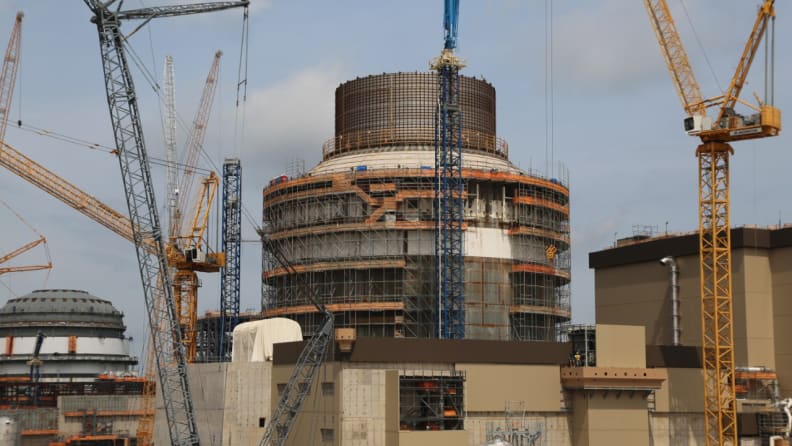
What ratepayers should know about the Plant Vogtle expansion January 6, 2022 By: Mary Landers , The Current
If you feel like you keep reading the same story about the expansion of Plant Vogtle, the only new nuclear power under construction in the U.S., you’re not exactly wrong.
Reactors No. 3 and 4 at Vogtle on the banks of the Savannah River near Waynesboro are more than five years overdue and $14 billion over budget. And that’s just a broad outline.
For more details, and for a take that’s sympathetic to consumers bearing these costs, read Georgia Conservation Voters‘ 32-page report “Ratepayer Robbery — The True Cost of Plant Vogtle.”
It includes timelines, data on expenses, and records of key decisions. The report reminds Georgia Power residential customers that they’ve been paying for Vogtle financing on their monthly bills for 10 years while industrial customers are exempt. It also spells out how Vogtle’s cost overruns actually increase Georgia Power’s profit. Footnotes link to news articles, and government and nonprofit documents.
“Plant Vogtle is a monumental example of failed leadership, oversight and lack of forethought,” said GCV Executive Director Brionté McCorkle. “What started out as an overpriced $14 billion project has ballooned into more than $30 billion, and that doesn’t take into account the future costs of completing the units.”
The report highlights the role of the Georgia Public Service Commission, an elected five-member panel, in moving the project forward. In a go/no go review of the project in 2017 after building contractor Westinghouse went bankrupt, expert witnesses and the PSC staff cautioned it wasn’t cost effective to continue. But the PSC voted to continue construction…………..
McCorkle is not against finishing the project, she said, but she is concerned about who will pay to finish it, residential ratepayers or Georgia Power shareholders.
“The responsible thing to do is to reassess the whole situation and reassess who’s picking up the tab for this and why customers are on the hook for paying for this energy,” she said.
Georgia Power, which owns 45.7% of the Vogtle expansion project, “has earned over $6 billion just from the delays of their own project,” the report states.
“They’re profiting, they’re making sky-high profits, while individual ratepayers are struggling to keep the lights on throughout a pandemic, people are losing family members,” McCorkle said. “And the squeeze is being felt everywhere. And our commissioners have a responsibility to do something about that.”
“Ratepayer Robbery — The True Cost of Plant Vogtle” concludes with a list of suggested actions. They are:
- The Georgia Public Service Commission should disallow Georgia Power from placing all of
these nuclear construction costs onto our bills and share rate increases more fully between
customer classes. - Voters should hold Commissioners accountable by ejecting them from their seats and electing pro-consumer candidates that commit to transparency.
- The Georgia State legislature should fully fund an independent Consumer Utility Counsel (CUC).
- The Georgia State legislature should create an independent study commission to document lessons learned.Read the entire report at https://www.scribd.com/document/550992905/Ratepayer-Robbery-The-True-Cost-of-Plant-Vogtle
- https://www.gpb.org/news/2022/01/06/what-ratepayers-should-know-about-the-plant-vogtle-expansion?fbclid=IwAR3zdntXhPLdXrqewGAw26Bt1FwsNXQSuLWXhN2cEvA3zJEyZyN5EZzgmyA
1 This Month



26 September – International Day for the Total Elimination of Nuclear Weapons


PLEASE OPPOSE HR 8255 AND S.3639 – bills would accelerate satellite deployment, with no environmental review or safeguards – https://ncstd5li.quorum.us/campaign/169331/
To see nuclear-related stories in greater depth and intensity – go to https://nuclearinformation.wordpress.com
-
Archives
- September 2026 (245)
- August 2026 (330)
- July 2026 (355)
- June 2026 (287)
- May 2026 (306)
- April 2026 (356)
- March 2026 (251)
- February 2026 (267)
- January 2026 (308)
- December 2025 (358)
- November 2025 (359)
- October 2025 (375)
-
Categories
- 1
- 1 NUCLEAR ISSUES
- business and costs
- climate change
- culture and arts
- ENERGY
- environment
- health
- history
- indigenous issues
- Legal
- marketing of nuclear
- media
- opposition to nuclear
- PERSONAL STORIES
- politics
- politics international
- Religion and ethics
- safety
- secrets,lies and civil liberties
- spinbuster
- technology
- Uranium
- wastes
- weapons and war
- Women
- 2 WORLD
- ACTION
- AFRICA
- Atrocities
- AUSTRALIA
- Christina's notes
- Christina's themes
- culture and arts
- Events
- Fuk 2022
- Fuk 2023
- Fukushima 2017
- Fukushima 2018
- fukushima 2019
- Fukushima 2020
- Fukushima 2021
- general
- global warming
- Humour (God we need it)
- Nuclear
- RARE EARTHS
- Reference
- resources – print
- Resources -audiovicual
- Weekly Newsletter
- World
- World Nuclear
- YouTube
-
RSS
Entries RSS
Comments RSS
 nuclear-news