Update on the status of Britain’s Rolls Royce Small Nuclear Reactor project

Safe Energy E-Journal No. 93 February 2022, Rolls Royce’s Small Modular Reactors On 9th November the Government announced that it would back the Rolls-Royce Small Modular Reactor with £210m in funding. Matched by private sector funding of over £250 million, this investment will be used to further develop the SMR design and start the Generic Design Assessment (GDA) process. (1)
This was followed in December by an announcement the Qatar Investment Authority will pour £85m into its Small Modular Reactor (SMR) programme, which now has total funding of £490m – enough for RR to start scouting sites for factories to supply parts to build SMRs. (2) France’s wealthy Perrodo family, is also investing in the project. (3) RR hopes to see the first reactors supplying electricity within the next decade.
Rolls-Royce is now seeking bids for a site for a factory to make parts for its small nuclear power plants. It has begun competition between English and Welsh regions. The industry consortium led by Rolls-Royce has sent letters to several regional development agencies in England and the Government of Wales to ask them to sell a site. (4) The main factory will build some of the key components of the reactors which will then be assembled at sites around the UK. The letter from Rolls-Royce promised “high value, sustainable jobs which will produce products that will be exported globally for many decades to come”. It also made clear they were looking for possible “financial and non-financial support” from the host. (5)
The consortium led by Rolls Royce, is planning to build 16 SMRs around the country by 2050, the first of which could be plugged into the grid by 2031. (6) Trawsfynydd and Wylfa are two sites expected to be in line for an SMR. (7) Moorside has also been mentioned and Tees Valley mayor Ben Houchen wants Hartlepool to be on the list. (8) North Ayrshire Conservative councillor Tom Marshall has called for an SMR to be built at Hunterston. (9)
Jamie Stone, the Liberal-Democrat MP for Caithness, Sutherland and Easter Ross wants Caithness to be considered as a possible site. Davie Alexander, the vice-chairman of the Dounreay Stakeholder Group and chairman of the Thurso and Wick Trades Union Council, would also like to see the county included as a possible location. (10) Stone is meeting with Rolls-Royce to discuss the matter. RollsRoyce welcomed the opportunity. (11)
Councillor Feargal Dalton, chair of the Scottish Forum of the NFLA urged Jaime Stone to think again. Given the good news on renewables, Councillor Dalton was shocked to hear that Stone has invited Rolls Royce for talks on locating a new reactor for Caithness.
“There is clearly no need, and almost no public support, for new nuclear in Scotland, and we need to tackle climate change now. The Rolls Royce technology is unproven, and civil nuclear projects continue to be notorious for being delivered years late or at an eye-wateringly inflated cost and there is no guarantee that the project will not eventually be cancelled because it took too long or cost too much.” (12)
In November Rolls Royce submitted its 470 MWe SMR design for entry to the UK’s Generic Design Assessment (GDA) process. (13) But this won’t formally begin until the government has assessed the company’s capability and capacity to successfully enter the GDA process. This could take up to 4 months. The GDA process, once it begins, will take 4 or 5 years. (14)
The Government claims that SMRs have the potential to be less expensive to build than traditional nuclear power plants because of their smaller size, and because the modular nature of the components offers the potential for parts to be produced in dedicated factories and shipped by road to site – reducing construction time and cost. But the reason why existing reactors are large is precisely to derive economies of scale: why smaller reactors should be more economic is problematic. Nuclear proponents allege that assembly-line technology will be used in reactor construction but this has yet to be shown in practice anywhere in the world
Some say that SMRs are little more than wishful thinking. For example, Professor MV Ramana ‒ Simons Chair in Disarmament, Global and Human Security at the School of Public Policy and Global Affairs at the University of British Columbia – states:
“SMR proponents argue that they can make up for the lost economies of scale by savings through mass manufacture in factories and resultant learning. But, to achieve such savings, these reactors have to be manufactured by the thousands, even under very optimistic assumptions about rates of learning.” (15)
The Rolls Royce SMR design is not exactly small at 470 MWe. It is proposing to build 16 reactors at an expected cost around £1.8bn – £2.2bn and producing power at £40-60/MWh over 60 yrs. (16)
As well as the Government funding, Rolls-Royce has been backed by a consortium of private investors. The creation of the Rolls-Royce Small Modular Reactor (SMR) business was announced following a £195m cash injection from BNF Resources, and Exelon Generation to fund the plans over the next three years. (17)
References; …………… https://www.no2nuclearpower.org.uk/wp/wp-content/uploads/2022/02/SafeEnergy_No93.pdf
Beleagured Vogtle nuclear project delayed yet again
Southern Co.’s beleaguered Vogtle nuclear project is getting pushed back
again after the company discovered documentation issues that will delay
completion by as much as six months, prompting a $920 million charge.
The Unit 3 reactor may not go into service until March 2023 and Unit 4 may not
be complete until the end of next year, Chief Executive Officer Thomas
Fanning said in an interview Thursday. The delays are yet another setback
for the only nuclear plant under construction in the U.S.
The Vogtle project in Georgia is now about seven years behind schedule and costs have
doubled. The project will be the first new nuclear units built in the
country in the last three decades.
Bloomberg 17th Feb 2022
No end in sight as the French nuclear industry reduces its output
There may be no end in sight for the European power crunch this year, even
after the winter season ends. Low nuclear power generation in France, a
major producer and exporter of nuclear-powered electricity in Europe, could
send power prices on the continent higher in the spring.
France gets more
than 70 percent of its total electricity from nuclear power generation and
is a major exporter of electricity, including to the UK. France’s EDF
stopped two nuclear power plants at the end of last year after finding a
fault at one during routine maintenance.
This brought the total number of
nuclear plants out of operation in December to four, which accounted for 13
percent of the current power availability in France.
Last week, EDF revised down both its 2022 and 2023 nuclear output estimates. As part of its
control program on the French nuclear fleet, EDF revised its 2022 nuclear
output estimate from 300 – 330 TWh to 295 – 315 TWh, the company said
on February 7.
Days later, EDF revised down its 2023 French nuclear output
estimate from 340 – 370 TWh to 300-330 TWh, to reflect a heavy industrial
program with 44 reactor outages for maintenance and inspection, including 6
ten-year inspections, plus 2 scheduled outages starting in 2022 that will
continue into 2023.
Another reason for the nuclear output downgrade is “the
continuation of the control and repair programme on the pipes potentially
affected by the stress corrosion phenomenon, which is still ongoing,” EDF
said.
Oil Price 17th Feb 2022
USA’s Department of Energy (DOE) will give $6 Billion in a program to to stop uneconomic nuclear reactors from closing down

DOE to offer $6B to keep struggling nuclear reactors online, Utility Dive Feb. 16, 2022 By Jason Plautz
Dive Brief:
- The Department of Energy (DOE) will spend $6 billion on a program designed to keep nuclear power plants from closing, according to a notice of intent published last week.
- The department’s Civil Nuclear Credit Program is backed by funding from the bipartisan Infrastructure Investment and Jobs Act signed into law in November. The program will allow owners and operators of commercial U.S. nuclear reactors to competitively bid on credits to help continue their operations amid economic hardship.
…………. The Notice of Intent and Request for Information released by the DOE Friday will help the department learn more about priorities for the program and certification process, which the administration anticipates launching later this year. ……………….. https://www.utilitydive.com/news/doe-to-offer-6-billion-to-keep-struggling-nuclear-reactors-online/618919/
The supposed new rise in nuclear power and the uranium business, is doubtful!

As nuclear power rises again, its second act is in doubt, THE GLOBE AND MAIL, 15 Feb 22,
”…………………………scratch beneath the surface, and it’s clear there are reasons to be wary of nuclear’s renaissance. Despite doubling in price since 2018 to trade at about US$43 a pound, uranium is far below the all-time high of approximately US$140 reached in 2007.
And while China, India, Russia and others are building new nuclear plants, the total number worldwide has fallen consistently since 2018, as other countries, including Germany, Belgium, Switzerland and Spain, phase out aging infrastructure.

…………………… one of the biggest factors holding nuclear power back globally is its growing reputation as a money pit. Outside of China, new power-plant construction is renowned for its astronomically long timelines, gargantuan cost overruns and persistent design problems. France’s Flamanville 3 plant took 16 years to build and went €16-billion ($23-billion) over budget. Finland’s Olkiluoto 3 reactor, which is finally scheduled to go into production later this year after more than a decade of delays, will have taken 20 years to build and is about €5-billion over budget.
Nuclear has always had its fair share of skeptics. Its new designation as an environmentally friendly fuel rankles some people because nuclear waste can stay radioactive for thousands of years and must be stored indefinitely. And the chance of a major accident, which can cause not only immediate fatalities but the potential of cancer deaths from exposure to radioactivity decades later, is a continuing risk. Cameco’s Mr. Gitzel acknowledges that as rare as major accidents have been – three in the past 40 years – they cast a long shadow.
Bradwell nuclear project -dead in the water? – partly due to work of BANNG (Blackwater Against New Nuclear Group).
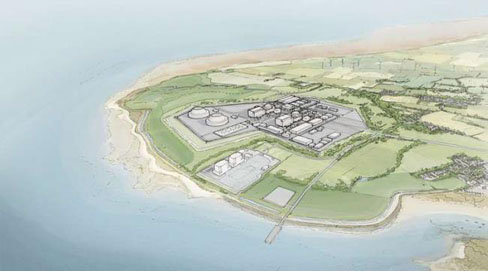
There are reasons to be cheerful. One is the long pause and retreat
confirmed by the developer who does not expect to submit an application
‘for several years yet’.
Another is the general feeling that the Chinese project is now dead in the water.
Yet another is the persistent failing of an industry that is too costly, too dangerous and too slow.
And, it must be said, BANNG’s unrelenting campaign over fourteen years, together with the support of local councils and communities, has demonstrated that the Bradwell site, far from being ‘potentially suitable’, is inappropriate, unsustainable and unacceptable.
It is clear that CGN has doubts about the viability of the Bradwell site in an era of Climate Change. It is likely it has hung on until it gains UK regulatory approval for its reactors. Gaining that coveted passport may be the signal for CGN to quit Bradwell and try its luck elsewhere.
BANNG 14th Feb 2022
Europe’s nuclear power plants will need investments of EUR 500 Billion, so they need to be labelled ‘green” !
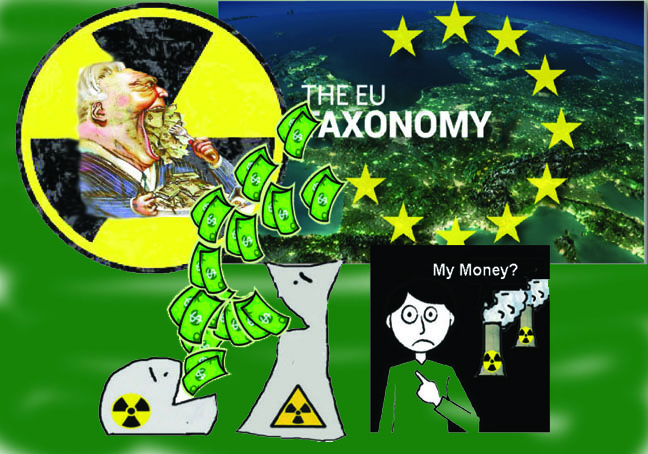
Nuclear Power Preparing to Change Colour, Energy Industry Review, Adrian Stoica February 16, 2022
Cutting-edge nuclear power plants will need investments of EUR 500 billion by 2050, according to the European Commissioner for the Internal Market, Thierry Breton, and to support these projects it is ‘crucial’ for nuclear power to receive the green label within energy transition.
The European Commission (EC) has already prepared a draft proposing rules for the classification of investments that will meet the climate sustainability criteria (“sustainable finance taxonomy”). Therefore, nuclear power plants will be considered green if there is a plan, funding, and location suitable for the elimination of radioactive waste.
The draft has already ignited the spirits in the European Union. While France, a country that ensures 70% of its energy consumption from nuclear source, supports it, Germany, but also other states, vehemently oppose to such draft and threatened to even consider legal action against the European Commission. Together with France, several states, including Romania, have signed a declaration requesting the Commission that nuclear energy be included in the list of green investments.
Existing nuclear plants alone will need €50 billion of investment from now until 2030. And new generation ones will need €500 billion by 2050,” said Thierry Breton. At the end of last year, the European Commission announced that it was preparing a draft according to which some nuclear power plants and some of the gas-fired power plants could be considered green projects, which would make it easier for them to attract funding. The Community Executive has raised comments on this draft until January 12, following to officially present the text of its proposal. Currently, about 26% of electricity produced in the EU comes from nuclear power plants and Commissioner Thierry Breton has estimated that it would account for at least 15% of the energy mix in 2050.
Romania supports the EC initiative
Romania, country which operates two nuclear units, and which has several projects providing for the construction of two other groups and small nuclear power plants with a US partner, has publicly requested, together with other states, the inclusion of nuclear energy in the list of ‘green’ investments………………………… For all of us, nuclear energy is a crucial and reliable asset for a low-carbon future,” reads a statement signed in October 2021 by the representatives of Poland, Hungary, Slovakia, Bulgaria, Croatia, Romania and Slovenia……………………… https://energyindustryreview.com/power/nuclear-power-preparing-to-change-colour/
Slovak government plans to tax nuclear power plants
Slovak government plans to tax nuclear power plants, owners threaten bankruptcy
By Michal Hudec | EURACTIV.sk 11 Feb 22, The “excessive profits” of nuclear power plants should be taxed as this would open up millions to compensate for the soaring energy prices, the economy ministry has said. But Slovenské elektrárne a.s, the owner of both Slovak nuclear power plants, claims the bill would lead to the private company filing for bankruptcy.
The government already agreed on a proposal and sent it to parliament to request a shortened legislative procedure. “The proposal introduces a tax on excessive profits for trading in electricity produced by nuclear facilities. The tax period will be a calendar month, ” the ministry wrote in an explanatory report.
According to the bill, excessive profit is a difference between electricity market prices and expenditures for their production in nuclear power plants. If parliament approves the bill, the state will get half of this difference. This year, it would be approximately €50 million………..
Slovenské elektrárne a.s. is a company owned by EPH of Czech billionaire Daniel Křetínský and Italian energy giant Enel. Together, they own two-thirds of the shares, with the rest belonging to Slovakia’s economy ministry. https://www.euractiv.com/section/politics/short_news/slovak-government-plans-to-tax-nuclear-power-plants-owners-threaten-bankruptcy/
EDF predicts more cuts in nuclear output, as repairs needed for defects in reactors
Electricite de France SA said Friday that it had cut its nuclear output
estimates in France for 2023, adding to concerns after defects had led to
output revisions for 2022. The French energy company said next year’s
output would between 300 and 330 terawatt hours, compared with 340-370 TWh
under previous estimates.
Earlier this week, EDF cut its 2022 output
expectations for the second time, after it found defects at five reactors
at its Civaux and Penly sites. The estimate for 2023 takes into account the
continuation of the control-and-repair program on “pipes potentially
affected by stress corrosion,” EDF said.
Market Watch 11th Feb 2022
https://www.marketwatch.com/story/edf-cuts-2023-french-nuclear-output-estimates-271644567491
President Macron asssures France’s EDF of tens of billions of euros in public financing for new nuclear reactors
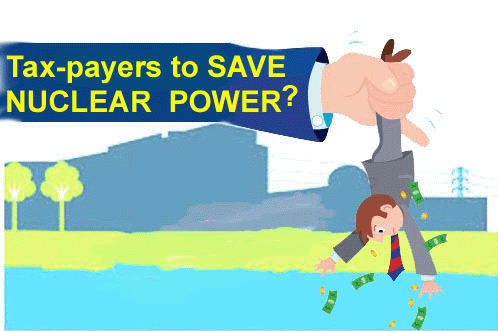
French Finance Minister Bruno Le Maire told C News TV on Friday that he was sure that EDF’s (EDF.PA) difficulties would “disappear” after France announced plans to build at least six new nuclear reactors in the decades to come.
President Emmanuel Macron said on Thursday that the new plants would be built and operated by state-controlled energy provider EDF and that tens of billions of euros in public financing would be mobilized tofinance the projects and safeguard EDF’s finances.
Reuters 11th Feb 2022
In Ukraine, USA to finance American companies to sell nuclear technology there, and to other States

Where the Russians are coming, so is Westinghouse with its nuclear ambitions, ANYA LITVAK, Post Gazette, 7 Feb 22, Over the past few months, Joel Eaker, Westinghouse Electric Co.’s vice president for new nuclear power plant projects, has been shaking hands and posing for pictures all over Eastern Europe.
He was in Poland last month, where he plans to move in the spring. A week before that, he was in the Czech Republic to announce agreements signed with local companies in Cranberry-based Westinghouse’s bid to sell its AP1000 reactors in the region.
The nuclear renaissance never happened in the United States. But Mr. Eaker thinks Europe is headed in that direction.
The long game
The nuclear business is a long game with fits and starts.
For more than two decades, Westinghouse has been seemingly on the cusp of selling new nuclear reactors to various Eastern European countries ………….
All along, Westinghouse was pursuing a parallel strategy: making fuel that could be used in existing Russian-made reactors that are scattered across Europe.
…… Westinghouse could provide an alternate supply of fuel, which effectively delinks those countries from Russia.”
After some attempts loading the fuel in Russian-made reactors at Temelin in the Czech Republic, it was Ukraine that allowed Westinghouse to test and refine its fuel assemblies in Russian reactors.
Today, the U.S. company’s fuel is loaded into nearly half of Ukraine’s nuclear plants, and Westinghouse is trying to use those bona fides to sell fuel to existing Russian-style reactors in Finland, Czech Republic, Slovakia and Hungary, Tarik Choho, president of Westinghouse’s Europe, the Middle East and Africa division, told Ukraine’s news service in August.
Mr. Eaker said Westinghouse’s pursuit of that market was both earnest and strategic.
The company’s bread-and-butter business is supplying fuel to and servicing existing reactors. It’s what made Westinghouse, then in bankruptcy, attractive to the Canadian asset management firm Brookfield Business Partners, which has owned it since 2018.
It’s difficult to predict if this recent burst of nuclear promise in Eastern Europe will yield actual new reactor projects, Ms. Harrington said.
………… In 2014, when the continued existence of the U.S.’s Export-Import Bank became a topic of debate in Congress, Westinghouse’s then-CEO Danny Roderick said the first thing he was asked when pitching a new plant to clients in places like Central Europe is how much the U.S. government is willing to help financially.
………. Pierre Paul Oneid, the chief nuclear officer at Holtec International, a New Jersey-based company that specializes in decommissioning and nuclear fuel storage. Holtec, Mr. Oneid said, had been working for a decade to close a deal for a centralized storage facility for spent nuclear fuel in Ukraine, which would not be possible without financing from the U.S. government.
…….. While Mr. Oneid said the deal was in the “eleventh hour,” in fact it took three more years to finalize. U.S. Overseas Private Investment Corp. announced in 2017 that it was providing $250 million in political risk insurance to the Ukrainian utility. Bank of America/Merrill Lynch would then sell that $250 million commitment in the form of fixed-rate bond securities.
It was the first such deal of its type, but probably not the last.
Show me the money
If there’s another major piece, other than climate change, that’s opening doors for Westinghouse in Eastern Europe, it’s the prospect of the U.S. government’s expanded role in financing nuclear projects, Mr. Eaker said.
In 2019, then-President Donald Trump created the U.S. Nuclear Fuel Working Group………. Among its recommendations was for the U.S. Development Finance Corp., a newly-created vehicle to fund projects in low-income countries, to lift its ban on providing funds to nuclear projects.
The development agency listened and, in the summer of 2020, it unshackled itself from the ban, which was a holdover from its predecessor and modeled on the language of the World Bank. The DFC can even provide financing to projects in higher-income countries in Eastern Europe as part of its charge under the The European Energy Security and Diversification Act of 2019.
This means the U.S. government can now offer equity financing for nuclear projects abroad, a first. It can also give larger loans and loan guarantees than what is typically handled by the Export-Import Bank, and it can offer political risk insurance.
This is the next step in Westinghouse’s advances in Eastern Europe. Once it finishes doing a $10 million front end engineering and design study for AP1000 reactors in Poland — the U.S. government funded 70% of that work as part of an intergovernmental agreement — then it hopes to submit a formal bid along with a U.S. government financing proposal this fall.
In Ukraine, Westinghouse has already signed contracts with the electric utility to start ordering long-lead equipment and doing other preparations, but the contracts won’t be fully implemented until the U.S. comes with the financing package.
Anya Litvak: alitvak@post-gazette.com. https://www.post-gazette.com/business/powersource/2022/02/07/Russia-Ukraine-Westinghouse-Electric-nuclear-AP1000-reactors-climate-change-energy-eastern-europe/stories/202201300126
Nuclear power: CO2 fix or cost disaster?
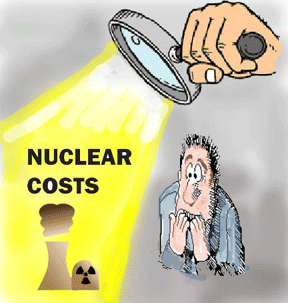
Nuclear power: CO2 fix or cost disaster? E and E News | 02/04/2022 President Biden’s plan to decarbonize the U.S. electricity sector by 2035 could give a boost to nuclear power, but that may hinge on two key questions: Can carbon targets really incentivize the technology, and can it compete cost wise with natural gas?
It’s a debate that is resurfacing, considering recent surging prices of natural gas.
Yet industry hasn’t answeredwhether nuclear will be more economic for producing power, especially after costs for two new reactors at Plant Vogtle in Georgia skyrocketed. The actual costs of 75 of the more than 90 existing nuclear power reactorsin the U.S. exceeded the initially estimated costs of the units by over 200 percent, according to the U.S. Department of Energy.
There are many facets of the cost question — existing nuclear plants in competitive markets face economic challenges that could force them to close early, saddling operators with stranded costs and removing emissions-free electrons [not really emissions-free] from the grid. Meanwhile, no large, baseload reactors are on the table. The industry is working to develop smaller, next-generation reactors by the next decade, but the fate and final costs of projects are uncertain.
“There doesn’t seem to be, in the near term, a big thing that’s going to be pushing” nuclear, said Paul Patterson, a utility analyst with Glenrock Associates LLC. Whether the nuclear industry builds new reactors could help shape the electricity mix for decades. Falling renewable energy costs and higher gas prices may also influence investment decisions for nuclear in unexpected ways.
………… Southern Co.’s Vogtle expansion project hasn’t helped the case for baseload nuclear. The project, which was supposed to lead a resurgence of larger reactors in the 2000s, remains theonly major nuclear power construction project in the United States. Vogtle’sprice tag is twice an earlier $14 billion budget, andthe project is more than seven years behind schedule.
……more than one big electric company has shelved its plans to build large reactors using similar technology because of the litany of troubles at Vogtle…………………….
it’s unclear whether SMRs will face some of the same cost challenges as traditional reactors.
In the past, the higher price tag for nuclearin comparison to expectations was tied to safety regulations, which are the most stringent of all power plants. What’s more, if any work needs to be redone to meet strict codes, that pushes out the deadline to finish the plant.
The longer it takes to get it right, the more expensive the reactors become.
“There are so many concerns about radioactive material, etc., so that’s what drives much of the cost,” Glenrock’s Patterson said. “You don’t have the same issues associated with regulations for other power plants, understandably so.”
………… A group of former nuclear regulators in the United States, Germany and France argued last month that nuclear isn’t safe, clean or smart.
It’smore expensive than renewables in terms of producing energy and mitigating carbon dioxide, even accounting for costs such as pairing renewable energy with storage, according to the group, which alsoincludes a former secretary to a United Kingdom radiation protection committee.
The former regulators said nuclear is unlikely “to make a relevant contribution to necessary climate change mitigation” that’s needed by the 2030s………………………………..
Gas and renewables
Ultimately, the trajectory of nuclear will directly affect how wind, solar, batteries and fossil fuels are used in the coming decades.
Coyle pointed out that while the cost of Vogtle has doubled during the seven-year delay, the price of renewables, including storage, has dropped. Going forward, she argues that Georgia Power should compare the cost of planned generation with not only combined-cycle natural gas but also with renewable options such as utility-scale solar and long-term agreements to buy wind power.
“This argument that, ‘Well, it’s reliable, it’s low-cost, it’s carbon-free,’ then why are we still comparing it to combined-cycle natural gas?” Coyle said.
“There are now significantly more cost-effective renewable energy options than any of us anticipated back in the day when Vogtle 3 and 4 were certified.”……………
Nuclear Free Local Authorities (NFLA) of the UK and Ireland call for clear commitment to employ LOCAL nuclear decommissioning workers.
The Nuclear Free Local Authorities (NFLA) of the UK and Ireland has called
for a clear commitment to offer work to local people on decommissioning
work when nuclear plants close.
In its response to the consultation just carried out by the Nuclear Decommissioning Authority (NDA), the agencycharged with making safe and clearing closed civil nuclear plants, on its
future Business Plan, the NFLA has called for support to be made available
to staff losing employment from a decommissioned plant to enable them to be
either reengaged in a role supporting the decommissioning process or find
alternate employment’. The NFLA also wants to see local contractors
continue to be hired to supply goods and services to the work.
NFLA 1st Feb 2022
Predictions of technical problems for Hinkley nuclear design turn out to be well founded
When the scheme started, EDF were confident that the facility would be
open within five years. The cost budget was £19 billion. Today the
situation is very different and many of the concerns expressed have proved
to be well founded.
There remain major concerns regarding the technical
solution being used by EDF. The reactor is a new generation design,
produced by France and Germany. To say that there are teething problems
with this would be an understatement. This system is being used to upgrade
France’s fleet of 56 ageing nuclear reactors. They are currently building
a new reactor in Flamanville. The project cost for this has quadrupled.
North Devon Gazette 3rd Feb 2022
https://www.northdevongazette.co.uk/news/opinion-we-should-celebrate-not-decry-nuclear-power-8649918
Electricity production at the new Olkiluoto 3 nuclear reactor in southwest Finland has been hit by yet further delays
| Electricity production at the new Olkiluoto 3 nuclear reactor in southwest Finland has been hit by yet further delays. Production had been set to begin in January, but this was postponed until early February. In a press release, the facility’s operator Teollisuuden Voima (TVO) said the much-delayed reactor will instead begin producing electricity at the end of February. “During the OL3 plant unit’s test production phase, it was observed that there is a need for modifications in the plant unit’s automation related to control functions, as well as further testing related to the modifications,” the statement said. The delay also means that regular electricity production will begin in July, and not June as planned. Production will operate at 30 percent capacity until then. YLE 4th Feb 2022https://yle.fi/news/3-12301825 |
1 This Month



26 September – International Day for the Total Elimination of Nuclear Weapons


PLEASE OPPOSE HR 8255 AND S.3639 – bills would accelerate satellite deployment, with no environmental review or safeguards – https://ncstd5li.quorum.us/campaign/169331/
To see nuclear-related stories in greater depth and intensity – go to https://nuclearinformation.wordpress.com
-
Archives
- September 2026 (245)
- August 2026 (330)
- July 2026 (355)
- June 2026 (287)
- May 2026 (306)
- April 2026 (356)
- March 2026 (251)
- February 2026 (267)
- January 2026 (308)
- December 2025 (358)
- November 2025 (359)
- October 2025 (375)
-
Categories
- 1
- 1 NUCLEAR ISSUES
- business and costs
- climate change
- culture and arts
- ENERGY
- environment
- health
- history
- indigenous issues
- Legal
- marketing of nuclear
- media
- opposition to nuclear
- PERSONAL STORIES
- politics
- politics international
- Religion and ethics
- safety
- secrets,lies and civil liberties
- spinbuster
- technology
- Uranium
- wastes
- weapons and war
- Women
- 2 WORLD
- ACTION
- AFRICA
- Atrocities
- AUSTRALIA
- Christina's notes
- Christina's themes
- culture and arts
- Events
- Fuk 2022
- Fuk 2023
- Fukushima 2017
- Fukushima 2018
- fukushima 2019
- Fukushima 2020
- Fukushima 2021
- general
- global warming
- Humour (God we need it)
- Nuclear
- RARE EARTHS
- Reference
- resources – print
- Resources -audiovicual
- Weekly Newsletter
- World
- World Nuclear
- YouTube
-
RSS
Entries RSS
Comments RSS
 nuclear-news