Investors keen on renewable energy, while UK govt is trapping consumers into paying upfront for nuclear power plants to be built in a decade or more
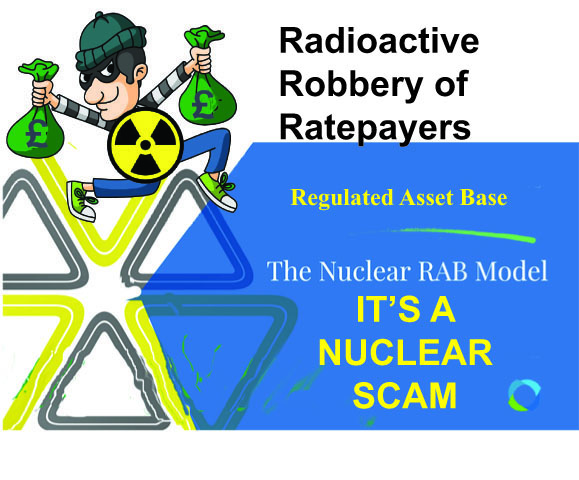
Gordon Murray: LESLEY Riddoch’s article (The National, March 10)
is eminently sensible. The UK Government wants to build more large nuclear
plants such as Hinkley Point C. The problem for Boris is that investors are
not interested.
Centrica abandoned its plans to build new nuclear, Toshiba
exited the giant 3.3GW plant at Moorside, Cumbria and Hitachi scrapped the
£16 billion Wylfa plant on Anglesey. The current Hinkley development costs
are a whopping £23bn, almost double that projected in 2008 and set to rise
further.
The smart money is now with renewables where the returns are
higher, more immediate and less risky. Notwithstanding these setbacks, the
Conservative government, backed by Labour, is determined to plough on with
Sizewell C.
Their problem is who is going to fund it. The Government is not
keen to involve the Chinese who already get a return of 15% on their
investment at Hinckley Point C.
The Business Secretary Kwasi Kwarteng’s
answer is the Regulated Asset Base (RAB) funding model whereby consumers,
that’s us, will pay the construction costs by increasing energy bills. It
is a fanciful type of nuclear subsidy where consumers pay for and
underwrite the construction costs for 10 years before a single watt of
power has been generated.
You have not misread this! The Government is set
to increase our energy bills even further at a time when gas/energy prices
are soaring, pushing even more people into fuel poverty. Perhaps their
spirits will be raised when they learn that RAB, according to Kwarteng,
will give private investors greater certainty through a lower and more
reliable rate of return.
An added bonus is that bill payers can expect
their bills to rise even further when the project is completed since we can
expect the energy strike price for nuclear to be twice that of renewable
– the cheapest form of electricity generation that is now subsidy
free-where consumers only start paying once they start to generate.
TheSmall Modular Reactor programme promises lower energy production costs but
there is no hard evidence to support this claim. What we will get for
certain is large numbers of these power plants spread all over the country
that will raise safety concerns over proliferation of nuclear materials and
terrorist attacks.
The National 12th March 2022
Markets are in denial about nuclear risk
Markets are in denial about nuclear risk, The Jordan Times, Mar 13,2022 – NEW YORK — Financial markets do not seem to be pricing in the full risks of Russia’s invasion of Ukraine. The absence of any meaningful negative response in equity, corporate debt and sovereign debt markets in Europe, the United States, Canada and Japan would barely make sense even if there was no chance of the situation escalating into an open conflict between NATO and Russia. But that is not the only real risk; so, too, is the threat of the conflict going nuclear……….
Global asset markets have not even priced in this least-bad scenario. But if the Russia-Ukraine war escalated to become a Russia-NATO war, there would be a serious risk of nuclear conflict. One sure way to achieve such an escalation would be for NATO to establish a no-fly zone over Ukraine, as the Ukrainian government has urged.
While NATO and Western governments have imposed economic and financial sanctions on Russia and furnished Ukraine with anti-tank weapons, drones, portable surface-to-air missiles and ammunition, these forms of support do not amount to an act of war. Enforcing a no-fly zone, however, would mean shooting down Russian targets. Were NATO to take this step, a wider war would become inevitable.
So far, NATO has forthrightly rejected calls for a no-fly zone. It has also shown restraint in response to Putin’s nuclear saber-rattling. On February 27, 2022, Putin put Russia’s nuclear forces on high alert in response to Western sanctions and what he referred to as “aggressive statements” from NATO powers.
On the same day, Belarus abandoned its non-nuclear status — thereby permitting Russia’s nuclear weapons on its territory. This escalation came on the heels of Russia’s extensive strategic nuclear exercises on February 19, and Putin’s televised speech announcing the invasion on February 24, when he emphasised that Russia is still one of the world’s most powerful nuclear-weapons states…………..
Today, there is scant evidence that markets have even noticed the rising risk of a nuclear conflict. Denial is the name of the game.
Willem H. Buiter is an adjunct professor of international and public affairs at Columbia University. 2022. www.project-syndicate.org http://www.jordantimes.com/opinion/willem-h-buiter/markets-are-denial-about-nuclear-risk
Ukraine war fills Pentagon’s, NATO allies’ war chests
“Over multiple administrations, Democrat and Republican, we have tried to minimize friction with Putin and with Russia, in the hopes that it wouldn’t exacerbate a problem….And I feel like that era is over,” said Slotkin, a former Pentagon official. “I think it’s a sea change for how both the Defense Department and the State Department should think about our presence in Europe.”

[N]ow there is a unique moment of bipartisanship that will allow the Pentagon to request and receive just about anything it wants, Rep. Elissa Slotkin, D-Mich., said last week during a House Armed Services Committee hearing. Congress is poised to approve $14 billion for Ukraine aid this week, including nearly $5 billion for additional troops in Europe and replenishing U.S. weapons already sent to Ukraine. The House passed the package Wednesday and the Senate is expected to vote on the bill by Friday.
“Over multiple administrations, Democrat and Republican, we have tried to minimize friction with Putin and with Russia, in the hopes that it wouldn’t exacerbate a problem….And I feel like that era is over,” said Slotkin, a former Pentagon official. “I think it’s a sea change for how both the Defense Department and the State Department should think about our presence in Europe.”
Ukraine war fills Pentagon’s, NATO allies’ war chests https://wordpress.com/read/feeds/113283937/posts/3880404511, Rick Rozoff, Anti-bellum
Stars and Stripes, March 10, 2022,
Congressional support for larger defense budget grows amid Ukraine invasion The changing security landscape in Eastern Europe will “no doubt” increase next year’s defense budget, Rep. Adam Smith, D-Wash., chairman of the House Armed Services Committee, said at an event last week. Other Capitol Hill lawmakers say they are also prepared to funnel more money to the Pentagon as the U.S. rethinks its national security and defense posture.
“President [Joe] Biden needs to put a serious budget proposal forward to confront the real threats we face,” Sen. Kevin Cramer, R-N.D., said in a statement. “Russia is just one reason why defense spending needs to be higher. China and other nations are watching the seriousness and resolve of freedom-loving nations.”
Russia’s unprovoked attack on Ukraine has prompted other NATO countries to pledge additional funding for their armed services.
In a reversal of decades of post-Cold War policy, Germany’s Chancellor Olaf Scholz said last month that his country would embark on a $110 billion rearming program. Poland announced last week that it will raise its spending on defense from 2% to 3% of the country’s gross domestic product. Leaders of France, Italy, Latvia and Romania have all vowed in recent days to boost their commitment to defense.
U.S. lawmakers authorized nearly $778 billion for defense spending for the 2022 fiscal year – $25 billion more than requested by the White House. The Biden administration has yet to submit its budget request for fiscal year 2023, which starts Oct. 1, but Smith said last week that the eventual spending plan will be “the most impactful and important budget that we’ve seen in the 25 years I’ve been in Congress.”
Sen. Jim Inhofe of Oklahoma, the top Republican on the Senate Armed Services Committee, said he wants to see defense expenditures grow by at least 3% to 5%, adjusted for inflation….
[N]ow there is a unique moment of bipartisanship that will allow the Pentagon to request and receive just about anything it wants, Rep. Elissa Slotkin, D-Mich., said last week during a House Armed Services Committee hearing. Congress is poised to approve $14 billion for Ukraine aid this week, including nearly $5 billion for additional troops in Europe and replenishing U.S. weapons already sent to Ukraine. The House passed the package Wednesday and the Senate is expected to vote on the bill by Friday.
“Over multiple administrations, Democrat and Republican, we have tried to minimize friction with Putin and with Russia, in the hopes that it wouldn’t exacerbate a problem….And I feel like that era is over,” said Slotkin, a former Pentagon official. “I think it’s a sea change for how both the Defense Department and the State Department should think about our presence in Europe.”
European Bank for Reconstruction and Development (EBRD) very anxious about Chernobyl nuclear situation
| The European Bank for Reconstruction and Development (EBRD) is extremely concerned by recent developments at the Chernobyl Nuclear Power Plant (ChNPP) in Ukraine. The EBRD, which has been managing over €2.5 billion in international funds to transform Chernobyl since 1995, believes that recent events are putting in jeopardy the achievements of decades of successful international collaboration to secure the site. The Bank’s position on ChNPP is fully aligned with the International Atomic Energy Agency (IAEA) and is based on the following safety and security considerations: Uninterrupted power supply must be maintained for the Chernobyl facilities. Any loss of power is potentially a serious threat to their nuclear safety. Since monitoring and control systems on site do not work, operators will not be aware of possible risks. They must stay in operation. The Chernobyl facilities have been operated by the same depleted shift of employees for more than two weeks. Normal shift rotation as well as supplies to operating staff must be ensured. Any military action on site is extremely dangerous for the old spent fuel storage facility housing around 20000 RBMK fuel assemblies. Inspections by the Ukrainian regulator and the IAEA must be allowed. Beyond Chernobyl, there are 15 VVER-type units across Ukraine. They have a relatively weak containment and will not withstand a direct hit, which may result in irreversible consequences. EBRD 11th March 2022https://www.ebrd.com/news/2022/ebrd-very-concerned-by-situation-at-chernobyl-nuclear-power-plant-.html |
Chernobyl nuclear workers ”exhausted and desperate”
Chernobyl workers are reportedly “exhausted and desperate” and surviving
on one meal of bread and porridge a day, sparking fears over their ability
to look after the nuclear plant safely.
The plant, where the world’s worst nuclear disaster happened in 1986, was taken by Russian forces at the start of the invasion of Ukraine. Hundreds of workers and guards have been
trapped for nearly two weeks, having not been able to leave since Feb 23.
The plant is not configured for workers living there, and they are sleeping
on floors, tables and camp beds. Communication with the Chernobyl workers
is currently limited to emails. Rafael Grossi, director general of the
International Atomic Energy Agency (IAEA), called on Russia to allow
Chernobyl staff to be relieved by colleagues. Mr Grossi has offered to
travel to the Chernobyl plant where 200-plus staff have been on-site for 12
days straight.
Telegraph 8th March 2022
Chernobyl workers still stranded at the power station
More than 210 workers remain trapped at the Chernobyl nuclear power plant
as all its facilities continue to be controlled by the Russian military
troops. The International Atomic Energy Agency (IAEA) said that it has been
informed by Ukraine’s nuclear regulator that the shift of around 210
technical staff and guards has still not been able to rotate as of Monday
7th February. That means that the same staff have been on the site for 12
days.
Energy Live News 8th March 2022
How the Narcotic of Defense Spending Undermines a Sensible Grand Strategy,

MARCH 2, 2022, How the Narcotic of Defense Spending Undermines a Sensible Grand Strategy, CounterPunch, BY FRANKLIN SPINNEY The Military-Industrial-Congressional-Complex’s (MICC) grand-strategic chickens are coming home to roost big time. While war is bad, the Russo-Ukrainian War has the champagne corks quietly popping in the Pentagon, on K Street, in the defense industry, and throughout the halls of Congress. Taxpayers are going to be paying for their party for a long time.
It is no accident that the United States is on the cusp of the Second Cold War.
Future historians may well view the last 30 years as a case study in the institutional survival of the American Military – Industrial – Congressional Complex (MICC), together with its supporting blob now saturating the media, think tanks, academia, and the intelligence community. Perhaps, these future historians will come also to view the Global War on Terror (GWOT) as the bridging operation that greased the transition to Cold War II by keeping defense budgets at Cold War levels after Cold War I ended. Also, 9-11 may have re-acclimated the American people to the climate of fear now needed to sustain Cold War II for the remainder of the 21st Century.
The First Cold War’s 40-year climate of fear was something Mikhail Gorbachev tried to end. But Presidents Clinton and Bush (the 2nd) were busy planting the seed money for a new generation of cold-war inspired weapons. These weapons required massive future defense budgets that would require a climate of fear to sustain (especially for the across-the-board nuclear modernization program). President Obama then locked in these programs, and won a Nobel Peace Prize to boot. President Trump and the Dems in Congress worked overtime to ice the Pentagon’s budget cake by incestuously amplifying the growing Russophobia
No one wants war, but rising tension and the politics of fear … and their bedfellow: demonization … had to be magnified to justify the huge bow wave of defense spending looming in the budgetary offing, particularly the trillion+ dollars to pay for the nuclear modernization program. This “chicken” takes us back to the “egg” laid in the 1990s.
As it gradually sank in that the First Cold War had indeed ended when the Soviet threat evaporated in 1991, the titans in the defense industry understood their comfortable market for new hi-tech, high-cost weapons could dry up.
At the same time, the defense industrialists recognized that market diversification was necessary. So, it was no accident that a lobbying operation named the Committee to Expand NATO emerged in the early 1990s and was headed by a vice president of Lockheed Martin — see also Why is US Foreign Policy a Shambles?. At the very least, in the mid-1990s, it seemed that expanding NATO implied dramatically increased requirements for what is known in NATO jargon as weapons interoperability……………..
the Pentagon’s strategy of maximizing its budget has created a growing dependency on defense spending in the American political economy. This grotesque distortion was first recognized by President Eisenhower in 1961. In 1987, George Kennan, forty years after he fathered the dominant US policy of “Containment” for the entire First Cold War, summed up the narcotic of defense spending, saying prophetically:
“Were the Soviet Union to sink tomorrow under the waters of the ocean, the American military-industrial complex would have to remain, substantially unchanged, until some other adversary could be invented. Anything else would be an unacceptable shock to the American economy,” …………..
Understanding the internal political-economic causes of the American addiction to the narcotic of defense spending is at the heart of the problem. This understanding is essential to reforming the foreign policy mess exacerbated by NATO expansion. …….
Franklin “Chuck” Spinney is a former military analyst for the Pentagon and a contributor to Hopeless: Barack Obama and the Politics of Illusion, published by AK Press. He be reached at chuck_spinney@mac.com https://www.counterpunch.org/2022/03/02/how-the-narcotic-of-defense-spending-undermines-a-sensible-grand-strategy/
British government searching for investors, needs to raise billions of pounds for Sizewell nuclear project.
The British government is seeking financial advisers to raise billions of
pounds for the proposed Sizewell C nuclear plant in Suffolk as ministers
close in on a tacit agreement with Beijing to remove Chinese state-backed
energy group CGN from the £20bn project.
A new company would replace the
joint venture between French utility EDF and CGN that is developing the
£20bn Sizewell C plant in Suffolk, according to people familiar with the
government’s plans.
EDF holds 80 per cent under the current structure
with the remainder held by the Chinese group. Under the revised plans, both
the UK government and developer EDF would take a 20 per cent stake each in
the new vehicle and end CGN’s involvement in the project, reflecting how
diplomatic relations between Beijing and London have deteriorated in recent
years.
The government this week launched the search for investment bankers
to find investors for the remaining 60 per cent stake, according to people
with knowledge of the situation. The new company would be chaired by
Stephen Billingham, a City veteran who was previously finance director of
British Energy, the group that owned Britain’s operational fleet of
nuclear reactors before it was bought by EDF in 2008.
FT 3rd March 2022
https://www.ft.com/content/95524dfc-6503-48c7-85ad-a116bdf2c9ed
Ukraine war – a great opportunity Each new NATO country was a new customer for the weapons industry

“Lockheed began looking at Poland right after the wall came down,” veteran salesman Dick Pawlowski recalled. “There were contractors flooding through all those countries.” Arms makers became the most aggressive lobbyists for NATO expansion. The security umbrella was not simply a formidable alliance but also a tantalizing market.
New alliance members meant new clients. And NATO would literally require them to buy Western military equipment.
Arms Industry Sees Ukraine Conflict as an Opportunity, Not a Crisis, Jonathan Ng, Truthout , 2 Mar 22,In February, a photograph of Russian President Vladimir Putin sitting hunched over a 13-foot table with French President Emmanuel Macron circulated the globe. News about their sprawling table and sumptuous seven-course dinner was reminiscent of a Lewis Carroll story. But their meeting was deadly serious. Macron arrived to discuss the escalating crisis in Ukraine and threat of war. Ultimately, their talk foundered over expansion of the North Atlantic Treaty Organization (NATO)

Yet the meeting was surreal for another reason. Over the past year, Macron, the leading European Union (EU) peace negotiator, has led an ambitious arms sales campaign, exploiting tensions to strengthen French commerce. The trade press even reported that he hoped to sell Rafale fighter jets to Ukraine, breaking into the “former bastion of Russian industry.”
Macron is not alone. NATO contractors openly embrace the crisis in Ukraine as sound business. In January, Raytheon CEO Greg Hayes cited “tensions in Europe” as an opportunity, saying, “I fully expect we’re going to see some benefit.” Likewise, CEO Jim Taiclet of Lockheed Martin highlighted the benefits of “great power competition” in Europe to shareholders.
On February 24, Russia invaded Ukraine, pounding cities with ordnance and dispatching troops across the border. The sonic boom of fighter jets filled the air, as civilians flooded the highways in Kyiv, attempting to flee the capital. And the stock value of arms makers soared.
The spiraling conflict over Ukraine dramatizes the power of militarism and the influence of defense contractors. A ruthless drive for markets — intertwined with imperialism — has propelled NATO expansion, while inflaming wars from Eastern Europe to Yemen.
Selling NATO
The current conflict with Russia began in the wake of the Cold War. Declining military spending throttled the arms industry in the United States and other NATO countries. In 1993, Deputy Secretary of Defense William Perry convened a solemn meeting with executives. Insiders called it the “Last Supper.” In an atmosphere heavy with misapprehension, Perry informed his guests that impending blows to the U.S. military budget called for industry consolidation. A frantic wave of mergers and takeovers followed, as Lockheed, Northrop, Boeing and Raytheon acquired new muscle and smaller firms expired amid postwar scarcity.
While domestic demand shrunk, defense contractors rushed to secure new foreign markets. In particular, they set their sights on the former Soviet bloc, regarding Eastern Europe as a new frontier for accumulation. “Lockheed began looking at Poland right after the wall came down,” veteran salesman Dick Pawlowski recalled. “There were contractors flooding through all those countries.” Arms makers became the most aggressive lobbyists for NATO expansion. The security umbrella was not simply a formidable alliance but also a tantalizing market.
However, lobbyists faced a major obstacle. In 1990, Secretary of State James Baker had promised Soviet leader Mikhail Gorbachev that if he allowed a reunited Germany to join NATO, the organization would move “not one inch eastward.” Yet lobbyists remained hopeful. The Soviet Union had since disintegrated, Cold War triumphalism prevailed, and vested interests now pushed for expansion. “Arms Makers See Bonanza In Selling NATO Expansion,” The New York Times reported in 1997. The newspaper later noted that, “Expansion of the North Atlantic Treaty Organization — first to Poland, Hungary and the Czech Republic and then possibly to more than a dozen other countries — would offer arms makers a new and hugely lucrative market.”
New alliance members meant new clients. And NATO would literally require them to buy Western military equipment.
Lobbyists poured into Washington, D.C. fêting legislators in royal style. Vice President Bruce Jackson of Lockheed became the president of the advocacy organization U.S. Committee to Expand NATO. Jackson recounted the extravagant meals that he hosted at the mansion of the Republican luminary Julie Finley, which boasted “an endless wine cellar.”
“Educating the Senate about NATO was our chief mission,” he informed journalist Andrew Cockburn. “We’d have four or five senators over every night, and we’d drink Julie’s wine.”
Lobby pressure was relentless. “The most interested corporations are the defense corporations, because they have a direct interest in the issue,” Romanian Ambassador Mircea Geoană observed. Bell Helicopter, Lockheed Martin, and other firms even funded Romania’s lobbying machine during its bid for NATO membership……………… https://truthout.org/articles/arms-industry-sees-ukraine-conflict-as-an-opportunity-not-a-crisis/?eType=EmailBlastContent&eId=734c56bc-48da-4e66-bea1-f2bedb7d1431
American nuclear power industry uses Russian fuel, seeks exemption from sanctions

U.S. utilities push White House not to sanction Russian uranium, By Ernest Scheyder and Trevor Hunnicutt, March 1 (Reuters) – The U.S. nuclear power industry is lobbying the White House to allow uranium imports from Russia to continue despite the escalating conflict in Ukraine, with cheap supplies of the fuel seen as key to keeping American electricity prices low, according to two sources familiar with the matter.
The United States relies on Russia and its allies Kazakhstan and Uzbekistan for roughly half of the uranium powering its nuclear plants – about 22.8 million pounds (10.3 million kg) in 2020 – which in turn produce about 20% of U.S. electricity, according to the U.S. Energy Information Administration and the World Nuclear Association.
Washington and its allies have imposed a series of sanctions on Moscow in the past week as Russian forces pushed deeper into neighboring Ukraine, though the sanctions exempt uranium sales and related financial transactions.
The National Energy Institute (NEI), a trade group of U.S. nuclear power generation companies including Duke Energy Corp (DUK.N) and Exelon Corp (EXC.O), is lobbying the White House to keep the exemption on uranium imports from Russia, the sources said.
The NEI lobbying aims to ensure that uranium is not caught up in any future energy-related sanctions, especially as calls intensify to sanction Russian crude oil sales, the sources said.
“The (U.S. nuclear power) industry is just addicted to cheap Russian uranium,” said one of the sources, who declined to be named, citing the sensitivity of the situation.
Duke and Exelon, two of the largest U.S. utilities, could not immediately be reached for comment…………………
Russia’s uranium production is controlled by Rosatom, a state-run company formed by Russian President Vladimir Putin in 2007. The company is an important source of revenue for the country……..
Other utilities around the globe have already begun looking beyond Russia for supply. Swedish power company Vattenfall AB (VATN.UL) said last week it would stop buying Russian uranium for its nuclear reactors until further notice, citing the Ukrainian conflict. https://www.reuters.com/business/energy/exclusive-us-utilities-push-white-house-not-sanction-russian-uranium-2022-03-02/
The expansion of NATO – a boon for the weapons industry and a prelude to conflict with Russia

Within two decades, 14 Central and Eastern European countries joined NATO. The organization originally existed to contain the Soviet Union, and Russian officials monitored its advance with alarm. In retrospect, postwar expansion benefited arms makers both by increasing their market and stimulating conflict with Russia.
Arms Industry Sees Ukraine Conflict as an Opportunity, Not a Crisis, Jonathan Ng, Truthout , 2 Mar 22,
”………………………….. Ultimately, policy makers reneged on their promise to Gorbachev, admitting Poland, Hungary and the Czech Republic into NATO in 1999. During the ceremony, Secretary of State Madeleine Albright — who directly cooperated with the Jackson campaign — welcomed them with a hearty “Hallelujah.” Ominously, the intellectual architect of the Cold War, George Kennan, predicted disaster. “Such a decision may be expected to inflame the nationalistic, anti-Western and militaristic tendencies in Russian opinion,” Kennan cautioned.
Few listened. Former Assistant Secretary of Defense Chas Freeman described the mentality of policy makers: “The Russians are down, let’s give them another kick.” Relishing victory, Jackson was equally truculent: “‘Fuck Russia’ is a proud and long tradition in US foreign policy.” Later, he became chairman of the Committee for the Liberation of Iraq, which paved the way for the 2003 invasion, the biggest industry handout in recent history.
Within two decades, 14 Central and Eastern European countries joined NATO. The organization originally existed to contain the Soviet Union, and Russian officials monitored its advance with alarm. In retrospect, postwar expansion benefited arms makers both by increasing their market and stimulating conflict with Russia.
Targeting Ukraine
Tensions reached a new phase in 2014 when the United States backed the removal of President Viktor Yanukovych in Ukraine. Yanukovych had opposed NATO membership, and Russian officials feared his ouster would bring the country under its strategic umbrella. Rather than assuage their concerns, the Obama administration maneuvered to slip Ukraine into its sphere of influence. Assistant Secretary of State Victoria Nuland coordinated regime change with brash confidence. Nuland openly distributed cookies to protesters, and later, capped a diplomatic exchange with “fuck the EU.” At the height of the uprising, Sen. John McCain also joined demonstrators. Flanked by leaders of the fascist Svoboda Party, McCain advocated regime change, declaring that “America is with you.”
By then, newly minted NATO members had bought nearly $17 billion in American weapons. Military installations, including six NATO command posts, ballooned across Eastern Europe. Fearing further expansion, Russia annexed the Crimean Peninsula and intervened in the Donbas region, fueling a ferocious and interminable war. NATO spokespeople argued that the crisis justified expansion. In reality, NATO expansion was a key inciter of the crisis. And the conflagration was a gift to the arms industry. In five years, major weapons exports from the United States increased 23 percent, while French exports alone registered a 72-percent leap, reaching their highest levels since the Cold War. Meanwhile, European military spending hit record heights.
As tensions escalated, Supreme Commander Philip Breedlove of NATO wildly inflated threats, calling Russia “a long-term existential threat to the United States.” Breedlove even falsified information about Russian troop movements over the first two years of the conflict, while brainstorming tactics with colleagues to “leverage, cajole, convince or coerce the U.S. to react.” A senior fellow at the Brookings Institution concluded that he aimed to “goad Europeans into jacking up defense spending.”
And he succeeded. The Stockholm International Peace Research Institute registered a significant leap in European military spending — even though Russian spending in 2016 equaled only one quarter of the European NATO budget. That year, Breedlove resigned from his post before joining the Center for a New American Security, a hawkish think tank awash in industry funds.
The arms race continues. After European negotiations gridlocked, Russia recognized two separatist republics in the Donbas region before invading Ukraine this February. Justifying the bloody operation, Putin wrongly accused Ukrainian authorities of genocide. Yet his focus was geopolitical. “It is a fact that over the past 30 years we have been patiently trying to come to an agreement with the leading NATO countries,” he said. “In response to our proposals, we invariably faced either cynical deception and lies or attempts at pressure and blackmail, while the North Atlantic alliance continued to expand despite our protests and concerns. Its military machine is moving and, as I said, is approaching our very border.”
In retrospect, three decades of industry lobbying has proved deadly effective. NATO engulfed most of Eastern Europe and provoked a war in Ukraine — yet another opportunity for accumulation. Alliance members have activated Article 4, mobilizing troops, contemplating retaliation and moving further toward the brink of Armageddon.
Yet even as military budgets rise, European arms makers — like their American counterparts — have required foreign markets to overcome fiscal restraints and production costs. They need clients to finance their own military buildup: foreign wars to fund domestic defense. ………………………….. https://truthout.org/articles/arms-industry-sees-ukraine-conflict-as-an-opportunity-not-a-crisis/?eType=EmailBlastContent&eId=734c56bc-48da-4e66-bea1-f2bedb7d1431
”Infinite war” – NATO and U.S. weapons industry found the perfect sales opportunity in Yemen
Arms Industry Sees Ukraine Conflict as an Opportunity, Not a Crisis, Jonathan Ng, Truthout , 2 Mar 22,

In the United States, the industry employs around 700 lobbyists. Nearly three-fourths previously worked for the federal government — the highest percentage for any industry. The lobby spent $108 million in 2020 alone, and its ranks continue to swell. Over the past 30 years, about 530 congressional staffers on military-related committees left office for defense contractors. Industry veterans dominate the Biden administration, including Secretary of Defense Lloyd Austin from Raytheon.
”’………………….Yemen Burning
Arms makers found the perfect sales opportunity in Yemen. In 2011, a popular revolution toppled Ali Abdullah Saleh, who had monopolized power for two decades. His crony, Abdu Rabbu Mansour Hadi, became president the next year after easily winning the election: He was the only candidate. Thwarted by elite intrigue, another uprising ejected Mansour Hadi in 2015.
That year, Prince Salman became king of Saudi Arabia, but power concentrated into the hands of his son, Mohammed bin Salman, who feared that the uprising threatened to snatch Yemen from Saudi Arabia’s sphere of influence.
Months later, a Saudi-led coalition invaded, leaving a massive trail of carnage. “There was no plan,” a U.S. intelligence official emphasized. “They just bombed anything and everything that looked like it might be a target.”
The war immediately attracted NATO contractors, which backed the aggressors. They exploit the conflict to sustain industrial capacity, fund weapons development and achieve economies of scale. In essence, the Saudi-led coalition subsidizes the NATO military buildup, while the West inflames the war in Yemen.
Western statesmen pursue sales with perverse enthusiasm. In May 2017, Donald Trump visited Saudi Arabia for his first trip abroad as president, in order to flesh out the details of a $110 billion arms bundle. His son-in-law, Jared Kushner, arrived beforehand to discuss the package. When Saudi officials complained about the price of a radar system, Kushner immediately called the CEO of Lockheed Martin to ask for a discount. The following year, Mohammed bin Salman visited company headquarters during a whirlwind tour of the United States. Defense contractors, Hollywood moguls and even Oprah Winfrey welcomed the young prince Yet the Americans were not alone. The Saudi-led coalition is also the largest arms market for France and other NATO members. And as the French Ministry of the Armed Forces explains, exports are “necessary for the preservation and development of the French defense technological and industrial base.” In other words, NATO members such as France export war in order to retain their capacity to wage it.
President Macron denies that the coalition — an imposing alliance that includes Saudi Arabia, Egypt, Jordan, the United Arab Emirates, Kuwait, Bahrain, Qatar, Sudan and Senegal — uses French weapons. But the statistics are suggestive. Between 2015 and 2019, France awarded €14 billion in arms export licenses to Saudi Arabia and €20 billion in licenses to the United Arab Emirates. CEO Stéphane Mayer of Nexter Systems praised the performance of Leclerc tanks in Yemen, boasting that they “have highly impressed the military leaders of the region.” In short, while Macron denies that the coalition wields French hardware in Yemen, local industrialists cite their use as a selling point. Indeed, Amnesty International reports that his administration has systematically lied about its export policy. Privately, officials have compiled a “very precise list of French materiél deployed in the context of the conflict, including ammunition.”
Recently, Macron became one of the first heads of state to meet Mohammed bin Salman following the assassination of journalist Jamal Khashoggi. Like Trump’s trip, Macron’s diplomatic junket was a sales mission. Eventually, Macron clinched a deal with the United Arab Emirates for 80 Rafale fighters. The CEO of Dassault Aviation called the contract “the most important ever obtained by French military aerospace,” guaranteeing six years of work for a pillar of its industrial base.
French policy is typical of NATO involvement in Yemen. While denouncing the war, every Western producer has outfitted those carrying it out. Spanish authorities massage official documents to conceal the export of lethal hardware. Great Britain has repeatedly violated its own arms embargo. And the United States has not respected export freezes with any consistency.
Even NATO countries in Eastern Europe exploit the war. While these alliance members absorb Western arms, they dump some of their old Soviet hardware into the Middle East. Between 2012 and July 2016 Eastern Europe awarded at least €1.2 billion in military equipment to the region.
Ironically, a leading Eastern European arms exporter is Ukraine. While the West rushes to arm Kyiv, its ruling class has sold weapons on the black market. A parliamentary inquiry concluded that between 1992 and 1998 alone, Ukraine lost a staggering $32 billion in military assets, as oligarchs pillaged their own army. Over the past three decades, they have outfitted Iraq, the Taliban and extremist groups across the Middle East. Even former President Leonid Kuchma, who has led peace talks in the Donbas region, illegally sold weapons while in office. More recently, French authorities investigated Dmytro Peregudov, the former director of the state defense conglomerate, for pocketing $24 million in sales commissions. Peregudov resided in a château with rolling wine fields, while managing the extensive properties that he acquired after his years in public service.
The Warlords
Kuchma and Peregudov are hardly exceptional. Corruption is endemic in an industry that relies on the proverbial revolving door. The revolving door is not simply a metaphor but an institution, converting private profit into public policy. Its perpetual motion signifies the social reproduction of an elite that resides at the commanding heights of a global military-industrial complex. Leading power brokers ranging from the Mitterrands and Chiracs in France, to the Thatchers and Blairs in Britain, and the Gonzálezes and Bourbons in Spain have personally profited from the arms trade.
In the United States, the industry employs around 700 lobbyists. Nearly three-fourths previously worked for the federal government — the highest percentage for any industry. The lobby spent $108 million in 2020 alone, and its ranks continue to swell. Over the past 30 years, about 530 congressional staffers on military-related committees left office for defense contractors. Industry veterans dominate the Biden administration, including Secretary of Defense Lloyd Austin from Raytheon.
The revolving door reinforces the class composition of the state, while undermining its moral legitimacy. As an elite rotates office, members insulate policymaking from democratic input, taint the government with corruption and mistake corporate profit with national interest. By 2005, 80 percent of army generals with three stars or more retired to arms makers despite existing regulations. (The National Defense Authorization Act prohibits top officers from lobbying the government for two years after leaving office or leveraging personal contacts to secure contracts. But compliance is notoriously poor.) More recently, the U.S. Navy initiated investigations against dozens of officers for corrupt ties to the defense contractor Leonard Francis, who clinched contracts with massive bribes, lavish meals and sex parties.
Steeped in this corrosive culture, NATO intellectuals now openly talk about the prospect of “infinite war.” Gen. Mike Holmes insists that it is “not losing. It’s staying in the game and getting a new plan and keeping pursuing your objectives.” Yet those immersed in its brutal reality surely disagree. The United Nations reports that at least 14,000 people have died in the Russo-Ukrainian War since 2014, and over 377,000 have perished in Yemen.
In truth, the doctrine of infinite war is not so much a strategy as it is a confession — acknowledging the violent metabolism of a system that requires conflict. As a self-selecting elite propounds NATO expansion, military buildup and imperialism, we must embrace what the warlords most fear: the threat of peace.The author would like to thank Sarah Priscilla Lee of the Learning Sciences Program at Northwestern University for reviewing this article. https://truthout.org/articles/arms-industry-sees-ukraine-conflict-as-an-opportunity-not-a-crisis/?eType=EmailBlastContent&eId=734c56bc-48da-4e66-bea1-f2bedb7d1431
EU to purchase weapons for Ukraine — live updates, DW
EU to purchase weapons for Ukraine — live updates, DW
The European Union said it will spend €450 million on weapons and equipment for Ukraine. Kyiv and Moscow have sent envoys to peace talks on the Belarus border. DW has the latest.
VSeveral countries have promised to equip Ukrainian soldiers with weapons.
- Putin has ordered nuclear deterrence be put on alert
- Ukraine agrees to talks at the Belarus border
- The EU will buy weapons for Ukraine to fight Russia
- Russians attack a gas pipeline and oil tanks
G7 threatens more sanctions against Russia
The G7 group of top industrialized nations warned Moscow that it could face additional sanctions if the war in Ukraine continues……………………………. https://www.dw.com/en/eu-to-purchase-weapons-for-ukraine-live-updates/a-60931396
Highest Number of Reactor Closures in a Decade
2021 in nuclear numbers—Six reactor startups, ten less than planned at
the beginning of the year. Eight closures plus two closure announcements.
Ten construction starts. Three reactors in Long-Term Outage (LTO)
restarted, two closed. As of 1 January 2022, 412 reactors in operation, 25
in LTO, and 55 under construction.
The Year 2021 saw the largest number of
nuclear reactor closures in a decade, since 2011, when the Fukushima
disaster began. Three of the six remaining units were closed in Germany, as
well as three closures announced in the UK including two reactors that had
not generated any power since 2018 (and thus enter WNISR closure-statistics
that year). Four additional units were closed, one each in Pakistan,
Russia, Taiwan and the USA.
WNISR 15th Feb 2022
https://www.worldnuclearreport.org/Highest-Number-of-Reactor-Closures-in-a-Decade.html
French government to subsidise EDF nuclear power company by another €2.1bn, to prop up its failing share price
The French government is to inject about €2.1bn (£1.75bn) into
state-controlled energy group EDF to ease the financial pain inflicted by
nuclear reactors going offline and the state making the firm supply power
below market prices. The finance minister, Bruno Le Maire, said the capital
injection would be made via a rights issue, announced by EDF on Friday,
aimed at raising €2.5bn to plug holes in the company’s balance sheet.
EDF said the combined effect of having to sell power at below-market prices
and the nuclear outages were likely to knock an estimated €19bn off its
forecast core profits in 2022. Its shares fell 2%, extending a slide in
which the company’s stock has dropped 19.3% in value since the start of
this year.
Guardian 18th Feb 2022
1 This Month



26 September – International Day for the Total Elimination of Nuclear Weapons


PLEASE OPPOSE HR 8255 AND S.3639 – bills would accelerate satellite deployment, with no environmental review or safeguards – https://ncstd5li.quorum.us/campaign/169331/
To see nuclear-related stories in greater depth and intensity – go to https://nuclearinformation.wordpress.com
-
Archives
- September 2026 (245)
- August 2026 (330)
- July 2026 (355)
- June 2026 (287)
- May 2026 (306)
- April 2026 (356)
- March 2026 (251)
- February 2026 (267)
- January 2026 (308)
- December 2025 (358)
- November 2025 (359)
- October 2025 (375)
-
Categories
- 1
- 1 NUCLEAR ISSUES
- business and costs
- climate change
- culture and arts
- ENERGY
- environment
- health
- history
- indigenous issues
- Legal
- marketing of nuclear
- media
- opposition to nuclear
- PERSONAL STORIES
- politics
- politics international
- Religion and ethics
- safety
- secrets,lies and civil liberties
- spinbuster
- technology
- Uranium
- wastes
- weapons and war
- Women
- 2 WORLD
- ACTION
- AFRICA
- Atrocities
- AUSTRALIA
- Christina's notes
- Christina's themes
- culture and arts
- Events
- Fuk 2022
- Fuk 2023
- Fukushima 2017
- Fukushima 2018
- fukushima 2019
- Fukushima 2020
- Fukushima 2021
- general
- global warming
- Humour (God we need it)
- Nuclear
- RARE EARTHS
- Reference
- resources – print
- Resources -audiovicual
- Weekly Newsletter
- World
- World Nuclear
- YouTube
-
RSS
Entries RSS
Comments RSS
 nuclear-news