UK government’s nuclear dream likely to fade away, as private investors resist that risky call

Private investors are yet to be convinced that the returns from nuclear
power are sufficiently attractive to plow billions of pounds into a new
fleet of reactors that is being pushed by the U.K. government.
Unclear policy, competition from renewables and concerns about how attractive the
financial returns will be all make the investment case for nuclear less
compelling, according to people involved in the discussions.
That could be a major stumbling block for the government as it seeks to enlist private
capital to help fund projects like Electricite de France SA’s Sizewell C
plant.
Financial Post 29th March 2022
NuScale’s small modular nuclear reactor – ”too late, too expensive, too risky and too uncertain” – Institute for Energy Economics and Financial Analysis

A small modular reactor (SMR) that NuScale has been developing since the turn of the century is “too late, too expensive, too risky and too uncertain,” according to an analysis of the project by the Institute for Energy Economics and Financial Analysis.
The first-of-its-kind SMR is a serious financial threat to the member communities of the Utah Associated
Municipal Power System that have signed up for a share of its power and to any other communities and utilities thinking about doing so. NuScale has optimistically targeted the cost of power from the new plant at $58 per megawatt-hour (MWh), although some estimates predict costs for the power from new SMRs could reach $200/MWh.
IEEFA 17th Feb 2022
EDF announces another delay and cost overruns to Hinkley Point C nuclear project
French energy giant EDF has revealed it will have to announce new delays
and cost overruns for its Hinkley Point C nuclear plant project in the UK.
The latest setback follows conflict in Ukraine, supply chain disruption and
inflationary pressures.
EDF last updated its construction schedule in
January 2021, when it said the UK’s first new nuclear plant to be built
in decades would be delayed by six months to June 2026. It revealed costs
would rise by an additional £500m to £23bn.
Originally, the plant was
expected to open in 2025 and had a construction budget of £18bn. However,
like similar nuclear new-build projects in Flamanville, France and
Olkiluoto, Finland, it has been subject to repeated delays and spiralling
costs. In a note to its 2021 annual report, EDF arued risks to schedule and
cost at completion targets had increased. The energy firm cited the ongoing
impact of the pandemic, Brexit, lower-than-expected civil performance and
tensions in global building materials markets.
22 Mar 22, https://www.cityam.com/edf-announces-another-delay-to-hinkley-point-c-nuclear-plant/
City AM 28th March 2022
Boris Johnson beholden to the nuclear industry. That’s going to cost UK bigtime – Chancellor Sunak not happy.
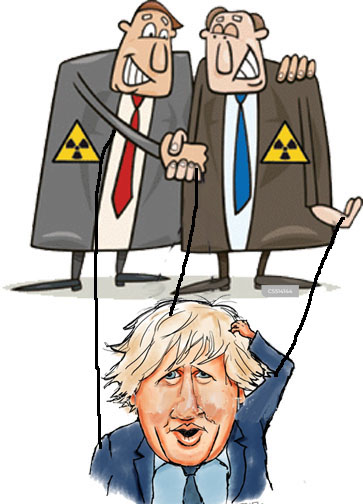
Boris Johnson’s flagship energy strategy has been held up over a row
with Rishi Sunak about funding a new generation of up to eight nuclear
power stations costing the public more than £13bn.
The strategy, which has
been delayed for a month, was due to be published this week but has now
been pencilled for 5 April after disagreement about the multibillion-pound
cost of new nuclear plants and amid ongoing tensions between the prime
minister and his chancellor, as well as the wider cabinet.
Johnson has told the nuclear industry that he wants 25% of electricity generation to come
from nuclear power by 2050, up from 16% now. Whitehall sources told the
Guardian this shift could require the building of about eight new nuclear
power stations. Draft targets suggest ministers are looking at 30GW of
nuclear power capacity, meaning a huge building programme would be needed,
as capacity is due to fall to 3.6GW as plants are decommissioned.
Of the eight UK plants currently in operation, all but one are due to be switched
off by 2030. Each new plant would require the government to take a minority
stake in the project to reduce the risk to developers, and substantial cash
outlay to encourage investment.
Despite Johnson’s keenness for new
nuclear power, Sunak is concerned about the cost to the taxpayer, or extra
costs added to soaring energy bills. The Treasury has already promised
£1.7bn of direct cash for a single large-scale nuclear project – the
£20bn Sizewell C – as well as £120m for a new Future Nuclear Enabling
Fund, which aims to address barriers to entering the sector.
Building eight plants could cost more than £13bn in initial investment costs from the
government if the same amount of investment were to be put in, according to
a Whitehall source. However, the government is also pushing for the nuclear
industry to reduce its build costs.
Guardian 28th March 2022
Hinkley Point C nuclear project faces mor.e delays, increased costs
 |
| Hinkley Point C faces more delays amid Ukraine crisis. Developer EDF warns war may trigger even higher costs for Britain’s flagship nuclear power station. The UK’s £23bn new flagship nuclear power plant is at risk of becoming more expensive and being plagued by delays as its developer EDF blamed challenges including the conflict in Ukraine. EDF is carrying out a “new comprehensive review” of the costs and timeframes of Hinkley Point C, which it is building in Somerset with updates expected in the summer. The majority French state-owned company had already raised cost estimates in 2017, 2019 and again in 2021 amid the pandemic, with the project currently set to cost between £22bn and £23bn and start generating power in mid-2026. It was originally forecast to cost £18bn. The developers have to foot the bill for cost overruns at the project, but it comes as EDF is in talks with the UK Government about building a second new power plant, Sizewell C in Suffolk, which could see households take on more risk for overruns. The Prime Minister is believed to want nuclear power to supply about a quarter of Britain’s electricity by 2050. That could imply about six large stations similar to Hinkley will be needed by 2050. In a sign of its commitment to the technology, the Government is planning to take a 20pc equity stake in the Sizewell C project. In documents filed with French financial authorities, EDF said of Hinkley Point C: “Due to the difficulties encountered by the project, notably on civil performance and marine works, and the increase in risks such as the Ukrainian conflict, Brexit, Covid, supply chain disruption and inflation, a new comprehensive review to update the costs and schedule estimates announced in January 2021 is underway and is expected to be finalised by summer 2022.” Telegraph 27th March 2022https://www.telegraph.co.uk/business/2022/03/27/hinkley-point-c-faces-fresh-cost-overrun-ukraine-crisis/ |
France’s nuclear energy output continues to slump

Falling nuclear output in France has spurred gas demand in the country and
is hampering EU moves to cut dependence on Russian supplies, according to
some analysts. “The underperformance of French nuclear power in the
Ukraine crisis is completely underestimated. The orders of magnitude are
dizzying” one analyst, who wished to remain anonymous, told Montel.
France, with 56 reactors – the world’s second-biggest nuclear
production capacity – has long been viewed as Europe’s powerhouse,
exporting output across the bloc. Now, that picture has changed with the
country’s nuclear availability plunging in recent months to its lowest
level in over 30 years.
Since 2015 France’s annual nuclear output has
slumped by around 100 TWh, TSO figures showed. In 2015, French reactors
generated 417 TWh. This year atomic output is forecast to drop to 295-330
TWh.
Montel 25th March 2022
https://www.montelnews.com/news/1308826/french-nuclear-slump-hinders-russian-gas-exit–analysts
Chernobyl nuclear worker gives the inside story on the dire situation for the staff as Russians took over.

Chernobyl nuclear power plant: Worker reveals risk of accident as Russians force staff to do 24-hour shifts i News, By Isabella Bengoechea, March 25, 2022 A Chernobyl worker has given the first inside account after the power plant was seized by Russian forces i News
A Chernobyl worker has given the first inside account of life at the nuclear plant since the Russian invasion and warned that exhausted staff are being forced to work 24-hour shifts, increasing the risk of an accident.
Mykola Pobiedin, foreman of the radioactive waste processing workshop at Chernobyl, who worked as a liquidator there after the 1986 disaster, described a dire safety situation where the plant was encircled by military trucks and tanks and troops patrolled with machine guns.
He compared allowing Chernobyl to be operated by exhausted staff to a bus driver who “has not slept for days” transporting passengers.
Chernobyl, the site of the worst nuclear disaster in history, was captured by Russia on the first day of invasion on 24 February.
More than 200 workers were forced to stay on site. On 20 March, about 100 were allowed to return to their homes, after nearly four weeks working under armed guard.
Personnel at Chernobyl usually work in 12-hour shifts before being replaced by the next shift.
However, because no rotation was permitted, they were forced to work for 24 hours straight with one half hour break.
Mr Pobiedin, who gave permission to be identified, spoke to i by phone from the city of Slavutych, which was built in 1986 to house workers evacuated from the plant after the disaster.
In a separate debrief, he spoke to Valeriy Korshunov, founder of the European Institute of Chernobyl, a Ukraine-based NGO which works to educate the public about the Chernobyl disaster through scientific and cultural projects, in order to prevent new nuclear disasters in future.
Mr Korshunov and his organisation hope to publicise the plight of the Chernobyl workers to draw attention to the dangerous situation Russia has inflicted on Ukraine’s nuclear sites.
He passed on his comments to i, with the permission of Mr Pobiedin and his family.
Mr Pobiedin suggested there was an increased risk of accidents as a result of the extreme fatigue of staff working at such a sensitive site.
“There may be some errors, some actions are not undertaken,” he said. “A tired person would do a mistake and it will cause issues.”
Though reluctant to cause alarm about a possible nuclear accident at Chernobyl, he added: “If you are riding a bus in which the driver has not slept for days. What could it lead to? If Europe agrees to drive with such a bus driver, then let it be…”
“There is a break for half an hour, for example to eat or for private needs, and the rest of the time people are concentrated on watching monitors. This is intellectual work; you cannot be distracted.”
Despite having managed to leave the power plant, his memories of Russia’s attack on the first day of the invasion are still stark.
“Everything started with the ‘Everyone to the bomb shelter’ alarm, which we followed,” he said.
“Then this whole situation got clear – it was a seizure.
“Then came the command ‘Everyone to the workplace!’ Well, then we started organising our life there somehow, adapting to the situation.
“The Russian military did not enter the territory of the power unit. They drove around the industrial site in their armored personnel carriers. In this way they controlled the whole situation.
“In other words, everything around us was encircled…………………………
the staff managed to keep up their spirits by attempting to carry on as normal and listening to the Ukrainian national anthem on the radio…………………………….
Since the release of the staff, only about 50 have opted to replace them – a perhaps understandable reluctance considering they would be going as hostages with no idea of when they could leave.
“I saw they arrived with backpacks,” said Mr Pobiedin. “They probably took something, but how long will it last?”
He called for the regular rotation of sufficient personnel to ensure the safety of the nuclear facilities: “The rotation is very important. We can’t let people just be there indefinitely.
“Some personnel change should be done. The Russians are not opposing to such shift changes. It should be scheduled: once a week, once every 10 days … So that people know and get prepared.
“And not so that people come and do not know how long they must stay. One does not know if it is one day, 20 days or for ever.”
While the freed workers may have breathed a sigh of relief at finally leaving, they may not have escaped the worst of their ordeals.
Many live in Slavuytsch, about 40km from Chernobyl. However the city is under intense shelling by the Russians.
Others who live in other nearby settlements are currently trapped in the city and cannot return home. When i was speaking to Mr Pobiedin, our interview was cut off halfway through after sirens went off and he had to go down into a bomb shelter. https://inews.co.uk/news/inside-chernobyl-nuclear-power-plant-accident-risk-1540986
World’s richest men enthuse over new nuclear power, despite its poor progress

The world’s richest people are going nuclear, By Lizette Chapman, SMH, March 24, 2022 — In recent weeks, some of Silicon Valley’s most famous technologists have hailed a historically polarising energy source — nuclear power — as a solution to both cutting carbon emissions and weaning the world off now-controversial Russian gas.

Billionaire entrepreneur Elon Musk wrote on Twitter that nuclear is “critical” to national security, while the risk of radiation is overplayed. And venture capitalist Marc Andreessen called for “1,000 new state-of-the-art nuclear power plants in the US and Europe, right now.”
The war galvanised a sentiment which has been building in recent years in the startup world, where billionaires including Bill Gates, Jeff Bezos and Peter Thiel have opened their wallets to back next-generation nuclear companies. None of the advanced reactor startups has yet produced an operating commercial product, but some believe that the combination of tech advances and a new urgency around ditching fossil fuels could be a catalyst for the sector — which has mostly languished in regulatory purgatory since the 1970s.
“We wouldn’t be having a conversation about innovation in nuclear power today without the investment and thinking of the leaders of Silicon Valley,” said Josh Freed, who specialises in climate and energy at public policy think tank Third Way in Washington.
Last year, venture investors ploughed a record $US3.4 billion into nuclear startups — more than in every year over the past decade combined, according to research firm PitchBook. That number reflects very early-stage startups as well as more mature companies like Commonwealth Fusion Systems and Helion Energy, both of which raised funding rounds of $US500 million or more in 2021. In the previous decade there was an average of fewer than 10 deals a year. Last year the number jumped to 28.
“We wouldn’t be having a conversation about innovation in nuclear power today without the investment and thinking of the leaders of Silicon Valley,” said Josh Freed, who specialises in climate and energy at public policy think tank Third Way in Washington.
Last year, venture investors ploughed a record $US3.4 billion into nuclear startups — more than in every year over the past decade combined, according to research firm PitchBook. That number reflects very early-stage startups as well as more mature companies like Commonwealth Fusion Systems and Helion Energy, both of which raised funding rounds of $US500 million or more in 2021. In the previous decade there was an average of fewer than 10 deals a year. Last year the number jumped to 28.
Nuclear energy development not possible in USA, unless it is tax-payer funded?

What Is Holding U.S. Nuclear Energy Back? OilPrice.com 21 Mar 22,
”……….There are three basic business risks associated with nuclear power for an investor-owned utility: financing, operating, and sales. (Four if you add in new construction risk which is not inconsequential.) The simple reason no US investor-owned utility — apart from Southern Company’s Plant Vogtle—- is building or considering new nuclear investments is the first risk, financing. To paraphrase a former NYC mayoral candidate, the capital costs are “too damn high”. By any metric, nuclear power is economically uncompetitive. According to the recent Lazard study comparing the cost of new power generation, it is about three times more costly than natural gas and five times more costly than new wind and solar.
This begs an obvious question. How can we have more of something if it is wildly, economically uncompetitive? The answer is simple: eliminate the consideration of economics from new power plant development. Take for example a large nuclear construction project at Turkey’s four-unit Akuyu nuclear power station. In the US that is a $40+billion capital project. No US investor-owned utility has the balance sheet to handle multiple unit projects of that size. Only the US government has the borrowing capacity for projects of that magnitude and risk. This, in turn, suggests that new nuclear power plant development will only occur in the US If we compromise on our free enterprise principles and take new nuclear plant development out of the private sector entirely. These enormous financing risks are now impossible to comfortably absorb in a corporate setting where they must be constantly balanced against shareholder interests. ….’
UK’s Business secretary Kwasi Kwarteng considering launching State-owned nuclear company
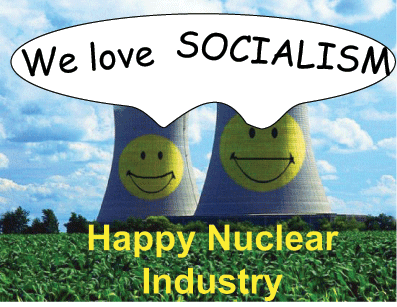
Government ministers are mulling over plans to launch a state-owned
nuclear company, which would assume stakes in future domestic projects.
Business secretary Kwasi Kwarteng is considering the move as he looks to
speed up the development of nuclear plants – which have suffered years of
delays- and reduce the UK’s reliance on foreign energy, according to The
Sunday Times.
City AM 20th March 2022
What the nuclear industry and its supporters have to say about the economic viability of nuclear power:

https://www.facebook.com/groups/1021186047913052 Jim Green, 20 Mar 22, What the nuclear industry and its supporters have to say about the economic viability of nuclear power: Nuclear Fuel Cycle Watch Australia
* “I don’t think we’re building any more nuclear plants in the United States. I don’t think it’s ever going to happen. They are too expensive to construct.” ‒ William Von Hoene, Senior Vice-President of Exelon, 2018.
* Nuclear power “just isn’t economic, and it’s not economic within a foreseeable time frame.” ‒ John Rowe, recently-retired CEO of Exelon, 2012.
* “It’s just hard to justify nuclear, really hard.” ‒ Jeffrey Immelt, General Electric’s CEO, 2012.
* “We see renewables plus battery storage without incentives being cheaper than natural gas, and cheaper than existing coal and existing nuclear.” ‒ Jim Robo, NextEra CEO, 2019.
* France’s nuclear industry is in its “worst situation ever”, a former EDF director said in November 2016 ‒ and the situation has worsened since then.
* Nuclear power is “ridiculously expensive” and “uncompetitive” with solar. ‒ Nobuo Tanaka, former executive director of the International Energy Agency, and former executive board member of the Japan Atomic Industrial Forum, 2018.
* “In developed markets, we see little economic rationale for new nuclear build. Renewables are significantly cheaper and offer quicker payback on scalable investments at a time when power demand is stagnating. New nuclear construction requires massive upfront investments in complex projects with long lead times and risk of major cost overruns.” ‒ S&P Global Ratings, 2019.
* Compounding problems facing nuclear developers “add up to something of a crisis for the UK’s nuclear new-build programme.” ‒ Tim Yeo, former Conservative parliamentarian and now a nuclear industry lobbyist, 2017.
* “It sometimes seems like U.S. and European nuclear companies are in competition to see which can heap greater embarrassment on their industry.” ‒ Financial Times, 2017, ‘Red faces become the norm at nuclear power groups’.
* “I don’t think a CEO of a utility could in good conscience propose a nuclear-power reactor to his or her board of directors.” ‒ Alan Schriesheim, director emeritus of Argonne National Laboratory, 2014.
* “New-build nuclear in the West is dead” due to “enormous costs, political and popular opposition, and regulatory uncertainty” ‒ Morningstar market analysts Mark Barnett and Travis Miller, 2013.
* “Nuclear construction on-time and on-budget? It’s essentially never happened.” ‒ Andrew J. Wittmann, financial analyst with Robert W. Baird & Co., 2017.
* “Nuclear power and solar photovoltaics both had their first recorded prices in 1956. Since then, the cost of nuclear power has gone up by a factor of three, and the cost of PV has dropped by a factor of 2,500.” ‒ J. Doyne Farmer, Oxford University economics professor, 2016.
References at:
Nuclear Power’s Economic Crisis and its Implications for Australia – Nuclear-Free Campaign
European countries make an exception for uranium from Russia – no sanctions on importing that!

So far, the EU has not put uranium on any sanctions list. Because only Russia can supply suitable fuel rods for many Eastern European nuclear power plants. Without Russia, the technicians at the Bohunice nuclear power plant in western Slovakia have a problem.
Here it is easy to imagine what an immediate embargo on raw materials from Russia would mean. They need uranium to keep the electricity flowing. But there is only one supplier who can supply the reactors with fuel. And that is, of all things, a Russian state-owned company. Slovakia has put itself in an awkward position.
Now Putin is bombing Ukraine. And yet uranium imports must continue. Of course, even Germany has not yet been able to bring itself to impose an energy embargo – the fear of skyrocketing prices, unemployment and cold living rooms is too great. But other European states also have red lines.
It is no coincidence that uranium is not on any EU sanctions list so far.
Sueddeutsche Zeitung 17th March 2022
https://www.sueddeutsche.de/wirtschaft/energie-atomkraft-uran-russland-1.5549686
Ukraine war a bonanza for Lockheed Martin, Raytheon, General Dynamics, Northrop Grumman and more

Less than three full months into 2022, Lockheed Martin’s stock has surged by more than 25%, while the share prices of Raytheon, General Dynamics, and Northrop Grumman have also risen by roughly 12%, 14%, and 16%, respectively.
War in Ukraine a Windfall for Weapons Industry
Military contractors “will benefit, and in the short term we could be talking about tens of billions of dollars, which is no small thing, even for these big companies,” said one analyst. Common Dreams KENNY STANCIL, March 15, 2022,
Russia’s deadly assault on Ukraine is a bonanza for arms manufacturers, which are lined up to profit as the United States and its allies increase military spending in an effort to bolster Kyiv’s forces.
William Hartung, a senior research fellow at the Quincy Institute for Responsible Statecraft, told The Hill on Tuesday that “there’s a lot of possibilities for ways that the contractors will benefit, and in the short term we could be talking about tens of billions of dollars, which is no small thing, even for these big companies.”
In the weeks since Russian President Vladimir Putin ordered his troops to invade, lawmakers in the U.S. Congress approved a record-setting Pentagon budget, and their counterparts in several European countries also vowed to significantly boost military spending to counteract Moscow.
The $1.5 trillion government funding bill that U.S. President Joe Biden signed Friday greenlights an astronomical $782 billion in military spending—an increase of 6% over last year and nearly $30 billion above the White House’s initial request. The package also provides $6.5 billion in military aid to Eastern European nations, including $3.5 billion worth of additional weapons for Ukraine.
As The Hill reported, the extra support for Ukraine “comes on top of more than $1 billion the U.S. has already spent in the past year to arm Ukrainian soldiers with modern weapons, including Javelin anti-tank missiles, manufactured by Lockheed Martin and Raytheon Technologies, and Raytheon’s anti-aircraft Stinger missiles.”
One arms industry lobbyist told the news outlet that an immediate effect of the U.S. ramping up weapons shipments to Ukraine is that “we’re going to have to backfill some of that ourselves, so that will force the Pentagon to buy more from some of the defense companies.”
As for longer-term implications, the lobbyist said that Democratic and Republican lawmakers alike expect to pass an even larger military budget next year, which “will pump more money into procurement and into [research and development].”
The U.S. is not the only country where military contractors are anticipating a bump in sales. Over the past few weeks, European countries including Germany, Italy, Poland, and Sweden have announced that they will boost military spending………….
“We are proud of the confidence the German Federal Ministry of Defense and Luftwaffe officials have shown in choosing the F-35,” Lockheed Martin said in a statement.
Less than three full months into 2022, Lockheed Martin’s stock has surged by more than 25%, while the share prices of Raytheon, General Dynamics, and Northrop Grumman have also risen by roughly 12%, 14%, and 16%, respectively.
Even before the Kremlin attacked Ukraine last month, arms manufacturers could hardly contain their excitement over the prospect of war, which they explained would be good for their bottom lines.
AsThe Hill reported:…………………………………
The weapons industry lobbyist told the news outlet that higher military spending in Europe would be a boon for U.S.-based military contractors:…………..
One day after Putin launched his full-scale invasion of Ukraine, the Quincy Institute’s Hartung warned against letting corporations and their allies in government use the war in Ukraine as a pretext for showering the military-industrial complex with even more money.
A week later, he argued that such a move would be “counterproductive” and potentially detrimental to U.S. security, echoing calls from anti-war groups that have long pushed for reallocating a portion of the Pentagon’s bloated budget to meet pressing human needs…………………
Last year, researchers at Brown University’s Costs of War project estimated that as much as half of the $14 trillion spent by the Pentagon alone since its 2001 invasion of Afghanistan has gone to private military contractors.
Lindsay Koshgarian and her colleagues at the Institute for Policy Studies’ National Priorities Project and Stephen Semler of the Security Policy Reform Institute, meanwhile, have estimated that corporations gobbled up more than half. https://www.commondreams.org/news/2022/03/15/war-ukraine-windfall-weapons-industry
The Ukraine war is bad for USA’s nuclear industry- hard to get the Highly Enriched Uranium needed from Russia for Advanced Nuclear Reactors
How Russia’s invasion is affecting U.S. nuclear, EE News, By Hannah Northey | 03/14/2022
Russia’s invasion of Ukraine is raising questions about the cost and flow of fuel to existing and yet-to-be commercialized advanced U.S. reactors touted by advocates as a tool for tackling climate change.
President Biden didn’t target the nuclear sector when he issued an executive order this month to block imports of Russian crude and natural gas.
But as the war drags on for a third week, the White House is consulting with the nuclear sector about the potential impact of imposing sanctions on Rosatom, Russia’s state-owned atomic energy company, according to Bloomberg, which cited anonymous sources familiar with the matter.
The White House did not immediately confirm talks with the nuclear industry.
Sanctions on Rosatom, sources told E&E News, could pose long-term challenges for the United States’ fleet of more than 90 reactors running on low-enriched uranium.
While the existing plants have enough fuel for the next six to eight months and possibly longer, experts say sanctions on Russian imports could raise the global cost of low-enriched uranium and rile U.S. plants sensitive to cost swings. Russia supplies 20 percent of the low-enriched uranium needed to run American nuclear plants, according to the Nuclear Energy Institute.
Others say the larger concern may sit with advanced reactor demonstrations expected to come online around 2028 that will require high-assay, low-enriched uranium, or HALEU. That’s because Russia is the only viable commercial supplier globally and other firms are years away from readily providing such fuel, they say.
Groups like Beyond Nuclear have said the Russian invasion highlights the liability of nuclear power and spent fuel, arguing the fuel source cannot be a climate solution.
Frank von Hippel, a physicist and professor emeritus at Princeton University, said the bigger challenge for nuclear power is that the technology is not economically competitive…………..
Russia represents— about 20 percent in 2020 — of the enriched uranium making its way to American reactors. Concerns about what steps the Biden administration would take regarding uranium began surfacing publicly when Reuters, citing sources familiar with the matter, reported earlier this month that NEI urged the White House to keep uranium sales exempt from sanctions (Energywire, March 3)…………………
Focus on advanced reactors
Possible sanctions on Russia could affect the current timeline for the deployment of advanced reactors in the U.S., said Jeff Merrifield, who sat on the Nuclear Regulatory Commission during the Clinton and George W. Bush administrations and is now a Pillsbury Winthrop Shaw Pittman LLP law firm partner.
Merrifield agreed Russia is the most readily available short-term option for providing fuel for advanced reactors that will need HALEU, uranium that’s enriched between 5 percent and 20 percent — higher rates that allow smaller designs to get more power for their size.
The first projects that would need a steady source of HALEU could be the Energy Department’s advanced reactor demonstration program, including a TerraPower plant in Wyoming and an X-energy project in Washington state. Those plants are expected to come online around 2028.
To be sure, sources of HALEU outside Russia are emerging — but industry and regulatory sources E&E News spoke with said it’s a matter of demand and timing as advanced reactors come online…………… https://www.eenews.net/articles/how-russias-invasion-is-affecting-u-s-nuclear/
Hypocritical cries of grief from weapons and other corporate businesses, as Western governments and media ramp up war fever.
[Ed. Here is the later part of this long article, which first details the history of other criminal wars, and the background to Russia’s understandable fear of Western aggression. I urge you to read the entire article, – while this bit examines only the current Ukraine situation]

Supporting this God-given path are not only big-biz executives, financiers, and military brass, but also a subservient media, obedient politicians aiming at highly-paid jobs when they leave politics, a number of labor leaders, and power holders in academia. They all form the Establishment, one quite similar in all so-called free and free market democracies, except that for over 80 years the U.S, sector has asserted its role in the pack as alpha wolf.
A Criminal War Ushers in the Worst of Times in Ukraine, Russia, and Europe
My overriding hope is that current talks may lead to peace, to an end of death and destruction, and to the repair and renewal of all efforts to build a world without exploitation, without aggrandizement, without aggression, without war.
Portside, March 12, 2022 Victor Grossman ”…………………………………………….Every single wartime death or wound is terrible; every missile, every bullet is unnatural. There are too many similar tragedies now in Ukraine. Yet, while writing this, I find myself thinking: Despite each and every tragedy—thank goodness that Ukraine has not been hit like Iraq in 2003, with the death of hundreds of thousands. Yet alas, while I see the Brandenburg Gate lit up with Ukrainian blue and yellow, I recall no Iraqi colors there in 2003, nor those of Palestinians in 2014 after the death of 547 children during the bombing of Gaza.
In the years that followed, as military campaigns in Iraq, Afghanistan, and elsewhere mired down or lost, symbols, slogans, and catchwords about terror wore thin, the fearfulness of words like Islamism, communism, and socialism eroded, like Bolshevism and anarchism in earlier eras. The gargoyle faces, the grayed grimaces of Reagan’s Evil Empire warnings in 1983 needed replacement, for the pressures remained. Putin’s angular face and physique often have to suffice—or is the yellow peril back in play? And what are those pressures, refurbished but still very real?
Some are easy to call by name: Lockheed, Northrop-Grumman, Raytheon, friendly German rivals like Rheinmetall, Krupp, Maffei—and a further limited list. They earn their billions by producing and selling their products, which must constantly be multiplied, replaced—or used.
Thus, while military actions by Putin or any others may be treated by such folk with loud cries of condemnation or sympathy for the victims, behind their dampened Kleenex hankies we can sense their jubilation as military budgets soar, now nearly $780 billion a year in Washington, and the German government, previously tugged one way by traders with Russia or China, now being overwhelmed by the military monopolies, ambitious expansionists, and devoted Pentagon friends who, since the march into Ukraine, have gained the upper hand.
The military budget in Berlin now aims at topping the 50-billion-euro level, with ever more spending for jets, frigates, armed drones, and more personal armor as well; after all, those patriotic lads or lasses in uniform must not be neglected, but always sent well-armored to their deaths.
And how many have the courage to disapprove of all of this? To vote against it, in the Capitol or the Bundestag? Only a very, very few, now angrily disqualified or ignored.
Not only manufacturers of armaments are waving blue-yellow flags with one hand and concealing profit calculations with the other. If their real hopes come true, if Putin’s move goes awry and ends up with a regime change in Red Square, as in Maidan Square in 2014 but far bigger, what new opportunities would be opened up!
….……. Many are surely dreaming of wide new Eurasian monoculture, of unlimited raw materials, new markets, skilled proletarians. Tyson and Cargill, Bayer and BASF, GM and Daimler, Nestlé and Unilever, Murdock and Springer, Facebook and Amazon must certainly be checking electronic atlases for maps reaching from Smolensk to Vladivostok—and across the Amur River, too, where great multitudes could then be reached so much more easily.
What this all adds up to is a continuing hope for world hegemony—always with God’s help of course. Sen. Mitt Romney, once a candidate for the presidency, put it clearly:

“God did not create this country to be a nation of followers. America is not destined to be one of several equally balanced global powers. America must lead the world, or someone else will. Without American leadership, without clarity of American purpose and resolve, the world becomes a far more dangerous place, and liberty and prosperity would surely be among the first casualties.”
Supporting this God-given path are not only big-biz executives, financiers, and military brass, but also a subservient media, obedient politicians aiming at highly-paid jobs when they leave politics, a number of labor leaders, and power holders in academia. They all form the Establishment, one quite similar in all so-called free and free market democracies, except that for over 80 years the U.S, sector has asserted its role in the pack as alpha wolf.
Countries to be “taken out”
In a broadcast with Amy Goodman on March 2, 2007 one vector of a world-wide program was revealed by Gen. Wesley Clark: a memo by then-Defense Secretary Paul Wolfowitz which described “how we’re going to take out seven countries in five years, starting with Iraq, and then Syria, Lebanon, Libya, Somalia, Sudan, and finishing off with Iran.”
The timetable didn’t work out exactly—timetables often don’t—but was close enough. And if Iran could really be tamed once again, as in 1952, Georgia would then be close. And Russia as well.
Another vector was even more crucial. When East German annexation was agreed upon in 1990, Soviet army withdrawal was matched by the American and West German verbal promise to a very trustful Mikhail Gorbachev that NATO would never expand past the Elbe River into East Germany or beyond.
The promise was soon broken. The Pentagon-based NATO moved with its military technology into East Germany and on to Poland, Czechoslovakia, the Balkans, the Baltic countries, thus surrounding all but the southern flank of European Russia with an increasingly tight, hostile ring, featuring broadened, strengthened highways and rail lines pointing eastwards, potential missile launchers in Poland, swift jet planes, fueled and polished, in German and Belgian hangars, with nuclear bombs waiting nearby, and annual aggressive military maneuvers along Russian borders. NATO was spending $111 billion on armaments, Russia $62 billion.
And then north and south were linked. In 2013, Ukrainian President Viktor Yanukovych, no angel, faced a choice between the unsteady but undeniable advantages of economic cooperation with Russia, his country’s main energy supplier, or biting at the bait of promised Western prosperity, with all the luxuries it symbolized for many Ukrainians, especially in its western regions.
The American leadership, thinking no doubt of fat dividends but far more about closing that tight ring, or noose, around Russia and gaining control of Sevastopol, the big naval base on the Black Sea, Russian till then, by contract, decided to move ahead. After spending $5 billion or more on propaganda and organizing anti-Russian groups and parties, it re-animated its earlier “Orange Revolution.” Joining with openly pro-fascist groups—complete with swastikas, “Heil Hitler!” salutes, and all—it managed the ouster of the elected president, who had to flee to safety. In a famous decision, revealed in a hacked telephone call between the U.S. ambassador in Kiev and Victoria Nuland, Assistant Secretary of State, the American puppet Arseniy Yatsenyuk, referred to endearingly as “Yats” by Nuland, was installed by her as prime minister.
Leadership positions in Ukraine have changed several times since then, as the influence of varying oligarchs altered. Some things remained constant. Russian speakers were discriminated against and suppressed, resulting in the vote of a great majority in Crimea to become part of Russia once again—as they had been until 1954. Two Russian-speaking eastern provinces defied the anti-Russian pressures and broke away, with Moscow support. Armed Ukrainian militia units, some with openly pro-fascist symbols on their uniforms or skins, kept battering against them
Perhaps it was their strength which prevented the Kiev government from abiding by the peace agreements of Minsk, in which Paris, Berlin, Moscow, and Kiev had agreed on seeking solutions, with partial autonomy for the Russian-speaking provinces, or was it pressure from Washington and local oligarchs which moved the current president, Volodymyr Zelensky, at first seemingly in favor of negotiations, to back out?
Since that goal of world hegemony in many wealthy American brains, Republican and Democratic alike, was never abandoned, and only Russia and China stood in the way, Ukraine was clearly being built up as a counterforce against one such barrier, indeed as a ramp for further action. Which leads us to 2022.
Putin clearly disapproved of any ramps close to his borders. He hardly needed to leaf in the history books for the years 1812, or 1918-21, or 1941-45 to strengthen his resolve. With the increasing threat from an enlarged, aggressive NATO, he could not possibly ignore a Ukraine eagerly pushing to join up as soon as possible, after it had already joined in NATO wars in both Iraq and Afghanistan. All the offers Russia made to negotiate the issues—above all a bar to Ukraine officially joining NATO—were rejected in the West as “non-starters” and accompanied by further waves of recriminations and new sanctions.
Was this extreme hostility by media and politicians, with its implied threats (and its actual incidents, as in Syria), the reason for Putin’s decision to invade Ukraine? Despite TV hours and piles of paper and ink expounding about it, I see absolutely no basis for warnings that Putin has plans to “expand his empire.” I have not seen a single word threatening Finland, Poland, Romania, or the Baltic trio, which are often loudest in exhortations. And Germany? The idea of Russia attacking Germany is fully unthinkable—though not enough to hinder big armament expansion plans in Berlin.
In the past, Russia was systematically threatened and also attacked—and is surrounded by a world with over 750 American military bases, with an American military budget bigger than the next ten countries combined, and with four times as many NATO soldiers as Russians in uniform. Even when Russia deployed troops outside its borders, bitter as these occasions were, they were only in countries which were on its borders, and hence—if under unfriendly control—were viewed as potential threats as much as Russian or Chinese deployments in Mexico or Canada would be viewed in the U.S. Ukraine definitely borders Russia—its heartland. Militarily, the USSR and Russia were always basically on the defensive, not on an offensive track.
And yet its soldiers, tanks, and planes have invaded Ukraine, with results just as horrible for those affected, even if not on the same scale, as American attacks in the Philippines and Vietnam, Nicaragua, and Iraq—or in two of the worst crimes ever committed by humankind—at Hiroshima and Nagasaki. We cannot look into Putin’s mind, nor know of possible threats he seems to have considered immediate. We must strictly reject any nonsense disputing the will of most Ukrainians to remain independent and sovereign—though not to become part of a NATO-led threat.
Why this war now?……………….
The invasion, for whatever reason, has not only caused great misery in Ukraine, but also given an immense steroid push to the forces on the political right, the traditional Russia-haters, those thinking constantly of protecting and increasing their fortunes and those who want no peace, but only victory, any victory, over Russia. They want to demolish not only the reign of Putin but Russia in general as a barrier to capitalist expansion, to a hegemony ruled from Washington, Wall Street, and the Pentagon.
It is these people who are demanding no-fly zones. Some 27 former Pentagon and State Department officials and a former top NATO military commander joined Zelensky in calling for a no-fly zone, although they know full well what that means. As even Republican Sen. Marco Rubio of Florida said of the demand: “It means starting World War III.”
On the other hand, the march into Ukraine has caused saddening collateral damage, another likely season with the splintering and weakening of progressive forces who work for peace and whose growth is becoming almost desperately necessary in the face of a growing fascistic menace around the world………… https://portside.org/2022-03-12/criminal-war-ushers-worst-times-ukraine-russia-and-europe
1 This Month



26 September – International Day for the Total Elimination of Nuclear Weapons


PLEASE OPPOSE HR 8255 AND S.3639 – bills would accelerate satellite deployment, with no environmental review or safeguards – https://ncstd5li.quorum.us/campaign/169331/
To see nuclear-related stories in greater depth and intensity – go to https://nuclearinformation.wordpress.com
-
Archives
- September 2026 (245)
- August 2026 (330)
- July 2026 (355)
- June 2026 (287)
- May 2026 (306)
- April 2026 (356)
- March 2026 (251)
- February 2026 (267)
- January 2026 (308)
- December 2025 (358)
- November 2025 (359)
- October 2025 (375)
-
Categories
- 1
- 1 NUCLEAR ISSUES
- business and costs
- climate change
- culture and arts
- ENERGY
- environment
- health
- history
- indigenous issues
- Legal
- marketing of nuclear
- media
- opposition to nuclear
- PERSONAL STORIES
- politics
- politics international
- Religion and ethics
- safety
- secrets,lies and civil liberties
- spinbuster
- technology
- Uranium
- wastes
- weapons and war
- Women
- 2 WORLD
- ACTION
- AFRICA
- Atrocities
- AUSTRALIA
- Christina's notes
- Christina's themes
- culture and arts
- Events
- Fuk 2022
- Fuk 2023
- Fukushima 2017
- Fukushima 2018
- fukushima 2019
- Fukushima 2020
- Fukushima 2021
- general
- global warming
- Humour (God we need it)
- Nuclear
- RARE EARTHS
- Reference
- resources – print
- Resources -audiovicual
- Weekly Newsletter
- World
- World Nuclear
- YouTube
-
RSS
Entries RSS
Comments RSS
 nuclear-news