Europe remains economically dependent on Russia as long as it has nuclear energy
As long as nuclear power plants are operated in Europe, the EU will be
dependent on Russian uranium supplies, BUND’s new uranium atlas makes
clear.
Neither economically nor ecologically does nuclear power still make
sense. The new edition of the Uranium Atlas makes it clear that Europe will
not be able to detach itself economically from Russia as long as the states
continue to use electricity from nuclear power.
After all, both Germany and other European states obtain a large part of the uranium needed for this
purpose from mines in Russia and Kazakhstan. The Uranium Atlas (in German),
released last week, is published by the Bund für Umwelt und Naturschutz
Deutschland (BUND) together with the Nuclear Free Future Foundation, the
Rosa Luxemburg Foundation, the environmental foundation Greenpeace and
“.ausgestrahlt”. According to the report, around 40 per cent of
European uranium imports come from Russia and Kazakhstan. Thus, in addition
to fossil energy imports, European countries are significantly dependent on
Russia.
Posteo 28th April 2022
https://posteo.de/en/news/uranium-atlas-2022-nuclear-power-increases-europes-dependence-on-russia
Hinkley Point C – costs soar, delays again. UK govt’s big bet on nuclear is backfiring
| The risks to the government’s plans to build another eight nuclear power plants have been underlined by the latest wave of ballooning costs and delays at Hinkley Point C. EDF, which is constructing the 3,200MW reactor in Somerset, has warned that estimated costs have jumped to between £25 billion and £26 billion, while the power station will not now start producing electricity until June 2027 at the earliest. The revised estimates are £3 billion higher than the previous cost projections in January last year, which were in turn well ahead of the group’s initial £18 billion forecast when the project was approved in 2016. Hinkley is Britain’s first new nuclear plant in decades. It is expected to power six million homes, with the government guaranteeing that consumers pay an index-linked £92.50 per megawatt hour, in 2012 prices, for its electricity. Construction costs are being met by EDF and its junior partner in the project, CGN of China. Critics seized on the latest overruns to point out the risks to Boris Johnson’s blueprint for another 24 gigawatts of new nuclear power by 2050. The Stop Sizewell C lobby group pointed out that, while EDF and CGN are on the hook for Hinkley’s “rocketing costs”, a proposed new financing model would see consumers paying upfront via higher bills for cost overruns. “The £20 billion estimate for Sizewell C is already two years out of date, with zero chance of it being delivered at that cost,” it said, noting that the risk of spiralling costs would “fall on consumers”. Doug Parr, Greenpeace’s UK policy director, said: “The government’s big bet on nuclear is backfiring with every extra billion added to the bill”. He advocated investment in offshore wind instead. Costs at the prototype for Hinkley, the Flamanville plant in France, have rocketed from €3.3 billion to €12.7 billion. Construction is running more than a decade late. Times 20th May 2022 https://www.thetimes.co.uk/article/hinkley-point-c-nuclear-plant-to-open-a-decade-late-9vsk6w9zx |
£3 billion more, 1 year longer: EDF Energy announces latest price hike and further delay at Hinkley Point C
£3 billion more, 1 year longer: EDF Energy announces latest price hike
and further delay at Hinkley Point C. Whilst news that yet another civil
nuclear power plant is to be delivered still further over-budget and still
further behind schedule may be ‘par for the course’, the Nuclear Free
Local Authorities still find EDF’s latest pronouncement that Hinkley
Point C will cost £3 billion more and take one year longer to build
shocking.
In a media release yesterday (Thursday 19 May), the French parent
of UK nuclear operator, EDF Energy, conceded that, on their latest
estimate, Hinkley Point C will now cost £25 to 26 billion to build and
become operational no earlier than July 2027.
EDF last updated its Hinkley
Point construction schedule in January 2021, when it stated the plant would
be delayed by a further six months to June 2026 with the cost rising by an
additional half billion pounds to £22 billion to 23 billion. NFLA Chair
Councillor David Blackburn commented: “EDF Energy have blamed COVID and
the Ukraine conflict for the price hike and the delay, but Hinkley Point C
was already way over budget and way behind schedule before either of these
calamities occurred. For the simple reality is that nuclear costs too much
and takes too long”.
NFLA 20th May 2022
France’s woes with nuclear power plants means more energy uncertainty for Europe
The utility cut its forecast as it realised that “stress corrosion” issues affecting some of its reactors will require more checks and repairs. Irish Examiner, THU, 19 MAY, 2022. LARS PAULSSON, JESPER STARN AND FRANCOIS DE BEAUPUY
The woes facing the nuclear power stations at France’s EDF — Europe’s largest electricity producer — will increase the pressure on war-hit European energy markets after the summer.
EDF, which is the backbone of Europe’s integrated power system, cut its nuclear output target for a third time this year, the latest sign that Europe’s power crisis is worsening.
Western Europe has for decades relied on exports of power from EDF’s nuclear stations. The cuts are another blow to European energy security just as the region is weaning itself off Russian supplies of everything from natural gas to coal and oil because of the war in Ukraine.
Less output from EDF is sending prices higher just as soaring inflation is pushing up costs for everything from petrol to food. It could get even worse in winter as France, traditionally an exporter of electricity, may be forced to import more from its neighbours.
French prices are the most expensive in Europe, with contracts for the period almost double levels in Germany. The utility cut its forecast as it realised that “stress corrosion” issues affecting some of its reactors will require more checks and repairs. The outlook for the following year remains unchanged for now, the firm said.
| “We fine-tuned the repairs to be made,” Regis Clement, deputy head of the company’s nuclear division, said during a media conference. “We’ve got to cut more pipes” to carry out further checks “and more repairs to handle”, he said.The big test will come when temperatures start to fall toward the end of the year. It won’t take many days of cold weather to jeopardise French power supplies, according to Emeric de Vigan, chief executive officer at French energy analysis firm Cor-e.“With such poor nuclear availability, if we reach 2 degrees Celsius below normal in the winter for a few days we could be in trouble, it would be really tight,” Mr de Vigan said. Paying customers and factories to lower consumption are steps that likely will need to be taken, he said. ………………. https://www.irishexaminer.com/business/economy/arid-40876541.html |
Russia’s grip on Europe’s nuclear power industry – this is being ignored
Europe needs a plan in place for cutting ties with Russia’s nuclear
giant Rosatom, says 2021 Right Livelihood Award winner and co-chairman of
Ecodefense Vladimir Slivyak. With the European Union tightening its
sanctions against Russia, banning Russian imports of oil, gas, and coal has
emerged as one powerful tool to starve the Kremlin’s war machine of
funding it needs to continue its brutal aggression in Ukraine.
But one other major source of Russia’s revenue in Europe has largely remained
unnoticed: Russia’s supplies of nuclear fuel and services to European
nuclear power plants.
Seeking to close this gap in Europe’s concerted
action against the war in Ukraine and to provide a comprehensive picture of
the union’s reliance on Russian nuclear technology, environmentalists
Patricia Lorenz, of Friends of the Earth Europe, and Vladimir Slivyak, a
2021 Right Livelihood Award laureate and co-chairman of the Russian
environmental group Ecodefense, on Wednesday jointly presented Russian Grip
on EU Nuclear Power – an overview of Russia’s businesses and supply
chains serving the European nuclear market.
Eco Defense 19th May 2022
EDF shares fall after new profit warning due to nuclear outages
Shares in EDF fell 1.8% on Thursday after the French utility warned
outages at its nuclear power plants would result in a steeper-than-expected
cut in power output and thus have a greater than previously estimated
impact on 2022 core earnings. EDF said the impact of the outages largely
related to a program of inspections and repairs the company is carrying out
on some of its reactors would have a negative impact of around 18.5 billion
euros on the group’s core earnings this year instead of the 14 billion
euros previously forecast.
Financial Post 19th May 2022
Nuclear Free Local Authorities seeks assurance British nuclear will not rely on Russian uranium
An organisation representing UK councils, Nuclear Free Local Authorities
(NFLA), has written for reassurance that Russian uranium will not be used
to power British nuclear reactors. The group reached out to the Chief
Executive of nuclear plant operator EDF energy, Simone Rossi, and the
Minister for Climate Change, Greg Hands, for clarification.
This comesafter NFLA Chair, Cllr David Blackburn, noticed mentions of a long-term
contract for natural and enriched uranium with Russian-owned supplier Tenex
in an EDF Energy report. In the annual financial report from EDF’s French
parent company, one section looks at the company’s strategy for enriching
natural uranium into uranium 235
Environment Journal 17th May 2022
Five reasons that Russia’s nuclear exports will continue, despite sanctions and the Ukraine invasion. But for how long?
By many measures, Russia’s state-controlled nuclear energy company,
Rosatom, has primacy in the global nuclear energy market. At any given
moment, the firm provides technical expertise, enriched fuel, and equipment
to nuclear reactors around the world.
The Russian invasion of Ukraine and,
more acutely, the Russian military’s dangerous actions at the
Zaporizhzhia nuclear power plant and in the Chernobyl exclusion zone have
many countries rethinking their dependence on Russian nuclear products and
searching for alternatives.
Additionally, the ensuing global effort to
cripple Russian access to international markets calls into question the
viability of current contracts, government licensing, and financial
instruments involved in Russia’s nuclear exports.
Concurrently, the invasion has highlighted the lack of energy source diversification across
Europe. Headlines have focused on how several European countries decided to
phase out or delay plans to build new nuclear power plants in the wake of
the 2011 Fukushima-Daiichi disaster and, instead, increase imports of
Russian oil and natural gas to feed their electric grids’ baseload needs.
Now, in response to the sudden European effort to minimize dependence on
Russian imports, the United States has sent tankers of liquefied natural
gas (LNG) to European ports. Additionally, the United States and partners
are releasing a round of oil from their strategic stockpiles to stabilize
market prices. For oil and natural gas supplies to Europe, there are some
immediate alternatives available.
However, for nuclear power plants,
swapping in alternative supplies is causing serious dilemmas and could lead
to stranded assets.
Bulletin of Atomic Scientists 17th May 2022
Five reasons that Russia’s nuclear exports will continue, despite sanctions and the Ukraine invasion. But for how long?
Don’t hold your breath waiting for NuScam’s small nuclear reactors to be profitable

As for valuation, the company is being valued on significant growth occurring in the potentially far distant future, so prospective investors would essentially be betting on the company’s ability to sell operating units at scale and profitably…and to do so in the coming near-to-medium term rather than the 2030s or beyond.
Spring Valley Completes NuScale Merger, But Growth Timing Is Unknown, Donovan JonesMarketplace, Author of IPO Edge. May 18, 2022 A Quick Take On NuScale.
Spring Valley Acquisition Corp. (NYSE:SMR) has announced the closing of its initial business combination with NuScale Power for an estimated enterprise value of approximately $1.9 billion.
NuScale has developed proprietary nuclear small modular reactors for utilities and industrial customers.
It is likely that NuScale will require significant time to generate material revenue growth and even longer for profits
……………. Business Combination Terms
The Spring Valley Acquisition SPAC originally raised $230 million in gross proceeds in its IPO in late 2020, selling a total of 23 million units including underwriter allotments.
The previously announced transaction included a PIPE (Private Investment in Public Equity) which rose to $235 million from Samsung C&T, DS Private Equity, Segra Capital Management and Spring Valley’s sponsor Pearl Energy.
The deal will provide NuScale with gross proceeds of up to $413 million to pursue its commercialization initiatives and growth plans.
Major NuScale investor Fluor Corporation will retain approximately 60% ownership of NuScale, with other legacy shareholders retaining approximately 20.4%, the Spring Valley SPAC public shareholders having 6.5%, the Spring Valley Acquisition Sponsor retaining 2.4% and PIPE investors purchasing 10.7% of the outstanding NuScale stock.
………………. As for valuation, the company is being valued on significant growth occurring in the potentially far distant future, so prospective investors would essentially be betting on the company’s ability to sell operating units at scale and profitably…and to do so in the coming near-to-medium term rather than the 2030s or beyond.
…………….. In any event, it is likely that NuScale will require significant time to generate material revenue growth and even longer for profits, so I’m on Hold over the near term for SMR. https://seekingalpha.com/article/4512948-spring-valley-completes-nuscale-merger-but-growth-timing-is-unknown
Back to square one for $28B nuclear management contract.

By Nick Wakeman, WashingtonTechnology, Editor-in-chief MAY 17, 2022
The National Nuclear Security Administration is taking current global events into account as it develops new solicitations. It’s back to the drawing board for the National Nuclear Security Administration and its $28 billion contract to manage two facilities that process nuclear weapons and other weapons of mass destruction.
That huge contract attracted mega-teams including such notable market players as Booz Allen Hamilton, Leidos, Amentum and Fluor.
Fluor and Amentum are the main partners in joint venture Nuclear Production One LLC. That team also known as NPOne unseated the incumbent Consolidated Nuclear Security LLC, another joint venture.
Consolidated Nuclear Security’s key members include Bechtel National, Leidos, Northrop Grumman and SOC LLC. Booz Allen is involved also as a subcontractor.
After losing the contract in late November, CNS went to the Government Accountability Office with a protest that claimed the winner had an organizational conflict-of-interest and NNSA improperly evaluated the bids.
In December, the National Nuclear Security Administration said it would review the award decision. NNSA is part of the Energy Department.
With that review done, NNSA decided this week to scrap the whole thing and split the contract into two separate acquisitions. One will be for the Pantex Plant near Amarillo, Texas; and the second for the Y-12 National Security Complex in Oak Ridge, Tennessee.
Each facility will now have its own presumably multibillion-dollar contract for management and operations services.
NNSA said it was splitting the contract because each facility has increased workloads. A “challenging geopolitical environment” was another reason cited………..
NNSA has now begun the process of developing two new solicitations. The NPOne and CNS teams will presumably continue to pursue the contracts.
But they are likely now armed with much more information on each other’s bids and approaches to the work, given what they’ve learned through debriefings and the protests.
NNSA’s restart also opens the opportunity to bring on new teammates as they push to differentiate themselves.
In the meantime, the current contract with Consolidated Nuclear Security will be extended.
GovTribe data shows that contract has netted $32 billion in spending since it was awarded in 2013. https://washingtontechnology.com/contracts/2022/05/back-square-one-28b-nuclear-management-contract/367044/
$40 Billion More for the Ukraine War

We love the Ukraine war !!!
$40 Billion More the Ukraine War: A Wakeup Call for Those Who Still Believe in Lesser-Evilism, Anti-War.com, by Ryan Costello , , The US House of Representatives just approved another massive military “aid” package for the Ukraine War. The Biden administration had initially requested $33 billion in new money for the war, but leaders of both parties in Congress, eager to support the war, quickly said this was not enough, and raised the total for this package to $40 billion, a truly staggering total.
The administration had already spent $14 billion before this latest weapons package. The latest spending spree (at a time when many Americans are struggling with crushing debt loads, lack of baby formula and other key supplies, and skyrocketing inflation) brings the total spent in Ukraine in 3 months to $54 billion on the books (not counting all the dark money for the spy agencies). The official annual budget for the War in Afghanistan averaged $46 billion…The sum the US has already spent on this war in a few months is quickly approaching the annual military budget of the entire Russian military.
This money goes to companies like Raytheon, Lockheed Martin, General Dynamics, etc. These merchants of death make up the military industrial complex; they promote the permanent war economy, and have a vested interest in ensuring the US continues to engage in and support devastating wars abroad that destroy whole countries and societies, lead to millions of deaths and untold horrors like what we have seen in Yemen over the past few years.
These same corporate and state ghouls are salivating over the profits to be made in a new cold war with China. In this conflict for global dominance they see a shining opportunity to bleed the taxpayers of this country dry, looking to get blood from a stone in our country where the rich pay and big corporations no real taxes, but the middle class and poor are bled dry, being pushed deeper and deeper into debt-peonage and wage slavery by rising tax rates, shrinking paychecks, and red hot inflation (itself a result of the Federal Reserve’s reckless money printing to bailout the banks numerous times since 2008).
And yet not one of the so-called progressive Democrats could find a spine to stand against this weapons package. Not AOC, not Ilhan Omar, not any of them. This is not so surprising when one considers their spinelessness on Yemen (introducing a War Powers Resolution under Trump, knowing he would veto it, bur refusing to do so now that Biden is president), their posturing around Palestine (where they consistently rotate turns supporting more military funding for Israel), and countless other betrayals and hypocrisies.
Of all the “squad” only Cori Bush has released a statement justifying her vote for the bill. The others have remained silent and refused to respond to requests for comment on why they voted to fund the war machine after so many promises (clearly hollow) to end “the forever war.” Bush’s statement, like the entire legacy of the Squad, is a pathetic excuse for progressive politics. First, she claims that this $40 billion in military funding is about “strengthen[ing] the Ukrainian people’s fight against oppression and tyranny.” She makes no mention of the fact that key US leaders from Hillary Clinton to the Chairman of the Joint Chiefs have made it clear that they want this war to drag out as long as possible to bleed Russia.
In the course of such a prolonged conflict, we can only imagine the cost the people of Ukraine will pay. In short, this bill is both about padding the pockets of the military industrial complex and also about sacrificing Ukraine to weaken Russia as a rival to the US and NATO. As many have noted, the US elite are more than happy to fight Russia to the last Ukrainian.
At the end of her statement, Bush includes a hollow note that “The sheer size of the package given an already inflated Pentagon budget should not go without critique. I remain concerned about the increased risks of direct war and the potential for direct military confrontation.” This is akin to helping someone pour gasoline on a fire, and then saying that one remains concerned about the risk of the fire spreading! This is what we can expect from Bush, the squad, and the entire so-called progressive wing of the democratic party…………………..
The time has come to cast aside illusions about our so-called representatives in Washington, to stop believing in the lie of the Democratic Party as the supposed lesser of two evils, and to redouble our efforts to build up a renewed antiwar movement. Likewise, while a few dozen Republicans voted against the $40 billion, this is no reason for optimism that the Republican Party can be a vehicle for real change. During the Iraq War, once the protests swelled in size, many Democrats made court theater by feigning opposition to the war when Bush was president, only to support continued escalations and drone strikes once Obama was elected. As Howard Zinn notes over and over again in A People’s History of the United States, the two parties are part of one unified system of corporate monopoly rule. They exist to co-opt, mislead, and ultimate destroy movements that seek to change this system of oligarchical control of nearly every aspect of our country.
As long as we remain beholden to the Democrat or Republican Party politics, our movements will be gobbled up, defanged, and spat back out; regurgitated as pliant pawns of the corporate state and the military industrial complex, able to offer only the mildest of criticisms, and utterly impotent and unable to stand against the machinations of the megalomaniacs who run this country and are driving us all towards the brink of WWIII.
Ryan Costello is an organizer in New York City with United Against War and Militarism and a member of the Yemen Peace Vigil https://original.antiwar.com/ryan_costello/2022/05/15/40-billion-more-the-ukraine-war-a-wakeup-call-for-those-who-still-believe-in-lesser-evilism/
Turkish nuclear plant threatened by Russian sanctions
Akkuyu nuclear power plant would be Turkey’s first, but Russia’s invasion of Ukraine may cause problems. Aljazeera, By Andrew Wilks, 16 May 2022,
Istanbul, Turkey – Unprecedented sanctions against Russia over its invasion of Ukraine have led to fresh concerns about Turkey’s first nuclear power plant, which is being built by Moscow’s state-owned nuclear company.
The first reactor of the Akkuyu Nuclear Power Plant, located on the Mediterranean coast near Mersin, is due to start production next year, but potential blocks on financing and equipment from third countries have threatened to delay the $20bn project.
Rosatom, the Russian firm behind Akkuyu, has so far escaped sanctions but the option has reportedly been discussed by the United States. Banks such as Sberbank, Russia’s largest financial institution and a major backer of the nuclear plant, have been hit.
……… Possible sanctions against Rosatom could also affect the flow of equipment to Akkuyu, barring suppliers from providing energy industry equipment, technology and services.
In an interview with Turkish broadcaster NTV, aired on February 23, Akkuyu CEO Anastasia Zoteeva highlighted the “large amount of equipment” produced for the plant in countries such as the Czech Republic, Hungary and South Korea. A key component was manufactured by GE Steam Power, a branch of General Electric, in France while French company Assystem is also involved in construction supervision.
Neither General Electric, Assystem nor other third-country companies contacted for comment by Al Jazeera responded…………………………… https://www.aljazeera.com/news/2022/5/16/turkish-nuclear-plant-threatened-by-russian-sanctions
Boris Johnson’s UK ”nuclear renaissance” – now desperate for funding, pleads to USA
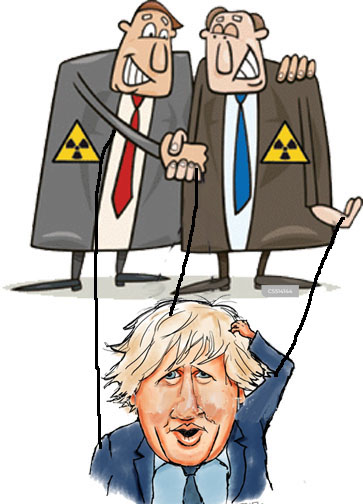
| Kwasi Kwarteng seeks US investment for UK nuclear plants to end reliance on China. There are plans for expansion of nuclear power in Britain as part of a new energy security strategy following the invasion of Ukraine. The Business Secretary is to fly to the US this week to drum up American investment in new nuclear plants amid concerns that the UK is too reliant on China for help building reactors in Britain. Kwasi Kwarteng is expected to hold talks with Jennifer Granholm, the US energy secretary, in Washington DC, where a Whitehall source said the minister was “keen to strengthen cooperation with the Americans on energy security”. Last month Boris Johnson and Mr Kwarteng announced plans for a massive expansion of nuclear energy in Britain as part of the country’s new energy security strategy that followed Vladimir Putin’s invasion of Ukraine. Mr Kwarteng is said to be concerned that Britain has become too reliant on two major players in the nuclear market – China General Nuclear, a Chinese state-owned energy giant, and EDF, which is owned by the French state. Ministers are hoping to raise more than £10 billion in private capital to fund the new Sizewell C nuclear power station in Suffolk. The Government is expected to take a 20 per cent equity stake in the project, with a further 20 per cent for EDF and the final 60 per cent coming from private investors. A Whitehall source said: “We’ve become too reliant on a handful of companies to develop new nuclear. Britain split the atom and built the world’s first full-scale nuclear power station, but we’ve fallen so far behind after three decades of drift. “We want British and American companies to pile in the cash to get our nuclear renaissance off the ground. The Business Secretary is keen to work with safe and reliable investors from like-minded countries and hug them close.” Telegraph 14th May 2022 https://www.telegraph.co.uk/politics/2022/05/14/kwasi-kwarteng-seeks-boost-us-investment-nuclear-end-reliance/ |
Uncertain funding for Britain’s plans for new nuclear reactors
China General Nuclear has provided substantial investment for Britain’s
nuclear power stations alongside France’s EDF. The two companies are
funding Hinkley Point C in Somerset but the project has been beset by cost
overruns and delays.
EDF is expected to announce more delays to Hinkley C
within weeks and will have to raise billions in extra finance for the
project. The company has warned CGN is not likely to increase its funding
for the plant.
Ministers have drawn up a so-called Regulated Asset Base
funding model to replace Chinese investment for nuclear plants in future
and incentivise other private investors to put forward funding. The RAB
model would see consumers start paying indirectly towards the costs of a
new power project during the construction phase. They would fund the
project through a small rise in their energy bills.
The model replaces the current Contracts for Difference scheme used for Hinkley Point C whereby
the developer finances the construction phase and only receives revenue
when the plant generates electricity.
EDF has also warned that separate
plans to build the Bradwell nuclear power plant in Essex are likely to fall
through because of political opposition to Chinese investment. In its
annual report, EDF said: “There is great uncertainty around the
development perspectives of the Bradwell Project, mainly related to the
political opposition to a Chinese company leading a critical UK
infrastructure project and from the lack of local stakeholder support.
““The risks of not being in a position to carry out the Bradwell project
are high and have increased in 2021.”
The government is also exploring
options for squeezing China out of the plans to build the Sizewell C plant
in Suffolk.
Telegraph 13th May 2022
https://www.telegraph.co.uk/business/2022/05/13/energy-bills-rise-pay-nuclear-plants-says-kwarteng/
Regulated Asset Base system will transfer nuclear’s financial risks to the UK public, rather than the nuclear companies

Some energy experts, however, are sceptical that the promised tidal wave of investment will ever materialise
Cran-McGreehin says one danger of the RABmodel is that it transfers risk to bill-payers rather than the companies building the station.
| City institutions have been taking a keen interest in the Tideway’s progress. Investors are intrigued by the novel way the £4.2 billion project was financed. The method has been seized on by the government to kick-start a £100 billion-plus splurge on new nuclear power stations, a move that could create a giant new market in infrastructure investment. The not-so-magic ingredient is asking customers to pay more up front and to guarantee payments in the future. Kwasi Kwarteng, the business secretary, said the plan would have a “small effect” on bills but did not say by how much they would go up. Industry experts think each large new station — and the plan envisages as many as eight — would add between £6-£10 to the average household bill. The buffer of cash raised from customers can be used to hammer out problems with power plant designs, and can be eaten into if construction proves troublesome. The project company is also allowed to continue to charge customers once the station is working, with the amount based on the value of the project. The whole arrangement is monitored by an independent regulator, hence its name: regulated asset base (RAB) financing. As a condition of the licence, investors in the project company are on the hook for a pre-agreed level of cost overruns. The Department for Business claims the reduction in interest payments could save consumers £30 billion over the life of a new power station. “In essence it is reducing the cost of capital by cutting back the construction risk to investors,” Richard Goodfellow, head of infrastructure, projects and energy at the City law firm Addleshaw Goddard, said. Some energy experts, however, are sceptical that the promised tidal wave of investment will ever materialise. “There is no cheap or easy way to do new nuclear,” Simon Cran-McGreehin, head of analysis at the Energy and Climate Intelligence Unit (ECIU), said. “I fear the government’s big ambitions will prove a distraction that won’t ultimately lead to much.” Since Johnson threw his weight behind the RAB route, the government has quickly put in place some necessary stepping stones. Four days after the nuclear summit at Downing Street, the Department for Business quietly published the criteria that projects would have to meet. Ministers are hoping that big British pension funds will buy the bonds and have helped to clear the way with reforms to the EU’s Solvency II regime, which at present limits the type of investments that insurers can hold. Goddard sees groups with a record of investing in infrastructure projects — Canadian pension funds, for example — as the biggest players. “I would expect the bulk of the investment — perhaps two-thirds — to come from the big global infrastructure funds that are already big investors in UK assets,” he said. “There are some investors who will be put off — either because of the size of the projects, the timescales, or just because it is nuclear.” After Sizewell, the pipeline of projects is unclear. Ministers are keen to push ahead with the on-again, off-again scheme for a new station at Wylfa on Anglesey. Hitachi, the Japanese industrial group, was to have built two new reactors there, but the project has now been taken up by the US engineering giant Bechtel. Senior sources at EDF say it is also casting a covetous eye over Wylfa as the possible site for another Hinkley Point design. There have also been discussions on a new plant at Moorside, close to the Sellafield nuclear site in Cumbria. RAB financing could also be adopted for a new type of small reactor. Rolls-Royce, which builds the power plants for nuclear submarines, has submitted a design to Britain’s nuclear regulators, while two US providers, Last Energy and TerraPower, are also weighing options in the UK. Cran-McGreehin says one danger of the RABmodel is that it transfers risk to bill-payers rather than the companies building the station. His bigger query, however, is whether there is too much concentration on nuclear. “Governments do from time to time get very excited about nuclear, then cool off,” he said. “I am not convinced allthis will actually come to pass, and in the meantime it risks taking thefocus away from investment in renewable energy.” Times 14th May 2022 https://www.thetimes.co.uk/article/why-nuclear-push-could-be-sweet-music-for-city-7gj7s5s38 |
1 This Month



26 September – International Day for the Total Elimination of Nuclear Weapons


PLEASE OPPOSE HR 8255 AND S.3639 – bills would accelerate satellite deployment, with no environmental review or safeguards – https://ncstd5li.quorum.us/campaign/169331/
To see nuclear-related stories in greater depth and intensity – go to https://nuclearinformation.wordpress.com
-
Archives
- September 2026 (233)
- August 2026 (330)
- July 2026 (355)
- June 2026 (287)
- May 2026 (306)
- April 2026 (356)
- March 2026 (251)
- February 2026 (267)
- January 2026 (308)
- December 2025 (358)
- November 2025 (359)
- October 2025 (375)
-
Categories
- 1
- 1 NUCLEAR ISSUES
- business and costs
- climate change
- culture and arts
- ENERGY
- environment
- health
- history
- indigenous issues
- Legal
- marketing of nuclear
- media
- opposition to nuclear
- PERSONAL STORIES
- politics
- politics international
- Religion and ethics
- safety
- secrets,lies and civil liberties
- spinbuster
- technology
- Uranium
- wastes
- weapons and war
- Women
- 2 WORLD
- ACTION
- AFRICA
- Atrocities
- AUSTRALIA
- Christina's notes
- Christina's themes
- culture and arts
- Events
- Fuk 2022
- Fuk 2023
- Fukushima 2017
- Fukushima 2018
- fukushima 2019
- Fukushima 2020
- Fukushima 2021
- general
- global warming
- Humour (God we need it)
- Nuclear
- RARE EARTHS
- Reference
- resources – print
- Resources -audiovicual
- Weekly Newsletter
- World
- World Nuclear
- YouTube
-
RSS
Entries RSS
Comments RSS
 nuclear-news