Campaigners are raising some very awkward questions about the financing of UK’s £20billion Sizewell C nuclear power plant.
Campaigners have raised questions after it was reported funding for a new
nuclear power station on the Suffolk coast is to be signed off by ministers
within a fortnight.
Funding for the £20billion Sizewell C plant is set to
be approved by the government by next month, paving the way for private
investment, according to The Telegraph. The decision would be a major boost
for EDF Energy, which is said to be in advanced talks with the government
over further cash to move the scheme forward ahead of a final investment
decision next year.
Reacting to the funding news, Alison Downes, from the
group, said: “Why do ministers appear willing to throw more cash at
Sizewell C, despite the risk and questionable value for money, when there
is none for hard stretched workers and – as Lord Deben pointed out – when
the nuclear industry ‘doesn’t deliver things on time and it doesn’t
deliver them to budget’?
“Nobody is even owning up to how much Sizewell C
would cost: the last estimate is more than two years out of date.” A
funding deal is not expected until after planning consent for Sizewell C is
granted, with the deadline for that decision set for July 8.
East Anglian Daily Times 26th June 2022
https://www.eadt.co.uk/news/business/sizewell-c-funding-to-be-signed-off-9098750
European Pressurised Water Reactors (EPRs) – a nuclear economic fiasco in Finland, France, UK and China
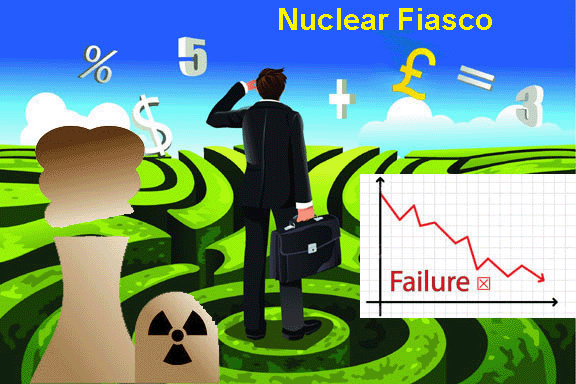
–It is over 30 years since the genesis of the EPR project in 1989. This reactor was presented from the start not as a technological revolution or breakthrough but as an evolution in the continuity of the second-generation pressurized water reactor sector, of which there are 56 in operation in
France.
It was also, according to its promoters, to constitute the
reference nuclear reactor of the 21st century, and be quickly and massively
exported all over the world. Three decades later, the reality is a far cry
from the announcements and ambitions of the industry.
While France envisages the construction of several of these EPR reactors for the 2050
horizon, this report aims to bring together in a single document the main
events that led to very substantial delays and additional costs on each of
the six EPRs in operation or still under construction in the world.
International overview of the industrial and economic fiasco of the EPR: at
Olkiluoto in Finland, Flamanville in France, Hinkley Point in the UK and
Taishan in China.
Greenpeace France (accessed) 24th June 2022
‘Revolting’: Senate Panel Adds Another $45 Billion to Biden’s Military Budget

“Time and again, Congress funnels billions in additional funds to costly weapons programs, war, and defense contractors, while claiming that human needs would ‘cost too much,'” said Weissman. “Most Americans oppose efforts to rocket-launch military spending towards a trillion dollars per year. Lawmakers should reject this and champion human-centered spending instead.”
https://www.commondreams.org/news/2022/06/17/revolting-senate-panel-adds-another-45-billion-bidens-military-budget “The Pentagon’s ever-growing budget is quite simply a theft from American people enriching some of the wealthiest corporations in this country,” said one critic. “It’s disgraceful.”
KENNY STANCIL June 17, 2022 Progressives responded with disgust after the Senate Armed Services Committee voted Thursday to tack an additional $45 billion on top of President Joe Biden’s already massive military spending request, bringing the total proposed budget for the coming fiscal year to a staggering $857.6 billion.
The Biden administration’s March request for $813 billion in military spending for Fiscal Year 2023 represented a $31 billion increase over the current level of $782 billion, which is already unprecedented.
During its closed-door markup of the National Defense Authorization Act this week, the Senate Armed Services Committee approved a bill with a topline budget of $847 billion—$817 billion of which is earmarked for the Pentagon. An additional $10.6 billion in national military spending falls outside the Senate panel’s jurisdiction. The House is expected to make its own push to further boost military spending for the next fiscal year.
William Hartung, a senior research fellow at the Quincy Institute for Responsible Statecraft, called the Senate panel’s decision “misguided.”
“The administration’s proposal is already higher than spending at the peaks of the Korean and Vietnam Wars and over $100 billion more than at the height of the Cold War,” Hartung said in a statement. “Throwing more money at the Pentagon will not make us safer—it will just divert funds from addressing other urgent challenges like pandemics and climate change that put millions of Americans at risk.”
Monica Montgomery, a research analyst at the Council for a Livable World, pointed out that the Senate committee’s proposed $45 billion increase in military spending is equivalent to Biden’s entire budget request for climate programs, demonstrating how “Congress will value militarism and defense contractors over a livable future.”
If Congress truly wants to keep people safe, they must start by rejecting this increase and investing taxpayer dollars in human wellbeing, instead,” Tori Bateman, policy advocacy coordinator at the American Friends Service Committee, said in a statement.
Earlier this week, Reps. Barbara Lee (D-Calif.) and Mark Pocan (D-Wis.)—co-chairs of the Defense Spending Reduction Caucus—introduced the People Over Pentagon Act of 2022, which proposes cutting Pentagon spending for the next fiscal year by $100 billion and reallocating those funds toward threats facing the nation that “are not military in nature,” such as the Covid-19 pandemic, the climate emergency, and worsening inequality.
Although a majority of U.S. voters are opposed to military spending in excess of $800 billion, earlier efforts to slash the Pentagon’s budget have failed to gain enough support to pass the House or Senate thanks in part to lawmakers who receive significant amounts of campaign cash from the weapons industry, which benefits from constantly ballooning expenditures.
Roughly 55% of all Pentagon spending went to private sector military contractors from FY 2002 to FY 2021, according to Stephen Semler of the Security Policy Reform Institute. “If this privatization of funds rate over the last 20 years holds,” Semler wrote in December, arms dealers will gobble up an estimated $407 billion in public money in FY 2022.
n the words of Win Without War president Stephen Miles, “The Pentagon’s ever-growing budget is quite simply a theft from American people enriching some of the wealthiest corporations in this country.”
Julia Gledhill, an analyst at the Project on Government Oversight’s Center for Defense Information, concurred.
“Increasing the Pentagon budget beyond President Biden’s request isn’t just irresponsible—it’s a slap in the face to American taxpayers,” said Gledhill. “Year after year the Department of Defense demonstrates its lack of fiscal discipline, failing financial audits and sinking money into weapon programs that do little more than enrich defense contractors.”
“This $45 billion increase isn’t about national security or the American people,” she added. “It’s about funneling money into the military-industrial complex.”
Sen. Jack Reed (D-R.I.) chair of the Senate Armed Services Committee, told reporters Thursday that inflation was “the first consideration” in increasing the topline. He also cited the need to support Ukraine, replenish weapons sent to aid the country’s fight against Russia, and fund military priorities not included in Biden’s Pentagon request, Politico reported.
The committee’s ranking Republican Sen. Jim Inhofe of Oklahoma hailed the proposed spending hike as “everything I hoped for.”
Experts, meanwhile, have documented how military spending has never moved in tandem with inflation. They have also warned that the nearly $60 billion worth of weaponry that Ukraine has already received from the U.S. is more likely to intensify the war than to advance peace, with arms manufacturers among the only beneficiaries of such prolonged suffering.
The Senate Armed Services Committee’s move to increase U.S. military spending comes despite the Biden administration’s withdrawal from Afghanistan following 20 years of war.
The more we spend on war & military, the less we have to invest in urgent human needs. This is a policy choice.
Robert Weissman, president of Public Citizen—a progressive advocacy group that is pushing the U.S. to ramp up vaccine manufacturing and inoculate the world against Covid-19 with an investment of just $25 billion, or roughly 3% of the nation’s annual military budget—said that “the Senate Armed Services Committee’s choice to defy both the president and public opinion and flood the Pentagon with more money is outrageous.”
“Time and again, Congress funnels billions in additional funds to costly weapons programs, war, and defense contractors, while claiming that human needs would ‘cost too much,'” said Weissman. “Most Americans oppose efforts to rocket-launch military spending towards a trillion dollars per year. Lawmakers should reject this and champion human-centered spending instead.”
Georgia cooperatives move to freeze nuclear costs at $8.1B

Seattle Times, June 18, 2022 By JEFF AMY. The Associated Press, ATLANTA (AP) — One of the owners of a nuclear power plant being expanded in Georgia says it’s shifting overruns to Georgia Power Co. in exchange for giving up a sliver of its ownership.
Oglethorpe Power Corp. which provides power to 38 electric cooperatives, said Saturday that it has exercised a contractual option to freeze its costs for Plant Vogtle at $8.1 billion.
Oglethorpe Power said it would save members at least $400 million. In exchange, Oglethorpe’s ownership share of the two new reactors being built at the plant east of Augusta would fall from 30% to 28%. That would bump Georgia Power’s share of ownership from 45.7% to 47.7%.
Associated Press calculations show the plant will cost at least $30.34 billion.
If costs rise further, Oglethorpe would save more, but give up a larger share of its ownership.
Georgia Power officials have said they don’t expect regulators with the Georgia Public Service Commission to approve customers paying further costs. That means shareholders of Georgia Power’s parent — Atlanta-based Southern Co. — would pay.
Oglethorpe, Georgia Power and Vogtle’s two other owners — the Municipal Electrical Authority of Georgia and the city of Dalton — have been arguing over Georgia Power’s obligations to start absorbing more costs.
It was supposed to begin after more than $2.1 billion in overruns had occurred following a 2018 agreement. Oglethorpe says costs have risen by $3.4 billion since then. But Georgia Power has said COVID-19 was an act of God that drove up costs and delayed work, and it shouldn’t have to pay for that slowdown.
Southern Co. has acknowledged it will have to pay at least $440 million more to cover what would have been other owners’ costs, and has said another $460 million is in dispute……………………
The 2018 escape hatch was written when Oglethorpe threatened to withdraw from the project, which could have led to its cancellation. Georgia Power first agreed to pay increasing shares of Vogtle’s cost beyond a certain point, costing Georgia Power $180 million without affecting others’ ownership shares. Then the co-owners can freeze costs in exchange for owning less of the generating capacity.
……………. Some of Oglethorpe Power’s cooperatives have already been charging their members for Vogtle’s construction costs. Oglethorpe President and CEO Michael Smith said the cooperatives remain “deeply invested in the success of these nuclear units” but said 4.4 million member owners had to be protected. Unlike Georgia Power, cooperatives don’t have shareholders to fall back on.
…………. Vogtle’s $30.34 billion cost doesn’t include $3.68 billion that original contractor Westinghouse paid to the owners after going bankrupt, which brings total spending to more than $34 billion.
Vogtle is the only nuclear plant under construction in the United States, and its costs could deter other utilities from building such plants………….
The municipal utility in Jacksonville, Florida, as well as some other municipal utilities and cooperatives in Florida and Alabama are obligated to buy power from the plant………………. https://www.seattletimes.com/business/georgia-cooperatives-move-to-freeze-nuclear-costs-at-8-1b/
Profit in a time of war? The madness of more reactors (from Westinghouse) in Ukraine

in the middle of all this, Ukraine is busy making business deals with a bankrupt American nuclear company with a lamentable track record of cost over-runs, technical challenges and long delayed completion times.
The madness of more reactors in Ukraine https://beyondnuclearinternational.org/2022/06/19/profit-in-a-time-of-war/
Profit in a time of war? — Beyond Nuclear International Westinghouse lands in Ukraine to ink new nuclear deal
By Linda Pentz Gunter
You might think that being in the middle of a war, the last thing you would be contemplating is building more nuclear power plants. But that hasn’t stopped Energoatom, the Ukrainian state nuclear operator.
Earlier this month, Energoatom inked a new agreement with Westinghouse of all companies, the American corporation that went bankrupt trying to build four of its AP1000 reactors in South Carolina and Georgia. The two in South Carolina were canceled mid-construction, while the pair in Georgia are years behind schedule and billions of dollars over-budget.
But like a good corporate vulture, Westinghouse has swooped into Ukraine, to grab a golden opportunity. Already the supplier of nuclear fuel to almost half of Ukraine’s reactors, the company now plans to increase that commitment to all 15, replacing Russia’s Rosatom; to establish a Westinghouse Engineering and Technical Center; and, craziest of all, build nine new AP1000 reactors there.
Westinghouse already has the contract to build more reactors at the 2-reactor Khmelnytsky nuclear power plant, which remain partially complete. Under the deal, Westinghouse will work first on Khmelnitsky 3, which is 75% complete, before taking on the 25% complete unit 4. Talks this month also evaluated Westinghouse building two more reactors at the site.
Fifteen operational reactors in a war zone — seven of them are apparently still running in Ukraine — is already risk enough. If even one of those reactors were fully breached, or its fuel pool caught fire or suffered an explosion — whether from an attack, accident, or meltdown due to gird failure — the amount of radioactivity released would dwarf the 1986 Chornobyl disaster.
Chornobyl Unit 4 was a relatively new reactor when it exploded on April 26, 1986, releasing potentially as much as 200 million curies into the environment. At least 100,000 square kilometres (39,000 square miles) of land was significantly contaminated with radioactive fallout. As much as 40% of Europe beyond Ukraine, Russia and Belarus, received fallout from the disaster. Certain plants and animals — including in Germany, Lapland and, until recently, the United Kingdom—remain unsafe to eat, even today.
The contamination from Chornobyl, and the resulting and widespread health effects, will endure potentially indefinitely. And all of that, as Scientists for Global Responsibility’s Phil Webber said in a recent webinar, would “look like a tea party” compared to the devastation unleashed should one of the older Ukrainian reactors suffer a catastrophe during this unforgivable war.
We’ve already seen the six-reactor Zaporizhzhia site attacked and a fire break out, mercifully not in one of the reactors or fuel pools. Zaporizhizhia will now likely remain permanently occupied by the Russians as they move deeper into Ukrainian territory from the east.
More recently, there have been incidences of Russian missiles flying low — too low — first over the six-reactor Zaporizhzhia site and then over the three reactors at the South Ukraine nuclear power plant. The humanitarian catastrophe that is already unfolding in Ukraine would be magnified beyond imagination were one of those missiles to malfunction and hit a nuclear plant — I use the term ‘malfunction’ because we still rest on the assumption that even Putin would not be reckless enough to deliberately order an attack on a nuclear reactor. But we can’t count on it.
And yet, in the middle of all this, Ukraine is busy making business deals with a bankrupt American nuclear company with a lamentable track record of cost over-runs, technical challenges and long delayed completion times.
All of this is testament to the misplaced caché still held by anything nuclear. Somehow, the possession of both nuclear weapons and nuclear power plants is seen as holding prestige. Indeed, Energoatom announced this latest Westinghouse deal thus: “Every such event in energy too brings the victory of Ukraine!”
It’s not really clear what, if anything, will bring victory to Ukraine and at what price. But building more nuclear power plants there only achieves one thing: putting the people of Ukraine in even greater danger, war or not. Reactors are vulnerable to failure and they make deadly radioactive waste, lethal for tens to hundreds of thousands of years. There is nothing victorious in perpetuating that. Just utter folly.
US squanders $80,000 every minute on nuclear weapons


These think tanks are routinely quoted in the press, who treat the proclamation of these corrupt representatives of the arms dealers as the gospel truth.
WSWS, Andre Damon @Andre__Damon 17 June 22, The United States spends over $80,000 every single minute on nuclear weapons, more than every single country in the world combined, according to a new report by the International Campaign to Abolish Nuclear Weapons.
The massive annual spending on these weapons of mass destruction is more than the federal government spends on primary and secondary education programs.
Despite rising inflation and a raging pandemic, the United States is massively expanding its nuclear arsenal, with spending on nuclear weapons surging 14 percent between 2020 and 2021.
While the US spent $44.2 billion on nuclear weapons in 2021, China spent $11.7 billion, and Russia spent $8.6 billion.
………………. The report found that major corporations providing nuclear weapons contracts to the US and its allies had their nuclear arms contracts double in 2021. “Companies in France, the United Kingdom and the United States were awarded $30 billion in new contracts (some spanning decades into the future), twice as much as they received in 2020.”
The report noted that in 2021, the Department of Defense requested $28.9 billion for “Nuclear Modernization,” including the “Ground-Based Strategic Deterrent, B-21 Bomber, Long-Range Stand Off Weapon, Columbia class submarine, missile warning” and “$7 billion for Nuclear Command, Control, and Communications.”
[Ed. note. This article goe s on to detail USA weapons expenditure.]
……………………………. The International Campaign to Abolish Nuclear Weapons report further reviews the corrupt nexus between major corporations, lobbyists and leading think tanks, which function as paid-for agents of the arms manufacturers. The report notes:
At least twelve major think tanks that research and write about nuclear weapons in India, France, the United Kingdom, and the United States collectively received between $5.5 million and $10 million from companies that produce nuclear weapons. The CEOs and board members of companies that produce nuclear weapons sit on some of their advisory boards, serve as trustees and are listed as “partners” on their websites.
The Atlantic Council, according to the report, “received between $590,000 – $1,284,992 from eight companies that produce nuclear weapons: Airbus, Boeing, Lockheed Martin, MBDA, Northrop Grumman, Raytheon Technologies, Safran and Textron. Additionally, the Atlantic Council received between $50,000 – $99,999 from a national laboratory working on nuclear weapons, Los Alamos National Laboratory.”
The Brookings institution think tank, for its part, “received between $575,000 and $1,149,997 from three companies that produce nuclear weapons: Leonardo, Lockheed Martin and Northrop Grumman. This represents an inflation-adjusted increase of between $287,075 and $574,149 from past year funding. The Brookings Institution reported a new funder, Leonardo, and constant funding from Lockheed Martin and Northrop Grumman.”
These think tanks are routinely quoted in the press, who treat the proclamation of these corrupt representatives of the arms dealers as the gospel truth.
Ultimately, however, the damage caused by the colossal squandering of social resources on nuclear weapons pales in comparison to the damage that would be caused if these weapons were used.
With the United States massively escalating its war against Russia, the prospect of the weapons of mass destruction that the United States uses to cajole and bully the whole world being put to use is an increasingly dangerous reality. https://www.wsws.org/en/articles/2022/06/17/glvd-j17.html
Nuclear-armed nations spent $82.4bn on weapons in 2021

Nuclear-armed nations spent $82.4bn on weapons in 2021 https://www.aljazeera.com/news/2022/6/15/nuclear-armed-nations-spent-82bn-on-weapons-in-2021
International Campaign to Abolish Nuclear Weapons accuses nuclear-armed nations of ‘obscene’ spending and notes extensive industry lobbying.
The world’s nine nuclear-armed countries spent $82.4bn upgrading their atomic weaponry in 2021, eight percent more than the year before, a campaign group has said.
The biggest spender was the United States, which accounted for more than half the total spending, followed by China, Russia, the United Kingdom and France, the International Campaign to Abolish Nuclear Weapons (ICAN) said in its annual report on nuclear spending.
“Nuclear-armed states spent an obscene amount of money on illegal weapons of mass destruction in 2021, while the majority of the world’s countries support a global nuclear weapons ban,” the group said in its report. “This spending failed to deter a war in Europe and squandered valuable resources that could be better used to address current security challenges, or cope with the outcome of a still raging global pandemic. This corrupt cycle of wasteful spending must be put to an end.”
ICAN noted that nuclear weapons producers also spent millions lobbying on defence, with every $1 spent lobbying leading to an average of $256 in new contracts involving nuclear weapons.
“The exchange of money and influence, from countries to companies to lobbyists and think tanks, sustains and maintains a global arsenal of catastrophically destructive weapons,” the report said.
On Monday, the Stockholm International Peace Research (SIPRI) warned that all nine nuclear-armed countries were increasing or upgrading their arsenals, and that the risk of such weapons being deployed appeared higher now than at any time since the height of the Cold War.
Russia, which invaded Ukraine in February, has openly threatened to use its nuclear weapons.
ICAN estimates North Korea spent $642m on nuclear weaponry in 2021 even as its economy struggled under United Nations sanctions and the pandemic-linked closure of borders.
Pyongyang walked away from denuclearisation talks after the collapse of a summit with then-US President Donald Trump in 2019, and has carried out a record number of missile launches this year. There are concerns it is preparing for its first nuclear weapons tests since 2017.
There is no official confirmation on the amount North Korea spends on nuclear weapons or its arsenal. SIPRI estimates it has as many as 20 warheads.
Nuclear weapons spending, 2021
Source: International Campaign to Abolish Nuclear Weapons
- United States $44.2bn
- China $11.7bn
- Russia $8.6bn
- UK $6.8bn
- France $5.9bn
- India $2.3bn
- Israel $1.2bn
- Pakistan $1.1bn
- North Korea $642m
Hinkley Point C nuclear supply engineers go on strike
| Plating engineers creating products to supply to the Hinkley Point C nuclear power station go on strike today [13 June] in a pay dispute. Dozens of workers at Darchem Engineering, in Stockton-Upon-Tees, will walk out today after welders working for same firm were given an additional pay supplement, while the engineers weren’t. Further strikes are planned for 20,21,28 and 29 June. Industrial action could lead to big delays at Hinkley Point C – the £25 billion nuclear reactor in Somerset. GMB 14th June 2022 https://www.gmb.org.uk/news/hinkley-point-supply-engineers-strike |
Fear the fallout of UK government’s unwise Regulated Asset Base funding for new nuclear reactors
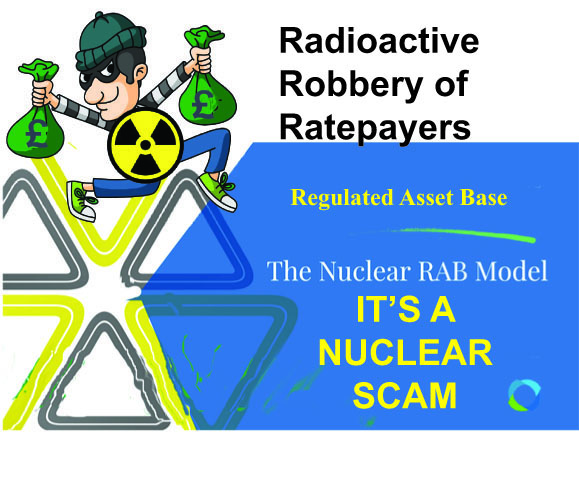
As if consumer energy bills aren’t high enough already. The government
seems hell bent on pushing them up some more. It’s poised to press the
button on its regulated asset base funding model for new nuclear power
plants: the financial bedrock of Boris Johnson’s fantasy plans to approve
eight new reactors by 2030.
The prototype is EDF’s Sizewell C, the £20
billion project nicely located on a Suffolk flood plain. By July 8
ministers will decide whether to approve the development consent order for
the 3,200MW nuke, said to be capable of powering six million homes. The
prelude to that?
Business secretary Kwasi Kwarteng going into overdrive on
the techie document front, not least over the joys of the RAB financing
model. As the law firm Slaughter and May noted in a briefing document, “a
major criticism is that . . . risk is passed on to the end consumer during
the construction phase and in a manner that may not best incentivise
developers to minimise the risk of cost overruns”.
Times 15th June 2022
https://www.thetimes.co.uk/article/fear-the-fallout-of-nuclear-funding-hszhd8lfz
Russia is winning the economic war – and Putin is no closer to withdrawing troops
Putin has rightly been condemned for “weaponising” food, but his willingness to do so should come as no surprise. From the start, the Russian president has been playing a long game, waiting for the international coalition against him to fragment. The Kremlin thinks Russia’s threshold for economic pain is higher than the west’s, and it is probably right about that
Guardian, Larry Elliott, 3 June 22,
The perverse effects of sanctions means rising fuel and food costs for the rest of the world – and fears are growing of a humanitarian catastrophe. Sooner or later, a deal must be made.
It is now three months since the west launched its economic war against Russia, and it is not going according to plan. On the contrary, things are going very badly indeed.
Sanctions were imposed on Vladimir Putin not because they were considered the best option, but because they were better than the other two available courses of action: doing nothing or getting involved militarily.
The first set of economic measures were introduced immediately after the invasion, when it was assumed Ukraine would capitulate within days. That didn’t happen, with the result that sanctions – while still incomplete – have gradually been intensified.
There is, though, no immediate sign of Russia pulling out of Ukraine and that’s hardly surprising, because the sanctions have had the perverse effect of driving up the cost of Russia’s oil and gas exports, massively boosting its trade balance and financing its war effort. In the first four months of 2022, Putin could boast a current account surplus of $96bn (£76bn) – more than treble the figure for the same period of 2021.
When the EU announced its partial ban on Russian oil exports earlier this week, the cost of crude oil on the global markets rose, providing the Kremlin with another financial windfall. Russia is finding no difficulty finding alternative markets for its energy, with exports of oil and gas to China in April up more than 50% year on year.
That’s not to say the sanctions are pain-free for Russia. The International Monetary Fund estimates the economy will shrink by 8.5% this year as imports from the west collapse. Russia has stockpiles of goods essential to keep its economy going, but over time they will be used up.
But Europe is only gradually weaning itself off its dependency on Russian energy, and so an immediate financial crisis for Putin has been averted. The rouble – courtesy of capital controls and a healthy trade surplus – is strong. The Kremlin has time to find alternative sources of spare parts and components from countries willing to circumvent western sanctions…………………
As a result of the war, western economies face a period of slow or negative growth and rising inflation – a return to the stagflation of the 1970s. Central banks – including the Bank of England – feel they have to respond to near double-digit inflation by raising interest rates. Unemployment is set to rise. Other European countries face the same problems, if not more so, since most of them are more dependent on Russian gas than is the UK.
The problems facing the world’s poorer countries are of a different order of magnitude. For some of them the issue is not stagflation, but starvation, as a result of wheat supplies from Ukraine’s Black Sea ports being blocked.
As David Beasley, the executive director of the World Food Programme put it: “Right now, Ukraine’s grain silos are full. At the same time, 44 million people around the world are marching towards starvation.”
………………….. Putin has rightly been condemned for “weaponising” food, but his willingness to do so should come as no surprise. From the start, the Russian president has been playing a long game, waiting for the international coalition against him to fragment. The Kremlin thinks Russia’s threshold for economic pain is higher than the west’s, and it is probably right about that……
The atrocities committed by Russian troops mean compromising with the Kremlin is currently hard to swallow, but economic reality suggests only one thing: sooner or later a deal will be struck.
- Larry Elliott is the Guardian’s economics editor https://www.theguardian.com/commentisfree/2022/jun/02/russia-economic-war-ukraine-food-fuel-price-vladimir-putin
Belgian government pressed to pay for extension of nuclear reactors Doel 4 and Tihange 3
| Power suppliers Engie up the pressure, ask Belgian government to step in to share nuclear burden. In a letter to PM Alexander De Croo, the French power suppliers Engie are asking the federal government to pay part of the bill for the lifetime extension of Belgium’s youngest nuclear reactors Doel 4 and Tihange 3. Earlier, the federal government had decided to extend the time frame for the youngest two nuclear reactors with 10 years – until 2035 – to guarantee power supplies. The rest will have to close in 2025 as part of a larger energy deal. Flanders News 2nd June 2022 https://www.vrt.be/vrtnws/en/2022/06/02/power-suppliers-engie-ask-federal-government-for-extra-cash-if-t/ |
EDF Nuclear Failures Undermine Europe’s Push to Exit Russian Gas
- France may need to import power from its neighbors this winter
That may drive up regional demand for gas to feed power plants - Bloomberg, By Rachel Morison and Francois De Beaupuy, 27 May 2022, Electricite de France SA’s nuclear failures are sending ripples through European energy markets, threatening to undermine the continent’s plan to turn its back on Russian gas.
- Europe’s biggest producer of atomic energy, which usually exports cheap power during the winter, may be forced to import this year after cutting its output forecast a third time. A fleet hobbled by faults is not just a problem for France but for countries such as neighboring Germany, which may have to burn more gas to keep the lights on despite pledging to cut its reliance on Moscow.
We have a French problem which is taking place at the wrong time, given the geopolitical situation,” said Nicolas Leclerc, co-founder of Paris-based energy consultant Omnegy. “The whole European equilibrium may be threatened.”…………. (subscribers only) https://www.bloomberg.com/news/articles/2022-05-27/edf-nuclear-failures-undermine-europe-s-push-to-exit-russian-gas
Twenty-Two House Republicans Demand Accountability on Biden’s $40b War Spending

“The aid package approved by Congress provides unprecedented funding for a foreign conflict in which the United States is not fighting, while there have been no significant hearings or substantive briefings on the use of the money and weapons being provided at taxpayer expense.” The lawmakers raised the prospect of sophisticated weaponry falling into the hands of terrorist organizations, citing a documented history of illicit arms-trafficking within Ukraine, a market which is one of the largest in Europe:
A cohort of Republicans, part of the dissenting vote on Biden’s Ukraine war package, seeks oversight and specifics about the destination of U.S. money and weapons.
| Glenn Greenwald and Anthony Tobin, May 25 |
The House of Representatives, on May 10, approved President Biden’s $33 billion package for the war in Ukraine, and then, on its own initiative, added $7 billion on top of it. That brought the new war spending authorization to $40 billion, on top of the $14 billion already spent just 10 weeks into this war, which U.S. officials predict will last years, not months. The House vote in favor was 368-57. All 57 NO votes were from GOP House members. All House Democrats, including the Squad, voted YES.
A similar scene occurred when the Senate, “moving quickly and with little debate,” overwhelmingly approved the same war package. All eleven NO votes were from Senate Republicans. All Senate Democrats, including Sen. Bernie Sanders (I-VT), voted in favor, seemingly in direct contradiction to Sanders’ February 8 op-ed in The Guardian warning of the severe dangers of bipartisan escalation of the war. Efforts by Sen. Rand Paul (R-KY) to delay passage of the bill so that some safeguards and accountability measures could be included regarding where the money was going and for what purposes it would be used were met with scorn, particularly from Paul’s fellow Kentucky GOP Senator, Minority Leader Mitch McConnell, who condemned Paul as an “isolationist.” Following the Senate vote, a jet was used to fly the bill across the world to President Biden in South Korea, where he signed it into law.
But the lack of any safeguards over the destination of the money and weapons prompted close to two dozen House Republicans, led by Rep. Yvette Herrell (R-NM), to send a letter to the Biden White House on Monday demanding greater specificity and assurances about legal requirements on how weapons are used. The letter urges a public reckoning on the dangers of the U.S.’s bankrolling of the war in Ukraine: “We write today to express grave concern about the lack of oversight and accountability for the money and weapons recently approved by Congress for Ukraine,” it began.
“The aid package approved by Congress provides unprecedented funding for a foreign conflict in which the United States is not fighting, while there have been no significant hearings or substantive briefings on the use of the money and weapons being provided at taxpayer expense.” The lawmakers raised the prospect of sophisticated weaponry falling into the hands of terrorist organizations, citing a documented history of illicit arms-trafficking within Ukraine, a market which is one of the largest in Europe:
“According to a 2017 Small Arms Survey briefing on arms trafficking, over 300,000 small arms disappeared from Ukraine between 2013 and 2015 and only 13 percent were recovered. Criminal networks, corrupt officials, and underpaid military personnel can make a profitable business from the sale of arms from Ukrainian military stockpiles. For example, in 2019, the Ukrainian Security Service uncovered a plot by Ukrainian soldiers to sell 40 RGD-5 grenades, 15 grenade launchers, 30 grenade detonators, and 2,454 rounds of ammunition for 75,000 Ukrainian hryvnia or around $2,900.”
Indeed, the relentlessly war-supporting CNN last month acknowledged that “the US has few ways to track the substantial supply of anti-tank, anti-aircraft and other weaponry it has sent across the border into Ukraine.” Biden officials admitted the “risk that some of the shipments may ultimately end up in unexpected places.” ……………………… more https://greenwald.substack.com/p/twenty-two-house-republicans-demand?s=r
Pretense in UK that Wylfa and other new nuclear stations are affordable – investors are staying away in droves.
A new Wylfa will cost between £14 and £17bn to build and won’t be up
and running until the 2030s, the UK Government have been told. Sources told
the Times newspaper that the 2.3-gigawatt plant would take six years to
build, on top of a lengthy planning and regulatory process, meaning that it
would not be operational until the early years of the next decade.
Westinghouse and Bechtel, the reactor maker and engineering group, are
hoping to win UK Government backing for their plan to build two reactors at
Wylfa on Anglesey. Their AP1000 reactor design has already completed
initial safety approval for use in Britain. However, Bechtel were hoping to
secure £20m from the UK Government before being able to provide a full
breakdown of the total costs of the project. Ivan Baldwin, head of the UK
civil nuclear market for Bechtel, told the Times that this taxpayer funding
would enable the developer to “provide to the government an estimated
project cost” and “to determine the optimum construction schedule at
the site”.
Hitachi, of Japan, currently own the rights to the Wylfa site
after giving up on their own plans to build a nuclear power plant there.
Dylan Morgan from People Against Wylfa B (PAWB) responded to the
announcement to say that Boris Johnson was just “shooting from the
hip”. “All his bluster about possible new nuclear reactors displays an
astounding level of economic and environmental illiteracy,” he said.
“Firstly, where is the strong economy coming out of Covid and post
Brexit? No nuclear companies will go it alone and invest heavily in
building new nuclear reactors.
“As in the case of Rolls Royce and their
modular reactor which isn’t small at all at 475 MW, bigger than the old
Magnox reactors at Trawsfynydd, they want government public handouts for
designing the reactors, more astronomic handouts financed through our
already vastly inflated electricity bills to construct these radiotoxic
monstrosities, and then even more handouts for an agreed price for
electricity produced, and last but not at all least, the massive
decommissioning costs over thousands of years of reactors and all the
problems with storage of hazardous nuclear wastes.
“There is little wonder that no corporations have come forward in droves to get a nuclear
renaissance much promised from the Blair/Brown era going. “Labelling
Wylfa and Trawsfynydd as possible new sites for this most dangerous, dirty,
radiotoxic, health-threatening and expensive technology is an insult to the
people of Wales. “It is the totally wrong path to tread and it may be the
case that Johnson will not be in office for too long to realise his madcap
nuclear ambitions.”
Nation Cymru 24th May 2022
https://nation.cymru/news/new-wylfa-will-cost-14-17bn-to-build-and-wont-be-ready-until-2030s/
Japan’s new ‘green economy’ bond may fund nuclear projects

- BY TAKASHI UMEKAWA AND SHOKO ODA, BLOOMBERG May 25, 2022
Japan plans to use its new type of sovereign debt to fund a wide range of projects designed to reduce emissions, possibly including nuclear power.
Prime Minister Fumio Kishida last week proposed a “green economy transformation bond” to raise as much as ¥20 trillion ($157 billion) to help meet climate goals. The government decided not to issue green bonds because the more standard instruments also constrain the use of proceeds, according to people familiar with the matter.,………… https://www.japantimes.co.jp/news/2022/05/25/business/green-economy-bond-nuclear/
1 This Month



26 September – International Day for the Total Elimination of Nuclear Weapons


PLEASE OPPOSE HR 8255 AND S.3639 – bills would accelerate satellite deployment, with no environmental review or safeguards – https://ncstd5li.quorum.us/campaign/169331/
To see nuclear-related stories in greater depth and intensity – go to https://nuclearinformation.wordpress.com
-
Archives
- September 2026 (233)
- August 2026 (330)
- July 2026 (355)
- June 2026 (287)
- May 2026 (306)
- April 2026 (356)
- March 2026 (251)
- February 2026 (267)
- January 2026 (308)
- December 2025 (358)
- November 2025 (359)
- October 2025 (375)
-
Categories
- 1
- 1 NUCLEAR ISSUES
- business and costs
- climate change
- culture and arts
- ENERGY
- environment
- health
- history
- indigenous issues
- Legal
- marketing of nuclear
- media
- opposition to nuclear
- PERSONAL STORIES
- politics
- politics international
- Religion and ethics
- safety
- secrets,lies and civil liberties
- spinbuster
- technology
- Uranium
- wastes
- weapons and war
- Women
- 2 WORLD
- ACTION
- AFRICA
- Atrocities
- AUSTRALIA
- Christina's notes
- Christina's themes
- culture and arts
- Events
- Fuk 2022
- Fuk 2023
- Fukushima 2017
- Fukushima 2018
- fukushima 2019
- Fukushima 2020
- Fukushima 2021
- general
- global warming
- Humour (God we need it)
- Nuclear
- RARE EARTHS
- Reference
- resources – print
- Resources -audiovicual
- Weekly Newsletter
- World
- World Nuclear
- YouTube
-
RSS
Entries RSS
Comments RSS
 nuclear-news