Biden Pledges Nearly $3 Billion To Ukraine In Largest U.S. Military Aid Package Yet

U.S. President Joe Biden has announced nearly $3 billion in new U.S. military aid for Kyiv as Ukraine marked its independence day six months after Russia invaded the country.
“On behalf of all Americans, I congratulate the people of Ukraine on their Independence Day,” Biden said in a statement on August 24.
“The United States of America is committed to supporting the people of Ukraine as they continue the fight to defend their sovereignty. As part of that commitment, I am proud to announce our biggest tranche of security assistance to date: approximately $2.98 billion of weapons and equipment to be provided through the Ukraine Security Assistance Initiative,” Biden said.
The financial package will allow Kyiv to obtain air-defense and artillery systems, ammunition, counter-unmanned aerial systems, and radars, the statement said…………….
Since Russia invaded Ukraine on February 24, the United States has provided $10.6 billion in military assistance to President Volodymyr Zelenskiy’s government.
On August 23, Germany said it will soon ship more than 500 million euros’ ($499.3 million) worth of weapons to Ukraine. https://www.rferl.org/a/biden-pledges-3-billion-military-aid-ukraine/32002639.html
S Korea signs $2.25 billion deal with Russia nuclear company
By KIM TONG-HYUNG, August 26, 2022
SEOUL, South Korea (AP) — South Korea has signed a 3 trillion won ($2.25 billion) contract with a Russian state-run nuclear energy company to provide components and construct turbine buildings for Egypt’s first nuclear power plant, officials said Thursday.
The South Koreans hailed the deal as a triumph for their nuclear power industry, although it made for awkward optics as their American allies push an economic pressure campaign to isolate Russia over its war on Ukraine.
South Korean officials said the United States was consulted in advance about the deal and that the technologies being supplied by Seoul for the project would not clash with international sanctions against Russia.
According to South Korea’s presidential office and trade ministry, the state-run Korea Hydro and Nuclear Power was subcontracted by Russia’s Atomstroyexport to provide certain materials and equipment and construct turbine buildings and other structures at the plant being built in Dabaa. The Mediterranean coastal town is about 130 kilometers (80 miles) northwest of Cairo.
Atomstroyexport, also called ASE, is a subsidiary of Rosatom, a state-owned Russian nuclear conglomerate. The company has a contract with Egypt to deliver four 1,200 megawatt reactors through 2030. Korea Hydro and Nuclear Power’s part of project is from 2023 to 2029…………….. https://apnews.com/article/russia-ukraine-middle-east-africa-349bf2b3eb2551bdea5ec886855dea92
Sacre Bleu: EDF Energy talk of lower bills, whilst planning to generate Britain’s most expensive electricity
Last week, EDF Energy called for the incoming British Prime Minister to work with the French-owned energy generator to reduce customer bills, whilst at the same time conspiring in the longer-term to put them up.
EDF Energy, operator of the UK’s nuclear power stations, is building a new power plant at Hinkley Point C that is already many years behind schedule and way over budget. At a whopping estimated cost of £26 billion (based on 2015 prices; actually, with inflation £29 billion today), EDF Energy plans to make a return on its investment for its backers, the French Government, by making its electricity the most expensive ever generated in Britain.
An agreement signed off with the UK Government in 2016 made EDF Energy responsible for meeting the upfront costs of building the 3.2 GW plant but granted them the concession to recoup costs by charging up to an astronomical £92.50 per MW/hour for the electricity Hinkley Point C eventually produces. If electricity does not retail at that price upon commission, British electricity customers will make up the difference with a surcharge on their bills, whether they are customers of EDF or not.
Provision was also made to make this figure index-linked to inflation, meaning the price if generation were taking place today would be an incredible £106 and this can only rise.
Not surprisingly, energy experts derided the deal at the time as outrageously favourable to the generator.
Contrast this with the recent Contracts for Difference round conducted by civil servants with renewable energy generators, where some providers contracted to generate electricity through offshore wind projects for less than £40 per MW/hour.
Nuclear fission is now the most expensive means to generate electricity, is never viable without huge government subsidies, and is fraught with operational and financial risk – and so is not an attractive proposition for private investors.

That is why the UK Government is introducing the RAB (the Regulated Asset Base) model by which to pass on the costs of developing future nuclear projects onto the shoulders of the already-overburdened British electricity customer through the imposition of a new nuclear tax on bills.
The most immediate beneficiary of this arrangement will be, unsurprisingly, EDF Energy which is the government’s approved partner to build the next large-scale nuclear power plant, at Sizewell C in Suffolk.
RAB means no more financial worries for EDF Energy as the Sizewell project invariably ratchets up massive cost overruns, like its forerunner at Hinkley, as the poor suffering consumer will be made to pay them. For the customer, it represents an ever-greater burden at a time when energy bills will continue to go ever higher, and, with colder days and darker nights on the horizon, many will struggle to heat their homes.
Even customers in receipt of the lowest means-tested benefits, or older customers who will not live long enough to see the Sizewell plant built, will currently be expected to pay their share of the nuclear tax – that is why the Nuclear Free Local Authorities call it ROB, a means to fleece the poor to renumerate industry fat-cats and want to see both it and plans for new nuclear scrapped.
Councillor David Blackburn, Chair of the NFLA Steering Committee said:
The Government’s nuclear ROB tax is an outrageous additional burden on the British people who have already seen their bills go through the roof. Rather than wasting a single penny more on the over-expensive and ridiculously-slow nuclear sector, we want to see government ministers invest billions in an emergency programme to retrofit Britain’s cold and damp homes to make them affordable and efficient to light and heat and we want to see investment in a range of renewable technologies to produce the cheaper, greener energy we so desperately need at a fraction of the price and much more-quicker than any nuclear delusion.”
Councillor Blackburn also had a sideswipe at EDF Energy’s senior management, adding:
“Whilst it is commendable that Monsieur Philippe Commaret, Managing Director of Customers at EDF, has called on government for urgent action over energy pricing, can I suggest that this appears to amount to ‘bill-washing’ as it offers nothing practical to reduce customers’ pain? Rather I suggest his company follow the example show by its French parent by introducing an absolute energy price cap on the bills of British EDF customers as they have in France. There bills only went up by 4%, on the direction of the principal shareholder of the company, French President Emanuel Macron. It is time for EDF Energy to do the same by its UK customers.”
French nuclear woes stoke Europe’s power prices

Forrest Crellin Reuters, Vera Eckert Reuters, 24 Aug 22, PARIS/FRANKFURT, Aug 24 (Reuters) – European power prices are surging to fresh records as France grapples with lower nuclear output, adding further pressure to wholesale energy markets already struggling with vastly lower Russian gas supply.
Technical problems have hampered French nuclear reactors along with summer maintenance and drought has curbed hydroelectric production, another of its key sources of electricity generation.
Power from neighbouring countries is needed to help France handle its nuclear shortage. With gas making up the majority of the deficit, the extra demand is driving prices higher again.
“In France, only half the reactors are running,” said German state secretary in the economy ministry, Patrick Graichen…………………. more https://www.nasdaq.com/articles/french-nuclear-woes-stoke-europes-power-prices—
South Korean unionists protest US-South Korea war games
Saturday, 13 August 2022, Frank Smith, Press TV, Seoul
Thousands of South Korean unionists and their progressive supporters rallied in downtown Seoul to protest against joint US-South Korea war games planned for later this month.
The drills will be the largest in years, and follow the May election of President Yoon Suk-yeol, who has promised to take a hardline with North Korea. Union leaders worry about risks.
While many South Koreans, especially supporters of President Yoon on the right, favor close ties with the U.S., large numbers also argue the US military and the country’s alliance with Washington, prevent the improvement of ties with North Korea – and generate tension…………….. more https://www.presstv.ir/Detail/2022/08/13/687322/South-Korean-unionists-protest-US-South-Korea-war-games
Twelve months, one meeting – the complete lack of accountability on nuclear in Copeland

In fact, the Rolls-Royce fronted consortium developing a 470-MW so-called ‘Small’ Modular Nuclear Reactor still faces considerable challenges in bringing a design to market. The design still needs to be approved by the Office of Nuclear Regulation after a comprehensive Generic Design Assessment. If approved, the consortium would need to build and test an actual working prototype; establish facilities to fabricate the parts; master the fabrication and on-site assembly process; secure funding; navigate the siting, planning and Development Consent process; and actually build the first plant. So hardly a rose in fragrant bloom!
https://www.nuclearpolicy.info/news/twelve-months-one-meeting-the-complete-lack-of-accountability-on-nuclear-in-copeland/ 19 Aug 22, Despite Copeland Council being at the heart of plans to develop a new nuclear plant and a nuclear waste dump in the borough, the Nuclear Free Local Authorities were surprised to see that the Council’s Strategic Nuclear and Energy Board has only met once in the last twelve months.[1]
Only last month, Copeland Borough Council’s Portfolio Holder for Nuclear and Commercial Services Councillor David Moore described how “the future looks rosy” for new nuclear in Copeland as talks progress on Small Modular Nuclear Reactors.[2]
Unfortunately, for the members of the Board, there was no opportunity to explore how ‘rosy’ the future was as the scheduled 9 August meeting was subsequently cancelled. Since the last meeting of the Board on 6 October 2021, meetings have been cancelled on 9 December; 10 February; 28 April; 7 June; and latterly on 9 August 2022.
In fact, the Rolls-Royce fronted consortium developing a 470-MW so-called ‘Small’ Modular Nuclear Reactor still faces considerable challenges in bringing a design to market. The design still needs to be approved by the Office of Nuclear Regulation after a comprehensive Generic Design Assessment. If approved, the consortium would need to build and test an actual working prototype; establish facilities to fabricate the parts; master the fabrication and on-site assembly process; secure funding; navigate the siting, planning and Development Consent process; and actually build the first plant. So hardly a rose in fragrant bloom!
Perhaps the infrequency of the meetings of the Board can be related to the disquiet expressed by some members over the lack of accountability over plans for Copeland Borough Council to partner with Nuclear Waste Services to bring a nuclear waste dump (a so-called Geological Disposal Facility or GDF) to Copeland. The Board minutes for 9 October 2021 record that three Councillors wanted the final decision taken by a meeting of the Full Council rather than reserved to the Executive; with a tied vote, this proposal was defeated only on the Chair’s casting vote. To placate the objectors, Councillor Moore promised that ‘this committee and full Council would be updated on a regular basis’.[3] The Board has since never met.
Commenting, Councillor David Blackburn said: “At a cost of up to £53 billion, the GDF would be the biggest engineering undertaking to take place in Copeland, since the creation of the Sellafield complex. It would be a repository for Britain’s high-level nuclear waste from seven decades of civil nuclear operations, and also take waste from future generation. Taking up to 150 years to build, fill and seal, it would have massive implications for, and be completely disruptive to, any host community in Copeland for generations.
“The GDF process is fast moving on apace. Since October 2021, first a Working Group and then a Community Partnership have been formed with Copeland’s involvement. In the last month, seismic testing has been taking place off the coast of West Cumbria, an activity which has rightly been hugely controversial for its adverse impact on marine life. Yet during this whole time, this Board, the very body charged by Copeland Council to provide oversight on the GDF and nuclear projects, has not met; no reports on these and other important issues have been brought before this Board for debate; and there has been no opportunity for members of the public to sit in on deliberations. Hardly democracy at its finest.”
For more information, please contact NFLA Secretary Richard Outram by email on richard.outram@manchester.gov.uk or telephone 07583 097793
Commenting, Councillor David Blackburn said: “At a cost of up to £53 billion, the GDF would be the biggest engineering undertaking to take place in Copeland, since the creation of the Sellafield complex. It would be a repository for Britain’s high-level nuclear waste from seven decades of civil nuclear operations, and also take waste from future generation. Taking up to 150 years to build, fill and seal, it would have massive implications for, and be completely disruptive to, any host community in Copeland for generations.
“The GDF process is fast moving on apace. Since October 2021, first a Working Group and then a Community Partnership have been formed with Copeland’s involvement. In the last month, seismic testing has been taking place off the coast of West Cumbria, an activity which has rightly been hugely controversial for its adverse impact on marine life. Yet during this whole time, this Board, the very body charged by Copeland Council to provide oversight on the GDF and nuclear projects, has not met; no reports on these and other important issues have been brought before this Board for debate; and there has been no opportunity for members of the public to sit in on deliberations. Hardly democracy at its finest.”
For more information, please contact NFLA Secretary Richard Outram by email on richard.outram@manchester.gov.uk or telephone 07583 097793
France’s government determined to expand nuclear power, oblivious to environmental, safety, and cost ill-effects

the plant’s cooling processes have increased the water’s temperature by 6 degrees C, which has triggered ripple effects throughout the food chain.
that will have a disastrous impact on the ecosystem,”
French nuclear plants break a sweat over heat wave, DW 15 Aug 22, Successive heat waves are putting French nuclear reactors under strain. But that is not pushing them into an existential crisis, as Lisa Louis reports from Paris.
Like other European countries, France has been baking in temperatures of up to 40 degrees Celsius (104 degrees Fahrenheit) for several weeks. Although that is putting French nuclear reactors under strain, this does not seem to be calling the country’s nuclear-heavy energy strategy into question.
Nuclear power plants normally generate roughly 70% of electricity in France — making nuclear’s share of the energy mix there higher than in any other country.
But more than half of the country’s 56 reactors have been closed for several months due to planned or extraordinary maintenance.
And about a fifth of them would normally need to interrupt their activity or at least reduce it to a bare minimum, as the water temperature of the rivers into which plants discharge their cooling water exceeds a certain limit.
But the government has suspended that rule until at least September 11.
‘Ripple effects throughout the food chain’
For Jean-Pierre Delfau, an environmental activist at local group FNE86, that is an exasperating decision.
“I just can’t understand how they can keep the reactors running although that will have a disastrous impact on the ecosystem,” he told DW, as he and two other environmentalists made their way through high grass on the bank of the Garonne river to take a water sample on a recent afternoon.
The Garonne supplies cooling water for the Golfech nuclear plant in southwestern France. One of the power station’s two reactors has been standing still for months, after authorities found corrosion and small cracks on pipes relevant for the plant’s safety. The second reactor is still functioning.
“Due to the heat, the Garonne’s water throughput is already down to 50 cubic meters per second, from several thousand in normal times,” Delfau said. “The Golfech plant makes that worse, as it uses 8 cubic meters for its cooling system but only discharges 6 cubic meters back, as some of the water evaporates during the process,” he pointed out.
He added that the plant’s cooling processes have increased the water’s temperature by 6 degrees C, which has triggered ripple effects throughout the food chain.
“The warmer water destroys microalgae that are food for certain small fish, which bigger fish feed on,” explained the 79-year-old, who has been an anti-nuclear protester for more than 50 years.
“Plus, warmer water contains more bacteria. In order to make it potable, we have to add a lot of chemicals, which people then drink.”
Not an existential crisis for French nuclear power
Power company EDF, which runs all of France’s nuclear power plants, declined an interview request with DW. A spokeswoman replied by email that the situation was “extraordinary” and that so far, environmental probes had not revealed any negative impact on the flora and fauna around the respective reactors.
Despite environmental concerns, current issues are not throwing French nuclear power into an existential crisis. The government is planning to soon nationalize EDF and construct additional nuclear plants.
That has Anna Creti, climate economy director at Paris University Dauphine, scratching her head.
“It’s not quite clear how this strategy is supposed to work on a technology level, especially in the short run,” she told DW.
Technology not ready

“France is banking on so-called small modular reactors (SMRs), for which there exist roughly 40 different technologies, all of them in a pilot phase,” Creti said. “Getting them ready for deployment could take up to 10 years,” she added.
“The government also plans to construct more pressurized-water, so-called EPR reactors — a model that has encountered numerous problems,” she continued.
According to current predictions, the country’s first EPR plant is to go live next year in Flamanville in the north of the country. According to developer EDF, building costs have so far at least tripled, to roughly €13 billion ($13.3 billion).
The European Court of Auditors puts that figure at €19 billion — with construction taking more than 10 years longer than planned. Other EPRs in Britain, China and Finland are reported to experience construction, conceptual or production problems.
“The government has nevertheless earmarked €150 billion for refurbishing existing nuclear plants and constructing new ones,” Creti said, adding that no such funding boon was announced for renewables, although Paris is working on new rules to cut red tape for development of renewables.
“Putting more money intorenewables would make sense, as theyhave become ever cheaper over the past few years, and their technology is sufficiently advanced for them to be deployed immediately across the country,” she emphasized.
France is the only European country not to have reached its 2020 EU renewables targets. Renewable energies make up only roughly 19% of energy production, instead of the planned 23%……………………………………..
Energy shortages expected in winter
Philippe Mante is strongly hoping for that [shift to renewables]. He’s in charge of climate affairs at EELV, France’s green party, which is opposed to constructing new nuclear plants. For the sake of energy security, the party is not in favor of immediately dismantling existing nuclear energy plants.
Neighboring countries will be watching closely. Until now, France has been Europe’s biggest net energy exporter. This year, however, the country will have to import more electricity than it’s exporting.
That’s likely to add even more pressure to energy prices, which are already skyrocketing, due among other things to Moscow’s invasion of Ukraine and reduced delivery of Russian gas. https://www.dw.com/en/french-nuclear-plants-break-a-sweat-over-heat-wave/a-
Inside Lockheed Martin’s Sweeping Recruitment on College Campuses

Our investigation found this unfettered recruiting access to be part of a deeper and growing enmeshment between universities and the defense industry.
at many college STEM programs around the country have become pipelines for weapons contractors.
if you’re an engineering student at Georgia Tech, Lockheed is omnipresent.
Reader Supported News, Indigo Olivier/In These Times 14 august 22
To a casual observer, the Black Hawk and Sikorsky S-76 helicopters may have seemed incongruous landing next to the student union on the University of Connecticut’s pastoral green campus, but this particular Thursday in September 2018 was Lockheed Martin Day, and the aircraft were the main attraction.
A small group of students stood nearby, signs in hand, protesting Lockheed’s presence and informing others about a recent massacre.
Weeks earlier, 40 children had been killed when a Saudi-led coalition air strike dropped a 500-pound bomb on a school bus in northern Yemen. A CNN investigation found that Lockheed — the world’s largest weapons manufacturer — had sold the precision-guided munition to Saudi Arabia a year prior in a $110 billion arms deal brokered under former President Donald Trump.
Back in Storrs, Conn., Lockheed, which has a longstanding partnership with UConn, appeared on campus to recruit with TED-style talks, flight simulations, technology demos and on-the-spot interviews. A few lucky students took a helicopter flight around campus.
UConn is among at least a dozen universities that participate in Lockheed Martin Day, part of a sweeping national effort to establish defense industry recruitment pipelines in college STEM (science, technology, engineering, and mathematics) programs. Dozens of campuses nationwide now have corporate partnerships with Lockheed and other weapons manufacturers.
Lockheed is the country’s single largest government contractor, producing Black Hawks, F-35 fighter jets, Javelin anti-tank systems and the Hellfire missiles found on Predator drones. With more than 114,000 employees, the company depends on a pool of highly skilled and highly specialized workers, complete with the ability to obtain proper security clearances when needed. In its most recent annual report, Lockheed tells investors, “We increasingly compete with commercial technology companies outside of the aerospace and defense industry for qualified technical, cyber and scientific positions as the number of qualified domestic engineers is decreasing and the number of cyber professionals is not keeping up with demand.”
Lockheed has hired more than 21,000 new employees since 2020 to replace retiring workers and keep up with turnover. Student pipelines are integral to the company’s talent acquisition strategy.
As tuition costs and student debt have skyrocketed, Lockheed has enticed students with scholarships, well paid internships and a student loan repayment program. When the pandemic made in-person recruitment more difficult, Lockheed expanded its virtual outreach — after one 2020 virtual hiring event, the company reported a 300% increase in offers and a 400% increase in job acceptances among the STEM scholarship program participants over the previous year.
And in a self-described effort to diversify its workforce and build an inclusive culture, Lockheed has also put new focus on financial support and recruitment at historically Black colleges and universities.
Lockheed’s recruitment efforts are intertwined with various types of “research partnerships.” Universities receive six- and seven-figure grants from Lockheed and other defense contractors — or even more massive sums from the Department of Defense — to work on basic and applied research, up to and including designs, prototypes and testing of weapons technology. A student might work on Lockheed-sponsored research as part of their course load, then intern over the summer at Lockheed, be officially recruited by Lockheed upon graduation and start working there immediately, with defense clearances already in place — sometimes continuing the same work. In 2020, Lockheed reported that more than 60% of graduating interns became full-time employees.
Lockheed is not alone among corporations or military contractors in its aggressive university outreach, but the expansive presence of private defense companies on campuses raises questions about the extent to which corporations — particularly those profiting from war — should influence student career trajectories. In April, student and community protesters at Tufts University shut down a General Dynamics recruiting event, then protested outside a Raytheon presentation later that month, chanting, “We see through your smoke and mirrors. You can’t have our engineers.”
Illah Nourbakhsh, an ethics professor at Carnegie Mellon University with a background in robotics, presents the question this way: “If you have a palette of possible futures for students, and you take some possible future, and you make it so shiny and exciting and amazing by pouring money on the marketing process of it that it overcomes any possible marketing done by alternatives that are more socially minded — do the kids have agency? Is it a fair, balanced field?
“Of course not.”
Lockheed did not respond by deadline to requests for comment on this article.
For more than a year, In These Times investigated the presence of Lockheed and other arms manufacturers on campuses, combing through company and university annual reports, IRS filings, LinkedIn profiles, budgets, legislative records and academic policies, as well as interviewing students and professors. Most students requested pseudonyms, indicated with asterisks*, so as not to adversely impact their career prospects. Several spoke positively of Lockheed.
“It’s probably what most engineers, especially in mechanical and aerospace who want to go into defense prospects, aspire to,” says Sam*, who graduated with a bachelor’s in aerospace engineering in December 2021. “They’re one of the biggest defense contractors in this country, so you have the opportunity to work on very state-of-the-art technology.”
Other students believe putting their skills to military use is unethical.
Alan*, a December 2021 graduate in electrical engineering at the University of West Florida who is currently job-hunting while living with his parents, says he’s not looking at defense contractors and is instead holding out for a position that allows him to leave the Earth better than he found it. “When it comes to engineering, we do have a responsibility,” he says. “Every tool can be a weapon. … I don’t really feel like I need to be putting my gifts to make more bombs.”
Located near the world’s largest Air Force base in the Florida panhandle, the University of West Florida regularly hosts recruiters from the defense industry, including Lockheed. Alan says companies like Lockheed set up tables in student buildings to recruit in the hallways.
“I just walked past those tables,” he says, “but sometimes they’ll call you over. It’s kind of like going to the mall, and people want you to try their soap. It’s kind of annoying, but I get that they always need new people.”
Our investigation found this unfettered recruiting access to be part of a deeper and growing enmeshment between universities and the defense industry.
Decades of state disinvestment in public higher education have converged with a growing emphasis on sponsored research, and in an era of ballooning student debt, the billions in annual defense spending prop up university budgets and subsidize student educations. The result is that many college STEM programs around the country have become pipelines for weapons contractors……………………………….
Cameron Davis, who graduated from Georgia Tech with a bachelor’s in computer engineering in 2021, says, “A lot of people that I talk to aren’t 100% comfortable working on defense contracts, working on things that are basically going to kill people.” But, he adds, the lucrative pay of defense contractors “drives a lot of your moral disagreements with defense away.”
In 2019 and 2021, Lockheed was the university’s largest alumni employer, and the company has been one of Georgia Tech’s most frequent job interviewers since at least 2002.
“Even in my field — which isn’t even as defense-adjacent as aerospace engineering or mechanical engineering — companies like Raytheon will have dedicated programs to recruit people,” says Davis. “I’ve been in line with other companies at a career fair and defense contractors literally walk up to me in line and be like, ‘Hey, do you want to talk about helicopters or something?’”
“The corporate presence at Georgia Tech is a little bit overwhelming at times,”……………………………………….
THE MILITARY’S STUDENT RESEARCHERS
Clifford Conner recalls his freshman year at Georgia Tech, in 1959, when the school was still segregated. He studied experimental psychology. When graduation approached, his professors — who also worked in the Lockheed Corporation’s Marietta office just north of Atlanta — said they could help him get a job at Lockheed. Conner accepted.
His work on the wing design of the C-5 Galaxy, then the largest military cargo plane in the world, took him to England, where he began reading a lot about the war in Vietnam. “I wasn’t under the spell of the American press,” Conner says. After a few years with Lockheed, he quit and joined the antiwar movement.
It took him another year to find a job at about a third of the salary he was making at Lockheed.
Conner went on to become a historian of science and a professor at the CUNY School of Professional Studies. His most recent book, The Tragedy of American Science: From Truman to Trump (2020), explores how the STEM fields have moved away from improving the human condition to advancing corporate and defense interests. He writes about the Bayh-Dole Act, which removed public-licensing restrictions in 1980 and “opened the floodgates to corporate investors seeking monopoly ownership of innovative technology.” The law allowed universities and nonprofits to file patents on projects funded with federal money, from weapons to pharmaceuticals. The rationale was to encourage commercial collaboration and underscore the idea that federally funded inventions should be used to support a free-market system.
“After the Bayh-Dole Act, the lines between corporate, university and government research were all blurred,” Conner tells In These Times.
Conner went on to become a historian of science and a professor at the CUNY School of Professional Studies. His most recent book, The Tragedy of American Science: From Truman to Trump (2020), explores how the STEM fields have moved away from improving the human condition to advancing corporate and defense interests. He writes about the Bayh-Dole Act, which removed public-licensing restrictions in 1980 and “opened the floodgates to corporate investors seeking monopoly ownership of innovative technology.” The law allowed universities and nonprofits to file patents on projects funded with federal money, from weapons to pharmaceuticals. The rationale was to encourage commercial collaboration and underscore the idea that federally funded inventions should be used to support a free-market system.
“After the Bayh-Dole Act, the lines between corporate, university and government research were all blurred,” Conner tells In These Times.
Georgia Tech’s applied research division, known as the Georgia Tech Research Institute (GTRI), now has four laboratories directly on Lockheed’s aeronautics campus in Marietta……………………………………
publicly available CVs, résumés and job listings for student researchers at GTRI explicitly detail work on weapons technology……………………………
Unlike Europe, the United States does not provide universities with general funding to support basic research, or “research for the sake of research.” A 2019 analysis by the American Association for the Advancement of Science, for example, notes, “on average, one-third of R…D in OECD countries” is funded by “government block grants used at the discretion of higher education institutions” — but the United States does not have the same mechanism.
U.S. appropriations to public higher education, meanwhile, have declined significantly in the past two decades, while the research environment has seen universities performing an ever-larger share of the nation’s technology research. The Defense Department has been the third-largest source of federal research and development funding to universities for decades (after the Department of Health and Human Services and the National Science Foundation).
But universities also seek out private-sector money to fund research directly, and the defense sector has been a willing donor.
In recent years, Lockheed has partnered with a network of more than 100 universities to advance hypersonics technology — weapons traveling so fast they’re undetectable by radar — and signed master research agreements for multi-year collaborations with Purdue, Texas A…M and Notre Dame in 2021.
While delivering technological innovations to defense companies, these partnerships also double as employment pipelines. The University of Colorado Boulder has collaborated on space systems with Lockheed for nearly two decades. In a statement on the university’s website, one Lockheed executive (and school alum) writes, “Lockheed Martin employs about 56,000 engineers and technicians, 35% of which could retire in the next few years. We must keep up a ‘talent pipeline’ to fill this pending gap: currently, our major source of talent is CU-Boulder.”
SADDLED WITH DEBT
Nearly half of the nation’s discretionary budget goes toward military spending; of that money, one-third to one-half goes to private contractors, according to a 2021 analysis by military researcher William Hartung for Brown University’s Costs of War Project.
Today, 46 million Americans hold student debt totaling $1.7 trillion, which is the projected lifetime cost to U.S. taxpayers of Lockheed’s F-35 fighter jet program — the most expensive weapon system ever built………….
Lockheed is among a growing number of companies that offer student loan assistance to its employees. The company’s Invest In Me program offers incoming graduates a $150 monthly cash bonus for five years and a student loan refinancing program. Every year, Lockheed awards $10,000 scholarships to 200 students that may be renewed up to three times for a potential $40,000. Lockheed also lists 61 universities participating in its STEM scholarship program, projected to invest a minimum of $30 million over five years as part of a larger $460 million education and innovation initiative using gains from Trump’s 2017 corporate tax cuts.
In a 2015 survey by American Student Assistance, 53% of respondents said student debt was either a “deciding factor” or had a “considerable impact” on their career choice.
“Pushing people into higher education has been our labor policy,” explains Astra Taylor, a writer, filmmaker and co-founder of the Debt Collective, a debtors’ union with roots in Occupy Wall Street. “You’re indebting yourself for the privilege of being hired, and it gives companies this economic power because then they can say, ‘We can help relieve some of the economic pain that you’ve incurred to make yourself appealing to us.’”
Raytheon, Northrop Grumman and Boeing all provide some form of student aid, such as scholarships and tuition reimbursement.
DIVERSIFYING WEAPONS MAKING
The private defense sector targets much of its financial support toward historically Black colleges and universities (HBCUs) and students from minority groups as part of stated efforts toward workforce diversity and promoting STEM jobs among a demographic that is critically underrepresented in STEM fields. Lockheed’s website and annual report note that minority groups are the “fastest-growing segment in the labor market” and that recruitment through “internships, early talent identification, outlying educational programs, co-ops, apprenticeships and pre-apprenticeships” is integral to building diverse employee pipelines.
This trend stirs up old controversies around military recruiting in communities of color.
The Army has long targeted minority-majority high schools and HBCUs with its Reserve Officers’ Training Corps programs and scholarships, to the extent that critics refer to it as a school-to-soldier pipeline. Without enlisting and the ensuing funding, many students wouldn’t receive a higher education. According to a 2016 report from the Brookings Institution, Black students hold an average of $7,400 more in student debt than their white counterparts upon graduating — a gap that widens to nearly $25,000 four years later. The Army leverages students’ predicaments to meet its recruiting goals.
Regardless, “the racial implications” of U.S. military actions “are hard to evade,” civil rights activist and Rep. John R. Conyers Jr. (D-Mich.) said at the outset of the Iraq War in 2003. “Would this be happening to [the Iraqis] if they were not nonwhite?” A Gallup poll at the time found 7 in 10 Black Americans opposed the war, while 8 in 10 white Americans favored it.
……………………………… Lockheed has started STEM education and recruiting initiatives at 20 minority serving institutions (MSIs), including 16 HBCUs. Of Lockheed’s 2021 scholarship recipients, 60% identified with a minority racial or ethnic group. In the 2020 to 2021 academic year, more than 40% of Lockheed’s early-career hires identified as people of color, with 450 coming from MSIs.
“Students who work in these spaces don’t know the gravity — are systematically made ignorant of the gravity — of participating in these systems,” says Myers……………………………………..
“You said that the CEO was an advocate for women and minorities,” a student organizer says during a recruitment presentation. “How does she maintain that role as head of a company that produces weapons which bomb and kill women and children in places like Palestine, Yemen, Libya and the Middle East?”
The recruiter responds: “I have no idea.”
MONEY TALKS
Ultimately, Lockheed’s deep reach into higher education reflects national priorities.
Since 9/11, the United States has spent $8 trillion on war. In 2020, for the first time, federal funding to Lockheed surpassed that of the U.S. Department of Education, the federal agency tasked with dispensing scholarships and Pell grants. Biden requested $813 billion in defense spending for fiscal year 2023, which includes the largest-ever allocation for research and development.
“Of course it’s the defense industries that have the ability to offer these favorable terms to people, because they’re also parasites on the public purse,” Astra Taylor says. “If these students weren’t worried about the cost of college, would they be as apt to take a job at a defense contractor versus doing something else in their community?”
Conner doesn’t fault students for taking jobs in the defense industry. “[They] realize that if they’re going to get a job when they graduate, it’s going to be at one of these places. And they can protest all they want, but they’ve got to be the spearpoint of a larger protest that involves the whole society.”
https://www.rsn.org/001/inside-lockheed-martins-sweeping-recruitment-on-college-campuses.html—
With its failing nuclear industry, France now an importer of power, no longer an exporter.
Sweden was the biggest net exporter of power in Europe during the first
half of 2022, overtaking France, according to a new report from EnAppSys.
France has long been a major exporter of power in the European market, with
a fleet of nuclear power stations generating a stable surplus of
electricity. However, that’s beginning to change, with France shifting from
a net exporter earlier in the year to a net importer.
This fall from grace
for France has, ironically, been blamed on its nuclear power station fleet,
which is beginning to show signs of age and unreliability. In fact, the
country has found several structural problems at its nuclear power
stations, which means it’s had to plug a significant gap in its electricity
supply with power generated elsewhere.
With France unlikely to be able to
fix its nuclear fleet anytime soon, it’s also unlikely to make it to the
top of the net power exporter list anytime soon either. Instead, the top
honour goes to Sweden, which exported a total of 16 TWh during the first
half of 2022. Most of that power, 7 TWh and 4 TWh, went to neighbours
Finland and Denmark, respectively.
However, the real story for the European
power export market is that Germany – a country commonly criticised for its
energy policies due to an overreliance on Russian gas – was Europe’s second
largest exporter in the first half of 2022. It exported 15.4 TWh, with
France taking the lion’s share. The UK also noticeably saw a change in its
fortunes in the first half of 2022, with the country going from a reliable
importer of electricity to a net exporter position, with power largely
flowing back to France. However, the UK still ended the six month period as
having imported 1.5% more power than exported.
Electrical Review 12th Aug 2022
Electricite de France (EDF) nuclear corporation is headed for bankruptcy – that’s why France’s government is nationalising it.

Is EDF running out of money? The French government is to spend £20
billion buying back the final 16% of Electricité de France (EDF) shares
still privately owned, bringing the company back under public ownership.
Why are they renationalising this company? The answer is simple. It is to
avoid EDF going bankrupt. Right now, over half (29 out of 56) of EDF’s
French nuclear reactors are currently offline. The company is already
hugely indebted and faces a massive bill of up to 100 billion euros (£85
billion) to keep its ageing nuclear fleet going.
And EDF’s flagship EPR reactor is over-cost and over-time everywhere it is being attempted to be
built. Aside from its debts, EDF has faced issues with ageing reactors,
after experts warned President Macron of significant corrosion safety
problems in EDF nuclear power plants in France as cracks were detected in
the cooling systems of some nuclear reactors.
Meanwhile there is delay after delay in bringing online every one of the EDF flagship nuclear
reactors, in Finland, in France, even here in Somerset. In desperation to
help fund its latest lossmaker at Sizewell, Suffolk, EDF is reaching out to
fellow utility giant Centrica for help. Could this be the same Centrica,
which in 2016 abandoned plans to invest in EDF’s Hinkley C partly because
of ‘the lengthening time frame for a return on the capital invested in a
project of this scale’?
Electrical Review 9th Aug 2022
Britain’s electricity needs for winter cannot depend on France’s unreliable nuclear power
Dave Toke: Oliver Wright writes that National Grid planning “assumes that Britain will be able to import 5.7GW of electricity via interconnectors, including from France” (“Ministers vow to keep lights
on as winter power squeeze looms”, Aug 9).
However, the French electricity system is in crisis owing to the fact that about half of France’s nuclear power station fleet is offline because of corrosion and other problems. Ageing reactors need urgent repair. There seems little prospect that these problems will be fully resolved by this winter.
Indeed these problems are exacerbating European power problems, already severe because of the war in Ukraine. Apart from the fact that this causes potentially serious issues for the UK, it emphasises that nuclear power is by no means as reliable as may otherwise be assumed.
Times 10th Aug 2022
https://www.thetimes.co.uk/article/times-letters-conserving-energy-and-saving-money-wjrh0kcxn
President Biden’s new weapons package for Ukraine is the largest one yet, Pentagon says

President Biden has sent $9.8 billion in security aid to Ukraine since entering office, https://www.foxnews.com/politics/president-bidens-new-weapons-package-ukraine-largest-yet-pentagon By Anders Hagstrom | Fox News 10 Aug 22
The Pentagon unveiled its latest $1 billion weapons package to support Ukraine against Russia’s invasion on Monday.
The Department of Defense says the massive delivery is the largest weapons package the U.S. has sent to Ukraine under President Joe Biden’s administration. The U.S. has sent a total of $9.8 billion in security assistance for Ukraine since Biden gained office, far eclipsing the $2 billion the U.S. sent between 2014 and 2021.
“To meet Ukraine’s evolving battlefield requirements, the United States will continue to work with its Allies and partners to provide Ukraine with key capabilities calibrated to make a difference,” the Pentagon wrote in a statement.
Only 30% of the Weapons Are Even Making it to the Frontlines
all the people with their snouts in the trough are stealing billions of dollars of Western tax money.
the attention of the spook agencies, the politicians and the media will zero in on where there is the most money to be made stealing from the public coffers. Is there money to be made sending money to Taiwan for defense against China and stealing 70% of it with the help of local corrupt officials?
the attention of the spook agencies, the politicians and the media will zero in on where there is the most money to be made stealing from the public coffers. Is there money to be made sending money to Taiwan for defense against China and stealing 70% of it with the help of local corrupt officials?
https://roloslavskiy.substack.com/p/only-30-of-the-weapons-are-even-making Rolo Slavskiy 8 Aug 22,
The new CBS documentary “arming Ukraine”, explores why much of the billions of dollars of military aid that the US is sending to Ukraine doesn’t make it to the front lines.
We talked about the topic of arms deliveries on the blog before.
There is a constant stream of videos coming out on Telegram of Ukrainian troops complaining that they have no weapons or have inferior weapons and that wages are going unpaid.
We were left with a dilemma last time: how do we square this with the information we have about billions of dollars being sent to arm the Ukrainian army?
Well, now we have yet more proof that indicates that the money is being stolen and the weapons being resold somewhere else.
Andrew Anglin thinks that the money could be being sent to arm terrorists in Europe.
He might be right and I’ve entertained similar ideas.
The key takeaway here for us though is that the West + Ukraine is too corrupt to fight an honest war against a peer or near-peer opponent. Stealing 70% of a war arsenal paid for by the Western taxpayers is a level of graft that makes winning wars impossible. I wrote an article musing that this war is bleeding the West dry and wondering whether or not the West was getting enough bang for its buck (dead slavs) for the obscene amounts of money they were spending and the damage that they were inflicting on their own countries with the sanctions
But a lot more money appears to be unaccounted for, or at least, not being put to use for the purpose that it was supposedly allocated for. It would be interesting to see an analysis, any analysis really, of the funds and the weapons to see where they actually ended up. More and more though, it seems that we have an Afghanistan 2.0 on our hands where Western taxpayer money is sent over in crate-loads, but very little of it actually seems to go towards either the war effort or state-construction or anything related to the supposed mission objectives.
I left the questions somewhat in the air then, but I’m going to have to revise that analysis now.
Put simply: the war is indeed bleeding the West dry.
Ukraine was supposed to be a quagmire for Russia, but it appears that it has become a quagmire for the West instead. The West, could, in theory, pull out of the Ukraine, which Russia cannot do, but the political will has to be there for that. The spook agencies are making a lot of money on this, as are their friends in the military industrial complex and the politicians and oligarchs who now have access to the Ukraine weapon slush fund. The media has whipped up a moral panic over Ukraine, making it difficult for the peasants to voice opposition to it, providing cover for the looting operation. Why the Deep State would put down this cash cow when the milk is flowing so abundantly is beyond me. There are no adults who care about balanced budgets and the national interests of Western states anymore. It’s all just non-stop looting and graft.
Ukraine, however, does appear to be fading out of the news cycle at the time of this writing. Zelensky’s view count is way down, as an example. He released a video a day ago about the Russians trying to cause a Chernobyl by firing at a nuclear plant that has only gathered 8500 Western audience views at the time of this writing:
This all indicates to me that the Western public is losing its enthusiasm and interest in this war and that perhaps the Ukraine psy-op won’t be renewed for another season.
So, on the one hand, ..They’re also damaging Russia, their Authoritarian mortal enemy. All opposition to this war has effectively become banned. All this seems to indicate that the West will continue its Ukraine operation.
On the other hand, enthusiasm and interest has dwindled to a trickle. I see this reflected in my own articles and other Russia bloggers’, as people are no doubt talking about monkeypox and COVID and the midterms and other topics now. Furthermore, the Pelosi stunt in Taiwan put the spotlight on China again.
I don’t know what to make of it all, but my gut instinct tells me that the attention of the spook agencies, the politicians and the media will zero in on where there is the most money to be made stealing from the public coffers. Is there money to be made sending money to Taiwan for defense against China and stealing 70% of it with the help of local corrupt officials? Sure.
But, Ukraine is quite unique in its ability to achieve new heights of excellence and innovation in the field of organized graft. The entire spook apparatus, government and military is completely committed to looting as much as possible and the West would be sad to see such a lucrative money-laundering operation go under.
Russia would no doubt liked to have knocked out Ukraine in the early days of the war with its push on Kiev and prepared covert operation, but, despite that failure, the unexpected runner-up prize of bleeding the West dry is starting to look quite good as well.
Why investors should be wary of small nuclear reactors

NuScale has some big challenges.
NuScale announced that completion of the project would be delayed by three years to 2030 and estimated the cost had climbed from $4.2 billion to $6.1 billion. This is a familiar old song in the nuclear energy sector: Big schedule delays and big cost-overruns.
M. V. Ramana, a physicist at the University of British Columbia who works on public policy was not surprised that so many utilities backed-out of the project. “They (utility companies) ought to be seeing the writing on the wall and getting out by the dozens.”
at least one study says that small nuclear power plants will generate more waste than conventional reactors.
NuScale: Finally Time For Small Module Nuclear Reactors?
Summary
- Small module nuclear reactors have been discussed and researched for decades – going back to at least my college engineering days in the 1970s.
- Yet for a variety of reasons, small module reactors (“SMR”) have never become a reality.
- NuScale Power wants to change that and at the present time, the company appears to be the planet’s best chance to do so.
- Today I’ll discuss my sense of NuScale’s chances of success and whether or not the stock is a good fit for an investor’s “speculative growth” bucket.
…………………………………………. My sense is that many of NuScale’s potential utility customers are waiting for – what I consider to be the “proof-of-concept” plant – to be built in Idaho.
Valuation
After a big jump in the stock price in July, NuScale currently has a $3.3 billion market cap (and a 13.7% short position):
……………… In June, NuScale gave a financial update re-affirming guidance for (only) $16 million in FY22 revenue. For the three-month period ending March 31, 2022, the company reported:
- Total available capital was $383.7 million.
- Revenue of $2.4 million and a net loss of $(23.4) million compared to revenue of $0.7 million and a net loss of $(22.7) million for the same period in 2021.
- Research and development expenses of $24.4 million compared to $18.8 million for the same period in 2021.
Clearly the company is burning cash. However, even if the cash burn grew to, say, $30 million per quarter, the available capital would last more than three years.
Risks
However, NuScale has some big challenges. Back in 2020, several utility companies within the UAMPS group backed-out of the deal to build the first NuScale SMR power plant. Even with the infusion of U.S. federal dollars, NuScale announced that completion of the project would be delayed by three years to 2030 and estimated the cost had climbed from $4.2 billion to $6.1 billion. This is a familiar old song in the nuclear energy sector: Big schedule delays and big cost-overruns. It was a big-blow: After all, the whole idea behind a small scale modular nuclear plant was to reduce the risk of both schedule and expense.
According to the previously reference source, critics of the project said it will be “untenably expensive.” M. V. Ramana, a physicist at the University of British Columbia who works on public policy was not surprised that so many utilities backed-out of the project. “They (utility companies) ought to be seeing the writing on the wall and getting out by the dozens.”
The Department of Energy (“DOE”) previously agreed to $1.4 billion in funding for the project. However, as I reported above, the cost estimate for the project now is $6.1 billion. That’s a big gap in funding. Further, at that price, investors need to question whether or not renewable solar and wind capacity would be better back-stopped by battery backup, and more wind and solar capacity additions, as opposed to an SMR.
Meantime, I personally would be much more supportive of the effort if NuScale had a partnership of some sort, or at least a well publicized plan, to re-process or store spent radioactive fuel. That’s especially the case given that at least one study says that small nuclear power plants will generate more waste than conventional reactors. The report said SMRs would create up to 30x more radioactive waste per unit of electricity generated as compared to conventional reactors. According to Reuters, Lindsay Krall – the study’s lead author – said:
Even if (the U.S.) had a robust waste management program, we think there would be a lot of challenges to deal with some of the SMR waste.
The study said NuScale’s reactor would produce ~1.7x more waste per energy equivalent than traditional reactors. NuScale countered that the study used “outdated design information and incorrect assumptions about the plants.”
Summary and Conclusions
In theory, small module nuclear reactors sound like a great idea. And they have been sounding like a great idea for decades. Yet despite all the technology available to man, and the pressing threat of global warming, no small module nuclear reactor has yet to be built in the United States. And that should tell the investor something. https://seekingalpha.com/article/4530416-nuscale-time-for-small-module-nuclear-reacto
US regulators approve small nuclear reactors – BUT – costs, delays, too late for climate help
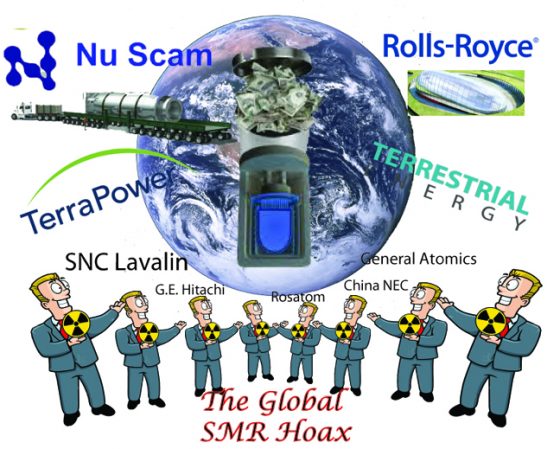
The First Small Modular Nuclear Reactor Was Just Approved by US Regulators, Singularity Hub, By Edd Gent-August 5, 2022
…………………………………… questions have been raised about whether SMRs will really live up to their billing as a cheaper, safer alternative to traditional nuclear power plants. A study published in Proceedings of the National Academy of Sciences in May found that contrary to the claims of SMR makers, these smaller reactors are actually likely to produce more radioactive waste than conventional plants.
In an article in Counterpunch, nuclear power expert M.V. Ramana also points out that the cost of renewable energy like wind and solar is already lower than that of nuclear, and continuing to fall rapidly. In contrast, nuclear power has actually become more expensive over the years.
SMRs could cost more than bigger nuclear plants, he adds, because they don’t have the same economy of scale. In theory this could be offset through mass manufacture, but only if companies receive orders in the hundreds. Tellingly, some utilities have already backed out of NuScale’s first project over cost concerns.
Perhaps even more importantly, notes Ramana, SMRs are unlikely to be ready in time to contribute to the climate fight. Projects aren’t expected to come online until the end of the decade, by which time the IPCC says we already need to have made drastic emissions reductions.
The technology has some powerful boosters though, not least President Joe Biden, who recently touted NuScale’s “groundbreaking American technology” while announcing a grant for an SMR plant the company will build in Romania. Engineering giant Rolls-Royce also recently announced a shortlist for the location of its future SMR factory, which will be used to build 16 SMRs for the UK government by 2050.
Whether SMRs can deliver on their promise remains to be seen, but given the scope of the climate challenge facing us, exploring all available options seems wise. https://singularityhub.com/2022/08/05/the-first-small-modular-nuclear-reactor-design-was-just-approved-by-us-regulators/
1 This Month



26 September – International Day for the Total Elimination of Nuclear Weapons


PLEASE OPPOSE HR 8255 AND S.3639 – bills would accelerate satellite deployment, with no environmental review or safeguards – https://ncstd5li.quorum.us/campaign/169331/
To see nuclear-related stories in greater depth and intensity – go to https://nuclearinformation.wordpress.com
-
Archives
- September 2026 (233)
- August 2026 (330)
- July 2026 (355)
- June 2026 (287)
- May 2026 (306)
- April 2026 (356)
- March 2026 (251)
- February 2026 (267)
- January 2026 (308)
- December 2025 (358)
- November 2025 (359)
- October 2025 (375)
-
Categories
- 1
- 1 NUCLEAR ISSUES
- business and costs
- climate change
- culture and arts
- ENERGY
- environment
- health
- history
- indigenous issues
- Legal
- marketing of nuclear
- media
- opposition to nuclear
- PERSONAL STORIES
- politics
- politics international
- Religion and ethics
- safety
- secrets,lies and civil liberties
- spinbuster
- technology
- Uranium
- wastes
- weapons and war
- Women
- 2 WORLD
- ACTION
- AFRICA
- Atrocities
- AUSTRALIA
- Christina's notes
- Christina's themes
- culture and arts
- Events
- Fuk 2022
- Fuk 2023
- Fukushima 2017
- Fukushima 2018
- fukushima 2019
- Fukushima 2020
- Fukushima 2021
- general
- global warming
- Humour (God we need it)
- Nuclear
- RARE EARTHS
- Reference
- resources – print
- Resources -audiovicual
- Weekly Newsletter
- World
- World Nuclear
- YouTube
-
RSS
Entries RSS
Comments RSS
 nuclear-news