Uncertainty over government funding for Rolls Royce’s small nuclear reactors

Concerns have been raised that the rollout of small modular reactors
(SMRs) in the UK could be delayed due to funding challenges. According to
The Times, a funding deal for the first fleet of mini nuclear reactors is
not expected to materialise for at least another 12 months, with a row
ongoing in government over the cost of Britain’s wider nuclear ambitions.
Going forward, SMRs, alongside large-scale nuclear plants, are seen as a
crucial tool in the country’s battle against the energy crisis and drive
towards net zero.

The government established a new body called Great British Nuclear (GBN) in conjunction with the release of its energy
security strategy with the aim of facilitating the growth of nuclear power on the grid.
However, Whitehall sources have now revealed that there
remains uncertainty over the government’s SMR investment plans. Rolls-Royce
has called for ministers to enter funding talks and start placing orders.
The firm is planning on building SMR power stations and recently announced
three shortlisted locations for its proposed factory and four potential
sites for the SMR plants themselves.
New Civil Engineer 9th Jan 2023 https://www.newcivilengineer.com/latest/fears-over-potential-delay-to-small-nuclear-reactor-rollout-09-01-2023/
A plan to build a fleet of mini nuclear reactors across the UK could be
delayed by at least another 12 months amid a row in the government over the
cost of Britain’s nuclear power ambitions. The Sunday Times cited sources
stating that there was still a large degree of uncertainty over the scale
of state investment in small modular reactors (SMRs).
Energy Live News 9th Jan 2023
Savannah River Site, Los Alamos plutonium pit production plan could cost over $30 billion

Matthew Christian, Aiken Standard, S.C. Sat, January 14, 2023 https://news.yahoo.com/savannah-river-los-alamos-plutonium-005900374.html?guccounter=1&guce_referrer=aHR0cHM6Ly9uZXdzLmdvb2dsZS5jb20v&guce_referrer_sig=AQAAADJqdcGm_qX6CdNLQ8_g7p81OistELVP4KvAUR1PfQl-0Q2SBtdSRa8GwdKyTIcwvX8aofXxou_a1DmL9axGTUu9S4o5f35bRYrwMTXGG5ZaoooE2PgjQaFWi5uLyJbf3gg8EShjtVi5A26UqvyJcSYMPWp9GQCX2T9NlsjflzJW
Jan. 13—It could cost over $30 billion for the National Nuclear Security Administration to reestablish plutonium pit production, according to recently released report.
Allison Bawden, director of natural resources and environment at the Government Accountability Office, wrote Thursday the Government Accounting Office has identified between $18-$24 billion in potential costs to begin production of 80 plutonium pits per year by 2036 at the Savannah River Site and Los Alamos National Laboratory.
Plutonium pits are the core of a nuclear weapon into which a neutron is injected to begin an uncontrolled reaction.
The United States has been without a permanent capability for plutonium pit production since 1989 after a combination of environmental mismanagement — the EPA and the FBI raided the facility in 1989 after receiving reports of numerous environmental violations from employees — and the end of the Cold War stopped pit production at the Rocky Flats facility in Colorado.
From 2007-2012, around 10 pits per year were made at the Los Alamos National Laboratory.
Trying to restart plutonium pit production and modernizing the Los Alamos National Laboratory for production has cost $8.6 billion since 2005 according to the report.
NNSA plans to produce 50 pits per year at the Savannah River Site beginning in 2036 and 30 pit per year at the Los Alamos National Laboratory beginning in 2027.
At the Savannah River Site, the plans call for the failed Mixed-Oxide Fuel Fabrication Facility to be converted into the Savannah River Plutonium Production Facility.
Bawden says the NNSA estimates through 2035 a cost of between $6.9-$11.1 billion to make the conversion, which is in three steps: getting the main building ready, providing utilities and other infrastructure to the area and constructing an administration building, security facilities and a training area.
Other costs include $6.94 billion for plutonium modernization program at the Savannah River Site and the Los Alamos National Laboratory .
At the Savannah River Site, Bawden says costs include preparing employees to produce pits and learning from the Los Alamos National Laboratory how to produce pits more efficiently. She says at Los Alamos the costs include designing a pit production line, getting equipment, hiring and training staff and making sure the production line is working and checking the quality of the produced pits.
She adds other costs at the Los Alamos National Laboratory include between $4.17-$5.61 billion for capital projects, $240-244 million for support buildings and $45-46 million for maintenance and recapitalization.
Bawden spends a few pages in the 84-page report discussing activities at other Department of Energy-owned sites that are not included in the NNSA cost estimates.
Those activities include design of a warhead at Lawrence Livermore National Laboratory and the lab making sure the produced pits meet the specifications of the warhead, experimental facilities at the Nevada National Security Site, production of non-nuclear pit components at the Kansas City National Security Campus, disassembling pits at the Pantex Plant in Texas and storing produced waste at the Waste Isolation Pilot Plant in New Mexico.
Including these costs and developing more thorough estimates of the costs at the Savannah River Site and Los Alamos is one of two recommendations the GAO makes in the report.
The other is for the NNSA to develop a more complete schedule of activities and when they’re supposed to happen.
Bawden notes NNSA decision-makers said both recommendations will be implemented later in the process when firm construction plans for the Savannah River Plutonium Production Facility are set in 2024 or 2025. She adds the NNSA decision-makers said they are hesitant to make more thorough cost estimates because of a concern of making an estimate, then paying a higher cost and having the public concerned about rising costs for the project.
Team Korea to bolster exports of nuclear energy systems

Korea Times, By Lee Kyung-min, 13 Jan 23,
State-run energy companies and private firms in the nuclear energy industry will join hands to advance exports of the stable and affordable power generation systems, the energy ministry said following a meeting attended by officials from the sector, Friday.
The Korea-developed APR1400, a nuclear reactor with a capacity of 1,400 megawatts, is increasingly recognized by its industry peers for its cost, quality and technological advantages.
Communication channels will be strengthened with the Czech Republic, the Philippines, the United Kingdom, and Turkey, to win orders to build nuclear reactors there. Also fortified will be government assistance to foster industries related to nuclear power generation equipment manufacturing, as well as facility safety and maintenance.
Second Vice Minister of Trade, Industry and Energy Park Il-jun presided over the meeting attended by members of Team Korea, a task force established to facilitate the export of the country’s nuclear reactors, at InterContinental Seoul COEX, southern Seoul.
In attendance were Korea Power Corp. (KEPCO) and its power subsidiary Korea Hydro & Nuclear Power (KHNP) as well as KEPCO affiliates…………….. https://www.koreatimes.co.kr/www/tech/2023/01/419_343553.html
UK should not be building Sizewell C, and rollout of small nuclear reactors will be a nightmare – energy boss.
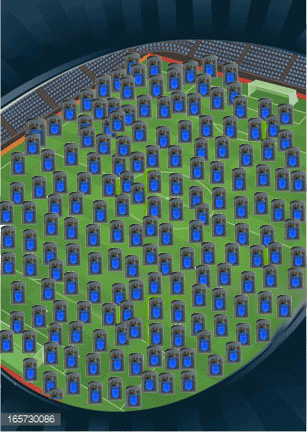
A nationwide rollout of small nuclear reactors has been hailed as a “nightmare” by Dale Vince
Dimitris Mavrokefalidis 10 Jan 23, https://www.energylivenews.com/2023/01/10/uk-should-not-be-building-sizewell-c-says-energy-boss/
The Founder of a British energy company has expressed his doubts about the government’s backing of Sizewell C.
A few months ago, ministers confirmed the first state backing of a nuclear project in more than 30 years, with a £700 million stake in Sizewell C in Suffolk.
Speaking to GB News, Dale Vince, Founder of Ecotricity, said: “It (nuclear energy) is much more expensive. It eats tens of billions of more public money than renewables have. And we will do it for a very long time because we have to actually deal with the radioactive waste as well.
“I think that what we have, we should keep and we should use it as we transition into 100% green energy. We shouldn’t be building Sizewell, the next one.”
Mr Vince questioned the turnover of such large projects and when asked about Rolls-Royce’s small reactors said: “What a nightmare. A proliferation of mini nukes around the country.”
The Delusion of Infinite Economic Growth

Even “sustainable” technology such as electric vehicles and wind turbines faces physical limits and exacts environmental costs
By Chirag Dhara, Vandana Singh on June 20, 2021 https://www.scientificamerican.com/article/the-delusion-of-infinite-economic-growth/#—
The electric vehicle (EV) has become one of the great modern symbols of a world awakened to the profound challenges of unsustainability and climate change. So much so that we may well imagine that Deep Thought’s answer today to Life, the Universe and Everything might plausibly be “EV.” But, as Douglas Adams would surely have asked, if electric vehicles are the answer, what is the question?
Let us imagine the “perfect” EV: solar powered, efficient, reliable and affordable. But is it sustainable? EVs powered by renewable energy may help reduce the carbon footprint of transport. Yet, the measure of sustainability is not merely the carbon footprint but the material footprint: the aggregate quantity of biomass, metal ores, construction minerals and fossil fuels used during production and consumption of a product. The approximate metric tonne weight of an EV constitutes materials such as metals (including rare earths), plastics, glass and rubber. Therefore, a global spike in the demand for EVs would drive an increased demand for each of these materials.
Every stage of the life cycle of any manufactured product exacts environmental costs: habitat destruction, biodiversity loss and pollution (including carbon emissions) from extraction of raw materials, manufacturing / construction, through to disposal. Thus, it is the increasing global material footprint that is fundamentally the reason for the twin climate and ecological crises.
The global material footprint has grown in lockstep with the exponentially rising global economy (GDP) since the industrial revolution. This is largely because of egregious consumption by the super-affluent in a socioeconomic system founded on growth without limits. Can we resolve this fundamental conflict between the quest for limitless growth and the consequent environmental destruction?
ENTER TECHNOLOGY
Technological innovation and efficiency improvements are often cited as pathways to decouple growth in material use from economic growth. While technology undoubtedly has a crucial role to play in the transition to a sustainable world, it is constrained by fundamental physical principles and pragmatic economic considerations.
…………………….We might consider that extensive recycling of materials would offset efficiency limits. Recycling is crucial; however, while glass and metals can be recycled almost indefinitely without loss of quality, materials such as paper and plastic can be recycled only a few times before becoming too degraded.
Additionally, recycling itself may be an energy- and materials-intensive process. Even if physical laws could be broken (they cannot) to achieve recycling with 100 percent efficiency, added demand from the imperative for economic growth would necessarily require virgin materials. The key point is that efficiency is limited by physics, but there is no sufficiency limit on the socioeconomic construct of “demand.”
Unfortunately, the situation is even more dire. Economic growth is required to be exponential; that is, the size of the economy must double in a fixed period. As referenced earlier, this has driven a corresponding increase in the material footprint. To understand the nature of exponential growth, consider the EV. Suppose that we have enough (easily extractable) lithium for the batteries needed to fuel the EV revolution for another 30 years. Now assume that deep-sea mining provides four times the current amount of these materials. Are we covered for 120 years? No, because the current 10 percent rate of growth in demand for lithium is equivalent to doubling of demand every seven years, which means we would only have enough for 44 years. In effect, we would cause untold, perhaps irreversible, devastation of marine ecosystems to buy ourselves a few extra years’ supply of raw materials.
Exponential growth swiftly, inevitably, swamps anything in finite supply. For a virus, that finite resource is the human population and in the context of the planet it is its physical resources.
The inescapable inference is that it is essentially impossible to decouple material use from economic growth. And this is exactly what has transpired……………………………………………..
The real question is this: how do we transition to alternative economic paradigms founded on the reconciliation of equitable human well-being with ecological integrity?
Slew of companies keeping watch on DOE nuclear cleanup work for small biz
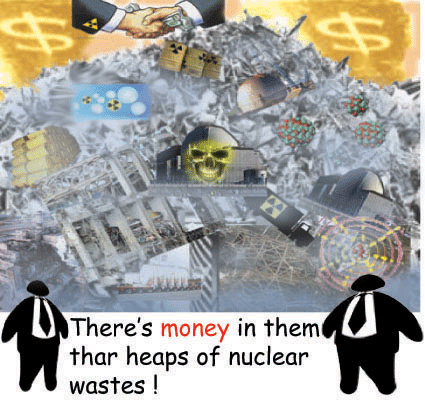
More than 20 companies expressed interest to the Department of Energy’s Office of Environmental Management in landing a slice of various nuclear remediation projects set aside for small business. Twenty-one signed up by Dec. 20 to be on an “interested vendors”… (subscribers only) more https://www.exchangemonitor.com/slew-of-companies-keeping-watch-on-doe-nuclear-cleanup-work-for-small-biz-2/
Holtec seeks $7.4 billion government loan for expansion tied to new reactor
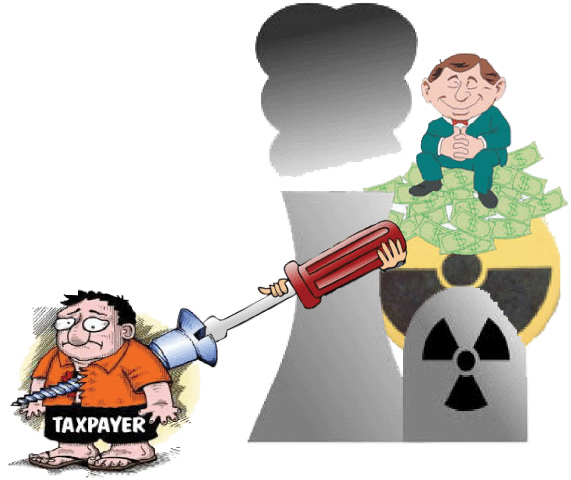
“an outrageous pickpocketing of hardworking American taxpayers to benefit a filthy rich private company.”
Jim Walsh, Cherry Hill Courier-Post, 9 Jan 23
CAMDEN – Holtec International Inc. has applied for a $7.4 billion federal loan to fund expansion expected from future sales of a company-designed nuclear reactor.
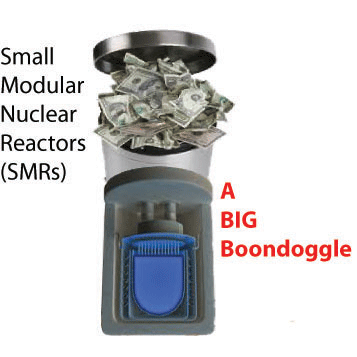
Holtec would tap the loan to boost capacity to make parts at its existing U.S. facilities, and to build and commission “at least four” SMR-160 advanced light water reactors.
It also expects to build “one or more additional manufacturing plants,” the company said.
Holtec added it’s “actively evaluating” potential sites “for the new ultra-modern manufacturing plant(s).”
The firm has three nuclear manufacturing facilities in the United States, including one at its Camden corporate campus that was designed for the eventual production of SMR-160s. It also has a fabrication plant in India.
Holtec claims its small modular reactor produces carbon-free energy more safely than a conventional nuclear power plant.
The firm has invested more than $400 million in the reactor’s development since 2010. It was approved in 2020 for $116 million in federal aid “to support the SMR-160’s commercialization readiness.”
Holtec is seeking the loan from the U.S. Department of Energy’s Loan Programs Office, which received an infusion of about $111 billion from last year’s Inflation Reduction Act.
“We anticipate that (the application process) will be ongoing for a while as DOE usually (has requests) for information or clarifying questions for an applicant,” said Holtec spokesman Patrick O’Brien………………….
Holtec also said it expects the U.S. Nuclear Regulatory Commission “early this year” will license its planned nuclear-waste storage facility in New Mexico.
The complex, in the works for seven years, could hold “the vast quantity of spent nuclear fuel presently stored at more than 70 nuclear sites in 35 states,” the company said.
But an environmental coalition plans to challenge any NRC approval in federal court, said Kevin Kamps of Beyond Nuclear, a nonprofit that’s sharply critical of Holtec’s plan.
Kamps said Holtec’s waste-storage project also faces court challenges from the states of New Mexico and Texas, as well as from businesses with mining and ranching interests near the proposed storage site.
He also described potential federal aid to Holtec as “an outrageous pickpocketing of hardworking American taxpayers to benefit a filthy rich private company.”
According to Holtec, the operation of a consolidated waste-storage site would spur nuclear power in the United States, “leading to the rise of small modular reactors.”
It also expressed the belief that modular reactors made in America would find “a large global export market.”
Holtec previously has predicted it could place 32 SMR-160s in the United Kingdom by 2050………….. https://www.courierpostonline.com/story/news/local/south-jersey/2023/01/09/holtec-federal-loan-production-advanced-nuclear-reactor-oyster-creek/69779027007/
GUSTAFSON: Russian nuclear power – unsanctioned – is prospering worldwide
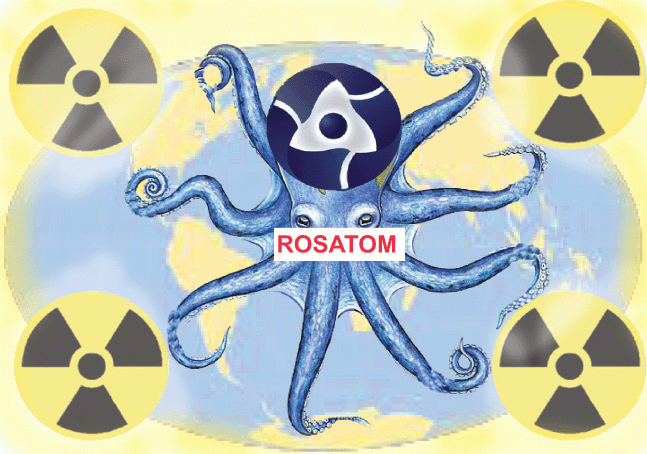
INTELLINEWS, By Professor Thane Gustafson in Washington January 8, 2023
As the Western nuclear industry flounders, Russia’s Rosatom is building nuclear power plants (NPPs) on time and under budget around the world, while selling uranium to the US……………….
Russia’s nuclear industry is thriving, thanks mainly to its international business. According to Aleksey Likhachev, CEO of Rosatom, Russia’s nuclear monopoly, Russia is currently at work on 23 nuclear power units in a dozen different countries, including China, India, Belarus, Turkey, Hungary and Egypt. It sold $10bn worth of products abroad in 2022, a 15% increase on the year before, and its current foreign order book stands at over $200bn. Rosatom is actively courting new customers, mostly in the developing world; it offers a “full service” package that covers construction and operation, as well as the supply and reprocessing of nuclear fuel. The Russian government actively supports Rosatom with low-interest financing. In short, Russian nuclear power is on a roll.
But that is not all. In addition to building and operating new NPPs, Rosatom exports enriched uranium to numerous countries around the world, including the US and Europe. (In addition, Rosatom provides services to five EU counties that operate Russian-built NPPs.) Even though the revenues are not comparable (only about $1bn per year), the fuel exports are key politically. Because of this dependence, Russia’s nuclear industry is not under Western sanctions (as discussed further below), and it is not likely to be so any time soon. At this moment, Rosatom is able to operate without impediment, both at home and abroad; one of the few sectors in the Russian economy to be able to do so.
For both the US and Europe the implications are serious. First, they will continue to depend on Russian enriched uranium for several years more, potentially weakening their common front on sanctions. (Indeed, there have already been substantial disagreements among EU members over their policy toward Russian nuclear power.)
…… . Russia should continue to hold a commanding position in nuclear power for some time to come. …..

…. Putin named a politician, Sergei Kiriyenko, (above)to head the nuclear programme. Kiriyenko had had a mixed career up to that time – including a disastrous five-month stint as prime minister that coincided with Russia’s 1998 financial meltdown – but he turned out to be a talented manager. He regathered Rosatom’s wandering assets under one roof and after seeing off the oligarchs, he brought the industry’s unruly suppliers and contractors to heel. During the next eleven years he built Rosatom into a powerhouse. In 2016, Putin rewarded him with a secret medal and a top job, as Number 2 in the Kremlin’s Presidential Administration, where he is today.
The secrecy was no accident. When Rosatom was created in 2007, it inherited both the civilian NPPs and the military weapons assets. Kiriyenko made vigorous efforts to disentangle the military wing from the civilian, but the separation proved easier to achieve on paper than in reality. Today, the civilian and the military parts of Rosatom remain connected at the hip, as many parts of the nuclear supply chain, beginning with the mining of uranium, serve both military and civilian customers inside Russia.
But the military part was (and is) funded directly by the government, while the civilian part was supposed to be self-supporting. For Kiriyenko, this was a crucial difference. He had begun with ambitious plans for expanding nuclear power inside Russia, but he soon realised that there was little domestic demand for new NPPs in an electricity sector dominated by gas, and so Kiriyenko turned his sights on the foreign market. For this he needed to persuade the international community that Rosatom had become essentially a civilian business, in other words to fashion a new “commercial” image for the company. By and large he was successful, and Rosatom owes its present prosperity largely to the international business he built.
The impact of Western sanctions
Because of its important role as a supplier of uranium and nuclear fuels to NPPs around the world, including the US, Rosatom is not under Western sanctions. The US, in particular, relies on Russia for low-enrichment uranium for its own NPPs. Although efforts are under way to develop substitutes, for the present Rosatom is simply too valuable to sanction.
But even if sanctions were to be imposed, Rosatom’s operations would be largely unaffected by them. Internally, its supply chain, which as mentioned runs from uranium mining to power plant construction and operation, depends very little on the outside. ………….
Rosatom’s international business might be somewhat more vulnerable to sanctions, but so far there is little sign of it. Only one country, Finland, has pulled out of an ongoing project with Rosatom. ………………………….
Multiple challenges ahead
Yet quite apart from sanctions, Rosatom and Russian nuclear power may face multiple challenges ahead. One of them is technological progress. …………
Russia is the only country in the world to operate nuclear-powered icebreakers and floating NPPs, both of which are powered by small reactors. The Russian experience in designing and building small reactors goes back decades to the Soviet era, and there have been multiple generations of successively improved designs. Rosatom is working on deploying them not only on nuclear icebreakers and floating platforms, but also on land.
…………………….. The key to the future of SMRs, in the longer term, will likely be so-called “Generation IV” reactors, based on revolutionary designs that break entirely from the traditional light-water-reactor technology. But Generation IV is still an immature technology, and the race for leadership in G-IV is only now getting under way.
The more proximate threat to Rosatom’s leading position is Beijing. China has a vigorous nuclear programme, which is entirely independent of Russia…………………………………………
Finally, the ultimate challenges for Rosatom may be safety and reputational risk. Ever since the Chernobyl disaster in 1986, the Russian nuclear industry has had an excellent safety record. But the Russian invasion of Ukraine raises a serious new threat. There are four NPPs operating in Ukraine – ironically, all of them of Soviet manufacture. Russian [?] missiles have already landed close to one of them, the Zaporizhzhia plant, which is located close to the current battle line between Russian and Ukrainian forces. Just who is responsible for the safety of the plant is in dispute……………for Rosatom this plan is full of risks. If the plant were damaged and there were radioactive contamination, quite apart from the further suffering this would inflict on the Ukrainian people, for Rosatom the reputational damage would be extreme.
……. The challenges ahead are real, but they will come more from technological changes and rising competition from China, than from sanctions, from which Rosatom in any case remains so far exempt. https://www.intellinews.com/gustafson-russian-nuclear-power-unsanctioned-is-prospering-worldwide-266160/
Sizewell C: How will the £20billion plant be fully-funded?
Campaigners will have their day in court to challenge the “woeful
decision” to give the go-ahead to the Sizewell C nuclear plant – just part
of a challenging year ahead for the huge project.
The government approved the £20billion-plus twin reactor on the Suffolk coast last summer and has
already pledged £700million of public money towards it along with a levy
on power bills.
But that still leaves huge decisions to be made as to where
the rest of the money will come from and how the power plant – which will
provide electricity for six million homes – will be fully funded.
Ministers say the financial investment decision (FID) will be made in this parliament
– which means in the next two years, though it could come sooner than that.
Construction work on the reactors will start soon after. Early work this
year will continue on the main development site and also to relocate some
buildings at Sizewell B to make room for Sizewell C.
East Anglian Daily Times 4th Jan 2023
https://www.eadt.co.uk/news/23225503.sizewell-c-will-20billion-plant-fully-funded/
Sizewell C Nuclear Project’s biggest stumbling block is its funding problem.
Everything you need to know about the future of Sizewell C power station
in 2023.
Sizewell C’s biggest stumbling block surrounds its funding. The
government’s £700 million commitment is merely a small amount of the
estimated final cost, which is likely to run above £25 billion.
In November, Business, Energy and Industrial Strategy Secretary Grant Shapps
confirmed that the government had bought out China General Nuclear’s stake
in the project. However, it’s reported that around 60 per cent of the
funding is yet to be found. Most of the returns for the investors will come
when they sell electricity to businesses and households around the UK.
However, the government has also said that it will allow investors in new
nuclear to get money through the so-called Regulated Asset Base model.
Suffolk Live 5th Jan 2023
https://www.suffolklive.com/news/suffolk-news/everything-you-need-know-future-7989137
A surging supply of green power is likely to limit any nuclear renaissance.
Green surge is circuit breaker on nuclear revival
By Robert Cyran, https://www.reuters.com/breakingviews/green-surge-is-circuit-breaker-nuclear-revival-2023-01-04/ 4 Jan 23,
NEW YORK, Jan 4 (Reuters Breakingviews) – Nuclear power received what seem like two plum gifts for 2023. High energy prices and the desire to decarbonize have spurred renewed interest in the technology that provides about 10% of the world’s electricity supply. Yet a surging supply of green power is likely to limit any renaissance.
There are 425 active reactors worldwide, according to the World Nuclear Association, about the same as three decades ago. Plants have opened in places like China and closed in Western countries.
Nuclear plants are expensive to build, and their complexity often causes projects to go way over budget. Plant Vogtle in the state of Georgia will be America’s first since the 1990s when finished in 2023. The $30 billion price tag is twice the initial estimate. Reactor opening delays in Finland and China show difficulties transcend borders.
The cost of a new nuclear power station is around $168 per megawatt hour according to Lazard. An efficient gas plant costs about a third as much, and solar and wind about one-fifth as much. So there’s little incentive to build. Running existing nuclear plants makes sense. A depreciated plant costs around $29 per MWh, reckons Lazard. And power is available rain or shine, day or night.
This reliability is the big reason there are 55 plants under construction, despite the cost, as wind and solar power currently need backup. Yet that appeal is limited. Over the past decade, green power production, excluding hydropower, has grown 15% annually worldwide according to BP’s Statistical Review of World Energy. Nuclear production was unchanged. China has 22 nuclear reactors under construction, but built renewables about twice as fast.
The price discrepancy keeps widening as wind and solar get cheaper, while nuclear hasn’t budged. Moreover, the cost of storing power in batteries is plummeting. NextEra Energy (NEE.N), America’s biggest deployer of green energy, estimates that by the late 2020s, wind and solar tied to batteries will be about as reliable as other sources during peak hours, but for roughly half the cost of depreciated nuclear or gas plants, and about one-seventh that of a new, small nuclear plant.
Shareholders may yet get some juice from nuclear players like $10 billion uranium producer and wannabe reactor servicer Cameco (CCO.TO). But wind and solar power’s burgeoning advantages have $172 billion NextEra and its rivals looking more plugged in.
Japan’s shortage of engineers and manufacturing capacity sets back its nuclear ambitions
Japan’s ambitions to reboot its nuclear industry risk being set back by a
shortage of engineers and manufacturing capacity that has atrophied in the
decade following the Fukushima nuclear disaster.
Prime Minister Fumio Kishida’s new policy calls for the construction of new nuclear power
plants, raising hopes for Japanese manufacturers that are working on
smaller reactors and other upgraded nuclear technologies. But the
industry’s nuclear supply chain is under strain, warned industry executives
and experts. The 2011 accident triggered a massive exit of more than 20
manufacturers, including Kawasaki Heavy Industries and Sumitomo Electric
Industries.
FT 4th Jan 2023
https://www.ft.com/content/e179ece0-6e0b-4ce7-98b5-30ae01d41501
Is EDF using Britain’s “windfall tax” as an excuse to get out of uneconomic Hartlepool and Heysham nuclear reactors?
EDF has complained that the British Government’s windfall tax, introduced on 1 January, may mean an early end for operations at Hartlepool & Heysham 1, but the Nuclear Free Local Authorities believe that these could be ‘crocodile tears’ with the tax providing the perfect excuse for the French-state owned company to bow out of running these increasingly unreliable reactors, which are already way past their close-by date.
In his November statement, Chancellor Jeremy Hunt extended the windfall tax to a charge upon the ‘excess profits’ of all energy generators, including nuclear and renewable generators. Many commercial energy businesses generating electricity from fossil fuels, nuclear and renewable technologies have made significantly increased profits as the wholesale energy price has been pegged to the price of gas, which skyrocketed following the outbreak of war in Ukraine.
Hartlepool and Heysham 1 are two of EDF’s five remaining British plants generating electricity from aging
Advanced Gas Cooled Reactors. Whilst they may be called ‘advanced’, the reactors were installed between 1976 and 1988, and all are well past their operational date. The reactors at both plants were off-line for significant periods, both planned and unplanned, for repairs, maintenance and safety checks. Indeed, EDF Energy reported to the International Atomic Energy Agency that Hartlepool 1 was offline 4,767 hours (equivalent to 198 days), Hartlepool 2 3,534 (147 days), Heysham 1, 3,165 (132 days), and Heysham 2 a
whopping 7,122 (297 days).
NFLA Steering Committee Chair, Councillor Lawrence O’Neill believes that EDF’s threat to shut the reactors in 2024 citing the new windfall tax is in fact hollow:
“Before there was even a hint of a UK government windfall tax, EDF Energy had already announced that
after an earlier lifetime extension they intended to close the Hartlepool and Heysham 1 plants on 2024 so this is clearly just scaremongering. “
The NFLA has raised repeatedly with the Office of Nuclear Regulation that the continued safe operation of these reactors is being compromised over time by the degradation and cracking of the graphite core moderators.
Closure will soon in any case be inevitable as these plants become increasingly uneconomic to run. “You can see from the latest operational figures supplied to the international regulator that the reactors at Hartlepool and Heysham are off-line for significant periods, in two cases for well over half the year. So much for nuclear being a source of reliable baseload
power”.
NFLA 3rd Jan 2023
How did the US nuclear industry fare in 2022?
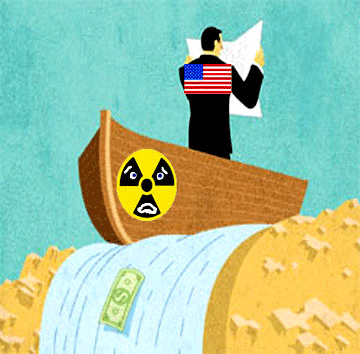
Nuclear plants big and small are getting support from the feds. Still, problems persist — TerraPower can’t source fuel, Oklo and NuScale are tangled in red tape, and more.
Canary Media 28 December 2022 Eric Wesoff
The U.S. nuclear power market continued to sputter in 2022 as it faced regulatory, technical and financial setbacks — despite solid support from the federal government.
This mirrors the global nuclear scene; plant closings and construction delays have resulted in nuclear falling to just 9.8 percent of global power generation in 2021, its lowest level since the 1980s, according to the World Nuclear Industry 2022 annual report.
The United States generates more nuclear power than any other country in the world, with about 95 gigawatts of capacity, followed by China, but construction of new plants has been plagued by cost and schedule overruns, as well as an inability to keep up with the plunging costs of natural gas and renewable energy sources. Still, nuclear power provides a crucial 20 percent of U.S. electricity from the 92 light-water reactors that were built in a seemingly unreplicable construction binge in the 1970s and ‘80s.
Some of these plants are struggling financially, many are approaching their decommission dates, and the only new large reactors constructed in recent memory, at the Plant Vogtle in Georgia, have been calamitous money pits brimming with incompetence and even fraud.
Here are the U.S. nuclear industry’s highs and lows from 2022.
Diablo Canyon lives
Diablo Canyon, California’s last remaining nuclear plant, was granted up to $1.1 billion in support from the U.S. Department of Energy in November, which might allow the two-reactor plant to remain in business. ……………..
Still, Diablo faces a reckoning with the federal Nuclear Regulatory Commission regarding its license, as the plant must now confront years of deferred maintenance in the run-up to its anticipated retirement.
Fuel loading at Vogtle
On October 17, Georgia Power reported that “fuel load” into the Plant Vogtle Unit 3 reactor core had been completed, marking an overdue milestone in the bumpy journey of getting two new reactors at this power plant up and running. During the fuel-loading process, technicians and operators transferred scores of fuel assemblies one by one to the Unit 3 reactor…………………….
On December 7, Vogtle’s Unit 4 completed cold hydro testing, the penultimate step before hot functional testing, which is scheduled to begin early next year.
The two units are the first new nuclear units to be built in the U.S. in more than three decades — and they haven’t made nuclear power look good. The project is six years overdue and will cost utility customers over $30 billion, more than double the original price tag. DOE’s Loan Programs Office provided more than $12 billion in loan guarantees to help complete Vogtle’s expansion.
DOE and IRA love nuclear power
The Biden administration is committed to maintaining the existing nuclear fleet and bringing innovative, new nuclear-reactor designs to market.
The Inflation Reduction Act provides generous production credits for existing nuclear plants and added premiums for meeting prevailing-wage requirements. These credits offer a potential $30 billion lifeline to struggling plants at risk of early retirement.
The IRA also provides a tax credit for advanced nuclear reactors and a credit of up to 30 percent for microreactors, while devoting $700 million to support the development of high-assay low-enriched uranium (HALEU), the highly enriched fuel used in many advanced nuclear reactors.
This funding is in addition to the 2021 Bipartisan Infrastructure Law’s $6 billion Civil Nuclear Credit program, which lets existing U.S. reactors bid on credits to help support their continued operations. The DOE’s Loan Programs Office also has $11 billion in funding for nuclear plants and nuclear supply chains, according to Jigar Shah, director of the office.
………………………….. TerraPower and dozens of other advanced nuclear startups require a concentrated form of fuel — HALEU. But the only current commercial supplier of HALEU is Tenex, a Russian state-owned company. That wasn’t a great situation even before Russia invaded Ukraine.
In mid-December, TerraPower announced that it has pushed back the planned start date for its reactor because depending on HALEU sourced from Russia had become an unworkable business plan. “Given the lack of fuel availability now, and that there has been no construction started on new fuel enrichment facilities, TerraPower is anticipating a minimum of a two-year delay to being able to bring the Natrium reactor into operation,” said CEO Chris Levesque.
The world’s fleet of light-water reactors runs almost entirely on fuel enriched to 3 to 5 percent U-235, which is classified as low-enriched uranium (LEU). In contrast, the vast majority of non-light-water reactor designs in development, like TerraPower’s, run on enrichments of 5 to 20 percent (HALEU).
X-energy goes public via SPAC
X-energy, a developer of small modular nuclear reactors and fuel, is going public through the magic of a merger with Ares Acquisition Corporation, a publicly traded special-purpose acquisition company…………… Once the disreputable domain of pink-sheet over-the-counter stocks, SPACs have become an acceptable way for companies to go public without the burden of revenue or the actual due diligence most public companies go through. ………………………………………………..
NuScale’s NRC blues………….
https://www.canarymedia.com/articles/nuclear/how-did-the-us-nuclear-industry-fare-in-2022—
The Ukraine Arms Drain
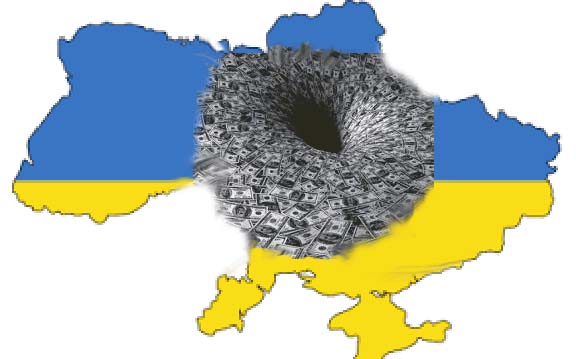
New Eastern Outlook, Brian Berletic 23 Dec 22
After months of feigned confidence and optimism from both the West and Ukraine’s senior military leadership, cracks are beginning to appear. During Ukrainian Commander-in-Chief General Valery Zaluzhny’s recent interview with the Economist, Ukraine’s desperate need for additional arms and the consequences for not receiving them was made very clear.
The discussion revolved around the desperate need for resources – everything ranging from air defense missiles to tanks, armored vehicles, artillery pieces and artillery shells themselves – all things that both the West and now Ukraine are admitting are in short supply, and perhaps cannot be supplied any time in the near or intermediate future.
From “Extending Russia” to “Demilitarizing” NATO
Washington’s proxy war against Russia in Ukraine is the manifestation of the RAND Corporation’s 2019 paper “Extending Russia” which recommended US policymakers to “provide lethal aid to Ukraine” hoping it would expand hostilities in eastern Ukraine and “increase the costs to Russia, in both blood and treasure, of holding the Donbass region.”
The paper had hoped that Russian losses in equipment and lives in the Donbass would replicate the costs the Soviet Union suffered in Afghanistan. While the Russian Federation is indeed facing mounting costs in Ukraine, it can easily be argued that the US, the rest of NATO, and most of all – Ukraine itself – are suffering at least as much if not more.
What’s perhaps more important than how much either side is losing in the conflict is how much either side can afford to lose because of their respective military industrial capacity to regenerate manpower and equipment throughout the fighting. After nearly a year of fighting, it is clear that Russia’s stockpiles and military were prepared for this type of protracted, intense, large-scale military conflict. Ukraine and its Western sponsors were not.
Ukraine’s General Zaluzhny shared with the Economist a “wishlist” of weapons he claimed he needed in order to restore the February 23, 2022 borders of what Kiev claims is Ukraine. The list included 300 tanks, 600-700 infantry fighting vehicles, and 500 howitzers – numbers NATO couldn’t provide Ukraine no matter how much it wants to.
This “wishlist” follows Ukraine expending a massive reserve made up of weapons, vehicles, and ammunition the collective West transferred to Ukraine ahead of the so-called Kharkov and Kherson offensives. In addition to losing multiple brigades worth of men, huge amounts of equipment were also lost as Russian ground forces withdrew and instead used long-range weapons to strike at Ukrainian forces now out from behind well-laid defenses.
The temporary political points Ukraine’s offensives gained by taking territory came at the cost of expending the vast majority of what the West could afford to transfer to Ukraine.
A growing number of admissions are now being made regarding the limits of Western aid to Ukraine……………………………………………….. more https://journal-neo.org/2022/12/23/the-ukraine-arms-drain/
1 This Month



26 September – International Day for the Total Elimination of Nuclear Weapons


PLEASE OPPOSE HR 8255 AND S.3639 – bills would accelerate satellite deployment, with no environmental review or safeguards – https://ncstd5li.quorum.us/campaign/169331/
To see nuclear-related stories in greater depth and intensity – go to https://nuclearinformation.wordpress.com
-
Archives
- September 2026 (233)
- August 2026 (330)
- July 2026 (355)
- June 2026 (287)
- May 2026 (306)
- April 2026 (356)
- March 2026 (251)
- February 2026 (267)
- January 2026 (308)
- December 2025 (358)
- November 2025 (359)
- October 2025 (375)
-
Categories
- 1
- 1 NUCLEAR ISSUES
- business and costs
- climate change
- culture and arts
- ENERGY
- environment
- health
- history
- indigenous issues
- Legal
- marketing of nuclear
- media
- opposition to nuclear
- PERSONAL STORIES
- politics
- politics international
- Religion and ethics
- safety
- secrets,lies and civil liberties
- spinbuster
- technology
- Uranium
- wastes
- weapons and war
- Women
- 2 WORLD
- ACTION
- AFRICA
- Atrocities
- AUSTRALIA
- Christina's notes
- Christina's themes
- culture and arts
- Events
- Fuk 2022
- Fuk 2023
- Fukushima 2017
- Fukushima 2018
- fukushima 2019
- Fukushima 2020
- Fukushima 2021
- general
- global warming
- Humour (God we need it)
- Nuclear
- RARE EARTHS
- Reference
- resources – print
- Resources -audiovicual
- Weekly Newsletter
- World
- World Nuclear
- YouTube
-
RSS
Entries RSS
Comments RSS
 nuclear-news