China marketing nuclear reactors to Pakistan
Pakistani Prime Minister Shehbaz Sharif has inaugurated the third unit of
the Karachi Nuclear Power Plant (KANUPP), which has 1.1GW of power
generating capacity. Built with an investment of $2.7bn, the K-3 nuclear
unit is expected to ease Pakistan’s ongoing energy crisis, according to
Bloomberg.
It is the second Chinese-designed Hualong One reactor to be
deployed at KANUPP, having been built with the Chinese Government’s
assistance under the China-Pakistan Economic Corridor (CPEC) initiative. At
the inauguration ceremony, Prime Minister Sharif said Pakistan ‘badly
needs’ clean and cheap sources of energy, be they nuclear, hydropower or
other renewables.
Power Technology 3rd Feb 2023
https://www.power-technology.com/news/pakistan-karachi-nuclear-power-plant/
South Korea to sell 40 trilion won ($32.55 billion) nuclear power plant to Turkey.
South Korea has conveyed its preliminary proposal to Turkiye for
constructing a major nuclear power plant in Turkiye, local Turkish media
reports. According to the report, Korea Electric Power Corp. (KEPCO)
presented the proposal regarding the construction of four reactors capable
of providing 1,400 megawatts (MW) of electricity in the northern province
of Sinop. The project is forecast to be worth about 40 trillion won ($32.55
billion).
Middle East Monitor 2nd Feb 2023
Ukraine planning for two $5 billion Westinghouse AP 1000 reactors, part of USA marketing a fleet of new nuclear reactors to Ukraine!

Ukraine’s Cabinet of Ministers has greenlighted the preliminary phases
of building two $5 billion Westinghouse AP 1000 reactors at the Kmelnitsky
nuclear power plant once the Russian invasion ends, the embattled
country’s energy officials have said, according to World Nuclear News.
The cabinet-level approval builds on the deal Kyiv and Westinghouse signed
in June that outlined plans for the US-based nuclear corporation to
construct a total of nine new reactors in Ukraine, as well as supply all
nuclear fuel burned in the country’s 15 Soviet-built reactors.
Bellona 3rd Feb 2023
Ukraine greenlights first steps on new nuclear reactor builds
Top UK pension funds refuse to invest in Sizewell C nuclear plan, despite government enticements.

‘Whatever the funding model, Sizewell C is highly controversial. It carries multiple risks, of time and cost overruns, reputation and technical problems.
‘If the Government is forced to peddle it to foreign investors, it will make its justification in terms of ‘energy sovereignty’ even more of a joke.’
‘If the Government is forced to peddle it to foreign investors, it will make its justification in terms of ‘energy sovereignty’ even more of a joke.’
Blow to Government’s infrastructure drive as two top UK pension funds snub Sizewell C nuclear plant plan
By FRANCESCA WASHTELL FOR THE DAILY MAIL, 1 February 2023
Efforts to attract investment in British infrastructure were hit after two of the UK’s biggest pension funds turned their backs on Sizewell C.
Ministers are tearing up old EU red tape that Chancellor Jeremy Hunt says will unlock £100billion in possible funding for major projects.
The most important of these is the £20billion Sizewell C nuclear power plant in Suffolk, which is being developed by the Government and EDF but will need billions of private funding.
The Government has spent years trying to woo pension groups and institutional investors by introducing a new funding model that allows them to receive dividends during the construction process.
It is expected to go a step further by classifying nuclear as a green energy source in an upcoming eco-friendly financing strategy, which would make it easier for companies to win support to invest in power plants.
But an industry source said Sizewell C would still not be an appropriate investment for ‘typical big-name UK pension schemes’, as they see the risk of cost over-runs and delays being too high.
So far, other potential backers such as Nest and Legal & General have said they do not intend to fund the project.
But British Gas owner Centrica is thought to be considering taking a stake, while FTSE 100 savings and retirement firm Phoenix Group has said it is keen to back nuclear.
The source added that funding was more likely to come from North America and the Middle East, with Emirati sovereign wealth fund Mubadala already said to be in the mix.
Alison Downes, the head of campaign group Stop Sizewell C, said: ‘Whatever the funding model, Sizewell C is highly controversial. It carries multiple risks, of time and cost overruns, reputation and technical problems.
‘If the Government is forced to peddle it to foreign investors, it will make its justification in terms of ‘energy sovereignty’ even more of a joke.’
The Unwarranted Ukraine Proxy War: A Year Later

US Big Defence will be the only winner of the proxy war in Ukraine. Not only do these global military contractors arm Ukraine, but they stand to benefit from the re-militarisation of Western European countries, Japan, and new NATO members.
In the view of Big Defence, peace is just a bad business proposition. There’s no money in it.
The World Financial Review, By Dr Dan Steinbock, 27 Jan 23
To Russia and Ukraine, the crisis is an existential issue. To the US and NATO, it’s a regime-change game. To Europe, it means the demise of stability – in the world economy, lost years (and that’s the benign scenario).
That’s how I characterised the US/NATO-led proxy war against Russia in Ukraine back in early March 2022. I argued that it was an “avoidable war that will penalise severely Ukraine, Russia, the US and the NATO, Europe, developing countries and the global economy”.[1]
At the time, the prediction was seen as contrarian. But it has prevailed. However, on January 25 the Ukraine proxy war entered a new, still more dangerous phase. The commitment of some 70 US, German, UK and Polish battle tanks herald lethal escalation, although hundreds more are needed to defeat Russia. For the first time since World War II, German tanks will be sent to the “Eastern front.” In Moscow, it will foster those voices who see the stakes of the war as existential.
Not only will economic and human costs climb even further, but strategic risks, including the potential of nuclear confrontation, will soar. With such escalation in high-tech arms sales to Ukraine, regional and military spillovers are no longer a matter of principle, but a matter of time.
Russia’s economic resilience
In early 2022, Western observers, with rare exceptions, predicted that the Russian economy would default within months as a net effect of sanctions. “Putin’s war” was doomed, they said. Obviously, the sanctions, which have been fuelled by might and economic coercion, have not been inconsequential. But nor were they new.
Already in February 2014, following the Russian annexation of Crimea, international sanctions were imposed against Russia and Crimea by the US, Canada, the EU, and the international organisations they dominate. While the West’s sanctions contributed to the fall of the Russian ruble, they also caused significant economic damage to the EU economy, with total losses at €100 billion in 2015. By mid-2016, Russia had lost an estimated $170 billion due to financial sanctions and another $400 billion in revenues from oil and gas.[2]………………………….
In fact, the Russian economy plunged 3.5 per cent in 2022, whereas inflation amounted to 5.4 per cent. In other words, Western institutions dramatically overestimated the GDP impact. Discrepancies of such magnitude are hard to explain away as simple prediction errors (figure 1 on original).
Proxy war united Russia
Officially, the invasion of Ukraine began as Russia’s “special military operation”. Unofficially, it soon morphed into a US/NATO-led proxy war against Russia in Ukraine. The true political objective of this war has been regime change. Hence the goal “to weaken Russia”, as Secretary of Defence Lloyd Austin acknowledged later. Hence, too, the international media predictions that the Russian economy would “inevitably” default and Putin be overthrown……………………
Today, in the view of ordinary Russians, Russia’s invasion of Ukraine is a defensive response to NATO’s offensive eastward enlargement. They see their country fighting for survival. That’s why the war caused Putin’s ratings to soar to the low 80s. That’s also why over 60 to 70 per cent of Russians support their government and believe the country is on the right track, despite extraordinary hardships. ……………………………………..
Amid this collapse of trust in the US and the EU, it certainly did not help that the Minsk peace process proved to be another Western ruse. Last December, German ex-Chancellor Angela Merkel disclosed in the Zeit newspaper that “the 2014 Minsk agreement was an attempt to give time to Ukraine.” That is, to make Ukraine stronger and for NATO to increase its support to the country in the face of Russia.[4]……………………
In the view of ordinary Russians, there is now a long continuum of betrayals from the pledge that NATO would never expand eastward in the early 1990s to Minsk today. In their view, the West’s recent arms escalation only confirms their worst suspicions.
Contradictory realities
Right before Christmas, President Volodymyr Zelenskyy delivered an emotional wartime appeal to a joint meeting of US Congress, pleading for more military assistance from the lawmakers, who were about to approve $45 billion in additional aid. It was necessary for “eventual victory”.[6]
Yet, there was a huge disconnect between the triumphant declaration and the realities. Earlier in the month, European Commission President Ursula von der Leyen had acknowledged that Ukraine’s losses in the war amounted to 100,000 soldiers and 20,000 civilians, though her tweet was quickly deleted and a new one was released without the true death count (figure 3 on original).[7
Behind the choreographed photo ops and bold sound bites, devastation had been expansive, progressive, and relentless…………..
In September 2022, a month before the Russian winter offensive, a World Bank report estimated that Russia’s invasion had caused over $97 billion in direct damage to Ukraine and it could cost $350 billion to rebuild the country. Worse, Ukraine had also suffered $252 billion in losses through disruptions to its economic flows and production, as well as extra expenses linked to the war.[8] (The report was quiet about the economic and human costs on the Russian side.)
In other words, what Zelenskyy asked in the Congress was less than one-tenth of what is actually needed to rebuild Ukraine.
Ukrainian nightmare
In effect, even as the international media was touting the mirage of Ukraine’s military triumph, the country’s real GDP declined over 35 per cent on an annual basis in the third quarter of 2022; that is, before Russia’s massive infrastructure attack.
Starting on 10 October, Russia’s waves of missile and drone attacks opened a new phase of the war.
The direct physical damage to infrastructure soared to $127 billion already in September; that’s over 60 per cent of Ukraine’s pre-war GDP. The impact on the productive capacity of key sectors, due to damage or occupation, is substantial and long-lasting.[9]
The population share with income below the national poverty line in Ukraine may more than triple, reaching nearly 60 per cent in 2022. Poverty will increase from 5.5 per cent in 2021 to 25 per cent in 2022, with major downside risks if the war and energy security situations worsen.[10] As casualties continue to mount, over a third of the population has been displaced and over half of all Ukrainian children have been forced to leave their homes. The nine months of war have caused massive population displacement. As of October 2022, the number of Ukrainian refugees recorded in Europe was over 7.8 million, and the number of internally displaced people was 6.5 million (figure 4 on original).[11]
As former Pentagon adviser Col. (ret.) Douglas Macgregor has argued, “Washington’s refusal to acknowledge Russia’s legitimate security interests in Ukraine and negotiate an end to this war is the path to protracted conflict and human suffering.”[12]
As former Pentagon adviser Col. (ret.) Douglas Macgregor has argued, “Washington’s refusal to acknowledge Russia’s legitimate security interests in Ukraine and negotiate an end to this war is the path to protracted conflict and human suffering.”[12]
West’s tough 2022 and darker 2023
Currently, the risk of recession casts a dark shadow over the US economy, ……………………………………………..
US and international war funding
In the proxy war, economic and humanitarian aid to Ukraine has been abundant………………………..
Internationally, the US provides the bulk of total aid to Ukraine (62 per cent). Aid from non-US sources amounts to $41.4 billion. The international total of more than $110 billion accounts for more than half of Ukraine’s pre-war GDP ($200 billion).[17] Effectively, these funding arrangements aim to sustain the hostilities and destruction not just in 2023, but at least until the late 2020s.[18] A scenario the West’s recent arms sales escalation could reinforce.
Ailing and indebted, the West cannot afford the proxy war in Ukraine. Hence, the frantic debt-taking. In the Eurozone, government debt to GDP remains close to 100 per cent. Ironically, that’s 40 percentage points higher than the region’s own debt limit. In the UK, the figure has doubled since 2008 to almost 100 per cent. In Japan, it is the worst among all high-income economies – close to 265 per cent, thanks to over two decades of secular stagnation. In the US, the debt ratio has also doubled and is inching toward 140 per cent. (That’s over 20 percentage points higher than that of Italy amid Rome’s 2010 debt crisis.) The rising debt as a percentage of the GDP will slow economic growth, push up interest payments to foreign holders of US debt, and heighten the risk of a fiscal crisis. The periodic debt-limit debacle in the US is just a minor political sideshow to the West’s future debt crisis, which will leave no economy, not even the major ones, unscathed (figure 5 on original).
The post-9/11 wars: the Big Defence bonanza
Ukraine is “absolutely a weapons lab in every sense because none of this equipment has ever actually been used in a war between two industrially developed nations,” said one source familiar with Western intelligence to CNN. “This is real-world battle testing.” Or as Zelenskyy put it more recently, arming Ukraine is a “‘big business opportunity,” as evidenced by his government’s new ties with Blackrock, Goldman Sachs and JP Morgan. In December 2022, he revealed that Ukraine had hired Blackrock to “advice” Kyiv on how to use the West’s reconstruction funds, which he then estimated would have to increase at least to $1 trillion.[19]
As I predicted in March 2022, US Big Defence will be the only winner of the proxy war in Ukraine. Not only do these global military contractors arm Ukraine, but they stand to benefit from the re-militarisation of Western European countries, Japan, and new NATO members. Washington has a great economic interest in such geopolitics. Brussels’ incentives are harder to fathom, especially as the euro area will pay a hefty premium on energy and food, which will also benefit Washington…………………………..
Military Keynesianism to rescue
From the economic standpoint, these military expenditures, including US Ukrainian aid, should be seen as massive, recurrent, multi-year bastard Keynesianism. That is, as a series of military stimulus packages to prop up the American economy (not Ukraine’s). Unlike Keynesian stimuli that can have an accelerator effect in the civilian economy, these packages benefit mainly the Pentagon and Big Defence; that is, the military industrial complex and its revolving-door elites.
Take, for instance, President Biden, Secretary of State Antony Blinken, National Security advisor Jake Sullivan and Blinken’s right-hand, Victoria Nuland. All four were key actors already in the 2014 Ukraine crisis. In one way or another, all are also linked with the Center for a New National Security (CNAS) and its consulting arm WestExec Advisors, which in turn is funded particularly by Big Defence. The same goes for Secretary of Defence Lloyd Austin, a veteran of the US Army and ex-board member of Raytheon, one of the largest defence giants and a big beneficiary of the Ukraine devastation.[22]
what’s good for Big Defence is not necessarily good for either the American people or the global economy. It aggravates income polarisation in America and between the high-income West and the developing Global South, while escalating geopolitical risks worldwide…………………………………
Plunging global growth
Unsurprisingly, global growth is now expected to decelerate sharply to 1.7 per cent in 2023…………………………
The unwarranted war
A year ago, I characterised the Ukraine conflict as an “unwarranted war” because it was avoidable. As declassified files show, a series of security assurances were given to Mikhail Gorbachev and other Soviet leaders against NATO’s eastward expansion at the turn of the 1990s, starting with President George H.W. Bush, followed by a cascade of assurances by German, French, British, and NATO leaders. The betrayal of these pledges was widely condemned already in 1997 by 50 US foreign policy authorities, including the leading Cold War hawks, in an open letter to President Clinton. What has ensued is three decades of NATO eastward expansion, which has made the world poorer and less secure, just as these US experts predicted over 25 years ago.[28]
If in 2022 the proxy war’s costs were disastrous in the West and Russia, 2023 will be worse…………………………….
- The year 2022 turned the Ukrainians’ dream of peace and development to ashes, as over a third of their economy disappeared, perhaps a quarter of the population fled and a generation of young men was sacrificed for the West’s geopolitics. What’s ahead in 2023 will be worse. Reconstruction will require a lot more than $1 trillion, according to Zelenskyy. That’s over five times Ukraine’s pre-war GDP.
- US Big Defence is the big winner of 2022 and, thanks to the military aid arrangements, could reap war profits well into the late 2020s. By then, new big “weapons labs” will be needed elsewhere – North Korea, Taiwan, Iran, perhaps even China, where there’s a will, there’s a way – to ensure new wars that will generate adequate returns.
…………………………………….. In the view of Big Defence, peace is just a bad business proposition. There’s no money in it.
………………………………….. Even in April 2022, after a month of hostilities, Russia and Ukraine tentatively agreed to end the war. Yet, that decision was undermined by former British Prime Minister Boris Johnson. His carefully timed Ukraine visit was designed to stop the talks, which were not acceptable to the US and its allies.[30] Today, in Pentagon, Defense Secretary Lloyd Austin sees the escalation as “a window of opportunity here, between now and the spring.”[31]
Only a year ago, Ukraine, under Zelenskyy’s leadership, was still positioned to play a constructive role as a bridge between Eastern and Western Europe, thanks to its vital position in China’s Bridge and Belt Initiative. Had that future prevailed, Ukraine might today be peaceful. Its GDP would be a third bigger. As a neutral country, its trading relationships would have thrived and it would have attracted investment from Russia and both Western and Eastern Europe. Young men would have good jobs. And Ukrainian refugees would be returning for new opportunities at home. When old sectarian conflicts dissipate, escaping abroad is no longer a necessity and even little children sleep their nights rather than being haunted by nightmares, overshadowed by post-traumatic stress.
Today, all those dreams, too, are in ashes. The proxy war is aimed against Russia. The Ukrainians’ role is to die in it. The puppet masters are the primary beneficiaries.
French nuclear availability reduced by 1.1 GW as strike gets under way– EDF
https://www.nasdaq.com/articles/french-nuclear-availability-reduced-by-1.1-gw-as-strike-gets-under-way-edf— Forrest Crellin for Reuters 30 jan 23
PARIS, Jan 30 (Reuters) – French nuclear power availability has been reduced by 1.1 gigawatts as production at four reactors lowered, the outage table of state-controlled nuclear group EDF showed on Monday as a strike over pension reforms got under way.
As SMR developer X-energy moves to go public, merger partner Ares cautions investors about risks
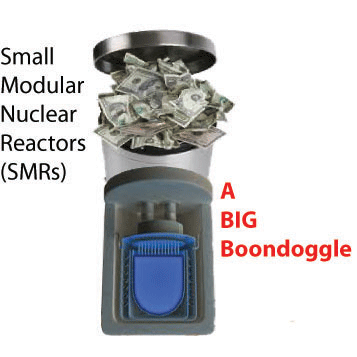
Utility Dive Stephen Singer, Editor, Jan. 27, 2023
Dive Brief:
- The partner in a merger with a small modular nuclear reactor developer going public has cautioned investors that changing markets and a “limited operating history” may ultimately be unfavorable to the business.
Ares Acquisition Corp., a special purpose acquisition company, warned in an S-4 filing with the U.S. Securities and Exchange Commission Wednesday of “limited operating experience for reactors of this type, configuration and scale” that could lead to higher than expected construction costs, maintenance requirements, operating expenses or changes in the timing of delivery. X Energy Reactor Co. announced the merger in December.- The market for SMRs generating electric power and high-temperature heat is not yet established and “may not achieve the growth potential we expect or may grow more slowly than expected,” Ares said. It’s backed by private equity firm Ares Management Corp.
Dive Insight:
The S-4 filing, which provides a preliminary proxy statement and spells out details of the renamed X-Energy business and market risks, provides boilerplate cautions to investors who require transparency and discussion of as many potential risks as possible. It highlights challenges in a still-emerging industry. The U.S. Nuclear Regulatory Commission on Jan. 19 certified NuScale Power’s SMR design, the first of its type to win federal approval………………………………
Ares said the market for SMRs, and particularly for SMRs using advanced nuclear technologies such as those employed in the Xe-100 — an 80 MWe reactor that can be scaled into a ‘four-pack’ 320 MWe power plant — has not yet been established. SMRs using advanced nuclear technologies have not been proven at scale, it said……………………..
Ares also warned that it may not attract customers for its SMR technology — a “relatively new and unproven technology” — as quickly as it expects, “or at all,” and acquiring customers may be more expensive than it currently anticipates.
In addition, Ares said the time and funding needed to bring X-energy’s nuclear fuel, TRISO-X, to market at scale may “greatly exceed” expectations………………….
Critics of SMRs have raised issues nearly identical to what Ares cited, calling out the reactors over the projected cost and time needed for siting and other approvals.
“Small modular reactors may be viable one day, but they are not today, will not be tomorrow and may never make as much economic sense as renewable sources of electricity,” the Institute for Energy Economics and Financial Analysis says. “We should stick to carbon-free energy sources that make financial and environmental sense.”………. more https://www.utilitydive.com/news/ares-acquisition-x-energy-smr-sec-investor-warning/641337/
Rolls Royce wants to make sure that the tax-payer cops the cost of their small nuclear reactor folly

Rolls-Royce calls on government for more clarity on nuclear. https://www.energylivenews.com/2023/01/26/rolls-royce-calls-on-government-for-more-clarity-on-nuclear/
Executives of the engineering giant have cited Britishvolt as an example of a company which committed to a factory without having orders.
Dimitris Mavrokefalidis
Rolls-Royce has urged the government to provide more clear vision of its target to roll out 24GW of nuclear power generation by 2050.
During a session at the House of Commons Welsh Affairs Committee, asked when Rolls-Royce will start the process of building its first Small Modular Reactor factory, Alastair Evans, Director of Corporate and Government Affairs at Rolls-Royce SMR, said: “If you look at the Britishvolt example, that is an example of a company that committed to a factory without orders. We don’t have clarity on orders in the UK.
“So, as soon as we have that clarity that the UK Government wants to deploy Rolls-Royce SMRs, we will be able to get the first factory moving, but our shareholders need that clarity. Britishvolt is a very good example of where you try and run a business and build a factory and get things moving without that certainty, orders and customers.”
A few days ago, company representatives visited the first four sites which have the potential to host 15GW of new nuclear power capacity.
Mr Evans confirmed that once Rolls-Royce receives the green light from the government, then the whole process around the development of its first SMR facility will accelerate.
He said: “That was the purpose of doing our planning processes, getting the selection of our heavy pressure vessel sites – we’ve got 600 people in the Rolls-Royce SMR business today. So we are set up to deliver at pace. We are 600 UK-based workers looking at manufacturing, assembly, lead skills, and module concept. We are ready to go.”
As the war rages on and military spending booms, the US arms industry is a big winner in Ukraine
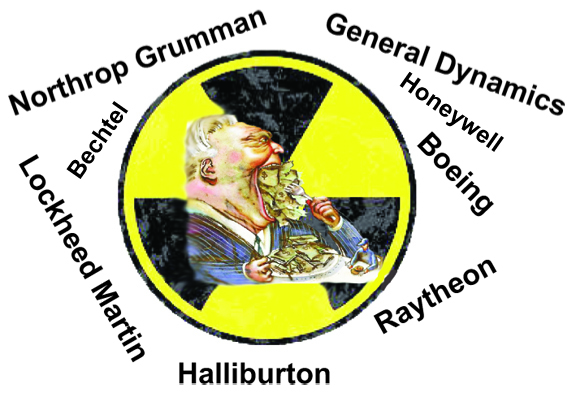
ABC News, By Annika Burgess 21 Jan 23
As the war in Ukraine heads towards the one-year mark, so far there has been only one clear winner — the US arms industry.
There is no way Ukraine would have been able to hold out against Russia without American weapons.
But as the conflict rages on, there have been accusations from some EU officials that the US is profiting from the war through weapons sales and gas prices.
Meanwhile, analysts have warned of excessive spending and the US military-industrial complex (MIC) expanding beyond what is needed in response to Ukraine.
Defence budgets are also booming worldwide as countries replenish stocks sent to Ukraine and try to boost military capabilities in the face of mounting security threats.
Ultimately, the US defence contractors are set for a bonanza. ……..
What are the issues with the MIC?
The military-industrial complex is a term coined during the Cold War to describe the relationship between a government and defence industry contractors that lobby for increased military spending.
A country’s MIC has the potential to exert influence over government policy, especially if there are legislators who can benefit from the partnerships.
In the US, there is a wider vested interest in keeping the industry thriving, especially for local economies that are highly dependant on defence contractors for jobs.
Charles Miller, senior lecturer at the ANU’s school of politics and international relations, said about 800,000 jobs are directly tied to the sector.
“The local economy is highly dependent on defence contractors for its economic wellbeing,” Mr Miller told the ABC.
“And that’s not the Raytheons or the Boeings themselves, but what’s called the secondary contractors — that is, the people and the companies that make a living by servicing them.”
Former US president Dwight Eisenhower warned of the rise of the MIC and its threat to democracy in his 1961 farewell address.
“He viewed it as a huge problem,” Bill Hartung, a defence analyst at the US Quincy Institute for Responsible Statecraft, told the ABC.
“Although, he did say in the Cold War-era large military sales were necessary, but the question was how to control it, and what democratic guardrails could be put in place.”
Today, there doesn’t seem to be the same level of concern.
The MIC was already a “powerful force”, and in response to Ukraine the US has stripped away many safeguards to protect against waste and price gouging, Mr Hartung said.
He added that a lot of changes being discussed will last far beyond the war in Ukraine.
“The United States is kind of seizing this moment to try to get out a bunch of things that have been on their wish list for years, like committing to multi-year procurement of weapons,” Mr Hartung said.
“All of which will probably make it easier for those companies to rip off the government, because there will be less negotiation over prices and the inclination to just push things out the door.”………………………………….
Who are the biggest winners?
Since Russia’s full-scale invasion in February 2022, the US and its NATO allies have been throwing tens of billions of dollars worth of military aid Ukraine’s way.
The United States alone sent around $US21.3 billion ($30 billion) in security assistance to Kyiv last year.
Contracts have been rolled out thick and fast to speed up weapons production and fill supply gaps.
And there are a small number of companies in the highly consolidated industry that are reaping the rewards.
Lockheed Martin, Raytheon, Boeing and Northrop Grumman — all from the US — are among the top contractors.
They also produce some of the most in-demand and expensive weapons being sent to Ukraine.
The conflict has sent their stocks surging, with the share price of Northrop Grumman increasing 40 per cent by the end of 2022, while Lockheed Martin’s was up by 37 per cent.
In October, the Pentagon announced $US1.2 billion in contracts were underway to replenish US military stocks for weapons sent to the battlefield.
Production for Lockheed Martin’s popular Javelin anti-tank missiles — dubbed “Saint Javelin”, the protector of Ukraine — increased from 2,100 to nearly 4,000 per year.
While production for its High Mobility Artillery Rocket Systems (HIMARS) shot up from 60 to 96 units a year.
The US upped the ante further in November, awarding Raytheon — which also co-produces Javelins — a $US1.2 billion contract for another six National Advanced Surface-to-Air Missile Systems (NASAMS) for Ukraine.
Soon after, Lockheed Martin won a $US7.8 billion contract modification for F-35 aircraft, and $US431 million to deliver new HIMARS and support services for the US Army and its foreign allies.
Australia this month also announced it was purchasing 20 HIMARS and associated hardware for $558 million.
Global defence spending boom
Last month, the US Senate passed a funding bill that included a record $US858 billion in annual defence spending — up from $US740 billion the previous year.
It was $US45 billion more than what was proposed by President Joe Biden.
The bill includes funding for Taiwan and Ukraine, allowing the Pentagon to buy massive amounts of high-priority munitions using multi-year contracts — both to help Kyiv fight Russia and to refill US stockpiles.
“It’s surprising how much it has gone up,” Mr Hartung said.
Hanna Homestead, a policy associate from the Center for International Policy (CIP) — a US-based group monitoring military spending and weapons — said contractors were already receiving a staggering amount.
“In 2020, Lockheed Martin got more money through federal contracts than the Department of State and USAID combined,” she told the ABC.
Allies like Japan have also announced historic surges in defence spending.
Last month, Prime Minister Fumio Kishida said he was boosting Japan’s 2023 defence budget by 20 per cent in the face of regional security concerns and threats posed by China and North Korea.
It includes around 250 billion yen ($3.16 billion) to buy Lockheed Martin fighter jets.
Japan’s major military reform plan will see it double defence spending to 2 per cent of GDP by 2027, using a spending target that follows the NATO standard.
Meanwhile, some NATO countries are pushing for a greater defence commitment in response to the Ukraine conflict, saying the benchmark of 2 per cent of GDP should be the bare minimum.
‘That’s just the way it is’
Many believe the US arms industry doesn’t have a great reputation.
“They continue to arm repressive regimes like Saudi Arabia, Egypt, the Philippines and Algeria that have horrific human rights records and have engaged in destabilising activities,” Mr Hartung said.
He also accused companies of “pure profiteering” when it came to Ukraine, saying they are buying back their own share market stocks to boost the prices at a time when they claim they need more money.
“[This] has nothing to do with making anyone safer,” Mr Hartung said.
“In general, the chaos of war makes profiteering easier.
The European Union’s chief diplomat Josep Borrell has accused the US of profiting from high gas prices, weapons and trade while its allies suffer.
However, Ms Homestead said it was still a small amount of companies getting the bulk of the benefits, which doesn’t necessarily trickle down.
“It’s really the private companies that are profiting, I wouldn’t say the US government is profiting,” she said. …………………………………………. https://www.abc.net.au/news/2023-01-21/us-arms-industry-military-spending-profits-ukraine-war-russia/101843752
David Schlissel: Small modular reactor project likely to end badly for Utah utilities

NuScale plan shows no promise of being better than solar and wind.
https://www.sltrib.com/opinion/commentary/2023/01/19/david-schlissel-small-modular/ By David Schlissel The Tribune, Jan. 20, 2023,
Solar and wind power, augmented by battery storage, are becoming less expensive. Hydropower and geothermal energy already are providing substantial amounts of power in many parts of the country. Cost-effective, proven technologies exist and can speed the transition to a carbon-free economy.
Small modular reactors (SMRs) designed by NuScale are not among them.
More than two dozen of the 48 Utah Associated Municipal Power Systems (UAMPS) members have signed on to buy power from the NuScale SMR when the project is planned to come online in 2029. But a history of the project — and of nuclear energy projects in general — suggests the project is likely to end badly for utilities and worse for ratepayers.
UAMPS announced earlier this month that the cost per megawatt-hour (MWh), a unit of measurement roughly equivalent to the electricity used by the average U.S. home for a little more than a month, has risen from $58/MWh to $89/MWh, a 53% increase. Plus, the cost of power from the project would be much higher than $89/MWh without more than $4 billion in subsidies the project would receive from the U.S. government. Already, the total cost of the project has risen from $5.3 billion to $9.3 billion.
Nuclear advocates often claim that the costs of nuclear reactors fall after a first design, which (if true) would be very good news for the NuScale design. Unfortunately, the nuclear industry has never shown the ability to take advantage of a learning curve, and there is no evidence to suggest that it will be able to do so now. A 2020 Massachusetts Institute of Technology study found the costs of successive nuclear projects are more expensive than the original project, which is very bad news for the NuScale design.
It’s also not good news for ratepayers. New reactor designs are already notoriously expensive and highly unlikely to meet initial deadlines. The Westinghouse AP1000 design at Plant Vogtle in Georgia, for example, was originally expected to cost $14 billion and begin operation in 2016. Its price tag has soared past $34 billion, and it won’t provide power until later this year.
Think corporations like Georgia Power, which are posting record profits, will pick up the tab? Think again: Residential consumers have already eaten $1.66 billion of construction costs, with more on the menu.
To be sure, nuclear energy has some advantages. It doesn’t emit carbon dioxide, takes up a relatively small amount of space and produces large amounts of energy. Its advantages, however, become far less apparent when the costs of a nuclear facility — and the time that it takes to build even a modest-sized project — are considered.
Proven, less-costly clean alternatives exist, especially in the western U.S. Geothermal, for example, made up 5.7% of California’s electricity generation in 2021; it was responsible for 9% in Nevada, and it’s being pushed as a much less expensive alternative to the NuScale project. Solar covers about 16% of Arizona electricity production and 6% in New Mexico. Almost 20% of Wyoming electricity comes from wind; in Idaho, the figure is about 16%.
The NuScale SMR is just another in a long line of overhyped and overpriced nuclear projects that take too much time and money — resources the planet doesn’t have in abundance if we’re serious about avoiding cataclysmic climate change by limiting global warming to 1.5⁰C by 2050.
Small modular reactors may be viable one day — but they are not today, will not be tomorrow, and may never make as much economic sense as renewable sources of electricity. We should stick to carbon-free energy sources that make financial and environmental sense.
The French nuclear sector up against the wall in terms of recruitment.
The French nuclear sector up against the wall in terms of recruitment. To
build the six reactors announced by the government, the sector must recruit
at least 10,000 people per year until 2030.
L’usinenouvelle 18th Jan 2023
Ukraine war boon/boondoggle for U.S. arms makers, Pentagon’s warfighting capabilities

Anti-Bellum January 20, 2023 Author: Rick Rozoff
Stocking Ukraine could generate foreign military sales boom
Replacing the military equipment transferred to Ukraine by the United States’ NATO allies could lead to roughly $21.7 billion in foreign military sales or direct commercial sales for American industry, according to research by the Foundation for Defense of Democracies’ Center on Military and Political Power.
….It would also enhance the quality of the weapons U.S. warfighters wield and strengthen U.S. defense industrial base capacity.
In addition to the $24.2 billion worth of security assistance the United States has committed (as of Jan. 6) to Ukraine since Russia’s Feb. 24 invasion, other NATO members have contributed billions of dollars’ worth of equipment. It is difficult to calculate precisely the cumulative value because many countries, unlike the United States, do not publish detailed lists.
NATO countries (not including the United States) have cumulatively increased their real defense spending each year since 2015, and those levels of defense spending are likely to increase further….Poland, for example, is raising its defense spending from 2.2% of its gross domestic product to 3%, which will help Warsaw purchase more military equipment………….. https://antibellum679354512.wordpress.com/2023/01/20/ukraine-war-boon-boondoggle-for-u-s-arms-makers-pentagons-warfighting-capabilities/
The British government’s Regulated Asset Base – the test case for reviving its nuclear power dream
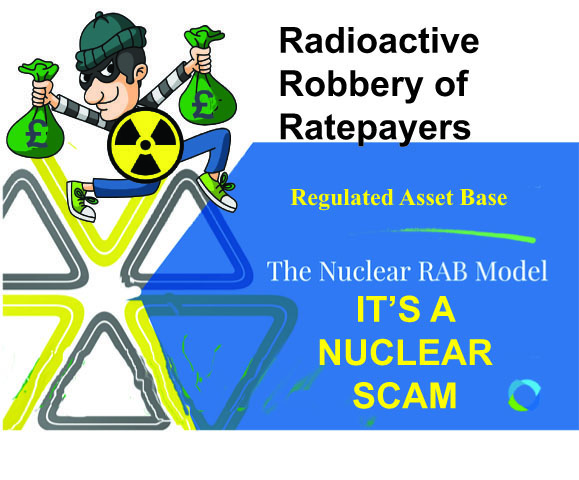
After years of false dawns, can Britain realise its nuclear ambitions? FT, 19 Jan 23 “…………………………………………………………………………………. Nuclear test case
Fresh hopes of encouraging the development of a new fleet of nuclear reactors — both large and small — now rest on a complex hybrid public-private partnership financing model known as the Regulated Asset Base. Already used for other infrastructure projects such as energy networks and airport terminals, RAB promises potential investors an “allowed revenue” — overseen by a regulator — from the start of construction, funded via a surcharge on consumer energy bills.
Supporters of the model, such as EDF, argue it significantly cuts the cost of financing because it lowers the interest that builds up during the construction phase and reduces the amount of compounded debt that needs to be serviced and paid off during the station’s lifespan. Financing costs account for roughly two-thirds of the overall cost of a nuclear plant. The allowed revenue payments continue after the plant is operational. Rather than paying a price for every unit of electricity produced, the model essentially pays for new nuclear power stations to be available.
But the RAB model is also divisive. Critics argue it would saddle bill payers with high additional costs if projects run over time and over budget.
The UK government intends for that risk to be shared between the project’s owners and consumers, according to people familiar with the discussions, although it is yet to reveal how that would work in the case of Sizewell C, which is unlikely to be connected to the electricity grid before the 2030s.
“If the cost of overruns and delays cannot just be lumped on to consumers, I think it would be implausible any investor would look at the deal,” says Steve Thomas, emeritus professor of energy policy at the University of Greenwich. “How would you feel if your pension fund was taking the risk of a nuclear project not being built to time and cost?”
For long-running nuclear sceptics, the latest attempt at ushering in a new civil nuclear golden age in Britain risks diverting attention and investment away from other technologies, such as wind, solar and storage, which could be delivered sooner to achieve the country’s near-term emissions targets.
The UK government is working towards a fivefold increase in offshore wind to 50GW by 2030 — which it claims would be enough to “power every home” — and to raise solar deployment to 70GW from 14GW by 2035. Renewables supporters claim these could still meet a lot of demand even on calmer, less bright days.
“If you want to hit your 2035 target and Sizewell C is not going to get you there [in time] then you have got to do something else . . . so why do Sizewell C as well if you are going to get there without it?” says Alison Downes, a former head of direct actions at Greenpeace UK who is now spearheading a campaign to stop Sizewell C being built.
Among longstanding nuclear proponents, there are still nerves about whether Britain’s latest attempt to revive an industry will come to fruition, even if they feel the politics are now on their side.
If a final investment decision is taken by the end of 2024 as hoped, Sizewell C will be the first test of the financing model for nuclear projects and only the second nuclear power station to enter construction since 1995, when the last of the current fleet opened. The other, Hinkley Point C, began construction in 2016 but is running over-time and over-budget. It is not currently envisaged to generate any electricity before mid-2027.
Nuclear industry executives have also been pushing ministers to confirm a new nuclear reactor construction programme beyond Sizewell C as part of GBN’s launch.
This should, in the short-term, include a commitment to take final investment decisions on two further nuclear projects in the next parliament.
But to get to that stage and avoid adding to the roster of failed nuclear projects, the impasse within government must first be resolved.
Graham Stuart, energy and climate minister at the BEIS, alluded on Wednesday to the tussle between departments, saying a date for the launch of GBN would be set once it had “a resolved and finalised agreement with His Majesty’s Treasury”.
A government insider confirmed the rollout was being held up by chancellor Jeremy Hunt who “wants to do due diligence on GBN before approving it”.
“Is there haggling over money?” the person says. “There always is.” https://www.ft.com/content/c4c481d3-99e0-4c2f-8d4e-96b4c9a3bd59
South Korea keen to market nuclear technology to United Arab Emirates, and missile technology, too.

South Korea president, in UAE, backs return to nuclear power
MRO, ABU DHABI, United Arab Emirates (AP) 16 Jan 23, – South Korean President Yoon Suk Yeol said on Monday that his nation’s efforts to be carbon neutral by 2050 would rely in part on returning to nuclear power, even though his predecessor had tried to move away from atomic power.
Yoon’s comments at a summit in the United Arab Emirates, made in front of the country’s leader, Sheikh Mohammed bin Zayed Al Nahyan, served to underline Seoul’s commitment to nuclear power as it works to finish the Arabian Peninsula’s first atomic power plant. That could see South Korea in line for lucrative maintenance contracts and future projects in the UAE, which Seoul has grown closer to over recent years.
Yoon’s predecessor, President Moon Jae-in, sought to move South Korea away from nuclear power amid safety and graft scandals and Japan’s 2011 Fukushima nuclear disaster………..
Yoon traveled later Monday to the Barakah nuclear power plant in Abu Dhabi’s far western desert near Saudi Arabia with Sheikh Mohammed before a planned business summit back in the capital.
On his arrival back, Yoon told the summit that, using the Barakah plant as an example, he hoped the Emirates and South Korea could expand this “new model of cooperation” to include nuclear fuel, small reactors and other joint advances to third countries…….
Yoon’s embrace of nuclear power also provides a guarantee of sorts that South Korea remains invested in servicing the Barakah plant. France, also home to nuclear power plants and another Emirati business and military ally, has sought contracts here as well.
Already, Yoon’s four-day trip the UAE has seen a promise from Sheikh Mohammed to invest some $30 billion in the country. Heavyweight business leaders from Hyundai, Samsung and other companies also are taking part in the state visit.
On Sunday, Yoon also visited South Korean special forces stationed in the United Arab Emirates, a murky deployment that grew out of Seoul’s deal over the nuclear power plant. The Akh unit is comprised of some 150 troops………..
Already, the Emiratis have paid $3.5 billion for the Cheongung II, or “Heaven’s Bow,” surface-to-air missile system from South Korea …. https://www.mromagazine.com/2023/01/16/south-korea-president-in-uae-backs-return-to-nuclear-power/
Poland’s energy company agrees to buy France’s NOT YET DESIGNED so-called “small” Nuward nuclear reactor!

Poland’s Respect Energy considers deploying French SMR design
WNN, 16 January 2023
Polish renewable energy trader Respect Energy has signed an agreement with EDF to cooperate on the development of nuclear power projects in Poland based on France’s Nuward small modular reactor (SMR) technology.
“This agreement marks Respect Energy’s and EDF’s firm intention to jointly proceed with the development of SMR projects in Poland and confirms the strong interest towards Nuward technology which has been selected by the energy trader to expand its footprint in the nuclear energy field,” the companies said in a joint statement. “Respect Energy and EDF will now jointly start the evaluation process of specific new greenfield sites and continue to work on detailing the business and financing plans for this endeavour.”
In October 2021, EDF made an offer to the Polish government to build as many as six EPR units. The “non-binding preliminary offer” represented a range of options for Poland. It detailed the engineering, procurement and construction that would be needed for four to six EPR units, at either two or three sites. The EPR units would produce 1650 MWe each if selected – the Polish government announced late last year that it had selected Westinghouse technology for at least the first three of its planned fleet of reactors……………….
The Nuward project was launched in September 2019 by the French Alternative Energies and Atomic Energy Commission (CEA), EDF, Naval Group and TechnicAtome. The Nuward – consisting of a 340 MWe SMR plant with two pressurised water reactors (PWRs) of 170 MWe each – has been jointly developed using France’s experience in PWRs……………..
Nuward is currently in the conceptual design phase, which focuses on choosing the major technical features while delivering real competitive advantages. Belgian engineering firm Tractebel was contracted in May last year to conduct studies for the completion of the conceptual design of “the first SMR in the European Union”.
The next phase of the project, the basic design completion, is expected to start this year and to be completed by 2025. The design should be in the “advanced concept phase” between 2025 and 2030, during which time Nuward is expected to be certified and the supply chain developed.
Construction of a demonstration Nuward SMR is expected to start in 2030. The construction of that unit is anticipated to take three years.
In June, it was announced the Nuward design will be the case study for a European early joint regulatory review led by the French nuclear safety regulator with the participation of the Czech and Finnish nuclear regulators….. https://world-nuclear-news.org/Articles/Poland-s-Respect-Energy-considers-deploying-French
1 This Month



26 September – International Day for the Total Elimination of Nuclear Weapons


PLEASE OPPOSE HR 8255 AND S.3639 – bills would accelerate satellite deployment, with no environmental review or safeguards – https://ncstd5li.quorum.us/campaign/169331/
To see nuclear-related stories in greater depth and intensity – go to https://nuclearinformation.wordpress.com
-
Archives
- September 2026 (233)
- August 2026 (330)
- July 2026 (355)
- June 2026 (287)
- May 2026 (306)
- April 2026 (356)
- March 2026 (251)
- February 2026 (267)
- January 2026 (308)
- December 2025 (358)
- November 2025 (359)
- October 2025 (375)
-
Categories
- 1
- 1 NUCLEAR ISSUES
- business and costs
- climate change
- culture and arts
- ENERGY
- environment
- health
- history
- indigenous issues
- Legal
- marketing of nuclear
- media
- opposition to nuclear
- PERSONAL STORIES
- politics
- politics international
- Religion and ethics
- safety
- secrets,lies and civil liberties
- spinbuster
- technology
- Uranium
- wastes
- weapons and war
- Women
- 2 WORLD
- ACTION
- AFRICA
- Atrocities
- AUSTRALIA
- Christina's notes
- Christina's themes
- culture and arts
- Events
- Fuk 2022
- Fuk 2023
- Fukushima 2017
- Fukushima 2018
- fukushima 2019
- Fukushima 2020
- Fukushima 2021
- general
- global warming
- Humour (God we need it)
- Nuclear
- RARE EARTHS
- Reference
- resources – print
- Resources -audiovicual
- Weekly Newsletter
- World
- World Nuclear
- YouTube
-
RSS
Entries RSS
Comments RSS
 nuclear-news