UK’s Sizewell Nuclear Investors to Face Security Checks
1\Investors in the UK’s next nuclear power plant, Sizewell C, will face
“strict national security checks” by the government, after the state
last year bought out a Chinese company’s stake in the project.
Britain opened the private investment process on Monday for the 3.2 gigawatt
nuclear power plant that’s being built by Electricite de France SA.
Companies will have to demonstrate that they meet key criteria before
starting negotiations on Sizewell C, including experience in delivering
major infrastructure projects, according to a statement.
The UK is particularly sensitive about which countries it allows into its nuclear
infrastructure. The administration last year took over China General
Nuclear Power Corp.’s stake in EDF’s Sizewell project following
concerns over national security.
Still, being too picky may make it
difficult to get investors for the projects that need billions of dollars
of spending, and also brings the risk of cost overruns and delays.
Bloomberg 18th Sept 2023
https://www.bnnbloomberg.ca/uk-s-sizewell-nuclear-investors-to-face-security-checks-1.1972837
Bidenomics: Millions to Rebuild Maui, Billions for Ukraine
Eve Ottenberg / CounterPunch SCHEERPOST, September 18, 2023
Last month, President Joe “No Comment on Hawaii” Biden’s Twitter boosters hurried to claim that the measly $700 he initially boasted of for Maui fire victims was but the first installment of more generous help to come. But the proof of the pudding is in the eating, and even with Biden’s added ingredients, the pudding’s comparatively pretty thin and watery. On August 30, Biden pledged $95 million from the Bipartisan Infrastructure Law to aid Mauli’s rebuilding. It remains to see how far that goes – thousands of homes burnt to the ground. With an average home price in the most affected area, Lahaina, coming in at a cool million dollars, Biden’s promised bonanza, made after his disastrous hegira to Hawaii, may not stretch far.
Meanwhile, the Biden bunch showers billions on the most corrupt government in Europe and possibly in the world, namely Ukraine, whose American-gifted weapons flame into action all over the Middle East and in the hands of Mexican drug cartels (whose dangers are small potatoes compared to this past week’s massive, reckless and wildly provocative clinker of NATO wargames in the Black Sea), but when it comes to actual needy Americans – well, they aren’t worth as much as Washington’s imperial clients……………………………………………………………..
We do NOT need billions for Kiev kleptocrats. We do not need trillions for that ravenous monster python called the military industrial complex, busy devouring the last bloody scraps of the heart of the American economy. Washington should begin planning – yesterday……………………………………………………………………………… more https://scheerpost.com/2023/09/18/bidenomics-millions-to-rebuild-maui-billions-for-ukraine/.
‘War Is Good for Business,’ Declares Executive at London’s Global Arms Fair

16 Sept 23 By Brett Wilkins / Common Dreams
“Deals done at DSEI will cause misery across the world, causing global instability, and devastate people’s lives,” one peace activist lamented.
Military-industrial complex players big and small gathered in London this week, hawking everything from long-range missiles to gold-plated pistols to arms fair attendees—including representatives of horrific human rights violators—as weapon-makers and other merchants of the machinery of death reap record profits.
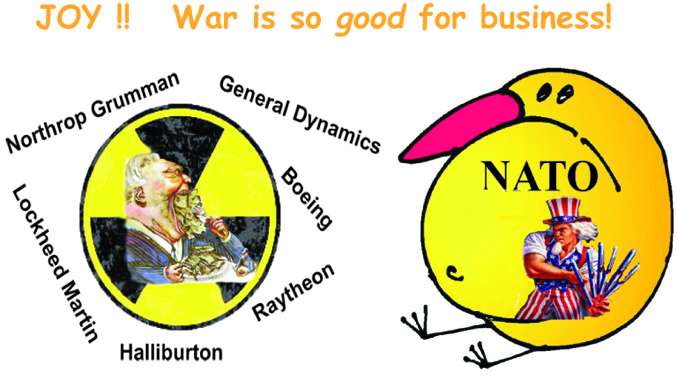
“War is good for business,” one defense executive attending the biennial Defense and Security Equipment International (DSEI) conference at ExCel London flat-out told Reuters. “We are extremely busy,” Michael Elmore, head of sales at the U.K.-based armored steelmaker MTL Advanced, told the media agency.
Russia’s ongoing invasion of Ukraine and the West’s scramble to arm Ukrainian homeland defenders have been a bonanza for arms-makers.
“Ukraine is a very interesting combination of First and Second World War technologies and very modern technology,” Kuldar Vaarsi, CEO of the Estonian unmanned ground vehicle firm MILREM, told Reuters.
Saber-rattling and fearmongering by government, media, and business figures amid rising tensions between the U.S. and its allies on one side, and a fast-rising China on the other, have also spurred military spending, including Japan’s $320 billion buildup announced last December.
“We think this is a longer-term essentially ‘sea change’ in national defense strategy for the U.S. and for our Western allies,” Jim Taiclet, CEO of U.S. arms giant Lockheed Martin, told investors during a call earlier this summer announcing higher-than-expected sales and profit outlooks.
According to the Stockholm International Peace Research Institute, the United States, Russia, France, China, and Germany were the world’s top arms exporters from 2018-22, with the five nations accounting for 76% of all weapons exports during that period. The U.S. accounted for nearly 40% of such exports during those five years, while increasing its dominance in the arms trade. The U.S. also remains by far the world’s biggest military spender.
In addition to major corporations, middlemen like Marc Morales have also been profiting handsomely from wars in countries including Ukraine. Morales happened to have a warehouse full of ammunition in Bulgaria that the Pentagon originally intended for Afghanistan when Russia invaded its neighbor, and he has been richly rewarded as the U.S. spends tens of billions of dollars arming Ukrainian forces. He named his new $10 million yacht Trigger Happy.
Outside the sprawling ExCel convention center in London’s Docklands, anti-war protesters rallied against the global arms trade and the death and destruction it fuels. The Guardianreported that at least a dozen demonstrators were arrested during the course of the conference, including nine on Thursday for blocking a road outside the venue.
Sam Perlo-Freeman, a researcher at the Campaign Against Arms Trade (CAAT), told The Guardian that “a lot of countries that are being talked about as new arms export markets are ones we would be concerned about.”…………………………………
“Deals done at DSEI will cause misery across the world, causing global instability, and devastate people’s lives,” Apple added.
Inside ExCel, it was business as usual. Pressed by Declassified U.K. chief reporter Phil Miller on why Britain’s right-wing government supports “selling arms to the Saudi dictatorship that sentences someone to death for tweeting,” Minister of State for the Armed Forces James Heappey deflected.
Private sector leaders, however, have been more forthcoming. As Raytheon CEO Greg Hayes opined during a 2021 investor call touting the company’s “solid” growth: “Peace is not going to break out in the Middle East anytime soon.” https://scheerpost.com/2023/09/16/war-is-good-for-business-declares-executive-at-londons-global-arms-fair/
Public Need Versus the Business of War
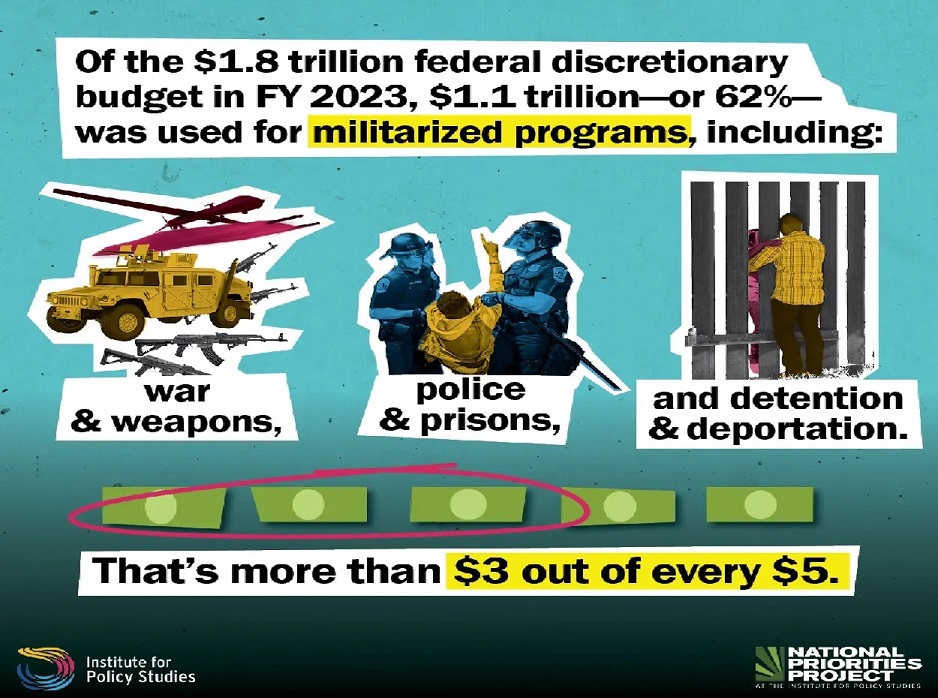
What does military contracting tell us about the priorities of the U.S. ruling class?
CHRISTIAN, SEP 16, 2023 Christian’s Substack
The American public is hurting. The bare necessities—clean water, nutritious food, and affordable housing—are hard to come by.
Tap water is contaminated with lead, PFAS, and other pollutants. The water systems that serve cities and towns suffer additional stressors, including drought, overuse, and a failure to incorporate greywater systems. And, like many necessities, you have to pay for it in the United States: Water utility prices continue to go up and up.
Hunger is a severe problem. ……………………………………
Housing is prohibitively expensive. …………………………………..
What is U.S. Congress doing as the public suffers?
Water Is Not a Priority
Every year, U.S. Congress appropriates money for two federal water funds. The Environmental Protection Agency gives this money to states in the form of grants. The Washington Post recently reported, “Since 2022, the federal allocation has totaled roughly $5.5 billion, amounting to a literal and figurative drop in the bucket for a nation with an estimated $625 billion backlog in projects just to provide cleaner, reliable drinking water.”
In other words, Congress has allocated 0.88 percent of the funding needed to establish infrastructure that dependably provides potable water.
It gets worse. Members of Congress skim funds off the top……………………………………
Food is Not a Priority
Stephen Semler, co-founder of the Security Policy Reform Institute, recently showed that annual U.S. military spending increased during the Trump administration by 20 percent in nominal terms and then increased during the first two years of the Biden administration by 15 percent in real terms. The military budget is now a record $858 billion for fiscal 2023, a bipartisan feat.
Food insecurity “climbed 18 percent during the same stretch,” Semler explained. “Something’s wrong when either military spending or food insecurity spikes over a two-year period. When they soar in tandem, it’s an abomination…”
There is plenty of money available to make sure people don’t go hungry. For example, the amount of money to be spent over several years on new land-based nuclear weapons ($263.9 billion) could instead build 52.5 million community gardens ($2,750 each) across the country, with more than enough money left over ($119.52 billion) to cover a year of food stamps. Tax dollars, we see, could be used to nourish instead of accidentally or deliberately eliminating human life on Earth.
The Housing Crisis……………………………………
Support the Troops
Evidence suggests that the federal government doesn’t even prioritize the troops’ water, food, and housing…………………………………………………………………………………
A State of Permanent Warfare
Military and intelligence personnel don’t deploy themselves. The U.S. ruling class deploys them.
When “successful,” military or intelligence operations open up an economy to multinational corporations, enriching the ruling class. Examples spanning the three main eras of the military-industrial complex (the first Cold War, the “global war on terror”, and today’s “strategic competition”) illustrate this success:……………………………………………………………………………………….
Moreover, U.S. military activity itself is extremely profitable for Wall Street and top corporate executives, as the U.S. military doesn’t shoot, move, or communicate—let alone eat, refuel, fly, or spy—without corporate goods and services. Corporations absorb more than half of the U.S. military budget. Many regularly price gouge the military.
The ruling class is organized and relentless in its pursuit of profit. The three branches of government (legislative, judicial, executive) largely respond to the needs of this class. Some of the richest and/or most influential members of U.S. government, such as a coal baron or a person who has profited from the provision of healthcare, even come from that class.
The Front Burner
A military aircraft, the F-35 Joint Strike Fighter, embodies the priorities of the ruling class. With a lifetime cost expected to top $1.7 trillion, the F-35 is on track to becoming the most expensive weapon of all time………………………………………………………………………………………………………………
One-Two Punch
The military-industrial complex is a one-two punch to the public………………………………………………………………………………… more https://thebusinessofwar.substack.com/p/public-need-versus-the-business-of?utm_source=post-email-title&publication_id=1769284&post_id=137081544&utm_campaign=email-post-title&isFreemail=true&r=c9zhh&utm_medium=email
Top candidate for head of European Investment Bank cautions about defense, nuclear investments
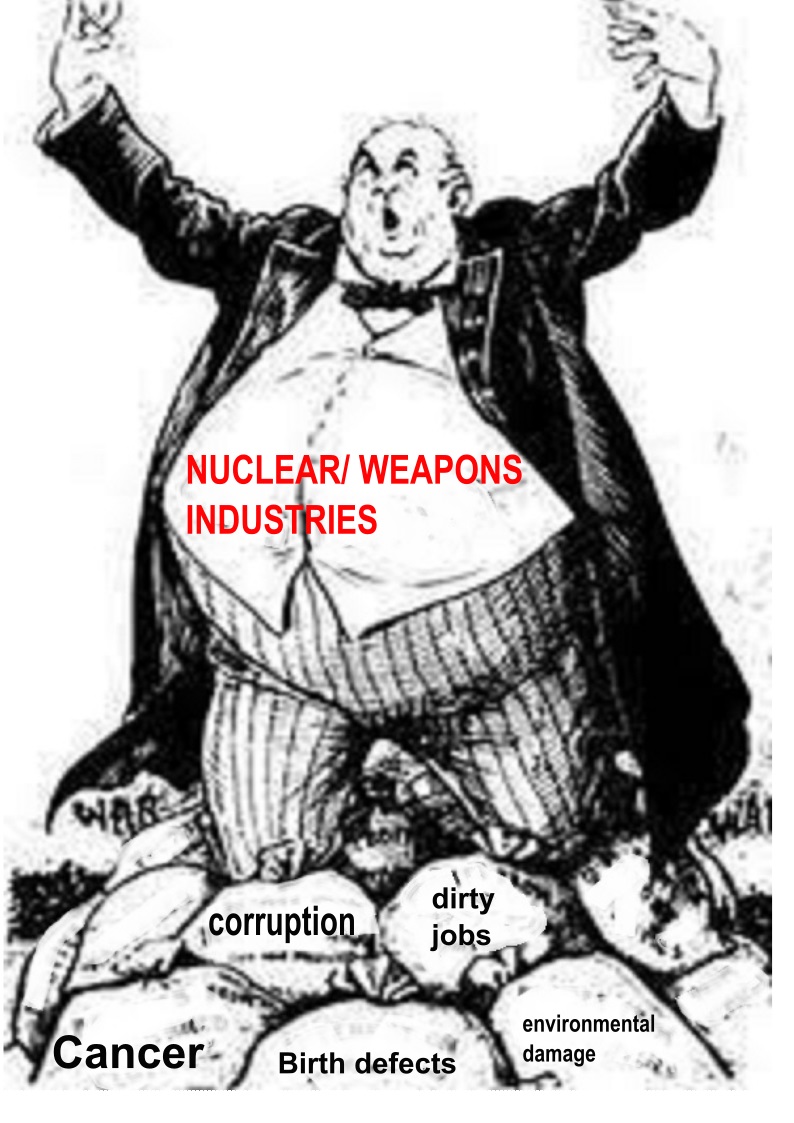
France has been pushing for a candidate sympathetic to steering the EIB funds to nuclear projects and defense investments.
Vestager cautions about defense, nuclear investments in EIB pitch
BY PAOLA TAMMA. SEPTEMBER 15, 2023, Politico
The European Investment Bank is ‘for everybody,’ Dane says in an effort to win wider support for job bid.
SANTIAGO DE COMPOSTELA, Spain — The European Investment Bank should not become a “political fighting arena” for investments in nuclear energy or defense, said Margrethe Vestager, who’s trying to convince European Union finance ministers to pick her to head the powerful government-backed lender.
Vestager, currently on leave as EU digital and antitrust chief, is one of the top candidates to take over from President Werner Hoyer next year and lead the bank that finances EU policies, from fighting climate change to rebuilding Ukraine.
She stressed that a successful candidate needed broad support, including smaller countries, because “the bank is for everybody, big shareholders as well as small shareholders,” she told POLITICO on the sidelines of a finance ministers’ gathering in Santiago de Compostela.
France and Germany, who together with Italy, account for nearly half of the bank’s capital, haven’t said who they will back. France has been pushing for a candidate sympathetic to steering the EIB funds to nuclear projects and defense investments. It also wants someone willing for the cautious lender to take on more risks.
Germany has emphasized that “sound banking is essential” and that “the mission of the EIB mustn’t be overstretched,” Finance Minister Christian Lindner said ahead of the meeting.
Nuclear “is a good example of the fact that the bank should not be a political fighting arena,” Vestager said. The EIB “should not take sides” and should “engage in processes that maybe can find a new balance.”……………more https://www.politico.eu/article/margrethe-vestager-nuclear-defense-eib-european-investment-bank-pitch-smaller-nations/
“A Good Investment”: The Ukraine War and the US Arms Racket
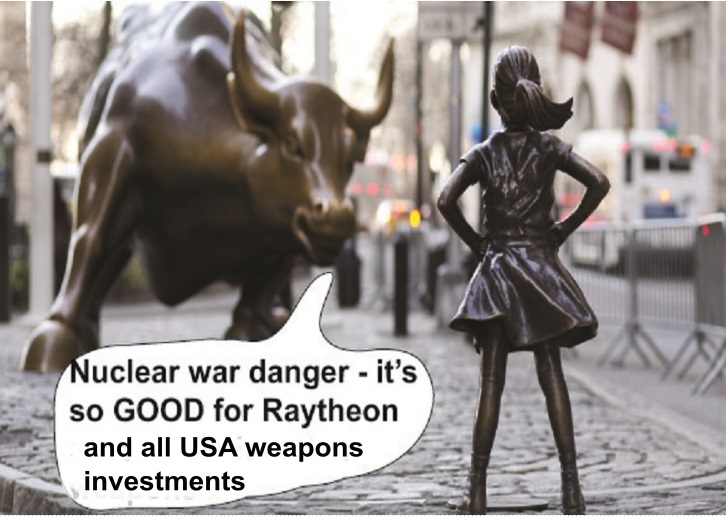
“from numerous perspectives, when viewed from a bang-per-buck perspective, US and Western support for Ukraine is an incredibly cost-effective investment.”
the US arms industry is the “one clear winner” in this bloody tangle.
September 9, 2023 by: Dr Binoy Kampmark https://theaimn.com/a-good-investment-the-ukraine-war-and-the-us-arms-racket/
It all tallies. War, investments and returns. The dividends, solid, though the effort expended – at least by others – awful and bloody. While a certain narrative in US politics continues in the vein of traditional cant and hustling ceremony regarding the Ukraine War – “noble freedom fighters, we salute you!” twinned with “Russian aggressors will be defeated” – there are the inadvertently honest ones let things slip. A subsidised war pays, especially when it is fought by others.
The latter narrative has been something of a retort, an attempt to deter a growing wobbling sentiment in the US about continuing support for Ukraine. In a Brookings study published in April, evidence of wearying was detected. “A plurality of Americans, 46%, said the United States should stay the course in supporting Ukraine for only one to two years, compared with 38% who said the United States should stay the course for as long as it takes.”
In early August, a CNN survey found that 51% of respondents believed that Washington had done enough to halt Russian military aggression in Ukraine, with 45% approving of additional funding to the war effort. A breakdown of the figures on ideological grounds revealed that additional funding is supported by 69% of liberals, 44% of moderates and 31% of conservatives. In Congress, opposition to greater, ongoing spending is growing among the Republicans, reflecting increasing concern among GOP voters that too much is being done to prop up Kyiv.
Such a mood has been anticipated by number crunching types keen to reduce human life to an adjustable unit on a spreadsheet. The Centre for European Policy Analysis, for example, suggested that a “cost-benefit analysis” would be useful regarding US support for Ukraine. “Its producing wins at almost every level,” came the confident assessment. In spectacularly vulgar language, the centre notes that, “from numerous perspectives, when viewed from a bang-per-buck perspective, US and Western support for Ukraine is an incredibly cost-effective investment.”
War-intoxicated Democrats would do well to remind their Republican colleagues about such wins, notably to those great patriots known as the US Arms Industry. Aid packages to Ukraine, while dressed up as noble, democratic efforts to ameliorate a suffering country’s position vis-à-vis Russia, are much more than that.
In May 2022, for instance, President Joe Biden signed a bill providing Kyiv $40.1 billion in emergency funding, split between $24.6 for military programs, and $15.5 billion for non-military objects. Even then, it was clear that one group would prove the greatest beneficiary. Stephen Semler of the Security Policy Reform Institute was unequivocal: US military contractors.
Of the package, rich rewards amounting to $17.3 billion would flow to such contractors, comprising goods, be they in terms of weapons and equipment, or services in the form of training, logistics and intelligence. “It allows the Biden administration,” writes Semler, “to continue escalating the United States’ military involvement in the war as the administration appears increasingly disinterested in bringing it to an end through diplomacy.”
Broadly speaking, the US military-industrial complex continues to gorge and merely getting larger. Whatever the outcome of this war – talk of absolute victory or defeat being the stuff of dangerous fantasy – it remains the true beneficiary, the sole victor fed by new markets and opportunities. Former Israeli foreign minister Shlomo Ben-Ami, now vice president of the Toledo Center for Peace, had to concede that the US arms industry was the “one clear winner” in this bloody tangle.
The addition of new member states to NATO, in this case Finland and Sweden, will, Ben Ami suggests, “open up a big new market for US defence contractors, because the alliance’s interoperability rule would bind them to American-made defence systems.” The evidence is already there, with Finland’s order of 64 new F-35 strike fighters developed by Lockheed Martin, Northrop Grumman and BAE Systems. The Ukraine War has been nothing short of lucrative in that regard.
Such expansion also comes with another benefit. The interoperability requirement in the NATO scheme acts as a bar to any alternatives. “The market for their goods is expanding,” writes Jon Markman for Forbes, “and they will face no competition for the foreseeable future.”
It should come as little surprise that the US defence contractors have been banging the drum for NATO enlargement from the late 1990s on. While a good number of those in the US diplomatic stable feared the consequences of an aggressive membership drive, those in the business of making and selling arms would have none of it. The end of the Cold War necessitated a search for new horizons in selling instruments of death. And with each new NATO member – Hungary, Poland, the Czech Republic – the contracts came. Washington and the defence contractors, twinned with purpose, pursued the agenda with gusto.
In 1997, Democratic Senator Tom Harkin was awake to that fact in hearings of the Senate Appropriations Committee on the cost of NATO enlargement. He was particularly concerned by a fatuous remark by Secretary of State Madeleine Albright comparing NATO’s expansion with the economic Marshall plan implemented in the aftermath of the Second World War. “My fear is that NATO expansion will not be a Marshall plan to bring stability and democracy to the newly freed European nations but, rather, a Marshall plan for defense contractors who are chomping [sic] at the bit to sell weapons and make profits.”
The moral here from the US military-industrial complex is: stay the course. The returns are worth it. And in such a calculus, concepts such as freedom and democracy can be commodified and budgeted. As for Ukrainian suffering? Well, let it continue.
Are They Already Cutting Corners on Worker Protection at DOE’s New Plutonium Processing Plant?

plutonium is toxic at the scale of micrograms, deadly at the scale of milligrams, and useable in nuclear weapons of mass destruction at the scale of kilograms. This is why plutonium work requires rigid, intensive safety systems, referred to as “defense in depth,” to protect workers and the surrounding people and landscape; as well as extreme levels of security and material accounting.
CounterPunch, BY DON MONIAK 11 Sept 23
As of this past Labor Day, there are strong indications that future workers at the planned, new Savannah River Plutonium Processing Plant (SRPPF) may face unnecessary, increased risks of exposure to radiological hazards inherent in plutonium toxicity and chemical complexity.
According to an August 3, 2023 letter from the Defense National Facilities Safety Board (DNFSB) to the Department of Energy’s (DOE) National Nuclear Security Agency (NNSA), the SRPPF project leadership team does not consider vital plutonium processing safety equipment as “safety significant controls.”
According to the letter, NNSA’s project leadership team believes a reliance on worker sense of sight, hearing, taste, smell, and touch is sufficient to detect and/or prevent accidents such as plutonium fires and dispersal of plutonium oxide powder.
In the hierarchy of nuclear safety, the Department of Energy standards place “Safety Significant Controls” above administrative controls that are reliant upon the absence of human error.
The motive for SRPPF project team’s preference for administrative controls is unknown.
The New Plutonium Processing Plant.
The plutonium/MOX (Pu/MOX) fuel facility was a massive, multi-billion dollar endeavor designed to help dispose of dozens of tons of surplus nuclear weapons plutonium (Pu). This Savannah River Site(SRS) project was abandoned in the late 2010’s, following a chronic array of technical issues, mismanagement, major cost overruns, cutting of corners, and the lack of commercial Pu/MOX fuel customers.
After the project was abandoned, the Department of Energy’s (DOE) National Nuclear Security Agency (NNSA) decided to repurpose the unfinished facility into a new “plutonium pit”production plant. The Mixed Oxide Fuel Fabrication Facility (MFFF) was then renamed the Savannah River Plutonium Processing Plant (SRPPF). This $11 billion plus repurposed facility is already burdened by cost overruns—-the original estimate was $3.7 billion.
Plutonium pits are referred to as the primary nuclear explosives, or triggers,” (1) that dominate the known U.S. nuclear weapons arsenal. Pits acquired their quaint nickname by virtue of the resemblance of the configuration of high explosives surrounding the primary nuclear explosive to stone fruit like peaches and plums—an example of early nuclear weaponeers’ inside humor.
The Pu pits are pressure vessels with nested shells of material, comprised of other non-nuclear parts, including the metal cladding, welds, a pit tube, neutron tamper(s) and initiator, as well as the usually hollow-cored plutonium hemispheres. In most pit designs, a sealed pit tube carries deuterium-tritium gas into the hollow-core to boost the nuclear explosive power of weapons.
But unlike the sweet, fruity, and and delectable flesh surrounding plum and peach pits, a Pu pit is surrounded by a high explosives package powerful enough to implode the plutonium metal sphere contained in the pit. This is not like compressing a tin can, as plutonium is the most durable of the transuranic heavy metals.
The current plan is to annually produce at least eighty new plutonium pits in the SRPPF. Pit fabrication was once the exclusive task at the long-closed Rocky Flats plant in Colorado, and the work processes constitute the most dirty—in terms of waste production—and dangerous workplace in the national nuclear weapons complex. In this century, Los Alamos National Laboratory (LANL) has failed miserably to reconstitute a tiny fraction of the Rocky Flats pit production rate.
Pit production is unlikely to be the only task at the SRPPF. An estimated ten to twelve-thousand surplus plutonium pits, containing a sum of 30 to 34-metric tonnes of plutonium, could also be processed at a plutonium pit disassembly and conversion line at the SRPPF. The resulting plutonium oxide powder would then be sent to the SRS K-Area’s Pu waste production facility, where the powder is diluted to a three to five percent level within a larger mixture of inert materials………………………….
Some Plutonium Processing Hazards
There is a negligible level of debate that plutonium is toxic at the scale of micrograms, deadly at the scale of milligrams, and useable in nuclear weapons of mass destruction at the scale of kilograms. This is why plutonium work requires rigid, intensive safety systems, referred to as “defense in depth,” to protect workers and the surrounding people and landscape; as well as extreme levels of security and material accounting.
The most hazardous plutonium operations involve plutonium pit fabrication. After pit disassembly, the plutonium within pits is converted to a finely dispersed powder form (2), made up of sticky grains containing energetic alpha particles that easily damage soft lung tissues. Sticky plutonium oxide particles clinging to ductwork can also hinder ventilation systems over time.
Recycling plutonium for pit production then requires difficult and dangerous processes to remove impurities and undesirable decay products such as intensely radioactive Americium-241. (3) The resulting plutonium form is transferred to the next step, the plutonium foundry.
The foundry work involves a complex ten-step process, summarized as melting, casting, and heat treating of plutonium metal. Gallium is added at a one-percent ratio to produce an alloy that is considered almost as easy to machine as aluminum or silver. The risk from explosion, criticality, and spill hazards must be rigidly controlled; while contaminated parts such as crucibles pose unique waste management measures.
The final plutonium processing step is machining the foundry product into a precise sub-critical configuration. Like any machining, Plutonium metal work casts tiny shavings and creates fine dust.
These shavings can ignite upon exposure to air and lead to larger fires that can destroy glove boxes and ventilation systems, and cause large releases of plutonium into the atmosphere. The Rocky Flats experience suggests that fires of any size are not a remote possibility, they are a probability.
The task is to keep Pu metal fires small and nondestructive, while preventing injury and harmful exposures to workers. A small fire can render costly equipment useless. A large fire can lead to a countryside contaminated with particles that become more intensely radioactive for decades.
Extreme care must also be taken to keep plutonium metal in a non-critical configuration at all times. The wrong geometry or placement of metal pieces in the wrong configuration can produce the deadly blue light that signifies criticality accidents. In 2009, a number of Los Alamos criticality engineers walked off the job at the lab’s pit production line, citing a casual approach to criticality safety.
The final step is assembly, where the parts that make pits tick are introduced. The making of these parts pose their own toxic hazards, such as the fine dust from machining beryllium metal.
Those are just several aspects of the safety issues involved with the plutonium pit fabrication.
The True, and False, Necessity for New Pit Fabrication and Production. ……………………………………………………………………………………………………………………………………………………………………………….
The Pit Plant’s Initial Design: One Less Layer of Safety Depth?
Because of all these factors, new pit production is considered essential, and a new, smaller scale—by Cold War Standards—plutonium pit fabrication capacity is presently in the preliminary design phase at the SRPPF complex.
The highest standards of safety are expected to prevent accidents or mitigate the impacts of spills, fires, leaks, and dispersion of fine radioactive dust. A less rigid approach to safety is quite unexpected for a high hazard, hardened nuclear facility that would only be the second its kind in the weapons complex—-the last being the Rocky Flats plant built in the 1950’s.
But according to the August 3, 2023 letter from the Defense Nuclear Facilities Safety Board (DNFSB), the DOE/NNSA’s project leadership team does not consider vital plutonium processing safety equipment as “safety significant controls.”…………………………………………………………………………………………………………………………………………………………………………………………….more https://www.counterpunch.org/2023/09/11/are-they-already-cutting-corners-on-worker-protection-at-does-new-plutonium-processing-plant/
1000 Sellafield Ltd. contractors to be balloted for strike by Unite
AROUND 1,000 contractors at Sellafield are being balloted for potential
strike action, after Unite have criticised an ‘unacceptable offer’ from
management. More than 3,000 engineering construction workers nationally,
operating under the National Agreement for Engineering Construction
Industry (NAECI), are being balloted for strike action overpay, Unite, the
UK’s leading union, said on Thursday, September 7. This includes about
1,000 Sellafield Ltd. contractors who the union say conduct critical repair
and maintenance at the site.
Whitehaven News 10th Sept 2023
Today Hinkley C contract would cost £180 per MWh around 3xs the cost of offshore wind

DAVID TOKE, SEP 8, 2023 https://davidtoke.substack.com/p/today-hinkley-c-contract-would-cost
There’s been a lot of talk about how offshore wind has ‘increased’ its costs since the last Government contract auction – but that’s not a patch on nuclear power a la Hinkley C, courtesy of EDF. Capital costs for the project have increased in real (not just inflation) terms by around 50 percent since 2012, and there’s probably a lot worse to come.
The figure of £92.50 per MWh is often mentioned as the price of the contract for Hinkley C, and that is the contract price in 2012 prices. In today’s money using the Government’s preferred CPI calculator that is £124 per MWh – higher even than the currently gas-inflated wholesale power price.
But it is worse, much much worse than that, because Hinkley C’s real, not just inflation-adjusted price, has increased. In 2012 the capital cost was estimated at £16 billion by EDF. Now the capital cost in 2012 prices has risen to around £33 billion in 2023 money or around £24 billion in 2012 money.
That means that if Hinkley C’s contract was set up today at the revised capital cost then the equivalent contract price would be about £138 per MWh in 2012 prices and around £180 per MWh in today’s prices. That is of course if the contract was assessed on the same contract length – 35 years, and on a similar rate of return. The rate of return certainly would not be less since interest rates are a lot higher than they were in 2012.
The estimates published by EDF do not include interest rate charges. They are called ‘overnight’ costs, which in itself is highly ironic since the last thing nuclear power stations are noted for is being built overnight. Their construction takes many years, racking up immense interest charges on the way. If this was a private company they surely would have gone bust by now. The only way that EDF could get themselves into this position is because everybody knows that the French Government will inevitably bail them out.
Of course, as far as Hinkley C costs go, the only way is up. Heaven knows how high they will go! And the Government is going to make electricity consumers pay for the next EDF nuclear disaster at Sizewell C!
So let’s reflect a bit on the apparent horror apparently experienced by the UK Treasury that they might have to offer more than £44 per MWh (at 2012 prices) for offshore wind contracts.
Health and safety concerns raised with Dounreay management
Some trade union and safety representatives have no confidence in the
management at Dounreay and have raised health and safety concerns at the
site.
A number of employees told the John O’Groat Journal that they are
also worried over how issues on the well-being of staff were being
addressed. “There are numerous cases of staff members off due to
work-related stress – some as a result of bullying and harassment,” said
one worker. “Concerns have been raised but do not appear to be addressed.
“Dounreay has said that ‘our workers are out greatest asset’, but from the
conversations I’ve had with people across site, this is not believed.”
Another employee stated: “This has been an ongoing issue for years. It is
hard to prove in many cases and has been dealt with in some instances.
Safety reps have been involved in meetings on this topic along with the
chairman of the Trade Union Co-ordinating Committee.”
John O’Groat Journal 8th Sept 2023
Biden’s horse-trading on nuclear technology and fuels is an unprecedented proliferation risk
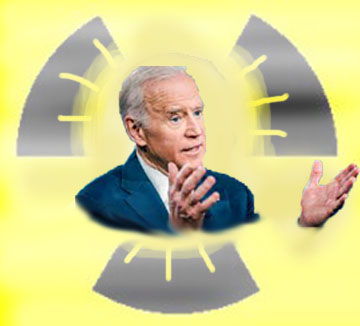
he is funding not just prudent nuclear research, but also their boondoggles to expand use of plutonium and HEU fuel. To ensure US military support for the trilateral Australia-United Kingdom-United States (AUKUS) deal, he is acquiescing to Navy insistence on using weapons-grade uranium reactor fuel, even in exported submarines. However, recent spikes in demand for nuclear weapons, among friends and foes alike, suggests this is a dangerously short-sighted approach.
Bulletin, By Alan J. Kuperman | September 6, 2023
News media in the United States rarely report on nuclear proliferation until it reaches the crisis stage—as in North Korea and Iran. By then, however, it is typically too late to stop the spread of nuclear weapons. Effective nonproliferation must begin much earlier, not only by suppressing demand for nuclear weapons but also by restricting supplies of the fissionable materials necessary to build them in the first place. Sadly, the Biden administration is bungling this latter responsibility.
To acquire the bomb, nuclear aspirants must first obtain its key ingredient: plutonium or highly enriched uranium (HEU). So, as demand for nuclear weapons grows in Asia, the Middle East, and Europe, one would expect the US government to do everything it can to clamp down on supply. Instead, President Joe Biden is actually doing just the opposite, by promoting commerce in weapon-usable nuclear materials as a bargaining chip for other issues. Unless the president reverses course, one of his greatest foreign policy legacies could wind up being global nuclear proliferation.
The spike in demand for nuclear weapons has been driven by several key events over the past two decades………………………………………………………………………………………………………….
Considering this growing demand for nuclear weapons, an essential policy to avert proliferation is to block the supply of the necessary fissionable materials. Regrettably, the Biden administration instead has taken four steps that would foster proliferation of both plutonium and weapons-grade uranium.
First, President Biden is funding US companies like Oklo that want to reprocess used reactor fuel—how plutonium is obtained in the first place, by separating it from nuclear waste—and then deploy its fuel recycling technology “on a global scale.” This would reverse nearly half a century of bipartisan US policy opposing such activity at home and abroad, which has succeeded at restricting commercial reprocessing to only two countries, France and Russia, both of which already have nuclear weapons.

Second, the Biden administration is providing a $2 billion subsidy to Bill Gates (currently the fifth richest person in the world) to develop exotic “fast” nuclear reactors, which originally were designed explicitly to increase supplies of plutonium. Gates’s nuclear energy startup Terrapower promises not to use them this way, but the reactors are so expensive that countries importing them could cite economics to justify turning them into plutonium factories.

Third, the president is pursuing construction of a civilian US research reactor using weapons-grade HEU fuel for the first time since the 1960s, thereby threatening to undermine decades of progress in delegitimizing this dangerous fuel globally.

Fourth, the White House has agreed to export tons of weapons-grade uranium—an amount sufficient for hundreds of nuclear bombs—to fuel Australia’s forthcoming SSN-AUKUS nuclear-powered submarines. This announcement already has prompted at least one other country, Iran, to suggest that it too may produce HEU for naval fuel—a well-known back door to nuclear weapons. The good news is that Australia’s submarines likely could be redesigned to use low-enriched uranium that is unsuitable for nuclear weapons. Unfortunately, the Biden administration recently canceled funding for the eight-year-old program to develop such proliferation-resistant naval fuel.
Why is President Biden doing all this? The US president seems to think he can prevent proliferation solely by quashing demand—using carrots and sticks to persuade countries not to seek the bomb—despite evidence to the contrary. So, he feels free to relax supply restrictions in political horse-trades. For example, to persuade legislators to support solar and wind power, he is funding not just prudent nuclear research, but also their boondoggles to expand use of plutonium and HEU fuel. To ensure US military support for the trilateral Australia-United Kingdom-United States (AUKUS) deal, he is acquiescing to Navy insistence on using weapons-grade uranium reactor fuel, even in exported submarines. However, recent spikes in demand for nuclear weapons, among friends and foes alike, suggests this is a dangerously short-sighted approach.
Of course, the United States should continue trying to reduce demand for proliferation, including by avoiding attacking any more countries that have halted their nuclear weapons programs like Iraq and Libya. But if President Biden imagines that demand-suppression is a silver bullet that gives him license to expand civilian commerce in nuclear weapons-usable materials, he is deeply mistaken. Unless Biden changes course, his promotion of such dangerous nuclear technologies will enable supply to meet demand—in the market of mass destruction. https://thebulletin.org/2023/09/bidens-horse-trading-on-nuclear-technology-and-fuels-is-an-unprecedented-proliferation-risk/
Unite urges employer to pay a fair wage and avoid nuclear plant shutdown
Unite urges employer to pay a fair wage and avoid nuclear plant shutdown.
Electricians who certify tools for use in nuclear power stations are taking
strike action.
Unite, the country’s leading trade union, announced today
(Wednesday 6 September) that its members at Altrad Babcock Ltd are taking
strike action following a dismal pay offer from the employer. Electricians
at Altrad Babcock, based in Tipton in the West Midlands, are responsible
for certifying that electrical tools are safe to use in nuclear facilities
across the country. Yet this safety-critical role is not being valued by
the employer, with some members earning as little as £13.62 per hour.
Unite 6th Sept 2023
Japan announces emergency relief for seafood exporters hit by China’s ban over Fukushima water
Japan announces emergency relief measures for seafood exporters hit by
China’s ban. Japanese Prime Minister Fumio Kishida announced on Monday a
20.7 billion yen ($141 million) emergency fund to help exporters hit by a
ban on Japanese seafood imposed by China in response to the release of
treated radioactive wastewater from the damaged Fukushima nuclear power
plant.
Daily Mail 4th Sept 2023
Globe & Mail 5th Sept 2023
US Officials Keep Boasting About How Much The Ukraine War Serves US Interests
Last November the imperial war machine-funded think tank Center for European Policy Analysis published an article titled “It’s Costing Peanuts for the US to Defeat Russia,” subtitled “The cost-benefit analysis of US support for Ukraine is incontrovertible. It’s producing wins at almost every level.”
CAITLIN JOHNSTONE, SEP 3, 2023
One of the most glaring plot holes in the official mainstream narrative on Ukraine is the way US officials keep openly boasting that this supposedly unprovoked war which the US is only backing out of the goodness of its heart just so happens to serve US interests tremendously.
In a recent article for the Connecticut Post, Senator Richard Blumenthal assured Americans that “we’re getting our money’s worth on our Ukraine investment.”
“For less than 3 percent of our nation’s military budget, we’ve enabled Ukraine to degrade Russia’s military strength by half,” writes Blumenthal. “We’ve united NATO and caused the Chinese to rethink their invasion plans for Taiwan. We’ve helped restore faith and confidence in American leadership — moral and military. All without a single American service woman or man injured or lost, and without any diversion or misappropriation of American aid.”
As Antiwar’s Dave DeCamp recently observed, this type of “investment” talk about Ukraine has been getting more common. Last weekend Senator Mitt Romney called the war “the best national defense spending I think we’ve ever done.”
“We’re losing no lives in Ukraine, and the Ukrainians are fighting heroically against Russia,” Romney said. “We’re diminishing and devastating the Russian military for a very small amount of money … a weakened Russia is a good thing.”
Last month Senate Minority Leader Mitch McConnell argued that Americans should support the US government’s proxy warfare in Ukraine because “we haven’t lost a single American in this war,” adding that the spending is helping to employ Americans in the military-industrial complex.
“Most of the money that we spend related to Ukraine is actually spent in the US, replenishing weapons, more modern weapons,” McConnell said. “So it’s actually employing people here and improving our own military for what may lie ahead.”
McConnell has been talking about how much this war benefits the US since last year. During a speech back in December the ailing swamp monster argued that “the most basic reasons for continuing to help Ukraine degrade and defeat the Russian invaders are cold, hard, practical American interests.”
……………. As we’ve discussed previously, US empire managers have been talking about how much this war serves US interests ever since it began.
In May of last year Congressman Dan Crenshaw said on Twitter that “investing in the destruction of our adversary’s military, without losing a single American troop, strikes me as a good idea.”…………
Last November the imperial war machine-funded think tank Center for European Policy Analysis published an article titled “It’s Costing Peanuts for the US to Defeat Russia,” subtitled “The cost-benefit analysis of US support for Ukraine is incontrovertible. It’s producing wins at almost every level.”
“US spending of 5.6% of its defense budget to destroy nearly half of Russia’s conventional military capability seems like an absolutely incredible investment,” gushed the article’s author Timothy Ash. “If we divide out the US defense budget to the threats it faces, Russia would perhaps be of the order of $100bn-150bn in spend-to-threat. So spending just $40bn a year, erodes a threat value of $100–150bn, a two-to-three time return. Actually the return is likely to be multiples of this given that defense spending, and threat are annual recurring events.”
And of course the mass media have been all aboard the same messaging. A few weeks ago The Washington Post’s David Ignatius wrote an article explaining why westerners shouldn’t “feel gloomy” about how things are going in Ukraine, writing the following about how much this war is doing to benefit US interests overseas:
“Meanwhile, for the United States and its NATO allies, these 18 months of war have been a strategic windfall, at relatively low cost (other than for the Ukrainians)…………………………..
So on one hand the western political/media class have been hammering us in the face with the message that the invasion of Ukraine was “unprovoked” and that the US and its allies played no antagonistic role in paving the road to this conflict whatsoever, and on the other hand you’ve got all these empire managers enthusing about how much this war benefits US interests.
Those two narratives seem a wee bit contradictory, do they not?
A critical thinker can reconcile this contradiction in one of two ways. First, they can believe that the world’s most powerful and destructive government is just a passive, innocent witness to the violence in Ukraine, and is only benefitting immensely from the war as a complete coincidence. Second, they can believe the US intentionally provoked this war with the understanding that it would benefit from it.
From where I’m sitting, it’s not difficult to determine which of these is more likely. https://www.caitlinjohnst.one/p/us-officials-keep-boasting-about?utm_source=post-email-title&publication_id=82124&post_id=136680185&isFreemail=true&utm_medium=email
Tax-payer funding to develop small nuclear reactors? Easy, get Defense and the Air Force to buy them.

The Department of the Air Force, in partnership with the Defense Logistics
Agency Energy, reached a critical milestone Aug. 31, in piloting advanced
nuclear energy technology with the issuance of the Notice of Intent to
Award a contract to Oklo Inc. Oklo Inc. will site, design, construct, own
and operate a micro-reactor facility licensed by the Nuclear Regulatory
Commission at Eielson Air Force Base, Alaska. The notice initiates the
acquisition process to potentially award a 30-year, firm-fixed-price
contract to the vendor after successfully obtaining an NRC license.
US Air Force 31st Aug 2023
1 This Month
Chernobyl: The Lost Tapes – A good documentary on Chernobyl on SBS available On Demand for the next 3 weeks– https://www.sbs.com.au/ondemand/tv-program/chernobyl-the-lost-tapes/2352741955560

of the week–London Campaign for Nuclear Disarmament

Tell the Ukrainian Government to Drop Prosecution of Peace Activist Yurii Sheliazhenko
To see nuclear-related stories in greater depth and intensity – go to https://nuclearinformation.wordpress.com
-
Archives
- April 2026 (139)
- March 2026 (251)
- February 2026 (268)
- January 2026 (308)
- December 2025 (358)
- November 2025 (359)
- October 2025 (376)
- September 2025 (257)
- August 2025 (319)
- July 2025 (230)
- June 2025 (348)
- May 2025 (261)
-
Categories
- 1
- 1 NUCLEAR ISSUES
- business and costs
- climate change
- culture and arts
- ENERGY
- environment
- health
- history
- indigenous issues
- Legal
- marketing of nuclear
- media
- opposition to nuclear
- PERSONAL STORIES
- politics
- politics international
- Religion and ethics
- safety
- secrets,lies and civil liberties
- spinbuster
- technology
- Uranium
- wastes
- weapons and war
- Women
- 2 WORLD
- ACTION
- AFRICA
- Atrocities
- AUSTRALIA
- Christina's notes
- Christina's themes
- culture and arts
- Events
- Fuk 2022
- Fuk 2023
- Fukushima 2017
- Fukushima 2018
- fukushima 2019
- Fukushima 2020
- Fukushima 2021
- general
- global warming
- Humour (God we need it)
- Nuclear
- RARE EARTHS
- Reference
- resources – print
- Resources -audiovicual
- Weekly Newsletter
- World
- World Nuclear
- YouTube
-
RSS
Entries RSS
Comments RSS
 nuclear-news