France: EDF Faces Unprecedented Nuclear Workload in France
Energy Intelligence Group, Fri, Feb 9, 2024, Grace Symes, London
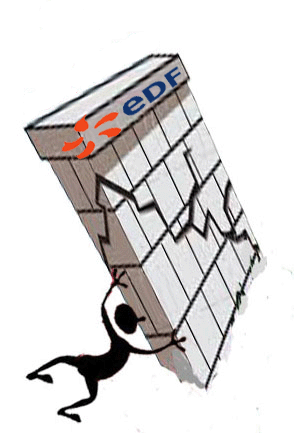
As France faces two major nuclear efforts — the refurbishment and life extension of EDF’s domestic operating fleet and a major nuclear newbuild program — there are already signs that the country’s nuclear workforce is struggling to keep up. With 10-year safety reviews, or decennial visits (DVs), of EDF’s 56 domestic reactors growing ever more complex and time-consuming, EDF anticipates flatlined nuclear output from 2025 to 2026, and beyond that France will need to ramp up an industrial effort not seen in generations if it hopes to successfully launch simultaneous large newbuilds (related).
Energy Intelligence 9th Feb 2024
https://www.energyintel.com/0000018d-7944-d1ef-a5cd-fd647d920000
Citing World Court, Japan Firm Cuts Ties With Israel Arms Maker
The ICJ’s ruling on Israel potentially committing genocide in Gaza is already showing substantive consequences for Israel’s arm industry.
By Ali Abunimah / The Electronic Infitada, 10 Feb 24
Amajor Japanese industrial conglomerate is cutting ties with Israeli arms maker Elbit, citing the International Court of Justice ruling that Israel may be committing genocide in Gaza.
Itochu Corporation said its aviation division would terminate its partnership with Elbit by the end of February.
Tsuyoshi Hachimura, Itochu’s chief financial officer, said that his company’s partnership with Elbit was “based on a request from the Japan’s defense ministry for the purpose of importing defense equipment for the Self-Defense Forces necessary for Japan’s security, and is not in any way related to the current conflict between Israel and Palestine.”
But the decision to end the relationship clearly is.
“Taking into consideration the International Court of Justice’s order on 26 January, and that the Japanese government supports the role of the Court, we have already suspended new activities related to the MOU [memorandum of understanding], and plan to end the MOU by the end of February,” Hachimura added.
The deal signed less than a year ago was hailed at the time by Israel’s ambassador in Tokyo as evidence of the “deepening relations between Israel and Japan, relations that are based on mutual interests and shared values.”
Action against Israel in Belgium, Spain and Switzerland
This is one of the first signs that the ICJ decision is already prompting companies and governments to cut ties with Israel – perhaps fearing that they too could become legally implicated in genocide.
This week the government of Wallonia, one of Belgium’s three federal regions, suspended arms export licenses to Israel, also citing the ICJ decision…………………………………………………
And on Tuesday, Spanish foreign minister José Manuel Albares told Al Jazeera that Madrid had suspended all arms exports to Israel since 7 October.
Albares said that the events of that day “made us realize the importance of a just and lasting solution to the issue of the Palestinian people.”
US arms genocide
While these steps are important and necessary, the reality remains that Israel’s chief arms supplier, the United States, shows no signs of slowing down its airlift of the bombs and other weapons Tel Aviv is using to methodically exterminate Palestinians in Gaza.
Last week, US President Joe Biden said he held Iran responsible for the deaths of three American soldiers in a drone attack on a base in Jordan because, he alleged, “they’re supplying the weapons to the people who did it.”
Biden has also previously acknowledged that Israel has engaged in “indiscriminate bombing” of Gaza – a war crime.
By his own standards, therefore, Biden is effectively confessing to his own guilt for war crimes that a growing number of companies and governments around the world refuse to support. https://electronicintifada.net/blogs/ali-abunimah/citing-world-court-japan-firm-cuts-ties-israel-arms-maker
EDF’s nuclear struggles dampen EU nuclear prospects – the industry “on a slow descent to hell”.

MURIEL BOSELLI, Paris, France, 08 Feb 2024 19:48
(Montel) The latest setbacks at the UK’s new Hinkley Point C nuclear power plant have cast a shadow over Europe’s nuclear revival, experts told Montel, with one former EDF executive saying France’s nuclear industry was “on a slow descent to hell”.
A feud between Paris and London over who should fork out an extra EUR 6-8bn for Hinkley Point C’s (HPC) cost overruns was tarnishing the nuclear industry’s image as pro-nuclear nations try to promote atomic power in the battle against climate change, experts said.
HPC faces a new four-year delay and may not be commissioned until 2031, with completion costs now forecast at between GBP 31-34bn,… (Subscribers only)
Montel 8th Feb 2024
https://www.montelnews.com/news/1537139/edfs-nuclear-struggles-dampen-eu-nuclear-prospects
Nuclear expert Mycle Schneider on the COP28 pledge to triple nuclear energy production: ‘Trumpism enters energy policy’.

The entire logic that has been built up for small modular reactors is with the background of climate change emergency. That’s the big problem we have………………… Climate change emergency contains the notion of urgency. And so we are talking about something where the time factor needs to kick in………………….. And if we are talking about SMRs picking up any kind of substantial amounts of generating capacity in the current market, if ever, we’re talking about the 2040s at the very earliest.
Now, we’re talking of tens of $billions that are going into subsidizing nuclear energy, especially as I said existing nuclear power plants.
The pledge was worded as a commitment “to work together to advance a global aspirational goal of tripling nuclear energy capacity from 2020 by 2050″………… “This pledge is completely, utterly unrealistic.”…………………….“It’s like Trumpism enters energy policy.”

The Bulletin, By François Diaz-Maurin | December 18, 2023
Last week, a group of independent energy consultants and analysts released the much-anticipated 2023 edition of the World Nuclear Industry Status Report 2023 (WNISR). In over 500 pages, the report provides a detailed assessment of the status and trends of the international nuclear industry, covering more than 40 countries. Now in its 18th edition, the report is known for its fact-based approach providing details on operation, construction, and decommissioning of the world’s nuclear reactors. Although it regularly points out failings of the nuclear industry, it has become a landmark study, widely read within the industry. Its release last week was covered by major energy and business news media, including Reuters (twice) and Bloomberg.
On December 2, the United States and 21 other countries pledged to triple the global nuclear energy capacity by 2050. The declaration, made during the UN climate summit of the 28th Conference of the Parties (COP28) in Dubai, United Arab Emirates, sought to recognize “the key role of nuclear energy in achieving global net-zero greenhouse gas emissions-carbon neutrality by or around mid-century and in keeping a 1.5-degree Celsius limit on temperature rise within reach.” The pledge was worded as a commitment “to work together to advance a global aspirational goal of tripling nuclear energy capacity from 2020 by 2050.” It was aspirational—and ambitious.
To discuss this pledge against the nuclear industry’s current trends and status, I sat down with Mycle Schneider, lead author of the World Nuclear Industry Status Report.
………… Diaz-Maurin: It’s undoubtedly a landmark report. With over 500 pages, it’s also massive. In a nutshell, what should our readers know about the main developments in the world nuclear industry over the past year?
Schneider: It really depends on from which angle you approach the issue. I think, overall, the mind-boggling fact is that the statistical outcome of this analysis is dramatically different from the perception that you can get when you open the newspapers or any kind of media reporting on nuclear power. Everybody gets the impression that this is kind of a blooming industry and people get the idea that there are nuclear power plants popping up all over the world.
But what we’ve seen is that some of the key indicators are showing a dramatic decline. In fact, the share of nuclear power in the world commercial electricity mix has been dropping by almost half since the middle of the 1990s. And the drop in 2022 was by 0.6 percentage points, which is the largest drop in a decade, since the post-Fukushima year 2012.
We have seen a four percent drop in electricity generation by nuclear power in 2022, which, if you take into account that China increased by three percent and if you look at the world, means that the drop was five percent outside China. So it’s significantly different from the perception you can get, and we can dig into some of the additional indicators. For example, constructions [of new reactors] give you an idea what the trends are and what the dynamic is in the industry. And so, when you look at constructions you realize that, since the construction start of Hinkley Point C in the United Kingdom in late 2019 until the middle of 2023, there were 28 construction starts of nuclear reactors in the world. Of these, 17 were in China and all 11 others were carried out by the Russian nuclear industry in various countries. There was no other construction start worldwide.
………………………………………………………………………………..The point is that we have had actually an increasing capacity that generates less. And, for obvious reasons, the most dramatic drop was in France. The French reactor performance has been in decline since 2015. That is, to me, one of the really remarkable outcomes in recent years. If you compare the year 2010 to 2022, in France, the drop [in electricity generated] was 129 terawatt hours. What happened is basically that, from 2015 onward, the trend line was toward a reducing electricity generation due to an accumulation of events, which are important to understand.
It’s not so much the stress corrosion cracking [in reactor vessels] that everybody has been talking about or another technical phenomenon that hit the French nuclear power plants worst, although it’s true it had a significant impact and was totally unexpected. So, it’s not an aging effect, although you do have aging effects on top of it because a lot of reactors are reaching 40 years and need to pass inspections and require refurbishment, etc. But you had climate effects in France too. And strikes also hit nuclear power plants. You don’t have that in other countries. So, it’s the accumulation of effects that explain the decline in electricity generation. This unplanned and chaotic drop in nuclear power generation in France compares with the loss of nuclear generation in Germany of 106 terawatt hours between 2010 and 2022, but in this case due to a planned and coordinated nuclear phaseout.
Diaz-Maurin: That is an interesting way to look at the data. What is the biggest risk of keeping existing reactors operating up to 80 years, as some suggest, or even more?
Schneider: Well, nobody knows. This has never been done. It’s like: “What’s the risk of keeping a car on the street for 50 years?” I don’t know. It’s not the way you do things, usually. First, I should say that we’re not looking at risk in that Status Report. This is not the subject of the report. But the lifetime extension of reactors raises the questions of nuclear safety—and security, which has always been a topic for the Bulletin.
If you have a reactor that has been designed in the 1970s, at the time nobody was talking or even thinking about drones or hacking, for example. People think of drones in general as a means to attack a nuclear power plant by X Y, Z. But in fact, what we’ve seen in the past are numerous drone flights over nuclear facilities. And so, there is the danger of sucking up information during those overflights. This raises security risks in another way. So, this idea of modernizing nuclear facilities continuously is obviously only possible to some degree. You can replace everything in a car, except for the body of the car. At some point, it’s not the same facility anymore. But you can’t do that with a nuclear power plant.
Diaz-Maurin: Talking about old facilities, Holtec International—the US-based company that specializes in nuclear waste management—say they want to restart the shutdown Palisades generating station in Michigan. Is it good news?
Schneider: To my knowledge, the only time that a closed nuclear power plant has been restarted was in Armenia, after the two units had been closed [in 1989] after a massive earthquake. We don’t have precise knowledge of the conditions of that restart, so I’m not so sure that this would be a good reference case. One has to understand that when a nuclear reactor is closed, it’s for some reason. It is not closed because [the utility] doesn’t like to do this anymore. In general, the most prominent reason [for closing reactors] over the past few years was poor economics.
This is, by the way, one of the key issues we’ve been looking at in the 2023 report: These entirely new massive subsidy programs in the US in particular didn’t exist [a year ago]. There were some limited programs on state level. Now these state support programs have been increased significantly and they are coupled in with federal programs, because the reactors are not competitive. So we’re talking really about a mechanism to keep these reactors online. That Palisades would restart is unique, in Western countries at least. For a plant that has been set to be decommissioned to restart, this has never been done. And, by the way, Holtec is not a nuclear operator. It is a firm that has specialized in nuclear decommissioning.
Now, that companies like Holtec can actually buy closed nuclear power plants and access their decommissioning funds with the promise to dismantle faster than would have been done otherwise, this is an entirely recent approach with absolutely no guarantee that it works. Under this scheme, there is no precedent where this has been done from A to Z. And obviously, there is the risk of financial default. For instance, it is unclear what happens if Holtec exhausts the funds before the decommissioning work is complete. Holtec’s level of liability is unclear to me prior to the taxpayer picking up the bill.
Diaz-Maurin: At Palisades, Holtec’s plan is to build two small modular reactors.
Schneider: Holtec is not a company that has any experience in operating—even less constructing—a nuclear power plant. So having no experience is not a good sign to begin with. Now, when it comes to SMRs—I call them “small miraculous reactors”—they are not existing in the Western world. One must be very clear about that. There are, worldwide, four [SMR] units that are in operation: two in China and two in Russia. And the actual construction history [for these reactors] is exactly the opposite to what was promised. The idea of small modular reactors was essentially to say: “We can build those fast. They are easy to build. They are cheap. It’s a modular production. They will be basically built in a factory and then assembled on site like Lego bricks.” That was the promise.
For the Russian project, the plant was planned for 3.7 years of construction. The reality was 12.7 years. In China, it took 10 years instead of five. And it’s not even only about delays. If you look at the load factors that were published by the Russian industry on the Power Reactor Information System (PRIS) of the IAEA, these SMRs have ridiculously low load factors, and we don’t understand the reasons why they don’t produce much. We know nothing about the Chinese operational record.
Diaz-Maurin: Last month, NuScale, the US-based company that develops America’s flagship SMR, lost its only customer, the Utah Associated Municipal Power System, a conglomerate of municipalities and utilities. This happened allegedly after a financial advisory firm reported on NuScale’s problems of financial viability. Have you followed this demise?
Schneider: Yes, of course. What happened there is that NuScale had promised in 2008 that it would start generating power by 2015. We are now in 2023 and they haven’t started construction of a single reactor. They have not even actually a certification license for the model that they’ve been promoting in the Utah municipal conglomerate. That’s because they have increased [the capacity of each module] from originally 40 megawatts to 77 megawatts.
Diaz-Maurin: Why is that? Is it a matter of economy of scale?
Schneider: Yes, of course. You need to build many modules if you want to get into economies of scale by number, if you don’t get into it by size. This is actually the entire history of nuclear power. So NuScale sought to increase the unit size in Utah. But then the deal with the municipalities collapsed after the new cost assessment in early 2023 showed that the six-module facility NuScale had planned would cost $9.3 billion, a huge increase over earlier estimates. It’s about $20,000 per kilowatt installed—almost twice as expensive as the most expensive [large-scale] EPR reactors in Europe.
Diaz-Maurin: Is it the same with the waste generated? Some analysts looking at the waste streams of SMRs conclude that smaller reactors will produce more radioactive materials per unit of kilowatt hour generated compared to larger reactors.
Schneider: That’s the MacFarlane and colleagues’ paper, which is pretty logical if you think about it. If you have a small quantity of nuclear material that irradiates other materials, then it’s proportionally more per installed megawatt than for a large reactor in which there is a larger core.
,………………Schneider: many technologies have been supported under the Inflation Reduction Act and many others will continue to receive significant support. But the problem here is different. The entire logic that has been built up for small modular reactors is with the background of climate change emergency. That’s the big problem we have.
Diaz-Maurin: Can you explain this?
Schneider: Climate change emergency contains the notion of urgency. And so we are talking about something where the time factor needs to kick in. If we look at how other reactor technologies have been introduced, a lot of them were supported by government funding, like the EPR in Europe or Westinghouse’s AP-1000 in the United States. Comparatively, the current status of SMR development—whether it’s NuScale, which is the most advanced, or others—corresponds to that of the middle of the 1990s [of the large light-water reactors]. The first EPR started electricity generation in 2022 and commercial operation only in 2023. And it’s the same with the AP-1000. By the way, both reactor types are not operating smoothly; they are still having some issues. So, considering the status of development, we’re not going to see any SMR generating power before the 2030s. It’s very clear: none. And if we are talking about SMRs picking up any kind of substantial amounts of generating capacity in the current market, if ever, we’re talking about the 2040s at the very earliest.
Diaz-Maurin: And that’s exactly where I want to turn the discussion now: nuclear and climate. At the COP28 last week in Dubai, 22 countries pledged to triple the global nuclear energy capacity of 2020 by 2050. What do these countries have in common when it comes to nuclear energy? In other words, why these 22 countries and not others?
Schneider: Most of them are countries that are already operating nuclear power plants and have their own interest in trying to drag money support, most of which by the way would go into their current fleets. Take EDF [France’s state-owned utility company], for example. Through the French government, EDF is lobbying like mad to get support from the European Union—European taxpayers’ money—for its current fleet. It’s not even for new construction, because the French know that they won’t do much until 2040 anyway. There is also another aspect that is related and that illustrates how this pledge is completely, utterly unrealistic.
The pledge to triple nuclear energy capacity is not to be discussed first in terms of pros or cons, but from the point of view of feasibility. And from this point of view, just looking at the numbers, it’s impossible. We are talking about a target date of 2050, which is 27 years from now. In terms of nuclear development, that’s tomorrow morning. If we look at what happened in the industry over the past 20 years since 2003, there have been 103 new nuclear reactors starting operation. But there have been also 110 that closed operation up until mid 2023. Overall, it’s a slightly negative balance. It’s not even positive. Now if you consider the fact that 50 of those new reactors that were connected to the grid were in China alone and that China closed none, the world outside China experienced a negative balance of 57 reactors over the past 20 years.
………………………………………….Now, if we look forward 27 years, if all the reactors that have lifetime extension licenses (or have other schemes that define longer operation) were to operate until the end of their license, 270 reactors will still be closed by 2050. This is very unlikely anyway because, empirically, reactors close much earlier: The average closing age over the past five years is approximately 43 years, and hardly any reactor reached the end of its license period. But even if they did, it would be 270 reactors closed in 27 years.
You don’t have to do math studies to know that it’s 10 per year. At some point it’s over. Just to replace those closing reactors, you’d have to start building, operating, grid connecting 10 reactors per year, starting next year. In the past two decades, the construction rate has been of five per year on average. So, you would need to double that construction rate only to maintain the status quo. Now, tripling again that rate, excuse me, there is just no sign there. I am not forecasting the future, but what the industry has been demonstrating yesterday and what is it is demonstrating today shows that it’s simply impossible, from an industrial point of view, to put this pledge into reality. To me, this pledge is very close to absurd, compared to what the industry has shown.
Diaz-Maurin: Based on your report, just to replace the closures, the nuclear industry would need to build and start operating one new reactor of an average size of 700-megawatt per month. And tripling the global capacity would require an additional 2.5 new reactors per month.
Schneider: Exactly; it’s a little less if you talk in terms of capacity. The capacity to be replaced by 2050 of those 270 units would be 230 gigawatts. Now, if small modular reactors were to be a significant contributor to this pledge, hundreds or even thousands of these things would need to be built to come anywhere near that objective. It’s impossible. We should come back to reality and discuss what’s actually feasible. Only then can we discuss what would be the pros and cons of a pledge.
But there was another pledge at the COP28, which is to triple the output of renewable energies by 2030. That’s seven years from now. To me, this pledge on renewable energy, if implemented, is the final nail in the coffin of the pledge on nuclear energy. It is very ambitious. Don’t underestimate that. Tripling renewables in seven years is phenomenally ambitious.
Diaz-Maurin: Is it feasible?
Schneider: Very difficult to say. But one important thing is that it’s not 22 countries. It’s over 100 countries that have already pledged their commitment to this objective. Also, a key player—if not the key player—is China. An important finding of our Status Report is that China generated for the first time in 2022 more power with solar energy than with nuclear energy. And this happened despite China being the only country to have been building [nuclear capacity] massively over the past 20 years. But still, the country is now generating more power with solar than with nuclear. The good news for the [renewable] pledge is that China is more or less on track with that tripling target. The rest of the world would have to speed up on renewables in a dramatic way to achieve this pledge. But at least China’s example shows that it’s feasible. That’s the interesting part. Because, on the contrary, there is no country—not even China—demonstrating that the nuclear pledge is possible.
Diaz-Maurin: If it’s not feasible, does the nuclear pledge impede other climate actions that are urgently needed then?
Schneider: That’s a good question. I think it’s a terrible signal, indeed. It’s like Trumpism enters energy policy: It’s a pledge that has nothing to do with reality, and it doesn’t matter. It is giving you the impression that it is feasible, that it is possible. And all that completely dilutes the attention and capital that are urgently needed to put schemes into place that work. And it doesn’t start with renewables, that’s very important to stress. It starts with sufficiency, efficiency, storage, and demand response. Only later comes renewable energy.
But these options are all on the table. They’re all demonstrated to be economic and competitive. That’s not the case with nuclear energy. It’s a pledge that has no realistic foundation that is taking away significant funding and focus. It used to be negligible funding. Up until a few years back, we were talking at most tens of millions of dollars. Now, we’re talking of tens of billions that are going into subsidizing nuclear energy, especially as I said existing nuclear power plants………………………………………………………………………………………………………………………………..
Schneider: What really has motivated most of my work over the past decades is that I can’t stand what you would call today “fake news.” All my work since the 1980s has been actually driven by the attempt to increase the level of information in—and having some kind of impact on—the decision-making process. To offer a service to civil society so it can take decisions based on facts, not beliefs. When I see what happens in terms of misinformation around nuclear power, it’s scary.
I think, today, the Status Report is probably more important than ever. Because there’s such an unbelievable amount of hype out there. It’s almost becoming an issue for psychologists. It has less and less to do with rationality because the numbers are clear. They are utterly clear: The cost figures are clear; the development is clear; the trend analysis is clear. So it is clear, but it doesn’t matter. It’s like the claim of stolen elections of Trump supporters. All court cases have shown that this was not the case. But, for half of the US population, it doesn’t matter. And I find this absolutely scary. When it comes to issues like nuclear power, it’s fundamental that decisions are made on the basis of facts.
Diaz-Maurin: Why is that?
Schneider: Because the stakes are incredibly high. First because of the capital involved. Researchers studying corruption cases know that the size of large projects’ contracts is a key driver for corruption. And the nuclear industry has been struggling with all kinds of mechanisms that are fraud yields. Financial corruption is only one issue.
Another is falsification. For a long time, we thought Japan Steel Works [JSW] was the absolute exemplary industry. Japanese factories used to build high quality and highly reliable key forged parts for nuclear power plants. It turns out, they have been falsifying quality-control documentation in hundreds of cases for decades. Corruption and falsification are two of the issues affecting the nuclear industry.
And, of course, the Bulletin has had a long focus on military issues related to nuclear energy. When we are talking about issues like SMRs, the key issue is not whether they are going to be safer or not, because there are not going to be many around anyway. So, safety is not the primary issue. But once you start signing cooperation agreements, it opens the valves to the proliferation of nuclear knowledge. And that is a big problem, because this knowledge can always be used in two ways: One is military for nuclear explosives, and the other is civilian for nuclear electricity and medical applications. Opening these valves on the basis of hype or false promise is a disaster. And the ones most actively opening these valves are the Russians. They are educating thousands of people from all around the world in nuclear materials and nuclear technology. In the United States, part of the thinking appears to say: “Oh, for God’s sake, better we train these people.” https://thebulletin.org/2023/12/nuclear-expert-mycle-schneider-on-the-cop28-pledge-to-triple-nuclear-energy-production-trumpism-enters-energy-policy/?utm_source=Newsletter&utm_medium=Email&utm_campaign=MondayNewsletter12182023&utm_content=NuclearRisk_TripleNuclear_11182023
The clock is ticking on the nuclear renaissance

Last week, Georgia Power revealed the latest delay to the expansion of
Plant Vogtle, a nuclear power station near Augusta which contains the first
new reactors built entirely from scratch in the US for more than three
decades. The company said unit 4 of the plant would not begin generating
power before the end of March due to the discovery of vibrations in a
cooling system in the reactor.
A similar problem affected the launch of
unit 3 before it finally began operating this past July, after seven years
of delays. Georgia Power said the problem with Vogtle’s unit 4 had been
fixed and it should begin operating in the second quarter.
But the disclosure marks the latest in a series of delays and cost overruns at the
flagship US project, which is forecast to cost more than double the
original price tag of $14bn.
Across the Atlantic, the UK’s plan to reboot
its nuclear sector has also run into trouble. Last month, French utility
EDF announced that Britain’s flagship Hinkley Point C power plant had
been delayed until 2029 at the earliest, with the cost spiralling to as
much as £46bn in today’s prices. The initial budget was £18bn, with a
scheduled completion date of 2025, but the project has faced repeated
setbacks. EDF cited the complexity of installing electromechanical systems
and intricate piping at the site in Somerset for the most recent delay.
The French government is pressing London to plug a multibillion-pound hole in
the budget of nuclear power projects being built in Britain by EDF. Both
projects are showcases for new, advanced, pressurised water reactors —
EDF’s EPR in the UK and Westinghouse’s AP1000 in the US —
underscoring the critical importance of getting them up and running as soon
as possible to encourage other customers to commit to the technologies.
US officials warn time is running out for the nuclear industry to prove it can
contribute to the country’s 2050 climate goals due to the long lead times
required to build reactors. Between five to 10 contracts to build new units
need to be signed within the next two to three years to enable the sector
to reach the commercial lift-off required to provide enough clean power by
the middle of the century.
FT 6th Feb 2024
https://www.ft.com/content/3777fb7f-4e7c-4ced-91b9-8de12a0cd428
Czech Republic / Government Seeks Binding Tenders For Four Nuclear Reactors From EDF And KHNP

By Kamen Kraev, 1 February 2024
Prague hopes to cut down new-build costs via a ‘package’ deal
The Czech government announced on Wednesday (31 January) that it will be seeking binding bids from two technology vendors, France’s EDF and South Korea’s KHNP, for the construction of up to four new reactor units at the existing Dukovany nuclear power station……. (Subscribers only) m https://www.nucnet.org/news/government-seeks-binding-tenders-for-four-nuclear-reactors-from-edf-and-khnp-2-4-2024
EDF’s Hinkley Point woes pile pressure on global nuclear push.

When in 2016 France’s EDF signed up to build Britain’s first new
nuclear power plant in two decades, defenders of the costly Hinkley Point C
project included Emmanuel Macron, then economy minister. “If we believe
in nuclear power, we have to do Hinkley Point,” France’s now president
told a parliamentary enquiry, rejecting some lawmakers’ concerns that
state-backed EDF, which was already struggling to deliver a new French
prototype plant in Normandy, may not have the financial bandwidth to take
on the British site, originally estimated to cost £18bn.
Eight years on, with cost overruns surging at Hinkley due to repeated delays and EDF on the
hook for at least another £5bn on top of previous budget revisions,
Macron’s government is on a mission to ensure the French nuclear operator
can indeed withstand the fallout — and keep on top of ballooning
investments and orders at home.
French ministers are trying to get the British state to stump up some support for the soaring Hinkley bill, which could reach a total of £46bn at today’s prices for the two reactors,
people close to the talks have said.
That would be roughly double the original budget in 2015 prices, compared with an EDF project in Finland that ended up costing more than twice what it was supposed to and a plan
for one reactor at Flamanville in France that is running four times over
budget, at €13.2bn.
But the Hinkley setbacks have also revived a core
strategic question that is becoming more pressing than ever for EDF, a
former French electricity monopoly that operates Europe’s biggest fleet
of 56 domestic reactors: whether it is equipped to handle multiple projects
at once, internationally and at home, and financially as well as from an
industrial perspective. Already an issue in 2016, when French labour unions
at the group opposed the Hinkley plans on the basis that the financial
set-up was risky, this tension now has a different edge to it.
FT 29th Jan 2024
https://www.ft.com/content/d401e42b-d953-4ef0-b3ea-ed80e974249a
France limits its investment in Britain’s Sizewell C, as the global nuclear industry requires massive government subsidies
Why are nuclear power projects so challenging? Increasing nuclear energy
capacity is not easy. Projects across the globe have been fraught with
delays and budget overruns, with the Financial Times revealing last week
that France is pressing the UK to help fill budget shortfalls at the
Hinkley Point C project in England, being built by EDF.
The International Energy Agency (IEA) says nuclear projects starting between 2010 and 2020
are on average three years late, even as it forecasts nuclear power
generation will hit a record high next year and will need to more than
double by 2050. Technical issues, shortages of qualified staff,
supply-chain disruptions, strict regulation and voter pushback are the key
factors developers and governments are grappling with. In the US, Georgia
Power is scheduled to complete work within weeks on the second of two
gigantic new nuclear reactors that are at the vanguard of US plans to
rebuild its nuclear energy industry.
But the expansion of Plant Vogtle is
seven years late and has cost more than double the original price tag of
$14bn due to a series of construction problems, highlighting the complexity
of nuclear megaprojects. These complexities, high costs and long build
times — as well as strict regulation due to risks of nuclear accidents
— make nuclear power a daunting prospect for many investors.
As a result, the sector is heavily subsidised by governments. Many reactor suppliers for
large-scale projects are state-owned, working alongside the private sector
to build the full plant. But countries also have a limit on how much they
are willing to spend. EDF, now fully owned by the French state, will limit
its stake in its next planned UK plant, Sizewell C, to 20 per cent.
FT 1st Feb 2024
https://www-ft-com.ezproxy.depaul.edu/content/6d371375-b7be-4228-a3d5-2ad74f91454a
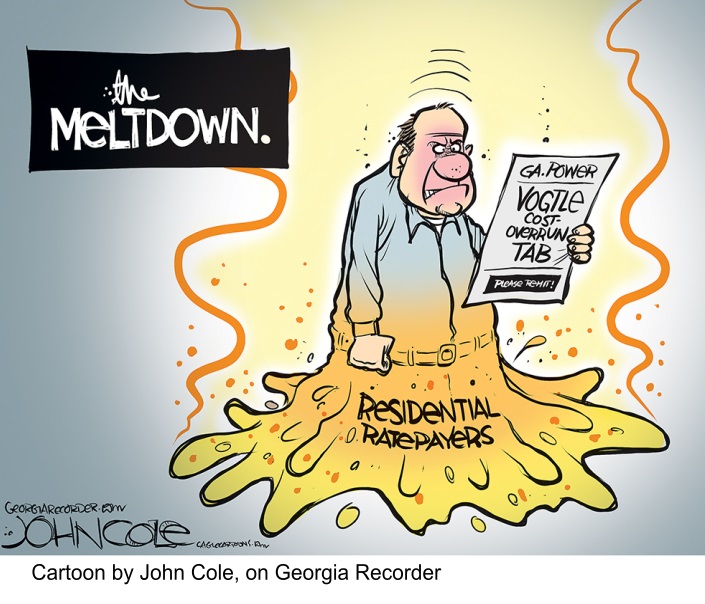
Vibrations in cooling system mean new Georgia’s Vogtle nuclear reactor will again be delayed, and costs blow out
Daily Mail, By ASSOCIATED PRESS, 2 Feb 24,
ATLANTA (AP) – Georgia Power Co. said Thursday that vibrations found in a cooling system of its second new nuclear reactor will delay when the unit begins generating power.
Plant Vogtle’s Unit 4 now will not start commercial operation until sometime in the second quarter of 2024, or between April 1 and June 30, the largest subsidiary of Atlanta-based Southern Co. announced.
The utility said in a filing to investors that the vibrations “were similar in nature” to those experienced during startup testing for Unit 3, which began commercial operations last summer, joining two older reactors that have stood on the site near Augusta for decades………
Georgia Power said it’s likely to lose $30 million in profit for each month beyond March that Unit 4 isn’t running because of an earlier order by state utility regulators. The five members of the Georgia Public Service Commission ordered that the company can’t earn an additional return on equity through a construction surcharge levied on Georgia Power’s 2.7 million customers after March 30.
The typical residential customer has paid about $1,000 in surcharges over time to pay for financing costs.
Georgia Power said it’s likely to lose $30 million in profit for each month beyond March that Unit 4 isn’t running because of an earlier order by state utility regulators. The five members of the Georgia Public Service Commission ordered that the company can’t earn an additional return on equity through a construction surcharge levied on Georgia Power’s 2.7 million customers after March 30.
The typical residential customer has paid about $1,000 in surcharges over time to pay for financing costs…………………………………..
The new Vogtle reactors are currently projected to cost Georgia Power and three other owners $31 billion, according to calulations by The Associated Press. Add in $3.7 billion that original contractor Westinghouse paid Vogtle owners to walk away from construction, and the total nears $35 billion.
The reactors were originally projected to cost $14 billion and be completed by 2017…………..
……even as government officials and some utilities are again looking to nuclear power to alleviate climate change, the cost of Vogtle could discourage utilities from pursuing nuclear power……….https://www.dailymail.co.uk/wires/ap/article-13036013/Vibrations-cooling-mean-new-Georgia-nuclear-reactor-delayed.html—
COP28 pledge to expand nuclear capacity is out of touch with reality.
Tripling the scale of the world’s nuclear fleet by 2050 could cost upwards of $11 trillion.
PV Magazine 30th Jan 2024, M V Ramana,
The 2023 Conference of Parties (COP) climate change summit held in Dubai in December ended with a call to contribute to a transition “away from fossil fuels in energy systems.” The discussion at the COP about how to replace fossil fuels included two pledges. One was ambitious but within the realm of possibility. The other pledge was plain wishful thinking. The first, signed by 123 countries, was enshrined in the final COP28 document. The second was unofficial and attracted only 25 countries. One concerned renewable energy and energy efficiency, the other, nuclear energy. No prizes for guessing which pledge corresponded to which energy source.
Historical trends can help us understand why a goal of tripling nuclear energy generation capacity by 2050 is unattainable. According to the latest edition of the “World Nuclear Industry Status Report (WNISR2023),” the operating power generating capacity of all nuclear plants in the world is 365 GW, as of July 2023. Tripling this by mid century, 27 years from now, would mean close to 1.1 TW of nuclear capacity.
Twenty-seven years ago, in 1996, the world had 344 GW of nuclear generation capacity. Since then, when the capacity added by new nuclear reactors is tallied and that of old reactors that have been shut down is subtracted, the global nuclear fleet has grown an average of 800 MW per year. At that rate, nuclear capacity in 2050 would be a mere 386 GW, assuming that a large number of reactors would be built to replace the aging nuclear fleets of most countries. In other words, the likely nuclear capacity in 2050 would be a mere fraction of what is desired by the COP28 pledge.
Falling share
A second trend should also be acknowledged. Since 1996, the share of global electricity produced by nuclear reactors has declined from 17.5% to 9.2%, according to “WNISR2023.” That is in stark contrast to the corresponding trends for renewables, especially solar and wind energy. Between 1996 and 2023, the share of global electricity produced by modern renewable forms of energy has grown from 1.2% to 14.4%, according to the Energy Institute’s “2023 Statistical Review of World Energy.” The actual increase in the amount of energy produced by renewable sources is even more dramatic because the total energy flowing in the world’s electricity grids has more than doubled over that period.
The phenomenal growth of renewables is fueled by an even more astonishing decline in the cost of generating solar and wind power. Between 2009 and 2023, the levelized cost of generating electricity from utility scale photovoltaic farms and onshore wind farms in the United States has decreased by 83% and 63%, respectively, according to the “2023 Levelized Cost of Energy+” report published by Lazard. Nuclear electricity costs have escalated by 47% over the same period.
For recently constructed reactors, each gigawatt of generation capacity costs around $15 billion, meaning a bill of around $11 trillion to build the 730 GW needed to triple current capacity. The cost would be even more when taking into account the need to replace some of the old reactors shut down over the same period……………………………………………….
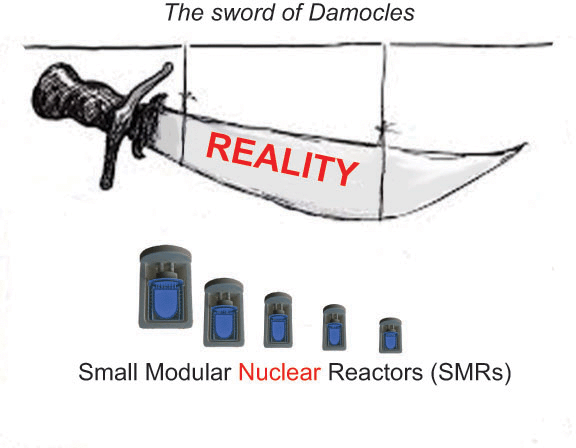
Some nuclear proponents argue that small modular reactors (SMRs) will change this picture. These will not benefit from economies of scale, however. A reactor that generates three times as much power as an SMR will not require three times as much concrete or three times as many workers. As a result, building and operating SMRs will cost more than large reactors for each megawatt of generation capacity. In turn, the electricity from small reactors will be more expensive than electricity from bigger sites, as was seen in the case of the many small reactors built in the United States before 1975. Those were financially uncompetitive and shut down early.
NuScale
The higher cost per unit of generating capacity was also seen in the case of the proposed NuScale reactor, which was planned for Utah, in the United States. The now abandoned project, which was to be developed by NuScale for electric utility Utah Associated Municipal Power Systems, would have involved six SMRs with a total generation capacity of 462 MW for an eye-popping $9.3 billion. At that rate, building a gigawatt of nuclear capacity would cost $20 billion, not $15 billion.
That cost would likely have been greater if the project had actually gone ahead and the reactor was built.
PV Magazine 30th Jan 2024 https://www.pv-magazine.com/2024/01/30/cop28-pledge-to-expand-nuclear-capacity-is-out-of-touch-with-reality/
Is this the World’s Most Expensive and Most Delayed Power Project?
By Leonard Hyman & William Tilles – Jan 31, 2024,
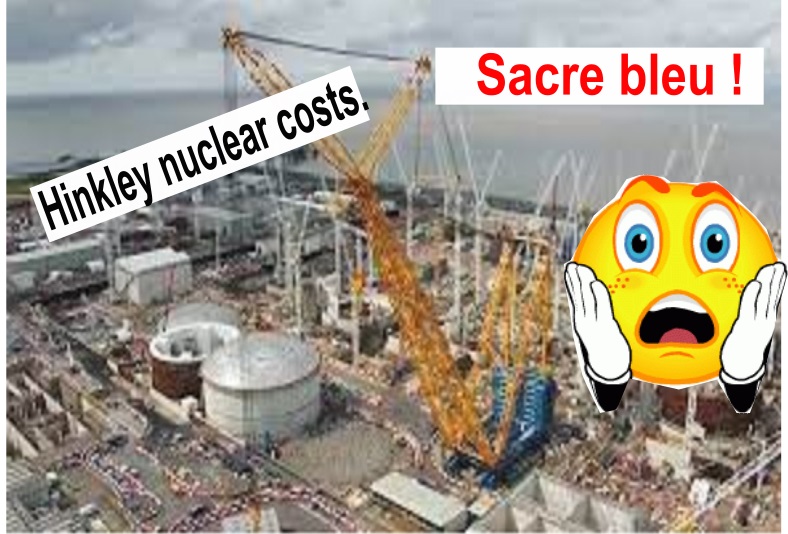
Yes, they are still building the Hinckley Point C nuclear power station in the United Kingdom, and yes the latest estimated cost is more than the previously estimated cost and the completion date has receded another two years into the future.
This nuclear project received its license for construction in 2012, with an estimated cost of £18 billion and completion date in 2025. The last estimate calls for 2029-2031 completion at a cost of £46 billion. To the extent that these estimates can be trusted, the plant would end up costing double the original estimate in real terms. In the same time period, solar and wind costs will decline by at least one half. We are not sure yet whether Hinckley Point will set an all-time record as the most expensive and most delayed power-related project in history, but it certainly will be a contender.
As is the case for so many climate- or security-related projects, the UK government offered significant subsidies to the builder. But in a different way. Most governments, nowadays, offer start-up subsidies in order to bring production levels up to a point where economies of scale kick in, after which costs drop rapidly and consumers get real benefits. The cost curves for wind, solar, and energy storage show how well this strategy works. Give the industry a kickstart and watch the action take place.
Not so with nuclear, where costs seem to rise with encouragement rather than fall. Opting for nuclear, then, seems more like an ideological rather than a technological or economic choice, especially for British Conservative politicians. “Nuclear has to be part of the package”, they seem to say. Even if the nuclear cost per kW installed is five-eight times higher than non-fossil alternatives. But, fortunately, the UK government is not directly on the hook for the added costs, the Chinese co-investor in the project has declared that it will not contribute more, and it looks as if French utility EDF will bear the increased costs if it does not get a new power contract. But if the UK decides to stick EDF with the bill, what will that decision do to discourage further nuclear construction? Given the perilous nature of that construction (namely the danger of cost inflation), who could take the risk of initiating new projects other than a government agency?………………………………………….
Oil Price 31st Jan 2024
Many challenges stand in the way of a ‘nuclear power renaissance’.

COMMENT Isn’t “challenge” a lovely word? Conjures up pictures of a tennis match, or some exciting venture.
It’s the word they use when they mean something more like “overwhelming frightening costs” ” “worrying safety and proliferation risks”, awful unsolved problem of toxic wastes”
Is this nuclear power’s moment? Many challenges stand in the way of a
‘nuclear power renaissance’. The nuclear power industry is receiving a
lot of attention recently thanks in part to new technological advancements.
That’s excited venture capital groups and private investors, such as Bill
Gates and OpenAI’s Sam Altman. But the industry is also known for its
boom-and-bust cycles. The FT’s US energy editor Jamie Smyth explains
there are many challenges that lie ahead for an industry, which has long
been plagued by controversy.
FT 31st Jan 2024
https://www.ft.com/content/5550dd4f-6399-447d-a220-6132dac19697
UK’s Nuclear “money pit” tops $59 billion.

What a turkey! by beyondnuclearinternational, https://beyondnuclearinternational.org/2024/01/31/what-a-turkey/
Hinkley Point C costs hit a new high but nuclear plant still isn’t roasting Christmas turkeys
By Linda Pentz Gunter
The Great Mosque of Mecca is considered the most expensive building in the world at $115.2 billion. Right behind it comes….a nuclear power plant! The two-reactor 3,260MW Hinkley Point C nuclear site still under construction in the UK will now cost at least £46 billion ($59 billion) according to the latest figures released by its developer, the French energy giant, EDF.
As such, Hinkley Point C has now earned the dubious honor of becoming the second most expensive building in the world. And it’s not even finished. The price could soar still higher.
EDF originally bragged that Britons would be baking their Christmas turkeys powered by Hinkley Point C by 2017. The completion date has now been pushed to “after 2029”.
The nuclear power industry is very good at tripling things. Perhaps not global nuclear installations by 2050 as it bragged would happen during an announcement at the COP28 climate summit last December. But the price tag for a new reactor? Timelines for new reactor construction? Straight A grades all around!
That’s almost what’s happening at Hinkley Point C where the new price is more than double the original estimated cost of £18 billion ($23 billion). Getting to triple the cost still seems eminently achievable given the new completion date.
This not-so-shocking news, given nuclear power’s track record, comes after the recent, overblown announcement by Rishi Sunak’s Conservative government that Britain would launch its “biggest expansion of nuclear power for 70 years to create jobs, reduce bills and strengthen Britain’s energy security.” The plan will of course achieve none of these things.
Far from reducing electricity bills for British consumers, the Hinkley nuclear project will in fact increase them “far above the market electricity price,” predicted Dr Norbert Allnoch, CEO of the International Economic Forum for Renewable Energies (IWR), based in Münster, Germany.
According to estimates by IWR, the cost of the electricity generated by Hinkley Point C will be “significantly higher than the 15 cents/kWh mark” and will continue to rise. This is because the UK government agreed a “state-guaranteed price for nuclear power being paid to EDF, which is linked to the inflation rate,” says IWR.
All of this came after the recent announcement that UK authorities had granted a Development Consent Order (DCO) to EDF’s identical twin EPR reactor project on the Suffolk Coast at Sizewell, while committing £1.3 billion ($1.6 billion) in funding for the project. The French company has already been tearing up pristine countryside there, destroying habitat and disturbing wildlife at the adjacent Minsmere Nature Reserve.
Meanwhile, France is pushing the UK to pay for the cost-overruns at Hinkley and the expected ballooning bills at Sizewell once work begins. France reportedly blames Britain for prompting the Chinese firm CGN to withdraw its 33.5% share from the Hinkley plant after Britain booted China out of the Sizewell C nuclear project.
Chinese investment in UK nuclear projects has been a hot political potato for some time, and came to be viewed as “an unacceptable national security risk.” A proposed new reactor project at Bradwell in Essex, a joint project between China and France, looks unlikely to go forward, at least in part due to security concerns about Chinese involvement.
These challenges prompted the UK government to seek alternative sources of funding, inevitably settling on ratepayers using something called a Regulated Asset Base (RAB). RAB effectively funds future nuclear projects by charging ratepayers up front in their electricity bills for the anticipated costs of nuclear plant design, construction, commissioning, and operation.
“Hinkley Point C has been a shambolic money pit,” said a spokesperson from Together Against Sizewell C on X (formerly Twitter). “It’s been hit by delay after delay and the costs are escalating at an alarming rate. Nobody can say with any confidence when it will go live or how much money will have been wasted on it.”
The story of Hinkley C illustrates that the nuclear sector is “out of control economically,” said Paul Gunter, director of the Reactor Oversight Project at Beyond Nuclear. The cost of EDF’s EPR reactor being built in France at Flamanville and still incomplete, has more than quadrupled to close to $15 billion. Another EPR, at Olkiluoto in Finland, went from $3.2 billion to more than $12 billion and launched 12 years late.
On U.S. soil, two AP1000 reactors at the Vogtle nuclear power plant site in Georgia, will likely come in at a total price tag of at least $35 billion, $20 billion more than originally estimated, with the second of the two reactors still not on line.
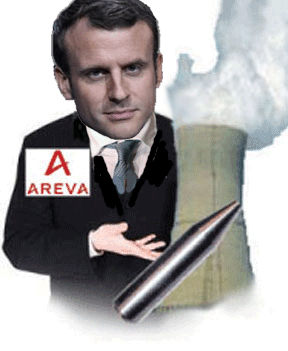
EDF, France’s state-owned nuclear company now in a fatal trap, as Hinkley Point C costs soar
Hinkley Point: endless setbacks at nuclear plant highlight political choice to destroy EDF
On January 22nd, state-owned French utilities group
EDF announced new delays in the construction of two EPR nuclear reactors at
the British plant of Hinkley Point. Originally planned to enter service in
2024, the first of the two reactors is now expected to be, at best,
operational in 2029, or possibly “2030 or 2031”.
Seven years after the project was launched, all the warnings against EDF’s involvement in it
made by the group’s staff have proved be right, writes Mediapart
economics correspondent Martine Orange in this op-ed article.
The state-owned group now finds itself in a fatal trap created by Emmanuel
Macron. Following the epic delays with the Olkiluoto nuclear power plant in
Finland, those of Flamanville in France, and those of Taishan in China, the
under-construction plant of Hinkley Point C in south-west England has now
joined the long story of an industrial catastrophe which is the third
generation EPR (pressurised water reactor) first designed by Areva, once
France’s nuclear energy giant.
Mediapart 28th Jan 2024
Are the French going cold on UK nuclear?

‘It would be madness to give Sizewell C the final go-ahead while the questions of whether Hinkley C can be finished, and who pays, are not resolved. Sizewell C is bound to take longer and cost more, but this time it would be we consumers who would bear the risk and pay the price through the “nuclear tax” on our energy bills.’.
The French government, which was previously relaxed about EDF’s forays into UK nuclear, now wants its energy company to work on projects back home in France.
So far, Britain has put £2.5billion into the project in total and taxpayers are the biggest shareholders. Campaigners who vehemently oppose the project are alarmed by the recent comments from Paris, pointing out that if the French back off from Sizewell, taxpayers could be on the hook for huge extra amounts of cash via their bills.
By FRANCESCA WASHTELL , 28 January 2024, https://www.thisismoney.co.uk/money/markets/article-13015713/Are-French-going-cold-UK-nuclear.html
Our nuclear industry is reawakening,’ energy secretary Claire Coutinho
declared in a Government strategy document published earlier this month. In
between invoking Winston Churchill’s enthusiasm for nuclear power and its
ability to help the UK reach net zero, Coutinho added that setting up new
plants would ensure our energy security ‘so we’re never dependent on the
likes of [Vladimir] Putin again’. Fighting talk. But in the space of a
fortnight, Coutinho’s gung-ho attitude has already been dented as a
diplomatic row brews over who should pay for the controversial power
stations.
French state-owned energy company EDF last week lit the blue
touchpaper with the revelation the UK’s flagship Hinkley Point C nuclear
plant in Somerset would be delayed until 2029 at the earliest. The cost, it
added, could spiral to as much as £46billion, from initial estimates of
£18billion.
Few in the industry will have been surprised, particularly as EDF has experienced delays on similar projects in Finland and France. But what was a shock were some incendiary remarks from the French government.
The Elysee Palace began pressing the UK to help plug a funding gap at Hinkley and for good measure cast doubt over its commitment to Sizewell C, the next nuclear power station in the pipeline.
A French Treasury official suggested the Government was trying to leave EDF in the lurch on Hinkley.
The official added that it cannot, at the same time, abandon the French firm to ‘figure it out alone’ on Hinkley and also expect it to plough money into Sizewell. It is, the official said, ‘a Franco- British matter,’ and not one for the French to resolve single-handedly.
This is a bad moment for two critical new nuclear plants – and our broader energy security – to be dragged into a cross-Channel tussle.
The French government, which was previously relaxed about EDF’s forays into UK nuclear, now wants its energy company to work on projects back home in France.
Well-placed UK sources deny the French claims that EDF has been left to shoulder the financing burden alone at Hinkley, or that it has been jettisoned by the British state.
They point to the fact EDF has all along had contractual obligations to shoulder the costs at this stage of the project. The early stages of developing Hinkley were undertaken by EDF along with China General Nuclear.
The Chinese firm has fulfilled its part of the bargain, leaving the onus on the French. ‘It’s all down to the French state,’ a senior industry source told The Mail on Sunday. ‘It’s tough, but they’ve not managed it at all well.’
A Department for Energy Security and Net Zero spokesman said: ‘The Government plays no part in the financing or operation of Hinkley Point C. The financing of the project is a matter for EDF and its shareholders.’
As well as backing Hinkley, EDF several years ago began serious talks with the Government over Sizewell C in Suffolk. Each could power an estimated 6 million homes for 60 years, meaning the two projects are linchpins for meeting future energy demand.
The French group is due to take a 20 per cent stake in Sizewell. The Government has previously indicated it will take 20 per cent. It was hoped the rest would be funded through money from the private sector, such as pension funds and sovereign wealth funds.
So far, Britain has put £2.5billion into the project in total and taxpayers are the biggest shareholders. Campaigners who vehemently oppose the project are alarmed by the recent comments from Paris, pointing out that if the French back off from Sizewell, taxpayers could be on the hook for huge extra amounts of cash via their bills.
The new type of funding structure for Sizewell C means consumers will already face an added tax to help pay for the plant.
Alison Downes of the Stop Sizewell C campaign group said: ‘It would be madness to give Sizewell C the final go-ahead while the questions of whether Hinkley C can be finished, and who pays, are not resolved. Sizewell C is bound to take longer and cost more, but this time it would be we consumers who would bear the risk and pay the price through the “nuclear tax” on our energy bills.’
And another area of the industry is watching the fracas with mounting frustration.
Companies vying to build ‘mini’ stations known as small modular reactors (SMRs) hope this prompts the Government to commit instead to their projects, which are quicker to build and cheaper [?]
The firms include Rolls-Royce SMR, which has already received significant funding from the Government. New nuclear plants of whatever size will almost certainly be part of the UK’s energy mix in the years to come.
The sector had already been championed by Boris Johnson before soaring oil and gas prices in the wake of Russia’s invasion of Ukraine highlighted Britain’s dependence on overseas energy.
Any fisticuffs with France over Hinkley and Sizewell would strain the sector and could fatally damage the level of public. Industry figures are urging ministers to resist stumping up cash the French had agreed to pay.
One senior source said: ‘I hope the Government doesn’t lose its nerve, though there’s no sign of that at the moment. It would be a terrible precedent.’
.
1 This Month



26 September – International Day for the Total Elimination of Nuclear Weapons


PLEASE OPPOSE HR 8255 AND S.3639 – bills would accelerate satellite deployment, with no environmental review or safeguards – https://ncstd5li.quorum.us/campaign/169331/
To see nuclear-related stories in greater depth and intensity – go to https://nuclearinformation.wordpress.com
-
Archives
- September 2026 (206)
- August 2026 (330)
- July 2026 (355)
- June 2026 (287)
- May 2026 (306)
- April 2026 (356)
- March 2026 (251)
- February 2026 (267)
- January 2026 (308)
- December 2025 (358)
- November 2025 (359)
- October 2025 (375)
-
Categories
- 1
- 1 NUCLEAR ISSUES
- business and costs
- climate change
- culture and arts
- ENERGY
- environment
- health
- history
- indigenous issues
- Legal
- marketing of nuclear
- media
- opposition to nuclear
- PERSONAL STORIES
- politics
- politics international
- Religion and ethics
- safety
- secrets,lies and civil liberties
- spinbuster
- technology
- Uranium
- wastes
- weapons and war
- Women
- 2 WORLD
- ACTION
- AFRICA
- Atrocities
- AUSTRALIA
- Christina's notes
- Christina's themes
- culture and arts
- Events
- Fuk 2022
- Fuk 2023
- Fukushima 2017
- Fukushima 2018
- fukushima 2019
- Fukushima 2020
- Fukushima 2021
- general
- global warming
- Humour (God we need it)
- Nuclear
- RARE EARTHS
- Reference
- resources – print
- Resources -audiovicual
- Weekly Newsletter
- World
- World Nuclear
- YouTube
-
RSS
Entries RSS
Comments RSS
 nuclear-news