Top 15 US Billionaires Gained Nearly $1 Trillion in Wealth in Trump’s First Year.

The US has 935 billionaires, roughly a dozen of whom have jobs within the Trump administration.
By Sharon Zhang , Truthout, January 7, 2026, https://truthout.org/articles/top-15-us-billionaires-gained-nearly-1-trillion-in-wealth-in-trumps-first-year/
new analysis finds that the richest 15 billionaires in the U.S. saw their wealth skyrocket by nearly $1 trillion in the first year of President Donald Trump’s second term, which also contained one of the single largest cuts to welfare benefits in U.S. history.
The Institute for Policy Studies (IPS) report, citing data from Forbes, has found that U.S. billionaires’ assets surged by a whopping 21 percent in 2025.
The 935 billionaires in the U.S. now control $8.1 trillion in wealth, the analysis found — nearly double the amount of wealth held by the bottom 50 percent of Americans, which comprises over 170 million people. Roughly a dozen of these billionaires work in the Trump administration.
The very richest billionaires saw the biggest gains. The top 15 richest people in the U.S. gained 33 percent in wealth last year, with their wealth skyrocketing from $2.4 trillion to $3.2 trillion — a gain of roughly $800 billion, IPS found.
A significant portion of this gain was driven by the wealth accumulation of one person: Elon Musk, the richest man on earth. In 2025, Musk’s wealth rose from $421 billion to $726 billion, a gain of $305 billion.
With this amount of money, Musk could singlehandedly pay for Republicans’ newly enacted cuts to Medicare for the next decade, estimated to cost $536 billion. He could fund health benefits for tens of millions of Americans and still be left with nearly $200 billion to spare.
IPS points out that Musk’s net worth has increased by 2,800 percent since 2020, when he was valued at just under $25 billion.
Other billionaires and billionaire families saw gains of tens of billions of dollars last year, including Google cofounder Larry Page, Oracle cofounder Larry Ellison, and the Walton family.
“The affordability crisis is hitting ordinary Americans particularly hard as we head into the new year, but not everyone is feeling the pain: billionaires are raking in staggering profits off the backs of ordinary workers,” said Chuck Collins, who directs IPS’s Program on Inequality and the Common Good.
Regular Americans are indeed struggling. At the end of 2025, polls were already finding that an affordability crisis was spreading across the U.S., with roughly 30 percent of Americans saying they skipped medical care in the past year due to cost, according to surveys by Politico and GQR for The Century Foundation.
This is slated to become far worse as Republicans’ cuts to Medicaid and Affordable Care Act (ACA) subsidies kick in this year. Last week, on New Year’s Day, Affordable Care Act subsidies for tens of millions of Americans expired overnight, causing premiums to double on average as a result of cuts to the Republican budget bill. Meanwhile, the Congressional Budget Office has estimated that 16 million people will lose their health care benefits altogether due to the Medicaid and ACA cuts.
These cuts were enacted to pay for a massive tax cut for billionaires and the rest of the top richest Americans. The CBO estimated that the richest Americans would see a gain of $12,000 each year as a result of the bill, while the poorest 10 percent would see their wealth decrease by $1,600 yearly on average.
“It’s not just that U.S. billionaires are entering 2026 with record-breaking increases in extreme wealth: it’s that they are also paying far less in taxes compared to the huge amount of wealth they amass. Average taxpayers like you and I pay income tax at triple the rate of the wealthiest Americans,” said Omar Ocampo, inequality researcher for IPS, in a statement. “Not only are a small number of Americans holding more wealth than the rest of America, but they’re also not paying their fair share in taxes.”
New owners of Canadian Nuclear Laboratories have extensive nuclear weapons connections.
| By hendricksonjones on January 10, 2026, https://concernedcitizens.net/2026/01/10/new-owners-of-canadian-nuclear-laboratories-have-extensive-nuclear-weapons-connections/ |
Nuclear weapons are an existential threat to life on Earth and need to be abolished.
Concerned Citizens and other civil society groups are concerned about the nuclear weapons connections of US-based multinational corporations contracted to operate Canadian Nuclear Laboratories. Some new facilities being built or proposed at Chalk River Laboratories are aimed at handling tritium and plutonium, both of which are key ingredients in nuclear warheads.
The current owner/operator of Canadian Nuclear Laboratories, “Nuclear Laboratory Partners of Canada,” assumed ownership in December 2025 under a 6-year, multibillion dollar contract with the Government of Canada. It consists of three US-based corporations: BWXT, Amentum, and Battelle. A fourth corporation, Kinectrics, was recently acquired by BWXT.
Here is what Perplexity Pro told us about nuclear weapons connections of BWXT, Amentum and Batelle.
BWXT
BWXT has significant connections to U.S. nuclear weapons programs through its work with government agencies and defense contracts.bwxt+1
Key Contracts
BWXT manages high-consequence nuclear operations for the U.S. Department of Energy (DOE) and National Nuclear Security Administration (NNSA), which oversees the U.S. nuclear weapons stockpile. In 2025, it secured a $1.5 billion contract from NNSA to build a uranium enrichment facility for defense applications, including tritium production—a key component in nuclear weapons.reuters+2
Naval and Defense Roles
The company manufactures nuclear reactor components for U.S. Navy submarines and aircraft carriers, including Virginia-class and Columbia-class vessels, under multi-billion-dollar contracts like a $2.6 billion award in 2025. BWXT holds licenses for depleted uranium fabrication for defense and has handled highly enriched uranium from down-blended nuclear weapon cores.reddit+3
Historical Context
BWXT was previously involved in tritium production for the U.S. nuclear arsenal. Subsidiaries like Nuclear Fuel Services support these government programs.dontbankonthebomb+1
Amentum
Amentum has substantial nuclear weapons connections through U.S. and UK defense contracts for weapons facilities, plutonium processing, tritium operations, and national security sites.amentum+2
U.S. Weapons Complex
Amentum manages the Pantex Plant (nuclear weapons assembly/disassembly) and Y-12 National Security Complex (uranium components for weapons) under a $28 billion NNSA contract via NPOne JV. It supports Los Alamos plutonium facilities, Savannah River pit production, and naval nuclear propulsion for ballistic missile submarines.amentum+3
Plutonium and Remediation
The company decommissions plutonium-contaminated facilities at U.S. sites like Hanford’s Plutonium Finishing Plant and UK’s Low Level Waste Repository, plus Portsmouth uranium enrichment for weapons.amentum+2
UK AWE (Atomic Weapons Establishment)Involvement
Amentum serves as Delivery Partner for AWE’s Enriched Uranium Components Programme at Aldermaston, handling enriched uranium for UK nuclear warheads, decommissioning gloveboxes, and program management.amentum+2
Battelle
Battelle Memorial Institute has deep historical and ongoing connections to nuclear weapons programs, including direct contributions to the Manhattan Project and management of key NNSA national laboratories involved in weapons research.battelle+2
Manhattan Project Role
During World War II, 400 Battelle researchers fabricated plutonium from uranium for atomic bomb cores. This work positioned Battelle as a leader in nuclear research, including extruding uranium fuel for early reactors at Oak Ridge.wikipedia+2
National Labs Management
Battelle manages or co-manages eight DOE national labs central to nuclear security, such as Los Alamos National Laboratory (plutonium pits for weapons via Triad National Security, LLC), Pacific Northwest National Laboratory, and Savannah River National Laboratory (nuclear materials management). These labs support stockpile stewardship, pit production, and nuclear deterrence under NNSA.battelle+4
Additional Ties
Battelle developed nuclear fuel rods for naval reactors like the USS Nautilus and provided Environment, Health and Safety support at Pantex Plant, the primary site for weapons assembly/disassembly. It oversees chemical weapons demilitarization and biodefense tied to nuclear security missions.battelle+3
References:
Billionaire’s Mouthpiece Searches for Reasons to Avoid Taxing Billionaires
Jim Naureckas, 8 Jan 26, https://fair.org/home/billionaires-mouthpiece-searches-for-reasons-to-avoid-taxing-billionaires/
The Washington Post, which exists mainly to serve the interests of its mega-billionaire owner Jeff Bezos, unsurprisingly thinks taxing the wealth of billionaires is a bad idea (FAIR.org, 12/11/19). Its recent editorial (1/1/26) warning California not to institute a tax on extreme wealth—headlined “California Will Miss Billionaires When They’re Gone”—illustrates that when you’re telling the boss exactly what he wants to hear, you don’t have to think very hard.
California is considering a referendum on whether to impose a one-time wealth tax on the state’s billionaires. The paper’s hot take: “Many progressives think of taxation the way teenage boys think about cologne: If some is good, more must be great.”
The paper offers PayPal’s Peter Thiel and Google‘s Larry Page, both of whom have threatened to leave California, as poster children for why you shouldn’t subject billionaires to a wealth tax—both highly dubious examples.
Thiel is well-known for his use of an absurd tax loophole (ProPublica, 6/24/21): He put 1.7 million shares of PayPal stock—which he valued at 0.1 cents apiece, so $1,700—into a Roth IRA, and by 2021 that had grown through reinvestment into a $5 billion nest egg. (In 2026, it’s likely the bulk of his $25 billion fortune.) A Roth IRA means that if he waits until 2027, when he turns 59, he won’t have to pay any taxes at all on that. This is precisely why people want a wealth tax, because the tax code makes it easy for oligarchs like Thiel to pay little or nothing in income tax.
Page is also known for tax shenanigans, parking much of his wealth in a “charity” that distributes almost none of its wealth to disclosed recipients (Vox, 12/18/19). When ProPublica (4/13/22) analyzed tax filings from the super-rich, Page had one of the lowest effective federal income tax rates among prominent billionaires.
‘Blew a hole in the budget’
To illustrate the fiscal danger California would be putting itself in with a wealth tax, the Post cited the example of New Jersey billionaire David Tepper, who “blew a hole in the state budget by moving to Florida.” That’s according to an article from Philadelphia public TV station WHYY (4/11/16), which said in 2016 that “while the amount Tepper paid in taxes last year is unknown to the public…a resident that rich [$11.4 billion] could pay tens or even hundreds of millions of dollars in income taxes if they paid New Jersey’s highest rate, 8.97%.”
The only way Tepper would have paid “hundreds of millions” in Jersey state income tax would be if he were declaring several billion in income a year. But Tepper reportedly made $750 million in 2016, which would be $67 million at the top tax rate—which he wouldn’t pay anyway, since he’s a hedge fund manager and benefits from a special tax loophole designed just for them.
In any case, Tepper moved back to New Jersey in 2020 (Politico, 9/24/20)—so it’s not clear what kind of object lesson he should serve for California. Was his 2016 move representative of a broader problem of the flight of the wealthy from New Jersey? It’s hard to see how, as the state has the highest concentration of millionaires in the country (Kiplinger, 5/27/20)—up from third-highest in 2014 (New Jersey Policy Perspective, 4/13/16).
Imaginary exodus
This is a perennial problem with the oligarchy’s don’t-touch-our-money arguments: They want to claim that they’ll run away from high taxes, but they like living in high-tax states. The LA Times‘ Michael Hiltzik (10/24/19) pointed this out years ago, responding to a similar editorial in the Wall Street Journal (“California’s Tax-the-Rich Boomerang,” 10/21/19).
The Journal leaned heavily on a study by two economists at the right-wing Hoover Institution, Joshua Rauh and Ryan Shyu, who the paper said found that “the likelihood of a wealthy resident moving out of California increased by about 40%”
following an income tax hike on the ultra-wealthy. Hiltzik noted that the actual percentage of rich people moving out was quite small—increasing from 1.5% to 2.125%—and, more importantly, that Rauh and Shyu only looked at outgoing multi-millionaires, ignoring the fact that more affluent people were moving to the state than moving away.
More than six years later, the Post is still citing Rauh and Shyu, still talking about that same 2013 California tax hike and the imaginary exodus of plutocrats it caused. I don’t know why they should be any more convincing than they were a decade ago—but then, the editorialists only have to convince one reader that they’re doing their best to protect his fortune.
Meta Is Making a Big Bet on Nuclear With Oklo1

Alexander C. Kaufman, Jan 9, 2026
Meta will finance Oklo’s purchase of uranium for its reactors. It’s a massive vote of confidence for both the startup and nuclear power, but challenges remain.
There are two ways for tech companies to invest in nuclear power right now. One is to buy power from traditional reactors that are already built, either by purchasing electricity from the plants directly or financing the reconstruction of decommissioned units. The other is to invest in one of the dozens of reactor startups promising to commercialize designs and technologies never before used in the American market to generate electricity.
Microsoft took the former approach with a 2024 deal to buy electricity from a revived Three Mile Island nuclear plant and gambled on Helion, one of the many startups promising to construct America’s first fusion energy station. Amazon chose the other approach, buying a stake in X-energy, the next-generation nuclear company for which the tech behemoth is financing construction of a debut power plant in Washington.
Google split the difference with deals to help bring Iowa’s lone decommissioned nuclear plant online again and back construction of the first plant from next-generation startup Kairos Power, the only reactor company in its class to sign a power purchase agreement with a utility so far.
Meta, on the other hand, has taken a cautious approach to nuclear power. The Facebook owner had previously only agreed to buy power from an existing atomic power station in Illinois for its data centers.
Now, Meta is making an unconventional bet on the widely hyped next-gen nuclear startup Oklo.
On Friday morning, the company announced a deal to pay Oklo cash up front to finance the purchase of fuel for the startup’s reactors.
The agreement will allow Oklo to advance its plans for a 1.2-gigawatt campus in Pike County, Ohio, a rural municipality east of Cincinnati within the grid system from which Meta’s data centers in the region draw power. The terms of the deal were not disclosed. But Oklo CEO Jake DeWitte tells WIRED in an exclusive interview that it represents “one of the biggest deals around the nuclear space as a whole.”
“This is one of the biggest commitments from a hyperscaler into the nuclear side that we’ve seen,” he said. “It’s a huge validator.”
It’s part of a broader new nuclear investment from Meta that also includes deals with the Texas-based nuclear utility Vistra and the Bill Gates–owned next-generation nuclear startup TerraPower, which the centrist advocacy group Third Way calls “the largest such investment in nuclear energy in US history.”……………….
The price of nuclear fuel is on the rise as a federal ban on certain uranium imports from Russia takes effect and investors speculate about the possibility of a renaissance of reactor construction across the US. For next-generation designers such as Oklo, whose reactors depend on unconventional types of fuel, the problem has been particularly acute. Oklo managed to acquire old government stockpiles of high-assay low-enriched uranium, the material known as HALEU (pronounced HAY-loo) that’s enriched roughly four times as much as traditional reactor fuel. The company is also angling for a chunk of some plutonium leftover from mid-century atomic bomb construction, which Oklo’s reactors can burn as a fuel……………………..
It’s not unusual for utilities to negotiate long-term contracts for fuel for reactors. But this is the first known incident where a hyperscaler is purchasing the fuel that will generate the electrons it plans to buy, says Koroush Shirvan, a researcher at the Massachusetts Institute of Technology.
“The Oklo model that they have advertised is that they build, own, and operate,” says Shirvan. “But I’m trying to think of any other customers who provide fuel other than the U.S. government. I can’t think of any.”
Oklo emerged in the past year as the poster child for a possible revolution in the US on how nuclear plants are built. Until recently, the US hadn’t started and completed any new reactors in a generation. By the time the only new machines came online at a Southern Company power plant in northern Georgia in 2023 and 2024—a pair of 1,100-megawatt Westinghouse AP1000s, the leading design for a traditional reactor in the US—the project was billions of dollars over budget and more than half a decade late……
To fix this problem, a growing faction in the nuclear industry proposed shrinking the size of reactors, so that building a 1,000-megawatt plant would require constructing multiple reactors of the same size, ultimately bringing down the cost. Many of those companies, including NuScale Power and GE Vernova-Hitachi Nuclear Energy, focused on building shrunken-down versions of the water-cooled reactors that make up all of America’s fleet of 94 units. But Oklo and rivals such as X-energy, Google-backed Kairos Power, and Aalo Atomics instead looked for a totally clean slate, seeking to commercialize experimental reactor models that use coolants such as sodium, molten salt, or high-temperature gas rather than water…………..
The company has been a darling of retail investors since going public via a SPAC merger with a blank-check firm in May 2024, soaring to a market capitalization worth tens of billions of dollars last year as traders looked to bet on the future of data centers powered by atomic energy. But Oklo has yet to generate any real revenues, the company’s Securities and Exchange Commission filings show, and it hasn’t resubmitted its application to the Nuclear Regulatory Commission. In October, an anonymous former NRC official who oversaw the last attempt at gaining approval in 2022 told Bloomberg Business that the company “is probably the worst applicant the NRC has ever had.” Oklo has, in turn, leveled fierce criticisms against the NRC for standing in the way of new technologies and said it plans to resubmit its application soon. https://www.wired.com/story/meta-is-making-a-big-bet-on-nuclear-with-oklo/
Oil Companies Are Key Partners in Trump’s Imperial Plans for Latin America

Stocks in ExxonMobil, Halliburton, and ConocoPhillips surged the day after Trump’s illegal attack on Venezuela.
By Derek Seidman , Truthout January 8, 2026
or months, U.S. President Donald Trump proclaimed that his pressure campaign against the government of Venezuelan President Nicolás Maduro, backed by dozens of illegal killings through drone strikes, was about fighting drugs and cartels. But at his press conference after the U.S. abduction of Maduro, Trump couldn’t stop talking about oil.
“We’re gonna take back the oil,” Trump brazenly said. “Very large United States oil companies” will “go in” and “spend billions of dollars,” he promised. “We’re gonna be taking out a tremendous amount of wealth out of the ground.”
All told, Trump uttered the word “oil” at least 20 times during the press conference. Oil company stocks — ExxonMobil, Halliburton, ConocoPhillips, Valero, Phillips 66 — surged the following day, with Chevron, the only major U.S. oil corporation with a current foothold in Venezuela, seeing its share value jump more than 5 percent.
Further demonstrating the administration’s drug accusations to be mere propaganda, the Justice Department recently dropped its longstanding claim that Maduro was the head of “Cartel de los Soles,” implicitly conceding that it is indeed not a drug cartel but a slang term referring to political officials who have become corrupted by drug money.
The Trump administration’s barefaced imperial grab for Venezuela’s oil is fraught with challenges, and it’s far too early to predict what will happen. But its abduction of Maduro and effort to gain control over Venezuela’s oil industry aligns with the administration’s openly stated vision of reasserting undisputed political and economic hegemony across the Americas and the Caribbean, including control over natural resources and trade routes, through gunboat diplomacy backed by military threats. In doing so, Trump is looking to corporate allies like Chevron, which could stand to benefit handsomely from his administration’s action — though this is far from guaranteed……………………………………………………………………………………………………………………………………………………https://truthout.org/articles/oil-companies-are-key-partners-in-trumps-imperial-plans-for-latin-america/?utm_source=Truthout&utm_campaign=26a84c82c8-EMAIL_CAMPAIGN_2026_01_08_10_43&utm_medium=email&utm_term=0_bbb541a1db-26a84c82c8-650192793
Oil in Venezuela: Strangulation, Not a Steal
8 January 2026 David Tyler, https://theaimn.net/oil-in-venezuela-strangulation-not-a-steal/
It’s not drill baby drill, after all. Picture a vast, rusting skeletal oil rig off Venezuela’s coast, derricks frozen mid-stroke like the limbs of some colossal fossil. If you’ve heeded Stenographers R Us, the mainstream international media franchise embedded with the rich the powerful and the fabulously ruthless, you’d think Washington’s frenzy over this country boils down to a simple heist. But you’d be wrong.
Put to one side Bull Dust Trump’s buccaneering fantasy, a daring smash and grab raid for the world’s largest proven oil reserves, a tanker-load of cut-price fuel so cheap that every man can run at least one Ram V8 or Ford F-Series truck. And one for the little woman. Above all, it’s the heist that pays for itself. You steal Venezuela’s oil. Take over their country. All free of charge; funded by the plundered oil.
Trump’s lying. Of course. Like his career as a deal-maker, turning Caracas into a McDonald’s hamburger franchise is a fantasy founded on a fiction based on a lie, pure and simple. Behind the headlines, see the levers of power post-Maduro’s Manhattan manacles, muffs and blindfold, the full, Gitmo rig, and a sharper, more sinister pattern swims into view. Not just touring the trophy in a van with the back door open. This isn’t about nicking the black gold. It’s all about the chokehold, a slow but sure squeeze to block off the oil, denying the flow not just to Venezuela, but to anyone who dares defy The Hulk.
The Chokehold Takes Shape
Cast your mind back to the early 2010s. US sanctions began to creep from diplomatic tiffs to industrial strength sabotage. PDVSA, Venezuela’s state oil mammoth, didn’t just falter; it was engineered into failure. Spare parts were embargoed, rigs starved of foreign cash, refineries left to rust in the tropical brine and the sulphur that makes the nation’s heavy, treacle-thick crude, notoriously hard to refine.
Output didn’t dip, it plummeted from three million barrels a day to under 800,000. The Intercept, and Democracy Now! map the blueprint: not haphazard penalties, but a calculated corrosion of the coronary arteries of the economy. And here’s the exquisite irony in the crude itself; that heavy, sour Venezuelan black isn’t some elixir of cheap bounty.
It demands bespoke refineries, the kind that gobble margins unless global prices pitch high, say at the $60-70 per barrel sweet spot for US shale outfits. By idling millions of barrels, Washington doesn’t just punish Caracas; it rigs scarcity, propping up prices for its own patch and Saudi bedfellows.
Why would the planet’s oil glutton sabotage a gusher? Follow the boardroom gaze across the trading floors: scarcity keeps the market taut, volumes crimped, returns plump for the anointed players. The Grayzone and The Real News call it engineered sabotage, with Chevron and Exxon not clamouring for a bargain-bin blowout, but biding time for PDVSA’s orderly dismemberment and disembowelling. It will be privatised, of course, to some asset-stripper, on terms dictated from Foggy Bottom.
The Empire’s Ledger: Workers Foot the Bill
Yet no imperial romp runs on fairy dust, and the tab for this buccaneering lands not in some mythical oil jackpot, but squarely on the brows of ordinary Americans. Imagine the bills: 80 billion dollars a year vanishing into overseas bases, the concrete teeth enforcing sanctions and glowering at rivals across 25 countries since 2001.
Tack on another 62 billion in fossil fuel subsidies; bargain priced pollution, tax loopholes ladled to a coterie of oil titans, as with our gas industry, and the mathematics unmasks itself. The truck driver filling up at dawn, the nurse tallying grocery receipts inflated by freight costs: they’re clobbered doubly, once by the pump’s regressive bite from jacked global crude, again by tax dollars greasing the imperial gears. No plunder’s bounty offsets it; this is a quiet expropriation from wage packets to corner suites.
Now widen the lens to Latin America, where the rogue elephant lumbers, trunk swinging. Step forward Marco Rubio, son of Cuban exiles, his irony bypass a marvel of surgical precision. There he is on ABC’s 7:30 Report, cool as a Miami breeze, labelling Havana a “huge problem” mired in “a lot of trouble” for cradling Maduro; ripe, he implied, for Uncle Sam’s rapture. Rubio has the gall to scorn Cuba’s “senile incompetents” while a demented Donald Trump cheers intervention and why stop with Venezuela?
Trump paints Colombia’s Petro a narco-overlord and Mexico’s Sheinbaum a cartel consort.
Cuba’s original sin harks to 1959, when Fidel Castro’s revolution swept away the neon bordello Washington had bankrolled. Havana wasn’t just a city then; it was an offshore playground for Mafia dons and sugar barons, gangsters and generals carousing amid the roulette wheels while peasants toiled in the cane fields. Paradise Lost. Be not afraid. Trump has the team to turn back the clock.
Socialism didn’t just nationalise assets; Cuba reclaimed dignity, dodging the fate of a permanent Americano brothel. The reprisal? The Bay of Pigs bloodbath, a six-decade embargo tighter than a drum, whispers of invasion perennially on the wind. Rubio’s ire isn’t bungled governance; it’s the gall of autonomy. Now Venezuela’s shell is broken, Havana may well be next; Latin America is no mere backyard, but a type of professional wrestling tournament where Trump shows off US muscle.
China’s Jolt: Crude Hijacked, Chains Rattled
Beijing, too, savours the aftershock. Picture the tankers rerouted: China guzzles 60-90% of Venezuela’s exports, some 470,000 barrels daily. That’s 4-7% of its total crude thirst, a sliver that balloons to strategic heft in a 30-35% import pool menaced by US writ (Iran in the crosshairs too).
Trump’s hijack doesn’t just nick barrels; it disrupts The Panda’s supply lines, spiking costs and forcing frantic diversification. Beijing’s Foreign Ministry thunders condemnation, pledging legal armour for billions in PDVSA loans, but the calculus shifts: no Taiwan gambit while Washington clutches the taps.
Trump: Puppet or Pyromaniac for Neocon Zealots?
Spare us the fairy tale about “transactions”.
Trump isn’t negotiating. He is issuing demands. He is the public face for a crowd that thinks power makes the rules. Stephen Miller says the quiet part out loud: America has “rights” to Greenland, and the military is “always an option”. That is not diplomacy. It is threat.
Greenland is the test case.
If the United States says it can take what it wants from an ally’s territory, then NATO is no longer a defensive pact. It becomes a protection racket. Denmark’s Prime Minister is right to spell out the obvious: if an ally is the aggressor, Article 5 becomes meaningless. The alliance stops. The guarantee dies. The post-war settlement cracks.
Europe can see it. Britain, France, Germany can mouth support for Denmark’s sovereignty, but the damage is already done. You cannot demand unity on Ukraine while leaning on a founding member with a bully’s grin. You cannot preach rules and practise coercion.
This is the return of gunboats.
The language changes first. “Rights” becomes a blank cheque. “Security” becomes a pretext. “Options” becomes a threat. Then the map changes. Resources become the prize: minerals, oil, shipping lanes, bases, ice. Sovereignty becomes conditional. Obedience buys “stability”. Independence buys punishment.
Greenlanders don’t want American rule. Danes are no longer sure America is a safe partner. That is what this behaviour produces: distrust, hedging, rearmament, fragmentation. Not order. Not peace. Not alliance.
And it’s the same playbook in Venezuela.
Venezuela’s mistake was not incompetence alone. It was disobedience. It traded with Russia and China. It tried to keep control of its crude and its policy. For that, it was put in a vise. Sanctions dressed up as morality. Pressure dressed up as rescue. A national oil company turned into a target.
The aim is simple: break the state, break the industry, and decide the terms of recovery. Not to “liberate” Venezuelans, but to control the output, the contracts, and the alignments. To make sure rivals don’t benefit. To make sure the price, and the leverage, stays where Washington wants it.
Call it what it is.
Greenland is not a quirky real estate stunt. Venezuela is not a humanitarian project. They are chapters in the same doctrine: America takes, others comply, and law follows power like a dog behind a ute.
If you keep pretending it’s “dealmaking”, you help the fraud along.
Name the grip. Or live inside it.
This article was originally published on URBAN WRONSKI WRITES
The cost of America’s nuclear revival

On an industrial site on the shores of Lake Michigan, hundreds of workers
are racing to do something that has never been achieved before: restart a
US nuclear power plant scheduled to be decommissioned.
The revival is being
driven by power demand from artificial intelligence data centres and
reshoring of manufacturing, which is straining energy grids and pushing up
electricity prices. Big Tech is attracted to nuclear because it provides
[?] clean power that does not suffer from the intermittency that is a feature
of solar and wind energy.
Concerned that a power crunch could delay the
roll out of data centres, Microsoft and Google have signed long-term power
deals to support the reopening of shuttered nuclear plants in Iowa and
Pennsylvania.
President Donald Trump has also embraced atomic energy,
pledging to slash regulation and invest tens of billions of dollars to
reopen and build new fleets of reactors to provide the power needed to
“win” the global AI race. In May he set a goal of quadrupling US atomic
energy capacity by 2050, a massive undertaking that would involve building
hundreds of new plants.
And in October Washington inked an $80bn
partnership with private equity group Brookfield and reactor designer
Westinghouse, which aims to kick-start construction of eight large-scale
nuclear plants.
Last year private investors funnelled a record $3bn into
start-ups building smaller modular reactors, technologies that provide a
third or less of the power of large-scale nuclear plants. In 2024, Amazon
bought a stake in X-energy, a reactor developer with power supply
agreements to support the construction of 144 small modular reactors (SMRs)
in the US and UK.
But in an industry subject to high financing, regulatory
and reputational risks, not everyone is convinced the resurgence will be
sustained. Only a handful of mothballed nuclear plants in the US are
capable of being restarted, critics warn, and building large-scale reactors
from scratch is a highly complex undertaking prone to delays and cost
overruns in western nations.
None of the more than 50 SMRs under
development in the US has proved they are commercially viable yet nor
obtained an operating licence from the US Nuclear Regulatory Commission.
“The industry is boasting about how things are different now and they are
going to build fleets of new reactors, large and small,” says Edwin
Lyman, a physicist at the Union of Concerned Scientists and critic of
nuclear energy. “But the fundamentals haven’t changed: nuclear is more
expensive than other forms of energy and still poses a risk of accidents
and proliferation. You can’t wish these problems away, so I think
Trump’s so-called nuclear renaissance is built on a house of cards.”
FT 7th Jan 2026,
https://www.ft.com/content/9f6c4db1-559f-48e1-8c21-ac0bc1a1237c
Following U.S. coup in Venezuela, the CIA’s former station chief is advertising support for corporate exploitation of the country’s oil
The CIA’s former Venezuela chief of station, Enrique de la Torre, advertised that his lobbying firm, Tower Strategy, is supporting clients “rebuilding the country’s energy sector.”
Jack Poulson, Jan 04, 2026, https://jackpoulson.substack.com/p/following-us-coup-in-venezuela-the?utm_source=post-email-title&publication_id=1269175&post_id=183365776&utm_campaign=email-post-title&isFreemail=true&r=8cf96&triedRedirect=true&utm_medium=email
“We’re going to have our very large United States oil companies, the biggest anywhere in the world, go in and spend billions of dollars and fix the oil infrastructure — the badly broken oil infrastructure — and start making money for the country,” U.S. President Donald Trump declared on Saturday morning. The remarks followed a raid by the U.S. military’s elite commando team, Delta Force, which kidnapped Venezuelan president Nicolás Maduro and his wife, Cilia, using what Trump described as cover of darkness implied to have been provided by a U.S. cyberattack.
“It was dark, the lights of Caracas were largely turned off, due to a certain expertise we have,” Trump stated, before adding that, “It was dark, and it was deadly.” A series of photos from the “deadly” raid was quickly published by the wire service Reuters.
A special operations source was summarized by the investigative journalism outlet The High Side as stating that a “local source network … helped install jammers and other technical equipment on the ground, including beacons for airstrikes.” “The operational preparation of the battlespace was conducted by Task Force Orange, which throughout its history has been known by a host of cover names, including the U.S. Army Office of Military Support, Titan Zeus and the Intelligence Support Activity,” reported The High Side.
“We’re ready to stage a much larger second attack,” continued the U.S. president, before adding that, “we have a much bigger wave that we probably won’t have to do.”
A recent CIA chief of station in Venezuela, Enrique de la Torre, quickly took to the professional networking site LinkedIn to claim that his newly formed lobbying firm with former U.S. Ambassador to Venezuela James B. Story, Tower Strategy, was “already working with clients focused on democratic recovery, restored U.S. engagement, and the serious work of rebuilding the country’s energy sector.”
Tower Strategy has so-far publicly disclosed representing four companies: the controversial treasure-hunting company Odyssey Marine Exploration, the Singapore-based and Tether-affiliated cryptocurrency company Bitdeer, the solar supply chain company T1 Energy, and the international solar power export company UGT Renewables / Sun Africa.
De la Torre spent roughly the first ten months of 2025 working for the lobbying and foreign influence firm Continental Strategy, which is run by Carlos Trujillo, a former U.S. Ambassador to the Organization of American States with close ties to U.S. secretary of state Marco Rubio. The former CIA station chief’s partner at Tower Strategy, Ambassador Story, further launched the consulting firm Global Frontier Advisors alongside former Pentagon artificial intelligence chief Michael S. Groen in late July, with partner David Kol noted in the press release to be the CEO of Zodiac Gold Inc.
Former CIA director Michael R. Pompeo similarly told the media platform Fox & Friends on Monday that the U.S. Government’s seizures of Venezuela-linked oil tankers was the “right course of action” and that, in the event of the overthrow of the Maduro government, “American companies can come in and sell their products — Schlumberger, Halliburton, Chevron — all of our big energy companies can go down to Venezuela and build out an economic capitalist model.”
Trump further declared in his Saturday press conference that, “We’re going to run the country [Venezuela] until such time as we can do a safe, proper and judicious transition,” further stating that the members of his administration standing behind him in the press conference would be designated to lead the country in the short term. Venezuelan president Delcy Rodriguez, who was today sworn in as the new leader of the country following the U.S. kidnapping of President Maduro, was claimed by Trump to have effectively agreed to concede to U.S. demands in a recent conversation with U.S. secretary of state Marco Rubio.
Trump described his government as having “superseded” the longstanding U.S. policy of dominating the politics of the Western Hemisphere, known as the Monroe Doctrine, by “a lot.” “They now call it the Donroe Doctrine,” Trump stated, in reference to the now-popular phrase.
The U.S. Government’s claim to legal legitimacy of the kidnapping and broader coup have centered upon allegations that Maduro and his administration have been engaged in large-scale cocaine trafficking meant to destabilize the United States. A U.S. Drug Enforcement Administration (DEA) jacket was partially visible in the background of a photograph published by Trump on his social media platform Truth Social on Saturday, showing a blindfolded Maduro aboard the U.S. warship Iwo Jima.
Several U.S. State Department-backed media and lobbying organizations helped amplify the impact of unilateral U.S. sanctions over the past several years, effectively providing a form of international legal top cover for the Trump administration’s coup this morning. The most notable were perhaps Transparency International through its Venezuelan branch, the National Endowment for Democracy-backed media platform Connectas, and the CIA-affiliated think-tank Center for Advanced Defense Studies (C4ADS).
Brazilian president Luiz Inacio Lula da Silva condemned the unilateral U.S. kidnapping of Venezuela’s leader as having crossed “an unacceptable line,” while UN Secretary-General Antonio Guterres described the U.S. raid as setting “a dangerous precedent.”
Jan 04, 2026
Microsoft wants to resurrect Three Mile Island. It will never happen.
regulatory barriers are just the start. Nuclear reactors can’t be simply switched back on like a light bulb. They’re more like a car left undriven in a garage for too long with old oil, putrid gasoline, rat-chewed wires and a rusty frame — except that nuclear plants are infinitely more complicated than any car.
The Hill. by Neil Chatterjee, opinion contributor – 01/02/26
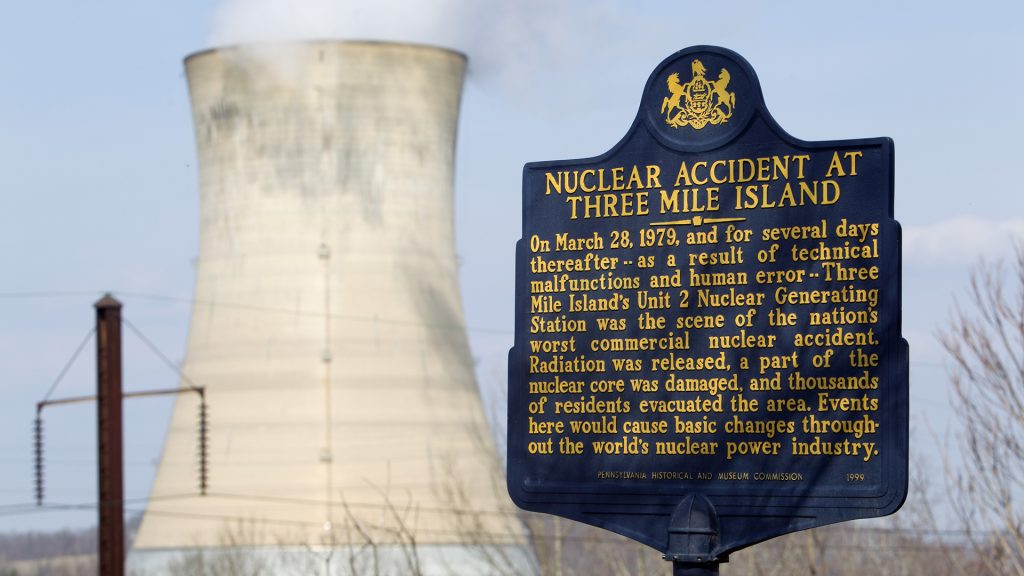
Microsoft and Constellation Energy have spent the last year trying to resurrect the Three Mile Island Nuclear power plant in Pennsylvania. The plant shut down in 2019 under economic pressure, after a separate part of the facility was decommissioned following a partial meltdown in 1979.
The effort is laudable, especially in light of Microsoft’s rapidly rising demand for [?] clean energy to fuel its artificial intelligence data centers. Unfortunately, it will never work. A fully shut-down nuclear plant has never been restarted in America for good reason: There are too many regulatory, material and logistical hurdles to overcome.
So far, Constellation Energy has painted a rosy picture. It originally stated the plant would be back online by 2028. Then, in early 2025, it revised its estimated opening date to 2027 following various inspections and the restoration of the plant’s water systems.
But traditional nuclear projects have a long history of going over budget and past schedule. A big factor is that the U.S. regulatory environment is not friendly to traditional nuclear power.
As the former head of the Federal Energy Regulatory Commission in the first Trump administration, I have seen firsthand how red tape can choke even the best-intentioned projects under goodwill regulators. Reactors that were permanently shut down must go through an extensive regulatory review process and request special exemptions for both their operations and use of radioactive fuel.
Constellation Energy and Microsoft have some solace in that the Department of Energy offered their project public support. But the Department of Energy isn’t the only player in town.
To ensure safety, Three Mile Island will also have to pass rigorous rounds of inspections, receive environmental approval and get the green light from the likes of the Environmental Protection Agency, the U.S. Nuclear Regulatory Commission, FERC and other state and local offices.
Even under a pro-business, pro-energy, regulation-slashing Trump administration, this is quite a gauntlet — especially because pro-nuclear government officials may nevertheless be hemmed in by existing laws and review processes outside of their control.
If regulatory barriers were the only holdup, perhaps there would be reasons to be more bullish on Three Mile Island. After all, President Trump has offered full support to nuclear energy and is committed to winning the energy-intensive AI race against China, red tape or not.
But regulatory barriers are just the start. Nuclear reactors can’t be simply switched back on like a light bulb. They’re more like a car left undriven in a garage for too long with old oil, putrid gasoline, rat-chewed wires and a rusty frame — except that nuclear plants are infinitely more complicated than any car.
At Three Mile Island, the reactor vessel could be brittle and fatigued. The core rods may need to be refurbished, the steam generators might have corroded, the turbines may break after not being rotated for years. And we know the cooling tower was partially removed as a fire hazard.
Replacing and restoring this equipment and more will not come cheaply. Constellation Energy originally projected it would take $1.6 billion to bring the facility back onto the grid, but that was before it fully cracked open the hood.
Then there are the basic economic realities of traditional reactors. Three Mile Island, Indian Point, Crystal River and others were shut down not because they were unsafe or failed to produce energy, but because maintenance was costly and they couldn’t keep up with the low price of other energy sources like natural gas.
As energy demand rises, those costs may become more comparable. But restarting Three Mile Island is still an expensive bet that will take years or decades of the right economic conditions to pay off.
And all of this does not even count the difficulties with accessing or creating a supply chain for nuclear fuel and long-unused components, integrating with the local electricity grid, hiring and training a highly competent workforce and overcoming the (unjustified) cultural stigma against a power plant that shares a name with the only major nuclear meltdown in American history…………………………… https://thehill.com/opinion/energy-environment/5667831-microsoft-constellation-nuclear-challenges/
How Corporations View (and Own) the U.S. Military
The most famous example in recent years is the 2023 NDAA, which contained several provisions regarding Taiwan. One provision allowed Taiwan to receive foreign military financing (FMF) from the U.S. government. FMF usually goes to independent countries, not breakaway provinces. FMF consists of loans and/or grants from the U.S. government for a country to purchase goods and services from the U.S. war industry.
And, just like that, the 2023 NDAA increased U.S. belligerence toward Beijing and made war more likely, profiting corporations all the while.
Corporate Capture Is Not Just Lobbying
Christian. Dec 27, 2025, https://thebusinessofwar.substack.com/p/how-corporations-view-and-own-the?utm_source=post-email-title&publication_id=1769284&post_id=179499875&utm_campaign=email-post-title&isFreemail=true&r=ln98x&triedRedirect=true&utm_medium=email
A for-profit corporation is a business organization designed to maximize short-term profit. The job of corporate executives is to maximize that profit, while the board of directors makes sure they do so.
The number one way that a corporation maximizes profit is by underpaying its workers.1 Workers create the profit, but don’t receive it. The executives funnel that profit to investors and themselves.
It goes without saying that the workers are not in charge. They are not allowed to make the business decisions in a given corporation. The executives make those decisions. There is no democracy in the workplace.
This is the situation in any industry, including the war industry.
What You Know about Corporate Capture
Big business works hard to influence the U.S. government. Corporate capture happens when it succeeds. Massive corporations work together to influence the government’s institutions and decision-making so that policy and regulation (or lack thereof) increase corporate profit instead of public well-being.
You likely know about think tanks, lobbying, and legal bribery.
- A think tank issues information favorable to those who fund it. Corporations and the super-rich fund think tanks, which create and inflate threats and justify the broad deployment of U.S. troops and sky-high military and intel budgets.
- Corporations and the super-rich hire lobbyists to swarm U.S. Congress and the Pentagon. Lobbyists even draft legislation, which they hand over to politicians.
- Corporations and the super-rich fund the two political parties and individual candidates. Once in office, elected officials pass laws favorable to these big business interests.
Think tanks, lobbying, and legal bribery are a powerful combination, but corporate capture is much more than that. War corporations (known as “military contractors” or “defense companies”) control the mind and the body in several ways.
Control the Mind
- Corporations regularly open (and close) offices and factories. Corporate executives promise a number jobs at a given location, particularly when seeking state and local tax breaks (though the fine print makes sure they never have to come through with all of those jobs or keep workers employed for the long run). Playing the “jobs” card is a way for big business and its politicians to pretend to care about workers.
- Legally designated as 501(c) nonprofits, trade groups (e.g., NDIA, AIA, AUSA) excel at networking active-duty military officers and industry officials, further blurring the line between government and corporate. Corporate viewpoints reign supreme at networking events, such as seminars, breakfasts, and arms fairs. (Additionally, 501(c)4 nonprofits are skilled at using dark money to influence politics.)
- Corporations help to craft policy and strategy on the inside. Corporations have had a hand in strategic initiatives and planning for Navy leadership, strategic plans and policy support for the Air Force, acquisition policy and program development for the Marine Corps, assessments and policy recommendations for the Deputy Assistant Secretary for Logistics, and more!
- The Pentagon gives corporations free labor from military officers. The corporations are allowed to propagandize these officers with recommendations about military policy, which the officers take with them when they return to their military unit.
- Greedy tycoons, including prominent war profiteers, sit on different boards that advise the Pentagon. The Defense Policy Board is one such grouping.
Control the Body
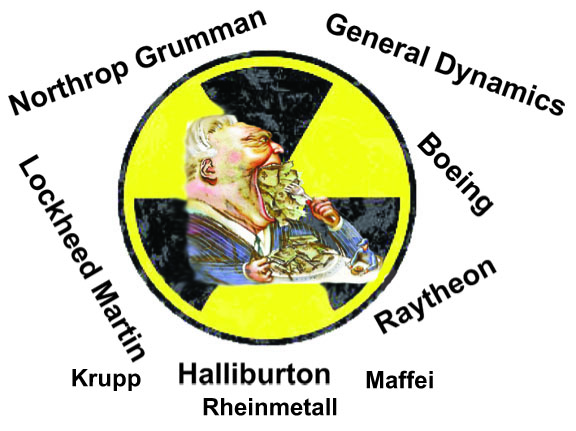
- The U.S. military doesn’t move, bomb, or communicate without corporations. In fact, it doesn’t do anything without corporate goods and services — from the largest aircraft carrier (itself a platform for innumerable goods and services) to the smallest microchip. Comprising the militant body, corporations gobble up more than half of the military budget. There still are uniformed troops (soldiers, sailors, airmen, Marines, and guardians), but they are merely users of corporate products… in the eyes of top executives.
- Corporate personnel are everywhere. These “contractors” even outnumber the troops in many military locations.
- The U.S. military isn’t allowed to repair most of its own equipment. Corporations must do it. This is just like corporations preventing farmers from repairing their tractors or you from putting a new battery into your old laptop.
- In the same vein, corporations do their best to hog the data pertaining to big-ticket weapons. The most famous example is the Lockheed Martin F-35 jet, the most expensive weapon of all time. The corporation owns the software code and the technical data for the jet. The U.S. military therefore is unable to operate, maintain, or upgrade the jet on its own.
- If you don’t own it, it’s not yours. Many corporations require the U.S. military to license their software, not purchase it outright. Licenses cover everything from accounting software and data integration software to products that monitor communications network and Oracle databases for a massive counterintelligence bureaucracy. Licensing is more profitable than a one-time sale.
- Capitalists move from industry to government and back again. When in government, they implement profit-over-people policies and they acquire knowledge to profit better whenever they leave government. (Top military officers also flock to war corporations in retirement, often becoming executives.)
Corporations don’t just run the show. Corporations are the show.
The Resulting Behavior
This corporate capture — mind and body — guarantees that government policy will help to maximize corporate profit.
The annual military policy bill known as the National Defense Authorization Act (NDAA) is crafted in the environment described above. Corporate lobbyists and U.S. Congress pack the NDAA with section after section designed to increase corporate profit.
Year after year, the NDAA requires the Pentagon to:
1. Train and arm foreign militaries or paramilitary groups. This increases arms sales and can give the Pentagon some influence over those being trained/armed.
A few examples of many include: training Iraqi forces and Kurdish Peshmerga (2024 NDAA); expanding the training of Eastern European “national security forces” (2025 NDAA); and reinforcing Lebanese military training and equipping (2026 NDAA).
2. Maintain or expand the U.S. military’s presence around the world.
The hundreds of U.S. military bases worldwide increase corporate sales — remember, corporations comprise most U.S. military activity2 — and allow the Pentagon to further bully governments/groups that chart an independent foreign policy or resist corporate domination of their land and resources.
No region is off-limits.
For example, the Pacific Deterrence Initiative, established through the 2021 NDAA and enhanced in all subsequent ones, is the main way the Pentagon militarizes the Pacific. It focuses on building up military infrastructure in the Pacific, purchasing and placing weaponry there, expanding military training and exercises there, and fostering and co-opting regional leaders.
3. Spend money on goods and services made by U.S. war corporations.3 For example, section 1640 of the 2024 NDAA required the Pentagon to establish a nuclear sea-launched cruise missile program. (Sections 1513 of the 2025 NDAA and 1633 of the 2026 NDAA refined the program’s goals.) Guess which corporations the military will pay to develop this weapon!
4. Assess what the official enemies are doing in a given region.
- Assess, for example, what Moscow and Beijing are up to in Latin America and the Caribbean (2024 NDAA, section 7342).
- Devise a strategy for “exposing, and, as appropriate, countering” China’s “malign activities” (2025 NDAA, section 1254).
- Evaluate [alleged] fentanyl trafficking by the Chinese government (2026 NDAA, section 8313) and plan to “respond” to China’s “global” military bases (section 8367).
These are just a few examples.
The assessments are then used to create fear and hype up such “threats.” Look out! [Country you’re taught to fear] is doing X, Y, and Z in [region U.S.-based capitalists want to dominate]! Bigger budgets follow. More money for war corporations.
5. Spend tax dollars on researching more technology for war and espionage. For example, the past three NDAAs have mandated research in artificial intelligence, microelectronics, nuclear weaponry, and much more. Industry does the research. And charges a pretty penny for it. (Meanwhile, corporations don’t use much of their own profit for R&D. Profit goes to execs and investors.)
The most famous example in recent years is the 2023 NDAA, which contained several provisions regarding Taiwan. One provision allowed Taiwan to receive foreign military financing (FMF) from the U.S. government. FMF usually goes to independent countries, not breakaway provinces. FMF consists of loans and/or grants from the U.S. government for a country to purchase goods and services from the U.S. war industry.
And, just like that, the 2023 NDAA increased U.S. belligerence toward Beijing and made war more likely, profiting corporations all the while.
Every subsequent NDAA increased the likelihood of all-out war with China. The 2026 NDAA, for example, further weaponized Taiwan by $1 billion, accelerated U.S.-Taiwan drone and counter-drone programs, encouraged the Pentagon to invite Taiwan to the massive annual military exercise known as RIMPAC, and more.
Full-court Press
Corporate capture is thorough.
It is lobbying; funding political parties and campaigns; establishing and funding think tanks; lying about jobs; using trade groups to imbricate military and industry; crafting policy and strategy on the inside; using boards to advise the Pentagon; flooding the military with corporate goods, services, and personnel; hogging data and requiring licensing; occupying the top Pentagon positions; and propagandizing military officers directly.
The troops are users of corporate goods and services.
Military bases are avenues of corporate profit.
That is how big business sees the U.S. military. And it has achieved its vision.
Christian Sorensen is a researcher focused on the U.S.-based corporations profiting from war. A U.S. Air Force veteran, Sorensen is associate director of the Eisenhower Media Network (EMN), a group of military and intel veterans who disagree with U.S. foreign policy and believe a better world is possible.
Chris Hedges: Profiting From Genocide
SOTT, Chris Hedges, MintPressNews, Wed, 02 Jul 2025
Chris Hedges breaks down a damning new UN report by Francesca Albanese exposing how tech giants, arms manufacturers, banks, and universities are profiting from Israel’s genocide of Palestinians.
War is a business. So is genocide. The latest report submitted by Francesca Albanese, Special Rapporteur on the Occupied Palestinian Territories, lists 48 corporations and institutions, including Palantir Technologies Inc., Lockheed Martin, Alphabet Inc., Amazon, International Business Machine Corporation (IBM), Caterpillar Inc., Microsoft Corporation and Massachusetts Institue of Technology (MIT), along with banks and financial firms such as Blackrock, insurers, real estate firms and charities, which in violation of international law are making billions from the occupation and the genocide of Palestinians.
The report, which includes a database of over 1,000 corporate entities that collaborate with Israel, demands these firms and institutions sever ties with Israel or be held accountable for complicity in war crimes.
“It describes Israel’s ‘forever-occupation’ as the ideal testing ground for arms manufacturers and Big Tech – providing significant supply and demand, little oversight, and zero accountability – while investors and private and public institutions profit freely.”
The post-Holocaust industrialists’ trials and the South African Truth and Reconciliation Commission laid the legal framework for recognizing the criminal responsibility of institutions and businesses that participate in international crimes. This new report makes clear that decisions made by the International Court of Justice place an obligation on entities “to not engage and/or to withdraw totally and unconditionally from any associated dealings, and to ensure that any engagement with Palestinians enables their self-determination.”
Albanese told me:
The report lambasts corporations for “providing Israel with the weapons and machinery required to destroy homes, schools, hospitals, places of leisure and worship, livelihoods and productive assets, such as olive groves and orchards.”
The Palestinian territory, the report notes, is a “captive market” because of Israeli-imposed restrictions on trade and investment, tree planting, fishing and water for colonies. Corporations have profiteered from this “captive market” by “exploiting Palestinian labour and resources, degrading and diverting natural resources, building and powering colonies and selling and marketing derived goods and services in Israel, the occupied Palestinian territory and globally.”
“Israel gains from this exploitation, while it costs the Palestinian economy at least 35 per cent of its GDP. Banks, asset management firms, pension funds and insurers have “channeled finance into the illegal occupation,” the report charges. In addition:
“Universities — centres of intellectual growth and power — have sustained the political ideology underpinning the colonization of Palestinian land, developed weaponry and overlooked or even endorsed systemic violence, while global research collaborations have obscured Palestinian erasure behind a veil of academic neutrality.
“Surveillance and incarceration technologies have evolved into tools for indiscriminate targeting of the Palestinian population. Heavy machinery previously used for house demolitions, infrastructure destruction and resource seizure in the West Bank have been repurposed to obliterate the urban landscape of Gaza, preventing displaced populations from returning and reconstituting as a community.
“The military assault on the Palestinians has also provided testing grounds for cutting-edge military capabilities: air defense platforms, drones, targeting tools powered by artificial intelligence and even the F-35 programme led by the United States of America. These technologies are then marketed as ‘battle proven’.”
Since 2020, Israel has been the eighth largest arms exporter in the world. Its two biggest weapons companies are Elbit Systems Ltd and the state-owned Israel Aerospace Industries Ltd (IAI). It has a series of international partnerships with foreign weapons firms, including “for the F-35 fighter jet, led by United States-based Lockheed Martin.”
“Components and parts constructed globally contribute to the Israeli F-35 fleet, which Israel customizes and maintains in partnership with Lockheed Martin and domestic companies.”
The report reads:
“Since October 2023, F-35s and F-16s jets have been integral to equipping Israel with the unprecedented aerial power to drop an estimated 85,000 tons of bombs, much of it unguided, to kill and injure more than 179,411 Palestinians and obliterate Gaza.
“Drones, hexacopters and quadcopters have also been omnipresent killing machines in the skies of Gaza. Drones largely developed and supplied by Elbit Systems and Israel Aerospace Industries have long flown alongside fighter jets, surveilling Palestinians and delivering target intelligence. In the past two decades, with support from these companies and collaborations with institutions such as the Massachusetts Institute of Technology, drones used by Israel acquired automated weapons systems and the ability to fly in swarm formation.”
Japan’s FANUC companies sell automation products and provide robotic machinery for weapons production lines, including for IAI, Elbit Systems and Lockheed Martin. Shipping companies such as the Danish A.P. Moller — Maersk A/Stransport components, parts, weapons and raw materials, sustaining a steady flow of United States-supplied military equipment post-October 2023.”
There was a “65 per cent surge in Israeli military spending from 2023 to 2024 – amounting to $46.5 billion, one of the highest per capita worldwide.” This “generated a sharp surge in their annual profits, while foreign arms companies, especially producers of munitions and ordnance, also profit.”
At the same time, tech companies have profited from the genocide:
“While providing dual-use infrastructure to integrate mass data collection and surveillance, while profiting from the unique testing ground for military technology offered by the occupied Palestinian territory, they enhance carceral and surveillance services, from closed-circuit television (CCTV) networks, biometric surveillance, advanced tech checkpoint networks, ‘smart walls’ and drone surveillance, to cloud computing, artificial intelligence and data analytics supporting on-the-ground military personnel.”
“Israeli tech firms often grow out of military infrastructure and strategy,” the report reads, “as the NSO Group, founded by ex-Unit 8200 members, did. Its Pegasus spyware, designed for covert smartphone surveillance, has been used against Palestinian activists and licensed globally to target leaders, journalists and human rights defenders. Exported under the Defense Export Control Law, NSO group surveillance technology enables ‘spyware diplomacy’ while reinforcing State impunity.”
IBM, whose technology facilitated Nazi Germany’s generation and tabulation of punched cards for nationalcensus data, military logistics, ghetto statistics, train traffic management and concentration camp capacity, is once again a partner in this current genocide.
It has operated in Israel since 1972. It provides training for Israeli military and intelligence agencies, especially Unit 8200, which is responsible for clandestine operations, the collection of signal intelligence and code decryption, along with counterintelligence, cyberwarfare, military intelligence and surveillance.
“Since 2019,IBM Israelhas operated and upgraded the central database of the Population and Immigration Authority, enabling collection, storage and governmental use of biometric data on Palestinians, and supporting the discriminatory permit regime of Israel,” the report notes.
Microsoft, active in Israel since1989, is “embedded in the prison service, police, universities and schools — including in colonies. Microsoft has been integrating its systems and civilian tech across the Israeli military since 2003, while acquiring Israeli cybersecurity and surveillance start-ups.”
“As Israeli apartheid, military and population-control systems generate increasing volumes of data, its reliance on cloud storage and computing has grown,” the report reads. “In 2021, Israel awarded Alphabet Inc. (Google) and Amazon.com, Inc. a $1.2 billion contract (Project Nimbus) — largely funded through Ministry of Defense expenditure — to provide core tech infrastructure.”
Microsoft, Alphabet Inc., and Amazon“grant Israel virtually government-wide access to their cloud and artificial intelligence technologies, enhancing data processing, decision-making and surveillance and analysis capacities.”
The Israeli military, the report points out, “has developed artificial intelligence systems such as ‘Lavender,’ ‘Gospel’ and ‘Where’s Daddy?’ to process data and generate lists of targets, reshaping modern warfare and illustrating the dual-use nature of artificial intelligence.”
There are “reasonable grounds,” the report reads, to believe that Palantir Technology Inc., which has a long relationship with Israel, “has provided automatic predictive policing technology, core defence infrastructure for rapid and scaled-up construction and deployment of military software, and its Artificial Intelligence Platform, which allows real-time battlefield data integration for automated decision-making.”
Palantir’s CEO in April 2025 responded to accusations that Palantir kills Palestinians in Gaza by saying, “mostly terrorists, that’s true.”
The report reads:
“Civilian technologies have long served as dual-use tools of settler-colonial occupation. Israeli military operations rely heavily on equipment from leading global manufacturers to ‘unground’ Palestinians from their land, demolishing homes, public buildings, farmland, roads and other vital infrastructure. Since October 2023, this machinery has been integral to damaging and destroying 70 per cent of structures and 81 per cent of cropland in Gaza.”
Caterpillar Inc. has for decades provided the Israeli military with equipment used to demolish Palestinian homes, mosques, hospitals as well as “burying alive wounded Palestinians,” and killed activists, such as Rachel Corrie………………………………………………………………………………………………………………………………………………………………………………………………………………………………………………
Genocide requires a vast network and billions of dollars to sustain it. Israel could not carry out its mass slaughter of the Palestinians without this ecosystem.
These entities, which profit from industrial violence against the Palestinians and mass displacement, are as guilty of genocide as the Israeli military units decimating the people in Gaza.
They too are war criminals, They too must be held accountable.
Comment: Israel is a major network operation…locking in every necessity with redundancy and delivery…no stone unturned, no challenge without guarantees and framework. It is jaw-dropping…really. https://www.sott.net/article/503682-Chris-Hedges-Profiting-from-genocide
Turkey Makes Another $9 Billion Bet on Russian Nuclear Power
By Julianne Geiger – Oil Price, Dec 26, 2025,
Turkey just took another very large, very deliberate step deeper into Russia’s energy orbit — and this time it comes with a $9 billion price tag.
Ankara says that Russia has provided $9 billion in new financing for the Akkuyu nuclear power plant, Turkey’s first-ever nuclear facility, which is being built by Russia’s state-owned Rosatom on the Mediterranean coast. According to Energy Minister Alparslan Bayraktar, the bulk of that money will be deployed in 2026 and 2027, with as much as $4–5 billion flowing next year alone. The plant is now expected to come online in 2026, after multiple delays.
While this may look like a straightforward infrastructure update, it’s more about how deeply intertwined Turkish and Russian energy interests remain, despite years of flowery talk about diversification and reduced dependence on Moscow.
Akkuyu has always been different from Turkey’s other energy ambitions. It is a build-own-operate project. This means that Rosatom shoulders the financial risk, owns the plant, and will operate it for decades. That structure is precisely why Akkuyu survived when Turkey’s second nuclear project at Sinop collapsed under runaway costs and political complexity. Only Russia stayed……………………………………. https://oilprice.com/Latest-Energy-News/World-News/Turkey-Makes-Another-9-Billion-Bet-on-Russian-Nuclear-Power.html
Trump Floundering Efforts to Shore Up US Hegemony
Michael Hudson The Unz Review, December 20, 2025
The National Security Strategy’s Drive to Shed the Costs of Imposing Its U.S. Unipolar Empire
The one area in which the National Security Strategy makes a claim to be realistic is to recognize that the United States cannot directly be seen to impose its control by force. This task is to be delegated more to client oligarchies and their governments, by assigning responsibility (and most important, the military costs) on a regionwide basis along lines similar to how the European Union’s foreign and domestic political policies have been made subordinate to NATO Cold War policy controlled by the United States.
Replacing at least the anti-Russian rhetoric of Biden’s and the EU’s support for the war against Russia, the NSS proposes dividing the world into spheres of influence for the major regional powers: the United States (monopolizing control of all of Latin America and the Caribbean for itself), Russia (with its Central Asian and other former Soviet republics, including what formerly was eastern Ukraine), and China over mainland Asian neighbors. A Pacific NATO-like arrangement to be shepherded (and financed) by Japan, with India as the wild card. The EU under NATO are dismissed as a waning power with little influence.
This plan is not really a division of spheres of regional influence at all, in the sense that World War II’s 1945 Yalta conference was. It does carve out a uniquely U.S. control over Latin America and the Caribbean. European and Asian countries are to keep away from investing in the major resources of these countries.[1] This is Trump’s travesty of the Monroe Doctrine. That doctrine called for a reciprocity with foreign countries: Europe would stay out of political control of Latin American countries, and the United States would not interfere in European affairs. But U.S. officials had no problem with the newly independent Latin American countries going deeply into debt to British and other foreign creditors who imposed debt dependency, much as France did with Haiti as the price of its buying its political freedom to abolish domestic slavery. The effect was for many of these countries obtained political freedom from colonialism only to fall into debt dependency. But the Monroe Doctrine was only concerned with direct political and military control.
The major U.S. violation of the original Monroe Doctrine has been to maneuvere to control Eurasian affairs. It has meddled in European elections, most notably in Italy and Greece after World War II by mounting right-wing challenges to their rising Communist parties. And it has ringed Eurasia with U.S. military bases and mounted regime change coups. The effect is that U.S. diplomats have been trying for eighty years to turn the entire world into a unipolar U.S. region of influence.
But the military and related costs of this effort have been largely responsible for the U.S. balance-of-payments deficit since the Korean War, and also the U.S. domestic budget deficit (at least until the neoliberal tax cuts on the revenue side of the budget). These costs are to be shifted onto foreign countries.
The costs of maintaining the U.S. diplomatic empire must be assigned on a region-wide basis under the leadership of particularly loyal U.S. proxies, much as is the case with NATO countries Europe under British, French and German dominance.
In Asia, U.S. diplomacy relies on the Quad (Japan, Australia, India and the United States) along with friendly governments in South Korea and the Philippines to prevent their economies and those of China and other countries in the region from obtaining oil and gas from Russia, Iran and Venezuela to install military basis ringing China. Much as U.S. neocons are trying to convince NATO allies that these adversaries pose an imminent military threat, Asian countries are being mobilized to support a separatist political movement in Taiwan.
………………………………………………………………………………………………………………………………………………………………………………………………………………………………… Trump’s drive to attract foreign financing to the U.S. debt market via cryptocurrency
In seeking to counter other countries’ moves away from the dollar, the most recent U.S. tactic is to try to surreptitiously get other countries to hold dollars by persuading them to invest in stablecoins – cryptocurrency that is invested in U.S. Treasury securities, not bonds of China or other countries…………………………………….
And a major aim of cryptocurrencies is, of course, to facilitate tax evasion and criminal activities through libertarian “privacy” (that is, secrecy from public authorities) and criminal management of such currencies themselves. The Trump Administration’s support for cryptocurrencies actually is a new version of the U.S. drive to promote offshore banking centers in the 1960s…………………………………………………………………………………………. https://www.unz.com/mhudson/trump-floundering-efforts-to-shore-up-us-hegemony/
Politico: Despite the war, France will build nuclear fuel in Germany with the help of a Russian company
Can the ambitious plan to phase out Russian nuclear fuel succeed with Russian expertise? Paris believes it can and is pressing Berlin for approval
Protothema, Newsroom, December 22, 2025
Takeawaysby Protothema AI
- A Franco-Russian joint venture plans to produce nuclear fuel components in Lingen, Germany, operated by Framatome
- The project faces scrutiny from German authorities due to security concerns and potential espionage risks
- Framatome is lobbying German officials for approval, arguing it is a European solution despite Russian components
- German regional authorities remain skeptical, citing past energy vulnerabilities with Russia
- A final decision on the Lingen plant’s approval is expected in the coming weeks.
A triangular relationship that is close to becoming a reality, despite the war in Ukraine and the sanctions imposed on Russia, will help France produce nuclear fuel for its reactors.
The Franco-Russian joint venture will manufacture nuclear fuel rods and other components in Lingen, Germany.
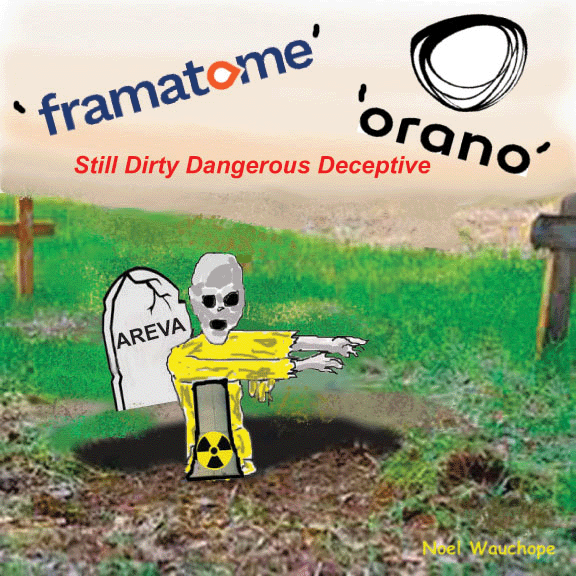
The plant will be operated by Framatome, a subsidiary of the French state-owned energy company EDF, using Russian components supplied by TVEL, part of the Kremlin-controlled nuclear giant Rosatom. TVEL will not be directly involved in the operation of the plant but will provide the Russian-made components necessary for producing the nuclear fuel.
The plant will not supply electricity directly; it will focus solely on producing nuclear fuel.
Framatome is putting intense pressure on the German authorities to approve the project, mobilizing the French government at the highest levels. The company argues that what is good for Framatome is good for Europe.
However, as Politico points out, the project comes at a time when the EU is attempting to ban all energy imports from Russia in response to Russia’s invasion of Ukraine. At the same time, the plan raises concerns among state and federal authorities about potential espionage and other security risks.
The French-Russian joint venture has not yet received approval from Berlin. A final decision is expected in the coming weeks, but no timetable has been set……………………………………………………
France–Russia Nuclear Cooperation
The cooperation between Framatome and Rosatom began in 2021, when the two parties signed a long-term partnership and established a joint venture in which Framatome owns 75% and TVEL 25%……………….. https://en.protothema.gr/2025/12/22/politico-despite-the-war-france-will-build-nuclear-fuel-in-germany-with-the-help-of-a-russian-company/
EU launches inquiry into Czech funding plan for new nuclear
WNN, Tuesday, 23 December 2025
The European Commission “has doubts” that the proposed Czech funding plan for its proposed new nuclear units “is fully in line with EU State aid rules”.
In April last year the European Commission (EC), which is the executive arm of the European Union (EU), approved the funding plan for a single new nuclear reactor at the Dukovany nuclear power plant site in the Czech Republic.
In July last year Korea Hydro & Nuclear Power (KHNP) was selected for the project, and in October this year the Czech Republic officially notified the EC it had expanded its plans to two new nuclear units, each with a capacity of 976 MWe
What is the funding plan?
The EC says: “Czechia plans to support the construction of the new nuclear units through three measures: a low-interest repayable State loan of an initial amount currently estimated between EUR23 billion (USD27.1 billion) and EUR30 billion, which will cover the full construction costs; a two-way contract for difference with a proposed duration of 40 years to ensure stable revenues for the nuclear power plant; and a mechanism to protect EDU II in case of policy changes and adverse impacts, to address the risk arising from the longevity of exposure to policy changes.”
EDU II is Elektrárna Dukovany II, a company set up to develop and operate the new nuclear units, which is owned by the Czech state (80%) and the Czech Republic’s nuclear power plant operator ČEZ (20%).
The contract for difference effectively means that if electricity prices are below the agreed level, the nuclear project will receive a subsidy to make it up to the agreed price, and if electricity prices are above the agreed price, the nuclear project would pay money back to the government…………………………………………………..
The EC has doubts about whether it is fully in line with EU State aid rules and wants to ensure that “no more aid than necessary is ultimately granted. In particular, the Commission has doubts on whether the proposed package achieves an appropriate balance between reducing risks to enable the investment and maintaining incentives for efficient behaviour, while avoiding excessive risk transfer to the State”.
It also wants to look at the impact of the State aid measures on competition in the market “in particular, the Commission has concerns that several essential design elements of the CfD remain insufficiently specified, preventing the Commission from fully assessing whether the mechanism maintains efficient operational and maintenance incentives”.
…………………………………….. Asked about the status of any investigation into foreign state aid, a European Commission spokesperson told World Nuclear News on Tuesday: “The Commission’s assessment of a complaint by EDF under the Foreign Subsidies Regulation regarding the award of a tender to KNHP is ongoing. We do not comment on ongoing investigations.” https://www.world-nuclear-news.org/articles/eu-launches-inquiry-into-czech-new-nuclear-funding-plan
1 This Month

of the week – Shut Down Drone Warfare!


Tell the Ukrainian Government to Drop Prosecution of Peace Activist Yurii Sheliazhenko

Petition to revoke the licensing of the Near Surface Nuclear Disposal Facility (NSDF) at Chalk River. https://www.ourcommons.ca/petitions/en/Petition/Details?Petition=e-7247
To see nuclear-related stories in greater depth and intensity – go to https://nuclearinformation.wordpress.com
-
Archives
- April 2026 (57)
- March 2026 (251)
- February 2026 (268)
- January 2026 (308)
- December 2025 (358)
- November 2025 (359)
- October 2025 (376)
- September 2025 (257)
- August 2025 (319)
- July 2025 (230)
- June 2025 (348)
- May 2025 (261)
-
Categories
- 1
- 1 NUCLEAR ISSUES
- business and costs
- climate change
- culture and arts
- ENERGY
- environment
- health
- history
- indigenous issues
- Legal
- marketing of nuclear
- media
- opposition to nuclear
- PERSONAL STORIES
- politics
- politics international
- Religion and ethics
- safety
- secrets,lies and civil liberties
- spinbuster
- technology
- Uranium
- wastes
- weapons and war
- Women
- 2 WORLD
- ACTION
- AFRICA
- Atrocities
- AUSTRALIA
- Christina's notes
- Christina's themes
- culture and arts
- Events
- Fuk 2022
- Fuk 2023
- Fukushima 2017
- Fukushima 2018
- fukushima 2019
- Fukushima 2020
- Fukushima 2021
- general
- global warming
- Humour (God we need it)
- Nuclear
- RARE EARTHS
- Reference
- resources – print
- Resources -audiovicual
- Weekly Newsletter
- World
- World Nuclear
- YouTube
-
RSS
Entries RSS
Comments RSS
 nuclear-news