Many thousands of jobs created by USA’s renewable energy grants program
DOE: Renewable grant program was a big jobs creator Politico, By ALEX GUILLEN | 4/6/12 A $9 billion Obama administration grant program for renewable energy projects has created tens of thousands of jobs, an Energy Department report out Friday concludes.

The report comes just one week after Speaker John Boehner slammed Energy Secretary Steven Chu over the claim and challenged him to provide proof of the jobs creation. The report — conducted by DOE’s National Renewable Energy Laboratory — concludes that the program supported 52,000 to 75,000 construction and installation jobs on average over the three years it was in effect. Continue reading
U.S. Nuclear Regulatory Commission perturbed about troubled San Onofre nuclear station
US nuclear agency head to visit troubled Calif reactors HOUSTON, Apr 5, 2012 (Reuters) – The chairman of the U.S. Nuclear Regulatory Commission and several California lawmakers are scheduled to tour the troubled San Onofre nuclear station in the state on Friday, the agency said.
NRC Chair Gregory Jaczko will visit Southern California Edison’s 2,150-megawatt San Onofre nuclear station near San Diego, where both reactors have been shut since January due to the discovery of premature wear on tubes inside giant steam generators. Continue reading
Cost of building nuclear plants, and the risk of time and cost overruns
the issue of shifting the risk from the banks back to convincing consumers that they must bear the risk….
the Vogtle project for two AP1000 reactors supplied by Toshiba/Westinghouse, is in a state (Georgia) where the regulator is already allowing cost recovery, even before the start of serious construction…. It is unlikely there will be many more states with regulators willing and able to commit consumers to repay all the costs, especially if things go wrong at these sites
 Prospects for Nuclear Power in 2012, The Energy Report, 5 April 12 “…..Gen III+ Claims The nuclear industry would probably like to forget the claims it made for Generation III+ designs. In short, Gen III+ reactors would achieve the dream combination of being both safer and simpler, making them cheaper and easier to build. The expected overnight (excluding finance charges) construction cost was forecast to be no more than $1,000/kilowatt hour (KWh), so that a typical 1,500-megawatt (MW) nuclear power plant would cost $1.5 billion (B). This was much less than the few plants completed in the 1990s and, not by coincidence, a figure that meant power from new nuclear reactors would be competitive with power from gas-fired plants.
However, the $1,000/KWh promise quickly began to unravel, when the first order for a Gen III+ design, Olkiluoto in Finland, was priced in 2004 at more than double that level. Construction of the European Pressurized Reactor (EPR) supplied by French company Areva, and its only successor so far in the West, Flamanville in France, has descended into farce. Both plants are now five years over their expected construction time and the latest cost estimates are about double the level forecast at construction start. Most recent serious cost estimates and bids in the past few years for Gen III+ designs have been of the order of $6,000/KWh. Continue reading
10,000 new renewable energy jobs, in UK marine energy sector
 Positive Energy: Renewable Energy Sector set to Offer More Jobs, Report reed.co.uk, LONDON, April 5, 2012 /PRNewswire via COMTEX/ — Renewable energy sector could potentially offer up to 10,000 more jobs over the next eight years, predicts job site
Starting salaries are also set to rise in the industry Continue reading
Japan’s nuclear utilities: debts piling up, banks nervous about funding
the latest setback over Tepco’s restructuring suggests even the mega banks are getting cold feet over providing unsecured loans to their utility clients.
Lights dim for Japan’s nuclear utilities, Reuters, By Mia Stubbs TOKYO, April 4 (IFR) – As the future of Tokyo Electric Power remains in question, concerns are building over how other nuclear power operating electric power companies (Epcos) will fund themselves going forward. Continue reading
Nuclear power in China has a doubtful future
 Prospects for Nuclear Power in 2012, The Energy Report, 5 April 12, “…….China has dominated new nuclear plant orders in the past few years, accounting for 25 out of the 38 reactors on which construction started worldwide between 2008 and 2010. Six of these units were for Gen III+ designs, four AP1000s and two EPRs. Almost all the others used a design imported from France in the 1980s, which in turn had been licensed from Westinghouse in the early 1970s. This design, the CPR1000, is showing its age and there was an expectation, even before Fukushima, that the AP1000 would replace it. This would have been a huge boost to the AP1000, giving it the volume of orders that might have allowed costs to come down and for teething problems to be solved. The EPR, by contrast, appears to have no prospect of further orders in China.
However, there were signs that the strain of the rapid pace of construction was beginning to show. In 2011, no new starts were made, compared with 10 in 2010. Fukushima explains this to a degree, but some might have been expected in the first three months of 2011 before disaster struck. The reason behind the slowdown is the high cost of the AP1000. The large Chinese utilities appear to be looking at other options.
There is now talk of pursuing indigenous advanced designs developed from the CPR1000 as well as Small Modular Reactors (SMRs). China has always been adept at convincing nuclear suppliers that there was a great future for their particular technology in China. It is unclear whether talk of SMRs and new advanced designs will go any further. China is looking much less committed to nuclear power than it was a year ago.
There is also speculation that China may enter the export market on the entirely unsupported assumptions that its reactors will be cheap and that it can successfully build them away from home soil. South Africa is particularly enthusiastic about Chinese designs, but whether this enthusiasm can be turned into orders remains to be seen.
The reality is that China needs nuclear power much less than the nuclear industry needs China. ….” http://www.theenergyreport.com/pub/na/12441
Cost, not just safety issues, send a toxic cloud over the nuclear industry’s future
Nowadays, a typical scheme involving multiple reactors on one site, puts you back $25bn! The money was not to be produced up-front, of course, but created by complex financial packages based on debt, not equity. The sums involved, the “paper” floating on the underlying asset – the nuclear complex – run into the trillions.

 Nuclear industry dreams dashed by current economic reality http://www.guardian.co.uk/business/economics-blog/2012/apr/02/nuclear-dreams-economic-reality-blog?newsfeed=true It was the financing model and rates of return that prompted German nuclear giants RWC and E.ON to pull out of UK energy plans Martin Cohen guardian.co.uk 2 April 2012 The news that nuclear giants RWE and E.ON are dropping plans to build any new UK reactors has sent a toxic cloud not only over Wales, but over the nuclear industry itself. Continue reading
South Carolina new nuclear reactors might have license, but costs are looking too great
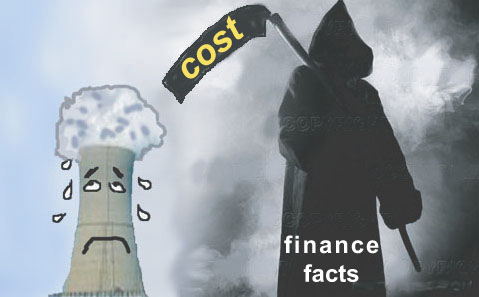
 Summer Nuclear Unit Already Behind As It Gets Federal Green Light, AOL Energy, By Margaret Ryan April 3, 2012 The long-expected federal decision giving SCANA a license to build two new nuclear reactors in South Carolina came along with news that project has already encountered delays and cost overruns. …. Continue reading
The smart money is on energy efficiency and renewables: the dumb money on nuclear
E.on and RWE are huge, blue-chip multinationals, yet see nuclear as too big a gamble and that’s despite the substantial subsidy it would enjoy in the UK,
 Contrast all this with energy efficiency and renewables. The former makes sense by definition. The latter is where costs are coming down, even with the relatively limited subsidies they receive. And neither involve the Faustian pacts of nuclear power or oil and gas: they are as safe as the houses they power…..
Nuclear and gas blow outs show where the dumb money is, Guardian UK, Damian Carrington, 30 March 12, The smart money is on energy efficiency and renewables yet a government terrified of “backing winners” appears happy to back the nuclear, oil and gas losers Follow the money: in the billion-dollar world of the energy business that is good advice. So what do the collapse of a quarter of the UK’s new nuclear power plans and the gas still billowing dangerously from Total’s Elgin rig in the North Sea tell us about keeping the lights on and tackling climate change at a price we can afford?
It tells us first that, despite decades of lavish public subsidy, nuclear power remains uninvestable without heavy state backing. Continue reading
Energy transition in Europe as nuclear power exits
The number of economically competitive non-nuclear options has therefore grown alongside the growing number of non-fossil options.
Europe’s Nuclear Exit Strategy The Market Oracle, Mar 30, 2012 By: Andrew_McKillop“.….NUCLEAR EXIT: THE SYMBOL OF ENERGY TRANSITION Even in France, where decades of state brainwashing on the benefits of nuclear power had created an apparent public-and-political consensus in favour of the Friendly Atom, opinion polls now indicate a straight majority of French want to quit nuclear power.
This opinion shift is powerfully aided by now much better information becoming available on the fantastic subsidies and support that have gone to French civil nuclear power since its very origins in 1957.
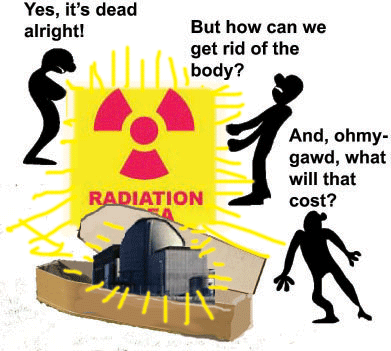 Also due to the sheer size of the French nuclear power system and its age, decommissioning will produce impossible to hide impacts on the power bills of all
consumers and users, in a context where new-build reactors to replace retired and dismantled reactors (in a process that can take 30 years for each reactor) are prohibitively costly, at admitted costs as high as 6500 euro per kiloWatt (close to US$ 9000 per kW) for Areva’s “Generation III” EPRs. Continue reading
Nuclear industry dead at home, but Japan tries to sell it abroad
 Japanese May Invest in U.K. Nuclear, WSJ, By SELINA WILLIAMS, 30 March 12 “……-RWE and E.ON are now seeking to sell their U.K. nuclear joint venture vehicle, named Horizon, that has two sites for new atomic power stations–at Wylfa in Wales and Oldbury in Gloucestershire in central England, as well as grid connections and around 130 employees,
including technical specialists, engineers, and project development specialists….
Japanese nuclear companies such as reactor vendors Hitachi and Toshiba Corp. and nuclear developers Mitsubishi Heavy Industries are seen by many in the nuclear industry as the most likely buyers.
Stymied at home following the Fukushima nuclear disaster last March, these companies are actively seeking new markets elsewhere and the U.K. could be a good base for expansion plans in Europe. “You could see a strong Japanese team coming in–there’s not going to
be building in Japan for the forseeable future, so growth for them can only come out of exports,” said George Borovas, a nuclear lawyer and partner at Pillsbury law firm that specializes in the energy sector…..
Stumping up the billions of pounds investment required to build a new reactor, coupled with the long lead times of construction as well as the cost overruns seen at other similar projects pose a huge challenge for any company seeking the finance, especially now in these
credit-strapped times.
Costs are killing the USA nuclear industry
”nuclear power is neither affordable nor worth the risk….. the very different natures of nuclear disaster versus coal pollution rightly makes people worried.
Expert: Nuclear Power Is On Its Deathbed A new report from a University of Vermont researcher says the cost of the safety measures needed for nuclear energy will eventually make the power source economically unviable USA News, By JASON KOEBLER March 30, 2012 After the Fukushima power plant disaster in Japan last year, the rising costs of nuclear energy could deliver a knockout punch to its future use in the United States, according to a researcher at the Vermont Law School Institute for Energy and the Environment.
“From my point of view, the fundamental nature of [nuclear] technology suggests that the future will be as clouded as the past,” says Mark Cooper, the author of the report. Continue reading
No new nuclear power plants says retiring CEO of Exelon nulcear company
 Exelon’s ‘Nuclear Guy’: No New Nukes Forbes, Jeff McMahon , C3/29/2012 Nuclear power is no longer an economically viable source of new energy in the United States, the freshly-retired CEO of Exelon, America’s largest producer of nuclear power, said in Chicago Thursday.
And it won’t become economically viable, he said, for the forseeable future Continue reading
2 big energy companies pull out of UK’s nuclear power projects
Energy firms abandon nuclear plans, Google News, (UKPA) –30 Mar 12 The Government’s plans for a nuclear-power renaissance are in disarray after two of the “big six” energy giants pulled out of a venture to build new reactors…… The venture was hit by the global economic crisis and Germany’s decision to phase out nuclear power in response to the disaster at Fukushima following the Japanese earthquake and tsunami last year,… as well as the significant costs of the project…… They also confirmed they were committed to investing in energy schemes in the UK, including renewables and gas, which have shorter payback times on capital investment than nuclear build.
The latest withdrawal from nuclear new-build comes after Scottish and Southern Energy announced last year that it was pulling out of the NuGeneration joint venture to build a new plant at a site near Sellafield, West Cumbria….. Gary Smith, of the GMB union, said: “This is a devastating blow which leaves the UK Government energy strategy in tatters.” … environmental groups seized on the news as evidence that nuclear power, which provides just under a fifth of UK electricity supplies, was not a financially-viable option for the country’s future energy mix. They called for the Government to back renewables, which they said had the potential to create thousands of jobs, supply households and businesses with clean, safe and affordable electricity, and tackle climate change.
Price, and politics too, are bringing nuclear power development to a halt
U.K. Feels the Fallout From Nuclear-Industry Woes, WSJ, By ANDREW PEAPLE, 30 Mar 12, Nuclear power has fallen out of fashion fast since last year’s Fukushima accident; now even supportive governments can’t catch a break. German utilities RWE RWE.XE -1.27% and E.ON EOAN.XE -1.79% on Thursday scrapped plans to invest £15 billion ($23.8 billion) building two new reactors in the U.K., …. Continue reading
1 This Month





PLEASE OPPOSE HR 8255 AND S.3639 – bills would accelerate satellite deployment, with no environmental review or safeguards – https://ncstd5li.quorum.us/campaign/169331/
To see nuclear-related stories in greater depth and intensity – go to https://nuclearinformation.wordpress.com
-
Archives
- October 2026 (29)
- September 2026 (339)
- August 2026 (330)
- July 2026 (355)
- June 2026 (287)
- May 2026 (306)
- April 2026 (356)
- March 2026 (251)
- February 2026 (267)
- January 2026 (308)
- December 2025 (358)
- November 2025 (359)
-
Categories
- 1
- 1 NUCLEAR ISSUES
- business and costs
- climate change
- culture and arts
- ENERGY
- environment
- health
- history
- indigenous issues
- Legal
- marketing of nuclear
- media
- opposition to nuclear
- PERSONAL STORIES
- politics
- politics international
- Religion and ethics
- safety
- secrets,lies and civil liberties
- spinbuster
- technology
- Uranium
- wastes
- weapons and war
- Women
- 2 WORLD
- ACTION
- AFRICA
- Atrocities
- AUSTRALIA
- Christina's notes
- Christina's themes
- culture and arts
- Events
- Fuk 2022
- Fuk 2023
- Fukushima 2017
- Fukushima 2018
- fukushima 2019
- Fukushima 2020
- Fukushima 2021
- general
- global warming
- Humour (God we need it)
- Nuclear
- RARE EARTHS
- Reference
- resources – print
- Resources -audiovicual
- Weekly Newsletter
- World
- World Nuclear
- YouTube
-
RSS
Entries RSS
Comments RSS

