Australian rare earths company Lynas – pulling out of its Malawi project?
Lynas Likely To Give Up Rare Earths Project in Africa International Business Times, By Esther Tanquintic-Misa | June 14, 2012 With its highly-controversial Malaysian rare earths processing plant an already ample source of headache, Lynas Corp. has been reported to be likely backing out from another rare earths project, this time in Africa.
Citing unidentified industry sources, The West Australian reported that Lynas Corp. is thinking of shunning the Kangankunde rare earths project in Malawi after a Malawi High Court questioned the authenticity of the Australian miner’s ownership over the project…..
With the recent development, the Australian rare earths miner deemed it might be better to give up the African project altogether, than suffer again the same fate as with its highly controversial rare earths processing plant in Malaysia, The West Australian reported…. Lynas Corp. “is reassessing the project’s risks in the context of Malawi’s present governance and institutional frameworks,” sources told The West Australian. … http://au.ibtimes.com/articles/351984/20120614/lynas-corp-rare-earths-malawi-africa-malaysia.htm
Nuclear company NuStart Energy Development LLC to disband
Nuclear power partnership to disband ww.power-eng.com/articles/2012/06/nuclear-power-partnership-to-disband.html, Jun 12, 2012 After achieving its goal of licensing the first new nuclear power plants in decades and spurring more than $2 billion in private investment in new nuclear energy development, NuStart Energy Development LLC on June 12 said it will disband and reallocate its resources back to its 10 member companies effective June 30, 2012. Continue reading
Shareholder meetings could be the next impediment to restarting Japan’s nuclear power industry
Fukushima Watch: Next Nuclear Battleground — Utilities’ Shareholder Meetings, WSJ, June 13, 2012, By Mitsuru Obe With the government inching closer to restarting the first nuclear reactors since last year’s Fukushima Daiichi nuclear disaster, a new battleground between Japan’s pro- and anti-nuclear camps is emerging: the annual shareholder meetings of the country’s big power companies in June.
Japan’s four biggest utilities hold their shareholder meetings on June 27. The meeting that’s drawing a lot of attention these days is that of Kansai Electric Power Co., which relied on
nuclear plants to supply around half of its electricity, and operates the Oi nuclear plant, whose No. 3 and 4 reactors are first in line to restart. Kansai Electric supplies energy to the region around the city of Osaka, Japan’s third-biggest metropolis and the utility’s largest shareholder, with 8.92% of outstanding shares.
And Osaka has submitted proposals to Kansai Electric that it exit nuclear power and separate
its power-generation operations from distribution and transmission — or control of the electricity grid. Continue reading
Private enterprise is the major funder for new renewable energy
 Who’s funding the green energy revolution? By Eoghan Macguire, June 12, 2012 – (CNN) — Money invested in renewable energy reached new heights last year, topping $257 billion.
So is the world finally going green?
The figures come from The Global Trends in Renewable Energy Investment 2012 report, a UN Environment Program backed study that has tracked the finance flowing into green energy across the world since 2004.
It found that renewables accounted for 44% of all new energy generation capacity added last year, up from 34% in 2010 and just 10.3% back in 2004.
The source for most of this finance came from the private sector, according to the report. Investment from the private domain in research and development of new technologies was almost double that of governments and public bodies.
While Europe attracts most of the investment, the renewable energy sectors of emerging economies such as India and China have been given the biggest boost.
China overtook the U.S. in terms of total annual investment in renewable energy in 2009 and attracted more money than any other country ($52.2 bn) in 2011.
India meanwhile saw the fastest expansion rate for any large renewables market last year, with a 62% increase in capital funding…… http://edition.cnn.com/2012/06/12/world/renewables-finance-unep/
Taxpayers’ huge costs for nuclear power mishaps
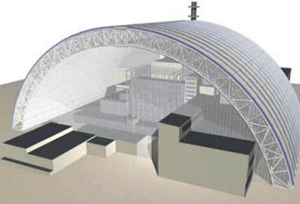 During a visit to Chernobyl in April, I learned about a new project to build, by 2015, a “shelter” to lock in the radiation still emanating from the reactor. The price tag is estimated at 1.5 billion euros ($1.9 billion). But this sarcophagus is no more than a wildly expensive Band-Aid, which will be ripped off a still-festering wound in 100 years.
Then there is the issue of who pays to build such facilities. In principle, private capital does not flow to nonprofit activities. In fact, it is flowing to renewable energy sources, not atomic.
It is governments—and thus taxpayers and bondholders—that finance nuclear plants. Moreover, the alleged “cost-savings” of nuclear power never include the price tag for direct and indirect governmental subsidies, decommissioning of aging facilities, and emergency cleanup and remediation of impacted communities when disasters occur—all, again, at taxpayers’ expense.

The road from Chernobyl, By: Alexander Likhotal, Philippine Daily Inquirer, June 11th, 2012 “……. While nuclear energy’s advocates often claim that there have been only two major calamities, a very different picture emerges if we consider other “accidents” that caused loss of human life or significant property damage.
Between 1952 and 2009, at least 99 nuclear accidents met this definition worldwide, at a cost of more than $20.5 billion, or more than one incident and $330 million in damage every year. This recurrence rate demonstrates that many risks are not being properly managed or regulated, which is worrying, to say the least, especially given the harm that even a single serious accident can cause. Continue reading
Half of the world’s nuclear reactors will be closed down by 2030
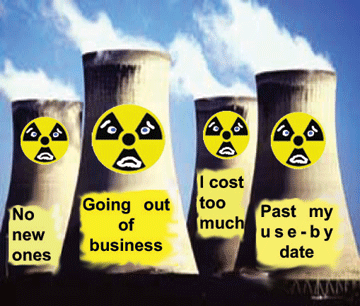 GlobalData’s report shows that more than 200 nuclear power stations across the world are expected to be closed by 2030, almost half of the number that are currently in operation.
Europe to Decommission Majority of Nuclear Power Stations by 2030 http://www.globaldata.com/PressReleaseDetails.aspx?PRID=174&Type=Industry&companyID=jpr Europe to Decommission Majority of Nuclear Power Stations by 2030 While US Bucks Global Trend 06 Jun 2012 Continue reading
San Onofre nuclear power plant shut throughout the summer
 San Onofre nuclear plant out of service for the summer, LA Times, June 7, 2012 The top official at Edison International said Thursday that the troubled San Onofre nuclear plant will remain out of service through the summer.
The plant has been shuttered since Jan. 31 while officials probe the extent and cause of unusual wear on tubes that carry radioactive water in the plant’s newly replaced steam generators. Continue reading
The unraveling of Europe’s nuclear dream
And, no doubt, new technologies will be proposed that promise to solve all the problems of the past, while utilities will fight tooth and nail to keep existing plants online long after their expected life-span is complete.
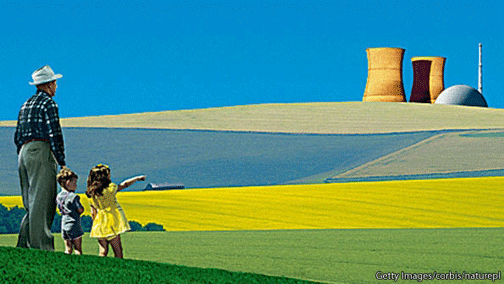
 Nuclear Europe: a dream unwinding, China Dialogue, Steve Thomas June 06, 2012“ Francois Hollande’s election victory is the latest blow to an industry struggling to revive the optimism of pre-Fukushima days. But the seeds of crisis were there well before Japan’s disaster, writes Steve Thomas. Prospects for nuclear power in post-Fukushima Europe are looking grim. Since the reactor meltdown in Japan last year, Germany, Switzerland and Italy have imposed phase-outs or abandoned attempts to start ordering new nuclear plants; the British programme has been delayed and one of the two remaining potential investors has dropped out; foreign investors are walking away from projects in eastern Europe, for example in Bulgaria and Romania; and France has elected a new president on an apparently anti-nuclear ticket.
With the leaders of Germany and France – two of Europe’s most powerful economies – now firmly in the “anti” camp, the outlook for nuclear power on the continent more widely is distinctly ropy. The Fukushima nuclear disaster of 2011, it seems on first glance, has been a devastating pill.
But while there is little doubt that the crisis in Japan significantly worsened the chances of a nuclear-powered Europe, it did so mainly by exacerbating problems that were already there – around cost, finance and public acceptance. It’s worth taking a moment to look at how these dynamics are playing out across the continent, and how they might impact Europe’s long-term energy agenda. Continue reading
China the nuclear lobby’s great hope – or is it?
Public opinion could also pose an obstacle. In a poll carried out by research agency Ipsos MORI after Fukushima, 42% of those surveyed in China were supportive of nuclear power – but that 48% were opposed. It
is also reported that public opposition and environmental concerns have led to the delay in construction of three inland nuclear power sites.
China’s nuclear developments probably matter more to the rest of the world than they do to China.

 Chinese nuclear goes global? China dialogue Antony Froggatt June 06, 2012 From Parisian boardrooms to Kazakh uranium mines, the nuclear industry anxiously awaits news from Beijing. …….
“…… the Fukushima crisis in Japan has had a significant – and under reported – impact on Chinese nuclear developments, triggering a freeze on the start of new construction, a re-consideration of the safety standards of domestic designs and unprecedentedly visible opposition to the building of new, inland nuclear plants. Continue reading
Nuclear companies compete desperately for sales, prices offered below costs!

 French Nuclear Watchdog Says Orders Won At Too-Low Prices Bloomberg, By Francois de Beaupuy – Jun 6, 2012 Nuclear-reactor makers are offering prices too low to cover costs to win orders abroad in a strategy that puts earnings at risk, the head of the industry’s watchdog in France said. “Export contracts for nuclear plants are being obtained at pure dumping-level prices,” Andre-Claude Lacoste, head of the Autorite de Surete Nucleaire regulator, said today at a conference organized by L’Usine Nouvelle magazine in Paris.
“Prices accepted by vendors and obtained by buyers are unsustainable,” Lacoste said. “There aren’t many tenders, which is why competitors are ripping each other off. It’s already a serious matter, and we need to make sure that there’s no dumping on safety on top of that.”
Areva SA (AREVA), the world’s largest provider of nuclear equipment and services, has booked more than 2.8 billion euros ($3.5 billion) of costs since 2005 because of delays and cost overruns at an atomic plant it’s building in Finland. The Paris-based company and General Electric Co. (GE) were beaten in 2009 on a four- reactor order in the United Arab Emirates by Korea Electric Power Corp. (KEP) in the Seoul-based company’s first export contract……. Areva is preparing
bids or in talks to sell reactors in countries including China, India, the U.K., the Czech Republic and Poland. In Finland, Areva faces GE Hitachi Nuclear Energy, Korea Hydro & Nuclear Power Co., Mitsubishi Heavy Industries Ltd. (7011) and Toshiba Corp. (6502) in a tender next year. http://www.bloomberg.com/news/2012-06-06/french-nuclear-watchdog-says-orders-won-at-too-low-prices.html
Vogtle nuclear power project – a money pit?
 A lot is at stake in the Vogtle project. The new breed of reactors being built at the site — featuring advanced standardized design, streamlined licensing and new construction techniques — are supposed to keep costs steady and bring projects in close to budget and on schedule.
That in turn is supposed to spur a new golden era for nuclear power.
Cost overruns of almost $1 billion — so far — at Ga. nuke reactors June 6, 2012, by Jay Bookman Last month, a consortium of utilities including Atlanta-based Southern Company announced cost overruns of almost $1 billion at two new nuclear reactors being built near Waynesboro.
That’s an arresting number under any circumstances, but it looms even larger when you realize that major construction on the Vogtle 3 and 4 reactors has basically just begun, with at least five more years of construction to come.
And if costs soar, who’s going to pay for it? Southern Company and its subsidiary, Georgia Power, own 45.7 percent of the project, so its ratepayers’ share of these recent overruns would come to more than $400 million. But according to Buzz Miller, Southern’s executive vice president of nuclear development, that cost will be borne by contractors who are building the project. Continue reading
The resuscitation of the nuclear industry is failing, because of costs
 Nuclear Europe: a dream unwinding, China Dialogue, Steve Thomas June 06, 2012“…”…….If Europe’s governments have been jolted by the aftermath of Fukushima, the big energy companies have been violently shaken. Nuclear has long been an attractive option for the major operators because the massive demands placed on plant-builders effectively rule out entry by new competitors – unlike smaller-scale decentralised technologies, which allow scope for small companies to join in. ….
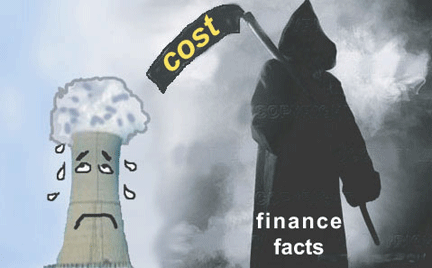
On cost, the promise was that these reactors could be built for US$1,000 (6,300 yuan) per kilowatt of capacity. That would bring a 1,700-megawatt EPR in at US$1.7 billion (10.8 billion yuan). At that price, it was claimed their power would be competitive with the cheapest option, natural gas. Today, even before any of these designs have entered service, the cost estimates are five to six times that level, and there is no sign that they have stopped rising.
On finance, the mandatory opening up of European electricity systems to competition has extinguished the assumption that consumers will underwrite whatever costs are incurred. That means the financial risk falls on the owner, not consumers. Financiers don’t like that equation, especially for a technology with as poor a record for being built to time and cost and operating reliably as nuclear power. Consumers always pay, but plant owners can go bankrupt losing money lent to them by banks.
It has become increasingly clear that a nuclear-power plant will struggle to find finance if destined to operate unprotected in a competitive market. The disastrous Olkiluoto and Flamanville projects suggest the promise of “buildability” was also fanciful – and will have made financiers even more sceptical…. . http://www.chinadialogue.net/article/show/single/en/4956
China raising funds to launch nuclear power, but public sentiment is “fragile”
China to Stoke Nuclear Power, WSJ 6 June 12, State-Owned Firm Plans IPO to Fund Reactors; $5.4 Billion Deal Is Possible BEIJING—China National Nuclear Power Co. said it is planning a Shanghai initial public offering that will go toward financing part
of five power projects worth 173.5 billion yuan ($27.2 billion), in a multibillion-dollar deal that signals that the country’s ramp-up of nuclear power is moving forward..
… China National Nuclear Power, according to a statement on the environmental ministry website, will sell shares to raise funds for nuclear-power projects in Fujian, Zhejiang, Hainan and Jiangsu provinces, the statement said, adding that these projects were approved by China’s National Development and Reform Commission between 2008 and 2010. Those projects require 173.5 billion yuan in funding,…
the IPO could be asking a lot of the country’s equity markets. The commission hasn’t approved any sizable IPOs since May, when the regulator gave the green light to China Postal Express & Logistics Co.’s potentially 9.98 billion yuan deal, though that has yet to
launch. Since early May, the benchmark Shanghai Composite Index is down 4%.
“A big IPO would weigh on the stock market further as it would divert funds from the secondary market, especially when the sentiment remains fragile,” said Yang Delong, a fund manager at China Southern Fund….. http://online.wsj.com/article/SB10001424052702303665904577449784005256706.html?mod=googlenews_wsj
France’s nuclear dilemma – costs of shutting aged reactors
Nuclear Europe: a dream unwinding, China Dialogue, Steve Thomas June 06, 2012“…… the real challenge – regardless of whether Hollande or Sarkozy had won the election – was always going to be what to do about France’s existing plants when they reach the end of their lives. Under present plans, these ageing reactors will be retired at a rate of five to six per year from 2017 onwards. The cheaper option for the country’s power giant EDF would be to do as the Americans and extend the plants’ lifespans from 40 to 60 years, though thanks to post-Fukushima regulatory requirements that existing plants be made more robust for “extreme situations” this is not such a cheap option as it once was.
On the other hand, if France takes the route of replacing old reactors with EPRs, assuming problems around cost, licensing and construction can be solved, and the EPR remains a viable option, then the cost to EDF of replacing old capacity would be astronomical – far higher than first time around. It is doubtful that France could sustain the logistical and financial challenge of ordering and building four or five EPRs a year for a decade. It would also have to start paying huge sums for decommissioning existing reactors. That leaves France facing some tough choices…. http://www.chinadialogue.net/article/show/single/en/4956
AREVA looks to China to save its nuclear export industry
 Areva sets nuclear sights on China http://www.brecorder.com/fuel-a energy/193/1196628/ JUNE 04, 2012 RECORDER REPORT French nuclear group Areva said it is prepared to put its mid-sized Atmea1 reactor into direct competition with a future Franco-Chinese reactor it hopes to help develop in an effort to sweep into China’s booming electricity market.
The head of Areva’s reactors and services division told Reuters it expects to know this year if it has a role to play in the construction of a 1,000 megawatt (MW) third-generation reactor alongside China Guangdong Nuclear Power Holding Co (CGNPC) and French utility EDF. That reactor would compete with the 1,100 MW Atmea1 pressurised water reactor (PWR) that Areva and Japan’s Mitsubishi Heavy Industries (MHI) have developed through their Atmea joint venture.
“If the new product or the development of the product corresponds to a clear opening of the Chinese market, to important industrial returns for us and with the support of EDF and CGNPC, I have no qualms about cannibalising Atmea1, and neither does MHI,” Claude Jaouen said in an interview.
The Franco-Chinese project is in a preliminary phase with EDF, CGNPC and Areva, in agreement with MHI, looking to see to what extent the reactor can resemble Atmea1 and at what cost.
Under France’s previous government, the Nuclear Policy Council last year decided to forge a partnership with China to build a new type of nuclear reactor, widening France’s nuclear range with a cheaper and smaller model than the 1,600 MW EPR reactor, which has suffered from cost overruns and delays.
1 This Month





PLEASE OPPOSE HR 8255 AND S.3639 – bills would accelerate satellite deployment, with no environmental review or safeguards – https://ncstd5li.quorum.us/campaign/169331/
To see nuclear-related stories in greater depth and intensity – go to https://nuclearinformation.wordpress.com
-
Archives
- October 2026 (29)
- September 2026 (339)
- August 2026 (330)
- July 2026 (355)
- June 2026 (287)
- May 2026 (306)
- April 2026 (356)
- March 2026 (251)
- February 2026 (267)
- January 2026 (308)
- December 2025 (358)
- November 2025 (359)
-
Categories
- 1
- 1 NUCLEAR ISSUES
- business and costs
- climate change
- culture and arts
- ENERGY
- environment
- health
- history
- indigenous issues
- Legal
- marketing of nuclear
- media
- opposition to nuclear
- PERSONAL STORIES
- politics
- politics international
- Religion and ethics
- safety
- secrets,lies and civil liberties
- spinbuster
- technology
- Uranium
- wastes
- weapons and war
- Women
- 2 WORLD
- ACTION
- AFRICA
- Atrocities
- AUSTRALIA
- Christina's notes
- Christina's themes
- culture and arts
- Events
- Fuk 2022
- Fuk 2023
- Fukushima 2017
- Fukushima 2018
- fukushima 2019
- Fukushima 2020
- Fukushima 2021
- general
- global warming
- Humour (God we need it)
- Nuclear
- RARE EARTHS
- Reference
- resources – print
- Resources -audiovicual
- Weekly Newsletter
- World
- World Nuclear
- YouTube
-
RSS
Entries RSS
Comments RSS

