Japan’s nuclear reprocessing reactor’s astronomic costs
Fast breeder reactor far costlier than regular nuclear power generation http://english.kyodonews.jp/news/2012/06/166571.html TOKYO, June 29, Kyodo If the development of the controversial Monju prototype fast breeder reactor is continued, its costs will swell to over 1.4 trillion yen and its power generation costs will be 10,000 yen per kilowatt hour, roughly 1,000 times greater than a regular reactor, according to data compiled by Kyodo News.
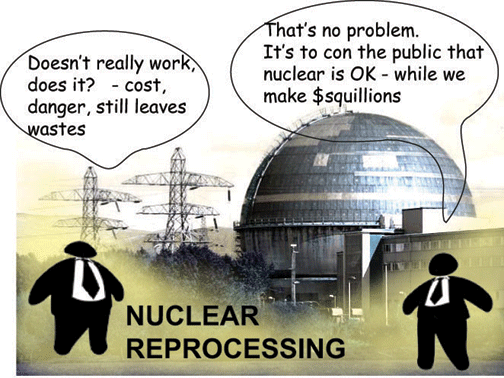
Construction of the Monju reactor started in Tsuruga, Fukui Prefecture, in 1985 as part of the government’s policy of establishing a nuclear fuel cycle to make use of spent nuclear fuel at conventional atomic plants that run on uranium. Monju uses a uranium and plutonium mix as fuel.
The facility of the government-affiliated Power Reactor and Nuclear Fuel Development Corp. first reached criticality, a situation where a chain reaction of nuclear fission is sustained, in 1994. http://english.kyodonews.jp/news/2012/06/166571.html
Nuclear company Entergy suddenly cutting out health benefits for Pilgrim nuclear workers
The Louisiana-based Entergy is slashing benefits as part of a hard-line lockout, while inexperienced and lesser trained replacements try to manage the 40-year-old plant’s complex operations.
“Our members have literally risked their lives time and again to keep this community safe and to help Entergy make $1 million a day in profits,”
Entergy’s Countdown to Cruelty: 48 hours until Pilgrim Nuclear workers and families lose healthcare Just days after Supreme Court Upholds Healthcare for all, Louisiana-based Entergy Corp. set to end medical coverage for workers and families facing surgery, cancer treatment, childbirth and other healthcare issues
The Sacramento Bee, By Utility Workers Union of America Local 369 , Jun. 28, 2012 PLYMOUTH, Mass., June 29, 2012 — Locked-out Pilgrim Nuclear Power Plant
workers and their families are bracing for a devastating blow as Entergy Corp. prepares to end their healthcare coverage at midnight on Saturday, June 30. Continue reading
Southern California’s electrical grid might not need nuclear power – ever!

 San Onofre: Do we really need it? UT San Diego, 28 June 12, This summer may be just a test run for operating Southern California’s electrical grid without a nuclear plant.
The latest report on the outage at the San Onofre Nuclear Generating Station shows the replacement of four massive steam generators was accompanied by serious design flaws, with no clear solution in sight.
Both stakeholders in San Onofre and critics of nuclear power say the start of a summer without the twin-reactor plant has forced a new accounting for its costs and benefits.
The utility industry and the state’s main grid operator are “considering a range of existing and new alternatives for mitigating the impacts of a long-term or permanent shutdown at San Onofre,” said Stephanie McCorkle, a spokeswoman for the California Independent System Operator….. the grid operator foresees only the remote chance of rolling outages during hot weather in the next three months — when San Onofre is needed the most.
That assessment alone has changed perceptions of the plant as indispensable, said Dan Sullivan, president of San Diego-based Sullivan Solar Power, which employs 65 workers designing and installing solar arrays.
The plant shutdown — along with California’s aggressive renewable-energy policies and a newly completed transmission line into San Diego — have shifted the conversation about nuclear power. The day is coming, Sullivan said, when “we can just say, ‘We’re done.
We don’t need it anymore.’ ”….
French company GDF Suez moving away from nuclear industry
Ambitions to own and operate new nuclear plants by 2020 and play a role in countries like Brazil and the United States have so far come to nothing. Challenges on GDF Suez’s two home fronts, France and Belgium, are making it even harder.

 GDF Suez’s nuclear business seen moving backstage by Caroline Jacobs and Benjamin Mallet PARIS, June 26 (Reuters) – GDF Suez is expected to significantly trim its 47-year old nuclear business now that its only showroom, Belgium, is gradually wrapping up its reliance on the energy form and with nuclear prospects in the French utility’s home market dimming. Continue reading
Thorium nuclear reactors not possible for decades to come

 India needs to wait for few decades to use thorium in reactor DNA, , Jun 27, 2012, Bhubaneswar PTI Describing India as self-reliant in nuclear technology, Atomic Energy Commission on Wednesday said the country has to wait for a few more decades to use thorium as the base for nuclear reactors.
“Using thorium as the base for reactors will take time. We have to wait a few decades to make it possible,” Atomic Energy Commission Chairman R K Sinha said….. Replying a question on the possible use of thorium as the base for the nuclear reactors, he said the country needs to wait…..
Poland delays nuclear power project – stuck on lack of finance
 American-Japanese group GE Hitachi , France’s Areva and Westinghouse, a U.S unit of Japan’s Toshiba , have all signalled interest in supplying technology for the project that has already faced a number of bureacratic delays.
Poland’s PGE delays nuclear tender PGE will not launch tender as planned in Q2 Still working on financing model for project. Investment estimated to be worth $8.79-14.65 bln WARSAW, June 27 (Reuters) – PGE has delayed launching the technology supplier tender for Poland’s first nuclear power plant as it works out how it will finance the multi-billion dollar project, PGE’s chief executive said on Wednesday.
PGE chief Krzysztof Kilian did not say when the tender, previously scheduled for the second quarter of 2012, would move forward. The cost to build the first reactors is estimated at 30 billion to 50 billion zlotys ($8.79-14.65 billion). We will not launch the tender in June (as previously planned),……. Continue reading
Japan’s utilities meetings: shareholders demand end to nuclear power
Utility shareholders meet / Nuclear power decried; TEPCO’s de facto nationalization OK’d The Yomiuri Shimbun, 28 June 12 De facto nationalization of Tokyo Electric Power Co., which will receive a capital injection of 1 trillion yen in public funds, was approved at its regular general shareholders meeting Wednesday in Tokyo.
TEPCO and eight other power utilities that own nuclear power plants held their annual shareholders meetings across the nation on the day, with shareholders demanding the companies ensure management transparency and give up nuclear power. Continue reading
Japan’s TEPCO nationalised, will restart another nuclear power plant
Tepco’s New Chief Sees No Plan B To Revive Profitability Bloomberg, By Tsuyoshi Inajima and Yuji Okada – Jun 27, 2012 Tokyo Electric Power Co. (9501), owner of the crippled Fukushima reactors, is committed to restarting another nuclear plant next year that is the world’s largest and itself was damaged in a 2007 earthquake.
Bringing the Kashiwazaki Kariwa power station online, even though it sets up the state-controlled utility for further conflicts with a nuclear-weary public, is part of “Plan A,” President Naomi Hirose, 59, said in an interview. The plan refers to a 10-year business
reconstruction that handed control of the power company known as Tepco to Japan’s government. Continue reading
Same old price doldrums for the uranium industry
Spot uranium price unchanged at $50.75/lb U3O8 in weak market, Washington (Platts)–26 Jun2012 The spot price for uranium was unchanged over the last week at about $50.75/lb U3O8, prompting one analyst to describe the market as”stuck” with few buyers or sellers anxious to make a deal.
TradeTech on Friday kept its weekly price at $50.75/lb, saying that spot uranium demand “continues to be dominated by highly price sensitive and discretionary demand, and while spot supplies are currently sufficient to meet demand [and] sellers are not actively seeking to push material to the market.”… http://www.platts.com/RSSFeedDetailedNews/RSSFeed/ElectricPower/8439315
Goodnight and goodbye for San Onofre nuclear plant?
Instead of spending the next five years figuring out how to keep the plant going indefinitely, Edison should be using that time to develop other ways to generate the needed power, especially from reliable, sustainable sources such as solar and wind.
Now is the perfect time for Edison, and the state as a whole, to begin the planning for a non-nuclear future.
 San Onofre’s cloudy future Can the damaged nuclear power plant be repaired and restarted? And if so, what then? LA Times, June 24, 2012 These are dark days at the San Onofre nuclear plant just south of Orange County. Both of its reactors have been shut down for more than four months, when abnormal “thinning” was discovered in the tubes of recently installed steam generators. Neither reactor will come back on line this summer, and after that, it’s still unclear whether one or both will be switched on again and if so, at full power or partial — or whether they’ll stay shut for the foreseeable future.
On Monday, the Nuclear Regulatory Commission provided a troubling assessment of the situation at San Onofre. A flaw in the design of the new generators — which cost ratepayers $671 million to build — appears to be responsible for making their tightly bundled tubes vibrate too much and rub together. The result is an alarming level of wear in equipment that is still in its relative infancy, especially in Unit 3, where, according to NRC officials, the damage reaches a level far beyond what’s been seen before in this nation’s nuclear industry. The rupture of one or more tubes could release radiation……. Continue reading
Restart of nuclear reactors in Oi, Japan, killing the tourism industry
the distinction of being selected as the first town with reactors designated for restart has put a damper on the town’s ambitions to diversify its economy by becoming more of a tourism resort.
A survey released May 31 by national broadcaster NHK found 81% of people in the towns bordering Oi think the nuclear plant there may suffer a Fukushima-type disaster.
 Japan’s Nuclear Restarts Worry Tourism Industry WSJ, By CHESTER, DAWSON, 22 June 12 OI, Japan—The Sodegahama public beach draws thousands of swimmers and sunbathers who flock each summer to the sheltered cove at the tip of a rural peninsula in Fukui prefecture. At one end of the arc of sand is a popular campground with a pair of historic bronze cannons dating from 1854. At the other lies a tree-covered hill shielding the view of four nuclear reactor domes 1,000 feet (several hundred meters) away.
As the Japanese government has moved to restart nuclear reactors for the first time since last year’s disaster in Fukushima, this seaside town, which depends on the plant for jobs and subsidies, is wary about of the impact on another major source of revenue: tourism….. Continue reading
Pilgrim Nuclear power plant workers vote down contract, with safety concerns
Workers say the inability of Entergy to perform a safety drill is one more reason why the Nuclear Regulatory Commission (NRC) should shut down the plant while the workers are locked out. …
Nuclear Power Workers Vote Down Contract As Safety Questions Mount, In These Times, BY MIKE ELK , 22 June 12, On Wednesday, locked-out nuclear power plant workers in Plymouth, Mass., members of Utility Workers Union of America (UWUA), voted down a proposed contract by a margin of 137 to 89. ….. UWUA Local 369 President Dan Hurley announced that the union had voted down the contract.
“The hardworking men and women who keep Pilgrim Nuclear Power Plant operating profitably and safely have spoken loud and clear: They will not accept cuts to their pay or healthcare from a company making record profits and paying executives in the tens of millions,” said Hurley. “We urge Entergy to return to the bargaining table so that we can realistically address the very real concerns of our members.”… Continue reading
AREVA nuclear power company is in trouble
 This renaissance is just a fairy tale, THE HINDU, 15 June 12, “…….In India, In Kalpakkam, , the Prototype Fast Breeder Reactor was slotted to contribute to the grid in March 2012. In 2005, Baldev Raj, Director of the Indira Gandhi Centre for Atomic Research, Kalpakkam, boasted that the 500 MW unit will be completed in 2010, 18 months before schedule.
Till date, there is no sign of this happening. The Kudankulam plant, which is now 23 years old since conception, lost only eight months due to protestors. In Jaitapur too, the government has more to worry about than local protestors.
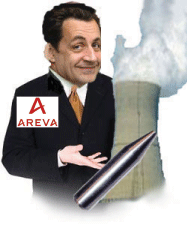
Areva, the technology supplier, is in trouble. Last year, it announced losses of €1.6 billion, and the sacking of 1,200 workers in Germany. Last June, it decided to suspend production at a Virginia reactor component plant due to declining market prospects. Its expansion plans in France, the United Kingdom, and the U.S. may never materialise. Areva expected to sell 50 nuclear reactors this decade. It has not received a single order since 2007.
Now, with a socialist president at the helm in France, Areva’s future looks even more uncertain. French President François Hollande had promised voters a reduction in nuclear dependence from 75 to 50 per cent, and shutdown of an aging reactor in Fessenheim. Whether or not he carries through with these promises, it appears certain that no new
plants will be built or planned during his term.
Both conservative-led Germany and socialist France will make up the shortfall from the
nuclear phase-out, by investing in renewables for electricity and new jobs. In replacing nuclear with renewables, these nations are declaring that despite its carbon dividend, nuclear is too risky — financially, politically and environmentally — to pursue.
http://www.thehindu.com/opinion/op-ed/article3528968.ece

The “Nuclear Renaissance” – dead in the water
 This renaissance is just a fairy tale, THE HINDU, 15 June 12, NITYANAND JAYARAMAN”.….Germany and Switzerland have decided to phase out nuclear power,
despite their substantial dependence on it. Israel abandoned its year-old civilian nuclear programme after Fukushima. Belgium revived a pre-Fukushima decision to phase out nuclear power, using the Japanese disaster as a reminder. Italy and Kuwait gave up their nuclear debut by abandoning plans for 10 and four plants respectively. Mexico dropped plans for constructing 10 plants. All of Japan’s 54 reactors are now closed, and plans for 14 new reactors killed. Continue reading
Australia’s uranium industry in decline
for all the hype, uranium accounts for a lousy 0.3% of Australian export revenue and a negligible 0.02% of Australian jobs. The industry’s future depends on the nuclear power “renaissance”, but global nuclear power capacity has been stagnant for the past 20 years.
The uranium price tanked after the Fukushima disaster and so far there is no sign of a bounce.

 Australian uranium industry in trouble after Fukushima,June 2, 2012,Green Left, By Jim Green A protest walk from Wiluna to Perth took place last year against the proposed Wiluna uranium mine.
These are interesting times in the uranium sector. The mining companies have had a few wins in the 14 months since the Fukushima disaster, but they’ve had more losses. Continue reading
1 This Month





PLEASE OPPOSE HR 8255 AND S.3639 – bills would accelerate satellite deployment, with no environmental review or safeguards – https://ncstd5li.quorum.us/campaign/169331/
To see nuclear-related stories in greater depth and intensity – go to https://nuclearinformation.wordpress.com
-
Archives
- October 2026 (29)
- September 2026 (339)
- August 2026 (330)
- July 2026 (355)
- June 2026 (287)
- May 2026 (306)
- April 2026 (356)
- March 2026 (251)
- February 2026 (267)
- January 2026 (308)
- December 2025 (358)
- November 2025 (359)
-
Categories
- 1
- 1 NUCLEAR ISSUES
- business and costs
- climate change
- culture and arts
- ENERGY
- environment
- health
- history
- indigenous issues
- Legal
- marketing of nuclear
- media
- opposition to nuclear
- PERSONAL STORIES
- politics
- politics international
- Religion and ethics
- safety
- secrets,lies and civil liberties
- spinbuster
- technology
- Uranium
- wastes
- weapons and war
- Women
- 2 WORLD
- ACTION
- AFRICA
- Atrocities
- AUSTRALIA
- Christina's notes
- Christina's themes
- culture and arts
- Events
- Fuk 2022
- Fuk 2023
- Fukushima 2017
- Fukushima 2018
- fukushima 2019
- Fukushima 2020
- Fukushima 2021
- general
- global warming
- Humour (God we need it)
- Nuclear
- RARE EARTHS
- Reference
- resources – print
- Resources -audiovicual
- Weekly Newsletter
- World
- World Nuclear
- YouTube
-
RSS
Entries RSS
Comments RSS

