An ugly story – Chrystal River nuclear plant – a national financial headache
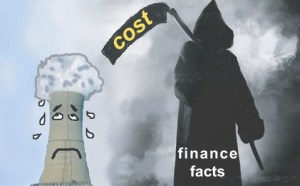 Utility companies pass those costs onto their customers, making
Crystal River’s failed do-it-yourself maintenance project a nationwide
responsibility…… And Crystal River isn’t the only concern. Most of
the 104 reactors in the United States were built in the 1970s and
early 1980s. They are starting to show their age, a fact that is
adding additional pressure to NEIL’s bottom line.
The insurance company is processing claims from American Electric
Power’s nuclear station in Bridgman, Mich., the South Texas Nuclear
Project and California’s San Onofre nuclear power station.
Adding in Crystal River, NEIL and its member utilities — and by
extension their customers — are potentially looking at a huge
financial hit. ” This,” said Cooper, the economist, “is an ugly story.”
Progress Energy Shares the Costly Pain of a Fix at Nuclear Power
Plant, News Chief.com By IVAN PENN TAMPA BAY TIMES, January 2, 2013
The crippled Crystal River nuclear plant, owned by Progress Energy, is
now America’s headache. The bill to fix it and pay for replacement
power may top $5 billion. The problem?
The company that insures all 104 U.S. nuclear power plants has just
$3.6 billion on hand to pay for claims.
Broken nuclear plants in California, Texas and Michigan will vie for
some of that money. But Crystal River alone represents such a
financial threat that the insurance company, Nuclear Electric
Insurance Ltd., may demand that its member utilities pony up more
money. And it could be a lot more — and quickly. Continue reading
Russia to sell nuclear technology to United Arab Emirates
 Moscow to help UAE with region’s largest nuclear energy program
World Tribune ABU DHABI 30 Dec 12 — Russia and the United Arab
Emirates have signed a
nuclear cooperation agreement. The two countries said they would
cooperate in nuclear energy as part of UAE plans to establish a
network of reactors over the next 20 years…..
Officials said the agreement could make Russia’s Atomic Energy
Cooperation, known as Rosatom, a leading supplier to Abu Dhabi’s
nuclear program.
They said the Kremlin was prepared to provide technology, equipment,
nuclear fuel and expertise to a UAE program estimated at $40 billion
and so far led by South Korea….
http://www.worldtribune.com/2012/12/30/moscow-to-help-uae-with-regions-largest-nuclear-energy-program/
TEPCO needs help! 3.2 trillion yen needed for Fukushima compensation
 Tepco requested additional financial support of 697 billion yen for the
  Nuclear Damage Liability Facilitation Fund http://fukushima-diary.com/2012/12/tepco-requested-additional-financial-support-of-697-billion-yen-for-the-nuclear-damage-liability-facilitation-fund/
by Mochizuki on December 27th, 2012 ·
Tepco has estimated the total nuclear damage compensation to be 2.5 trillion yen and has been requesting the financial support from the Nuclear Damage Liability Facilitation Fund based on the revised Special Business Plan approved on May 9, 2012.
However, after deciding the compensation standard of lands or houses, adding real estate and postponing the compensation term for spontaneous evacuees and harmful rumor of agricultural products, the estimated compensation amount increased to be 3.2 trillion yen.
On 12/27/2012, Tepco requested the Nuclear Damage Liability Facilitation Fund for 697 billion yen of the additional financial support.
Related article..[Bloomberg] Tepco Sued by U.S. Sailors Exposed to Radiation [Link]
Long term investors wary about nuclear power’s future in Japan
 Nuclear Caution Holds as Bonds Diverge With Stocks: Japan Credit
Bloomberg By Yoshiaki Nohara, Satoshi Kawano & Amina Mobley – Dec 26,
2012 Japan’s bond and stock investors are at odds as to whether Prime
Minister Shinzo Abe can speed up the restart of nuclear reactors idled
on earthquake concerns…… .
 “The institutional investors at the core of the bond market are still not convinced whether nuclear power generation can resume in earnest and are considering the worst case- scenario,” said Takayuki Atake, chief credit analyst at SMBC Nikko Securities Inc. in Tokyo. “The equity markets, with their large proportion of individual investors, are more responsive to news flow and the short-term prospects.”…..
While the LDP has said Japan needs its 50 reactors working, all but two remain closed and any restart will need approval from the Nuclear Regulation Authority, which is investigating six atomic plants on concern they sit on active fault lines…….
Active Fault Japan Atomic Power Co.’s Tsuruga and Tohoku Electric’s Higashidori plants may be sitting on active faults, teams of scientists working for Japan’s Nuclear Regulation Authority said this month. Under the country’s guidelines, utilities are not allowed to construct reactor buildings and other important facilities above an active quake fault. Abe indicated he may allow utilities to build a new nuclear power plant if it meets safety standards to be set by the NRA, the Tokyo Shimbun reported Dec. 1, citing an interview with him. Former prime minister Yoshihiko Noda in September approved a policy calling for banning the construction of new atomic plants. LDP Chairman Hiroyuki Hosoda said in an interview with Bloomberg last month that Japan must restart its plants quickly after confirming they’re safe, citing increasing energy prices….. http://www.bloomberg.com/news/2012-12-26/nuclear-caution-holds-as-bonds-diverge-with-stocks-japan-credit.html
Quebec’s nuclear power plant will be gone – but the radioactive problem lingers on
 Non Nukes: Québec Shutters Its Only Nuclear Power Plant http://www.7dvt.com/2012non-nukes-qu-bec-shutters-its-only-nuclear-power-plant
BY KEN PICARD [12.26.12] “….. Seven Days reported in May, “G-2” is closer to northern Vermont than any American reactor, including Vermont  Yankee. And, like the Vernon plant, G-2 got a new lease on life when its owner, Hydro-Québec, announced plans to refurbish the reactor and keep it operational for another three decades.
Canadian antinuke activists have fought for years to shut down G-2. Since going online in 1983, the plant has experienced problems eerily similar to those at Vermont Yankee — but worse. G-2 releases more radioactive tritium into the air and water each day than the tritium estimated to have leaked from Vermont Yankee in all of 2011.
Yet despite those problems and overwhelming opposition from Québécois — 320 Québec municipalities adopted resolutions calling for G-2’s closure — Canadian regulators earlier this year gave the plant approval to continue splitting atoms. In October, Hydro-Québec announced it would close G-2 at the end of this year — specifically, on December 28.
Why the change of heart? The company cited “increased production costs” — $6.3 billion compared to $1.8 billion to decommission the plant — combined with “falling market prices” for electricity.
Politicians, too, were against the plant. During last summer’s election, Québec’s newly elected premier, Pauline Marois, promised to shutter the province’s only nuke when its license expires at the end of 2012.
Gordon Edwards, president of the Canadian Coalition for Nuclear Responsibility, hailed the decision, saying “Québecers are proud that ours will be the first jurisdiction in North America to phase completely out of nuclear power.”
But even after G-2’s electricity is long gone, its radiation will linger. HQ plans to leave the facility dormant for 40 years before removing its spent fuel and radioactive equipment, dismantling the facility, and restoring the site. That work won’t be completed until 2062.
Problems, $900 lawsuits – Vogtle Nuclear Plant now years away
The delays and cost pressures have created friction between the
construction partners and utility companies that will serve as the
plant’s owners, escalating into a series of lawsuits totaling more
than $900 million.
New Nuclear Plant Hits Some Snags, WSJ, By REBECCA SMITH, 23 Dec 12
The first newly licensed nuclear-power plant to be built in the U.S.
in decades, the Vogtle project in Georgia, has run into construction
problems and may be falling years behind schedule, according to an
engineering expert advising the state. Continue reading
Community owned solar farm – a model for investment
With over 59 million renters, more than 96 million poorly sited properties and 148 million people for whom cost is a barrier to acquiring a solar power system, community owned solar farms are likely to spring up right across the USA in the years ahead.
Colorado’s 500kW Community-Owned Solar Farm http://www.energymatters.com.au/index.php?main_page=news_article&article_id=3528 25 Dec 12
Clean Energy Collective (CEC) recently held a Grand Opening ceremony for its Colorado Springs Community-Owned Solar Farm.
With a 500 kW capacity and consisting of 2,210 solar panels, the facility currently generates enough to power 100 homes.
Based on a community ownership model, investors are able to participate for as little as $565; Continue reading
Probe into EDF – China deal to develop a new type of nuclear reactor
EDF declines comment on China nuclear probe report PARIS http://uk.reuters.com/article/2012/12/25/uk-edf-china-nuclear-idUKBRE8BO03K20121225 by Lionel
Laurent and Gerard Bon Dec 25, 2012
Electricite de France (EDF.PA) on Tuesday declined to
comment on a report of a probe into its recent partnership with a
Chinese utility to develop a new type of nuclear reactor.
Several French news websites cited a forthcoming article in satirical
weekly Le Canard Enchaine, due to appear on Wednesday, as saying that
French finance-ministry inspectors had begun an inquiry into the terms
of the China agreement.
“We have no reaction,” a spokeswoman for EDF said, adding she had not
seen the forthcoming article. The French finance ministry was
unavailable for comment.EDF had said in November that the agreement
with China Guangdong Nuclear Power Corporation Holding GDNCP.UL was to
develop a concept for a 1,000-MW reactor. This would be cheaper and
smaller than the 1,600-MW EPR reactor blamed for the loss of a
landmark project in Abu Dhabi in 2009.
Nuclear industry embarrassed by its own bungles
 A Year Of Nuclear Bungles, New Matilda, By Jim Green, 20 Dec 12, The nuclear industry’s biggest enemy in 2012 was itself. Security breaches, leaks, illegal dumping and poor oversight – anything that could go wrong, did. Jim Green rounds up this year’s nuclear hijinks
The nuclear industry inflicts far more damage on itself than its opponents could ever hope to. The mere mention of the easily-preventable Fukushima disaster probably suffices to establish that point, but there are many more examples. To make the task manageable, this snapshot of recent nuclear shenanigans, jiggery-pokery, goings-on and own-goals is restricted to countries that Australia sells uranium to (or plans to sell uranium to).
Tests carried out at the European Union’s 143 nuclear power reactors have exposed hundreds of problems requiring up to €25 billion (AU$31 billion) to remedy, according to a report by the EU energy commissioner. The report concludes that “practically all” plants need safety improvements.
Gee-whiz “next generation” power reactors in Finland and France continue to embarrass the industry. Continue reading
Plant Vogtle nuclear expansion behind schedule and over budget,
“It’s time to cut our losses now because you are throwing good money after bad,”
Nuclear energy critics assail Plant Vogtle http://www.bizjournals.com/atlanta/news/2012/12/18/nuclear-energy-critics-assail-plant.html
Atlanta Business Chronicle by Dave Williams, December 18, 2012, Georgia’s energy regulators should pull the plug on the Plant Vogtle nuclear expansion rather than make customers keep paying for a project that is behind schedule and over budget, Continue reading
How the nuclear industry bungled things in 2012
A Year Of Nuclear Bungles, New Matilda, By Jim Green, 20 Dec 12, The nuclear industry’s biggest enemy in 2012 was itself. Security breaches, leaks, illegal dumping and poor oversight – anything that could go wrong, did. Jim Green rounds up this year’s nuclear hijinks
The nuclear industry inflicts far more damage on itself than its opponents could ever hope to. The mere mention of the easily-preventable Fukushima disaster probably suffices to establish that point, but there are many more examples. To make the task manageable, this snapshot of recent nuclear shenanigans, jiggery-pokery, goings-on and own-goals is restricted to countries that Australia sells uranium to (or plans to sell uranium to). Continue reading
South Korea keen to sell nukes: must clean up their act
 There is a lot at stake for South Korea, which aims to export 80 nuclear reactors by 2030, expected to be worth up to $300 billion, according to government plans.
South Korea urged to restore trust in nuclear Australia Network News Nov 24, 2012 The International Energy Agency (IEA) says South Korea needs to rebuild public trust in nuclear power by boosting transparency and improving regulation, after safety scares have closed reactors and threaten to trigger blackouts over winter. Continue reading
Costs are killing American nuclear power plants
A pattern is developing. It may take a few years, but it appears small nuclear plants will face increasing pressure to retire early. They cannot compete, particularly in soft markets. Some plants will find their costs consistently exceed any benefits they earn and their owners will be forced to retire and dismember plants.
The Nation’s Nuclear Plants Are Nuked, AOL Energy By Glenn S. K. Williams December 18, 2012 While the nation has been focused on new sources of natural gas and shale oil, few noticed the slow decline of an older energy source, nuclear power. Today, commercial nuclear power is struggling to stay in the game. Continue reading
No early return to nuclear energy, for Japan
Japan Shifts to LNG Dependency from Nuclear, Eyes US Fuel, Energy Tribune, December 17, 2012 Liquefied Natural Gas (LNG) purchase, a post-Fukushima item in Japan’s imports list that sent country’s foreign trade figures to their first deficit in 38 years in 2011, will continue dominating the country’s energy near future, as officials confirm that they are in LNG trade talks with the U.S., not a traditional supplier. Qatar and Australia seem to be maintaining their top supply positions to the Japan with new deals, the country’s Nuclear Policy Unit has said.
Before the devastating earthquake and subsequent tsunami on May 11, 2011, Japan was planning to increase nuclear power’s share in its energy bucket to 50 percent as of 2030, from 26 percent at the time.
Today, the revised plans vary from zero to a maximum 25 percent of nuclear, the Nuclear Policy Unit Cabinet Secretariat Yoshinori Tanaka told journalists in Tokyo on Dec. 13.
Along with purchases from Qatar and Australia, the country is looking to buy LNG from the U.S., he also revealed. However, other officials have stated that the U.S. is primarily considering meeting its domestic demand first.
A new Japanese strategy document prioritizes renewables, but such projects will take time to fill the significant energy gap in Asia’s second largest economy.
Japan, which was once energy self-sufficient, this year and in 2011 bought large amounts of LNG, along with coal and oil, to meet the gap that emerged after the closure of its nuclear facilities, the assistant press secretary of the Japanese Foreign Ministry, Masaru Sato, told the Hürriyet Daily News……
The country’s newly founded Nuclear Regulation Authority, a governmental body focusing exclusively on nuclear safety, will start inspecting nuclear plants to restart operations only in June 2013, showing that a nuclear comeback is also not on the agenda in the immediate short term…..http://www.energytribune.com/68237/japan-shifts-to-lng-dependency-from-nuclear-eyes-us-fuel
Brazil’s wind farms bring cheapest electricity prices
Wind farms set record low generation prices, SMH, December 16, 2012 Four energy developers agreed to sell power from 10 proposed wind farms in Brazil at the cheapest rates ever.
Enerfin Sociedad de Energia SA, Renova Energia SA, EGP- Serra Azul and Bioenergy Geradora de Energia Ltda. won contracts to sell electricity to distributors for an average price of 87.94 reais ($41) a megawatt-hour, Brazil’s national energy agency Empresa de Pesquisa Energetica said in an e-mail yesterday. (Australian wholesale prices are about $50 per megawatt-hour, including the $23 carbon tax per tonne.)
“This is definitely the cheapest wind energy in the world,” Maria Gabriela da Rocha Oliveira, a Sao Paulo-based analyst with Bloomberg New Energy Finance, said in a telephone interview. It’s 12 per cent lower than the August 2011 auction that yielded an average price of 99.58 reais a megawatt-hour. That was the lowest price in the world for wind power then and the least expensive power in Brazil, beating natural gas and hydroelectricity….. http://www.smh.com.au/business/carbon-economy/wind-farms-set-record-low-generation-prices-20121216-2bh4z.html#ixzz2FLfka1Ga
1 This Month





PLEASE OPPOSE HR 8255 AND S.3639 – bills would accelerate satellite deployment, with no environmental review or safeguards – https://ncstd5li.quorum.us/campaign/169331/
To see nuclear-related stories in greater depth and intensity – go to https://nuclearinformation.wordpress.com
-
Archives
- October 2026 (19)
- September 2026 (339)
- August 2026 (330)
- July 2026 (355)
- June 2026 (287)
- May 2026 (306)
- April 2026 (356)
- March 2026 (251)
- February 2026 (267)
- January 2026 (308)
- December 2025 (358)
- November 2025 (359)
-
Categories
- 1
- 1 NUCLEAR ISSUES
- business and costs
- climate change
- culture and arts
- ENERGY
- environment
- health
- history
- indigenous issues
- Legal
- marketing of nuclear
- media
- opposition to nuclear
- PERSONAL STORIES
- politics
- politics international
- Religion and ethics
- safety
- secrets,lies and civil liberties
- spinbuster
- technology
- Uranium
- wastes
- weapons and war
- Women
- 2 WORLD
- ACTION
- AFRICA
- Atrocities
- AUSTRALIA
- Christina's notes
- Christina's themes
- culture and arts
- Events
- Fuk 2022
- Fuk 2023
- Fukushima 2017
- Fukushima 2018
- fukushima 2019
- Fukushima 2020
- Fukushima 2021
- general
- global warming
- Humour (God we need it)
- Nuclear
- RARE EARTHS
- Reference
- resources – print
- Resources -audiovicual
- Weekly Newsletter
- World
- World Nuclear
- YouTube
-
RSS
Entries RSS
Comments RSS

