Nuclear weapons workers vote for strike action
David Gilyeat, South of England, BBC 10th Feb 2026
Workers that build and maintain the UK’s nuclear weapons have voted to strike over a planned restructuring of the organisation.
Prospect said the Atomic Weapons Establishment’s (AWE) staff were being “pushed to the brink by the repeated errors” of its leadership, affecting sites including Aldermaston and Burghfield in Berkshire.
The union said in November 500 jobs were at risk, with another 750 posts recruited for. Last month it said potential redundancies had increased to 800.
The Ministry of Defence (MoD) said it was “disappointed” by the result but was looking for a “constructive resolution”.
Prospect said 95% of staff who voted were in favour of action short of a strike, with 81% in favour of strike action.
The union has warned action could cost AWE millions of pounds at a time when the government has said it will invest £15bn in a new nuclear programme.
“This crucial investment risks being derailed if this restructure continues to cause internal chaos,” Prospect said.
But it said a “failed reorganisation could have much greater consequences for the future of the organisation”.
Prospect also accused AWE of “drip-feeding” information over weeks so full consultation with its scientists and engineers was “impossible”.
The union said the nature and timing of the industrial action would be “announced in due course”……………………….
https://www.bbc.co.uk/news/articles/c743l4rr4g1o
Electricity: A confidential EDF report anticipates an explosion in costs and risks.
Le Point has obtained EDF’s internal report on the consequences of adjusting its nuclear power plant fleet to make room for renewables. This explosive document comes as the government prepares to publish its Multiannual Energy Programme (PPE).
Géraldine Woessner, Editor-in-Chief of the Society Department.
They marched to Matignon this Friday, February 6 – wind power unions, solar power unions, network managers, representatives of the nuclear industry – “in an electric atmosphere, no pun intended,” a counselor whispered.
With the budget finally passed, the government intends to publish
its 3rd Multiannual Energy Programme (PPE 3) by the end of next week , a strategic document setting out the country’s energy roadmap until 2035. A storm is guaranteed, as the text, delayed by two and a half years, has been the subject of intense – and sometimes outrageous – lobbying by the industries concerned for months, against a backdrop of strong budgetary constraints and falling electricity consumption.
Le Point 7th Feb 2026, https://www.lepoint.fr/economie/electricite-un-rapport-confidentiel-dedf-anticipe-une-explosion-des-couts-et-des-risques-4G7YLSKDKBD7VOCDY66CHASSVQ/
Mediterranean Dockworkers Launch Historic International Strike
On February 6, dockworkers in more than 20 Mediterranean ports went on strike against war, militarization, and port privatization.
February 06, 2026 by Ana Vračar, https://peoplesdispatch.org/2026/02/06/mediterranean-dockworkers-launch-historic-international-strike/
Dockworkers in more than 20 ports across the Mediterranean marked a historic moment today as they launched an international day of strike and protest against war and rearmament. Dockers also protested the privatization and militarization of port infrastructure.
Unionists involved in preparing the action described it as the result of a long and complex process, built on dockworkers’ solidarity with Palestine and their struggles for dignified working conditions at home.
The impact of the strike was felt even before it fully unfolded on February 6, as reports emerged of ships – vessels that regularly transport military cargo to Israel – disrupting their itineraries due to the actions.
“Ports are places of sweat, not blood”
Demonstrations began in the morning in the Greek ports of Piraeus and Elefsina, in Türkiye’s Mersin, and in Bilbao and Pasaia in the Basque Country. The trade union Liman-İş Sendikası rallied hundreds of its members to send a message against genocide and in solidarity with Palestine, echoing similar dispatches by their comrades from LAB in the Basque Country.
In Greece, dockworkers highlighted the contradiction between massive European investments in rearmament and the imposition of austerity on public services and infrastructure, which is leading to increasingly unsafe working conditions. “We won’t accept work without rights,” said Damianos Voudigaris of the Greek union ENEDEP later in the day. “Development should mean going home alive. Ports are places of work, not war. They are places of sweat, not blood.”
Some of the largest mobilizations of the day took place in Italy. Strikes were organized in Ancona, Bari, Cagliari, Civitavecchia, Crotone, Genoa, Livorno, Palermo, Ravenna, Salerno, and Trieste, involving not only dockworkers and port employees but also students and members of the public. The map of the strikes once again underscored the momentum built by Italy’s labor movement over the past year, including three general strikes for Palestine – mobilizations that have drawn inspiration from some of the dockers collectives’ anti-war activism.
The trade union Unione Sindacale di Base (USB) reported from all striking ports, with union representatives addressing assemblies prominently displaying Palestinian and Cuban flags. Workers stressed that Europe’s labor movement must find an internationalist orientation in order to block the anti-worker agenda of the European Union and right-wing governments. Governments including that of Prime Minister Giorgia Meloni, which, as USB activists noted during live broadcasts, was rattled by the determination shown by workers after years of stagnation. According to trade unionists, this panic has translated into a new wave of repression, including measures targeting union members involved in Palestine solidarity actions. USB, however, insisted that resistance to Meloni’s policies would only intensify in the coming weeks.
“Today it’s the ports, tomorrow it will be the entire logistics sector”
While uniting around shared demands – to prevent the militarization of ports, reject rearmament, and stop a war economy from stifling all other priorities – striking workers also raised local concerns. Dockworkers in Trieste warned against port privatization. Elsewhere, including in Bari and Ravenna, workers and students described how port infrastructure was being used, sometimes covertly, to transport military and dual-use materials to Israel. “Everyone here has had enough of that,” one activist in Ravenna said.
Demonstrations held in Civitavecchia, Livorno, and Ancona on Friday evening were notable, with strikers in Ancona describing the day as “monumental.” In Genoa, as has become customary, turnout was massive. Members of the collective CALP – who had previously vowed that “not one nail” would leave the port if Israel attacked the Global Sumud Flotilla en route to Gaza – led the protest. Speaking to media and fellow activists, they stressed that the success of the international strike once again proved that dockworkers keep their promises.
“We promised to block everything – and we blocked everything. We promised a general strike – and we had a general strike. We promised an international strike – and here we are,” they said.
The international dockworkers’ strike, however, is not the end of the road, workers emphasized. “Today it’s the ports, tomorrow it will be the entire logistics sector, and then it will be all workers,” strikers in Ravenna concluded.
Actions were also reported in the ports of Fos-sur-Mer near Marseille, the German hubs of Bremen and Hamburg, and in Corsica. Dockworkers from Morocco’s Democratic Labor Organization (ODT), who had been involved in preparing the strike throughout the process, were forced to postpone their industrial action due to extreme weather conditions that led to port closures.
Will soaring electricity rates kill Ontario’s nuclear expansion?
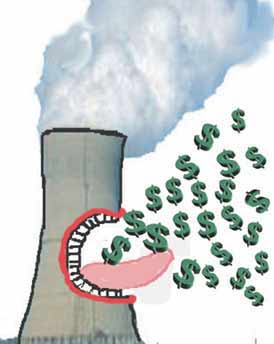
At $20.9-billion, the Darlington SMRs are expected to cost nearly as much as larger reactors that would have generated far more power. The government is betting that the economic benefits will be worth it: by building the first-ever BWRX-300 reactor, it hopes to win export opportunities for Ontario-based nuclear suppliers.
Future plans include what would be two of the largest nuclear plants on Earth, which will cost hundreds of billions of dollars. And while the IESO holds competitive procurements for other forms of generation including natural gas, wind and solar, nuclear plants are exempted from that requirement………… “There’s no real competition and there’s no real incentive for them to deliver that power at the cheapest cost “
Matthew McClearn, The Globe and Mail, Feb 5, 2026
The Ontario government’s plans to more than double the capacity of the province’s fleet of nuclear power reactors is sprawling in its ambition – and has a price tag to match.
Last May, Energy Minister Stephen Lecce stood alongside Premier Doug Ford to announce that the government would spend $20.9-billion to build four new small modular reactors in Clarington, Ont. In November, they approved a $26.8-billion overhaul of four old reactors at Ontario Power Generation’s Pickering Nuclear Generating Station, just east of Toronto.
Ontario’s electricity rates shot up 29 per cent in November, driven in part by rising nuclear generation costs. Further hikes are virtually certain: Ontario Power Generation (OPG) recently filed a rate application before the Ontario Energy Board, which it says will lay the foundation for the province’s energy supply over the next quarter century. The utility seeks roughly a doubling of the payments it receives for the electricity generated by its nuclear power plants. If granted, monthly bills would increase by an average of $3.50 each year for the next five years.
What comes next, though, promises to be even more expensive.
The Ford government asserts that Ontario will need roughly 18,000 additional megawatts of nuclear capacity by mid-century. (Ontario’s existing Darlington, Bruce and Pickering stations represent about 12,000 megawatts.) They’re ready to embark on what they describe as “the largest expansion of nuclear energy on the continent,” which includes plans for two of the largest nuclear plants on Earth. They could easily cost hundreds of billions of dollars.
This aspect of Ontario’s nuclear ambitions – the cost, and how residents and businesses will pay – is rarely discussed by provincial officials, and then only in vague terms. But the Ford government has long insisted that it can do it all while keeping electricity costs down. Critics – particularly those favoring renewable generation – have warned for years that this nuclear-focused approach would eventually lead to steep rate hikes.
“Ontario is on a track to more expensive energy in the future,” said David Pickup, manager of electricity at the Pembina Institute, an energy thinktank.
In a presentation in late January, Jack Gibbons, chair of the Ontario Clean Air Alliance, said Mr. Ford’s plans would see 75 per cent of Ontario’s electricity produced by nuclear power by 2050.
“If his nuclear projects proceed, our electricity rates will rise dramatically,” he predicted.
The Ford government came to power in 2018 riding a wave of dissatisfaction with the energy policies of its Liberal predecessors, which also led to surging power bills. Have Mr. Lecce and Mr. Ford similarly miscalculated?
Surging rates
Ontario’s Nov. 1 rate hike of 29 per cent was likely the largest on the continent last year. In the past year, Maine and New Jersey experienced increases of 25.5 per cent and 21 per cent, respectively, according to data published by the U.S. Energy Information Administration. The U.S. national average was just 6.6 per cent.
OEB spokesperson Tom Miller attributed Ontario’s rate increase partly to unexpectedly high nuclear generation last year, including from a refurbished reactor at Darlington that returned to service five months earlier than expected.
The November hike was almost entirely offset by an accompanying increase in the Ontario Energy Rebate, a provincial subsidy the government uses to lower residential electricity bills. But those subsidies will cost taxpayers billions of dollars each year, competing with other priorities.
For now, Ontarians’ rates still compare favorably to some provinces, including Nova Scotia, and also U.S. states around the Great Lakes. But the higher payments sought by OPG, if approved, would endure for years.
Traditionally, OPG recovered its costs for projects once they began generating electricity – a common practice worldwide. But nuclear plants can take a decade or two to construct and therefore tend to rack up sizeable interest charges, adding to their final tab.
Last year the government amended the Ontario Energy Board Act to allow OPG to immediately begin recouping some costs associated with building the small modular reactors (SMRs) and refurbishing Pickering.
“The intended effect is to smooth out the cost over time, rather than massive jumps from one year to the next,” explained Brendan Frank, who heads policy development and analysis at Clean Prosperity, a clean energy thinktank.
The Association of Major Power Consumers of Ontario, which represents major industrial electricity users, accepts the charges.
“It’s a legitimate ask from the generators,” said Brad Duguid, the organization’s president. “They have preliminary costs that they’re incurring, and they need to have a way to pay for that.”
Nonetheless, similar regulatory changes elsewhere in North America led to misfortune. In the U.S., a practice known as Construction Work in Progress was introduced in South Carolina and Georgia, which obligated ratepayers in those states to pay up front for the only new nuclear plants built in the U.S. since the 1980s. The South Carolina plant was never finished, and the Georgia plant came in well over budget and many years late, contributing to major rate increases in both states.
Another factor driving up rates in Ontario are refurbished reactors returning to service. Including Pickering, Ontario has decided to refurbish 14 reactors, at a cost of several billions of dollars each. OPG is wrapping up an overhaul of its Darlington plant while Bruce Power’s is scheduled to run until 2033.
Refurbishments enjoy broad political support. One reason is that Ontario’s nuclear industry employs tens of thousands of people. At a press conference held in November to announce the Pickering refurbishment, Finance Minister Peter Bethlenfalvy turned to the unionized workers behind him and assured them: “You folks are gonna be working for a long time. By the way, you’ve got job security…I can guarantee you that we’ll have the nuclear industry’s back all the way through for the next 50 years.”
Local economic benefits are central to Mr. Lecce’s enthusiasm for nuclear, as is energy security.
“The alternative is either a dirty source of power,” he said, “or it is leveraging procurements or materials that are often made in China.
“When I think about President Trump’s attack on the country and his ongoing antagonistic approach to allies and historic friends of the U.S. like Canada, it only reaffirms to me that we are on the right path.”
An expensive future
How much of a premium are Ontarians prepared to pay?
At $20.9-billion, the Darlington SMRs are expected to cost nearly as much as larger reactors that would have generated far more power. The government is betting that the economic benefits will be worth it: by building the first-ever BWRX-300 reactor, it hopes to win export opportunities for Ontario-based nuclear suppliers.
Nuclear plants worldwide have routinely suffered serious delays and cost overruns during construction, and one in nine is never completed. Mr. Lecce exudes confidence that OPG can repeat its performance with the Darlington refurbishment.
Mr. Lecce emphasized that his government is pursuing an “all-of-the-above” approach. The province’s Independent Electricity System Operator (IESO) has awarded contracts to natural gas and battery storage projects, which are to come online in 2028. But the slogan obscures the fact that the government’s plans would see Ontario lean even more heavily on reactors than it has in the past.
And while the IESO holds competitive procurements for other forms of generation including natural gas, wind and solar, nuclear plants are exempted from that requirement.
Said Mr. Pickup: “There’s no real competition and there’s no real incentive for them to deliver that power at the cheapest cost – unlike these competitive procurements, where if they don’t come in at low cost, they won’t win and they won’t get built.”
The Ford government supports Bruce Power’s proposal to build four large new reactors at its plant in Kincardine, Ont., adding up to 4,800 megawatts to what is often described as the world’s largest nuclear power plant. Known as Bruce C, it could be Canada’s first large-scale nuclear build in more than 30 years. The government has agreed to pay for most of the impact assessment, a benefit few other private power producers enjoy.
Simultaneously, OPG has begun planning an even larger plant at Wesleyville, the site of a partly-constructed oil-fired facility near Port Hope. Wesleyville’s capacity could be as high as 10,000 megawatts, enough to seize the Bruce’s crown as the world’s largest nuclear plant.
Nuclear plants take at least a decade, often two or more, to plan and build. This long lead time, accompanied by their huge output of electricity, requires governments to make big bets about future demand.
Mr. Lecce has placed his. He expects 21 million people will live in Ontario by mid-century, up from 16 million currently. He anticipates mass-adoption of electric vehicles, new data centres and massive investment in Ontario’s industry, including electrification of steel mills.
“We need 65 per cent more power at least, 90 per cent at the high,” Mr. Lecce said. “The province is going to be investing in energy generation, one way or another.”
But many EV projects announced in the past few years have stalled or been cancelled outright. U.S. President Donald Trump’s efforts to curtail automotive imports into his country has led automakers to lower production in Ontario, and the future of other power-intensive industries such as steel are similarly unclear.
The path not taken
The Ford government’s nuclear expansion plots the opposite course to that taken by most other jurisdictions globally.
According to the International Energy Agency, renewables (particularly solar) are growing faster than any other major energy source, and will continue to do so in all scenarios it has presented – even accounting for continuing hostility from the Trump administration.
“Renewables and storage have come down massively” in cost over the last 15 years, Mr. Pickup said. “Cost reductions have been 80 to 90 per cent, so renewables aren’t just competitive, they’re much cheaper.”
Mr. Ford resolutely opposed wind generation when he first assumed office; his government sought to halt construction of two partly-constructed wind farms, much as Mr. Trump now attacks offshore wind projects.
Mr. Ford’s antipathy toward renewables appears to have softened since then. Nonetheless, the IESO expects renewables will supply roughly the same proportion of Ontario’s electricity 25 years from now as they do today.
Mr. Pickup said the Pembina Institute doesn’t think Ontario should throw out its nuclear plans entirely, only that it should moderate its ambitions considerably in favor of alternatives, particularly renewables and energy storage.
“Nuclear comes in as expensive today,” he said. “It’s going to be relatively more expensive tomorrow.”
Mr. Gibbons, of the Ontario Clean Air Alliance, asserted that the cost of new nuclear capacity is between two and eight times more expensive than wind and solar generation.
“If we build new nuclear stations, our electricity rates will rise. If we actually want to lower our electricity bills, we need to invest in the lower cost options.”
But renewables have their own shortcomings and hidden costs. Unlike nuclear plants, wind and solar facilities provide electricity only intermittently, the amount of which is largely determined by environmental conditions like wind speed and daylight. And they require additional transmission infrastructure to connect to the grid, not to mention lots of land.
Ontario’s Nuclear Rate Shock Reveals a Deeper Affordability Problem

Michael Barnard, Clean Technica, 4 Feb 26
Ontario Power Generation (OPG) has asked the Ontario Energy Board to approve a sharp increase in regulated nuclear payment amounts, including a year over year jump of more than 40% in 2027. The weighted average regulated payment amount rises from about $78/MWh in 2026 to roughly $110/MWh in 2027, driven by the nuclear payment amount increasing from around $111/MWh to about $207/MWh, almost doubling. For a typical household, this does not mean a 40% increase in the electricity bill. OPG’s own consumer impact analysis shows an increase of roughly $8 per month on a typical bill of about $142, or around 5.6%, mostly because a lot fewer MWh are being delivered at the much higher price. The difference between those two figures is the starting point for understanding what is happening and why it matters for affordability and system design.
An electricity bill is a bundle of charges layered together. Generation is only one part of what households pay. Transmission, local distribution, system operations, and regulatory charges make up a large share of the total. Nuclear sits inside the generation portion, and OPG’s regulated nuclear sits inside nuclear. When the regulated payment amount for OPG’s nuclear fleet rises sharply, the overall bill moves much less because the other layers do not change at the same rate. This does not make the nuclear increase less real. It means the effect is diluted across a broader bill structure.
Importantly, the more Ontario is electrified with good demand management and batteries smoothing peaks, the more that the additional costs of transmission, local distribution, system operations, and regulatory charges are spread across more units of electricity, lowering their portion of the final bill. Expensive nuclear begins to dominate bills in that scenario causing higher rates than necessary, just as inexpensive renewables would lower rates.
Ontario’s nuclear system also has an important institutional split that needs to be clear early.
There are two major nuclear operators. OPG is publicly owned and regulated on a cost of
service basis. The other, Bruce Power, is privately owned and operates under a long term
contractual structure with more exposure to performance and market discipline. The current
rate application applies only to the public operator’s regulated nuclear fleet. System wide
visuals and energy flows, however, reflect the combined output of both operators. Keeping that
distinction clear avoids confusion when comparing rate case numbers to province wide
generation totals.
What is increasing in this application is not spending that OPG failed to anticipate. It is the
amount the regulator allows OPG to recover in a given year under cost of service regulation.
The revenue requirement includes operating and maintenance costs, depreciation of capital
already spent, return of capital, return on capital, taxes, and nuclear liability accruals. These
costs were planned, forecast, and approved years ago. The regulatory question is not whether
OPG expected them, but how and when they are recovered from ratepayers. A large increase in
a payment amount can occur even when nothing unexpected has happened on the ground.
The key mechanical driver of the 2027 spike is a drop in output from OPG’s nuclear fleet, not a
sudden surge in total nuclear spending. OPG’s filing shows production from its regulated
nuclear facilities falling to roughly 18.7TWh in 2027, compared with values in the high 20s or
low 30s TWh in surrounding years. This reflects planned refurbishment outages at Darlington
combined with conservative assumptions about Pickering availability as those units operate
under life extension conditions. Nuclear plants are expensive to own and relatively inexpensive
to operate, while still having costs of operations above the cost of new wind and solar. When
nuclear reactors are offline, most costs continue while output falls. Fixed costs are spread over
fewer kWh under the regulatory structure, and the $/MWh figure rises quickly.
This is why outages matter so much in a nuclear heavy system. A large portion of Ontario’s
electricity comes from a small number of very large units. When one or more of those units is
offline, there are limited alternatives ready to scale up at the same cost. Gas generation can fill
gaps, but that introduces fuel price exposure and emissions. Imports can help at the margin,
but intertie capacity is finite. The result is that nuclear outages show up as price volatility even
when total system costs remain within expected ranges…………………………………………………………………………………………………………………………………………………………………………………………………………………………………………
The decision to pursue small modular reactors adds another layer to this picture. The SMRs at
Darlington are being developed by the publicly owned utility, OPG, under a cost of service
framework. Development and early construction costs are already flowing into the nuclear
revenue requirement, even though the units won’t be producing electricity for years, likely
many more years than the current schedule projection. Ratepayers are paying financing and
development costs today, with much larger construction and depreciation costs to come later
in the decade.
The contrast with the private nuclear operator, Bruce Power, is instructive. The private
operator has chosen to focus on refurbishing existing large reactors rather than building SMRs.
That choice reflects exposure to cost, schedule, and performance risk. First of a kind nuclear
projects have long lead times, uncertain costs, and limited flexibility. In addition to first of a
kind risks, the SMR reactor designs, operations and fuel cycle are completely unfamiliar to
Ontario’s nuclear operators. Ontario has no nuclear reactor construction experience left, as the
last reactor was turned on a generation ago, so there are no master builders and experienced
teams. Ontario knows how to run existing nuclear and occasionally refurbish the CANDU fleet,
but that’s it. Without guaranteed cost recovery, private capital won’t proceed under those
realities. In Ontario, the reason SMRs are moving forward is that risk can be socialized to
Ontarians through regulation and the current Administration refuses to accept the global
lessons on renewables, not that SMRs are the lowest cost or most flexible option.
This distinction matters for rates. When SMR costs rise above current projections, and they will,
those overruns will flow into rate base if deemed “prudent” by the regulators. That increases
depreciation, return of capital, and return on capital for decades, and Ontario ratepayers or
taxpayers will be paying those costs. Overruns also raise financing costs during construction,
which affects rates before any electricity is delivered. If delays accompany overruns, fixed costs
are spread over fewer kWh for longer, worsening the same denominator problem seen in the
2027 refurbishment year, but stretched across many years.
It’s worth pointing out that Ontario still carries the legacy financial burden of the massive
nuclear build-out undertaken by Ontario Hydro in the 1970s and 1980s, and that burden has
persisted for decades. When Ontario Hydro was reorganized in 1999, its assets were valued at
roughly $39.6 billion while its long-term debt was about $26.2 billion, with a large portion of
that debt tied directly to nuclear construction, cost overruns, and related liabilities.
Much of that stranded debt was transferred to the Ontario Electrical Financial Corporation to
manage and service, rather than being absorbed by investors, and it has been paid down only
gradually over the years. As of 2024, that successor entity still carried about $12.1 billion in
debt originally associated with the old nuclear program, and it was paying roughly $626 million
in interest charges in that year alone. That debt does not mature until 2050, which means
Ontario taxpayers and ratepayers will continue servicing obligations from past nuclear build
projects well into the middle of this century. Current discussions about new, expensive and
untried SMRs should be occurring in context of that still very high debt that Ontario taxpayers
and ratepayers are funding.
It is also important to separate refurbishment from new nuclear. Refurbishment creates short
term price volatility because of outages, but the assets already exist and return to service,
assuming refurbishment goes well. New nuclear creates long term cost commitments. In OPG’s
own filings, the Darlington New Nuclear Program already accounts for hundreds of millions of
dollars per year in revenue requirement. By the end of the decade, new nuclear is likely to
represent roughly one quarter to one third of the incremental increase in nuclear costs. These
commitments are locked in early and recovered over decades. Extending the life of nuclear
reactors instead of more aggressively ramping up wind and solar is a trade off, and at present
Ontario is making the decision to refurbish very old reactors, with the intent of running them to
ages no nuclear reactor in the world has ever seen. This doesn’t mean geriatric nuclear reactors
will necessarily be unsafe, but they get increasingly expensive to maintain, operate and
refurbish………………………………………………………………https://cleantechnica.com/2026/02/02/ontarios-nuclear-rate-shock-reveals-a-deeper-affordability-problem/#google_vignette
Britain courts private cash to fund ‘golden age’ of nuclear-powered AI.

SMR trials are on the horizon, but commercial viability is not expected until the 2030s.
Things get a little hazy over the question of any financial support.
Framework aims to lure investors into powering the compute boom
Dan Robinson, Thu 5 Feb 2026,
https://www.theregister.com/2026/02/05/uk_private_finance_smr/
The British government today launched the Advanced Nuclear Framework to attract private investment in next-generation nuclear technology for factories and datacenters.
The framework aims to accelerate development of advanced modular reactors to power the AI infrastructure boom and provide [?]clean energy for economic growth.
The Department for Energy Security and Net Zero (DESNZ) will create a “pipeline” of projects meeting readiness criteria, offering a “concierge-style” service to help the developers navigate UK planning, regulations, and secure private investment.
DESNZ says emerging nuclear technologies like small modular reactors (SMRs) can be prefabricated in factories, enabling faster, cheaper assembly using skilled jobs across multiple regions. These reactors can provide [?] clean energy to the grid or directly to industrial users, it claims. SMRs, as Reg readers likely know, are newfangled designs with a power capacity of up to about 300 MW per unit, about a third of the generating capacity of traditional atomic reactors.
However, the novelty of these designs means they probably won’t be pumping out the megawatts any time soon. As Omdia principal analyst Alan Howard told us last year, SMR trials are on the horizon, but commercial viability is not expected until the 2030s.
Howard was commenting on the announcement of the UK’s first SMR plant last November, which being built at Wylfa on Anglesey, an island off the coast of Wales.
DESNZ also points to plans for X-Energy and Centrica to build 12 advanced modular reactors in Hartlepool, while Holtec, EDF, and Tritax aim to build SMRs at a former coal-fired power station site at Cottam in Nottinghamshire.
Lord Patrick Vallance, Minister for Science, Innovation, Research and Nuclear, claimed advanced nuclear technology could revolutionize the power and AI datacenter industries, delivering [?]clean energy and more jobs.
“We are seizing the opportunity to become a frontrunner in this space as part of our golden age of nuclear, creating the conditions for the industry to flourish,” he said.
The British government today launched the Advanced Nuclear Framework to attract private investment in next-generation nuclear technology for factories and datacenters.
The framework aims to accelerate development of advanced modular reactors to power the AI infrastructure boom and provide clean energy for economic growth.
The Department for Energy Security and Net Zero (DESNZ) will create a “pipeline” of projects meeting readiness criteria, offering a “concierge-style” service to help the developers navigate UK planning, regulations, and secure private investment.
DESNZ says emerging nuclear technologies like small modular reactors (SMRs) can be prefabricated in factories, enabling faster, cheaper assembly using skilled jobs across multiple regions. These reactors can provide clean energy to the grid or directly to industrial users, it claims.
SMRs, as Reg readers likely know, are newfangled designs with a power capacity of up to about 300 MW per unit, about a third of the generating capacity of traditional atomic reactors.
However, the novelty of these designs means they probably won’t be pumping out the megawatts any time soon. As Omdia principal analyst Alan Howard told us last year, SMR trials are on the horizon, but commercial viability is not expected until the 2030s.
Howard was commenting on the announcement of the UK’s first SMR plant last November, which being built at Wylfa on Anglesey, an island off the coast of Wales.
DESNZ also points to plans for X-Energy and Centrica to build 12 advanced modular reactors in Hartlepool, while Holtec, EDF, and Tritax aim to build SMRs at a former coal-fired power station site at Cottam in Nottinghamshire.
Lord Patrick Vallance, Minister for Science, Innovation, Research and Nuclear, claimed advanced nuclear technology could revolutionize the power and AI datacenter industries, delivering [?]clean energy and more jobs.
“We are seizing the opportunity to become a frontrunner in this space as part of our golden age of nuclear, creating the conditions for the industry to flourish,” he said.
The AI datacenter focus reflects the government’s ambitions for UK AI leadership. It is encouraging a rash of datacenter projects to house AI infrastructure, which is notoriously hot and hungry. One of many reports published last year estimated that global datacenter electricity use is set to more than double by 2030 thanks to AI.
Interested parties will be able to use the Advanced Nuclear Framework to submit proposals to join the pipeline from March. These will then be assessed by Great British Energy-Nuclear, the government-owned atomic energy company.
Things get a little hazy over the question of any financial support. Successful applicants get government endorsement “in principle,” and while they will be expected to secure private finance, the government says it is open to discussions on what may be needed to help get projects off the ground.
Developers will also be able to approach the National Wealth Fund, which can act as a “catalytic investor” for projects that meet their criteria.
The UK isn’t alone in looking to revitalize nuclear power. The US is also encouraging new builds and the development of advanced technologies, and it appears the Trump administration is prepared to overlook safety precautions to speed things along.
From Net Zero to Nuclear: the skills gap that could stall UK growth
The UK has no shortage of ambition when it comes to infrastructure. From
Net Zero commitments and energy security to rail modernisation, water
resilience and nuclear new build, the pipeline of nationally significant
projects is substantial. Yet beneath the headlines lies a constraint that
threatens to undermine delivery across all of them: a critical shortage of
skilled labour. While capital allocation, planning reform and supply chains
dominate much of the public debate, workforce capability is increasingly
the factor that determines whether projects progress as planned — or
drift into delay and cost escalation.
City AM 29th Jan 2026,
https://www.cityam.com/from-net-zero-to-nuclear-the-skills-gap-that-could-stall-uk-growth/
DAVOS: THE RULE OF THE RICH

Jonathon Porritt, 24 Jan2026, https://jonathonporritt.com/davos-rule-of-the-rich/
I’ve always hated the very idea of the annual World Economic Forum in Davos. I’ve never been myself, but that hasn’t stopped me ridiculing former NGO colleagues only too happy to go on squandering their supporters’ money rubbing shoulders with the business world’s ‘great and good’– or, more accurately, the worst of the world’s grasping, greedy, earth-trashing, plutocratic scumbags. And the politicians aren’t that much better either – and I’m not just talking about the increasingly deranged Donald Trump. Which made this year’s Parade of the Plutocrats a real corker.
Organisers and attendees pride themselves on Davos being the place to address the ‘biggest threats’ that the world faces. And, to be fair, its annual Global Risks Report regularly features the climate crisis, ecosystem collapse, and even worsening inequality and social polarisation. But it never mentions the source of all these interlocking crises, namely neoliberal capitalism itself. The Davos elite is far too self-serving ever to go there.
Every year, Oxfam piggybacks on this obscene jamboree by publishing its own annual wealth survey. This year’s report – (“Resisting the Rule of the Rich: Protecting Freedom from Billionaire Power”) provides some mind-boggling insights, including the fact that the twelve richest individuals now hold more wealth than the poorest half of humanity — 4 billion people! Billionaires control more than half of the world’s media companies, and nine of the ten biggest social media platforms are in their hands.
So how does it make you feel to hear that there were more than 3,000 billionaires in 2025, with a combined wealth of $18.3 trillion, representing an increase of 16% over 2024 figures? That increase is 3 times faster than the average 5% annual increase. Since 2020, billionaire wealth has increased by a staggering 81%.
It’s almost beyond comprehension. We’ve seen these statistics moving in the same direction for so long that we’ve become inured to the annual repetition- “for whomsoever hath, more shall be given.” And we’ve simultaneously normalized the inevitability that these statistics will continue in the same direction, accepting that today’s politicians (in both autocratic and democratic countries) appear to have neither the will nor the capacity to do anything to reverse that trend.
Elastic bands immediately come to mind: at some point, however many times one twists that band, it somehow stays intact- until it doesn’t. Overstretched, as it were.
Is that process now underway?
Over the last year or so, we’ve seen uprisings in many different countries, including Nepal, Madagascar, the Philippines, Bangladesh, Kenya, Sri Lanka, Morocco, Peru, Mexico — more often than not led by young people. Rage at the growing influence of the billionaire class is very much part of this ‘Gen Z’ phenomenon — Oxfam’s report highlights the way in which the super-rich have emerged from the shadows in terms of their increasingly brazen interventions in politics. Just think Elon Musk here, with a chainsaw in one hand whilst giving a Nazi salute with the other.
The USA is the epicentre of this deeply disturbing trend. Stubbornly persistent adherence to the myth of the American Dream accounts for an almost inconceivable number of twists in that rubber band. But we’re not immune here in the UK either. Oxfam’s report reveals that the richest 56 people in the UK (all billionaires) now hold more wealth than nearly 40% of the population — 27,000,000 citizens. One in five UK citizens now lives in poverty, and yet the super-rich still pay lower taxes than anyone else – including such illustrious plutocrats as Sir James Dyson, Sir Anthony Bamford, and the utterly loathsome Sir Jim Ratcliffe.
Intuitively, it’s so obvious what the consequences of this look like- even if our political elites (in Labour as much as in the Tories) spurn such insights. A recent report from the Fairness Foundation (“Inequality Knocks”) revealed that more than 60% of UK citizens believe the rich have far too much influence in UK politics, and that poverty and inequality are eroding the living conditions of people up and down the country. Fairness is fundamental to a functional society and democracy: “Growing inequality presents a genuine risk to the UK’s resilience, acting as both cause and amplifier of multiple societal challenges.” As a result, people are losing faith in our democracy, leading to “the very real possibility of societal breakdown.”
Over the top? Possibly. But polling insights are consistently stark: around 20% of UK voters under the age of 45 believe that our country would be “better off with a strong leader who doesn’t have to bother about elections,” compared with only 8% of those over 45.
It’s the failure of the centre-left to confront these issues when in power (in the UK, Germany, France, Spain, Holland, and even in Scandinavian countries) that has paved the way for the rise of often xenophobic nationalist movements. As the economist Thomas Piketty puts it, “We seem to have given up on some ambitious continuation of the egalitarian agenda of making the most powerful economic actors accountable to democratic control, making them contribute to the public goods we need to fund.”
Whenever this model of capitalism fails (as it did in 2008, through a combination of economic austerity and populist scapegoating), citizens rightly become frustrated. But it’s the right wing that benefits from this frustration, with their devastatingly effective social media strategies emphasising people’s loss of control and dignity. As well as the basic lack of fairness — caused, as we all know, primarily by the right wing’s own policy prescriptions. Western politicians must address this challenge — before authoritarianism turns into fascism, the kind of fascism “that arrives in fancy dress”, as the poet Michel Rosen puts it. This challenge must be addressed by western politicians — before it’s too late. Before democracy weakens further.
Moreover, that demands one thing above all else: wealth taxes, both globally and in every Western country. The Global Solidarity Levies Task Force (led by France, Kenya, Barbados, the World Bank, the European Commission, and the African Union) is advocating for a targeted tax of 2% for today’s 3,000 billionaires, which would bring in somewhere between $200 billion and $250 billion a year. By some calculations, this would affect no more than 100 extended families around the world- even if, as the Task Force wryly observes, implementation would be “very challenging.”
Here in the UK, the Patriotic Millionaires and New Economics Foundation have also suggested a 2% annual wealth tax on assets of more than £10 million, taxing income from wealth at the same level as income from work, effectively creating an “extreme wealth line” to match the UK’s “extreme poverty line.” Around 20,000 taxpayers in the UK would be affected, generating revenues of between £20 billion and £24 billion a year.
That’s what fair taxation looks like in a country like the UK, filling gaps in our public finances, restoring trust in basic fairness, increasing investment in sustainable infrastructure, and so on. And in the process, reinforcing the first line of defence around the integrity of our democratic processes and institutions keeping authoritarianism at bay.
As you might imagine, I’m absolutely delighted that the case for wealth taxes here in the UK is now being made so articulately by Zack Polanski, leader of today’s resurgent Green Party. It’s already far too late for Labour to distance itself from the Rule of the Rich – Rachel Reeves looked completely at ease mingling with the rest of the Davos elite — raising the very real prospect of the Green Party becoming the principal opposition to today’s neoliberal nexus made-up of the Tories, Reform and Labour at the next General Election. With the Lib Dems taking their customary seat on that ideological fence!
Just think of that!
World’s Largest Nuclear Station or Lower Electricity Bills?
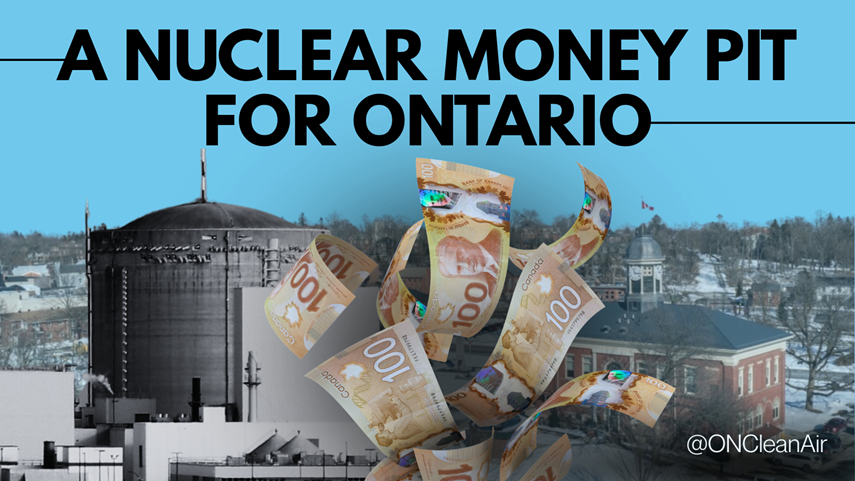
Nuclear Power: The Most Expensive and Slowest Option
Nuclear reactors are the highest cost option to meet Ontario’s electricity needs – up to 10 times higher than energy efficiency, and 2 to 8 times higher than new wind and solar energy.
They are also far too slow. According to OPG, these new nuclear reactors would not come online until 2040 – 2048. That means more than 20 years of construction, cost overruns, and continued reliance on polluting gas.
By contrast, new wind and solar projects can be built in 6 months – 2 years, reducing emissions and lowering bills quickly.
A Risky Dependence on Foreign Fuel
To make matters worse, OPG is considering purchasing American-designed reactors from GE-Hitachi or Westinghouse. These reactors would require Ontario to import enriched uranium from the United States to fuel them. Does that seem like a good idea given the current political craziness unfolding south of the border?
The Better Alternative
OPG’s proposal fails to examine crucial alternatives.
Could Ontario meet its electricity needs more cheaply, more quickly, and more safely by investing in energy efficiency, wind power, solar energy, and energy storage (such as batteries and compressed air storage)?
This is a question that the Impact Assessment Agency of Canada (IAAC) must examine during its mandatory review. That will only happen if the public demands it.
What you can do
 Submit Public Comments – Deadline: Midnight, Wed. Feb. 11
The IAAC is accepting public comments on OPG’s application.
Submit your comments through the IAAC portal or email them to: wesleyville@iaac-aeic.gc.ca
Ask the IAAC to direct OPG to evaluate whether energy efficiency, renewables, and energy storage are lower-cost, faster, safer, and more secure ways to meet Ontario’s electricity needs than building a massive new nuclear station at Port Hope
Europe Economic Panic
Lorenzo Maria Pacini, January 18, 2026, https://strategic-culture.su/news/2026/01/18/europe-economic-panic/
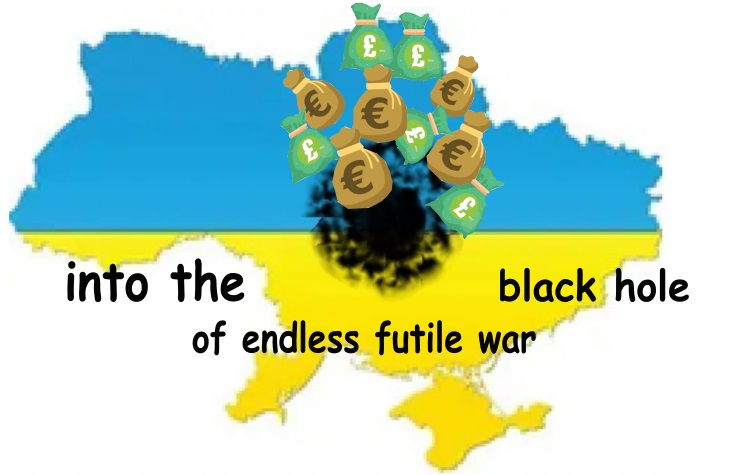
Europeans are tired. They want peace, stability, and the quiet dignity of prosperity.
When a prime minister advises his staff to rest because the coming year will be much more difficult, it is neither black humor nor fatigue. It is a moment of sincerity, the kind that only emerges when internal projections no longer support the public narrative.
Giorgia Meloni was not addressing the electorate. She was addressing the machinery of the state itself, the administrative core charged with implementing decisions whose effects can no longer be hidden. Her observation was not about a normal increase in workload. She was talking about constraints, about limits being reached, about a Europe that has moved from crisis response to a phase of controlled contraction, fully aware that 2026 is the year when deferred costs will eventually converge.
What has leaked out is what European ruling circles have already understood: the Western strategy in Ukraine has run up against material limits. Not with Russian messages, not with disinformation, not with populist dissent, but with steel, ammunition, energy, manpower, and time. Once these realities assert themselves, political legitimacy begins to erode.
The EU cannot sustain this war economically. Europe can strike poses of readiness. It cannot manufacture war.
After years of high-intensity conflict, both the US and Europe are rediscovering a long-forgotten truth: wars of this nature cannot be sustained with speeches, sanctions, or the abandonment of diplomacy. They require bullets, missiles, trained personnel, maintenance cycles, and industrial production that consistently exceeds battlefield losses. None of this exists, not in sufficient quantities, and it is not feasible in the timeframe preached in Brussels.
Russia is producing artillery ammunition in quantities that Western officials now openly admit exceed NATO’s total production. Its industrial base has shifted to near-continuous wartime production, with centralized procurement, streamlined logistics, and state-led manufacturing, without even total mobilization. Estimates place Russian production at several million artillery shells per year, already delivered, not just projected.
Europe, meanwhile, spent 2025 congratulating itself on targets it is structurally incapable of achieving. The EU’s stated commitment of two million shells per year depends on facilities, contracts, and labor that will not be available by the decisive period of the war, if ever. Even if achieved, the figure would still be less than Russian production. The US, despite emergency expansion, expects about one million shells per year once full ramp-up is complete, and only if that happens. Even on paper, combined Western production struggles to match what Russia is already producing in practice. The imbalance is clear.
This is not just a deficit, but a misalignment of timing. Russia is producing now. Europe is planning for the future. And time is the only factor immune to sanctions.
Washington, in fact, cannot indefinitely compensate for Europe’s eroded capacity because it faces its own industrial difficulties. Patriot interceptor production remains in the order of a few hundred per year, while demand simultaneously concerns Ukraine, Israel, Taiwan, and the replenishment of US stocks: an imbalance that, as Pentagon officials admit, cannot be resolved quickly. Shipbuilding tells a similar story: submarines and surface ships are years behind schedule due to labor shortages, aging infrastructure, and skyrocketing costs, pushing significant expansion toward 2030. The assumption that America can indefinitely support Europe is no longer in line with reality. This is a systemic Western problem.
Unfounded war rhetoric
European leaders talk about a “state of war” as if it were a rhetorical position, but in reality, it is an industrial condition that Europe does not meet.
New artillery lines take years to reach stable production. Air defense interceptors are produced in long, batch-based cycles, not in sudden spikes. Even basic components such as explosives remain a critical issue, with plants that closed decades ago only now reopening and some not expected to reach full capacity until the late 2020s. This timeline is in itself an admission.
Europe’s weakness is not intellectual, but institutional: huge sums have been authorized, but procurement inertia, fragmented contracts, and a depleted supplier base have meant that deliveries are years behind schedule. France, often described as Europe’s most capable arms manufacturer, is capable of building advanced systems, but only in limited quantities, counted in dozens, while a war of attrition requires thousands. EU ammunition initiatives have expanded capacity on paper, while the front has exhausted ammunition in a matter of weeks.
These are not ideological shortcomings, but administrative and industrial failures, which are exacerbated in stressful situations. It is yet another example of the failure of European Community policy, so much so that the structural contrast is stark. Western industry has been optimized for shareholder returns and peacetime efficiency, while Russian industry has been reoriented to withstand pressure. NATO announces aid packages. Russia counts deliveries. You can already guess what the outcome of this situation will be, right?
This industrial reality explains why the debate on asset freezing was so important and why it failed. Europe did not pursue the seizure of Russian sovereign assets out of legal ingenuity or moral determination, but because it needed time: time to avoid admitting that the war was unsustainable in Western industrial terms, time to replace production with financial maneuvers.
When the effort to confiscate some €210 billion in Russian assets failed on December 20, blocked by legal risks, market repercussions, and opposition led by Belgium, with Italy, Malta, Slovakia, and Hungary opposing total confiscation, the Brussels technocracy settled for a reduced alternative: a €90 billion loan to Ukraine for 2026-27, with interest payments of around €3 billion per year. This further mortgages Europe’s future. This is not a strategy, but emergency triage. A collapsing political hospital. Pure panic.
Narrative, crisis, disaster
The deeper reality is that Ukraine is no longer primarily a military dilemma, it is a question of solvency. Washington recognizes this, because it cannot absorb the reputational discomfort, but they cannot take on unlimited responsibility forever. A way out is being explored, discreetly, inconsistently, and shrouded in rhetorical cover.
Europe cannot admit the same necessity, because it has ultimately adopted ‘Putin’s version’, i.e. it has framed the war as existential, civilising, moral – but do you remember when European politicians enjoyed calling Putin crazy for talking about a clash of civilisations?
Compromise has become appeasement, negotiation surrender. In doing so, Europe has eliminated its own escape routes. Well done, ladies and gentlemen!
On the narrative front, greetings to all. The aggressive enforcement of the EU’s Digital Services Act has less to do with security than with containment: building an information perimeter around a consensus that cannot survive open scrutiny. Translated: censorship as a solution. The truth of the matter must not be made known, and those who try to do so must be suppressed in an exemplary manner. This also explains why regulatory pressure now extends beyond European borders, generating transatlantic friction over freedom of expression and jurisdiction. Confident systems welcome debate. Fragile ones suppress it. In this case, censorship is not ideology, but a form of insurance.
The information crisis, rest assured, will very soon become… a social crisis ready to detonate into domestic conflict.
And the crisis is also one of resources and energy. We are witnessing the securitization of decline, whereby obligations are postponed while the productive base needed to sustain them continues to shrink. It’s a cat chasing its tail. Here too, you know how it will end, don’t you?
Europe has not only sanctioned Russia. It has sanctioned itself. European industry will continue to pay energy prices well above those of its competitors in the United States or Russia throughout 2026. Take a trip around Europe, read the headlines in local newspapers, look at people’s faces: the fabric of small and medium-sized enterprises, the true beating heart of entire EU countries, is quietly disappearing. And this is logically reflected in large companies too. This is why Europe cannot increase its production of ammunition and why rearmament remains an aspiration rather than a concrete operation.
Energy, we said. Low-cost energy was not a convenience, it was essential. If it is eliminated through self-inflicted damage, the entire structure is emptied. Even the most ambitious plans preached for years, such as the IMEC corridor, are still a mirage. There is a stampede towards Turkey, Azerbaijan, and Georgia to try to scrape together a few kilowatts. A ridiculous attempt to save what is now tragically unsalvageable.
China, observing all this, represents the other half of Europe’s strategic nightmare. It controls the world’s deepest manufacturing base without having entered into a position of war. Russia does not need China’s full capacity, only its strategic depth in reserve. Europe has neither.
A frightening 2026
2026 therefore looks set to be a terrible year, I’m sorry to say. The European elites find themselves losing control on three fronts at once. On finance, because the budget will be bitter and the money for the insane support to Kiev will no longer be the same. On narrative, because the question citizens will ask themselves will be ‘what was the point of all this?’. On the cohesion of the Alliance, both NATO and the EU, because Washington’s disengagement will force a review of the balance of power on the European continent to the point of no return and, perhaps, a break between the two sides divided by the ocean.
Panic, again. Not a sudden defeat, but the slow erosion of legitimacy as reality creeps in through gas that costs as much as gold, closed plants, empty stockpiles, obsolete rifles, and a future that is turning away.
This is not just a difficult situation for Europe, but a matter of civilization. A system incapable of producing, supplying, speaking honestly, or retreating without collapsing in credibility has reached its limit. When leaders begin to prepare their institutions for worse years, they are not anticipating inconveniences, but recognizing structural failure.
Empires proclaim victory loudly. Declining systems quietly lower expectations or, in this case, momentarily say the quiet part out loud. But the truth is that nothing is the same as before, and it is obvious.
For most Europeans, the reckoning will not come as an abstract debate about strategy or supply chains, but as a simple realization: this was never a war they consented to. It did not defend their homes, their prosperity, or their future. And so, again, how do you think it will end?
An ideological war has been fought in the name of imperial ambition and financed through declining living standards, industrial decline, and the prospects of their children. In the name of big pro-European capital, of the privileged few with robes, stars, and crowns.
For months, even years, it was said that “there was no alternative” and that this was the only course of action. And now?
Europeans are tired. They want peace, stability, and the quiet dignity of prosperity: affordable energy, a functioning industry, and a future unencumbered by conflicts they NEVER chose and, above all, they do not want the decline of millennia-old civilizations.
And when this awareness has taken hold, when the fear has faded and the spell has been broken, the question Europeans will ask themselves will not be technical or ideological. It will be existential. And all existential questions lead to radical choices, even terrible ones.
May this dramatic fear keep the mad leaders of this Europe awake at night.
Ontario utility wants to double the asking price of nuclear, while US wants reactors on the moon
Giles Parkinson. Jan 14, 2026, https://reneweconomy.com.au/ontario-utility-wants-to-double-the-asking-price-of-nuclear-while-us-wants-reactors-on-the-moon/
The main power utility in the Canadian province of Ontario has put in a request to nearly double the price of payments its receives for nuclear power, in order to cover the cost of maintenance, upgrades and new projects.
Ontario Power Generation has asked the local regulator – the Ontario Energy Board – to increase the payments for nuclear power to $C207 a megawatt hour ($A222/MWh) from January, 2027, nearly double what it received ($C111.61/MWh) in 2025.
Nuclear accounts for more than half of the generation in Ontario, which is often held up by nuclear advocates as a shining light for Australia to follow, but it faces massive expenses in coming years as it refurbishes its ageing nuclear fleet, and embarks on a program to build four small modular reactors.
The first of these SMRS are expected to be delivered in the early 2030s, and the total cost is currently put at more than $C21 billion. But more money, nearly $C27 billion, is to be spent on refurbishing four existing reactors at Pickering, and yet more on other nuclear upkeep costs.
The huge investment in nuclear is raising concerns among environmental groups and also major energy users, which include steel makers and car companies such as Ford and Toyota.
The Association of Major Power Consumers in Ontario, says its members are facing “skyrocketing” electricity prices, including a 165 per cent rise in the next three years.
AMPCO president Brad Duguid blames the rising cost of nuclear, and also the heavy price of gas generation which is being used to fill the gap caused by the refurbishment of the old nuclear plants, some of which are scheduled to be offline for three years.
“Over the next seven to 10 years, we’re seeing significant increases in the market energy rates to make up that difference,” he told the Globe and Mail.
“We’re talking about increases in the range of 165 per cent for the market rate over the next three years alone. That’s untenable. That’s an absolute threat to the competitiveness of our industrial sector and the hundreds of thousands of jobs it supports.”
Retail customers are also suffering. Residential power prices jumped 29 per cent in October, although they were partially offset by an increase in government rebates.
The cost of those rebates – which are used by the government in Ontario, as they are in nuclear dependent France, to hide the true cost of nuclear – have jumped to $C8.5 billion a year. Other costs are incorporated in general government debt, critics note.
“This application really confirms that these projects are among the most expensive ways to meet our need for electricity,” said the Ontario Clean Air Alliance, which supports renewables and opposes the nuclear expansion.
“We could expand solar, wind and storage at a fraction of the cost and avoid seeing our power bills go through the roof.
“The Premier’s buddies in the nuclear and gas industries may like his plan for an old school electricity system built around eye-wateringly expensive mega projects. But the people of Ontario are now in for some serious sticker shock.
“This is really the tip of a very big iceberg coming straight at your household budget.”
Meanwhile, the Trump administration across the border has doubled down on its plan, first flagged in August last year, to build a series of nuclear power plants on the moon – by 2030 – and to get them ready for Mars, whenever they get there.
The US Department of Energy and NASA announced on Tuesday that they intended to deploy nuclear reactors on the Moon and in orbit, including the development of a lunar surface reactor by 2030.
Russia has also announced plans to deploy nuclear power on the moon, although it is aiming for 2035.
Newly appointed NASA Administrator Jared Isaacman said the US is committed to returning to the Moon, and making “the next giant leap to Mars” and beyond.
“Achieving this future requires harnessing nuclear power. This agreement enables closer collaboration between NASA and the Department of Energy to deliver the capabilities necessary to usher in the Golden Age of space exploration and discovery,” he said in a statement.
How New Venezuela President Will Save Us from Trump’s Crazy
The Radical Pragmatist versus Rubio’s Vulture
by Greg Palast. for Raw Story, Substack and Thom Hartmann, January 14, 2026
Trump aims to drop oil to $50 a barrel; Chavez offered that years ago.
The US press is confused. Nothing new there. They are confused about the Acting President of Venezuela, Delcy Rodriguez.
The New York Times says Rodriguez “Went From Revolutionary to Trump’s Orbit”
Oh no, she didn’t.
Rodriguez still attacks Trump as an outlaw kidnapper and imperialist invader. But, at the same time, she says she’s seeking the restoration of diplomatic relations with the US and offers tens of millions of barrels of oil to Trump.
I’ve known Rodriguez for years. Is she a militant Leftist or a moderate pragmatist?
The answer is, “Yes.” I’d call Rodriguez a “radical pragmatist.”
Trump is wise to keep Rodriguez in the Presidential office. Did I just associate “Trump” and “wise”? Yes, but it seems Trump’s wisdom may be accidental. He is reported to be furious at the leader of the Venezuelan opposition, Maria Corina Machado, for accepting the Nobel Peace Prize instead of leaving it to Trump. And the result is that he has vetoed installing her in power.
Notably, oil and finance interests want the “Leftist” Rodriguez to stay — even the CIA wants her to stay. But Sec. of State Marco Rubio and an outlaw US billionaire want her out. Who wins? I’ll handicap the race below.
Trump wants Venezuelan oil — that we already had
Rodriguez and Trump desire the same thing: to send Venezuelan oil to the US. But Donald, we already had Venezuelan oil…until YOU embargoed imports of their crude.
Venezuela’s socialist President Hugo Chavez enjoyed taunting George W. Bush. I remember when Chavez spoke at the UN General Assembly right after Bush left the podium. Chavez began, “There is a distinct smell of sulphur here.” Bush went after Chavez. It was a bit less subtle than Chavez’ comment. Bush backed the kidnapping of Chavez in 2002. Unlike Trump, Bush’s scheme face-planted and Chavez was returned by his kidnappers, more popular than ever.
But despite the barbs and kidnapping, Bush, with Chavez’ encouragement, kept Venezuelan oil flowing to the US, more than a million barrels a day.
Trump is crowing that, “we’re going to be taking oil” from Venezuela. Mr. President, we were taking Venezuela’s oil until you stopped the flow with an embargo.
Now, it will be nearly impossible, and cost a prohibitive amount, to crank up Venezuela’s production to get back up to the flow quantities we had before Trump’s embargo. Because, when the extraction of super-heavy oil of Venezuela stopped, it congealed into tar and then into asphalt. Refineries and pipes are choked and destroyed, a destruction Trump engineered through blocking Venezuela from paying for equipment to maintain the lines. Now, Trump is trying to bully US oil companies to invest as much as $100 billion to restore the oil infrastructure that Trump himself destroyed.
Trump wants praise for (expensively) rebuilding what he demolished. He’s like an arsonist who wants praise for calling the fire department.
Chavez’ $50/barrel offer
US voters have decided that price inflation is a real bummer. So, Trump has decided, correctly, that unleashing Venezuela’s oil is the way to go. Trump states bluntly that he wants to open Venezuela’s oil spigots to bring down the price of crude to $50 a barrel. Today, crude sells for just under $60/bbl.
But Venezuela already offered to cap the price of its oil at $50/bbl years ago. In one of my interviews with Chavez for BBC Television, he said he would agree to cap oil at $50 if the US would guarantee that oil would not slip below $30/bbl. Venezuela, unlike Saudi Arabia, could not afford another crash to $10 a barrel, as happened in 1998, which bankrupted South American OPEC members. So, Chavez enthusiastically endorsed this idea of a “band” — you give us a bottom and we’ll give you a top — which was first suggested, notably, by industry consultant Henry Kissinger.
Chavez told me he got along well with Kissinger and George Bush Sr., a fellow oil man. And, as Chavez noted, he was “a good chess player,” a pro at realpolitik, a skill he passed to his protégé Rodriguez.
In other words, Trump killed a hundred people in his coup (and thousands may yet die) to get something by force that he could have gotten by contract.
OPEC: “no brainer” or “no brains”?
The first strike against right-wing fave Machado is her avowed desire to sell off Venezuela’s state oil company, Petroleos de Venezuela, S.A. (PdVSA, pronounced, Pay-day-VAY-sah). What Machado, a neophyte to petroleum economics, does not understand is that full privatization is a direct threat to the oil majors and OPEC.
I’ve seen this movie before. Leading up to the invasion of Iraq, neo-cons within the Bush Administration wanted to privatize Iraq’s state oil companies, selling the fields to American and European majors who would then, the neo-con plan went, compete to maximize output, crash the price of crude and bring OPEC to its knees. Ari Cohen of the Heritage Foundation told me this scheme was a “no-brainer.”
But then I spoke with Philip Carrol, past President of Royal Dutch Shell USA who said, “Anyone who thinks pulling out of OPEC is a ‘no brainer’ has no brains.” Oil companies are not in the business of getting oil; they are in the business of making money. A crash in the price of crude could indeed end OPEC’s price-setting power and no US oil company wants to see their revenues collapse.
There’s also a legal issue. There is no way for Venezuela to stay in OPEC if its state oil company is sold to US interests because US law makes it a crime to participate in a price-fixing cartel. But our government has carved out a convenient exception for state-owned oil companies allowing Exxon and Chevron and their buds to surf on the high prices set by the OPEC monopoly.
Rodriguez is not only Acting President, she remains the Minister of Petroleum and Hydrocarbons. She has a detailed knowledge of the hard realities of oil production. But, she’s a patriot, too. She will not allow the theft or seizure of Venezuela’s oil, but she sure as hell wants to sell us oil again. Chevron, which has worked closely with
Rodriguez, couldn’t be happier. Oil companies don’t want to own oil fields. That’s not how the industry operates. They don’t want the real estate; they want profit. They work with OPEC nations through PSA’s, Profit Sharing Agreements. The issue is always the split of the revenues, not ownership; with the state’s share paid as a “royalty” for US tax purposes.
The last thing the oil companies need is Machado, a free-market fanatic, creating a civil war over ownership of fields that the majors want to drill, not own.
And there’s a practical problem. At $50/bbl, no one is going to drill in the Orinoco Basin, where most of the oil is, because it’s just not profitable to try and pull up the sulphurous gunk there. As petroleum engineer Beck would say, “It’s a loser, baby.” That’s why Trump was so frustrated with the oil big wigs who just met with him at the White House. He’s telling them to dump tens of billions into a money pit, rebuilding what Trump destroyed…………………………………………………………………………………………………………………….https://www.gregpalast.com/how-new-venezuela-president-will-save-us-from-trumps-crazy/
TerraPower and Meta partner on Natrium nuclear plants
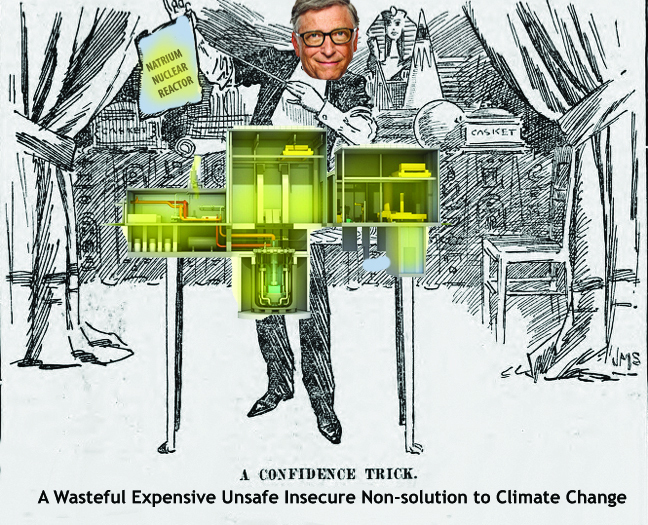
The agreement launches early work on two initial units and secures Meta rights to energy from six more, marking the tech giant’s largest investment in advanced nuclear energy to date.
erraPower and Meta have agreed to develop up to eight Natrium nuclear reactor and energy storage system plants in the United States, a move that could supply Meta with up to 2.8 gigawatts of carbon-free baseload energy. With the Natrium system’s built-in energy storage, total output could be increased to as much as 4 gigawatts.
The agreement supports early development of two initial Natrium units and gives Meta rights to energy from up to six additional units. Each reactor provides 345 MW of baseload power and can ramp up to 500 MW for more than five hours. A dual-unit site could deliver up to 690 MW of firm power and as much as 1 GW of dispatchable electricity.
The companies said delivery of the first units could begin as early as 2032. They also plan to identify a site for the initial dual-reactor project in the coming months.
Donald Trump calls for emergency energy auction to make tech giants pay for AI power
Donald Trump and a number of state governors are pushing the US’s
largest electrical grid operator to hold an emergency auction to make tech
giants foot the bill for AI power infrastructure.
The administration along
with governors of states including Pennsylvania, Ohio and Virginia have
urged PJM — which serves more than 67mn people in the US north-east and
Midwest — to hold a power auction in which big data centre operators bid
for 15-year contracts to build new power plants. Such contracts could
support the construction of about $15bn worth of new power plants, with
tech companies paying for them regardless of whether they use the resulting
electricity, a White House official confirmed.
FT 16th Jan 2026
https://www.ft.com/content/9b3d179e-129c-4aa1-a5c0-1cc1703b0234
Ontario Power Generation seeks rate increase for electricity from nuclear plants
Matthew McClearn, 13 Jan, 26 https://www.theglobeandmail.com/business/article-ontario-power-generation-rate-increase-application-electricity-nuclear
The Pickering Nuclear Generation Station in January, 2020. In November the Ontario government approved the $26.8-billion refurbishment of four aging reactors at the station.
Ontario Power Generation is seeking a near-doubling of payments it receives for electricity produced by its nuclear power plants, a request that could lead to surging power bills.
In a rate application submitted to the Ontario Energy Board in December, OPG requested payments of nearly $207 dollars per megawatt hour produced by its nuclear power stations beginning Jan. 1, 2027, roughly double what it received as recently as last year. It seeks similar amounts for each year through 2031.
OPG spokesperson Neal Kelly said the sought rates would cause a typical residential customer’s payments to rise by roughly 2.4 per cent annually in each of the next five years.
Ontario has generated roughly half of its power in recent years from its Darlington, Pickering and Bruce nuclear stations. (The latter is operated by private power producer Bruce Power and is not part of OPG’s application.) Energy Minister Stephen Lecce is pursuing an aggressive expansion of the reactor fleet to meet an expected surge in demand for electricity between now and mid-century, which includes plans to build large new multi-reactor stations.
Chelsea McGee, a spokesperson for Mr. Lecce, referred an interview request from The Globe and Mail to the OEB and OPG.
The requested payment increases require the board’s approval. OEB spokesperson Tom Miller said it would be inappropriate to comment on OPG’s application because it is before a panel of commissioners. Mr. Miller said it will be adjudicated later this year.
Made in Canada: Inside an urban Toronto facility making uranium fuel for CANDU reactors
OPG is entering a period of intense capital spending. Last year, it began constructing the first of four new small modular reactors at its Darlington station, with an estimated cost of $20.9-billion. OPG said that project accounts for about one-quarter of the sought payment increases.
Far more consequential, at 60 per cent of the payment increase, is the $26.8-billion refurbishment of four aging reactors at Pickering station. The government approved that overhaul in November; it’s expected to wrap up in the mid-2030s.
OPG is also spending to refurbish many of its hydroelectric stations.
“Every investment in the application has been carefully evaluated, planned prudently and designed to provide long-term value to Ontarians,” Mr. Kelly wrote in a statement.
Mark Winfield, a professor at York University’s environmental faculty, said that because OPG’s projects have been approved by the government, the OEB has little room to disallow the payment increases sought by the utility.
“They can’t really say no to OPG,” he said.
“The system runs by political fiat, and all the agencies are basically mandated to fulfill the minister’s will.”
Ontario to spend $1.5-billion on underwater electricity cable from nuclear plant to Toronto
Ontario’s residential electricity rates previously increased 29 per cent on Nov. 1. The OEB attributed those hikes to “higher-than-expected generation costs” as well as increased spending on conservation programs, but it provided few additional details. Those rate hikes were largely offset by a 23.5-per-cent increase in the Ontario Electricity Rebate, a taxpayer-funded instrument the government uses to provide relief on residential power bills.
The Globe twice requested interviews with OEB officials in December to explore the role rising nuclear costs played in the Nov. 1 rate increases. Mr. Miller denied those requests but agreed to answer questions by e-mail. The Globe sent questions to the OEB on Jan. 5, but had not received responses by late Monday.
A report by Power Advisory LLC, a consultancy that performed work for the OEB related to the Nov. 1 rate increases, attributed them partly to “higher-than-expected nuclear generation.” That report noted payments for OPG’s nuclear generation rose to $123.76 per megawatt hour in 2026, as compared with $111.61 per megawatt hour last year.
The current trajectory for power rates has attracted concern from the Association of Major Power Consumers in Ontario, which represents industrial power users including automakers Ford Motor Co. and Toyota Motor Corp., and steel producers Stelco and ArcelorMittal Dofasco.
AMPCO president Brad Duguid said the province has no choice but to overhaul and expand its nuclear fleet – a decision he argued will preserve the provincial grid’s reliability. But he’s concerned that industrial power rates are already “skyrocketing” for AMPCO’s members – increases he mainly attributed to rising natural gas generation as reactors are taken offline for refurbishment.
“Over the next seven to 10 years, we’re seeing significant increases in the market energy rates to make up that difference,” he said.
“We’re talking about increases in the range of 165 per cent for the market rate over the next three years alone. That’s untenable. That’s an absolute threat to the competitiveness of our industrial sector and the hundreds of thousands of jobs it supports.”
Ottawa, Ontario pledge combined $3-billion for new nuclear reactors
Jack Gibbons, chair of the Ontario Clean Air Alliance, attributed the hikes directly to the government’s nuclear expansion and predicted the situation will only worsen.
“It’s just absurd to be investing in high-cost nuclear,” he said.
“It’s going to push up rates, make life less affordable for hard-working families and make Ontario’s businesses less competitive.”
York University’s Mr. Winfield said the government has four options to address the upward pressure on electricity rates. First, it can allow them to rise, but that would undermine affordability and could stall electrification of Ontario’s economy.
The government could also further increase subsidies such as the Ontario Energy Rebate. But at a total annual cost “of $8.5-billion per year, this has to be already at or near the limits of fiscal feasibility,” Mr. Winfield wrote in an e-mail.
Another option is to reconsider the province’s electricity plans to focus on lower-cost options. Finally, the government could conceal the additional costs as debt, a choice previous governments pursued.
Electricity rates are also rising sharply in many other jurisdictions across North America, including ones with little or no nuclear generation. According to the U.S. Energy Information Administration, average residential rates across the United States increased 5 per cent for the year ended Oct. 31, reaching nearly 18 US cents per kilowatt hour.
1 This Month

of the week – Shut Down Drone Warfare!


Tell the Ukrainian Government to Drop Prosecution of Peace Activist Yurii Sheliazhenko

Petition to revoke the licensing of the Near Surface Nuclear Disposal Facility (NSDF) at Chalk River. https://www.ourcommons.ca/petitions/en/Petition/Details?Petition=e-7247
To see nuclear-related stories in greater depth and intensity – go to https://nuclearinformation.wordpress.com
-
Archives
- April 2026 (57)
- March 2026 (251)
- February 2026 (268)
- January 2026 (308)
- December 2025 (358)
- November 2025 (359)
- October 2025 (376)
- September 2025 (257)
- August 2025 (319)
- July 2025 (230)
- June 2025 (348)
- May 2025 (261)
-
Categories
- 1
- 1 NUCLEAR ISSUES
- business and costs
- climate change
- culture and arts
- ENERGY
- environment
- health
- history
- indigenous issues
- Legal
- marketing of nuclear
- media
- opposition to nuclear
- PERSONAL STORIES
- politics
- politics international
- Religion and ethics
- safety
- secrets,lies and civil liberties
- spinbuster
- technology
- Uranium
- wastes
- weapons and war
- Women
- 2 WORLD
- ACTION
- AFRICA
- Atrocities
- AUSTRALIA
- Christina's notes
- Christina's themes
- culture and arts
- Events
- Fuk 2022
- Fuk 2023
- Fukushima 2017
- Fukushima 2018
- fukushima 2019
- Fukushima 2020
- Fukushima 2021
- general
- global warming
- Humour (God we need it)
- Nuclear
- RARE EARTHS
- Reference
- resources – print
- Resources -audiovicual
- Weekly Newsletter
- World
- World Nuclear
- YouTube
-
RSS
Entries RSS
Comments RSS
 nuclear-news