Shareholders will propose shutdown of japan’s nuclear power
All of the proposals being submitted are expected to be rejected because large stakes are held by financial institutions, which are expected to vote along the lines of company management. Approval of two-thirds of shareholders with voting rights who attend the meetings is needed in order to pass any proposal.

 Utilities face shareholders’ proposals to get rid of nuclear power,http://ajw.asahi.com/article/economy/business/AJ201306220057 Asahi Shimbun, By TAKASHI EBUCHI/ Staff Writer June 22, 2013
Shareholders of eight of the nine utilities that operate nuclear power plants will present proposals at shareholders’ meetings next week urging the companies to abandon nuclear power.
But with the Abe administration clearly in favor of nuclear power, the utilities are all expected to reject the proposals and press ahead with plans to restart reactors currently offline.
All of Japan’s electric power companies will hold their annual shareholders’ meetings on June 26.
Similar proposals were made at last year’s meetings for seven of the utilities, which all rejected the proposals. Continue reading
USA’s nuclear power industry in its economic death throes
These are the facts: Renewables have taken the lead in new power generation in America, comprising nearly half of all new generating capacity installed in the United States in 2012. In the first quarter of this year, nearly half the new capacity installed was solar. With its poor economics, enormous complexity, overly-large capital requirements, too-long lead times, and overall risk, US nuclear power is headed for contraction, not resurgence. Ultimately, I think the same will be true globally
 The real reason to fight nuclear power has nothing to do with health risks, Quartz, By Chris Nelder, 17 June 13“……Nuclear’s long goodbye The simple fact is that, at least in the US, the nuclear industry is dying a slow death. The announced closure of four major facilities in 2013 alone amount to 4,246 megawatts of nuclear capacity—enough to power 2.7 million homes for a year—that are being retired.
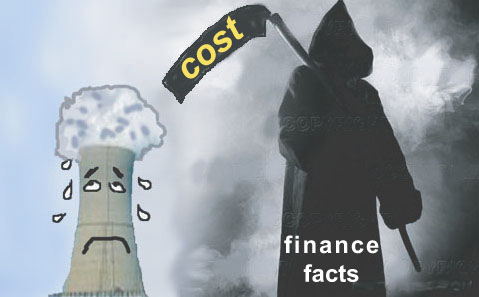
Even while the nuclear industry is able to externalize its costs for insurance (which are federally limited), loan guarantees (which are federally backstopped), decommissioning (which is pushed onto ratepayers) and waste handling (which is pushed onto taxpayers), it still lost. If it had to stand on its own and pay its full insurance costs like every other energy source, we could never build another nuclear plant in America, because no private investors would be willing to take that kind of risk. It’s hard to imagine how the economics could be more tilted in nuclear’s favor (although I’m sure its proponents have ideas on that).
The reason nuclear is dying is economics, not tribalism, as Shellenberger and Nordhaus claim. Continue reading
UK’s new nuclear plan will dramatically increase electricity costs

 Electricity From New UK Nuclear Plant To Be Linked to Inflation WSJ, By SELINA WILLIAMS AND GERALDINE AMIEL, 18 June 13, The U.K. government has agreed that the guaranteed fixed price for electricity from a new nuclear power plant that Electricite de France SA EDF.FR +0.30% (EDF.FR) wants to build would be fully linked to inflation, said people familiar with the matter, a move that would add tens of billions of pounds to the total cost of electricity from the reactors.
The agreement to inflation-link the electricity price EDF would receive–known as the strike price–for 35 years substantially eases the financial risks for the French utility for constructing two nuclear reactors, but there is still no deal on the actual price, the people said.
The whole nuclear plant is estimated to cost around 14 billion pounds ($22 billion) to build.
EDF, the world’s largest nuclear operator, seeks a strike price between GBP95 to GBP100 per megawatt hour of electricity while the government would rather settle around GBP80 to GBP85 per megawatt hour, one of the people said. The current wholesale electricity price is around GBP48/MWh. The talks are expected to continue for several weeks, the person said.
Whether EDF and the U.K. can reach an agreement is seen as a litmus test for nuclear energy and its economic viability in Europe……
The agreement links the strike price, which amounts to an indirect subsidy for nuclear power, to an inflation measure called the consumer price index, one of the people said. This would dramatically increase the costs to taxpayers, said Roland Vetter, head of research at CF Partners, an environment and energy advisory, trading and investment
firm.
“Indexation is important because it will increase the subsidies every year in line with inflation and the public therefore will carry thelong-term inflation risk in their electricity bills,…… http://online.wsj.com/article/SB10001424127887323566804578553030018924570.html?mod=googlenews_wsj
5.7 million people employed in renewable energy

2012 was the second highest year ever for renewable energy investments – but being “second” doesn’t reflect installed capacity as prices for renewable energy equipment, particularly related to solar power, have plummeted.
Last year was another record year in terms of installed capacity; with 115 GW of new renewables put in place globally. However, 2012 saw the most significant change so far in the balance of renewable energy investment activity between developed and developing economies. Continue reading
Collapse of nuclear industry due to financial realities
In short: Cost estimates for new nuclear plants are not credible. I have yet to find a single one that stood up to close scrutiny. And as far as I am aware, no nuclear plant has ever been built for close to its original cost estimate.
The real reason to fight nuclear power has nothing to do with health risks, Quartz, By Chris Nelder, 17 June 13 Chris Nelder is an energy analyst, consultant and speaker who has written about energy and investing for more than a decade.
Nuclear proponents are launching a full-court press for fresh investment in the technologyThe release of the new film Pandora’s Promise, another editorial from ardent nuclear champions Michael Shellenberger and Ted Nordhaus of the Breakthrough Institute, and Paul Blustein’s recent piece in Quartz, “Everything you thought you knew about the risks of nuclear energy is wrong,” are part of an effort to put a new shine on a technology that once offered, but failed to deliver, electricity “too cheap to meter.”
Missing from the entire debate about nuclear is the most important fact of all: Nuclear is dying due to poor economics, and the debate is already over as far as the market is concerned.
Shellenberger and Nordhaus have backed up their arguments with junk accounting on nuclear energy’s costs. This is where the discussion must depart from mere boosterism and descend into the deep, dark world of energy economics—a subject that Blustein did not even address. Continue reading
Poland likely to delay nuclear power program
Poland may delay launch of nuclear plants Phys Org, 18 June 13 Poland could delay building its first nuclear power plants as natural gas, including shale gas, becomes less costly, the prime minister of the central European heavyweight said Tuesday. Read more at: http://phys.org/news/2013-06-poland-nuclear.html#jCp
Anxiety in the uranium industry
Uranium One cutting 26 staffhttp://www.mining.com/uranium-one-cutting-26-staff-43352/Michael Allan McCrae | June 15, 2013 Bowing to miserable prices for its product, Uranium One (TSE:UUU) is letting go of 26 employees.
The company’s Willow Creek Mine will see 16 people cut. The Casper operation will lose the other 10.
Donna Wicher, the company’s senior vice president of Americas, told the Wyoming Staff Tribune that the company is adjusting to the market.
“The price is so low that we have to sell our uranium at these low prices, and that’s not good,” said Wichers.
“We need higher prices in order to make a profit that we need to develop new well fields.”
Uranium One operates in situ recovery at its Willow Creek Mine in Wyoming. It also has additional exploration projects in Arizona, Colorado, and Utah.
Uranium is in the dog house after the spot price hit a seven-year low last week. In January Uranium One’s board approved a deal to be taken private by the the Russian firmJSC Atomredmetzoloto (ARMZ) for C$1.3 billion, a move that was oppos
USA nuclear industry getting too old and too expensive
Nuclear Plants, Old and Uncompetitive, Are Closing Earlier Than Expected , NYT By MATTHEW L. WALD June 14, 2013 Washington — When does a nuclear plant become too old? The nuclear industry is wrestling with that question as it tries to determine whether problems at reactors, all designed in the 1960s and 1970s, are middle-aged aches and pains or end-of-life crises.
This year, utilities have announced the retirement of four reactors, bringing the number remaining in the United States to 100. Three had expensive mechanical problems but one,Kewaunee in Wisconsin, was running well, and its owner, Dominion, had secured permission to run it an additional 20 years. But it was losing money, because of the low wholesale price of electricity.
“That’s the one that’s probably most ominous,” said Peter A. Bradford, a former member of the Nuclear Regulatory Commission and a former head of the Public Service Commission in New York. “It’s as much a function of the cost of the alternatives as it is the reactor itself.”
While the other three, San Onofre 2 and 3 near San Diego and Crystal River 3 in Florida, faced expensive repair bills because of botched maintenance projects, “Kewaunee not only didn’t have a major screw-up in repair work, it didn’t even seem to be confronting a major capital investment,” he said.
This is a turnaround because until recently, the life expectancy of reactors was growing. When the Nuclear Regulatory Commission began routinely authorizing reactors to run 20 years beyond their initial 40-year licenses, people in the electricity business began thinking that 60 was the new 40. But after the last few weeks, 40 is looking old again, at least in reactor years, with implications for the power plants still running, and for several new ones being built…….
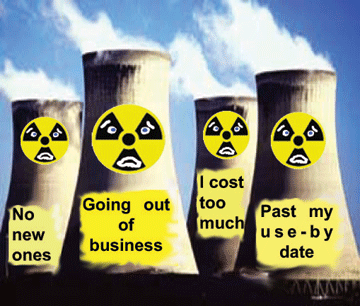
Two to watch are Vermont Yankee, in Vernon, just north of the Massachusetts border, and Indian Point, in Buchanan, N.Y., 30 miles up the Hudson River from New York City. The states of Vermont and New York are seeking to close them. If they remain profitable, the owner of all three units, Entergy, seems likely to fight tooth and nail to keep them open, but Vermont Yankee’s profitability does not seem certain. It could join plants like Maine Yankee, or Zion, near Chicago, in retirement and decommissioning…While utilities in the last few years have announced plans for more than a dozen new reactors, beyond the five now under construction only another four or so seem possible in the next few years.
And all the others are getting older…..http://www.nytimes.com/2013/06/15/business/energy-environment/aging-nuclear-plants-are-closing-but-for-economic-reasons.html?ref=business&_r=0
Japanese PM in Europe to market Japan’s nuclear reactors
 Japan PM promotes nuclear exports at central Europe summit Global Post, 16 June 13 Japanese Prime Minister Shinzo Abe made a push on Sunday for his country’s nuclear technologies at a summit in Warsaw with leaders of four ex-Communist European Union countries, as part of his bid to boost the Asian powerhouse’s exports.
Abe recently unveiled plans to treble Japan’s infrastructure exports to 30 trillion yen ($300 billion, 225 billion euros) a year, a target that could not be reached without nuclear reactors.
At Japan’s first summit with the so-called Visegrad Group — the Czech Republic, Hungary, Poland and Slovakia — Abe sought to interest the four in Japanese nuclear technology.
“We stressed the necessity of strengthening cooperation, especially in the area of energy policy,” Abe told reporters.
A joint statement issued after the talks said “Japan welcomed the fact that private sectors of both sides demonstrated keen interest in concrete forms of cooperation in nuclear energy and safety”……
In his first visit to Europe since taking office in December, promoting his country’s nuclear technologies was high on his agenda for boosting overall Japanese exports….http://www.globalpost.com/dispatch/news/afp/130616/japan-pm-promotes-nuclear-exports-at-central-europe-summit-0
They don’t now how much it costs to bury all those dead nuclear reactors
 Nuclear Decommissioning Surge Is Investor Guessing Game, Bloomberg by Stefan Nicola in Berlin at snicola2@bloomberg.net; Julie Johnsson in Chicago at jjohnsson@bloomberg.net editor responsible for this story: Reed Landberg at landberg@bloomberg.net 16 June 13
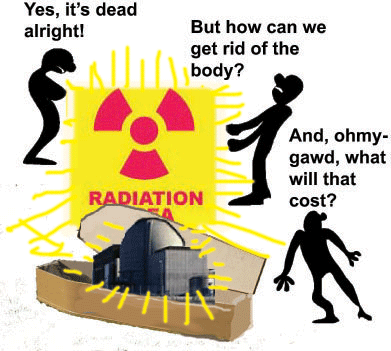
Nuclear utilities thrust into the spotlight after the Fukushima meltdowns have ordered 20 reactors shut, the most in a three-year span since Chernobyl’s aftermath, saddling the industry with a possible $26 billion in costs.
EON SE and RWE AG (RWE) are leading the biggest decommissioning project by European utilities ever, an effort to tear down 12 reactors in Germany over two decades. Edison International (EIX) said June 7 it will never restart its idled two-unit San Onofre Generating Station outside Los Angeles, bringing the number of U.S. reactors permanently closed in a year to a record four.
The global utility industry faces its biggest test to prove enough money was saved for shutdowns, having undergone numerous cost-overruns building atomic plants. A cautionary tale can be seen with government-owned facilities. In Britain, where taxpayers are on the hook to retire the Sellafield complex’s seven reactors and fuel-reprocessing stations on the Irish Seaduring the next 100 years, the U.K. government this year doubled its estimate for the work to 67.5 billion pounds ($106 billion).
“There’s a lot of speculation how much these projects cost, but an exact estimate can only be given by utilities,” said Sascha Gentes, a Karlsruhe Institute for Technology professor specializing in atomic shutdowns. “The longer a nuclear decommissioning project takes, the more expensive it becomes.” Continue reading
Nukenomics: shifting nuclear costs from nuclear suppliers to taxpayers
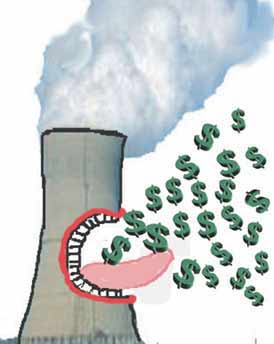 Nuclear Power, Part 2: Nukenomics , By Ned Madden, 14 June 13 TechNewsWorld Can the nuclear industry stand on its own two feet financially? It all depends on whom you ask. “There are plenty of cost estimates out there regarding what a new nuclear power plant will cost — unfortunately, those estimates are speculative. It has been decades since anyone has tried to build a nuclear plant in the United States,” said the Cato Institute’s Jerry Taylor.
There’s no denying that safety and effectiveness are both critical concerns when it comes to nuclear power, and that’s just as true for investors in the technology as it is for those who rely on the energy it generates.
Part 1 of this three-part series describes a new generation of small modular reactor designs whose promise is  undeniably compelling. What’s less certain, however, is whether they are feasible as a free-market business proposition without current levels of government-backed investment.
That’s the question at the heart of what’s sometimes called “nukenomics,” and it’s a complicated one.
Even giant corporations in the nuclear energy industry are cautious about the fiscal viability of the nuke space. Construction cost estimates for new nuclear power plants are highly uncertain.
Risky Business Continue reading
Western powers want to sell nukes to India, never mind about the Nuclear Non-Proliferation Treaty (NPT)……
 Western powers have taken a keen interest in the nuclear emergence of India …… making it an attractive
prospect for technology exporters.
If India joined the NSG, it would be the only member of the suppliers group that has not signed up to the 1970 nuclear non-proliferation treaty (NPT)
BRITAIN LOBBIES FOR NUCLEAR EXPORT GROUP TO ADMIT INDIA Yahoo 7 News, Reuters June 15, 2013 By Fredrik Dahl VIENNA – Britain has stepped up efforts to let India join an influential global body controlling nuclear exports, a move that would boost New Delhi’s standing as an atomic power but which has faced resistance from China and other countries. Continue reading
USA Federal Subsidies for Small Modular Reactors
Department Of Energy’s Small Modular Reactor Program
Savannah River Nuclear Development Site
Taxpayer Subsidies for Small Modular Reactors Taxpayers for Common Sense February 27, 2013 Download: Golden Fleece: Taxpayer Subsidies for Small Nuclear Reactors (pdf) “…..Federal Subsidies for Small Modular Reactors Federal support for SMRs is provided through a subsidy program for commercial nuclear power that can be traced back to the 1950s when federal subsidies for nuclear power reached astronomical levels. Not only did the government develop reactor and enrichment technology for the private sector, it also assumed legal responsibility for nuclear waste disposal, something never done for any other industry. In addition, the government issued multimillion-dollar development grants for many reactor technologies (most since abandoned) and distributed research reactors around the world. Continue reading
Japanese Red Cross Society radiation limits for emergency workesr
Red Cross radiation limit for relief workers too low, say critics Asahi Shimbun, By YURI OIWA June 13, 2013 The Japanese Red Cross Society has established a guideline for medical workers that sets an accumulated radiation dose limit of 1 millisievert for relief activities, although experts have said the ceiling is too low to allow workers to provide ample assistance to disaster victims.
“Radiation doses above 1 millisievert have no health effects,” said Yasushi Asari, a professor of emergency medical care at Hirosaki University. “There is no need for medical workers to use that threshold.”
Masahito Yamazawa, director-general of the Red Cross nuclear disaster preparedness task force, said during in-house discussions there were arguments for and against the 1-millisievert threshold. But the Red Cross determined that a 1-millisievert limit would still allow its workers to engage in relief activities in zones with high radiation levels because each relief mission usually lasts only up to a week, Yamazawa said.
One millisievert is the legal annual dose limit for members of the public during normal times.
Yamazawa added that allowances were also made for the fact that its medical relief squads include clerical workers.
“We have created the guideline out of a positive desire to help victims during a nuclear disaster,” Yamazawa said. “We will use it as a platform for further improvements if the need arises.”
Japanese Red Cross relief units fulfilled a total of 900 missions in communities ravaged by the 2011 Great East Japan Earthquake. However, initially they were unprepared for a nuclear disaster, and that created a vacuum of relief squads in Fukushima Prefecture during the early stages of the crisis at the Fukushima No. 1 nuclear power plant.
Red Cross officials said they learned from that experience and decided to create the new guideline for nuclear disaster relief activities.
The guideline says relief squad members should carry dosimeters and iodine tablets at all times, and retreat to safety whenever they are in danger of being exposed to more than 1 millisievert in accumulated radiation. It also says relief workers should keep clear of zones that are off-limits to residents……
Cutbacks as TVA struggles to revive Bellefonte Nuclear Power Station, Alabama
 TVA cuts 530 jobs, spending on Ala. nuclear plant Knox News, RAY HENRY – Associated Press (AP) June 12, 2013 The Tennessee Valley Authority will cut 530 jobs and trim millions of dollars in spending on its effort to revive a mothballed nuclear plant in Alabama, utility officials said Wednesday in a decision that calls into question the project’s future.
A total of 35 TVA employees and 495 contractors will lose their positions at the Bellefonte Nuclear Power Station northeast of Scottsboro, Ala. The budget will fall from $182 million to $66 million, a reduction of roughly 64 percent. Some of the affected TVA employees may be reassigned to other roles within the utility.
The decision comes as the price of natural gas has plummeted, making it difficult for the electric industry to justify the massive costs of new nuclear plants. Utilities in California, Florida, New Jersey and Wisconsin have either shut down plants or will halt operations in the future because they are too costly to repair or upgrade. While the industry proposed building a new wave of reactors just a few years back, only a handful are likely to be completed in the Southeast because of the same economics.
Finishing the first reactor at Bellefonte by 2020 was expected to cost roughly $4.9 billion……. Already, the TVA is under pressure to control its costs. An effort to finish another of its mothballed reactors at the Watts Bar Nuclear Plant in Spring City, Tenn., was originally expected to cost $2.5 billion. Finishing the project may require as much as $2 billion more, according to utility estimates…… http://www.knoxnews.com/news/2013/jun/12/tva-cuts-400-jobs-spending-on-ala-nuclear-plant/
1 This Month





PLEASE OPPOSE HR 8255 AND S.3639 – bills would accelerate satellite deployment, with no environmental review or safeguards – https://ncstd5li.quorum.us/campaign/169331/
To see nuclear-related stories in greater depth and intensity – go to https://nuclearinformation.wordpress.com
-
Archives
- October 2026 (19)
- September 2026 (339)
- August 2026 (330)
- July 2026 (355)
- June 2026 (287)
- May 2026 (306)
- April 2026 (356)
- March 2026 (251)
- February 2026 (267)
- January 2026 (308)
- December 2025 (358)
- November 2025 (359)
-
Categories
- 1
- 1 NUCLEAR ISSUES
- business and costs
- climate change
- culture and arts
- ENERGY
- environment
- health
- history
- indigenous issues
- Legal
- marketing of nuclear
- media
- opposition to nuclear
- PERSONAL STORIES
- politics
- politics international
- Religion and ethics
- safety
- secrets,lies and civil liberties
- spinbuster
- technology
- Uranium
- wastes
- weapons and war
- Women
- 2 WORLD
- ACTION
- AFRICA
- Atrocities
- AUSTRALIA
- Christina's notes
- Christina's themes
- culture and arts
- Events
- Fuk 2022
- Fuk 2023
- Fukushima 2017
- Fukushima 2018
- fukushima 2019
- Fukushima 2020
- Fukushima 2021
- general
- global warming
- Humour (God we need it)
- Nuclear
- RARE EARTHS
- Reference
- resources – print
- Resources -audiovicual
- Weekly Newsletter
- World
- World Nuclear
- YouTube
-
RSS
Entries RSS
Comments RSS

