USA’s only new nuclear reactors paid for in advance by ratepayers
 The U.S. Nuclear Power Industry’s Dim Future Bloomberg Business Week By Matthew Philips July 18, 2013“…….The four reactors that are under construction are within about 120 miles of each other in Georgia and South Carolina. That’s hardly a coincidence. In 2006 state legislators in South Carolina, Georgia, Florida, and Tennessee made financing new nuclear plants easier by allowing utilities to raise electricity rates before the reactors were operational. Southern Co. (SO) had already collected $481 million through 2012 from customers in Georgia to help finance two new reactors as part of a $14 billion expansion of its Vogtle facility. Meanwhile, two new reactors at the Summer station in South Carolina are costing $10.5 billion. Scana, which owns 55 percent of the project, has raised electricity rates six times since April 2009 by a total of 11.5 percent, including a 2.9 percent hike slated to take effect this November…”http://www.businessweek.com/articles/2013-07-18/the-u-dot-s-dot-nuclear-power-industrys-dim-future
Financial disaster of USEC threatens viability of USA nuclear industry
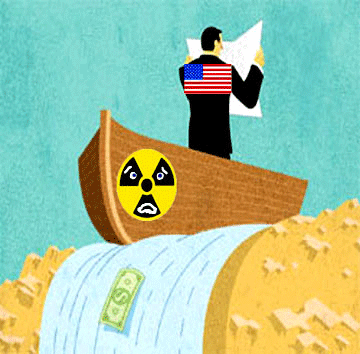 USEC’s flirtation with a non-nuclear Apocalypse has profound implications for the safe completion of power-down at Paducah, for the long-term cleanup of the contaminated sites that USEC will leave behind, for the well-being of a region that came to depend on the company’s draw of unproductive federal spending, and for the viability of the U.S. nuclear industry as a whole.
Uranium Titan Tumbles EcoWatch July 12, 2013 By Geoffrey Sea High drama hits the world of the former U.S. Enrichment Corporation as a shareholder rebellion drubs the company stock price, restructuring and bankruptcy rumors swirl, safety issues delay USEC’s departure from Kentucky, a “left-right” anti-USEC coalition of Non-Governmental Organizations emerges and charges of USEC’s direct involvement in illegality proliferate.
USEC used to be a world giant in the supply of nuclear fuel. Once wielding monopoly power over the domestic supply and international pricing of enriched uranium, its motto touts “A Global Energy Company,” even as USEC struggles with the expense of closing its last production facility in the non-metropolis of Paducah, Kentucky. (Metropolis is over the river in Illinois.)
But in a spectacular sell-off signaling bizarre irregularities in the way the company has been managed and subsidized, USEC Inc.’s stock price has tumbled in a pattern known to market analysts as a “falling knife.” Continue reading
Cost overruns racing away at Monticello nuclear plant
Monticello nuclear plant repairs surge $267 million over budget by: DAVID SHAFFER , Star Tribune July 15, 2013 The bill for upgrades to Monticello nuclear plant is expected to grow even more, which may affect utility’s rate hike request.MONTICELLO, MINN. – A major upgrade to Minnesota’s oldest nuclear power plant is finally finished — and way over budget.
Xcel Energy expects to restart its Monticello Nuclear Power Plant this week after a four-month shutdown that allowed workers to replace aging pumps and other equipment to keep the 43-year-old reactor running another two decades and to boost electric output by 12 percent.
But the cost of the work surged $267 million, or 83 percent, over its 2008 budget of $320 million. The Minneapolis-based electric and gas utility says the final costs will be even higher, but hasn’t publicly disclosed the amount.n the meantime, Xcel’s 1.2 million electric customers in Minnesota are being asked to pay for the cost overruns. This sort of nuclear-related expense is one of the major drivers behind Xcel’s requested rate hike that an administrative judge recently recommendedslashing to 4.7 percent. The Minnesota Public Utilities Commission will decide, probably this fall, how much more ratepayers will pay.
Utility officials declined to answer questions about the cost overruns, ……..
Just how much customers will have to bear remains unclear.
That’s partly because not all of the cost overruns have been disclosed. Under a state law, Xcel has classified its latest cost-overrun estimate as a “trade secret.” The estimate has been disclosed to regulators, however, and the Star Tribune last week petitioned to have it made public, but the PUC has not yet acted…….http://www.startribune.com/business/215458431.html
The disastrous history of U.S. Enrichment Corporation (USEC)
Despite public funding, no governmental process is contemplated for gathering or disseminating data on the commercial worthiness of USEC’s centrifuges, because that answer is already widely known: The technology at issue is forty years old and out of date…… doesn’t produce anything anymore and it never will
 the “American Centrifuge” project (ACP) was never more than a false front, a mechanism for wrangling government bailout after government bailout, while the rock-red company waited for a Republican administration that would approve its audacious waste storage plans.
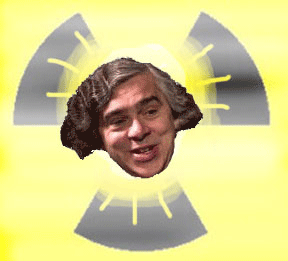 That team included Iraq War architect Richard Perle and a physics professor whose only claim to fame was in pushing centralized storage solutions for spent nuclear fuel. His name was Ernest Moniz. (left)
Uranium Titan Tumbles EcoWatch July 12, 2013 By Geoffrey Sea “……The Un-American Centrifuge Plant Created first as a government corporation in response to a mismanagement scandal at the U.S. Department of Energy (DOE) in the 1990s, USEC was privatized in 1998. The USEC Privatization Act, premised on delusional Thatcherite ideology, placed two solemn obligations on the respective parties in the split: The Department of Energy, though continuing to own the land and facilities with which USEC operates, had to stay out of the business of uranium enrichment; USEC, while free to conduct its business as a private corporation, had to use its free access to public land and resources to develop advanced uranium enrichment technology and improve the U.S. position in the global enrichment marketplace.
Now those statutory goals can only bring a ROFLMAO reaction. USEC has become a wholly-dependent ward of the Department of Energy, which effectively makes all the big “business” decisions that concern enrichment, and USEC has defaulted on any credible effort to deploy a domestic advanced enrichment technology. Yet the Privatization Act remains on the books, its provisions violated cavalierly but with no efforts at repeal, like metropolitan municipal laws about donkey carts and Sunday dancing.
The basic and shocking truth about USEC, Continue reading
Auditors shocked at rocketing costs for Uranium Processing Facility
 Auditors Slam Uranium Project’s Ballooning Expense http://news.yahoo.com/auditors-slam-uranium-projects-ballooning-expense-150204641.html Diane Barnes, Global Security Newswire 16 July 13, WASHINGTON –– When U.S. government contractors designing a $500 million nuclear-weapon facility last year said they would have to raise the roof, they didn’t exactly mean it was time to pump up the music.
An update to plans for the future Uranium Processing Facility at the Y-12 national security complex in Oak Ridge, Tenn., would increase its height by 13 feet — a move required for the building to hold all its intended contents. Problem was: officials offered no stab at how much the revision would cost.
The changes ended up costing well over half a billion dollars more, congressional auditors said last Friday. The site is to replace existing facilities that handle and store highly enriched uranium.
The Government Accountability Office blamed the additional $540 million price tag on a failure by the lead design firm to “adequately manage and integrate the design work” of four subcontractors. Construction of the building itself has not begun.
The unanticipated expense contrasted with a number of “overly optimistic assumptions” made by the National Nuclear Security Administration, which has overseen the project, and laid out in a 35-page GAO report.
The project’s maximum anticipated expense soared from $1.1 billion to $6.5 billion between 2004 and 2011, and the cost might increase further because the roof revision burned through nearly half of NNSA “contingency” funds. The nuclear weapons complex oversight agency — a semiautonomous branch of the Energy Department — “did not account for such a large sum of money being needed to address this risk,” the auditors said in their report to the Senate Appropriations Energy and Water Development Subcommittee.
The panel fears “NNSA will not be able to execute multiple, highly complex life-extension projects and construction projects concurrently under ambitious schedules,” lawmakers said in a report on spending legislation approved by the full committee in June.
The Energy Department last month informed Congress the facility will not start becoming operational until 2025, the Knoxville News Sentinelreported on Saturday.
Gloomy state of the nuclear industry – worst year ever
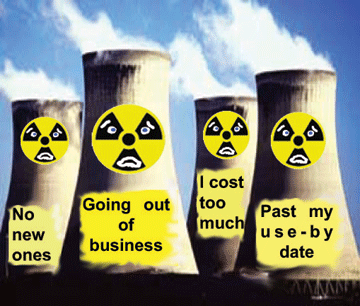 2012 Was the Worst Year Ever for Nuclear Energy the Motley Fool By Tyler Crowe, July 14, 2013 There are lots of nuclear energy companies that would like to leave 2012 behind. Of all the major energy sources, it was the only one that saw a global decline in total consumption. The decline in the United States was largely attributed to cheap natural gas, as it captured a much larger chunk of market share, while alternative energy options became more attractive. To compound the problem, the Fukushima Daiichi meltdown made several countries abroad rethink nuclear use. In Japan, 89% of all nuclear power was shut down as a result of the disaster.
So the question remains, where does nuclear go from here? The increasing attractiveness of solar and wind is going to make it harder and harder to justify using nuclear as a base-load power source, because the economics of doing so is not as attractive as that for natural gas or even coal…..
San Onofre nuclear plant – doomed by its new steam generators
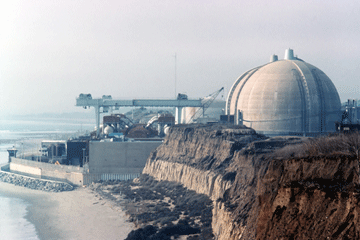 How San Onofre’s new steam generators sealed nuclear plant’s fate San Onofre’s replacement generators were supposed to extend the nuclear plant’s life and save money. The opposite ensued. LA Times, By Abby Sewell and Ken Bensinger July 13, 2013,
In March 2004, an attorney for Southern California Edisonsat before state utility regulators to propose what seemed like a great deal.
The San Onofre nuclear plant was approaching the end of its life span. But Edison wanted to invest $680 million in new steam generators, attorney Carol Schmid-Frazee told a judge presiding over a hearing at the California Public Utilities Commission’s San Francisco headquarters. The new equipment, she said, would give the 2,200-megawatt plant a new lease on life, providing cheap, reliable energy in Southern California for decades to come while also saving ratepayers nearly $2 billion.
Edison’s lawyer also issued an ominous warning: If regulators did not approve the upgrade, the plant would close, provoking “very serious problems with the California electric grid.”
The commission was persuaded, and Edison began remaking San Onofre.
But less than a year after the new steam generators came online, a tube in one of them sprang a radioactive leak, setting off a chain of events that ultimately led Edison to close the plant permanently…… http://www.latimes.com/news/local/la-me-07-14-san-onofre-tic-toc-20130714,0,5736015.story
Global renewable energy investment has risen rapidly in 2013
 Rise in global clean energy investment Renewable Energy Focus 12 July 2013 Global investment in clean energy in Q2 was up 22% from Q1, due to upturn in the financing of wind and solar projects and a 170% surge in equity funding for specialist companies on public markets.
The investment rose to US$53.1 bn, led by the US, which saw investment jump 155% compared to a weak first quarter, to reach US$9.5 bn, and China (up 63% at US$13.8 bn) and South Africa (up from almost nothing in Q1 to US$2.8 bn in Q2).
China was the largest investor in clean energy in Q2, followed by the US. Third on the list was Japan, Continue reading
Uranium price goes ever downward
Spot uranium prices about $39.50/lb with ‘downward’ bias: sources Washington (Platts)- Jim Ostroff -9 Jul2013 The spot price of uranium is around $39.50 a pound, unchanged from last Tuesday, but the ongoing weak demand for U3O8 indicates that prices are more likely to soften further than rise in coming weeks, according to price publisher Ux Consulting and market sources.
Ux, in its weekly report Monday, said the spot U3O8 price was $39.50/lb, unchanged from Friday, but that the market “could see further erosion as the month wears on.” It added, “The overall demand situation may not improve anytime soon,” noting it is unlikely “that Japanese reactors will see a surge in restarts in the near future.”
Ux on Monday reduced its daily Broker Average Price — based on information from Evolution Markets and Armajaro Securities — by 6 cents to $39.38/lb. The BAP bid-offer spread Monday was $39.00-$39.75/lb, with the bid down 13 cents and the offer unchanged from Friday…..”The bias still is to the downside a bit” in the uranium spot market, one market source said in an interview Tuesday. “There remains more supply than demand and nobody seems to be motivated on either side,” to conclude deals, he said. http://www.platts.com/latest-news/electric-power/washington/spot-uranium-prices-about-3950lb-with-downward-21262350
Uranium Processing Facility in Tennessee getting even further behind schedule
Oak Ridge uranium project even more behind schedule than it used to be http://www.abqjournal.com/main/219488/blogs/nm-science/oak-ridge-uranium-project-even-more-behind-schedule-than-it-used-to-be.html By John Fleck / Journal Staff Writer on Wed, Jul 10, 2013
[T]he Department of Energy’s Stockpile Stewardship and Management Plan states that the First Phase of the Uranium Processing Facility project will be completed in 2025, which indicated a rather significant delay from previous reports that — just a couple of years ago — had the entire project completed before then. The First Phase is focused on moving the operations now housed in the 9212 uranium processing complex at the Y-12 nuclear weapons plant in Oak Ridge. Phases Two and Three, incorporating the work now done in Y-12′s 9215 building and 9204-2E (Beta-2E), would not be completed until around 2038.
The National Nuclear Security Administration, in a response to earlier questions about the plan, this week confirmed the schedule in the Stockpile Stewardship report as being the most up-to-date assessment of the work plan for the multibillion-dollar project.
Nuclear industry executives realise that their business is in decline
 Nuclear power faces uncertain future The shifting economics of energy and Japan’s Fukushima disaster may have squashed the industry’s attempted comeback. Jonathon Berr, MSN Money, 7 July 13, About a decade or so ago, many Americans were talking about a “Nuclear Renaissance.” The public’s unease about the industry, which dated at least as far back as the 1979 Three Mile Island accident, had begun to fade and new nuclear power plants were being proposed in the U.S. for the first time in decades…..Now, though, optimism surrounding nuclear energy is slipping away, even as President Obama has vowed that 80% of America’s electricity will come from renewable resources by 2035 to reduce greenhouse gas emissions……. Continue reading
Unsafety at Brown’s Ferry nuclear plant, and a whistleblower’s case
 For Johnson, speaking out has had consequences, as she said she ran up substantial legal bills without expectation of a resolution with TVA. But she became more concerned about the costs of not speaking out.
“I found myself in the position of becoming a whistleblower when TVA management altered root cause reports I authored to subdue their findings,” she said last week. “I hope that bringing this story to public light will force TVA to address the safety significance of altering the findings of teams of engineers and experts for the sake of protecting production and their own bonuses.”
 Browns Ferry: Shrinking the safety margin at Alabama’s largest nuclear plant By Challen Stephens and Brian Lawson, All Alabama 7 July 13
What federal regulators have said in recent years:
• Browns Ferry received a red finding, the federal government’s most serious warning  before shutdown.
• Browns Ferry failed to notice a blocked low-pressure cooling line.
• Inspectors discovered wider problems with safety culture at Browns Ferry.
What a search of TVA and Nuclear Regulatory Commission documents also shows:
• The backup low-pressure line also malfunctioned.
• The high-pressure core spray was installed incorrectly.
• The Unit 1 reactor operated for years with overlapping, malfunctioning emergency cooling systems.
What a whistleblower alleges, and paperwork supports:
• TVA ignored or obscured failing safety tests for malfunctioning equipment.
• TVA hurried to install equipment based on managerial bonuses.
What TVA acknowledges in their own paperwork:
• The plant operated for years with a bias toward power production over safety. Continue reading
The dimming prospects for the nuclear industry
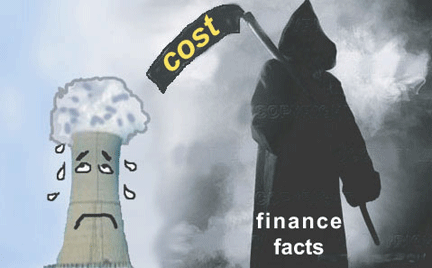 Exelon, which bills itself as the nation’s “largest competitive power generator,” cited “low natural gas prices and economic and market conditions” that make nuclear construction uneconomical “now and in the foreseeable future.”
Was nuclear the right decision for SCE&G?, Post and Courier, dDoug Pardue, 7 July 13 “…….Ratepayer outrage Robert Johnston buys none of SCE&G’s promise of the billions of dollars in long-range savings from nuclear power.
Johnston is not your normal disgruntled ratepayer. He’s chief strategy officer and executive vice president at The InterTech Group Inc., a North Charleston-based manufacturing conglomerate that also invests in utilities.
Johnston turned rate protester in 2010 when SCE&G tried to win approval for a 10 percent rate increase amid the recession. Johnston helped InterTech make its headquarters building mostly solar-powered, and he added a false roof to his Isle of Palms home so he could place enough solar panels to make his house energy independent.
His monthly electric bill is no longer $400. It’s $9.79. “I’ve effectively fired SCE&G,” he said And that’s what he’d like everyone to do. Continue reading
Dodgy tax deals by uranium companies in Africa: Paladin under investigation
Advocacy group ActionAid claims poor countries are losing more than $130 billion in tax revenues a year by giving generous tax breaks to big companies, including Australian miners. There are about 240 Australian mining companies with operations in Africa.
Perth-based uranium miner Paladin Energy, came under scrutiny for its tax arrangements in Malawi where it runs a mine in Karonga. A report by the group Norwegian Church Aid alleges there are discrepancies between Paladin’s reported tax and its tax paid. It also alleges other payments by Paladin in Malawi are lower than the company reports.
Paladin has subsidiaries registered in Mauritius and the British Virgin Islands, both tax havens. Last year’s annual report showed the company accumulated losses that mean it will need to make profits totalling $208 million in Australia before paying any tax.
 Tax man takes scalpel to energy and resources firms http://www.theage.com.au/national/tax-man-takes-scalpel-to-energy-and-resources-firms-20130705-2phat.html July 6, 2013 Georgia Wilkins The Tax Office will open 60 cases of suspected tax dodging by Australian and international companies amid global pressure to crack down on profit shifting.
The investigations will add to the 26 cases of offshore restructuring already under review  by the government body.
Under scrutiny are companies that deliberately restructure their business to route profits through low-tax jurisdictions or tax havens to avoid paying higher taxes in Australia, often through the use of post box companies or marketing hubs that have little real substance. Continue reading
Germany’s Chancellor Merkel got it right, on switch from nuclear to renewables
 Nuclear Cuts Vindicate Merkel as RWE Profit Dips, Bloomberg By Julia Mengewein – Jul 5, 2013 Germany’s $710 billion green-energy drive is cutting production at nuclear reactors, the nation’s most profitable large-scale plants, as power prices slump to a six-year low. The proportion of hours during which electricity traded at less than 30 euros ($39) a megawatt-hour, the level at which UBS AG says reactors start losing money, rose to 50 percent last month, the most since 2007 and 92 percent more than a year ago, data from the Epex Spot SE exchange show. RWE AG (RWE) cut output at its Gundremmingen plant near Munich 31 times in the first half as solar and wind output jumped, compared with 18 times in 2012, according to data compiled by Bloomberg.
The reductions, which typically last for hours at a time, underscore how Chancellor Angela Merkel’s plan to replace atomic power with renewable energy within a decade is gaining ground at the expense of profit at utilities from RWE to EON SE. The boom in green power, coupled with the lowest demand in 10 years, sent the average operating margin at 15 European utilities to the lowest since 2002, company data compiled by Bloomberg show.
“We will see more of those situations where renewable output is so high, that spot prices collapse below the level of the cash costs for nuclear plants,” Patrick Hummel, an analyst at UBS in Zurich, said July 2 by e-mail. “This really is a double-whammy for power producers. Fewer running hours means less power is sold and that happens at a lower price.”….. Continue reading
1 This Month





PLEASE OPPOSE HR 8255 AND S.3639 – bills would accelerate satellite deployment, with no environmental review or safeguards – https://ncstd5li.quorum.us/campaign/169331/
To see nuclear-related stories in greater depth and intensity – go to https://nuclearinformation.wordpress.com
-
Archives
- October 2026 (10)
- September 2026 (339)
- August 2026 (330)
- July 2026 (355)
- June 2026 (287)
- May 2026 (306)
- April 2026 (356)
- March 2026 (251)
- February 2026 (267)
- January 2026 (308)
- December 2025 (358)
- November 2025 (359)
-
Categories
- 1
- 1 NUCLEAR ISSUES
- business and costs
- climate change
- culture and arts
- ENERGY
- environment
- health
- history
- indigenous issues
- Legal
- marketing of nuclear
- media
- opposition to nuclear
- PERSONAL STORIES
- politics
- politics international
- Religion and ethics
- safety
- secrets,lies and civil liberties
- spinbuster
- technology
- Uranium
- wastes
- weapons and war
- Women
- 2 WORLD
- ACTION
- AFRICA
- Atrocities
- AUSTRALIA
- Christina's notes
- Christina's themes
- culture and arts
- Events
- Fuk 2022
- Fuk 2023
- Fukushima 2017
- Fukushima 2018
- fukushima 2019
- Fukushima 2020
- Fukushima 2021
- general
- global warming
- Humour (God we need it)
- Nuclear
- RARE EARTHS
- Reference
- resources – print
- Resources -audiovicual
- Weekly Newsletter
- World
- World Nuclear
- YouTube
-
RSS
Entries RSS
Comments RSS

