Another $5 billion borrowed by Japan for Fukushima nuclear cleanup
Japan readies additional $30 billion for Fukushima clean-up: sources BY YOSHIFUMI TAKEMOTO TOKYO Tue Nov 12, (Reuters) – Japan’s government is finalizing plans to borrow an additional 3 trillion yen ($30 billion) to pay for compensating Fukushima evacuees and cleaning up the area outside the wrecked nuclear plant, said people with knowledge of the situation.
The additional borrowing would mark both a recognition of the project’s mounting costs and the difficulty of hitting initial targets for reducing radiation levels in the towns and villages hardest hit by the fallout from the worst nuclear accident since Chernobyl.
The new government borrowing program would increase the amount earmarked for Fukushima-related expenses to the equivalent of just over $80 billion, according to government officials with knowledge of the developing plan who asked not to be named.
That $80 billion excludes the cost of decommissioning Fukushima’s six reactors, a process expected to take decades.
The new funding, which is being reviewed as part of the regular budget-setting process, would increase the amount earmarked for paying for work crews to decontaminate Fukushima towns and villages by about $500 million, according to the sources.
The rest of the extra funding raised by the government would be used to defray the cost of creating a storage facility for the radioactive waste, including topsoil and leaves collected from the evacuated zone, and would be available to pay compensation to more than 50,000 nuclear evacuees who remain shut out of their homes more than two and a half years after a massive earthquake and tsunami in March 2011 triggered meltdowns and explosions at the Fukushima plant…… http://in.reuters.com/article/2013/11/12/us-japan-fukushima-borrowing-idINBRE9AB0H520131112
South Korea could find nuclear power much more costly
Nuclear power could be more costly than thought, The Hankyorheh, S. Korea, : Nov.12,2013 Analysis shows that if full range of costs is factored in, nuclear energy is not as low-cost an option as the gov’t says By Hwangbo Yeon, staff reporter
A newreport suggests that nuclear power would lose its price competitiveness if taxes on power sources like coal and liquefied natural gas (LNG) were collected more fairly and costs of transmission grid construction and social risks were assessed.
If such a price structure is realized, it stands to undermine claims of the superior cost-effectiveness of nuclear power, which the government has used to argue for its expansion.
The report on a price recalculation scenario for different power generation facilities was presented at a recent Power Industry Research Association seminar by Hanbat National University professor Cho Young-tak…….
The cost-effectiveness reversal becomes even more conspicuous when nuclear power accident risk costs and price variations from the introduction of shale gas are also factored in. The price of nuclear power rises from as low as 95 won to as much as 143 won when conditions such as damage payment costs (based on the compensation levels for the Fukushima Daiichi Nuclear Power Plant disaster in Japan) and a 25% drop in gas import costs due to shale gas are taken into account. This range is well ahead of the 88-102 won for coal and 92-121 won for LNG.
Nuclear power ” Very Disappointing “ – economists
 EdF’s major shareholder, the French government, is looking to reduce the share of nuclear in France’s generation to around 50 per cent from more than 70 per cent, and intends to fill that hole with (cheaper) renewables.
EdF has effectively handballed the risk of new nuclear to consumer and the UK government. The consumer is picking up the tab through higher electricity bills, and the UK government is using taxpayers money to guarantee 65 per cent of the project cost.
 Nuclear Energy Verdict:” Very Disappointing “ Clean Technica, Giles Parkinson, 112 Nov 13 (very good graphs, diagrams) …..we have received an analysis from Deutsche Bank, which makes some other observations about the cost of nuclear, the comparisons with gas, the price of abatement, and the cost of upkeep for France’s existing fleet.
The first point made by Deutsche is that this deal underlines the fact that nuclear is not cheap, but really, really expensive – a point that should not be forgotten in Australia, where there is still a push for nuclear in some quarters despite the abundant alternatives (in particular solar) that are not available to the UK.
As we have noted in the other article, the £92.50/MWh strike price is nearly double the current average cost of generation in the UK. Deutsche takes issue with the UK government’s claim that the contract is “competitive with other large-scale clean energy and with gas’. Continue reading
Consortium cleaning up Sellafied radioactive mess has been wildly over-spending
Sellafield nuclear complex clean-up contract winner criticised on spending Margaret Hodge and KPMG, working for the Nuclear Decommissioning Authority, accuse group of overspending Terry Macalister The Guardian, Saturday 9 November 2013 A five-year extension to the Sellafield nuclear decommissioning contract worth £5bn was handed to a private consortium even though its performance had been fiercely criticised by accountants.
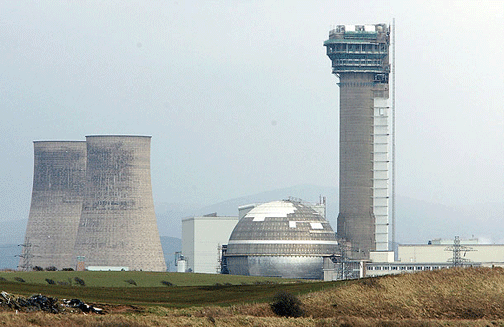 KPMG, working for the Nuclear Decommissioning Authority, accused the clean-up group of overspending, failure to reach operational targets and weak leadership at the atomic complex in Cumbria, according to documents seen by the Guardian.
Margaret Hodge, who chairs the parliament’s public accounts committee, said that in the light of the critical review it was “inexplicable” that the NDA was prepared to reward the Nuclear Management Partners (NMP) consortium for spending cash “like confetti”.
She also complained the critical KPMG report was not shown to her committee or the National Audit Office until the last minute. It had only been sent to the spending watchdogs via a member of the public who conducted a freedom of information request. “But having looked at the report it is inexplicable that the NDA would continue with this consortium after such a hugely critical assessment,” she added.
The NMP decommissioning consortium comprises Areva, the French engineering firm that is also working on the new Hinkley Point power station, in Somerset, which also includes URS of the US and Amec of Britain.
KPMG says it went through 28 out of 154 “bid commitments” at Sellafield and found 30% were deemed fully achieved and 4% partially achieved. KPMG added: “There is still considerable uncertainty in schedules and costs of the projects that account for 26% of annual spending” while the site manager “does not bear risks for delays and cost increases”.
There had been widespread speculation that the consortium would either see the renewal time shortened or be stripped of the work, which would be handed back to the public sector. But the decommissioning authority nevertheless gave the go-ahead to a further five years in October….http://www.theguardian.com/politics/2013/nov/08/sellafield-nuclear-margaret-hodge-kpmg-overspending
No, Pandora, the slump in nuclear energy is due to economics, not anti-nuclear protestors
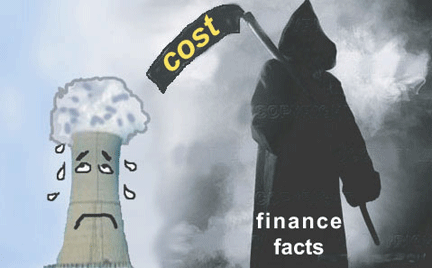 Most of the new plants announced with such enthusiasm have been cancelled or deferred indefinitely. Those that have commenced construction have run over time and over budget, exactly as happened in the last big nuclear boom of the 1970s.
the fact that the world has not turned to nuclear power as a solution to climate change is a matter of economics. much of the current demand for “baseload” power is an artifact of pricing systems designed for coal, and may disappear as prices become more cost-reflective.
 Reviving nuclear power debates is a distraction. We need to use less energy, The Guardian, John Quiggin, 8 Nov 13 The documentary Pandora’s Promise presents an environmentalist case for nuclear power. But why has the world has not turned to it as a solution? It’s a matter of economics There’s been a lot of buzz recently about a new film by controversialist documentary-maker, Robert Stone, Pandora’s Promise…..
The only surprising thing about this film is the release date. The makers and participants are apparently unaware that the rest of the world had this debate 10 to 15 years ago, and that, for the most part, the advocates of nuclear power were victorious. Environmentalists largely abandoned anti-nuclear campaigns and focused their energy on attempts to reduce the use of fossil fuels, and promote energy efficiency and renewable energy sources. While most environmentalists remained sceptical of, or opposed to, nuclear power, the end of active opposition paved the way for a range of pro-nuclear policy initiatives….. Continue reading
USA nuclear plants likely to be shutting down in a ‘domino effect’
 6 Nuclear Plants That Could Be Next To Shut Down Forbes, 7 Nov 13 “…..“In the last year, U.S. utilities have closed or announced plans to close five nuclear reactors in addition to the canceled development plans,” according to Morningstar’s Utilities Outlook for November, “leading to speculation that prolonged low gas prices could drive more plant closures given the high maintenance capital investment requirements.”Below is a list of operating nuclear plants that Morningstar analysts believe are most exposed to the possibility of closure. The list does not include disabled plants, like Fort Calhoun in Nebraska, that are offline and may never reopen. And it does not include plants already scheduled for closure, like Exelon’s Oyster Creek plant in New Jersey.
1. Indian Point: Less than 50 miles north of Manhattan, the reactors at Entergy’s Indian Point Energy Center face a tough political fight for relicensing. One license has expired, and that reactor is operating under an allowance from the Nuclear Regulatory Commission. Another license is due to expire in 2015. New York Gov. Andrew Cuomo opposes relicensing. Outgoing New York Mayor Michael Bloomberg has defended the plant, based on the impact closure could have on New Yorkers’ electric bills. Mayor-elect Bill DeBlasio has called for a gradual decommissioning as alternative power sources come online, which isn’t how the process works. Ultimately, the decision rests not with local officials, but with the NRC.
2. Ginna Nuclear Generating Station: On the south shore of Lake Ontario near Rochester, NY, Ginna is a single-reactor plant that faces fresh competition from wind turbines, falling power prices, and, like Indian Point, a political climate hostile to nuclear reactors. “Upstate New York off-peak power prices have fallen to $32 per megawatt hour as of mid-2013 from $55/MWh in 2008,” according to Morningstar. Ginna is owned jointly by Exelon and Électricité de France.
3. James A. Fitzpatrick Nuclear Power Plant: Another plant on the south shore of Lake Ontario in New York, FitzPatrick faces the same challenges as Ginna, but it’s also an older boiling-water reactor that may need upgrades. “Fitzpatrick’s operating license expires in 2034, but its revenue-sharing agreement with the New York Power Authority expires in December 2014, and unfavorable contract renewal negotiations could lead Entergy to shut the plant.”
4. Three Mile Island: Most of the shale gas boom in America is happening in the Marcellus region of Western Pennsylvania, according to the Energy Information Agency, which means Exelon’s infamous Three Mile Island plant now has to compete with an abundance of gas never before seen in its lifetime. Several large, high-efficiency gas power plants are planned for the region.
5. Davis Besse Nuclear Power Station: FirstEnergy’s plant near Toledo is not far from the Marcellus Shale formation and all that cheap natural ga. After Indian Point, it’s the next power plant up for license renewal— in 2017. “We expect strong opposition from some parties,” says Morningstar. “It has a tarnished reputation after an extended outage in 2002-04 due to corrosion in the reactor vessel head and several smaller issues since then.”
6. Pilgrim Nuclear Generating Station: Entergy’s Pilgrim plant in Plymouth, Mass., just survived a contentious license renewal process and was granted a new lease on life through 2032. But it may not survive the energy economy in which it now must compete. “Entergy is not obligated to operate it for that long and could exit if power prices sink much further,” Morningstar says. The old boiling water reactor is more expensive to operate than newer designs.
Reactors recently closed or scheduled for closure:
- Vermont Yankee, Vermont
- San Onofre, California
- Kewaunee, Wisconsin
- Crystal River, Florida
- Oyster Creek, New Jersey….. http://www.forbes.com/sites/jeffmcmahon/2013/11/07/6-nuclear-plants-that-may-be-next-to-shut-down/
Uranium workers unhappy with safety arrangements
A Fridge Full of Uranium for Honeywell Employees, In These Times, BY MIKE ELK 7 Nov 13 On Monday, a Nuclear Regulatory Commission (NRC) team arrived at Honeywell’s Metropolis, Ill., uranium conversion plant to do a routine weeklong inspection. Recently, workers at the plant have alleged that the employee refrigerator in the control room of the main processing building has repeatedly tested positive for dangerous levels of uranium.
But because Honeywell will not allow a qualified union worker to accompany NRC representatives on their inspections if the workers are on layoff, the union claims that the company is putting them and the local community at risk.
During the last few years, the plant has faced problems with federal authorities over a series of safety issues. In March 2011, after an investigation by the Environmental Proection Agency (EPA), Honeywell pleaded guilty to one felony offense for knowingly storing hazardous radioactive waste without a permit in violation of the Resource Conservation and Recovery Act (RCRA)” and paid an $11.9 million fine to the federal government. Two months later, OSHA officially cited the company for 17 serious violations for the accidental release of toxic hydrogen fluoride (HF) gas directly into the atmosphere outside of the plant in December 2010.
Members of United Steel Workers Local 7-699, which represents workers at the Metropolis plant, claim that having a specifically designated worker present during inspections was the key to at least some of the company’s citations in 2011. The plant, workers say, is large and complex. Though inspectors are highly trained, they may miss small but crucial details during their visits. Union representatives, they say, can point out problems known to workers that regulatory officials may otherwise overlook.
So when workers found out that the union’s elected representative, USW Local 7-699 President Stephen Lech, would not be allowed to go on the NRC inspections because he is on what the union labels a “punitive” layoff, they were outraged. As union president, they say, Lech talks to more members of the union and has a more in-depth knowledge of safety issues than anyone else…….http://inthesetimes.com/working/entry/15848/honeywell_employees_west_texas_regulation_uranium_fridge/
Low morale amongst Fukushima’s cut price nuclear clean-up workers
Fukushima: Japan’s Cut-Price Nuclear Cleanup: Human Error, Plummeting Morale and Worker Exodus 福島は割引清掃 By Global Research News Global Research, November 04, 2013
The Asia-Pacific Journal, Vol. 11, Issue 43, No. 2, October 28, 2013. TEPCO woes continue amid human error, plummeting morale and worker exodus By Justin McCurry and David McNeill reporting from Fukushima
During a visit to Fukushima Daiichi in September, Abe Shinzo told workers: “the future of Japan rests on your shoulders. I am counting on you.”
The prime minister’s exhortation was directed at almost 6,000 technicians and engineers, truck drivers and builders who, almost three years after the plant suffered a triple meltdown, remain on the frontline of the world’s most hazardous industrial cleanup.
Yet as the challenges facing Fukushima Daiichi become clearer with every new radiation leak and mishap, the men responsible for cleaning up the plant are suffering from plummeting morale, health problems and deep anxiety about the future. Even now, at the start of a decommissioning operation that is expected to last four decades, the plant faces a shortage of workers qualified to manage the dangerous work that lies ahead, according to people with firsthand knowledge of the situation inside the facility. Continue reading
Nuclear power – the costly ‘renaissance’ that went awfully wrong
“The fundamental problem was the renaissance was always economically unsound,” Bradford said. “There was never a point in time at which private investors were prepared to back new nuclear. There were just too many things that could go wrong.”
“The problem with using nuclear as an answer to climate change is it’s so much more expensive than other potential answers,” Bradford said. “It’s like building palaces to solve a housing shortage, or using caviar to solve world hunger.”
The ‘nuclear renaissance:’ What went wrong? By Matt Smith, CNN 6 Nov 13“…….Not long ago, nuclear energy seemed poised to start a much-touted renaissance in the United States. Buoyed by forecasts of increased demand, utilities were gearing up to start building the first new reactors since the 1970s. Concerns about the emissions from carbon-rich fossil fuels blamed for global warming started to offset public fears about safety that had lingered since the Three Mile Island accident in 1979. But since then, the industry has seen a dramatic reversal of fortune. And while some environmentalists, now argue that nuclear power is needed to head off climate change, the market has become a hostile place. Continue reading
Uranium project in trouble – will apply for $2 billion govt loan
Uranium project faces more money quandaries Politico, By DARIUS DIXON | 11/6/13
A major project aimed at maintaining the nation’s ability to enrich its own uranium may soon find itself in another cash crunch.
USEC, the company behind the American Centrifuge Project, said Tuesday that it will enter a period of fiscal uncertainty after the end of the year, when it’s scheduled to finish a cost-share agreement with the Energy Department aimed at demonstrating the project’s technology. The company plans to reapply for a $2 billion loan guarantee from the agency as early as December, but that will leave a gap when USEC may not have the money to keep working on the Ohio project while DOE studies the application.
“In light of our liquidity, we do not have the ability to continue to fund ACP at its current levels beyond the end of 2013 without additional government support,” USEC President and CEO John Welch said Tuesday on a call with investors. “Even with their support, our ability to provide funding in 2014 will be limited.”
He said the company “could make a decision to demobilize or terminate the project in the near term.”…….
“In light of our liquidity, we do not have the ability to continue to fund ACP at its current levels beyond the end of 2013 without additional government support,” USEC President and CEO John Welch said Tuesday on a call with investors. “Even with their support, our ability to provide funding in 2014 will be limited.”
He said the company “could make a decision to demobilize or terminate the project in the near term.”
: http://www.politico.com/story/2013/11/uranium-project-faces-more-money-quandaries-99407.html#ixzz2jzXqnI26
Uranium miner at Grand Canyon halting, due to poor uranium market
Work for uranium mine near Grand Canyon hits pause Arizona Daily Star, 7 Nov 13 The Associated Press FLAGSTAFF — A uranium mining company that was sinking a shaft for a mine south of Grand Canyon National Park has put the work on hold, citing market conditions and the expense of litigation. Energy Fuels Resources Inc. said the operation will be on standby until December 2014 or until a ruling is issued in a federal case challenging the U.S. Forest Service’s decision to allow development of the Canyon Mine near Tusayan. The company had planned to start extracting 83,000 tons of ore to produce 1.6 million pounds of processed uranium, or yellow cake, in 2015 but now will have to re-evaluate the timeframe….
….Prices for uranium have dropped to the mid-$30s per pound on the spot market, among the lowest in the past five years. http://azstarnet.com/ap/state/work-for-uranium-mine-near-grand-canyon-hits-pause/article_643f8e19-f2a1-565e-ad6b-7acb0ac2a625.html
Russia wants to subsidise Armenian nuclear power plant
 Russia Offers to Subsidize Nuclear Plant Asbarez.com, 6 Nov 13YEREVAN (Arka)—Russia is ready to finance 35 percent of the cost of construction of a new power unit for Armenia’s nuclear power plant, Vahram Petrosyan, the secretary of a presidential council on nuclear power safety, said today……On September 3, Russian president Putin said experts from Russian state nuclear company Rosatom and Armenian experts will work to extend the service life of the Armenian nuclear power plant in Metsamor for another 10 years until 2026.
Petrosyan said the extension of the service life of the facility requires at least $150 million……
he governments of the Republic of Armenia and the Russian Federation will soon sign an agreement on cooperation in the area of nuclear safety, the President said. The agreement will allow Armenia to:
– develop infrastructure for nuclear safety in preparation for the construction of new energy units based on Russian designs.
– train, re-train and upgrade specialists of nuclear safety, taking into consideration IAEA recommendations.
– expand the framework of cooperation in nuclear energy…….http://asbarez.com/115886/russia-offers-to-subsidize-nuclear-plant/
Mandatory disaster insurance for nuclear power, proposed at European Union
 EU seeks nuclear power disaster insurance plan http://www.miamiherald.com/2013/11/05/3732827/eu-seeks-nuclear-power-disaster.htmlTHE ASSOCIATED PRESS 5 NOV 13 BRUSSELS – The European Commission’s energy chief says the bloc’s executive arm will present a proposal on mandatory disaster insurance for nuclear power plants in coming weeks.

Guenther Oettinger said Tuesday the proposal should be one of the first items on the European Parliament’s agenda following elections in May. He declined to elaborate.
The world’s nuclear power plants have hardly any coverage. Governments implicitly guarantee they’ll pay for the bulk of a disaster.
In several EU nations, required insurance only covers liabilities of a few hundred million dollars, while a worst-case scenario accident is estimated to cost up to hundreds of billions. In the U.S., the necessary insurance for nuclear operators is capped at just $375 million per plant, with further claims funded by utilities up to a maximum of $12.6 billion.
As far as the market goes, nuclear power is finished
Nuclear Prices Itself Out Of The Market — Graph, Clean Technica 6 Nov 13, Originally published on RenewEconomy The extent to which nuclear is being priced out of electricity markets has finally been revealed by the pricing mechanism unveiled by the British government in the deal to subsidise the Hinkley C nuclear.
The UK government will pay £92.5 for each megawatt hour produced from hinkley ($A154/MWh), around double the prevailing market price. This is after the UK supplied a loan guarantee for 65 per cent of the estimated $24 billion capital cost. The “strike price” – a fancy name for a feed in tariff – also has an escalator to take into account the impact of inflation, so the cost will rise in coming years.
So how does this compare with rival clean energy technologies? Pretty badly as it turns out.
This graph below, published by Craig Morris in Renewable Energy World reveals that the rates that will be offered for new nuclear from 2023 in the UK are far above what solar and wind currently cost. And, as Morris points out, the rates for solar and wind will go down by then, not up! Even offshore wind is getting £95/MWh from 2018 in the UK, but only for 15 years and without any loan guarantees.
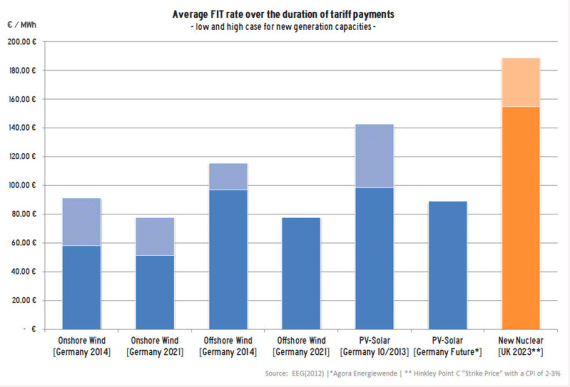
This second graph below is even more interesting. It takes into account all the expensive PV that was installed with really high feed in tariffs at the start of Germany’s energy transition before the price of solar fell dramatically. From 2023, when the Hinkley reactor is due to be switched on, nuclear at this price still fairs poorly, and as the cost of those tariffs continue to decline, the cost of nuclear will continue to rise. It’s probably as good an illustration as any as to why Germany are not interested in new nuclear power station, and few countries are.
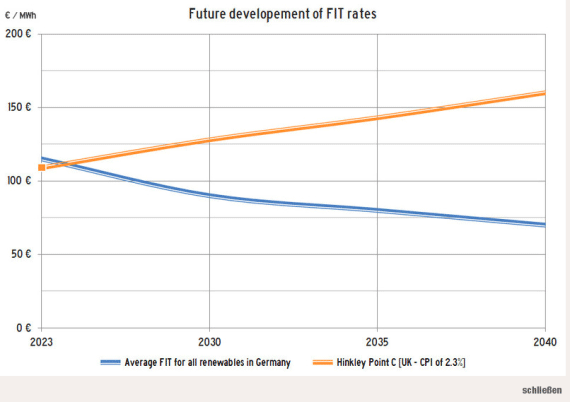
Read more at http://cleantechnica.com/2013/11/05/nuclear-prices-market-graph/#eaoQsOJd4EMOXHqk.99
Japan, USA, France, (not India) gain from nuclear sales to India
India shouldn’t buy what Japan is selling, Live Mint, 4 Nov 13, Materials of substandard quality have already been installed in Kudankulam plant, says former chairman of AERB Pankaj Mishra ……… there are also broader political and economic compulsions behind the new proliferation of nuclear technologies.Japan’s conservative leaders want to preserve their nuclear option, even if that risks provoking South Korea and a devastating arms race in north Asia. Worried by Japan’s unused plutonium supply, the US, as the Wall Street Journal reported in May, is pushing to restart nuclear reactors in Japan.

1 This Month





PLEASE OPPOSE HR 8255 AND S.3639 – bills would accelerate satellite deployment, with no environmental review or safeguards – https://ncstd5li.quorum.us/campaign/169331/
To see nuclear-related stories in greater depth and intensity – go to https://nuclearinformation.wordpress.com
-
Archives
- October 2026 (10)
- September 2026 (339)
- August 2026 (330)
- July 2026 (355)
- June 2026 (287)
- May 2026 (306)
- April 2026 (356)
- March 2026 (251)
- February 2026 (267)
- January 2026 (308)
- December 2025 (358)
- November 2025 (359)
-
Categories
- 1
- 1 NUCLEAR ISSUES
- business and costs
- climate change
- culture and arts
- ENERGY
- environment
- health
- history
- indigenous issues
- Legal
- marketing of nuclear
- media
- opposition to nuclear
- PERSONAL STORIES
- politics
- politics international
- Religion and ethics
- safety
- secrets,lies and civil liberties
- spinbuster
- technology
- Uranium
- wastes
- weapons and war
- Women
- 2 WORLD
- ACTION
- AFRICA
- Atrocities
- AUSTRALIA
- Christina's notes
- Christina's themes
- culture and arts
- Events
- Fuk 2022
- Fuk 2023
- Fukushima 2017
- Fukushima 2018
- fukushima 2019
- Fukushima 2020
- Fukushima 2021
- general
- global warming
- Humour (God we need it)
- Nuclear
- RARE EARTHS
- Reference
- resources – print
- Resources -audiovicual
- Weekly Newsletter
- World
- World Nuclear
- YouTube
-
RSS
Entries RSS
Comments RSS

