EDF has passed UK nuclear costs on to the British taxpayer

 Deutsche Bank notes that EdF has effectively handballed the risk of new nuclear to consumer and the UK government. The consumer is picking up the tab through higher electricity bills, and the UK government is using taxpayers money to guarantee 65 per cent of the project cost. With the involvement of Chinese nuclear interests, that leaves EdF with an exposure of just £3.5 billion. http://reneweconomy.com.au/2013/nuclear-part-2-36006

Japan’s taxpayers to cop huge expense in fukushima radiation clean-up
 State to spend over ¥1 trillion of taxpayer money for Fukushima decontamination work http://www.japantimes.co.jp/news/2013/11/02/national/state-to-spend-over-%C2%A51-trillion-of-taxpayer-money-for-fukushima-decontamination-work/?utm_source=rss&utm_medium=rss&utm_campaign=state-to-spend-over-%25c2%25a51-trillion-of-taxpayer-money-for-fukushima-decontamination-work#.Unli23Bwo7o KYODO NOV 2, 2013
In a major policy shift, the government will use more than ¥1 trillion in public funds to clean up contaminated areas around the Fukushima No. 1 plant, according to sources.
The plan revealed Friday to alleviate the financial burden Tokyo Electric Power Co. was supposed to shoulder is in line with a ruling Liberal Democratic Party proposal compiled Thursday on ways to accelerate the sluggish recovery from one of the world’s worst nuclear crises.
Tepco is still expected to stump up to some ¥3 trillion because the government has no intention of exempting it from decontamination payments that have already been planned by the state and local governments.
The central government, for its part, plans to use taxpayers’ money to respond to additional decontamination needs for infrastructure restoration, such as cleaning schools, parks and other public facilities that have been left to go to seed after residents fled from their homes. It will also use public funds to build interim storage facilities to keep radioactive soil and other waste from the cleanup efforts.
The Environment Ministry has earmarked a total of ¥1.5 trillion for radioactive decontamination through fiscal 2013, ending next March, and has asked Tepco to pay back ¥40 billion of the funds it has so far used. But the utility has only returned ¥6.7 billion, citing delays in clerical work and tough business conditions.
Tepco is struggling amid soaring costs for fuel imports to boost thermal power generation to cover the loss of all its nuclear plants. It also needs funds to compensate people and companies affected by the nuclear crisis and to decommission the crippled reactors of the Fukushima No. 1 plant.
TEPCO struggles with plans to avoid bankruptcy
Japan’s Fukushima operator mulls overhaul to counter break-up plans http://in.reuters.com/article/2013/11/04/japan-fukushima-tepco-reorganisation-idINL2N0IP09C20131104 By Yoshifumi Takemoto and Kentaro Hamada TOKYO | Mon Nov 4, 2013 (Reuters) – The operator of Japan’s wrecked Fukushima nuclear plant is working on a reorganization plan to fend off more drastic proposals, including possibly dragging the company through bankruptcy in return for a publicly funded clean-up and shutdown of the reactors. Continue reading
Big corporations increasingly investing in renewable energy
 Why corporations like Microsoft are investing in renewable energy Microsoft joins the growing ranks of firms – including Walmart, Google and Ikea – that are investing in renewable energy. Do these deals make good business sense? Ucilia Wang theguardian.com, Tuesday 5 November 2013 In a move that underlines the growing appeal of corporate investment in renewable energy, Microsoft announced Monday that it will power one of its data centers with electricity from a Texas wind farm.
The software giant has agreed to buy all of the output from the 110MW wind farm for 20 years. The project, to be built by RES Americas, will send electricity into a local grid that serves a Microsoft data center in San Antonio. Construction is set to start next year and be completed in 2015……..
as the wind and solar markets grow, thanks in large part to federal and state tax breaks and other subsidies, the cost of building and owning renewable-energy projects – along with the price of renewable energy – has steeply declined. The average long-term price for wind power to US utilities plummeted to $40 per megawatt-hour, in 2012 contracts, from $70 per megawatt-hour in 2009, according to Lawrence Berkeley National Laboratory report.
Meanwhile, the marketing benefit of investing in renewables remains strong. Buying wind power or owning wind farms, for example, represents a deeper commitment to fighting climate change than simply buying credits. ….. Continue reading
Japan’s Prime Minister energetically marketing nuclear reactors to Asia and Middle East
 Under Abe, the government has also agreed to start discussing a nuclear energy pact with Saudi Arabia ….The government hopes that the contract with Turkey will improve Japan’s chances in winning competition for nuclear power projects in Vietnam, India and Russia,
In a speech at an International Olympic Committee meeting in September before the IOC members picked Tokyo to host the 2020 Games, Abe said, “The situation is under control,” referring to the radioactive water problem.
“How dare he sell nuclear power plants abroad when he has not been able to bring an accident under control?”
 Abe leads nuclear plant exports while problems pile up at home Asahi Shimbun October 31, 2013 As the Abe administration crows about Japan’s first nuclear plant export after the 2011 disaster, it continues to face the daunting tasks of containing radioactive water at the stricken Fukushima plant and cleaning up contaminated communities.
“I’m delighted that commercial negotiations on a nuclear plant contract have been completed and an agreement has been reached,” a beaming Prime Minister Shinzo Abe said at a news conference in Istanbul on Oct. 29. Continue reading
Nuclear Affordability Depends on Massive Subsidies: let’s end them
End Taxpayer Subsidies for Nuclear Power Veterans Today, By Dr Stuart Jeanne Bramhall, 31 Oct 13 One week we learn the stricken Fukushima nuclear plant has contaminated the entire North Pacific with via the daily discharge of 300 tons of radioactive water into the ocean. The following week we learn that Britain has approved the first new, “totally safe” nuclear power plant in 35 years, at Hinkley Point in Somerset. The snow job being perpetrated on the British and American public is that nuclear energy creates electricity without emitting carbon dioxide and that it’s cheaper than renewable energy. Neither is true.
A Little Problem of Nuclear Waste
Nuclear energy only looks cheap and carbon neutral if you take plant construction and nuclear waste disposal out of the equation. The US, British, French, Chinese and other governments driving the current nuclear renaissance don’t want you to think about nuclear waste disposal. This is because the technology required to safely neutralize and store spent plutonium that remains radioactive for 10,000 years has yet to be invented.

Finland has come the closest, with the launch of a $3 billion excavation of an underground depository at Onkalo. Since the US site at Yucca Mountain was defunded in 2010, most countries have been leaving their spent fuel rods lying around in containment pools. At Fukushima, the spent rods were on the roof of the stricken reactors – before they melted down and spewed immeasurable amounts of radiation into the air and groundwater. In Britain, most nuclear “decommissioning” happens at a former nuclear weapons site called Sellafield. Despite a government allocation of more than ₤67 billion to the facility, the spent rods are still lying around in open pools. No one can figure out what to do with them.
Nuclear Affordability Depends on Massive Subsidies
Aside from the unsolvable nuclear waste dilemma, nuclear power plants are also incredibly expensive to build, owing to extensive safety/containment requirements. None have been built anywhere without major government subsidies. Prime Minister David Cameron boasts that Hinkley Point will be the very first to be constructed without government support. Instead of committing taxpayer funds to its construction, Cameron is guaranteeing that British consumers will pay a price for Hinkley Point power that is double what they currently pay.
At present the British public pay an average of ₤0.05 (7 ½ US cents) per kilowatt hour (kwh) for electricity produced by existing coal and gas powered plants. In sealing the deal with the French-Chinese consortium building Hinkley Point, Cameron has locked British consumers into paying twice that – ₤0.092 or 14 cents per kwh – when Hinkley Point comes on line in 2023.
Deceptive Claims About Renewable Energy
Cameron’s claims that the above price will be competitive with renewable energy are also extremely deceptive. Fossil-fuel based electricity continuously increases in price over time. This is due to growing oil and gas scarcity and the prohibitive cost of clean coal technology. In contrast, renewable energy costs keep coming down, as cheaper technologies come to market and increased volume slashes per-unit production costs.
Already the price the British government (and the BBC) cites for solar energy is out of date. They incorrectly list the current cost of British-produced solar electricity at ₤0.125 (19 cents) per kwh. However, thanks to the recent availability of cheap Chinese photovoltaic cells (PVCs), a British solar unit installed in 2013 produces electricity for 11 cents per kwh. This rate is expected to drop as low as 3 cents per kwh in coming years – and even lower as cheaper alternatives to silicon come on board. In Seattle, the cost of solar-based electricity is already down to 7 cents per kwh.
Ignoring the Cheapest Renewable Sources……..
Obama’s Nuclear Obsession
Obama, of course, is even more pro-nuclear than his British counterpart. According to Zero Hedge, his 2013 energy policy includes $14-16 billion dollars in loan guarantees for 8,400 Megawatts of new nuclear power. In other words, six or seven new nuclear plants. This is despite warnings by Congressional Budget office of a 50 percent risk contractors will default on their loans. According to the CBO:
“The key factor accounting for the risk is that we expect that the plant would be uneconomic to operate because of its high construction costs, relative to other electricity generation sources.”
As usual, Obama is less concerned about taxpayers than his friends in the nuclear industry who helped finance his political career. http://www.veteranstoday.com/2013/10/31/end-taxpayer-subsidies-for-nuclear-power/
$400 billion for USA nuclear weapons upgrade?
 “That program is unaffordable, unrealistic and unnecessary because there are cheaper alternatives to extend the life of the weapon,”
US readies for $400 bln nuclear arms upgrade Rt.com : November 01, 2013
High-ranking Pentagon officials told members of Congress this week that the United States is in dire need of billions of dollars’ worth of upgrades to the country’s arsenal of antiquated atomic warheads.
Before a meeting of the House Armed Services Committee on Tuesday, United States Department of Defense officials said the US must spend at least a decade working to revitalize the high-power weapons, and insisted that doing otherwise could be detrimental to the country’s national security.
Madelyn R. Creedon, the assistant secretary of defense for global strategic affairs, insisted to lawmakers that the US is obligated to move forward with plans to invest a tremendous amount of time and money into the program, because the repercussions of not doing so would be not worth risking.
“Modernization work of this kind is expensive, but there is no doubt that the investment … is necessary,” Creedon said, according to Reuters’ David Alexander. Continue reading
African bank backs renewable energy
 Africa must look at renewable energy Standard Bank Wed, 2013/10/30 – Power is key to economic growth and competitiveness in Africa. The continent has massive potential to use renewable energy sources as it seeks to address an electricity shortage that has left more than half of the continent’s one billion people without access to power. Ntlai Mosiah, who heads up the Power, Infrastructure & TMT (Technology, Media, Telecoms) team at Standard Bank Group, looks at the opportunities and costs of untapping this resource.
Questions have been raised about whether renewable energy might be too expensive for Africa given the abundance of cheap coal, but it is now clear that this has changed as the cost of renewable technology is steadily falling while the capital expenditure costs of coal-fired power stations are rising Continue reading
Focus shifts to investing in renewable energy – German power provider RWE
RWE’s “business of renewable energy will provide stable value contributions and remain the only area for growth investments”
 Germany’s RWE looks for renewable energy push Eco News, 30 Oct 13 Germany’s major power producer RWE recently surprised by revealing it was departing from its traditional business model and would “create value by leading the transition to the future energy world”.
Now, RWE is looking for new ways to boost its renewable power business, including partnerships with investors, according to an internal document seen by Reuters Newsagency.
In the past Germany’s largest power producer, has traditionally based its business model based on large-scale thermal power production.
European media reports say the new strategy was decided on at a meeting of RWE’s Supervisory Board in the Polish capital, Warsaw, in September and will be revealed publicly soon.
RWE plans to “develop new partnership models with financial investors” to fund renewable projects, according to the document.
Its technological focus has been on wind power, which is better suited to larger utilities due to its plant-sized parks and requires large investments. A steep drop in wholesale power prices and a boom in renewable energy, which has driven conventional power plants into loss-making territory, have hit hard at RWE, along with other German utilities E.ON and EnBW.
RWE, which is scheduled to report nine-month results on November 14, could not immediately be reached for comment.
RWE’s “business of renewable energy will provide stable value contributions and remain the only area for growth investments”, Reuters reports the document saying….. http://econews.com.au/news-to-sustain-our-world/germanys-rwe-looks-for-renewable-energy-push/
Growing world realisation that nuclear power is an economic disaster
Because of costs, the de facto “solution” is firstly to extend reactor operating lifetimes, then partly decommission and dismantle reactors when they are taken out of service, delaying the decontamination of nuclear sites, and pushing all costs into the future. Unfortunately and until the reactors are made safe, they by definition pose almost open-ended risks. These extend from “simple” accidents and technical malfunction, to operator errors, and to the risk of them becoming giant Dirty Bomb targets in civil war, international war, or terror attacks. Even the most extreme non-nuclear industrial risks, notably at “Seveso or Bhopal type” chemical facilities, are pale by comparison.
Nuclear Power Dirty Bomb The Market Oracle, Oct 28, 2013 By: Andrew_McKillop THE 100-YEAR CURSE Within the next 15 – 20 years as many as 100 industry standard Westinghouse-type 900 MW PWR pressurized water reactors, concentrated in the “old nuclear’ countries will have to be decommissioned, dismantled and their sites made safe – unless political deciders maintain the sinister farce of rubber stamping reactor operating lifetime extensions. The decontamination process could take as long as 100 years. In several countries, especially Germany, Switzerland and probably Japan the dangerous game of politically-decided reactor life extensions – to push back the date of final decommissioning – has already ended or is ending.
But when it does end, nuclear debt will go into overdrive from its already extreme high setting. Nuclear power is capital intensive, lives on subsidies, thrives on false hopes and dies in debt.
Putting a figure on how much the nuclear “decomm” story will cost and how long it will take is in fact impossible – and is signalled by the tell-tale anticipative action of nuclear friendly governments. One stark example is the UK, which now sets decomm as an activity that will only need to start at a generous, or foolhardy 30 or 40 years after the reactor was powered down and removed from the national power grid. Until then, the reactor can sit on the horizon as a contribution to national culture or something “in perfect safety of course”. Decomm periods could or might therefore be 100 years.
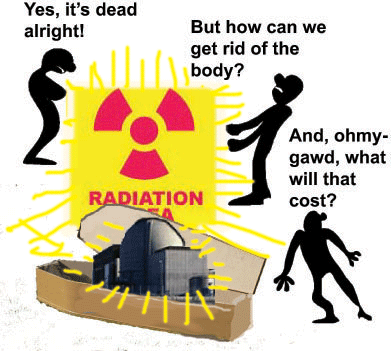 DECOMMISSIONING SAGAS As already noted above, there are no rules, standards and best practice in decommissioning, dismantling and “making safe” or “securing” the former sites of reactors. So there is no standard cost for getting rid of reactors. It is a case-by-case process. This alone prods the highly political decision to set a “delay” between reactor shut down, and decommissioning which as noted above, in the extreme UK case is now set at 30-40 years.
Before the final shut down, of course, reactor operating life extensions can squeeze some more power out of the reactor – and further delay the moment when it has to be decommissioned. Only idiots can pretend this does not expose the reactor to increased risks of accidents. Ask yourselves if you prefer to fly in a 40-year-old airplane, or a new one.
Real-life decomm sagas, as distinct from emergency dismantling following a serious or catastrophic accident as in the case of Three Mile Island, Chernobyl and Fukushima are always – always – a tale of vastly underestimated initial costs and timelines for decomm, followed by massive cost overruns and time overruns. Plenty of examples concern the now-quarter-century old projects, and longer, where initial cost estimates have been exceeded by actual spending by 5 or 10 times, and the decomm project’s time for completion multiplied by 3. And today the projects are not yet fully completed!…….. Continue reading
Unemployed Japanese tricked into dangerous jobs at Fukushima
 ‘Nuclear Slaves’ at Fukushima: Workers have debts paid off, forced to stay as ‘indentured servants’ — Foreign workers may soon be needed at plant, official reveals http://enenews.com/nuclear-slaves-at-fukushima-workers-have-debts-paid-off-forced-to-stay-as-indentured-servants-foreign-workers-may-soon-be-needed-at-plant-reveals-tepco-vp
Voice of Russia, Oct. 27, 2013: “Nuclear slaves” discovered at Fukushima […] An in-depth journalistic investigation uncovered that thousands of unemployed Japanese were tricked into working underpaid and highly dangerous jobs on the site of Fukushima’s nuclear disaster. […] Yakuza act as enforcers who keep the “nuclear slaves” from complaining or leaving their jobs. […] Reuters reports that “labor brokers” […] resort to “buying” laborers by paying off their debts and then forcing them to work in hazardous conditions until their debt to the “labor broker” is paid off. Such “employment schemes” are commonly referred to as “indentured servitude” and are a form of slavery […] Lake Barrett, a former US nuclear regulator and an advisor to Tepco, told the news agency that existing practices won’t be changed for Fukushima decontamination: “There’s been a century of tradition of big Japanese companies using contractors, and that’s just the way it is in Japan. You’re not going to change that overnight just because you have a new job here, so I think you have to adapt.”
Asahi Oct. 28, 2013: TEPCO President Naomi Hirose […] explained that it is getting difficult for the utility to secure sufficient manpower at the plant and that it was grappling with tasks the company was not familiar with.
AP,, Oct. 28, 2013: Hirose acknowledged that TEPCO is having trouble finding a stable pool of workers at the plant […] TEPCO Vice President Zengo Aizawa said […] that uncertainty remains over the long-term decommissioning process. “We are not sure about our long-term staffing situation during the upcoming process of debris removal, which requires different skills,” Aizawa told a news conference. Asked if the company may have to consider hiring foreign workers, he said TEPCO is open to that idea even though it’s not an immediate option. […] [Shunichi Tanaka, chairman of the NRA] called on Hirose to implement sweeping steps to safeguard workers from high doses of radiation and other troubles […]
The end of nuclear power is becoming the only solution to its financial mess
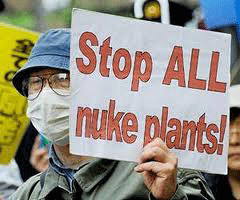 Nuclear Power Dirty Bomb The Market Oracle, Oct 28, 2013 By: Andrew_McKillop “………LOSS AVOIDANCE IS THE ONLY SOLUTION Turning off the nuclear tap will soon become the only solution. Civil nuclear power plant growth and proliferation has already cancelled in several countries, including Germany, Japan and Switzerland, and is likely to be placed on hold, because of nuclear debt and the sheer un-economic nature of nuclear power, in other countries. Of course we can be sure that China and India will come very late to the party and may need the “tweak” of one or more worst-case reactor meltdowns to make them move.
We can however be sure that Nuclear Nirvana’s murky underside of a Pandora’s Box of evils will soon cause a sea shift in ruling elite thinking.
Options exist for the rapid removal of nuclear power from the scene. Since 2008, in more than a half of OECD countries exposed to the realities of the sovereign debt crisis, electricity consumption has fallen, sometimes by double-digit amounts in 3 years. The need for nuclear power is cut by this real world trend. To be sure there are also long-term and rising nuclear debts due to accumulated wastes and to the near-term future crisis of reactor decommissioning – which in a sane world would only hasten the total abandonment of this failed option for supplying “cheap, clean and safe” power.
The options are better known than ever. The pathology of “we didnt know” has worn awfully thin after the Fukushima disaster. The same applies to Depleted Uranium weapons, nicely reserved for expert commentators to pontificate about – but which cause real world cancers and economic loss every day in Iraq and Afghanistan.
The choices and options are on the table for those who want to admit them. Unfortunately our current political decider elite is congenitally unable to admit them. Soldiering along and muddling through with the deadly, high cost option of nuclear power will continue – but not for long. As ever, one disaster is worth a lot more than a million words. http://www.marketoracle.co.uk/Article42864.html
France’s Flamanville EPR fiasco – not a good look for UK’s new nuclear reactors
Dr Paul Dorfman, of the Energy Institute at University College, London, believes the British public is facing a turbulent nuclear future. He says: ‘It’s extremely likely that the construction at Hinkley Point will be over-budget and late. It is unfortunate because it will be the UK taxpayer and consumer, no doubt, who will be picking up the bill.’…..
Professor Steve Thomas, an energy policy expert at the University of Greenwich, has written a damning report on the EPR project, claiming, in 2010, that the entire design and construction was ‘in crisis’. His 26-page report catalogued the errors at Flamanville and in Finland, and concluded construction had gone ‘dramatically wrong’.
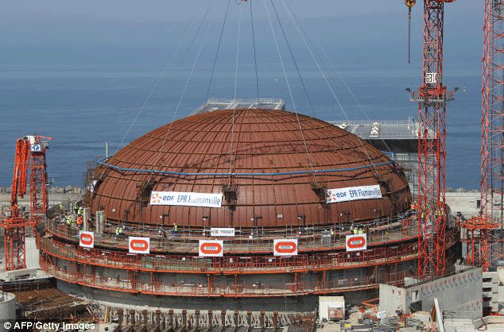
Deaths, chilling safety lapses, lawsuits, huge cost over-runs and delays: Why we can’t trust the French with Britain’s nuclear future, Daily mail UK, , 26 October 2013, By STEVE BIRD
- EDF’s nuclear reactor plant at Flamanville, Normandy, is beset by financial mismanagement and the deaths of workers
- EDF, along with French nuclear group Areva and investors from China, are due to start work on a £16bn plant in Hinkley Point in Somerset in 2017 It will be the first nuclear reactor in the UK in nearly 20 years – and also first European Pressurised Reactor (EPR)
- … yet no reactor of this design is yet working anywhere in the world……
- The optimism and excitement of that first day of construction is now long gone.Since then, the predicted cost of just under £3 billion has rocketed to more than £7 billion (it could go up still further). Continue reading
Bill Gates promotes his nuclear reactor business in Idaho
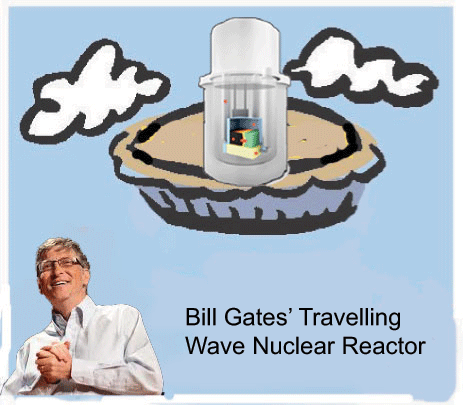 Bill Gates goes nuclear in Idaho http://gigaom.com/2013/10/25/bill-gates-goes-nuclear-in-idaho/?go_commented=1#comment-1375195 Katie Fehrenbacher OCT. 25, 2013 – Bill Gates, along with the staff of nuclear startup TerraPower, visited the U.S. government-owned Idaho National Labs this week to check out the facilities in advance of reactor design work that TerraPower plans to do at the facility. Gates is chairman of, and investor, in TerraPower, which has been developing a traveling wave nuclear reactor that can run on waste uranium, and can make and consume its own fuel — theoretically it doesn’t need to be refueled for hundreds of years.PD
“Nuclear Gypsies” work in Japan’s $150-billion Fukushima radiation clean-up
Radiation, desperation and gangsters: Inside the hidden tragedy of Fukushima The Globe and Mail , 25 Oct 13 ANTONI SLODKOWSKI AND MARI SAITO IWAKI — Reuters , Oct. 25 2013 Tetsuya Hayashi went to Fukushima to take a job at ground zero of the worst nuclear disaster since Chernobyl. He lasted less than two weeks.
Hayashi, 41, says he was recruited for a job monitoring the radiation exposure of workers leaving the plant in the summer of 2012. Instead, when he turned up for work, he was handed off through a web of contractors and assigned, to his surprise, to one of Fukushima’s hottest radiation zones.
He was told he would have to wear an oxygen tank and a double-layer protective suit. Even then, his handlers told him, the radiation would be so high it could burn through his annual exposure limit in just under an hour.
“I felt cheated and entrapped,” Hayashi said. “I had not agreed to any of this.” Continue reading
1 This Month





PLEASE OPPOSE HR 8255 AND S.3639 – bills would accelerate satellite deployment, with no environmental review or safeguards – https://ncstd5li.quorum.us/campaign/169331/
To see nuclear-related stories in greater depth and intensity – go to https://nuclearinformation.wordpress.com
-
Archives
- October 2026 (10)
- September 2026 (339)
- August 2026 (330)
- July 2026 (355)
- June 2026 (287)
- May 2026 (306)
- April 2026 (356)
- March 2026 (251)
- February 2026 (267)
- January 2026 (308)
- December 2025 (358)
- November 2025 (359)
-
Categories
- 1
- 1 NUCLEAR ISSUES
- business and costs
- climate change
- culture and arts
- ENERGY
- environment
- health
- history
- indigenous issues
- Legal
- marketing of nuclear
- media
- opposition to nuclear
- PERSONAL STORIES
- politics
- politics international
- Religion and ethics
- safety
- secrets,lies and civil liberties
- spinbuster
- technology
- Uranium
- wastes
- weapons and war
- Women
- 2 WORLD
- ACTION
- AFRICA
- Atrocities
- AUSTRALIA
- Christina's notes
- Christina's themes
- culture and arts
- Events
- Fuk 2022
- Fuk 2023
- Fukushima 2017
- Fukushima 2018
- fukushima 2019
- Fukushima 2020
- Fukushima 2021
- general
- global warming
- Humour (God we need it)
- Nuclear
- RARE EARTHS
- Reference
- resources – print
- Resources -audiovicual
- Weekly Newsletter
- World
- World Nuclear
- YouTube
-
RSS
Entries RSS
Comments RSS

