Navajos copped uranium pollution, now they’re to do the clean-up

they always give the dirty jobs to indigenous people
NAU seeks Navajos for uranium cleanup training http://www.sunherald. com/2013/11/25/5146098/nau-seeks-navajos-for-uranium.html BY FELICIA FONSECA Associated PressNovember 25, 2013 FLAGSTAFF, ARIZ. — Northern Arizona University is using federal grant money to address two of the most widespread problems on the Navajo Nation — unemployment and uranium contamination.
A $200,000 grant from the U.S. Environmental Protection Agency will allow the school’s Institute for Tribal Environmental Professionals to train up to 40 people over three years to safely handle radioactive materials and to find a job in a place where the unemployment rate hovers around 50 percent.
About 4 million tons of uranium ore were mined from the reservation from 1944 to 1986 for wartime weapons, leaving a legacy of death and disease. Families still live among the contamination that the tribe and federal government are working toward cleaning up. The top priority is the former Northeast Church Rock Mine near Gallup, N.M. Continue reading
Canada’s nuclear industry not dead yet, but dying?
 Nuclear faces long road as Ontario maps its energy future SHAWN MCCARTHY The Globe and Mail Nov. 25 2013 Canada’s nuclear industry is looking to persuade Ontario that it’s not dead yet. Ontario Energy Minister Bob Chiarelli will launch in the coming weeks a revised long-term
  energy plan that will spell out how the current government expects to feed the province’s appetite for electricity over the next two decades. The new road map comes as the nuclear sector – which will supply more than half the province’s electricity this year – battles to maintain its share of that market by proposing long-term, multi-billion-dollar projects in order to refurbish existing plants and sell the province new reactors.
But the industry is confronting a myriad of challenges: including assumptions about weak demand growth as a result of to economic shifts and greater efficiency and conservation; the low price of natural gas that is fuelling a boom in gas-fired power in the United States; the Liberal government’s aggressive commitment to build new wind and solar capacity, and even the possibility of buying electricity from Quebec.
Taken together, those factors could add up to a sharply diminished role for nuclear in Ontario, even as the country’s domestic reactor company, SNC-Lavalin Inc.’s Candu Energy Inc., struggles to make sales abroad. ……..
Some critics question whether even the refurbishments are needed, let alone the new reactors. Nuclear power suffers from that fact that its high, upfront capital costs must be amortized over 30 years in the case of refurbishments, and 50 to 60 years in the case of new reactors. Given the rapid technology transformation, a long-term bet on nuclear is fraught with the risk of the province being saddled with an expensive white elephant, York University’s Mark Winfield said…….
Ontario is currently moving towards a much greater reliance on wind power, backed up by natural gas generation when the wind turbines aren’t producing as much as expected…… http://www.theglobeandmail.com/report-on-business/industry-news/energy-and-resources/nuclear-faces-long-road-as-ontario-maps-its-energy-future/article15595098/
Uranium market not a good prospect – Goldman Sachs gets out
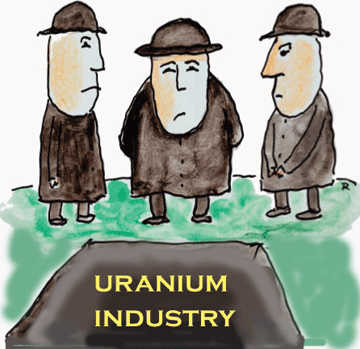 Goldman Sachs to sell uranium unit BUSINESS DAY, BY SCOTT DISAVINO AND DAVID SHEPPARD, NOVEMBER 25 2013 NEW YORK — US BANK GOLDMAN SACHS GROUP HAS PUT ITS URANIUM TRADING BUSINESS UP FOR SALE, A SOURCE FAMILIAR WITH THE MATTER SAID ON FRIDAY, THE LATEST SIGN THAT WALL STREET’S MOST STORIED COMMODITY TRADER IS PARING BACK PARTS OF THE BUSINESS.
The move comes as other US banks, including JPMorgan Chase and Morgan Stanley, look to exit physical commodity trading in the wake of increased government scrutiny, squeezed trading margins and forecasts for tepid demand in certain markets……
The move to sell also comes as uranium prices languish at their lowest since 2005. Spot prices of U3O8 (triuranium octoxide), a material that is converted to uranium hexafluoride for the purpose of uranium enrichment, have ranged from $34-$35 a pound since September, less than half the price prior to the Fukushima disaster in Japan in 2011……
Financial firms started to get into the uranium business in the mid-2000s when prices were rising on expectations demand would grow with the nuclear renaissance. Reuters http://www.bdlive.co.za/world/americas/2013/11/25/goldman-sachs-to-sell-uranium-unit
Japan’s mafia gangs exploiting homeless people in Fukushima nuclear cleanup
TV: Mentally disabled are working at Fukushima Daiichi, says journalist — Many men forced to go to plant — Homeless treated like ‘disposable people’ (VIDEO) http://enenews.com/tv-journalist-says-theres-mentally-disabled-workers-at-fukushima-many-men-forced-to-work-at-plant-homeless-treated-like-disposable-people-video
Atomic Mafia? Yakuza cleans up Fukushima, neglects basic worker
RT News, , Nov. 20, 2013: Homeless men employed cleaning up the stricken Fukushima nuclear plant, including those brought in by Japan’s yakuza gangsters, were not aware of the health risks they were taking and say their bosses treated them like “disposable people.” […] While some workers voluntarily agreed to take jobs on the nuclear clean-up project, many others simply didn’t have a choice […] many of the workers were brought into the nuclear plant by Japan’s organized crime syndicates, the yakuza. […] Although a special task force to keep organized crime out of the nuclear clean-up project has been set up, investigators say they need first-hand reports from those forced to work by the yakuza […]
Anonymous former Fukushima worker: We were given no insurance for health risks, no radiation meters even. We were treated like nothing, like disposable people — promised things, and then kicked us out when we received a large radiation dose.
Tomohiko Suzuki, journalist who worked at Fukushima plant: The government called Tepco to take urgent action, Tepco relayed it to subcontractors — and they, eventually, as they had a shortage of available workers, called the Yakuza for help. […] They were given very general information about radiation and most were not even given radiation meters. They could have exposed themselves to large doses without even knowing it. Even the so-called Fukushima 50 […] at least three of them were enrolled by the yakuza.
Aleksey Yaroshevsky, RT: : There are 25% more openings for jobs at Fukushima plant than applicants, according to government data. Gaps filled, says Suzuki, by the homeless, the desperately unemployed and even those with mental disabilities. Watch the broadcast here
TEPCO’s plan to restart 4 nuclear reactors by 2015
 TEPCO eyes restarting 4 reactors by 2015 November 23, 2013 THE ASAHI SHIMBUN by Mari Fujisaki and Takashi Ebuchi.) Tokyo Electric Power Co. hopes to have four nuclear reactors in Niigata Prefecture back online by 2015, including two planned for next summer, despite the crisis at its hobbled Fukushima nuclear plant.
The company intends to reactivate the No. 1 and No. 5 reactors at the Kashiwazaki-Kariwa nuclear plant during the first half of 2015 after restarting the No. 6 and No. 7 reactors as early as July 2014, sources said. Both plans will be included in the utility’s rehabilitation program when it is revised toward the end of this year.
The Kashiwazaki-Kariwa plant has seven reactors. TEPCO estimates that for each reactor restart its annual profit will increase by about 100 billion yen ($1 billion)……
it remains unclear whether TEPCO can restart the reactors under its proposed time frame. NRA screenings could drag on if regulators demand detailed investigations to confirm that no active faults run immediately under the reactors.
Consent of local communities is also essential, but Niigata Governor Hirohiko Izumida remains cautious. He has criticized plans to restart the two reactors next summer as a pipe dream.
Meanwhile, TEPCO will speed up streamlining its operations while expanding investments, the sources said……http://ajw.asahi.com/article/0311disaster/fukushima/AJ201311230052
Another uranium company stops operations, with poor market prospects
Company slows uranium mining in northern Arizona, Yahoo 7 Finance 21 Nov 13,Uranium mining company to temporarily halt operations in northern Arizona amid low ore prices. FLAGSTAFF, Ariz. (AP) — The only two uranium mines operating in Arizona and an associated mill in southern Utah are set to cease operations temporarily as prices for the ore decline.
Energy Fuels Resources Inc. said uranium at its Arizona One Mine in the north part of the state will be depleted in early 2014, and the nearby Pinenut Mine and the White Mesa Mill in Blanding, Utah, will be placed on standby next year.
The move comes after the company stopped short of extracting uranium at another mine south of the Grand Canyon near Tusayan and as per-pound prices for uranium on the spot market dip to a five-year low, in the mid-$30s. The company plans to maintain the sites so that they can begin operating if the uranium market improves……..
Environmentalists are looking to the U.S. Forest Service and the U.S. Bureau of Land Management to ensure that the company doesn’t leave anything behind that would harm wildlife or the landscape.
“It’s a good thing on the one hand, but there’s a systemic problem in the regulations by the land management agencies that allow these mines to blink on and off at will without any review or revision in their plans of operation,” said Roger Clark of the Grand Canyon Trust. http://au.finance.yahoo.com/news/company-slows-uranium-mining-northern-153826141.html
Scandal-ridden South Korea wants a piece of the UK nuclear action!
 Scandal-hit Korean group makes UK nuclear bid, Ft.com, 19 Nov 13 By Guy ChazanA Korean nuclear company that has been rocked by a domestic safety scandal is close to becoming a major investor in the UK – a development that could hit public confidence in the country’s much-vaunted nuclear renaissance. Korea Electric Power, or Kepco, is in talks to join the NuGen consortium, which has an option to build a reactor near Sellafield in Cumbria……
Some UK industry figures have expressed concern.
“Why would you want anyone with that kind of safety record?” said one person with knowledge of the NuGen negotiations. He said it risked “damaging the public perception of nuclear in the UK”.
But such concerns are likely to grow as more and more overseas state-owned groups enter the British marketplace. “If major pieces of UK energy infrastructure – not just nuclear – are owned by investors from afar, it’s going to give rise to a level of public disquiet that we haven’t seen so far,” said Nick Pidgeon, head of the Understanding Risk Research Group at Cardiff University.
The NuGen development highlights how reliant the UK is on foreign investors for its nuclear renaissance. Continue reading
Yet another uranium company makes wider losses
 Energy Fuels makes efforts to sustain current drop in uranium prices Proactive Investors by Deborah Bacal 16 Nov 13 Energy Fuels (TSE:EFR)(OTCQX:EFRFD), which recently gained a majority stake in one of the largest and highest grade uranium projects in the U.S. through its acquisition of Strathmore Minerals, reported widened third quarter losses as a result of a drop during the period
  in both uranium spot and term prices, which it sees rising in the future.
For the three months to September 30, America’s largest conventional uranium producer, which says it has a strategy in place to beat current low prices, reported net loss was $70.47 million, or $4.30 per share, compared to $19.16 million, or $1.41 per share, a year ago. Revenues fell slightly to $24.5 million from $25.03 million.
As a result of the downward trend in prices through to the end of the quarter and Energy Fuels’ expectations to place the Pinenut mine on stand-by in July of next year, the company said it recorded an impairment loss of $60.26 million in the period. ince July 1, the spot price of uranium dropped from $39.65 per pound to its current price of $35.35 per pound, the company noted, and the long term price declined from $57.00 per lb. to $50.00 per pound.
Australian uranium miner Paladin in a poor situation, battles to survive
 Weak uranium price hurts Paladin http://au.news.yahoo.com/thewest/business/a/-/national/19838677/weak-uranium-price-hurts-paladin/ Nick Sas, The West AustralianNovember 15, 2013, Paladin Energy has underscored the enormity of its battle for survival, admitting its African uranium mines lost $US14.9 million ($15.9 million) in the September quarter despite record production. Continue reading
Radiation fears severely damaging South Korea’s seafood traders
 Fish Is Off the Menu in South Korea Over Radiation Fears Koreans Avoid Seafood Over Fears of Fukushima Contamination, WSJ, By KWANWOO JUN 14 Nov 13, SEOUL—”There have been no buyers yet,” said fish trader Choi Mi-ja as the clock ticked toward 3 p.m., some 10 hours after her store at the Noryangjin Fisheries Wholesale Market opened for the day.
“In 26 years in this business, I’ve never seen anything like this before,” Ms. Choi added, standing by tanks where live, locally bred flatfish and Russian-imported king crabs were displayed.
Ms. Choi’s predicament provides a taste of the psychological impact of Japan’s nuclear crisis on South Korea’s seafood industry. Sales of marine products have plummeted in recent months as three out of every four Koreans say they have cut back on fish consumption following leaks of radioactive water from the Fukushima Daiichi nuclear power plant in Japan.
The fears come despite Seoul imposing some of the toughest restrictions on seafood imports from Japan. Since September, it has blocked all fishery imports from eight prefectures surrounding the Fukushima Daiichi plant, on Japan’s Pacific coast.
Around 80% of seafood consumed in South Korea is caught locally, where there is no evidence of any impact from the nuclear disaster. Despite the facts, many Koreans are shunning seafood……..http://online.wsj.com/news/articles/SB10001424052702303289904579196893701088208
Finland nuclear power consortium sees exodus of 15 members

 More partners pull out of Fennovoima nuclear project UUTISET, 14 Nov 13, The consortium of Finnish power companies backing a planned nuclear power plant in Pyhäjoki, western Finland is shrinking. Some 15 members of the Fennovoima public power consortium announced Thursday that they were pulling out of the project, leaving 45 partners still on board. Thursday’s development saw 15 members of the Voimaosakeyhtiö SF announce their withdrawal from the planned nuclear power project in Ostrobothnia, western Finland. Voimaosakeyhtiö is a power consortium comprising 67 companies who jointly own Fennovoima.
Among the companies that decided to withdraw support from the nuclear power plant are Boliden Harjavalta, Boliden Kokkola and Componenta.
Back in 2012, Finnish retail cooperative S-Group and the German-based power giant E.ON announced that they were leaving the project behind. E.ON sold its 34 percent stake in the consortium, saying that the move was part of a strategy to sell off all of its Finnish operations.
S-Group said it shed its three-percent shareholding to focus on investments that would benefit its shareholders.
Fennovoima still in talks with Rosatom
About 45 companies remain as partners to the project. However their support is still conditional, given that Fennovoima is still in talks with Russian nuclear contractor and proposed minority owner, Rosatom.
The remaining consortium members include mining company Talvivaara, steel company Outokumpu, dairy company Valio and a group of regional energy companies…….http://yle.fi/uutiset/more_partners_pull_out_of_fennovoima_nuclear_project/6934299
Mitsubishi cutting back on nuclear engineering staff
Mitsubishi cutting Charlotte nuclear engineering staff in half Charlotte Business Journal, John Downey 14 Nov 13 Mitsubishi Nuclear Energy Systems will lay off 48 people from its Charlotte Engineering Center by the end of the year, cutting the staff by roughly half.
The layoffs come as Mitsubishi has decided to slow its efforts to get Nuclear Regulatory Commission certification of its US-APWR reactor. That led the power companyLuminant to announce plans last week to suspend its effort to license two 1,700 megawatt Mitsubishi reactors at the Commanche nuclear plant in Texas.
In April, Dominion announced it was abandoning plans to build a Mitsubishi unit at its North Anna Nuclear Station…….. Mitsubishi had about 100 workers when it celebrated the grand opening of its center in Ballantyne in spring of 2012.
At that time, executives said the center could have as many as 150 workers by 2017. But the center never got above the 100 mark.
The state offered $4.1 million in incentives to bring the center here.http://www.bizjournals.com/charlotte/blog/power_city/2013/11/mitsubishi-cutting-charlotte-nuclear.html
Poor uranium market freezes Uranium One’s expansion
Rosatom’s Uranium One to Freeze Expansion Moscow Times, 13 November 2013 | Issue 5255 Reuters Canadian miner Uranium One Holding, acquired this year by state-owned reactor builder and supplier Rosatom, said it would freeze expansion projects in Russia and elsewhere due to low uranium prices.
The price of uranium, used mainly as fuel for nuclear plants, plummeted after the March 2011 meltdown at Japan’s Fukushima Daiichi atomic power plant and has shown no signs of recovery.
“We cannot discount the dramatic fall in natural uranium prices, as a result of which more than 50 percent of global uranium production is currently loss-making,” Uranium One President Vadim Zhivov said in e-mailed comments Wednesday.
Uranium One, which Rosatom took private last month, will mothball the Honeymoon mine in uranium-rich South Australia, local media reported this week, citing high costs and unfavorable contracts with Japan’s Mitsui.
A company spokesman confirmed Wednesday that the mine would be put in “care and maintenance” mode. Zhivov did not specify which of the company’s projects had been cancelled, saying the details would be announced later…….
November uranium futures on the New York Mercantile exchange closed at $35.85 per pound on Tuesday, compared with $68 per pound before the earthquake and tsunami in Japan.
Fukushima cleanup costs – $250-$500 billion!
 The staggering costs to clean up Fukushima Smart Planet By Tyler Falk | November 12, 2013 More than two years since the worst nuclear disaster since Chernobyl, the Fukushima power plant meltdown is still a major, global environmental problem. And the staggering price tag for cleaning it up continues to rise.
The Japanese government just announced that it’s borrowing about $30 billion more to cover costs related to Fukushima, bringing the total amount the Japanese government has borrowed to clean up the mess to around $80 billion, more than three times the amount BP spent to clean up the massive oil spill in the Gulf of Mexico in 2010. That money will go into cleanup, along with compensation for the people who may never go back to their homes near the contaminated area, and the decommissioning of the nuclear reactors. But it’s not money that the government is on the hook for, Reuters reports:……
it should hardly come as a surprise that the cleanup is proving so costly. Independent estimates put the total economic cost of the disaster at $250-$500 billion. Tepco has said it will need $137 billion to cover costs related to Fukushima. And if Chernobyl is any indication, the costs will likely continue for decades to come. And the real issue might not even be the cleanup costs or health concerns, but the fact that a large, productive area of land (of which Japan doesn’t have much to begin with) is now essentially useless and will be for many years, decades, or possibly centuries to come……. http://www.smartplanet.com/blog/bulletin/the-staggering-costs-to-clean-up-fukushima/33974
Japan’s electricity companies profitable without using nuclear power
Fukushima Watch: Some Power Companies in Black without Nuclear Restarts WSJ, By Mari Iwata, 12 Nov 13 Many of Japan’s power companies generated a profit in the first half of the year. While that’s good news for shareholders, it’s an awkward outcome for utilities that have insisted they cannot stay out of the red without restarting their nuclear reactors. The latest earnings show that many of Japan’s major utilities generated a profit in the first half of this fiscal year, even without the help of their nuclear power plants.
Amid uncertainty about whether nuclear restarts can win regulatory approval, that is good news for shareholders. But it puts the utilities themselves in a difficult position, since they have been loudly complaining that without their nuclear plants, they will remain in the red.
Five of the nine regional utilities that have nuclear power plants posted a net profit for the six months ending Sept. 30. They include Tokyo Electric Power Co., whose Fukushima Daiichi plant in northern Japan was at the center of the nuclear crisis that led to the shutdown of nuclear plants amid safety concerns. Also making profits were Tohoku Electric Power Co.,Hokuriku Electric Power Co., Kansai Electric Power Co. and Chugoku Electric Power Co…….
epco was the biggest gainer, with a ¥616 billion ($6.19 billion) net profitfor the six months. That compared with a ¥299 billion net loss a year earlier and a ¥627 billion net loss in the same period the previous year as the company struggles to pay for the cleanup and decommissioning of the Fukushima plant…..
“Tepco’s profit is false, coming from the government’s handouts,” said Akiko Sekine of Greenpeace Japan.
But she said that for other utilities, the figures showed there may be life after nuclear power.
“They have said they wouldn’t be able to get by without restarting reactors, but it seems they can,” she said…… http://stream.wsj.com/story/latest-headlines/SS-2-63399/SS-2-379528/
1 This Month





PLEASE OPPOSE HR 8255 AND S.3639 – bills would accelerate satellite deployment, with no environmental review or safeguards – https://ncstd5li.quorum.us/campaign/169331/
To see nuclear-related stories in greater depth and intensity – go to https://nuclearinformation.wordpress.com
-
Archives
- October 2026 (10)
- September 2026 (339)
- August 2026 (330)
- July 2026 (355)
- June 2026 (287)
- May 2026 (306)
- April 2026 (356)
- March 2026 (251)
- February 2026 (267)
- January 2026 (308)
- December 2025 (358)
- November 2025 (359)
-
Categories
- 1
- 1 NUCLEAR ISSUES
- business and costs
- climate change
- culture and arts
- ENERGY
- environment
- health
- history
- indigenous issues
- Legal
- marketing of nuclear
- media
- opposition to nuclear
- PERSONAL STORIES
- politics
- politics international
- Religion and ethics
- safety
- secrets,lies and civil liberties
- spinbuster
- technology
- Uranium
- wastes
- weapons and war
- Women
- 2 WORLD
- ACTION
- AFRICA
- Atrocities
- AUSTRALIA
- Christina's notes
- Christina's themes
- culture and arts
- Events
- Fuk 2022
- Fuk 2023
- Fukushima 2017
- Fukushima 2018
- fukushima 2019
- Fukushima 2020
- Fukushima 2021
- general
- global warming
- Humour (God we need it)
- Nuclear
- RARE EARTHS
- Reference
- resources – print
- Resources -audiovicual
- Weekly Newsletter
- World
- World Nuclear
- YouTube
-
RSS
Entries RSS
Comments RSS

