Farce of Olkiluoto Nuclear Power Plant – an expensive white elephant
 Finland Government faces two in-principle decisions on nuclear power http://www.helsinkitimes.fi/finland/finland-news/domestic/10691-government-faces-two-in-principle-decisions-on-nuclear-power.html 22 May 14, The Government faces two new in-principle decisions on nuclear power projects, after Teollisuuden Voima (TVO) announced on Tuesday that it will request an extension to the in-principle decision granted for the construction of a fourth reactor at the Olkiluoto Nuclear Power Plant and a new time limit for filing the building permit application.
“[Work on] Olkiluoto 3 has been delayed to the extent that we can’t make any big decisions on Olkiluoto 4. All the conditions and grounds for Olkiluoto 4 remain in tact. It’s only a question of timing,” explains Jorma Tanhua, the CEO at TVO.
Under the current in-principle decision, TVO must apply for a building permit for Olkiluoto 4 by the end of June 2015.
TVO has asked for the time limit to be extended by five years. In addition, the Government must take a new in-principle decision on the nuclear power project of Fennovoima in Pyhäjoki due to the withdrawal of Germany’s E.ON from the project.
If the in-principle decisions are granted, the Parliament can either rescind or approve the decisions as such.
The Minister of Economic Affairs, Jan Vapaavuori (NCP), says that it is now necessary to consider whether such a notable extension can be granted to TVO. “It’s obvious that if more time is granted, it can’t be as much as five years,” he views.

Vapaavuori on Tuesday also underlined that the Government must consider the applications of both TVO and Fennovoima sooner rather than later in order to be able to present them to the Parliament in the autumn.
“We may even have to consolidate the schedules of the projects. If both are approved by the Government, they’ll be presented to the Parliament in the same context,” he said.
Ville Niinistö, the Minister of the Environment, believes the in-principle decisions on nuclear power have become a farce. Nuclear power, he argues, is no longer pertinent or economically cost-effective.
Olli Pohjanpalo, Petri Sajari – HS
Aleksi Teivainen – HT
© HELSINGIN SANOMAT
Better cut supply of uranium, as price drops below production costs

 Uranium supply cuts needed as spot price continues to tumble,Financial Post, Peter Koven | May 21, 2014 |Last week was another bad one in the uranium market, as the spot price dropped yet another dollar to US$28 a pound, the lowest level since 2005. By comparison, the price was US$66.50 prior to the Fukushima disaster in 2011, and topped out at more than US$135 in 2007.
Uranium miners maintain they are optimistic about prices in the coming years, as demand is expected to increase and outstrip supply. But that doesn’t help anyone in the short term, while Fukushima still looms large over the market. Scotiabank analyst Ben Isaacson said demand upside is “unlikely to stabilize” the uranium market this year, even with some Japanese reactor restarts, an acceleration of reactor starts in China and inventory building.
Instead, he said there has to be a response on the supply side, both from existing and planned mines.
“The challenge will be to figure out when/where the next supply cuts will come from,” he said in a note.
Mr. Isaacson noted that a lot of global production is inelastic to price moves, either because it is low cost, locked into contracts or politically important. He did not speculate on where the cuts will come from.
Another complication is that uranium enrichment capacity continues to expand globally. He said a glut of enriched supply could cause marginal demand for uranium to slow down…….http://business.financialpost.com/2014/05/21/uranium-supply-cuts-needed-as-spot-price-continues-to-tumble/?utm_source=feedburner&utm_medium=feed&utm_campaign=Feed%3A+FP_TopStories+%28Financial+Post+-+Top+Stories%29
Bad omens for uranium mining expansion
By Dave Forest | Mon, 19 May 2014 Uranium prices took another slump the last several weeks. Spot prices for uranium oxide have now fallen below $30 per pound for the first time since 2005. Even long-term prices sagged, falling below $50–to a current $45 per pound.
That’s stopped the wave of optimism that had been running through uranium stocks earlier this year.
Cameco..told regulators in Canada that it is shelving one of its biggest development projects in the uranium-rich province of Saskatchewan.The Canadian Nuclear Safety Commission (CNSC) said in a press release Friday that Cameco is not proceeding with permitting for the company’s Millennium project. The up-and-coming mine had been scheduled for public hearings in June, to consider the grant of a 10-year operating license.
……… Cameco is concerned about low uranium prices. And how they will affect the potential economics of a start-up at Millennium.The company has now reportedly withdrawn its application to construct and operate the mine………
Simply put, Millennium was one of the world’s premier uranium development projects. Hosting an indicated mineral resource of 46.8 million pounds uranium oxide–grading a league-leading 4.53% U3O8. The proposed mine here would have been one of the world’s largest producers. Slated to put out up to 7 million pounds of uranium oxide yearly.
But all of that supply is now lost to the market. Just another sign that current prices are too low to support much of the existing uranium mining industry. Let alone necessary expansion projects.
This is not a sustainable situation. With supply also falling in major producing centre like Kazakhstan and Africa, something will have to give…..http://oilprice.com/Finance/investing-and-trading-reports/This-Is-A-Major-Loss-For-Uranium-Supply.html
German government will not pay costs of burying dead reactors
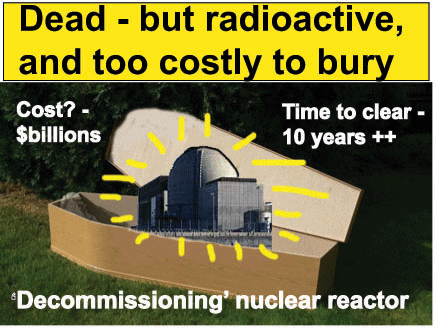 Germany’s Gabriel says state won’t pay for nuclear decommissioning http://uk.reuters.com/article/2014/05/18/uk-germany-energy-nuclear-idUKKBN0DY0EM20140518 BERLIN Sun May 18, (Reuters) – Germany‘s economy minister has joined Angela Merkel in rejecting talk that utilities might hand over responsibility for decommissioning Germany’s nuclear powerplants to a new public entity, as the projected costs of decommissioning rise.
“It should not be tax payers who pay for the clean-up of atomic waste but rather those who made money for decades through running nuclear power stations,” Sigmar Gabriel told the newspaper Bild am Sonntag in an interview published on Sunday.
Two sources told Reuters last weekend that utilities were in talks with the government about setting up a “bad bank” for nuclear plants, in response to Chancellor Angela Merkel’s decision to close them all by 2022 after the Fukushima disaster.
The foundation would use provisions earmarked by the nuclear plant operators but would also take on the risk of unforeseen extra costs, effectively capping the utilities’ liability.
The Environment Ministry said last week the utilities bore full responsibility for safely decommissioning and dismantling the nine nuclear power plants still on the grid.
One of the sources had told Reuters that if the state takes over responsibility for the decommissioning, the utilities might be willing to drop their legal claims against the government for compensation for having to shut the plants. The four operators of nuclear plants in Germany – the German companies E.ON (EONGn.DE), RWE (RWEG.DE) and EnBW (EBKG.DE) and Sweden’s Vattenfall VATN.UL – have set aside total provisions of around 36 billion euros (29.3 billion pounds) for dismantling the plants and disposing of nuclear waste.
Germany’s Spiegel magazine reported on Sunday that government experts predicted a possible shortfall of 3.5 billion euros for the clean up, as costs had risen sharply. (Reporting by Alexandra Hudson; Editing by Larry King)
The news is bad for the uranium industry – again!
 Uranium Slides as Banks Reduce Outlook Amid Japan Delays, Bloomberg, 18 May 14 By Ben Sharples Delays in restarting Japan’s nuclear reactors are prolonging a uranium supply glut that’s driven prices to an eight-year low, making banks from UBS AG to Credit Suisse Group AG less bullish on the fuel.
Uranium dropped to $29 a pound on May 2, the lowest since June 2005 and extending this year’s drop to 16 percent, according to TradeTech, a Denver, Colorado-based consultant to the nuclear industry. UBS reduced its 2014 forecast by 9 percent last month as Credit Suisse cut its projection by 7 percent.
Kansai Electric Power Co. (9503) and other utilities are taking longer than expected to restart reactors that closed after the Fukushima disaster in March 2011 as Japan’s nuclear regulator seeks more safety checks. While producers from Australia to Africa shut mines as prices retreated to unprofitable levels, Raymond James Ltd. is among those who say supply will still outstrip demand this year.
“There is too much supply floating around the marketplace and demand is highly limited,” said David Sadowski, a Vancouver-based analyst at Raymond James, a financial adviser, who cut his 2014 forecast by 14 percent to $36 a month ago. “Japanese restarts are the key catalyst to get utilities to resume long-term contracting, which should support prices.”
Uranium for immediate delivery averaged $33.93 this year, compared with $38.47 in 2013 and $46.27 in 2010, the year before the earthquake and meltdown of the Fukushima Dai-Ichi plant and subsequent closure of Japan’s reactors for safety checks. Uranium closed at $28.40 yesterday on the New York Mercantile Exchange………
Forecasts Cut
UBS reduced its 2014 forecast for uranium on April 9 to $39, while Credit Suisse cut its estimate to $38.80, according to an April 1 note. The exit of traders such as Goldman Sachs Group Inc. from the market is also reducing transactions, according to Roswell, Georgia-based Ux Consulting Co.
Deutsche Bank AG is cutting back parts of its commodities business including uranium, Nick Bone, a London-based spokesman, said by e-mail May 7. Michael DuVally, a spokesman for Goldman Sachs in New York, declined to comment in an e-mail on the sale of its unit trading the fuel………
Prices are below the marginal cost of production of $35 estimated by UBS. Paladin Energy Ltd. said in February it will halt its Kayelekera operation in Malawi while Russia’s Atomredmetzoloto last year shuttered Honeymoon in Australia. Kazakhstan, the world’s biggest producer, said in November it will halt all projects to increase output after the decline.
Paladin, which gets all of its revenue from selling uranium, fell as much as 4.6 percent today in Sydney trading………http://www.bloomberg.com/news/2014-05-15/uranium-slides-as-banks-reduce-outlook-amid-japan-delays.html
No go for Cameco’s Saskatchewan uranium mine plan, as prices plummet
Poor markets put Saskatchewan uranium mine plan on hold Global News, By Staff The Canadian Press SASKATOON 18 May 14 – Cameco Corporation (TSX:CCO) has withdrawn its application to build and operate a new underground uranium mine in northern Saskatchewan.
The mining company says in a statement on its website that it has also asked the Canadian Nuclear Safety Commission to postpone a hearing scheduled next month into a licence application for the Millennium Mine project.
Cameco cites poor economic conditions in world uranium markets…..http://globalnews.ca/news/1338415/poor-markets-put-saskatchewan-uranium-mine-plan-on-hold/
Uranium stock prices plunge along with disastrous uranium market
CHART: Uranium stocks vs spot price – something’s gotta give #auspolhttp://tinyurl.com/n25brbj Frik Els | May 15, 2014
The prospect of a Japanese nuclear reactor restart. The end of the Russia-US megatons to megawatts program last August, eliminating a huge source of supply. China’s accelerated plan to approve six to eight plants a year through 2020; part of its war on pollution. The possibility of a rethink in Germany about phasing out nuclear (coal is the only viable alternative and Putin’s gas is becoming dearer).As the stars aligned for a pickup in global uranium demand so did investors for uranium stocks.
But the rapid run-up in uranium shares – especially developers – didn’t turn out to be a leading indicator.
The spot price continued to slide going below $30 a pound to levels last seen in 2005. That dragged the long term price, where most uranium business is conducted, down to $45, a six year low.
Uranium stocks have now come down to earth as this chart from Haywood Securities shows.
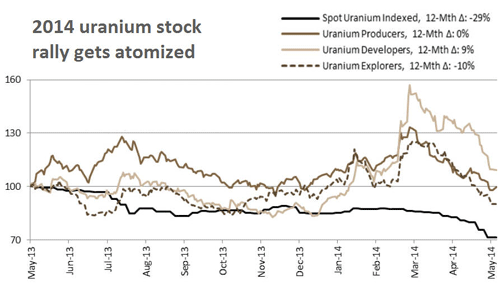
The independent investment dealer with $5 billion under management says now that the spot price appears to have found something of a floor, the sell-off may begin to slow down.
But the Vancouver-based firm cautions that the shares of producers and developers “remain at or above their indexed price point of 12 months ago, when spot uranium was $40.70 U3O8, a 40% premium to current spot”.
There may be more pain ahead
The terminal decline of the nuclear industry is becoming apparent
 Our Nuclear Menace – Just as Darwin Would Have Predicted Andrew McKillop MAY 6, 2014 BY 21WIRE The Dark Enlightenment
The nuclear enlightenment has shredded the claims that nuclear power is “clean cheap and safe”. The most nuclear-intensive country in the world for power production, France, from 2013, has set a yearly rise of power prices of 10% for at least the next 3 years, probably continued after 2017, in an attempt to start paying the economic damage from its nuclear binge. France’s official CPI is about 1.5% annual, meaning that power prices will rise at 7 times the official inflation rate.
As many as 25 of its 60-strong reactor fleet, simply due to age, will have to start being decommissioned through 2025-2040. The cost estimates for this are unsure, but the French General Accounting Office (Cour des Comptes) in Jan 2012 estimated about 3.8 billion euros for each NPP – and the French government is now trying to amass a decommissioning and dismantling fund. Inevitably this will mean further decline of power-intensive industries and fuel poverty.
The Fukushima disaster of 2011 in Japan has had a wide number of estimates for its total costs through the next 15 – 20 years, running to a consensus average around $150 – $175 billion, and that cost will surely increase as every year of inaction passes by.
Total accumulated costs from the Chernobyl disaster of 1986, to date, for the governments of Ukraine, Belarus and Russia are placed in the region of at least $350 billion by sources including the UN Economic Commission for Europe (ECE).
Uranium industry has a poor short term future and a poor long term future
www.neimagazine.com/opinion/opinionthe-future-of-uranium-higher-prices-to-come-4259437/ Predictions of the rise in price of uranium are unjustified; they do not fully appreciate the segmented nature of the market. Steve Kidd 6 May 14
The world uranium market has fallen back substantially from the highs it sustained in the period around 2005-2010, when the spot price peaked at over $130 per pound in summer 2007. After the Fukushima accident in 2011, the price drifted down further and has been stable at the $35 per pound level since last summer. Although this is well above the $10 per pound that prevailed for the long period from the late 1980s up until 2003, it is universally agreed that very few (if any) new mines can be developed at today’s price level. The suggestion is therefore made (particularly by uranium producers and their financial sector backers) that with rising demand, there will be shortages of supply in future unless we soon have much higher prices to encourage new production. On the demand side, a lot of attention is currently being to the upcoming Japanese reactor restart programme, in terms of timing and number of reactors.
A recent report from my company (East Cliff Consulting, ‘The Fifth Age of Uranium’) shows why the case made by the uranium bulls is in reality full of holes. We are now more likely to see a long period of relatively low prices, in which uranium producers will find it hard to make a living.
Substantial oversupply in the Fourth Age
Failing nuclear industry launches lobbying campaign
 Nuclear lobbying campaign aims to boost industry’s fortunes, philly.com Andrew Maykuth, Inquirer Staff Writer 6 May 14 Last year’s closure of the Kewaunee Power Station in Wisconsin sent shock waves though the American nuclear industry, not because the reactor suffered an accident but because it could not withstand something more potent – market forces.
So two months ago, the industry launched a lobbying campaign called Nuclear Matters, whose aim is to create a greater appreciation of atomic power’s role as a reliable source of carbon-free electricity.
“I think most Americans aren’t sensitive to the fact that nuclear energy is going through challenging times,” Evan Bayh, a former Democratic senator from Indiana, told a roundtable discussion Monday at the Constitution Center sponsored by the Greater Philadelphia Chamber of Commerce.
Bayh and former Sen. Judd Gregg, a Republican from New Hampshire, were enlisted as the bipartisan co-chairmen of Nuclear Matters, whose purpose is to start a dialogue that will lead to improvements in the nuclear business climate
Nuclear power accounts for 19 percent of the nation’s electricity generation, but the industry is challenged by a slow-growth market in which electricity prices are depressed by cheap energy from the shale-gas boom and a flood of tax-subsidized wind power……..
The campaign bills itself as “a cross-section of individuals, organizations and businesses.” Monday’s session was attended by U.S. Sen. Pat Toomey (R., Pa.), utility officials, labor and business leaders, and nuclear-power academics from Pennsylvania State University and the University of Pittsburgh……..
The campaign already has attracted opposition from anti-nuclear activists. The Nuclear Information and Resource Service has denounced Nuclear Matters as an industry “front group.”
Exelon Corp., the nation’s largest nuclear fleet operator and owner of Peco Energy Co., wrote the initial check to fund the campaign.
Exelon declined to disclose the amount of its funding, but Christopher Crane, the company’s chief executive, and in an interview last week that Exelon was “very supportive” of the effort………
Bayh downplayed the effect of the 2011 Fukushima nuclear accident in Japan as undermining public confidence, citing strong support in areas surrounding reactors.
“You look at polling, scientific polling, and for most people, safety is not a concern,” he said.
But McGowan, the Malvern manufacturer, cautioned the industry about becoming too comfortable with polls. He said his sense is that there is an underlying apprehension with safety that needs to be addressed. http://www.philly.com/philly/business/20140506_Nuclear_lobbying_campaign_aims_to_boost_the_industry_s_flagging_business_fortunes.html#cOmXlecVcosu5OUs.99
The coming demise of coal and nuclear power
Coming Coal & Nuclear Power Plant Retirements, & What That Means, Clean technica 5 May 14 (Good Graphs) “……..Some of the challenges faced by coal-fired and nuclear generators, and the implications for electricity markets if the plants are retired in significant numbers, are analyzed in this discussion………In 2012 and 2013, operators of five nuclear power reactors representing 4.2 GW of capacity announced plans to retire the reactors by 2015. Four of the reactors—San Onofre 2 and 3, Kewaunee, and Crystal River—already have ended nuclear power production, and the fifth, Vermont Yankee, is expected to end generation by the end of 2014 [1]. In addition, the Oyster Creek plant is expected to conclude operation in 2019 [2]. These are the first retirements of U.S. nuclear power plants since Millstone Unit 1 was retired in 1998. Retirements often are the result of unique circumstances, but some owners of nuclear power plants have voiced concerns about the profitability of their units, sparking discussion of possible additional nuclear retirements [3]. In order to evaluate the impacts of potential retirements beyond those in the Reference case, AEO2014 includes several alternative cases with economic assumptions that make it less likely that existing coal and nuclear power plants will be used for generation.
Factors that lead to power plant retirements
Power plant owners generally make the decision to retire plants when their expected costs exceed their expected revenues over the future life of the plants [4]. Costs incurred by power plants can include large capital projects, such as installation of flue gas desulfurization (FGD) systems or scrubbers on coal plants, increased operating costs, or higher fuel costs. Revenues are received from energy sales or capacity payments in wholesale electricity markets in regions of the country with competitive wholesale markets, or from cost-recovery mechanisms in regions with vertically integrated utilities subject to rate regulations [5].
Recent trends in the electric power industry have resulted in both declining revenues and increased operating costs for coal plants…….
When faced with declining profitability, plant owners may choose to retire their units rather than make additional investments to keep them operating. In the AEO2014 Reference case, all coal-fired plants are required to have either a scrubber or a dry sorbent injection (DSI) system combined with a fabric filter in order to continue operating in 2016 [8] and later years. As of the end of 2012, 64% of the U.S. fleet of coal-fired generators was compliant with this requirement. The remaining plant owners are in the process of deciding whether to retrofit or retire their plants [9]………
Conclusions
Accelerated retirements of coal-fired and nuclear electricity generation capacity would cause natural gas and renewables to gain an increased share in the nation’s electricity generation mix. Natural gas is most often the lowest-cost option for replacement capacity, while renewable generation grows, spurred by the increased economic competitiveness of solar and wind technologies toward the end of the projection period. The rising use of natural gas in the electric power sector results in price increases for both natural gas and electricity in all sectors relative to the Reference case http://cleantechnica.com/2014/05/05/power-plant/#S7icgLuw3MM0xsAf.99
Exiting the nuclear energy business – Exelon following Dominion Resources, Ameren and Duke Energy
 Why Exelon will unload its nuclear plants Crains Chicago Business, Joe Cahill, 2 May 14, “…..a nuclear engineer just set the stage for Exelon Corp. to exit the nuclear power business. CEO Christopher Crane’s agreement this week to acquire Washington’s Pepco Holdings Inc. for $6.8 billion would shift Exelon’s center of gravity decisively toward regulated utility operations and away from the fleet of nuclear power plants that has been the centerpiece of company strategy for the better part of two decades under Mr. Crane and predecessor John Rowe. If the Pepco acquisition proceeds as planned, Exelon would get well over half its profit from utility ratepayers in Illinois, Pennsylvania, Maryland and the District of Columbia. A far smaller share will come from nuclear operations that once generated as much as two-thirds of corporate earnings.
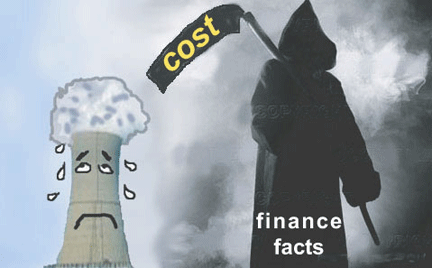
The deal speaks volumes about Mr. Crane’s view of the nuclear business he oversaw before succeeding Mr. Rowe in 2012. Since taking over, he has largely stuck to the nuclear-focused script penned by his predecessor, assuring Wall Street that depressed electricity prices squeezing profits in the nuclear unit will rise in the not-too-distant future. But prices remain stubbornly low, as expanding natural gas supplies reduce costs at gas-fueled electric power plants.
Mr. Crane told investors the deal was an opportunistic move and insists he still expects power prices to rise…………
in the end, it really doesn’t matter if Mr. Crane still believes power prices will recover. His deal for Pepco all but ensures Exelon eventually will sell or spin off its nuclear unit.
Acquiring utility-focused Pepco will reduce power generation to a sideshow at Exelon. Investors sizing up the company will consider nuclear operations an unpredictable outlier and a drag on earnings from the utility business……..
Mr. Crane wouldn’t be the first CEO to give up on power generation. Dominion Resources, Ameren and Duke Energy have sold or are in the process of selling their generating units. And Mr. Crane himself has talked about closing some of Exelon’s most profit-challenged plants. http://www.chicagobusiness.com/article/20140502/BLOGS10/140509964/exelons-next-deal-the-spinoff-of-its-nuclear-fleet
Japanese nuclear utilities call for tax-payer support as they post losses
 Japanese utilities post losses, seek state support Star Online 2 May 14 TOKYO: Japan’s nuclear-reliant utilities reported losses for the third straight year and warned of further electricity rate hikes to pay for surging fuel imports as they face an uncertain outlook for restarting idled reactors.
Six of Japan’s nine big regional power companies, all of which own reactors, reported a combined net loss of US$3.3bil as they face the rising fuel costs and also spend billions of US dollars to  upgrade nuclear facilities to meet new regulatory standards. “We can no longer deny the possibility that we will not be able to restart a nuclear plant for some time,” Kansai Electric Power president Makoto Yagi told an earnings briefing, adding that another electricity rate hike might become inevitable. It raised rates by 9.75% last May.
Kansai Electric, Japan’s second-largest utility by revenue which supplies nearly one-fifth of the nation’s electricity, reported a 97.4 billion yen (US$950mil) net loss for the fiscal year that ended on March 31, its third consecutive year of losses.
Kyushu Electric Power and Hokkaido Electric Power said on Wednesday they would request financial support from the government-affiliated Development Bank of Japan, asking it to buy 150 billion yen in preferred shares in the two utilities.
Kyushu Electric serves Japan’s southern main island which is home to several auto and chip plants, while Hokkaido Electric serves the northern-most island.
The three consecutive years of net losses for utilities will make it difficult for them to secure further private-sector loans under standard Japanese banking practices, pushing firms like Kyushu and Hokkaido to seek public support……..Even in the most optimistic scenario, analysts and industry watchers say Japan may only be able to restart one-third of its reactors, while 17 are unlikely ever to come back online due to their age, location or proximity to suspected active fault lines. — Reuters http://www.thestar.com.my/Business/Business-News/2014/05/02/Japanese-utilities-post-losses-seek-state-support/
TEPCO makes $4.3 Billion Profit
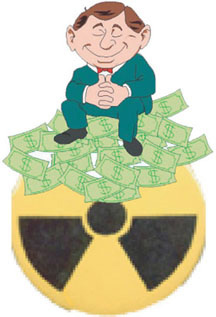 Fukushima Nuclear Plant Operator Tepco Books $4.3 Billion Profit http://www.thejakartaglobe.com/business/fukushima-nuclear-plant-operator-tepco-books-4-3-billion-profit/ By Agence France-Presse Apr 30, 2014 The operator of Japan’s crippled Fukushima nuclear plant said on Wednesday it booked a $4.3 billion annual net profit owing to an electricity rate hike and a massive government bailout following the 2011 disaster.
Tokyo Electric Power (Tepco) was teetering on the brink as cleanup and
 compensation costs stoked huge losses and threatened to collapse the sprawling utility until Tokyo stepped with a multi-billion dollar rescue.
The company at the center of the worst nuclear accident in a generation said it earned 438.65 billion yen ($4.3 billion) in the fiscal year to March, compared with a net loss of 685.3 billion yen in the same period a year earlier.
Sales rose 11.0 percent to 6.63 trillion yen, it said.
The company’s results got a boost from a rate hike, and helped offset a decline in the amount of electricity Tepco sold owing to warmer-than-usual winter weather, it said.
It also booked a special gain of 1.8 trillion yen based on funds the company received from a government-backed bailout fund as well as asset sales.
But it added that rising fossil fuel costs after Japan switched off its nuclear reactors were pressuring its bottom line.
“The business environment that surrounds us remains very serious,” Tepco president Naomi Hirose told a news conference.
The Fukushima plant’s cooling systems were swamped by the 2011 tsunami, sparking reactor meltdowns and radiation leaks.
Tens of thousands of people were evacuated from around the plant with decommissioning of the site expected to take decades.
Renewable energy: GE’s $1 billion investment
According to the division’s CEO, David Nason, renewable power is its fastest growing market and also a good way of spurring sales of GE wind turbines and solar inverter equipment.
“We see renewable energy providing very significant returns going forward,” Nason told Bloomberg.
As part of this the company is actively involved in a range of solar projects with solar panel manufacturer and project developer First Solar. According to Kevin Walsh, the company’s head of power and renewable energy, “There is a very active dialog with First Solar”.
1 This Month





PLEASE OPPOSE HR 8255 AND S.3639 – bills would accelerate satellite deployment, with no environmental review or safeguards – https://ncstd5li.quorum.us/campaign/169331/
To see nuclear-related stories in greater depth and intensity – go to https://nuclearinformation.wordpress.com
-
Archives
- October 2026 (10)
- September 2026 (339)
- August 2026 (330)
- July 2026 (355)
- June 2026 (287)
- May 2026 (306)
- April 2026 (356)
- March 2026 (251)
- February 2026 (267)
- January 2026 (308)
- December 2025 (358)
- November 2025 (359)
-
Categories
- 1
- 1 NUCLEAR ISSUES
- business and costs
- climate change
- culture and arts
- ENERGY
- environment
- health
- history
- indigenous issues
- Legal
- marketing of nuclear
- media
- opposition to nuclear
- PERSONAL STORIES
- politics
- politics international
- Religion and ethics
- safety
- secrets,lies and civil liberties
- spinbuster
- technology
- Uranium
- wastes
- weapons and war
- Women
- 2 WORLD
- ACTION
- AFRICA
- Atrocities
- AUSTRALIA
- Christina's notes
- Christina's themes
- culture and arts
- Events
- Fuk 2022
- Fuk 2023
- Fukushima 2017
- Fukushima 2018
- fukushima 2019
- Fukushima 2020
- Fukushima 2021
- general
- global warming
- Humour (God we need it)
- Nuclear
- RARE EARTHS
- Reference
- resources – print
- Resources -audiovicual
- Weekly Newsletter
- World
- World Nuclear
- YouTube
-
RSS
Entries RSS
Comments RSS

