$1billion Liability Limit for Canada’s Nuclear Industry
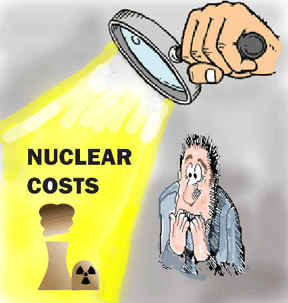
 Canadian Nuclear Industry Accepts $1 Billion Liability Limit OTTAWA, June 5, 2014 /CNW/ – The Canadian nuclear industry told a parliamentary committee today that it accepts a proposed $1 billion liability limit for nuclear accidents.
“The $1 billion limit balances the nuclear industry’s operational needs and the public’s need for an effective liability regime,” Dr. John Barrett, the President and CEO of the Canadian Nuclear Association, told the Commons Standing Committee on Natural Resources.
The $1 billion limit would take effect if Bill C-22, the proposed Energy Safety and Security Act, becomes law. The bill would replace the 1976 Nuclear Liability Act (NLA) with a Nuclear Liability and Compensation Act, and ratify an international treaty providing additional coverage for foreign damage caused by Canadian nuclear operators…
….. the bill’s treaty provisions would enable industry members to operate in other countries, and increase the industry’s economic contributions to Canada…… f Parliament passes Bill C-22, the nuclear industry would encourage the government to increase the number of insurance companies eligible to provide nuclear liability insurance.
Bill C-22 would allow nuclear operators to provide insurance alternatives for up to 50 per cent of their liability. http://www.newswire.ca/en/story/1368049/canadian-nuclear-industry-accepts-1-billion-liability-limit
Uranium companies in a turmoil as analysts forecast prices staying low

 Uranium stocks tumble after RBC takes axe to price forecasts,Financial Post Peter Koven | June 5, 2014 Uranium miners have offered a very consistent message to investors over the past couple of years: The short-term outlook is bad, but don’t worry, a lot more uranium is going to be needed down the road.
RBC Capital Markets Analysts agree. Only they think it will be a much longer road than most.
Analysts Fraser Phillips and Patrick Morton on Thursday sent shudders through the industry as they took an axe to their uranium price forecasts. They cut their 2014 spot price forecast to US$31.50 a pound, down from US$45. And it got worse from there. The 2015 target was cut to US$40 (from US$60), and targets for the 2016 to 2018 period fell to just US$40-US$45 from US$75-US$80. Not surprisingly, shares of every significant uranium company (including Cameco Corp., Paladin Energy Ltd. and Denison Mines Corp.) tumbled on Thursday.
The analysts believe the uranium market is going to be in surplus until 2021, which is far longer than most insiders expect. They blame continuing oversupply in the market.
“Active annual supply exceeds demand by a significant margin, and on top of that, significant excess inventories have been and continue to be accumulated post the Fukushima disaster, particularly in Japan,” they said in a note. It is no secret the uranium market is under pressure. The sector is still reeling from the Fukushima disaster in 2011, and approvals for Japanese reactor restarts are taking longer than expected. The spot uranium price recently fell below US$30 a pound for the first time since 2005…….
The RBC analysts pointed out that mine production has continued to grow during the past two years despite low prices, and that the Japanese restart process has stalled. They believe only four Japanese reactors will restart this year, and just 28 (out of 50) will be online by 2018…….http://business.financialpost.com/2014/06/05/rbc-annihilates-uranium-price-outlook/
Warren Buffett backs revolutionary development in renewable energy
 Buffett’s $28 billion winning bet on clean energy, SMH, June 5, 2014 Warren Buffett’s $US26 billion (A$28 billion) bet on western US power plants, transmission lines and wind farms is poised to pay off.
The energy unit of Buffett’s Berkshire Hathaway, with the help of California’s grid operator, is moving to unite the holdings under a single market capable of dispatching power across seven states every five minutes. The system, designed to handle sudden swings in supply and demand, would revolutionise the markets from Oregon to Nevada, where 38 transmission operators manually balance their territories on an hourly basis.
The move would be a game-changer for the renewables that Berkshire Hathaway Energy has accumulated over the past decade, including two of the world’s largest solar farms, and for other clean-power producers, according to those who trade in the region’s markets. Berkshire’s plants stand to run for longer periods of time, and its NV Energy and PacifiCorp utilities will save as much as $US63.9 million annually by 2017, Energy and Environmental Economics reports show.
“It would be huge if all 38 balancing authorities joined,” Sean Breiner, a market design analyst for energy trader Viasyn, said by telephone June 2. “Instead of having these balkanised regions, you’d have resources from Idaho to Wyoming all flowing into one kind of large spot market.”
Green power……
California has a goal of securing 33 per cent of power from clean energy by 2020. By next year, the California Independent System Operator Corp. expects renewables to meet almost a quarter of demand. In the Northwest, renewables are nearly 7 per cent of total supply, excluding hydropower.
The market, scheduled to start Oct. 1 pending approval from the Federal Energy Regulatory Commission, would use hourly bids from generators to match the cheapest resources with supply, demand and transmission changes every five minutes. It would initially include the territories of the California ISO and PacifiCorp — spanning 42,200 miles of transmission lines in six states from California to Wyoming, extend to NV Energy’s Nevada network a year later and could accommodate all operators in the region…….
Berkshire Hathaway Energy’s spending in the western states included $US10.7 billion to acquire PacifiCorp and NV Energy, $US8.7 billion in renewable investments, a $US6 billion Northwest transmission project and at least $US568 million on the Lake Side natural gas-fired power plant being completed this year in Utah, according to company filings.
Power generators and transmission operators in other parts of the US already participate in real-time markets run by grid operators from the Northeast to Texas. California runs a five-minute market within its own territory. Should all the authorities in the western US join the new system, it would become the nation’s largest geographically.
Analyses prepared by San Francisco-based Energy and Environmental Economics show the real-time market would save the California ISO area as much as $US74.3 million, PacifiCorp $US54.4 million and NV $US9.5 million in the year 2017……….. http://www.smh.com.au/environment/climate-change/buffetts-28-billion-winning-bet-on-clean-energy-20140605-zry0t.html#ixzz33v2NcWMC
Canada’s nuclear industry plans propaganda campaign, especially in schools
Canada’s uncertain nuclear future article is based on Canada’s Nuclear Energy Sector: Where to from here? published by Canada’s Public Policy Forum. 2 June 2014“……One approach to address the concerns of the anti-nuclear movement is to work with environmental NGO leaders, to foster trust and a less-polarised dialogue. Such dialogues will be difficult and will take time: workshop participants said this approach was successful in the forestry sector, but it required much time and effort over two decades. To gain social license and broader acceptance, groups outside the sector will need to initiate the discussions. The start of this dialogue can be seen in the US, with recent efforts by some prominent environmental NGO leaders, who had once been opposed to nuclear.
The often passionate public reaction against nuclear power is a significant challenge. Extensive media coverage of the Fukushima Daiichi disaster in Japan, bad memories of Chernobyl and Three Mile Island, and common misunderstandings around radiation mean the public is often reluctant to embrace nuclear power plant construction or to view nuclear as a viable energy source. A key to success in both the UK and France has been including information about nuclear energy in school curriculums.
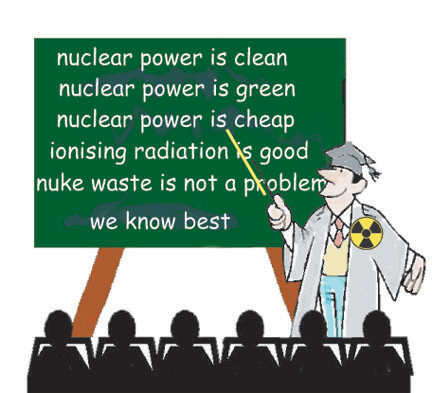
By educating students about nuclear energy, both countries have been successful in helping to dispel myths around safety and security that persist elsewhere. These countries have shown that education could be a useful first step to engaging citizens in a more enlightened discussion on nuclear energy. Given the diverse energy sources in Canada, school boards would be wise to develop science programmes that explore all types of energy and allow students to be exposed to and learn about the positive and negative aspects of all of them.
Doom and gloom now permanent for the uranium industry
We are heading for a uranium crisis , Investor Intel, June 2, 2014 by Robin Bromby“……Welcome to the “perma-gloom” with spot uranium now at $28.25/lb. But it really does portend a very troubling situation. We could be on the brink of a real uranium crisis, one that could have serious ramifications down the road. This is because, on top of all the doubts about nuclear post-Fukushima and the slowness of Japan to get reactors back on line, uranium is caught up in the general malaise affecting the mining industry ……….the uranium price has fallen by 30% over the past year. If it keeps falling, and it well might, more and more companies will either go into hibernation mode or quit the sector all together ……..

A surer sign that all is not well can be evidenced from an ominous trend — exploration companies quitting the sector. Others are making cuts: Cameco closed its Cheyenne office, while BHP Billiton has deferred its expansion at the world’s biggest uranium deposit, Olympic Dam in South Australia. Australia’s Paladin Energy (ASX:PDN) has put one of its mines, Kayelekera in Malawi, on care and maintenance.
Back in 2007-8, after spot uranium hit $137/lb, this was the place to be. Suddenly every mining explorer was keen to be in the uranium hunt. At one stage, more than 260 companies listed on the Australian Securities claimed to have uranium projects (many of them in what the Canadian miners call “moose pasture”).
Now, it seems, those small number remaining can’t wait to get out. FYI Resources (ASX:FYI), which got into uranium after quitting the eye care business (it’s previous name was Freedom Eye) in 2009, is now concentrating on potash in Thailand. Uranex (ASX:UNX) is staying in Tanzania, but has put its uranium on the back-burner in order to pursue graphite.
But possibly the most startling change was reported today. Junior United Uranium (ASX:UUL) which has six projects in Western Australia [and A$3.41 million in the bank as at March 31] is getting out of uranium and into — wait for it — property development.You can’t exactly blame the directors. The shares are trading at a discount to the company assets (the market capitalisation being just A$2 million), all its projects are early-stage ones that will require considerable sums to explore and may not turn out to be viable, no one is investing in the sector, the uranium price is depressed as is the resource sector generally.
Just two weeks ago another uranium explorer working in Western Australia, Prime Minerals (ASX:PIM), signalled it was changing direction. It is merging with Cocoon Data Holdings which has data security software. The news lifted Prime’s stock from A0.9c to A2.2c.
Back in 2007, announcing you were getting into uranium could see your stock price double. Now announcing you’re switching focus away from uranium does the trick. This is not a good trend. http://investor
Dodgy future for Canada’s nuclear industry
 Canada’s uncertain nuclear future article is based on Canada’s Nuclear Energy Sector: Where to from here? published by Canada’s Public Policy Forum. 2 June 2014 “……. over the past two decades declining R&D funding has combined with an absence of new domestic nuclear power plant construction to push the sector into stagnation. Political and public support, once a source of strength and pride for the nuclear industry, has waned to such an extent that it is one of the greatest contributors to nuclear energy’s decline. Recent decisions by political leaders, including moratoria on uranium mining in Quebec, Nova Scotia and British Columbia, Ontario’s hesitancy to build proposed new reactors, and the federal government’s privatisation of the reactor business of Atomic Energy Canada Limited (AECL), are seen by many as evidence that government is now looking to redefine its role in the sector……..
Challenges
The following serious challenges have significantly impaired the industry’s ability to compete in domestic and international markets:
High capital costs. In today’s uncertain economic environment, it is difficult to make the political case that public funds should be committed to large, expensive energy projects that may not come online for nearly a decade. Typically, investment costs of nuclear power plants account for around 60% of total project lifecycle costs.
Unclear foreign investment rules. Organisations that constitute a “strategic asset” to Canada may be barred from foreign purchase or takeover. In fact, the phrase “strategic asset” is not discussed in the Canada Investment Act, but its frequent mention by federal and provincial politicians has created confusion in Canada and abroad. As a result, there is uncertainty around whether foreign entities will be able to purchase Canadian nuclear energy companies and assets, or even compete in the Canadian market. In the absence of a transparent investment framework, it is difficult for international organisations to expand or develop operations in Canada that could generate greater economic growth.
A historical CANDU monopoly places the sector in a niche market.The Canada Deuterium Uranium (CANDU) reactor has been the flagship of Canada’s nuclear energy sector for almost 50 years. But since the nuclear energy market shifted to light water reactors (LWRs) — approximately 30 years ago, when France started procuring LWR technology from the US — heavy water reactors have become a minority technology in the global market.
Acquiring and maintaining social license. Among the greatest challenges facing stakeholders in the nuclear sector is the lack of social license for new nuclear power plants. This concern does not necessarily exist in communities near power plants or uranium mines, but it is a broader perspective within the general population. Concerns around safety, spent fuel storage, and high capital costs have decreased public and political support for large nuclear construction programmes. Fears over nuclear proliferation and plant meltdowns and accidents, like those at Chernobyl, Three Mile Island and Fukushima, are common…..
Few political champions. An important element in any country with a successful nuclear energy programme is leaders who champion the merits of nuclear energy, often at great political risk. Overcoming the concerns of the public is much more difficult without this political support……
US tax-payer is propping up the uranium industry
THE GOVERNMENT IS PROPPING UP THE URANIUM INDUSTRY AND WE’RE PAYING FOR IT http://www.esquire.com/blogs/politics/white-mesa-uranium-mill-lawsuit-053014 The Department of Energy is promoting uranium mining at places like the White Mesa Mill and is tasked with the pricey cleanup. By Leslie Macmillan on May 30, 2014
The Grand Canyon Trust, an environmental group, has sued the operator of America’s last conventional uranium processing mill, saying its vast piles of spent ore and radioactive waste emit dangerous levels of radon and other toxins that violate the Clean Air Act.
The group and other critics of the White Mesa Mill near Blanding, Utah say it is a poorly disguised nuclear waste dump that would have gone out of business long ago were it not propped up by a lucrative federal contracts.
 The uranium market has declined in the wake of the Fukushima meltdown. To stay alive in a depressed market, Energy Fuels Resources, the mill’s operator, recycles mine tailings and radioactive waste — known as “alternate feed” — from Superfund sites around the country. The mill extracts any remnants of uranium from the waste then sells the concentrated, purified uranium, called yellowcake, to its customers, some of which are government-owned utilities obligated to buy White Mesa yellowcake at prices far higher than the $35 a pound it is currently fetching on the spot market. The leftover waste, a toxic stew of industrial chemicals, is stored in open pits called impoundments.
Energy Fuels spokesperson Curtis Moore said the issues raised in the lawsuit “are either inaccurate or have already been addressed through the proper regulatory channels.”
Taylor McKinnon of the Grand Canyon Trust says he hopes the lawsuit will “rip the mill from the rat’s nest of bureaucrats who have been protecting the status quo.”
The mill, he and other critics contend that uranium mining, milling and cleanup has become a virtual cottage industry — one orchestrated largely by the federal government.
During the Cold War period of 1940s through the 1980s, uranium was mined extensively in the Colorado Plateau to supply critical materials for the nation’s nuclear weapons program. The U.S. Department of Energy manages the nation’s surplus uranium and much of the cleanup of old processing mills.
Travis Stills, an energy and conservation law attorney, argues that the DOE’s mandate to “provide a domestic supply of uranium” is outdated and wreaks havoc on environmental and human health. He also says it’s unnecessary. The DOE already owns a uranium stockpile worth $7 to $8 billion.
The DOE doesn’t want to sell off the stockpile, Stills argues, because that would drive uranium prices down. Instead, the government artificially inflates prices to keep the industry going, he says.
Energy Fuels also operates several mines at the Grand Canyon, despite the federal ban on uranium mining there, because it possesses old mining claims that were “grandfathered in.” The company said in December it planned to shutter its Pinenut Mine there as well as the White Mesa Mill in 2014 and potentially reopen them in 2015. It reversed that decision last month and announced it would continue mining, but stockpile the ore pending better market conditions.
Cleaning up uranium is not cheap. The DOE is spending a billion dollars to dispose of tailings at an enormous site near Moab — a cost “born by the taxpayer,” the Trust’s lawsuit points out. On the Navajo reservation alone, there are 500 abandoned uranium mines. The EPA estimates the cleanup cost would be in the hundreds of millions. An $18 million bond has been posted for cleaning up White Mesa Mill when it stops processing uranium — not nearly enough, Stills argues. He says the federal government — and the taxpayer — will be left holding the bag for that cleanup too.
Indeed, the DOE is slated to inherit White Mesa Mill for cleanup. Stills says that the department’s mission, to at once promote uranium mining and oversee its cleanup, is contradictory but that it keeps the agency employed. “It’s bureaucratic make-work,” he says. “As long as they keep making a mess, they’ll need to keep cleaning it up.”
Renewable energy employing 6.5 million people world wide
 IRENA: 6.5 M People Employed in Renewable Energy Worldwide http://dailyfusion.net/2014/05/6-5-m-employed-in-renewable-energy-28962/ May 30, 2014 In 2013, approximately 6.5 million people were already employed in the renewable energy industry worldwide, a new study by the International Renewable Energy Agency (IRENA) reveals.

SEE ALSO: IRENA: Global Renewable Energy Share Can Double by 2030
“With 6.5 million people directly or indirectly employed in renewable energy, the sector is proving that it is no longer a niche, it has become a significant employer worldwide,” said IRENA Director-General Adnan Z. Amin. “The insights into shifts along segments of the value-chain revealed in the report are crucial to developing policy that strengthens job growth in this important sector of the economy.”
Renewable energy employment was shaped by regional shifts, industry realignments, growing competition and advances in technologies and manufacturing processes in 2013. The largest employers by country are China, Brazil, the United States, India, Germany, Spain and Bangladesh, while the largest employers by sector are solar photovoltaic, biofuels, wind, modern biomass and biogas.
Among other updates, the 6.5 million figure published in the annual review reflects growth in Chinese numbers, which can be attributed to a significant increase in annual installation and manufacturing activity and differences in the way employment figures are estimated. IRENA estimates a five-fold increase of solar PV installations in China from 2011 to 2013. Surging demand for solar PV in China and Japan has increased employment in the installation sector and eased some PV module over-supply concerns,” said Rabia Ferroukhi, heading the Knowledge, Policy and Finance division at IRENA and lead author of the report. “Consequently some Chinese manufacturers are now adding capacity.”
In the wind industry, China and Canada provided positive impulses while the outlook for the United States remains somewhat mixed because of political uncertainty. The offshore wind industry is still concentrated in Europe, particularly the United Kingdom and Germany.
The biofuels value chain provides the second largest number of renewable energy jobs after solar PV. The United States remains the largest biofuels producer, while Brazil remains the largest employer.
Corporate executives could be liable for damages for funding climate denialsim
 Big Carbon’s Big Liability Environmental groups have warned directors of fossil fuel companies that they may be held personally liable for misleading the public about climate change. The Nation Dan Zegart May 29, 2014
A new and potentially potent weapon is being unleashed in the climate wars. Yesterday, three major international environmental organizations warned the corporate executives of some of the largest fossil fuel companies that they could be personally liable for damages for funding climate change denialists and working against efforts to slow climate change. Continue reading
No new contracts for 3 Exelon nuclear reactors: they may now close
 Exelon nuclear plants may retire after failing to secure new contracts, Utility DIVE, By Claire Cameron MAY 27, 2014
Dive Brief:
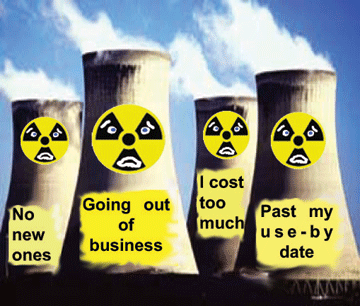
- Three of Exelon’s nuclear power plants failed to get new contracts at the annual PJM Interconnection capacity auction for 2017-18, putting their future at risk.
- The plants, Byron and Quad Cities in Illinois and Oyster Creek in New Jersey, could now close after they were priced out of the market by cheaper competitors. Traditionally, the company has made between $1-8 per megawatt-hour in revenue from the sale of power from these plants.
- This year’s PJM capacity auction saw power supply prices rise from last year’s three year low of $59.37 per MW to $120 per MW.
Dive Insight:
Exelon relies on the capacity auction to keep funding the expensive nuclear facilities it operates. Without contracts, however, the utility could be forced to turn to federal and state regulators for a bailout.
Exelon has yet to seek such a resolution. Prior to the results of the auction being announced, an Illinois House Resolution charging the Environmental Protection Agency, the Federal Energy Regulatory Commission and grid operators to adopt more nuclear-friendly policies was floored. ……http://www.utilitydive.com/news/exelon-nuclear-plants-may-retire-after-failing-to-secure-new-contracts/267503/
The flight of investment – away from uranium
A uranium price collapse has made mining companies radioactive to investors,Quartz By Jason Karaian May 28, 2014 Here’s the latest sign that uranium-mining doesn’t pay: Paladin Energy, an Australian uranium mining group, announced today that it was ceasing production(pdf) at a key mine in Malawi. The move will take 3.3 million pounds of uranium per year off the market.
Paladin is far from alone. As uranium prices have tumbled, others have been feeling the pinch. Indeed, for some 60% of global uranium production, the cost of extraction is higher than the market price for the commodity, the firm says.
Uranium prices have been hit by a series of setbacks in recent years, from a global financial crisis that put a big dent in nuclear power demand, to a glut ofdecommissioned weapons-grade uranium, to the Fukushima nuclear disaster in Japan, which led to the shutdown of all that nation’s nuclear power plants and inspired nuclear phase-outs in places such as Germany and Switzerland.Investors in uranium mines have seen their assets plunge in value:……http://qz.com/213889/a-uranium-price-collapse-has-made-mining-companies-radioactive-to-investors/
Unpalatable price facts hit Wyoming’s uranium industry
Wyoming mines affected by low uranium prices Houston Chronicle, May 29, 2014 CASPER, Wyo. (AP) — Some uranium producers in Wyoming say they’re being affected by weak demand that has caused prices for the nuclear fuel to slip to their lowest level in eight years.
Spot prices for yellowcake are down to $28 per pound. That’s as low as they’ve been since 2006 and down from $75 per pound in 2011………
the current situation is that we have oversupply due to excess inventories,” said Rob Chang, an industry analyst at the New York-based investment firm Cantor Fitzgerald.
Wyoming is among the top uranium-producing states. Wyoming’s uranium mines employ a process of dissolving uranium out of underground deposits and then pumping the ore-containing solution to the surface through wells.
Uranium One has stopped drilling new uranium wells and laid off eight employees since last year, said Donna Wichers, Uranium One vice president for the Americas.
“At $28 a pound you can imagine what that is doing to us,” Wichers said……..http://www.houstonchronicle.com/business/energy/article/Wyoming-mines-affected-by-low-uranium-prices-5514120.php
Curtains for Autralian uranium miner Paladin’s mine in Malawi
Paladin to shut its uranium mine, Australian Mining, 27 May, 2014 Cole Latimer Paladin has announced it will cease production at its Kayelekera uranium mine in Malawi. It comes after the miner advised it would place the operation in to care and maintenance earlier this year. According to Paladin it is ceasing production “due to reasons beyond the company’s control and related to the depressed uranium prices”. On May 21 it halted all operations at the mine, and will now cease supplying uranium to the global market, causing a drop of around 3.3 million pounds of supply per annum. “The outcome is an unfortunate but direct consequence of the continuing deterioration in the uranium price,” the company said in a statement. “Certain estimates now place up to 60% of current annual global production with costs above the current spot price, which is unsustainable.”…..http://www.miningaustralia.com.au/news/paladin-to-shut-its-uranium-mine
Niger still short-changed in new uranium deal with AREVA
 Niger, Areva in hard-won uranium deal, Yahoo 7 Finance, 26 May 14—The government of Niger and French nuclear energy group Areva announced on Monday that they had signed a deal to renew a decades-old agreement for the operation of two uranium mines.
Under the deal, negotiated for 18 months, Areva agreed that a 2006 mining law sharply increasing taxes on mineral extracted would apply to the Somair and Cominak operations in the north of the country which it partially controls.
“We have heard the government’s legitimate call for higher receipts coming from uranium,” said Luc Oursel, Areva CEO, on a visit to Niamey to sign the deal.
However, a joint statement said that the operations would be exempt from sales tax over the course of the five-year deal.
The revenue issue had been the main sticking point in the talks since the government considered that the previous contracts, which expired at the end of last year, were unfavourable to the country, the fourth-biggest producer of uranium in the world.
The French arm of charity Oxfam, which has been a sharp critic of state-controlled Areva’s uranium dealings with Niger, said the new deal continued to shortchange Nigeriens, who stood to lose “10 to 15 million euros a year.” ($13.6 to $20.5 million)……. https://au.finance.yahoo.com/news/niger-areva-hard-won-uranium-085912953.html
AREVA’ s giant new Imouraren uranium mine stalled due to poor market
Areva signs uranium deal with Niger, delays new mine May 27, 2014 By Abdoulaye Massalaki NIAMEY (Reuters) – French nuclear group Areva agreed to a reduction in tax breaks and a rise in royalty rates at its uranium mines in Niger on Monday but said the start of production at its giant new Imouraren mine would be delayed until prices improve……https://au.news.yahoo.com/world/a/23870138/areva-signs-uranium-deal-with-niger-delays-new-mine/
1 This Month





PLEASE OPPOSE HR 8255 AND S.3639 – bills would accelerate satellite deployment, with no environmental review or safeguards – https://ncstd5li.quorum.us/campaign/169331/
To see nuclear-related stories in greater depth and intensity – go to https://nuclearinformation.wordpress.com
-
Archives
- October 2026 (10)
- September 2026 (339)
- August 2026 (330)
- July 2026 (355)
- June 2026 (287)
- May 2026 (306)
- April 2026 (356)
- March 2026 (251)
- February 2026 (267)
- January 2026 (308)
- December 2025 (358)
- November 2025 (359)
-
Categories
- 1
- 1 NUCLEAR ISSUES
- business and costs
- climate change
- culture and arts
- ENERGY
- environment
- health
- history
- indigenous issues
- Legal
- marketing of nuclear
- media
- opposition to nuclear
- PERSONAL STORIES
- politics
- politics international
- Religion and ethics
- safety
- secrets,lies and civil liberties
- spinbuster
- technology
- Uranium
- wastes
- weapons and war
- Women
- 2 WORLD
- ACTION
- AFRICA
- Atrocities
- AUSTRALIA
- Christina's notes
- Christina's themes
- culture and arts
- Events
- Fuk 2022
- Fuk 2023
- Fukushima 2017
- Fukushima 2018
- fukushima 2019
- Fukushima 2020
- Fukushima 2021
- general
- global warming
- Humour (God we need it)
- Nuclear
- RARE EARTHS
- Reference
- resources – print
- Resources -audiovicual
- Weekly Newsletter
- World
- World Nuclear
- YouTube
-
RSS
Entries RSS
Comments RSS

