100,000 renewable energy jobs now in Britain
Renewable energy sector now supports over 100,000 UK jobs by ClickGreen staff. Published Wed 30 Apr 2014 The renewable energy industry has attracted nearly £30 billion of private sector investment since 2010, according to a new joint report published by the REA, Innovas and PwC.
The huge investment has enabled the industry to sustain over 100,000 jobs in 2013, generate turnover last year of £14 billion and deliver 4.2% of UK energy.
The report, REview – Renewable Energy View: 2014, builds on the REA’s 2012 report Renewable Energy: Made in Britain, the first industry-wide analysis of employment in the UK renewable energy industry.

The 116-page paper is the most complete assessment to date of the UK renewable energy market and will be formally launched this evening by Energy Minister Greg Barker in the House of Commons.
REA Chief Executive Dr Nina Skorupska said the report should provide the Government with a reminder of learning from past mistakes and provide market stability.
She added: “This report highlights the close relationship between clear, stable policies and sustained growth and jobs in the renewable energy industry. The Government’s renewable electricity policies have incentivised nearly £28 billion of private investment since 2010, achieving annual growth rates of over 20%. The world’s first Renewable Heat Incentive is also beginning to spur positive growth in green heating. This is a tremendous success story.
“This positive message also comes with a warning. Drastic Feed-in Tariff cuts in 2011/12 led to widespread job losses in the solar industry, and the continued policy uncertainty for renewable transport has seen employment and investment opportunities in UK refineries go begging.
“Clear, stable policies create the investment, jobs and growth in renewables that the UK needs. We urge the Government to learn the lessons from past experiences, such as solar FITs and biofuels uncertainty, and engage closely with industry to resolve outstanding uncertainties, such as State Aid rules and the details of CfDs.”
Analysis by the REA reveals that:
* Renewable electricity generation has grown steadily, increasing on average by 20.3% year-on-year between 2009 and 2013………
Continue reading
Costs of dead San Onofre nuclear reactor – who pays?
Nuclear settlement costs investors $96M By Morgan Lee .APRIL 29, 2014 A San Onofre settlement proposal held back first-quarter earnings at Southern California Edison by $96 million, the Rosemead-based utility said Tuesday in federal financial filings.
The agreement, negotiated between the nuclear plant’s owners and two consumer groups, would hold customers responsible for about $3.3 billion in facility-related expenses and the cost of securing replacement power. The California Public Utilities Commission is considering the proposal amid objections from consumer groups that say the agreement favors investors over utility customers.

Including previous charges last year, Edison estimated the settlement would have a $461 million after-tax impact on its bottom line. Before-tax charges totaled $806 million.
Edison’s first-quarter earnings declined by 35 percent — to $176 million — compared with the same period last year.
Edison is the main owner and the operator of San Onofre. San Diego Gas & Electric owns a 20 percent stake in the plant; it took a $187 million impairment charge last year and said recently that it expects no further write-downs.
Crippled by the rapid degradation of newly installed steam generators, San Onofre stopped producing power on Jan. 31, 2012. Edison chose to retire San Onofre for good in June of last year, leaving state regulators to decide who should pay for an assortment of leftover costs — utility customers or corporate stockholders……..http://www.utsandiego.com/news/2014/apr/29/nuke-settlement-impact-reported/
The demise of the Small Modular Nuclear reactor (SMR) dream
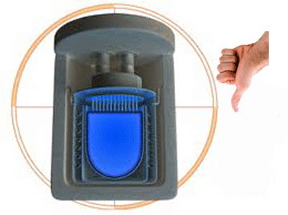 mPower Pullback Stalls Small Nuclear, Forbes, 28 April 14 Richard Martin Nuclear technology supplier Babcock & Wilcox (B&W) has slashed funding for its Generation mPower program, an effort to develop a small modular reactor (SMR) for power generation and other applications. The pullback represents a major blow to the development of SMRs, which have been hailed as the next step forward for the nuclear power industry.
Dead End
All told, B&W, the DOE, and partners have spent around $400 million on the mPower program. Another $600 million was needed just to get the technology ready for application to the Nuclear Regulatory Commission for licensing…..B&W said last year it would seek a majority investor in the project but was unable to secure a buyer. ..
Investment analysts point to the opportunities in solar power
 Solar Power on the Rise The Motley Fool, By Stephen O’Brien April 28, 2014 “…..The obvious solution is to substitute these fossil fuels with solar power. While the technology to harness the sun’s energy is perpetually being upgraded and refined, solar power is gradually becoming the most attractive choice for many consumers to power their homes, and not only for environmental reasons, but often for the lower costs solar energy is affording.
 The corporate sector has also begun to see solar’s advantages. IKEA has committed to becoming a zero-energy company 2020, and has allotted $2 billion for a number of renewable energy endeavors. It has already installed more than 550,000 solar panels. The company is additionally involved in wind energy, and has established a wind farm about a hundred miles south of Chicago and other wind projects in eight countries. In 2013, renewable energy sources accounted for close to 40% of IKEA’s energy usage.
Aside from such moves by a few of the larger corporations, demand for solar power has been increasing significantly in the U.S. residential market. SunPower (NASDAQ: SPWR ) , a U.S. firm headquartered in San Jose, California, has been leasing its solar-panel systems to over 20,000 U.S. customers.
Demand for solar power around the world is also increasing rapidly. SunPower has offices in Europe, Australia, Africa and Asia to meet the growing cries for sun-generated energy. SunPower recently announced that it has begun selling megawatts of cell packages in inner Mongolia, and plans further moves to serve companies and consumers in China.It will have to contend, however, with the Chinese companies that currently serve the Chinese market, the leaders being Trina Solar (NYSE: TSL ) and JinkoSolar (NYSE: JKS ) .
Solar companies are in their early stages of development, and it is unclear who will become the dominant player a few years from now. Currently, there seems to be plenty of growth ahead for a number of solar companies. SunPower is said to have an advantage in that its solar panels are smaller in size and convert energy efficiently, making them well suited for rooftop installations.
Brean Capital recently initiated coverage on the company’s shares and rated them as a buy. SunPower’s stock currently has a forward price to earnings ratio of under 20, and its five-year growth rate in earnings per share looks to be over 30%, making the stock highly attractive to a longer-term investor who don’t mind price volatility. This company is clearly worth considering when investing in the solar sector, and in clean energy generally.
As the world shifts to solar power due to its increasingly cheaper cost or to ward off environmental catastrophe in the years ahead, a great investment opportunity has presented itself. While there certainly are strong competitors to SunPower, there is also a vast market for solar energy, and SunPower is poised to flourish……http://www.fool.com/investing/general/2014/04/28/solar-power-on-the-rise.aspx
Shutting down nuclear power – a process already on the way
U.S. expects about 10 pct of nuclear capacity to shut by 2020 HOUSTON, April 28 Tue Apr 29, 2014 (Reuters) – Lower natural gas prices and stagnant growth in electric demand will lead to the loss of 10,800 megawatts of U.S. nuclear generation, or around 10 percent of total capacity, by the end of the decade, the U.S. Energy Information Administration said in a report issued on Monday.
About 6,000 MW of nuclear capacity will shut by 2020 in addition to six reactors totaling 4,800 MW that have already shut or plan to shut in that time period, the EIA said in its 2014 annual electric output study.
“Retirements often are the result of unique circumstances, but some owners of nuclear power plants have voiced concerns about the profitability of their units,” the EIA said in its report.
Lower natural gas prices that have pared wholesale power prices will hurt profitability for nuclear units and some high-cost reactors will shut as economic challenges mount, the EIA said.
“When faced with declining profitability, plant owners may choose to retire their units rather than make additional investments to keep them operating,” the report said…….
In its 2013 report, the EIA projected only 7,700 MW, or about 7 percent, of nuclear capacity would retire by 2040. The report did not mention the number of units that are likely shut after operating for 60 years after 2029. http://in.reuters.com/article/2014/04/28/utilities-nuclear-eia-idINL2N0NK23D20140428
Collapse of uranium prices forces mining companies to stockpile uranium
Mining companies stockpile uranium near Grand Canyon Mining.Com Cecilia Jamasmie | April 28, 2014 Faced with dropping uranium prices, US mining companies close to the Grand Canyon have begun storing their output as they wait for prices to recover, which has environmentalists up in arms over potential radioactive contamination…….
“The cumulative effects of uranium ore on [nearby waterways] were not anticipated by the original federal environmental review, which really needs to be redone,” he was quoted as saying.
Controversy around Energy Fuels’ project sparked in April last year, after the company announced it was going ahead with its Canyon Mine despite a 20-year ban on new uranium mining claims, passed by the Obama administration in 2012, which applies to the a 1 million-acre area around the park.
The company has clarified the ruling doesn’t affect its plans, as it obtained the rights for it almost two decades ago.
What does affect the company’s plans is the current price of uranium, which has dropped about 25% so far this year…..http://www.mining.com/mining-companies-stockpile-uranium-near-grand-canyon-64493/
$10 billion renewable energy investment by GE Energy Financial Services
 GE bankrolls $10bn renewables http://renews.biz/65461/ge-bankrolls-10bn-renewables/ United States-based GE Energy Financial Services has exceeded $10bn in renewable energy investment commitments worldwide, including $8bn in wind power projects.
The financing agency expects it will continue to invest more than $1bn annually in wind, solar and other renewable energy projects, its fastest-growing energy sector and one that often facilitates sales of GE’s energy technology.
“Our rapid growth in renewable energy investments benefits not only GE’s customers and shareholders but society at large,” said GE Energy Financial Service CEO David Nason.
“These benefits will increase as we execute on a robust pipeline of prospective new investments that provide excellent risk-adjusted returns, serve as a catalyst for the growth of GE’s industrial energy business, and provide customer value.”
GE’s renewable energy projects represent 17GW of generating capacity. Of the more than $10bn in cumulative equity and debt investment commitments, $8bn are in more than 12GW of wind farms and $1.7 billion are in 1GW of solar power installations, with the balance in other renewables.
The projects span 16 countries and 28 states, helping 18 states meet their renewable portfolio standards. The developments create an estimated 10,000 direct US jobs, according to National Renewable Energy Laboratory and GE modeling.
GE capital is working in southern California to complete the 550MW Desert Sunlight solar power project, which uses GE power inverters and is already producing more than 375MW.
It’s also building wind farms in Ireland, Nebraska, Illinois and Texas. The wind farms under construction or completed use more than 4,400 GE turbines.
Nuclear power plants operating license fees to go up
Indian Point nuclear licenses to cost more lohud.com Michael Risinit April 22, 2014 The Nuclear Regulatory Commission collects most of the money in its budget from the nation’s nuclear plants, including Indian Point. our first driver’s license at 16 will cost you $80. A resident hunting license? $22. A license to operate a nuclear reactor? Millions.
While most of your tax dollars go toward the agencies and departments involved with healthcare, defense and the national debt, the Nuclear Regulatory Commission gets most of its money from the industry it oversees. By law, the NRC must recover about 90 percent of its budget from license charges, spokesman Neil Sheehan said.
This year the fee is going up by $938,000. That means Entergy, the owner of Indian Point nuclear power plant, and the country’s other nuclear power companies must pony up $5,328,000 for each running reactor. That money will go back into the U.S. Treasury’s general fund………http://www.lohud.com/story/news/local/indian-point/2014/04/22/nuclear-plant-licenses-costly-indian-point-owner/8004159/
An economic hazard to United Arab Emirates – nuclear power?
Nuclear Power: Boon Or Bane For The GCC?, Gulf Business,
As the UAE and Saudi race to build nuclear reactors to meet mounting energy needs, the inevitable question arises – is nuclear a viable option?, Gulf business By Aarti Nagra 18 April 14
Fuelled by rising energy demand and depleting oil and gas resources, nuclear energy has gained strong momentum in the GCC, particularly in countries like the UAE. The country has lofty ambitions to generate up to 25 per cent of its electricity needs – or 5.6GW – through nuclear means by 2020.
Abu Dhabi began construction of its first nuclear reactor, Barakah 1, in July 2012, and it is in the process of building three more plants.
Emirates Nuclear Energy Corporation, the body responsible for the project, announced in February that the first two plants are on schedule and are up to 35 per cent complete……..However, nuclear energy may not necessarily be the best option for the GCC region, states Mohammed Atif, area manager, Energy Advisory, Middle East at DNV GL – Energy.
“A reasonable diversification of fuels is always beneficial for a region in order to reduce risks and price volatility,” he says.
“The right composition of a generation portfolio is always a difficult question and has to take political, economic, technical and environmental aspects into consideration.
“We would suggest entering into a roadmap to achieve security of supply at a good price level even without nuclear energy.”……….An Oxford report on nuclear power production in the GCC published in December 2012 also pointed out that nuclear power generation could prove an expensive option for GCC states.
“The substantial initial investment costs, coupled with the high expected level of long run variable costs, is unlikely to render nuclear power cost effective vis-à-vis conventional oil and gas fired power plants in the region,” it says.
“The existing absence of cost-recovering power tariffs throughout the GCC already renders effective cost recovery for nuclear power unlikely, implying a substantial bill in the form of nuclear power subsidies to be picked up by GCC governments.”
There are also other hidden costs, such as national and regional security concerns and the future disposal of nuclear waste.
“And the acquisition of nuclear technology by GCC states, albeit for civilian purposes, provides fuel to those critics of nuclear power in the region who fear a nuclear arms race in the Gulf should Iran pursue a nuclear weapons programme in the future.
“All these concerns make nuclear power a potentially costly option for the GCC,” the report cautions………….http://gulfbusiness.com/2014/04/nuclear-power-boon-bane-gcc/#.U1WPalVdWik
Secret deals trapping Turkey into buying Japanese nuclear technology
 Why would the Western authorities allow a country like Turkey to have nuclear plants?
Because it can trap such a nation under secret deals of the colluding powers, expanding and stabilizing their profit-oriented status quo guaranteed by the magic words “national security”
Japanese Nuclear Plants For Sale http://www.opednews.com/articles/Japanese-Nuclear-Plants-Fo-by-Hiroyuki-Hamada-Fukushima-Meltdown_Government-Industry-Collusion_Government-Transparency_National-Security-140417-354.html?show=votes
By Hiroyuki Hamada 17 April 14 I don’t understand why people are not talking about this but here it goes. Japan has been working hard to export nuclear plants. That’s odd, right? After what happened in Fukushima? I mean who would want it? And if you want it, would you get it from Japan?
Here is an interesting fact. Japan has accumulated at least 4000 nuclear warheads’ worth of plutonium, and in fact, it used to export plutonium to England where it was used to make nuclear weapons (1). And that is actually an enormous feat for a nation with a peace constitution that bans wars as a means of conflict resolution, and for a nation with multiple regulations guarding against exporting weapons, which of course stipulate anything nuclear as a big no. What I’m trying to say is that Japan has been very very dishonest about its nuclear policies. The numbers and the facts, which have become available after the accident, state that the nuclear energy has not been as efficient as what has been claimed, while the safety measures and potential risks have not been the primary concerns. In fact some of us now believe that the primary reason why Japan acquired nuclear energy at the first place was to acquire bomb- making capability, along with the lucrative deals guaranteed by the western nuclear authorities (2).
Last year, one of the Japanese parliament members demanded detailed info regarding the export of the nuclear plant to Vietnam. Many of us were stunned to see the disclosed papers completely filled with black rectangles, the contents were pretty much all censored due to national-security concerns (3).
Now, why would anyone want a nuclear plant from Japan? Continue reading
Nuclear companies switch to more lucrative business – closing down reactors
OPG, Westinghouse forge nuclear alliance OPG and Westinghouse will join forces to bid for nuclear projects around the globe Toronto Star, By: John Spears Business reporter, Apr 16 2014
Ontario Power Generation will join forces with Westinghouse to bid for nuclear projects around the globe, the companies announced Wednesday.
The news comes the same week that the Ontario government set up a panel headed by TD Bank chairman Ed Clark to consider privatization – or other strategies – for provincial assets.
OPG is 100 per cent owned by the province.
“Under the agreement, the companies will consider a diversity of nuclear projects including refurbishment, maintenance and outage services, decommissioning and remediation of existing nuclear power plants, and new nuclear power plants,” OPG said a release.
Westinghouse will work directly with Canadian Nuclear Partners, a subsidiary of OPG headed by Pierre Tremblay….http://www.thestar.com/business/2014/04/16/opg_westinghouse_forge_nuclear_alliance.html
Investors wary of South Dakota uranium mining project, and with good reason
Employment boost for South Africa due to renewable energy projects
Green energy IPPs create 14 000 jobs http://www.iol.co.za/business/companies/green-energy-ipps-create-14-000-jobs-1.1675332 April 14 2014 Independent power producers (IPPs) using renewable energy had created about 14 000 jobs over the past three years, Energy Minister Ben Martins said on Friday. “One of the imperatives of government is to ensure that all departments assist in job creation. Through the independent power producers programme, more than 14 000 have been created,” Martins said following a summit with 61 IPPs. “At the meeting, we acknowledged and expressed appreciation of the fact that to date more than R100 billion has been invested into this particular sector.” IPPs are entities which either own and or operate facilities that generate electric power. They then sell the power to a utility, central government buyer or to end users. The meeting was also attended by representatives of the Development Bank of Southern Africa, Eskom and the Public Investment Corporation. Diplomats representing Denmark, Spain, Germany, Norway, and the UK were also present at the Pretoria meeting. Martins said the IPP project had brought significant direct foreign investment. – Sapa
SMR & Thorium proponents desperately promoting their failed plans to Australia

Christina Macpherson’s websites & blogs
While the BHP-funded Grattan Institute and a number of other “authoritative” bodies tout Small Modular Nuclear Reactors (SMRs) – powered by Thorium, for Australia, the bottom is falling out of the SMR project. The big firms involved are pulling out. Westinghouse already has. Babcock and Wilcox will be next.
Lobbyists like the USA’s nuclear front group, the Breakthrough Institute, have worked successfully on Australia’s pro nukers to flog off these (so far non-existent) SMRs to Australia. Note that they leave out the word “nuclear”, knowing that this word gives their project a bad smell.
However, – forget the associated bad smells of terrorism targets, proliferation dangers, waste problems that go with these nasty little nuclear reactors.
The biggy is economics. They just don’t stack up economically. (It’s such bad taste to mention this – but reneweable energy does stack up economically. And when you’re talking about small decentralised power sources – well – solar and wind are obviously the go.)
Small Modular Nuclear Reactors (SMRs) uneconomic: Babcock and Wilcox pulling out?
B&W scales back its small nuclear reactor project, Charlotte Observer, By Bruce Hendersony, Apr. 14, 2014 Charlotte-based Babcock & Wilcox said Monday it will scale back its mPower small modular nuclear reactor program after being unable to attract needed investors or contracts. The president of its mPower subsidiary, Christofer Mowry, left the company as of Sunday, B&W said in a securities filing. Mowry was terminated “without cause,” the filing said. William Fox III will replace him.
Announced in 2009, small modular reactor technology had been the company’s largest research and development project……Babcock & Wilcox announced an “accelerated” search for additional investors in the program last November.
But the project struggled to find additional investors or construction contracts that would bring in enough revenue to continue its development, B&W said Monday……..mPower recorded an $87 million operating loss in 2013, B&W said in a March proxy statement. http://www.charlotteobserver.com/2014/04/14/4841485/bw-scales-back-its-small-nuclear.html
1 This Month





PLEASE OPPOSE HR 8255 AND S.3639 – bills would accelerate satellite deployment, with no environmental review or safeguards – https://ncstd5li.quorum.us/campaign/169331/
To see nuclear-related stories in greater depth and intensity – go to https://nuclearinformation.wordpress.com
-
Archives
- October 2026 (10)
- September 2026 (339)
- August 2026 (330)
- July 2026 (355)
- June 2026 (287)
- May 2026 (306)
- April 2026 (356)
- March 2026 (251)
- February 2026 (267)
- January 2026 (308)
- December 2025 (358)
- November 2025 (359)
-
Categories
- 1
- 1 NUCLEAR ISSUES
- business and costs
- climate change
- culture and arts
- ENERGY
- environment
- health
- history
- indigenous issues
- Legal
- marketing of nuclear
- media
- opposition to nuclear
- PERSONAL STORIES
- politics
- politics international
- Religion and ethics
- safety
- secrets,lies and civil liberties
- spinbuster
- technology
- Uranium
- wastes
- weapons and war
- Women
- 2 WORLD
- ACTION
- AFRICA
- Atrocities
- AUSTRALIA
- Christina's notes
- Christina's themes
- culture and arts
- Events
- Fuk 2022
- Fuk 2023
- Fukushima 2017
- Fukushima 2018
- fukushima 2019
- Fukushima 2020
- Fukushima 2021
- general
- global warming
- Humour (God we need it)
- Nuclear
- RARE EARTHS
- Reference
- resources – print
- Resources -audiovicual
- Weekly Newsletter
- World
- World Nuclear
- YouTube
-
RSS
Entries RSS
Comments RSS

