$US1 billion loan for Japanese solar projects, from Deutsche bank and Goldman Sachs
 Deutsche Bank lends $US1 billion in Japan’s solar gold rush, SMH, July 9, 2014 Chisaki Watanabe and Finbarr Flynn Deutsche Bank plans to lend about $US1 billion ($1.06 billion) for Japanese solar projects, joining Goldman Sachs in funding cleaner energy as the government struggles to restart nuclear power plants after the Fukushima disaster.
The bank is ready to provide financing for three to six projects in the next 12 to 18 months, said Hans Van Der Sande, director of Deutsche Bank’s structured products group at its Tokyo branch. The Frankfurt-based lender agreed last month to provide a 11.1 billion yen ($116 million) loan for a solar power project on a former golf course north of Tokyo to be operated by a unit of Spain’s Gestamp Renewables Corp.
Japan may add the most solar power capacity in the world this year, according to Bloomberg New Energy Finance, as a two- year-old incentive program attracted investors including Goldman Sachs…http://www.smh.com.au/business/carbon-economy/deutsche-bank-lends-us1-billion-in-japans-solar-gold-rush-20140709-zt0uh.html#ixzz378jMBQUy
Solar energy in Japan attracting nuclear workers – for clean, safe, and better paid jobs
Stigmatized nuclear workers quit Japan utility. Bloomberg Business Week, By By Yuri Kageyama July 10, 2014 TOKYO (AP) —”………While TEPCO is out of favor with the public, the skills and experience of its employees that span the gamut of engineers, project managers, maintenance workers and construction and financial professionals, are not.
Energy industry experience is in particular demand as the development of solar and other green energy businesses is pushed along in Japan by generous government subsidies.
Currently the government pays solar plants 32 yen ($0.31) per kilowatt hour of energy. The so-called tariff for solar power varies by states and cities in the U.S., but they are as low as several cents. In Germany, it’s about 15 cents.
Sean Travers, Japan president of EarthStream, a London-based recruitment company that specializes in energy jobs, has been scrambling to woo TEPCO employees as foreign companies do more clean energy business in Japan.
“TEPCO employees are very well trained and have excellent knowledge of how the Japanese energy sector works, making them very attractive,” he said. Two top executives at U.S. solar companies doing business in Japan, First Solar director Karl Brutsaert and SunPower Japan director Takashi Sugihara, said they have interviewed former TEPCO employees for possible posts.
Besides their experience, knowledge of how the utility industry works and their contacts, with both private industry and government bureaucracy, are prized assets.
“It’s about the human network and the TEPCO employees have all the contacts,” said Travers, who says he has recruited about 20 people from TEPCO and is hoping to get more.
Yoshikawa, the former TEPCO maintenance worker, said he has received several offers for green-energy jobs that paid far better than his salary at TEPCO of 3 million yen ($30,000) a year.
Since September 2012, all TEPCO managers have had their salaries slashed by 30 percent, while workers in non-management positions had their pay reduced 20 percent. http://www.businessweek.com/ap/2014-07-10/stigmatized-nuclear-workers-quit-japan-utility
The coming economic disaster for USA’s nuclear towns, starting with Kewaunee
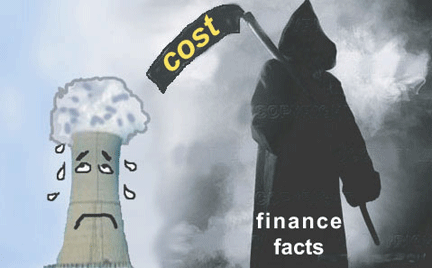 Wisconsin Reactor’s Demise Shows Nuclear Towns’ Plight Bloomberg News By Tim Jones July 08, 2014 “……..The Wisconsin facility is part of what Moody’s Investors Service describes as the largest wave of U.S.-based nuclear and coal electric-plant retirements in the past 35 years. The closings stem from abundant supplies of cheaper natural gas and changes in environmental policies. The consequences can be sudden and drastic, affecting school funding, real-estate values and economic development that were linked to the facilities.
Unlike abandoned industrial plants, which can be retooled for another manufacturer, nuclear plants leave another legacy: radioactive waste, which at the Kewaunee site sits in concrete canisters about 100 yards (91 meters) from Lake Michigan.
“The challenge that local officials have to face is large,” said Julie Beglin, one of the report’s co-authors……..
“It was cheaper to purchase energy on the open market than to produce it at Kewaunee,” said Mark Kanz, a company spokesman. “I’m sure it won’t be the last to close. There will be other plants that go through decommissioning, whether it’s economics or from equipment-related issues.”…….
While the economics of power generation can change, two factors work against the nuclear industry, said David Lochbaum, director of the Nuclear Safety Project at the Union of Concerned Scientists.
“The cost of non-nuclear electricity is trending down,” Lochbaum said, “and the cost of maintaining aging nuclear power reactors is trending up.”……
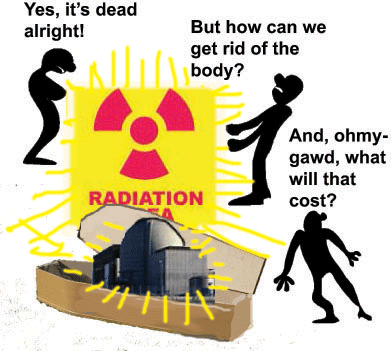 Six Decades The aftermath of a nuclear power plant’s leaving a community is more complicated and lengthy than the end of a conventional industrial facility. Federal regulations governing the decommissioning of sites are designed to protect the public.
The process must be completed within 60 years, according to the Nuclear Regulatory Commission. Seventeen plants, including Kewaunee, are in some phase of decommissioning, the NRC said on its website…….http://www.businessweek.com/news/2014-07-08/wisconsin-reactor-s-slow-motion-end-shows-nuclear-towns-plight
Nuclear colonialism- pushing nuclear sales to Vietnam

Meanwhile, Vietnam Plus of the Vietnam News Agency reported that the US Congress began considering a cooperation proposal on May 9. It has 90 days to consider the issue before making a final decision.
Prior to that, the Vietnamese and US representatives signed a Vietnam-US nuclear cooperation agreement in Hanoi on May 6 (Agreement 123).
Vietnamese officials and scientists have expressed their satisfaction about the agreement.Minister of Science and Technology Nguyen Quan said at the signing ceremony that the agreement can be seen as an open door for both the US and Vietnam to accelerate projects on nuclear energy development…….
 The US Nuclear Energy Institute (NEI) and the US nuclear energy firms have unanimously urged the US Congress to ratify the agreement soon, emphasizing that the strengthened cooperation with Vietnam in the sector would help boost exports and create more jobs.
The US firms can expect to earn $10-20 billion from the deals with Vietnam…..David Durham from GE Hitachi Nuclear Energy (GHE) has warned that if the US Congress does not ratify the agreement, US firms will lose the lucrative market of Vietnam……http://english.vietnamnet.vn/fms/science-it/106944/vietnam-nuclear-power-market-eyed-by-three-major-countries.html
Ever escalating costs of failed Florida nuclear plant
 Trigaux: Failed Florida nuclear plant’s costs keep rising Tampa Bay Times Robert Trigaux 3 July 14, The costs of prematurely closing Crystal River 3 — Duke Energy’s sole nuclear power plant in Florida — keep on rising. Duke Energy recently agreed to a settlement that sent at least $55 million to eight minority owners of “CR3.” That’s the nuke plant Duke closed last year due to a bungled do-it-yourself repair job that the power company finally acknowledged last year would prove too expensive to fix. The bigger settlement sums are going to minority investors like Ocala and the Orlando Utilities Commission. But even smaller towns like Bushnell and Alachua, with small stakes in CR3, will be compensated.
Another $8.4 million will go to nine wholesale customers with contracts to receive electricity from CR3. Those customers range from Homestead, south of Miami, to Bartow in Hillsborough County.
Total payout to minority owners and wholesale customers: $63.4 million.
The 860-megawatt Crystal River plant was expected to operate until 2036. Instead, CR3’s concrete containment wall cracked in 2009. Never restarted, the plant is scheduled to be decommissioned over the next 60 years at a cost topping $1 billion……..
CR3’s demise coincided with a severe state recession that has decreased demand for electricity since 2008.
“We do not need to add more capacity at this time,” McCain said. “But it was important for these cities and utilities to end their ownership and liabilities in Crystal River 3. This settlement transfers ownership back to Duke.”
One more CR3 conflict resolved with big checks. They likely won’t be the last.
$63.4 million: Cashing out of Duke Energy’s closed nuclear plant………..
Contact Robert Trigaux at rtrigaux@tampabay.com or (727) 893-8405. Follow him@venturetampabay. http://www.tampabay.com/news/business/energy/amid-pricey-ripples-from-failed-florida-nuclear-plant-minority-investors/2186912
Impressive growth in renewable energy jobs
Jobs in Renewable Energy Expand in Turbulent Process http://www.investorideas.com/news/2014/renewable-energy/07031.asp New analysis examines global trends in employment in the renewable energy sector

Ideas get bigger when you share them… Washington, D.C. – July 3, 2014 (Investorideas.com renewable energy stocks newswire) There may now be as many as 6.5 million direct and indirect jobs in renewable energy, according to updated data from theInternational Renewable Energy Agency (IRENA). Earlier assessments had put the global estimate at 2.3 million jobs in 2008 (United Nations Environment Programme) and at 5 million jobs in 2012 (International Labour Organization). Although these estimates suggest a strong expansion in employment in renewable energy, the figures also represent successive efforts to broaden data collection across countries and sectors, write Worldwatch Senior Researcher Michael Renner and IRENA’s Rabia Ferroukhi, Arslan Khalid, and Alvaro Lopez-Peña in the Worldwatch Institute’s latest Vital Signs Online trend (www.worldwatch.org).
The overall upward trend in renewable energy jobs has been accompanied by considerable turmoil in some industries. Nowhere are the upheavals more noticeable than in the solar photovoltaic (PV) sector, where intensified competition, massive overcapacities, and tumbling prices have caused a high degree of turbulence in the last two to three years, but they have also triggered a boom in installations. Global PV employment is thought to have expanded from 1.4 million jobs in 2012 to as many as 2.3 million in 2013.
Solar PV has bypassed biofuels (ethanol and biodiesel) as the top renewable energy job generator. Most of the 1.45 million biofuels jobs are found in the growing and harvesting of feedstock such as sugar cane, corn, or palm oil. This involves physically demanding manual work, and workers often contend with oppressive workplace conditions. Processing of the feedstock into fuels offers far fewer jobs, but the ones created are higher skilled and they pay better.
Employment in the next-largest renewables sector, wind power, is estimated to run to some 834,000 jobs. Uncertainty about the future direction of policies in several countries weakened job creation in this field in 2013, leading to a sharp drop in new installations in the United States and to weak markets in large parts of Europe and in India. In contrast, developments in China and Canada were more positive.
Countries that are home to half of the world’s population-China, members of the European Union, Brazil, the United States, and India-account for the bulk of renewable energy employment: 5.8 million direct and indirect (supply chain) jobs out of 6.5 million worldwide.
Better information is necessary for a range of countries to generate a more complete and accurate renewable energy employment picture. Attention is also needed on the question of whether development of renewable energy leads to job loss elsewhere, including in the conventional energy industries.
All in all, available information suggests that renewable energy has grown to become a significant source of jobs. Rising labor productivity notwithstanding, the job numbers are likely to grow in coming decades as the world’s energy system shifts toward low-carbon sources.
Country Highlights from the Report:
- China is the largest employer in the renewable energy sector. The latest estimates by the country’s National Renewable Energy Center suggest almost 1.6 million jobs in the solar PV industry in 2013. Other major sources of renewables employment provide close to 1 million jobs.
- European Union member states had more than 1.2 million renewable energy jobs in 2012. Even though Germany suffered some job losses in 2013, the country remains the dominant renewable energy employer in Europe, with about 371,000 jobs. Spain’s renewables sector has been hit hard by economic crisis and a series of adverse government policy changes. The country suffered a net loss of 23,700 jobs between 2008 and 2012, or 17 percent.
- In Brazil, renewable energy is largely synonymous with sugarcane-based ethanol. A factor of rising importance is the growing mechanization of sugarcane harvesting, which has brought the number of direct jobs down from 460,000 in 2006 to 331,000 in 2012, even as ethanol processing jobs increased.
- In the United States, the number of wind and ethanol jobs has fluctuated, but solar employment has been rising fast. In the wind sector, the stop-and-go nature of the U.S. Production Tax Credit has affected employment, with the 92 percent drop in new wind installations during 2013 resulting in a decline from 80,700 jobs in 2012 to 50,500 jobs in 2013. U.S. ethanol employment fell in 2012 because of rising feedstock prices, reduced yields due to drought, and lower demand, although conditions improved and employment stabilized in 2013. Solar employment was close to 143,000 jobs in 2013, a gain of 20 percent.
- In most other countries, the number of renewable energy jobs is still limited, and often there is simply no reliable information at all.
For more information and to obtain a complimentary copy of “Jobs in Renewable Energy Expand in Turbulent Process,” please contact Gaelle Gourmelon at ggourmelon@worldwatch.org.
About the Worldwatch Institute:
France pushing as nuclear salesman to India
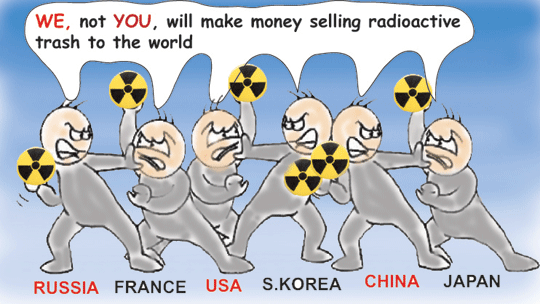 Defence, nuclear reactor deals on agenda for Fabius’ India visit http://www.thenewage.co.za/129938-1020-53-Defence_nuclear_reactor_deals_on_agenda_for_Fabius_India_visit A multi-billion-dollar deal for fighter jets and another for nuclear reactors are expected to be discussed between Indian leaders and French Foreign Minister Laurent Fabius, who arrives in New Delhi later on Sunday.
 The negotiations for six nuclear reactors from French company Areva for the state-run Nuclear Power Corporation’s power plant in Jaitapur in western India was initiated in 2010.
USA’s EPA carbon plan makes coal the loser, but nuclear power loses out, too
 The EPA carbon plan: Coal loses, but nuclear doesn’t win, Bulletin of the Atomic Scientists Mark Cooper. 19 June 14 MARK COOPER The claims and counterclaims about EPA’s proposed carbon pollution standards have filled the air: It will boost nuclear. It will expand renewables. It promotes energy efficiency. It will kill coal. It changes everything. It accomplishes almost nothing.
Evaluating the impact of the so-called Clean Power Plan requires a clear view of how the new rule will work. The plan centers on performance standards, which have yielded effective outcomes in other energy areas—such as appliance efficiency standards and fuel economy standards for light-duty vehicles. It sets a moderate, mid-term target for carbon reductions, but allows for flexibility because it does not dictate the use of specific technologies or products. States are allowed to design programs in response to local conditions.
The EPA plan picks a loser: coal. It does not, however, pick winners among the low-carbon options available. It does not offer much in the way of sweeteners for any specific technology. Assuming that states generally adhere to the prime directive of public utility resource acquisition—choosing the lowest-cost approach—the proposed rule will not alter the dismal prospects of nuclear power, which will therefore play no role in the reduction of carbon emissions from power plants.
EPA’s analysis of the proposed carbon pollution guidelines reflects this reality. EPA forecasts for nuclear power are flat-lined, which means that other resources—including energy efficiency, natural gas, wind, and solar—will carry the full weight of carbon reductions.
It is unlikely that the states will act irrationally enough to make the EPA analysis miss the mark by a wide margin. The marketplace and 48 of the 50 states have declined to embrace nuclear energy during the past decade, despite the incentives included in the Energy Policy Act of 2005……….http://thebulletin.org/epa-carbon-plan-coal-loses-nuclear-doesnt-win7253
New design nuclear reactors will not need much uranium
New nuclear reactors ‘to need much less uranium’ The world’s nuclear watchdog has been told that new generation nuclear reactors will need much less uranium than those currently in service. SBS, Kerry Skyring and Zara Zaher World News Radio 25 JUN 2014
The comments came at a symposium on uranium and the nuclear fuel cycle which the IAEA is holding in Vienna. http://www.sbs.com.au/news/article/2014/06/25/new-nuclear-reactors-need-much-less-uranium
New nuclear power, especially Small Modular Reactors, are the most costly of the low carbon energy options
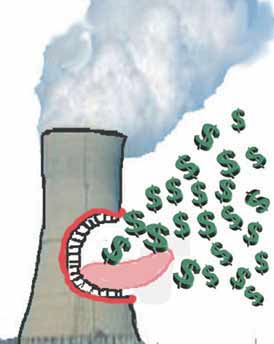 The EPA carbon plan: Coal loses, but nuclear doesn’t win , Bulletin of the Atomic Scientists Mark Cooper. 19 June 14 “………New nuclear capacity would be expensive. The day before the EPA carbon plan was proposed, efficiency was the least costly way to meet the need for electricity. Gas and onshore wind were next. The cost of solar was dropping like a rock, and load factors for wind and solar—the so-called intermittent resources—were rising dramatically, due to technological improvements, the rapidly falling cost of energy storage, and information and control technologies that make it possible to manage fluctuating energy sources on a minute-by-minute basis. The EPA plan does nothing to change the fundamental economics of low-carbon resources in the mid- and long term.
As a result of this economic reality, a boatload of independent analysts—including Lazard, Citi, Credit Suisse, McKinsey & Company, Sanford C. Bernstein, The Motley Fool, Morningstar, and Barclays—not only had concluded that efficiency, renewables, and natural gas would account for the vast majority of resources deployed to meet the need for electricity over the next decade, but also that the model of the electric utility that dominated the 20th century has become obsolete.
The adoption of the climate change rule is likely to reinforce the pressure to modernize the electricity system and, to the extent that it requires more low-carbon resources, it will accelerate this process. In the short term, this might have the effect of raising the cost of electricity slightly, because resources with slightly higher costs will be pulled into the market. On the other hand, because many of the alternative energy sources have not been dominant in the past, accelerating their adoption might actually lower electricity costs, because these energy sources are still at the stage of development where innovation, learning by doing, and increases in economies of scale are dramatically cutting the price.
As I have shown in a number of reports over the past five years, most recently a May 2014 report on small modular reactors, nuclear power in not one of the technologies that will benefit from the emergence of an integrated, two-way electricity system that accommodates decentralized energy production. It remains among the most costly of the low-carbon options and will become relatively more costly as the other technologies develop. The target reduction in carbon emissions under the EPA plan is well within the capacity of the lower-cost alternatives……http://thebulletin.org/epa-carbon-plan-coal-loses-nuclear-doesnt-win7253
New plan to assist Fukushima clean-up is really designed to protect and promote USA nuclear technology sales
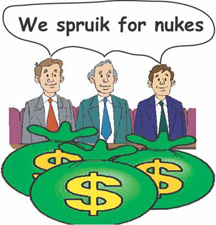 The U.S. is pushing the CSC because its nuclear industry needs new markets, said Tom Vanden Borre, a researcher in nuclear liability law at the Catholic University of Leuven in Belgium.
Countries with plans to build nuclear power plants are important because the U.S. hasn’t had a new atomic plant begin service since 1996, he said.
“It’s merely to protect the American industry and nothing more.”
Fukushima Fires Up Atomic Industry’s Removal-of-Liability Drive http://www.businessweek.com/news/2014-06-12/japan-may-ratify-atomic-treaty-for-u-dot-s- dot-aid-in-fukushima-cleanup By Jacob Adelman June 13, 2014 Japan will introduce legislation this year to ratify a controversial treaty backed by General Electric Co. and other atomic-plant manufacturers seeking protection from damage claims caused by nuclear accidents.
The treaty, known as the Convention on Supplementary Compensation for Nuclear Damage or CSC, will encourage experienced U.S. companies to assist in the cleanup and decommissioning at the Fukushima atomic accident site, Japan’s Foreign Ministry said in a statement today.
Protection from accident claims is needed because of the dangers and risks that remain at Fukushima, said U.S. Deputy Energy Secretary Daniel Poneman in an interview in Tokyo yesterday. The plant has three melted reactors and thousands of tons of radioactive water.
“The important thing is to do everything that we can to facilitate the cleanup and decontamination of the Fukushima site,” Poneman said. The CSC is a means to support U.S. companies in that role, he said.
Poneman was in Tokyo to attend a meeting of the U.S.-Japan Bilateral Commission on Civil Nuclear Cooperation, which was established after the March 2011 accident at Tokyo Electric Power Co. (9501)’s Fukushima Dai-Ichi plant.
The CSC puts all liability for accidents at a nuclear power plant on the operator of the facility. To cover potential damage claims, CSC member countries would each contribute the equivalent of about $465 million. An atomic plant operator would have access to that fund after paying out an equivalent amount itself.
CSC Critics
Critics of nuclear power, environmental group Greenpeace among them, say the CSC acts as a subsidy for atomic power plant makers, such as GE, Toshiba Corp.’s Westinghouse unit and Areva SA of France, by shielding them from accident claims. Continue reading
Individual shareholders in Japan push for withdrawal from nuclear power
 Individual Shareholders of Japan Nuclear Power Plants Want Reduced Reliance on Nuke Energy – Report International Business Times, By Esther Tanquintic-Misa | June 13, 2014 Individual shareholders of Japan‘s nuclear power plants want the government to review the country’s current energy mix to rely less on nuclear energy, a report by the Asahi Shimbun said. Shareholders of Tokyo Electric Power Co (TEPCO) want the company to evaluate and examine its Comprehensive Special Business Plan.
The report noted individual shareholders of Japan‘s nine electric utilities with nuclear power plants had also submitted proposals to strengthen their call ahead of the June 26 annual general shareholders’ meetings of the power companies.
It was the first time that individual shareholders joined in the fray to push for a withdrawal of Japan’s dependence on nuclear power.
However, Asahi Shimbun believed their calls for major changes in policy would fall on deaf ears. These individual shares, when gathered, make up only a small number of total shares.
The bulk of the nine electric utilities’ shareholders belong to financial institutions and other corporate entities…….http://au.ibtimes.com/articles/555644/20140613/shareholders-japan-nuclear-power-plants-reliance-nuke.htm#.U5z0IJRdUnk
By 2020 France’s wind and solar power to be cheaper than its nuclear electricity
 French nuclear more costly than renewables by 2020 – Greenpeace PARIS, June 12 Thu Jun 12, 2014 (Reuters) – Electricity produced by onshore wind and solar plants may become more competitive with power generated by upgraded nuclear plants in France by the end of this decade, a study by environmental group Greenpeace showed on Thursday.
The study comes a week before Energy Minister Segolene Royal presents the broad lines of a much-delayed framework energy law that aims to spell out how France will cut the share of atomic energy to 50 percent from the current 75 percent by 2025.
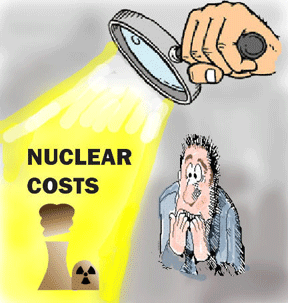 The rising cost of France’s nuclear energy is a concern and the government should set up independent expert institutions to help it plan long-term energy investments, a parliamentary committee said in a report published on Tuesday.
According to the Greenpeace study, the investment needed to upgrade French utility EDF’s 58 nuclear reactors to bring them close to the safety level of a new-generation EPR reactor would raise median production costs to 133 euros ($180) per megawatt-hour (MWh). That estimate, based on an extension of the lifespan of current reactors by 10 years to 50 years and 4.4 billion euros worth of work per reactor, would make nuclear energy less competitive than onshore wind power around 2015, the study said.
Greenpeace also sees the cost of photovoltaic power falling to less than 134 euros/MWh around 2019 from more than 250 euros/MWh today, making it competitive with the renovated French nuclear plants by that time……
French regulator ASN is expected to give a first opinion on whether reactors can be granted life extensions in 2015 and decide reactor by reactor in 2018-2019. ($1 = 0.7345 Euros) (Reporting by Michel Rose; Editing by James Macharia, Larry King) http://in.reuters.com/article/2014/06/12/france-nuclear-idINL5N0OT2LN20140612
Japan joins scramble to sell nuclear technology to India, despite Liability Law
 Japan wants slice of nuclear pie, warms up to liability law Indian Express, by Subhomoy Bhattacharjee , Anil Sasi | New Delhi | June 12, 2014 While Toshiba owns US-based reactor manufacturer Westinghouse, Hitachi is a partner of GE’s reactor business. The deadlock on the liability issue, which had stonewalled progress on the operalisation of nuclear pacts that India had signed with global reactor vendors, is on the verge of being broken.
Japan could offer Prime Minister Narendra Modi a nuclear deal in the civil sector when he travels to Tokyo next month, Hiroshi Hirabayashi, former Japanese ambassador to India and now adviser to Prime Minister Shinzo Abe, indicated.
Russia too is reported to have communicated an “in principle” nod to the Indian nuclear liability law, paving the way for signing a contract for the setting up the third and fourth units of the Kudankulam Nuclear Power Project…….
Japan is a key player in the operationalisation of the commercial nuclear pacts signed by India. Japanese companies are major players in two of the four reactor vendors that have signed preliminary agreements with India for supply of equipment for imported Light Water reactor-based projects planned on coastal sites.
While Toshiba owns US-based reactor manufacturer Westinghouse, Hitachi is a partner of GE’s reactor business.The government has short-listed Toshiba-Westinghouse’s ‘AP1000’ reactors, GE-Hitachi’s ‘ESBWR’ reactors, along with French firm Areva’s EPRs and the Russian firm Atomstroyexport’s ‘VVER’ series reactors, which are already being deployed at Kudankulam. http://indianexpress.com/article/business/business-others/japan-wants-slice-of-nuclear-pie-warms-up-to-liability-law/
Total costs of nuclear power make it uneconomic for South Africa
Long time frames and dodgy numbers justify worry about nuclear power’s cost, Business Report, South
Africa June 10 2014 By Yvette Abraam
“………My chief objection to nuclear power is precisely on the cost issue……….from 2008 to early 2010 nuclear costs were stated to be twice as much by nuclear power vendors than by the state. By early 2011, after a multitude of submissions by civil society, even the state admitted that it had undercosted nuclear power by about 40 percent and included a new estimate. The new estimate remained substantially lower than the two tenders submitted by suppliers.
Yet the amount of nuclear energy planned in the IRP II remains unchanged, despite the variation in costs. International experience rates the cost of constructing nuclear plants at about $6 000 (R63 500) per kilowatt hour.
The South African energy planning process calculated this cost as $3 000 in 2010 and $4 300 in 2011 – on what basis remains a mystery.
The second problem with assembling a budget for nuclear procurement is that the costs of waste disposal and decommissioning are of the same order as the cost of construction, but are beset by large uncertainties. For example, in the 2007/08 annual report and accounts of nuclear power generator British Energy, it was estimated the cost of decommissioning its eight plants was £9.4 billion (R167bn) and the cost of disposing of the spent fuel was £5.5bn.
Although we can estimate the order of magnitude, the actual costs are affected by the choice of technology. As such, it is important to include these costs in a tender since they deeply affect the final choice of bidder. So far these costs have not been included in South African energy planning.
As far as the cost of waste disposal is concerned, it has to be borne in mind that these costs have to be borne for a minimum of two and a half centuries before the waste can safely be neglected. Even a very small error in calculation can lead to very large divergences across this timespan. Under conventional accounting procedure, liabilities that must be met in the future should be discounted.

Effectively, this means that a sum of money (or assets of that value) is set aside now and it is assumed that money will earn interest and grow to meet the liability……..What happens if, as is the case in Germany and Japan, the interest rate is negative? It would mean we have to set aside more money now than will be required in the future.
This example demonstrates the point that the really difficult part of nuclear energy planning is that the amount it is going to cost is not knowable. Calculating the net present value of a 250-year expenditure would require that we could foresee the interest rate and the inflation rate for the next 250 years. But we are citizens, not soothsayers. Anybody who tells you they can predict these costs is talking through their hat. To any suggestion that we should give the approval anyway and trust officials to prevent any unreasonable cost overruns, I have but one word: Nkandla.
* Dr Yvette Abrahams works in the department of women and gender studies at University of the Western Cape and with Electricity Governance Initiative South Africa. http://www.iol.co.za/business/opinion/long-time-frames-and-dodgy-numbers-justify-worry-about-nuclear-power-s-cost-1.1700897#.U5oL1HJdUnk
1 This Month





PLEASE OPPOSE HR 8255 AND S.3639 – bills would accelerate satellite deployment, with no environmental review or safeguards – https://ncstd5li.quorum.us/campaign/169331/
To see nuclear-related stories in greater depth and intensity – go to https://nuclearinformation.wordpress.com
-
Archives
- October 2026 (10)
- September 2026 (339)
- August 2026 (330)
- July 2026 (355)
- June 2026 (287)
- May 2026 (306)
- April 2026 (356)
- March 2026 (251)
- February 2026 (267)
- January 2026 (308)
- December 2025 (358)
- November 2025 (359)
-
Categories
- 1
- 1 NUCLEAR ISSUES
- business and costs
- climate change
- culture and arts
- ENERGY
- environment
- health
- history
- indigenous issues
- Legal
- marketing of nuclear
- media
- opposition to nuclear
- PERSONAL STORIES
- politics
- politics international
- Religion and ethics
- safety
- secrets,lies and civil liberties
- spinbuster
- technology
- Uranium
- wastes
- weapons and war
- Women
- 2 WORLD
- ACTION
- AFRICA
- Atrocities
- AUSTRALIA
- Christina's notes
- Christina's themes
- culture and arts
- Events
- Fuk 2022
- Fuk 2023
- Fukushima 2017
- Fukushima 2018
- fukushima 2019
- Fukushima 2020
- Fukushima 2021
- general
- global warming
- Humour (God we need it)
- Nuclear
- RARE EARTHS
- Reference
- resources – print
- Resources -audiovicual
- Weekly Newsletter
- World
- World Nuclear
- YouTube
-
RSS
Entries RSS
Comments RSS

