No plain sailing for japan’s nuclear restart as Fukushima’s waste problems continue
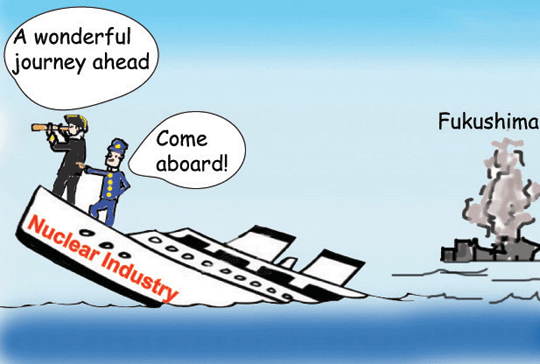 Persistent Nuclear Waste From Fukushima Inhibits Restarts Fukushima’s long-term problems will make public acceptance of a general nuclear restart difficult.http://thediplomat.com/2014/07/persistent-nuclear-waste-from-fukushima-inhibits-restarts/ By Clint Richards July 30, 2014 After months of attempting to negotiate with local residents in Fukushima, the Japanese government has abandoned its attempt to purchase land to store nuclear waste from the stricken Fukushima Daiichi reactors. Storing nuclear waste and preventing groundwater from entering the disaster site continue to be persistent problems for the government, with no clear solution. This inability is a key factor explaining why public sentiment remains so strong against restarting Japan’s nuclear reactors, despite newer and much more robust safety standards from the Nuclear Regulatory Authority (NRA).
Instead of purchasing nearby land, Environment Minister Nobuteru Ishihara and Reconstruction Minister Takumi Nemoto met with Fukushima Governor Yuhei Sato and the mayors of Futaba and Okuma and proposed a 30 year lease for 230 billion yen ($2.25 billion). The Jiji Press reported that local residents had refused to selltheir land because they believed the temporary storage facilities would become permanent if the land was owned by the state. The mayors of the respective towns said they would submit the proposal to their residents, but that it would take time to gain acceptance.
Additionally, on Monday Tokyo Electric Power Co. (TEPCO) finally admitted that an operation underway since May to divert groundwater from entering into reactor buildings was unsuccessful. TEPCO had been attempting to intercept the water before it entered the tainted facilities and divert it into the ocean, but so far “the utility has yet to see tangible results,”according to the Japan Times. There are reportedly 400 tons of water flowing into the contaminated area on average every day, with TEPCO’s operation intended to reduce that amount by as much as 100 tons. Instead, the company hopes to stop groundwater from entering by solidifying the nearby hillside soil with concrete.
The government’s piecemeal approach to the waste problem generated by the Fukushima Daiichi reactors has done little to inspire the confidence of the Japanese population about plans to restart some of its reactors in the coming months. While Kyushu Electric Power Co.’s Sendai nuclear power plant passed the NRA’s new, more stringent safety inspections on July 16, 59 percent of Japanese people oppose the restart, according to an Asahi Shimbun poll conducted July 26 and 27. Even though the Sendai reactors only need to gain local acceptance in order to restart, these poll numbers indicate that a more general restart will continue to be met with resistance. The government has further plans to stem the flow of contaminated groundwater, for instance revamping its “ice wall” beneath the Fukushima Daiichi reactors by adding additional pipes and dumping as much as 10 tons of ice a day. However, until Japanese people feel there is an effective, long-term solution to the nuclear disaster in place, public opposition to nuclear energy will remain.
2014 World Nuclear Industry Status Report released
 Executive Summary: World Nuclear Industry Status Report 2014: Paris, London, Washington, 29 July 2014.
http://www.worldnuclearreport.org/The-World-Nuclear-Industry-Status-Report-2014.html
The world’s nuclear statistics are distorted by an anomaly whose cause is not technical but political. Three years after the Fukushima events started unfolding on 11 March 2011, government, industry and international institutional organizations continue to misrepresent the effects of the disaster on the Japanese nuclear program. In statistical documents on the issue, with the exception of the six units at Fukushima Daiichi, the entire Japanese reactor fleet of 48 units is considered operating. The International Atomic Energy Agency (IAEA) classifies all of these Japanese reactors as “in operation”—11 percent of what the IAEA considers the world nuclear fleet—despite the fact that none of them have generated power since September 2013, only two produced electricity in 2013 and just ten in 2012. The average outage of these Japanese “operational” units is over three years, as this report documents. In fact, three units have not generated power for the past seven years. To find a more appropriate way to deal with this situation, the World Nuclear Industry Status Report 2014 proposes a new category called Long-Term Outage (LTO).
Taking into account reactors in LTO, the number of operational reactors in the world drops by 39 (9 percent) from 427 in July 2013 to 388 in July 2014—50 fewer than at the peak in 2002— and brings world nuclear statistics into closer alignment with reality.
Mycle Schneider, Project Coordinator and Lead Author of the WNISR, states: “It is time to match the international nuclear statistics to the industrial reality. The introduction of the new category Long-Term Outage (LTO) more appropriately represents the operational status of nuclear power plants and provides industry analysts, political decision-makers and investors with a tool that mirrors empirical facts rather than wishful thinking.”
The World Nuclear Industry Status Report 2014 (WNISR) provides a comprehensive overview of nuclear power plant data, including information on operation, production and construction. The WNISR assesses the status of new-build programs in existing as well as in potential newcomer nuclear countries and looks in detail at how the changing market conditions are affecting the economics of nuclear power. WNISR2014 also updates a Fukushima Status Report featured for the first time in 2013 that triggered widespread media and analyst attention. While the Nuclear Power vs. Renewable Energy chapter provides comparative data on investment, capacity, and generation and assesses how nuclear power performs in systems with high renewable energy share.
Finally, a detailed country-by-country analysis provides an overview of all 31 countries operating nuclear power plants, with extended sections on China, Japan, and the United States.
Some of the key features of the World Nuclear Industry Status Report 2014 include:
- Declining role. Nuclear power’s share of global commercial primary energy production declined from the 2012 low of 4.5 percent, a level last seen in 1984, to a new low of 4.4 percent.
- Aging. The average age of the world’s operating nuclear reactors to increase and by mid-2014 stood at 28.5 years.
- Construction Delays. At least 49—including three quarters of the Chinese projects—of the total of 69 construction sites have encountered delays, many of them multi-annual. Construction of two units in Taiwan was halted.
- Project Cancellations. Several projects have been cancelled and new programs indefinitely delayed, including in the Czech Republic and in Vietnam.
- Operating Costs Soar. Nuclear generating costs jumped by 16 percent in real terms in three years in France, and several units are shut down in the U.S. because income does not cover operating costs. The economic survival of nuclear plants is also threatened in Belgium, Germany and Sweden.
- Renewables vs. Nuclear. In 2013 alone, 32 gigawatts (GW) of wind and 37 GW of solar were added to the world power grids. By the end of 2013, China had 91 GW of wind power and 18 GW of solar capacity installed, solar exceeding for the first time operating nuclear capacity. China added four times more solar than nuclear capacity in the past year. And Spain generated more power from wind than from any other source, outpacing nuclear for the first time. It is also the first time that wind has become the largest electricity generating source over an entire year in any country. Spain has thus joined the list of nuclear countries that produce more electricity from new renewables—excluding large hydro-power—than from nuclear power that includes Brazil, China, Germany, India and Japan.
The World Nuclear Industry Status Report 2014 is a © Mycle Schneider Consulting Project.
For further information and full copies of all previous reports see The World Nuclear Industry Status Report 2014.
Lead Authors
Mycle Schneider
Antony Froggatt
Decline in nuclear power as supplier of electricity
 Nuclear power at ‘lowest levels since 80s’ http://www.businessspectator.com.au/news/2014/7/30/energy-markets/nuclear-power-lowest-levels-80s REUTERS , 30 July 14, Atomic power’s share of global electricity supply is at the lowest level since the 1980s following the shutdown of Japan’s reactors after the Fukushima disaster, and may fall further without major new plant construction.
The forecast is one of the main conclusions of the World Nuclear Industry Status Report 2014, a draft copy of which was passed to Reuters before general release later on Tuesday.
The report paints a bleak picture of the industry more than three years after three reactors melted down at Tokyo Electric Power Co’s Fukushima Daiichi station north of the Japanese capital after an earthquake and tsunami.
Rising costs, construction delays, public opposition and aging fleets of reactors will make it difficult for nuclear to reverse the decline in its share of global energy supply, even after two reactors in Japan won provisional approval to restart earlier this month.
Discounting the bulk of Japan’s 48 reactors due to their long-term outage, the report said the number of operating units in the world has fallen to 388, 50 less than the peak in 2002.
Nuclear’s share of global power generation has fallen to 10.8 per cent, down from a high of 17.6 per cent in 1996 and the the lowest since the 1980s, it said.
The report also pointed to delays in construction projects, even in China, where the government is strongly pushing for nuclear power to replace heavy carbon emitting coal stations.
Of the 67 reactors under construction globally as at July 2014, at least 49 were experiencing delays and eight had been under construction for 20 years, it said.
The average age of reactors has also increased, rising to more than 28 years, while more than 170 units, or 44 per cent of the total, have been operating for more than 30 years or more.
“More than 200 reactors may face shutdown in the coming two decades,” Tatsujiro Suzuki, a former Vice Chairman of the Japan Atomic Energy Commission, said in the foreword of the report.
“If new construction pace does not match the pace of shutdown, it is clear that the nuclear share will decline rapidly,” Suzuki said.
Renewable energy is taking up an increasing share of the energy mix, the report said. Installed solar capacity in China topped operating nuclear capacity, while in Spain more power was generated from wind in 2013 than any other source, beating nuclear for the first time.
The report’s lead authors are industry analysts Mycle Schneider, who is based in Paris, and London-based Antony Froggatt. Both have advised European government bodies on energy and nuclear policy issues.
In Japan, where the pro-nuclear ruling Liberal Democratic Party faces strong public opposition to restarts, the nuclear industry won some relief when the Cabinet reversed the previous government policy of a gradual abolition of atomic power.
But it also endorsed a push for more renewables and set no targets for nuclear energy.
Australia’s much hyped Silex uranium enrichment technology bites the dust

| GLE suspends Silex laser treatment of uranium as market bites, Optics.org Matthew Peach |
| 29 Jul 2014 |
| Focus switches to reduced US program after Japanese shutdown narrows market; Silex hopes for resumption when conditions pick up. Silex Systems, an Australian high-tech company developing energy and materials technologies, has announced that the Licensee for Silex’s Uranium Enrichment Technology,GE-Hitachi Global Laser Enrichment, is reducing its funding and commercialisation program of the laser treatment technology in response to “current adverse market conditions” – with the result that related operations in Australia are stopping. GLE will consolidate its efforts on the technology development activities to its Wilmington facility in North Carolina, USA. The Silex annoncement said, “most contractor-based work on the project will be suspended, with the project facility near Oak Ridge, Tennessee to be placed in a safe storage mode, and GLE-funded activities at the laser development facility at Lucas Heights, Sydney, to cease.”……… Dr Michael Goldsworthy, Silex CEO and Managing Director, said, “the global nuclear industry is still suffering the impacts of the Fukushima event and the shutdown of the entire Japanese nuclear power plant fleet in 2011. Demand for uranium has been slower to recover than expected and enrichment services are in significant oversupply.”…….. Media speculationJust two days before the GLE announcement, Australian daily newspaper the Sydney Morning Herald suggested that “With a share price down 65 per cent in the past year, [Silex] is one of the best intelligent speculations on the ASX (Australian Stock Exchange)”, adding, “The enrichment market is expected to be worth US$10 billion by 2019.”http://optics.org/news/5/7/48 |
Russia ramps up marketing nuclear technology to India
 India and Russia hold major consultation to set up 22 nuclear power projects in India By ET Bureau | 30 Jul, 2014 NEW DELHI: India and Russia held major consultation in the realm of nuclear research away from the public eye ahead of Prime Minister Narendra Modi’s meeting with President Vladimir Putin in Brazil in July.
Last month a scientific forum was held at the Joint Institute for Nuclear Research (JINR) in the Russian city of Dubna with .. http://economictimes.indiatimes.com/articleshow/39250290.cms?utm_source=contentofinterest&utm_medium=text&utm_campaign=cppst
Glum future for nuclear industry as wind and solar power get ever cheaper
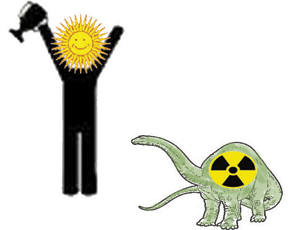 “Even if the government can get over that hurdle, there are many problems to overcome—for example, the designs of the stations have to be finalised. The process could take years, by which time wind, solar and other renewables will have expanded so much it will make nuclear redundant.”
Boom-or-Doom Riddle for Nuclear Industry, truthdig, 27 July 14 “………The figures show that nuclear production is currently in decline from a peak in 2006, and is now producing less than 10% of the world’s electricity needs.
World solar capacity, on the other hand, increased by 35% in 2013, and wind power by 12.5%—although, added together, they still do not produce as much power as nuclear.
All the evidence is that wind and solar will continue to grow strongly, and particularly solar, where technological advances and quantity of production means that prices have dropped dramatically.
Costs of producing energy are hard to compare because solar is small and local and dependent on sunshine, while nuclear is large and distant and must be kept on all the time. However, research suggests that solar is already producing cheaper power per kilowatt hour than nuclear, the costs of which have not come down.
Commercial market
Both costs and time seem to be major factors in deciding which technology will gain market share. Nuclear stations are expensive and a long time passes before electricity is produced, making them almost impossible to finance in a normal commercial market. Solar panels, in contrast, can be up and running in days, and wind turbines within weeks.
Historically, nuclear power plants have always been built with government subsidy—a pattern that is continuing across the world. For example, the two countries with the largest number of reactors under construction—China, with 29, and Russia, with 10—have populations with no democratic say in the matter.
Critics of the WNA figures say that while the claims for reactors planned and proposed might be real, the chances of most of them actually being built are remote.The US is said to have five reactors under construction, five more planned and 17 proposed—but with existing nuclear stations closing because they cannot compete with gas on price, it is unlikely that all of these will be completed by 2030.
The UK, which has a government keen to build nuclear stations, is said to have four stations planned and seven more proposed. The first of these stations was due to be opened by 2017, but work has not yet been started. The earliest completion date is now expected to be 2024, and the rest will follow that.
The delay in Britain is partly because the subsidies offered to French, Chinese and Japanese companies to build the UK reactors are under investigation by the European Commission to see if they breach competition rules.
Massive subsidies
Martin Forward is from the English Lake District, where one of the four nuclear stations is planned, and runs Cumbrians Opposed to a Radioactive Environment. He said: “I cannot see how nuclear has any future in Europe because of cost. Nuclear needs massive subsidies to be financially viable, but these are currently illegal under European law, so it is unlikely that the British ones will be built.
“Even if the government can get over that hurdle, there are many problems to overcome—for example, the designs of the stations have to be finalised. The process could take years, by which time wind, solar and other renewables will have expanded so much it will make nuclear redundant.”…….http://www.truthdig.com/report/item/boom-or-doom_riddle_for_nuclear_industry_20140727
USA’s new nuclear power construction is not working out
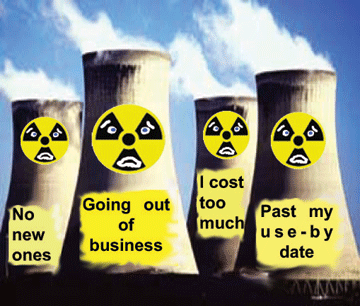
 Promises of easier nuclear construction fall short, Tri City Herald, BY RAY HENRY Associated Press July 26, 2014 WAYNESBORO, GA. The U.S. nuclear industry has started building its first new plants in decades using prefabricated Lego-like blocks meant to save time and money and revive the once promising energy source.
So far, it’s not working.
Quality and cost problems have cropped up again, raising questions about whether nuclear power will ever be able to compete with other electricity sources. The first two reactors built after a 16-year lull, Southern Co.’s Vogtle plant in Georgia and SCANA Corp.’s VC Summer plant in South Carolina, are being assembled in large modules. Large chunks of the modules are built off-site, in an effort to improve quality and avoid the chronic cost overruns that all but killed the nuclear industry when the first wave of plants was being built in the 1960s and 1970s.
Analysts say engineers created designs that were hard or impossible to make, according to interviews and regulatory filings reviewed by The Associated Press. The factory in Louisiana that constructed the prefabricated sections struggled to meet strict quality rules. Utility companies got early warnings but proved unable to avoid the problems. Now the firms leading the project are phasing out the Louisiana factory for work on the biggest modules and contracting with new manufacturers………
Inspectors for the U.S. Nuclear Regulatory Commission halted their first review of the plant the following month, saying it was not ready for in-depth scrutiny. Follow-up inspections found more issues with the plant’s quality assurance programs. NRC officials proposed a $36,400 fine against The Shaw Group for firing a quality insurance supervisor elsewhere in its company who warned a potentially faulty part may have been shipped to a project in New Mexico. The fine was dropped after the company agreed to changes. The agency also said workers at the Lake Charles facility feared raising safety and quality concerns to their supervisors………http://www.tri-cityherald.com/2014/07/26/3079384/promises-of-easier-nuclear-construction.html?sp=/99/915/
Russian firms to star in nuclear materials, nuclear weapons sales festival in London
 Diary: Russians selling nuclear weapons expertise in Westminster? What’s not to like? Reception at Westminster Abbey, gala dinner in Kensington, maybe even a night of top-flight football at the Crabble. Business as usual for Alexander, Lyudmila and comrades, you might say
Will there be a resounding silence in September at the World Nuclear Association symposium and exhibition in Central Hall, Westminster?
The world’s nuclear industries will be strutting their stuff: 700 business and leaders from 30 countries discussing such issues as the fuel cycle front-end (no, me neither), the security of nuclear fuel supplies, financing new builds, and uranium resources. There will be a reception at Westminster Abbey and a gala dinner at the Natural History Museum.
And, to crown it all, a discussion panel. That is due to feature Alexander Lokshin, deputy director general of Rosatom, the organisation that controls Russia’s nuclear weapons companies, research institutes and safety agencies; and Lyudmila Zalimskaya of Tenex, which exports the country’s nuclear materials, such as enriched uranium, and is big in the Emirates and China. So far 34 Russian delegates have booked (last year there were 70), but it’s early days. “We have not been told that they will not be allowed to come,” says an organiser. So, business as usual. Maybe…….http://www.theguardian.com/politics/2014/jul/24/stephen-bates-diary-tenex-crabble
“Going naked” – the nuclear industry’s huge financial risks
Earth Focus Episode 55 – Nuclear Insurance: America Goes Naked
Earth Focus Episode 55 – Nuclear Insurance: America Goes Naked
Fukushima Crisis Total Cost $1 To $10 TRILLION Dollars; via A Green Road
http://agreenroad.blogspot.com/2012/06/fukushima-crisis-total-cost-up-to-10.html
Fukushima Crisis Total Cost $1 To $10 TRILLION Dollars; via A Green Road
http://agreenroad.blogspot.com/2012/06/fukushima-crisis-total-cost-up-to-10.html
$1.9 million bonus to Mexico nuclear dump operator – 5 days after underground fire!
 Operator of New Mexico nuclear dump reaped $1.9 million bonus after underground truck fire http://www.foxnews.com/us/2014/07/20/operator-new-mexico-nuclear-dump-reaped-1-million-bonus-after-underground-truck/ CARLSBAD, N.M. – The contractor that operates the federal government’s underground nuclear waste dump in southeastern New Mexico received a $1.9 million bonus just five days after an underground truck fire closed the facility.
The Albuquerque Journal reported (http://bit.ly/1nLfPmq) Sunday that the U.S. Department of Energy awarded Nuclear Waste Partnership the funds based on an “excellent” job performance in maintaining the Waste Isolation Pilot Plant in Carlsbad.
Some observers say last February’s fire and the radiation leak that followed nine days later show the contractor failed at its job.
Initial probes by federal regulators into both incidents identified a host of management and safety shortcomings.
The Department of Energy says it is not considering revising or terminating its contract with Nuclear Waste Partnership.
The company has a contract to operate the Waste Isolation Pilot Plant through 2017.
China to get “zombie” Canadian nuclear reprocessing, from SNC Lavalin
SNC-Lavalin seeks to expand nuclear enterprise in China SHAWN MCCARTHY – GLOBAL ENERGY REPORTEROTTAWA — The Globe and Mail Apr. 13 2014,SNC-LAVALIN INC. IS HOPING TO REVITALIZE ITS INTERNATIONAL NUCLEAR BUSINESS THROUGH AN EFFORT WITH ITS CHINESE PARTNERS TO BURN REPROCESSED FUEL IN A CANDU REACTOR AS A WAY TO REDUCE RADIOACTIVE WASTE.
Officials from Candu Energy Inc. are leading a Canadian nuclear industry mission to China this week, which will include a visit Monday to the Qinshan nuclear power station south of Shanghai where two heavy-water Candu 6 reactors are in operation. Candu Energy is the former Atomic Energy of Canada Ltd., and is now wholly owned by SNC-Lavalin……..
Critics contend the Candu 6 is an outdated design that lacks safety features included in newer reactors, and that it is a technology that the international marketplace has largely rejected since the 1990s.
“So yeah, the industry is trying to say Candu isn’t dead. Never say die,” said Shawn-Patrick Stensil, a nuclear campaigner at Greenpeace Canada. “If Candu isn’t dead, it’s a zombie.”
Egypt planning nuclear power launch (is that safe?)
Nuclear plant tender to launch by year’s end; winning country to finance project: El-Osery, Daily News Egypt Sara Aggour / July 20, 2014 Egypt is to launch a global tender for its first Dabaa nuclear plant by the end of 2014, said Ibrahim El-Osery, the Ministry of Electricity’s adviser for nuclear energy
Speaking to the Daily News Egypt, El-Osery said the plant will be located in the Matruh governorate, with Egypt paying for the implementation expenses after operations start.
“One of the tender’s conditions is that whoever wins will take the responsibility of financing the project till its implementation,” said El-Osery……..http://www.dailynewsegypt.com/2014/07/20/nuclear-plant-tender-launch-years-end-winning-country-finance-project-el-osery/
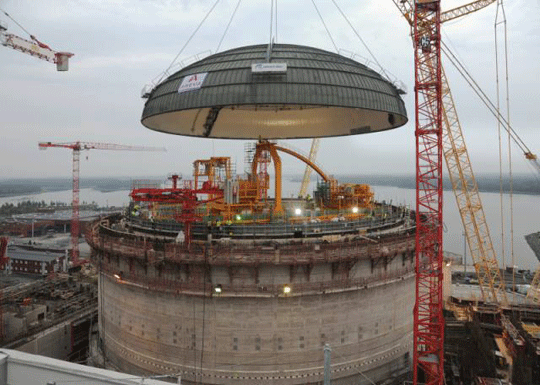
The whopping great financial mess that is Finland’s Olkiluoto nuclear power plant
 French auditors slam Areva for Olkiluoto nuclear project in Finland http://yle.fi/uutiset/french_auditors_slam_areva_for_olkiluoto_nuclear_project_in_finland/7358244?origin=rss 16 July 14, The French nuclear contractor Areva is at the centre of a storm of criticism by French government auditors over its operations. Finland’s Radiation and Nuclear Safety Authority STUK says it still hasn’t received all of the new paperwork relating to nuclear safety for the long-delayed Olkiluoto 3 nuclear power plant currently at a standstill in western Finland. And the company remains locked in a cycle of recrimination with the plant’s owner. A 122-page report by French government auditors has not yet been officially published but the financial paper Les Échos has quoted liberally from the account, which details major fiascos, billion-euro losses and the dissemination of misleading information by the French nuclear power plant contractor Areva.
The progress of the Olkiluoto 3 nuclear reactor in Eurajoki western Finland forms a central part of the narrative. Areva was selected in 2003 — as part of the Franco-German joint venture Areva-Siemens — to deliver the Finnish nuclear reactor.
“Areva was ready to do anything to win the Olkiluoto deal, including downplaying project management deficiencies. They had also previously delivered and commissioned nuclear reactors but they had never undertaken an entire project end-to-end, since the main French contractor had always been the EDF Group (Électricité de France), explained Les Échos editor in chief Pascal Pogam in an interview with Yle’s A-Studio current affairs program.
Based on accounts by parties such as the Olkiluoto owner-operator, the Finnish power consortium Teollisuuden Voima or TVO, Areva is said to have lied about the possibility of constructing a nuclear reactor within the agreed schedule.
“During the time of the Olkiluoto agreement Areva and Siemens (Areva’s former German joint venture nuclear partner) assured TVO that they had the required expertise to see the enterprise through to the end. On hindsight, TVO has speculated that Siemens and Areva minimised their difficulties and covered up their shortcomings to get the deal,” Pogam continued.
Bottomless pit of financial losses However the Olkiluoto reactor turned out to be a bottomless pit of financial losses for Areva, with the project languishing seven years behind schedule and racking up nearly 3.5 billion euros in deficits for the French contractor.
French government auditors took Areva to task for its inability to accurately estimate the cost and timetable required to complete the project.“It’s difficult to blame Areva alone, which is now locked in a futile dialogue with TVO and STUK. The parties can no longer communicate. The future of the project remains wide open because there seems to be no solution to the dispute. Currently Areva and TVO are only communicating via their lawyers. That’s not helping and no one can say when the project will be completed or at what cost,” Pogam remarked.
“According to the report the uncertain situation could get out of hand and the final bill could be massive. However I wouldn’t blame Areva entirely, it’s more a question of each side holding the other to ransom in a situation where each is equally to blame,” Pogam added.
Escalating arbitration battle
For the last couple of years Areva and TVO have been engaged in a pitched arbitration battle before the International Chamber of Commerce, with each side ratcheting up compensation claims over construction delays and unpaid fees.
In late October last year, Areva slapped an additional 700 million euros to bring its claim to 2.6 billion euros for the voided nuclear reactor deal. In its turn, TVO has claimed 1.8 billion euros in compensation for construction delays.
Meanwhile according to the most optimistic estimates the reactor is expected to be ready for firing up at the beginning of next year – many years behind the original completion schedule of 2009. However TVO has said Olkiluoto 3 won’t be operational until one year later in 2016 – and it’s anybody’s guess what the final price tag will be.
Renewabl eenergy providing 6.5 million jobs
 Career in renewable energy? 6.5m jobs for grabs, Emirates 24/7 July 12, 2014 There may now be as many as 6.5 million direct and indirect jobs in renewable energy, according to updated data from the International Renewable Energy Agency (Irena).
Earlier assessments had put the global estimate at 2.3 million jobs in 2008 (United Nations Environment Programme) and at 5 million jobs in 2012 (International Labour Organisation).
Although these estimates suggest a strong expansion in employment in renewable energy, the figures also represent successive efforts to broaden data collection across countries and sectors, reads the Worldwatch Institute’s latest Vital Signs Online trend.

The overall upward trend in renewable energy jobs has been accompanied by considerable turmoil in some industries.
Nowhere are the upheavals more noticeable than in the solar photovoltaic (PV) sector, where intensified competition, massive overcapacities, and tumbling prices have caused a high degree of turbulence in the last two to three years, but they have also triggered a boom in installations.
Global PV employment is thought to have expanded from 1.4 million jobs in 2012 to as many as 2.3 million in 2013……….
All in all, available information suggests that renewable energy has grown to become a significant source of jobs. Rising labour productivity notwithstanding, the job numbers are likely to grow in coming decades as the world’s energy system shifts toward low-carbon sources.
Solar PV has bypassed biofuels (ethanol and biodiesel) as the top renewable energy job generator……….http://www.emirates247.com/news/career-in-renewable-energy-6-5m-jobs-for-grabs-2014-07-12-1.556215
Exodus of nuclear workers from TEPCO
Stigmatized nuclear workers quit Japan utility. Bloomberg Business Week, By By Yuri Kageyama July 10, 2014 TOKYO (AP) — Stigma, pay cuts, and risk of radiation exposure are among the reasons why 3,000 employees have left the utility at the center of Japan’s 2011 nuclear disaster. Now there’s an additional factor: better paying jobs in the feel good solar energy industry.
Engineers and other employees at TEPCO, or Tokyo Electric Power Co., were once typical of Japan’s corporate culture that is famous for prizing loyalty to a single company and lifetime employment with it. But the March 2011 tsunami that swamped the coastal Fukushima Dai-ichi plant, sending three reactors into meltdown, changed that.
TEPCO was widely criticized for being inadequately prepared for a tsunami despite Japan’s long history of being hit by giant waves and for its confused response to the disaster. The public turned hostile toward the nuclear industry and TEPCO, or “Toh-den,” as the Japanese say it, became a dirty word.
Only 134 people quit TEPCO the year before the disaster. The departures ballooned to 465 in 2011, another 712 in 2012 and 488 last year. Seventy percent of those leaving were younger than 40. When the company offered voluntary retirement for the first time earlier this year, some 1,151 workers applied for the 1,000 available redundancy packages.
The exodus, which has reduced staff to about 35,700 people, adds to the challenges of the ongoing work at Fukushima Dai-ichi to keep meltdowns under control, remove the fuel cores and safely decommission the reactors, which is expected to take decades……
The factors pushing workers out have piled up. The financial strain of the disaster has led to brutal salary cuts while ongoing problems at Fukushima, such as substantial leaks of irradiated water, have reinforced the image of a bumbling and irresponsible organization…….http://www.businessweek.com/ap/2014-07-10/stigmatized-nuclear-workers-quit-japan-utility
1 This Month





PLEASE OPPOSE HR 8255 AND S.3639 – bills would accelerate satellite deployment, with no environmental review or safeguards – https://ncstd5li.quorum.us/campaign/169331/
To see nuclear-related stories in greater depth and intensity – go to https://nuclearinformation.wordpress.com
-
Archives
- October 2026 (10)
- September 2026 (339)
- August 2026 (330)
- July 2026 (355)
- June 2026 (287)
- May 2026 (306)
- April 2026 (356)
- March 2026 (251)
- February 2026 (267)
- January 2026 (308)
- December 2025 (358)
- November 2025 (359)
-
Categories
- 1
- 1 NUCLEAR ISSUES
- business and costs
- climate change
- culture and arts
- ENERGY
- environment
- health
- history
- indigenous issues
- Legal
- marketing of nuclear
- media
- opposition to nuclear
- PERSONAL STORIES
- politics
- politics international
- Religion and ethics
- safety
- secrets,lies and civil liberties
- spinbuster
- technology
- Uranium
- wastes
- weapons and war
- Women
- 2 WORLD
- ACTION
- AFRICA
- Atrocities
- AUSTRALIA
- Christina's notes
- Christina's themes
- culture and arts
- Events
- Fuk 2022
- Fuk 2023
- Fukushima 2017
- Fukushima 2018
- fukushima 2019
- Fukushima 2020
- Fukushima 2021
- general
- global warming
- Humour (God we need it)
- Nuclear
- RARE EARTHS
- Reference
- resources – print
- Resources -audiovicual
- Weekly Newsletter
- World
- World Nuclear
- YouTube
-
RSS
Entries RSS
Comments RSS

