Nuclear industry’s survival hangs on tax-payer funding – World Nuclear News
 Banking on nuclear, World Nuclear News, 18 August 2014The nuclear industry needs to satisfy the multi-criteria approach to risk that banks take when they decide whether to invest in a large infrastructure project. Only then, can it expect to attract this form of financing to nuclear new build projects, writes Ron Cameron.
Specifically, banks look for long-term certainty on price, stable government policy, industry reputation, regulatory certainty, the process for addressing planning and environmental issues and public acceptance, in addition to the economics of the project.
European wholesale electricity markets are currently not favourable to nuclear power,……..
there is a real difficulty in seeing where nuclear new build is going to come from in Europe, without government action. ……the UK is trying to do something about the market disadvantage which is keeping investors away from nuclear. ……
Other countries, too, are making clear that the State is behind nuclear new build. For example, in the US, new nuclear power plants are being built with loan guarantees and tax credits. …….http://www.world-nuclear-news.org/E-Banking-on-nuclear-1808201401.html
Banks won’t lend for new nuclear projects. Industry wants tax-payers to fund them
Banking on nuclear, World Nuclear News, 18 August 2014 “……..Banks are reluctant to become involved with first-of-a-kind projects, whether that concerns a new reactor technology or a country embarking on nuclear power for the first time.

Our focus then should perhaps be on trying to get banks into new projects at existing sites, such as plant life extensions. The latter is a lower risk process because the banks would be funding the cost of upgrades needed for plants whose construction costs have been essentially amortized and yet which could run for another 20 years.
And there are usually no great public concerns attached to life extensions, since the plant has already operated for some time. If the banks got involved with those and became familiar with nuclear industry issues, then they could one day be willing to join a consortium in new build projects. Banks look particularly at the track record of the industries that they are working with. And of course there is always the concern of delays for them. So some certainty that the government is behind these projects and prepared to support them with some form of guarantee is important………
Banks also monitor public opinion, but even more importantly, the World Bank, Asian Development Bank and the European Investment Bank are driven by the appetite from their member countries for financing nuclear power projects. It is up to the consortia of countries that are in favour of nuclear power to have more of a say on the banks’ boards. http://www.world-nuclear-news.org/E-Banking-on-nuclear-1808201401.html
Europe’s aging reactors: increasing safety and cost problems
 With exposure to radiation, high temperatures and pressure, the components of nuclear plants take a battering over time. “They can, for example, become more brittle, susceptible to cracking or less able to cope with temperature extremes,” said Anthony Froggatt, senior research fellow at London-based thinktank Chatham House.
Insight: The cost of caring for Europe’s elderly nuclear plants LONDON (Reuters)
 18 Aug 14, – Europe’s ageing nuclear fleet will undergo more prolonged outages over the next few years, reducing the reliability of power supply and costing plant operators many millions of dollars.
Nuclear power provides about a third of the European Union’s electricity generation, but the 28-nation bloc’s 131 reactors are well past their prime, with an average age of 30 years.
And the energy companies, already feeling the pinch from falling energy prices and weak demand, want to extend the life of their plants into the 2020s, to put off the drain of funding new builds…….
as nuclear plants age, performance can suffer, and outages – both scheduled and unplanned – rise.
With nuclear safety in the spotlight since the 2011 reactor meltdown at Japan’s Fukushima plant – which in turn prompted Germany to call time on its entire nuclear fleet – operators can take no chances with their elderly plants, but the outages get longer and more difficult.
“These reactors were designed over 30 years ago. The people involved are either retired or dead, and most of the companies involved no longer exist,” said John Large, an independent nuclear engineer and analyst who has carried out work for Britain’s Atomic Energy Authority.
Jean Tandonnet, EDF Group’s nuclear safety inspector, said in January that its French fleet last year had a series of “problematic unit outages”, and scheduled outages were extended by an average of more than 26 days. Regular maintenance and major equipment replacement jobs had increased by 60 percent in the last six years, he said. France is the EU’s nuclear leader, its 58 reactors producing nearly three quarters of the country’s electricity. France’s nuclear watchdog will make a final decision on whether to extend the life of the French fleet to 50 years in 2018 or 2019. EDF has estimated the extension would cost 55 billion euros.
“The average age of the (French) reactors is now about 30 years, which raises questions about the investment needed to enable them to continue operating, as ageing reactors increasingly need parts to be replaced,” according to the World Nuclear Industry Status report 2014.
SAFETY FIRST
Though the EU has conducted risk and safety tests on the bloc’s nuclear plants, environmental campaigners say the tests failed to address risks associated with ageing technology, among other things.
With exposure to radiation, high temperatures and pressure, the components of nuclear plants take a battering over time. “They can, for example, become more brittle, susceptible to cracking or less able to cope with temperature extremes,” said Anthony Froggatt, senior research fellow at London-based thinktank Chatham House.
“While this can be monitored, it can be problematic if ageing occurs at a greater rate than anticipated or it occurs in areas which are difficult to access or monitor,” he added.
As reactors age, there is also a risk of finding a generic design flaw that could affect all the reactors in a country if they are of the same design. ………..Additional reporting by Barbara Lewis in Brussels and Geert de Clercq in Paris; Editing by Will Waterman) http://www.firstpost.com/world/insight-the-cost-of-caring-for-europes-elderly-nuclear-plants-1668443.html
Expensive delays pile up for USA’s new nuclear plants in Georgia andSouth Carolina
 Delays for SC nuclear plant further pressure industry; questions over potential delays in Ga. ATLANTA -Nanaimo daily news, 17 Aug 14, Expensive delays are piling up for the companies building new nuclear power plants, raising fresh questions about whether they can control the construction costs that crippled the industry years ago.

The latest announcement came this week from executives at SCANA Corp., which has been warned by its builders the startup of the first of two new reactors in South Carolina could be delayed two years or more. SCANA Corp. and plant co-owner Santee Cooper have not accepted that timeline from the companies designing and building the reactors, nor have they accepted responsibility for additional costs.
That announcement may well foreshadow more delays for a sister project in eastern Georgia, and they have caught the attention of regulators and Wall Street.
“Delays generally cause cost increases, and the question becomes who’s going to bear the costs?” said C. Dukes Scott, executive director of the South Carolina Office of Regulatory Staff, a watchdog agency that monitors SCANA Corp.’s spending.
None of this is helpful for the nuclear power industry, which had hoped its newest generation of plants in Georgia and South Carolina would prove it could build without the delays and cost overruns so endemic years ago. When construction slows down, it costs more money to employ the thousands of workers needed to build a nuclear plant. Meanwhile, interest charges add up on the money borrowed to finance construction.
A single day of delay in Georgia could cost $2 million, according to an analysis by utility regulators. Utility consumers often end up paying for these extra charges in the form of pricier electricity bills, unless the government intervenes and forces shareholders to absorb all or some of the losses………
Additional delays could prove unwelcome news for two pro-nuclear Republicans seeking re-election in November to Georgia’s Public Service Commission, H. Doug Everett and Lauren “Bubba” McDonald. -……….http://www.nanaimodailynews.com/business/delays-for-sc-nuclear-plant-further-pressure-industry-questions-over-potential-delays-in-ga-1.1316089#sthash.Yp8aLYvT.dpuf
Geriatric disorders in old nuclear reactors – Britain, France and Belgium
Insight: The cost of caring for Europe’s elderly nuclear plants LONDON (Reuters) 18 Aug 14
“…………...GERIATRIC DISORDERS Britain has 16 reactors in operation that came online from the 1970s to 1990s, and all but one will be retired by 2023 unless they get extensions.
At the Wylfa plant in Wales – Britain’s oldest, at 43 years – the one remaining operational reactor was out of service for seven months this year. It was first taken down for maintenance, but the restart was delayed as new problems were discovered.
The reactor is scheduled to be taken out of service for good in September, but operator Magnox is seeking an extension to December 2015.
This week, EDF Energy took offline three of its nuclear reactors at its Heysham 1 and Hartlepool plants in Britain for inspection which are both 31 years old, after a crack was discovered on a boiler spine of another Heysham 1 reactor with a similar boiler design, which had already been taken offline in June. [POWER/GB]
The boilers will be checked for defects with thermal imagery done using robotics, and the firm will know more about what caused the fault after the inspections, which should take around eight weeks, the EDF Energy spokeswoman said. EDF Energy has been incorporating extra checks into its strategy for its ageing nuclear plants since it inherited them from previous operator British Energy, she said.
British Energy was delisted in 2009 following financial collapse. Several unplanned outages had reduced its power output, and its load factor – the ratio of actual output to its maximum capacity – fell to its lowest level of 56 percent in 2009, Britain’s National Archives show.
This compares with EDF’s average load factor for its French nuclear fleet of 73 percent in 2013, which is also down from its highest level of 77.6 percent in 2005, the company’s 2013 results show.
The fleet’s net output of electricity has declined from 429 terawatt hours in 2005 to 404 TWh last year, though this could be for a range of reasons, including weak energy demand.
Apart from reducing the reliability of Europe’s electricity supply, operators stand to lose many millions of euros from a single outage from lost electricity sales alone. Reuters calculations, based on industry estimates of lost daily electricity sales, show the outages at two EDF Energy plants could cost the firm some 155 million pounds during the outages from when they began in June or August to October, not including the costs of inspection and maintenance work.
Industry sources say the lost revenue from the loss of output at a 1 gigawatt plant could reach 1 million pounds a day.
British utility Centrica, which owns 20 percent of EDF Energy’s nuclear fleet, said on Monday the reduction in output would reduce its earnings per share by around 0.3 pence this year.
More than half of Belgium’s nuclear capacity is offline for maintenance. The three closed reactors are 29, 31 and 32 years old.
Though it doesn’t break out the nuclear data separately, statistics from Europe’s electricity industry association Eurelectric show both planned and unplanned outages mostly increased at thermal power plants in eight European countries examined, and periods of energy unavailability increased from around 12.8 percent in 2002 to 18.3 percent in 2011.
As the plants age, that can only increase. Additional reporting by Barbara Lewis in Brussels and Geert de Clercq in Paris; Editing by Will Waterman) http://www.firstpost.com/world/insight-the-cost-of-caring-for-europes-elderly-nuclear-plants-1668443.html
Japan’s nuclear power restart is just not really happening
 After the Fukushima meltdown, Japan’s nuclear restart is stalled, WP By Daniel Aldrich and James Platte August 15 “……Last month, the two reactors at the Kyushu Electric Power Company’s Sendai nuclear power plant were the first to pass new, stricter safety tests, but the actual restart date has been pushed back into the winter of 2015. Residents within 5 km of the plant now have potassium-iodide pills in the event of another accident, and some nine towns within 30 km of the plant have finally designed evacuation plans in case of a meltdown. These changes were a direct result of the Fukushima accident, which also spurred the creation of a new, independent nuclear industry regulator.
The Nuclear Regulation Authority (NRA) replaced a patchwork of bureaucrats who controlled the industry before the disaster — many of whom were simultaneously tasked with promoting the field through incentives and grants to local communities. ……..
Beyond changing the regulatory environment in Japan, the Fukushima meltdowns caused a sea change in public opinion on nuclear power. Before the accidents, some two-thirds of respondents regularly supported increasing the number of nuclear power plants. Now, the same percentage of residents oppose the use of nuclear power in Japan, and a national poll at the end of July found nearly 60 percent of respondents opposed the restart of the Sendai nuclear plant.
Communities that directly host the facilities continue to — with some exceptions — support the restart of these facilities. Their support derives primarily from financial reasons: the central government provides up to $10 million a year to the small, rural, coastal towns that have these projects in their back yards. Research published by one economist showed that even for these communities the actual benefits to individuals vary widely.
But towns more than 5 km from the plant receive few, if any, financial benefits and have been vocal in their opposition to restarts. Further, because of a longstanding gentlemen’s agreement between utilities and local communities, mayors and governors hold unofficial veto power over the process. Without their support, power utilities will be unable to restart their plants…….
all of Japan’s power utilities that operate nuclear power plants are struggling financially, consistently posting large losses since 2011. TEPCO was effectively nationalized to prevent it from failing, and in April, the state-owned Development Bank of Japan announced a total of nearly$1.5 billion in preferred stock investments into Kyushu Electric Power Company and Hokkaido Electric Power Company. Kyushu and Kansai Electric Power Company both recorded losses of over $900 million last year.
The ultimate question is how many reactors will restart and by when……..
While restarting some reactors will help generate revenue for Japan’s struggling power utilities, the cost of decommissioning about half of Japan’s pre-Fukushima reactor fleet will be significant. Despite the nuclear revival ambitions of the LDP and industrial leaders, Japan’s nuclear sector appears to have a long, difficult road ahead of it. http://www.washingtonpost.com/blogs/monkey-cage/wp/2014/08/15/after-the-fukushima-meltdown-japans-nuclear-restart-is-stalled/
Thorium lobby’s misinformation is hampering rare earths industry
 It’s anybody’s guess how long Thorium, with its “peacenik” aura, will take to get traction in corridors well-trodden by the US nuclear energy lobby, who have singularly shown zero interest in the blandishments of Thorium.
Thorium lobby thunder intent on hijacking rare earths’ coattails Investor Intel August 12, 2014 by Christopher Ecclestone Anyone in the Rare Earths space knows that Thorium frequently appears as an unwanted guest at the party. Explorers have worked on various ways to get around the issue. However there is a small group out there who we would call the “deniers”. They absolutely love Thorium. They are like Swedes liberated from the sauna in the dead of winter and would roll around in the stuff naked, if they could, to prove their commitment. While greater love hath no man to a chemical element than the Thorium crowd to their object of desire, the more measured amongst us realize that the mineral has been stuck for decades like a racehorse suffering a starting-gate malfunction.
What are we talking of here Continue reading
More delays, more cost overruns for South Carolina nuclear power plants

SCE&G nuclear plants facing more delays, cost overruns, The State, South Carolina, BY RODDIE BURRIS rburris@thestate.com August 12, 2014 Two nuclear reactors under construction in Fairfield County are facing another significant delay, utility provider S.C. Electric & Gas confirmed.
The delay will put the $10 billion project at V.C. Summer Nuclear Power plant outside the 18-month contingency allowed by state regulators and likely will drive up the costs, but utility officials said they would not know how much until later this year…….. Continue reading
The Future for Small Modular Nuclear Reactors s does not look promising
 NuClear News August 14 “………The Future for SMRs does not look promising
On costs and safety, solar energy far better than nuclear, for South Africa
 Nuclear plan incomprehensible http://www.bdlive.co.za/opinion/letters/2014/08/05/letter-nuclear-plan-incomprehensible Liz McDaid AUGUST 05 2014 THE Southern African Faith Communities’ Environment Institute (Safcei) shares the government and Eskom’s commitment to service the energy needs of the country and the poor in particular. We therefore find the growing emphasis on and commitment to nuclear energy incomprehensible on economic and moral grounds.
Following Eskom’s revelations to Parliament at the end of last month, Safcei believes that, financially, we cannot afford nuclear energy and calls on the Cabinet to abolish the nuclear focus and expand its renewable energy programme.
According to Eskom, 60% of our power stations are older than the recommended design age of 30 years, resulting in increased breakdowns and need for maintenance.
Life extensions and environmental retrofits will require between R50bn and R260bn. Eskom is looking to claw back additional revenue through more electricity tariff increases. Yet poor communities struggle to afford electricity right now.
According to Deputy President Cyril Ramaphosa, we will find additional finances to build new nuclear energy plants. Given that the cost of nuclear has been put at R1-trillion, who will provide the money?
By contrast, globally, a record of 39GW of new solar photovoltaic capacity was installed last year, which required less financing than in 2012, when only 31GW was deployed. In South Africa, renewable energy plants have added 1,300MW to the grid in just less than two years (with a further 1,200MW expected by end of next year.).
As people of faith, we express our deep concern that our public policies are not in line with the best options for preserving our natural environment, saving energy and alleviating poverty. Safcei believes therefore that there is an ethical imperative to expand renewable energy, which is cheaper to build, has zero fuel costs and can provide sustainable, affordable energy for the people of South Africa.
Public Enterprises Minister Lynne Brown says she is hoping to appoint a CEO for Eskom in the next few weeks. If the government is serious about addressing the Eskom crisis, it needs to direct the utility to abandon 19th-century thinking and catch up with the 21st century.
We therefore call on Ms Brown to appoint someone who can consider the long-term energy needs of the country. Appointing a renewable energy expert as a CEO would be a good first step.
Industry and Energy Business taking note of World Nuclear Status Report
Nuclear is generating less of world’s power; renewables are accelerating, MINN Post By Ron Meador 6 Aug 14, At best, nuclear power accounted for only 10.8 percent of the world’s electricity last year — down from a peak of 17.6 percent in 1996 — and faces a difficult future in at least the short term because the world’s reactor fleet is aging, while new projects are burdened by high costs and construction delays.
So says last week’s World Nuclear Industry Status Report 2014, which so far is getting more attention in business and power-industry publications than in general media…….. The report’s chief author is Mycle Schneider…his consulting clients have included the International Atomic Energy Agency, the French and German environment ministries, the Belgian energy ministry and members of the European Parliament.
The IAEA has distributed his reports in the past; some have been reprinted in the Bulletin of the Atomic Scientists. This year’s report has gained attention from U.S. News & World Report, hardly a journal for lefty, anti-nuke bunny-huggers, as well as Power, concerned with “business and technology for the global generation industry.”
And Power’s take on the Schneider analysis, by the way, is that the true decline is even steeper than stated above. It leads with statistics putting nuclear’s share of “global commercial primary energy production” — which does sound like the thing you’d really want to measure — at 4.4 percent last year, “a level not seen since 1984.”………..
-
The average age of the world’s operating nuclear fleet has increased to 28.5 years with over 10% of the total having operated for over 40 years.
-
While 67 reactors are under construction in 14 different countries, at least 49 of them have encountered construction delays, with eight being “under construction” for more than 20 years.
-
“Newcomer countries” have seen delays in development, with Belarus the only nation to have “an actual construction project” while Bangladesh, Jordan, Lithuania, Poland, Saudi Arabia, Turkey, and Vietnam aren’t that far along as yet.
-
Capital costs for construction have escalated from roughly $1,000 per installed kilowatt a decade ago to what is expected to be around $8,000 per installed kilowatt for two new units at the Hinkley Point facility in the UK……..
In 2013 alone, 37 gigawatts of solar and 32 GW of wind capacity were added throughout the world. In contrast, nuclear capacity has declined by 19 GW since 2000. Again, much of that decrease is due to Japanese reactors being placed in LTO, but even with those reactors considered operational, nuclear capacity would only have increased 17.5 GW during the 14-year period………
Schneider’s own view:
It is time to match the international nuclear statistics to the industrial reality. The introduction of the new category Long-Term Outage more appropriately represents the operational status of nuclear power plants and provides industry analysts, political decision-makers and investors with a tool that mirrors empirical facts rather than wishful thinking……..
Industry prefers other stats
Neither U.S. News nor Power sought industry comment on the Schneider analysis but — interestingly — Climate Central’s blogger Bobby McGill did, and neither spokesman he interviewed actually took issue with Schneider’s methods or measures, including LTO. They just prefer different, more nuke-favorable ones:……… http://www.minnpost.com/earth-journal/2014/08/nuclear-generating-less-worlds-power-renewables-are-accelerating

Delay in plans to restart Sendai nuclear reactors
 Restart of Sendai reactors unlikely before winter Japan Times 5 Aug 14 Kyushu Electric Power Co. said Tuesday it won’t be able until late September or October to submit documents necessary for regulatory safety checks of two of its nuclear reactors.
This means it is unlikely that reactors 1 and 2 at the nuclear power station in Sendai, Kagoshima Prefecture, will be restarted before this winter.
Kyushu Electric initially planned to submit the documents, including specific steps to deal with accidents, in late May.
It is expected to take at least several months after the documents are submitted before all required procedures for restarting the reactors can be completed…….http://www.japantimes.co.jp/news/2014/08/05/national/restart-of-sendai-reactors-unlikely-before-winter/#.U-MNaONdUnk
Tough times for nuclear giant AREVA – shares plunge, sales wither
 Areva’s stock plunges on sales warning, solar exit PARIS, Aug 1 (Reuters) – Shares in French nuclear power group Areva closed 20 percent lower on Friday, the worst fall since the company was formed in 2001, as it posted a first-half loss, exited a thermal solar power business and cut sales targets.
The shares were down by as much as 23 percent earlier in the session with trading the busiest by volume since late February, when Areva posted a net loss of nearly half a billion euros.
Chief Executive Luc Oursel dropped a long-held target to sell 10 nuclear reactors by 2016, saying it would “take a few more years” and the firm warned that 2014 revenue would fall 10 percent, more than the 2-5 percent decline forecast in February.
 Areva, which has not sold a new nuclear reactor since 2007, hopes French utility EDF will get the green light from European Union competition authorities this year to build two Areva reactors in Britain, but its reactor sales are suffering badly from the aftermath of the 2011 Fukushima disaster.
Billions of cost overruns and multi-year delays in four projects involving its flagship EPR reactor have also hit the state-owned firm’s image, whileRussian, Korean and American reactor builders are winning orders at its expense……..
Revenue fell 12.4 percent to 3.89 billion euros and earnings before interest, tax, depreciation and amortisation (EBITDA) more than halved to 226 million euros from 487 million.
Oursel said the nuclear market environment had further deteriorated as constructionprojects for new reactors abroad as well as reactor overhaul operations in France had been delayed.
As a supplier to the utilities industry – which is suffering from overcapacity and slack power demand – Areva is feeling the impact of its customers’ efforts to cut costs and is trying to make savings itself to restore profitability.
The firm hiked its cost cut target to 1.2 billion euros from 1 billion and said it would cut 1,500 jobs in Germany by the end of 2015, as well as 200 jobs in the United States this year. It had earlier warned of 1,200 to 1,500 job losses in Germany. http://uk.reuters.com/article/2014/08/01/areva-results-idUKL6N0Q71IK20140801
Nuclear power could vanish in 50 years
The rise and fall of nuclear power, in 6 charts, Vox by Brad Plumer on August 1, 2014,
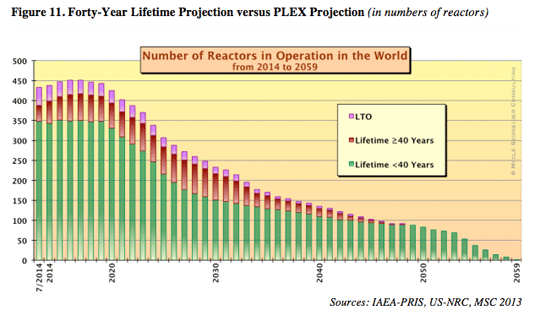
………….Without further action, nuclear power could vanish in 50 years The chart above shows how long the world’s existing reactors are likely to last in the decades ahead. By 2059, most of them are likely to be retired. That means, unless the world goes on a frenzy of new construction, nuclear power will nearly vanish by mid-century.
WE’D NEED TO BUILD 400 REACTORS BETWEEN NOW AND 2059 JUST TO MAINTAIN EXISTING CAPACITY
Here’s how the authors figure: Without new construction, the average age of the world’s nuclear reactors has now reached 28.5 years. Many reactors may shut down once they hit 40 years, although some will likely get extended for longer than that (at a cost of $1 billion or more).
It all depends on the country. In the United States, many reactors were initially licensed to last 40 years, although they can apply for a 20-year extension — and, so far, 72 of the 100 existing reactors have received government permission to keep operating for 60 years.
Eventually, however, all of the world’s current reactors will have to retire — as the chart above shows, the report pegs this date at sometime in the 2050s. That means the world will have to build around 394 additional reactors between now and then just to maintain existing capacity. And if nuclear power is to expand above current levels, we’d have to build more than that. http://www.vox.com/2014/8/1/5958943/nuclear-power-rise-fall-six-charts
Upgrading USA nuclear power is costing $billions
 US nuclear industry spends billions on post-Fukushima upgrades Washington (Platts)–31Jul2014 The US nuclear power industry has so far spent about $3 billion taking actions and making plant modifications to address lessons learned from the 2011 Fukushima I accident in Japan, a utility official told the US Nuclear Regulatory Commission during a briefing Thursday.
NRC ordered US nuclear power plant operators in March 2012, almost exactly a year after the accident, to comply with new requirements designed to strengthen their ability to keep reactors and spent fuel cooled during severe external events, such as the earthquake and tsunami that hit the station in Japan………
Pete Sena, president and chief nuclear officer of FirstEnergy Nuclear Operating Company, told the commission during the briefing Thursday that since the March 2011 accident, in which three of six reactors at Fukushima suffered fuel damage and released radioactivity, FENOC has spent about $125 million to increase the safety margin of the four nuclear power reactors it operates.
If those figures are an accurate average cost for all 100 operating nuclear power reactors in the US, the industry has spent around $3 billion or more on post-Fukushima safety upgrades, Sena said.
Jim Scarola, executive director at NEI and co-chair of the industry’s Fukushima response steering committee, said during the briefing that the industry “does not look at this task as finished. It is a continuous improvement.” …….http://www.platts.com/latest-news/electric-power/washington/us-nuclear-industry-spends-billions-on-post-fukushima-21004195
1 This Month





PLEASE OPPOSE HR 8255 AND S.3639 – bills would accelerate satellite deployment, with no environmental review or safeguards – https://ncstd5li.quorum.us/campaign/169331/
To see nuclear-related stories in greater depth and intensity – go to https://nuclearinformation.wordpress.com
-
Archives
- October 2026 (10)
- September 2026 (339)
- August 2026 (330)
- July 2026 (355)
- June 2026 (287)
- May 2026 (306)
- April 2026 (356)
- March 2026 (251)
- February 2026 (267)
- January 2026 (308)
- December 2025 (358)
- November 2025 (359)
-
Categories
- 1
- 1 NUCLEAR ISSUES
- business and costs
- climate change
- culture and arts
- ENERGY
- environment
- health
- history
- indigenous issues
- Legal
- marketing of nuclear
- media
- opposition to nuclear
- PERSONAL STORIES
- politics
- politics international
- Religion and ethics
- safety
- secrets,lies and civil liberties
- spinbuster
- technology
- Uranium
- wastes
- weapons and war
- Women
- 2 WORLD
- ACTION
- AFRICA
- Atrocities
- AUSTRALIA
- Christina's notes
- Christina's themes
- culture and arts
- Events
- Fuk 2022
- Fuk 2023
- Fukushima 2017
- Fukushima 2018
- fukushima 2019
- Fukushima 2020
- Fukushima 2021
- general
- global warming
- Humour (God we need it)
- Nuclear
- RARE EARTHS
- Reference
- resources – print
- Resources -audiovicual
- Weekly Newsletter
- World
- World Nuclear
- YouTube
-
RSS
Entries RSS
Comments RSS

