UK’s National Audit Office investigating subsidy price for Hinkley nuclear power electricity
 Hinkley C deal goes under scrutiny again Somerset County Gazette, 23 October 2014
ANOTHER investigation into the controversial Hinkley C deal has begun.
Just two weeks ago, the European Commission approved plans for the £16bn nuclear power plant.
They had been investigating whether the subsidy deal between energy company EDF and the Government constituted as illegal State aid.
While the project was approved, the National Audit Office has now begun investigating the deal to make sure the subsidy price of £92 a megawatt hour represented value for money.
The NAO is a financial watchdog which scrutinises public spending on behalf of Parliament……….
The Stop Hinkley Campaign welcomed the news about the investigation. Spokesperson Allan Jeffrey said: “This is an extraordinarily bad deal, locking consumers into high prices until almost 2060.
“Worse still, it will use up most of the money available to subsidise non-fossil fuel energy, leaving almost nothing available for renewables at a time when their costs are plummeting.
“The European Commission’s ill-thought through decision has turned UK Energy Policy into even more of a dog’s breakfast than it was to begin with…….
Energy supplier Ecotricity has said it is considering taking legal action against the deal along with the Austrian Government and Germany………http://www.somersetcountygazette.co.uk/news/11554761.Hinkley_C_deal_goes_under_scrutiny_again/
US Dept of Energy warding research grants to universities

Pitt researchers awarded a nearly $1-million grant for nuclear power safety research By Stephanie Ritenbaugh / Pittsburgh Post-GazetteOctober 22, 2014 Researchers at the University of Pittsburgh were awarded a $987,000 grant from the U.S. Department of Energy’s Nuclear Energy University Programs to develop a fiber optical sensor network to improve safety in nuclear power reactors……..The grant was part of $11 million awarded for 12 research and development projects. http://powersource.post-gazette.com/powersource/companies-powersource/2014/10/22/Pennsylvania-DEP-fines-Regency-Marcellus-Gas-Gathering-more-than-300-000/stories/201410220158
South Africa a juicy target for the nuclear reactor marketers
 State shops for ‘nuclear vendor’ IOL October 20 2014 Cape Town – The government has confirmed it is shopping around for its nuclear build programme and says it is consulting “nuclear vendors” in the US, South Korea, Russia, France, Japan and China.

The announcement by the Department of Energy yesterday comes weeks of controversy about the multibillion-rand nuclear project since it emerged last month that a R1-trillion agreement had been signed with Russia, followed by another with France.
The department said the government was consulting “nuclear vendor countries” with pressurised water reactor nuclear technology, similar to that used at Koeberg………
DA leader Helen Zille has said the nuclear co-operation agreement with France, signed by Joemat-Pettersson on Wednesday, is nothing more than a “decoy”.
“This is… to muddy the waters and divert attention from the Russian deal negotiated by President (Jacob) Zuma and signed by Minister Joemat-Pettersson last month.
“We are led to believe a similar agreement with the Chinese is next and that a proper procurement process has yet to begin, but all evidence points to a done deal with the Russians. No amount of obfuscation can allow our focus to shift from this.” – Cape Times http://www.iol.co.za/business/companies/state-shops-for-nuclear-vendor-1.1767746#.VEcGcSJ4pBE
4 decades and 4 $billion later, Watts Bar nuclear power plant might be finished by end of 2015
 In Tennessee, Time Comes for a Nuclear Plant Four Decades in the Making, NYT, By MATTHEW L. WALDOCT. 19, 2014………..The agency started Watts Bar as part of a campaign to build 17 reactors, but dropped the project in 1988 after spending about $1.7 billion, when it was supposedly 80 percent complete. In 2007, with electricity demand growing again, the T.V.A. board voted to restart work because, consultants said, it could be finished for $2 billion. But by the end of next year, when commercial operation is now expected, the T.V.A. will have spent more than $4 billion…………..Not everyone is convinced that finishing the job is a good idea.
The underlying difficulty, according to S. David Freeman, whom President Jimmy Carter appointed to chair the T.V.A. in 1977, and who tried to shut many of the nuclear projects, is that the agency’s executives are “nuke-aholics.”
“They’re addicted to nuclear power,” said Mr. Freeman, the author of a bookthat argues that renewable energy can meet nearly all electricity needs. He said that when he joined the T.V.A. board, “they were telling me Watts Bar was 90 percent finished, but a few years later it was 84 percent finished.”
Stephen A. Smith, executive director of the Southern Alliance for Clean Energy, is another skeptic. “There are elements of T.V.A. that are drawn to nuclear like a moth to the flame,” he said. “And the reality is T.V.A. has been burned very, very badly by nuclear power over the years.”
The contractors lowballed the price to build it in 1970 and again in 2006, Mr. Smith said. “To make it like new, they’re pulling out equipment that has never operated, and replacing it with new equipment,” he said. For people who pay electric bills, he added, “this has been a disaster.”…..http://www.nytimes.com/2014/10/20/us/in-tennessee-time-comes-for-a-nuclear-plant-four-decades-in-the-making.html?_r=0
South Africa’s Treasury advised against getting Russian nuclear reactors, but Putin is pushing for the sale
 Vladimir Putin’s quest for a nuclear monopoly, Mail & Guardian, South Acfrica 17 OCT 2014 00:00 QAANITAH HUNTER Somehow Russia has persuaded President Jacob Zuma into agreeing to a deal for a nuclear fleet that the treasury opposed. The Russians are coming. The nuclear deal with Russia is to dominate the agenda when the South Africa-Russia joint intergovernmental committee on trade and economic co-operation meets next month.
Even though the South African government insists it has not entered into the procurement phase for the nuclear fleet, it has become clear that Russian President Vladimir Putin managed to sway President Jacob Zuma and Energy Minister Tina Joemat-Pettersson into giving Russia the entirety of the deal.
Zuma and his most trusted Cabinet ministers went against the strict advice of the national treasury and his senior advisers when a nuclear energy “agreement” was signed with Russia last month.
Two sources who also advised against it revealed this week to the Mail & Guardian that an initial bid made by Russian nuclear company Rosatom last year was rejected by the treasury and a number of Zuma’s advisers. A third credible source who was close to the negotiations confirmed their version of events.
The treasury this week did not deny advising against the initial Russian proposal.
“Nuclear would be a substantial financial commitment and government can only make that kind of commitment after careful and thorough-going modelling and an affordability assessment,” said spokesperson Jabulani Sikhakhane.
He said they had yet to discuss how the treasury would pay for nuclear energy.
Exclusive rights
It has emerged that the Russians wanted exclusive rights to South Africa’s nuclear industry. This was substantiated by a statement made by Putin in March last year, following his visit to South Africa, saying his country did not want to merely build the nuclear plants but would bid to run the entire nuclear industry here.
South Africa plans to enhance its energy mix by creating 9.6 gigawatts of nuclear energy by 2030.
The M&G spoke to three highly placed sources – all of them indicated that:
- The initial Russian proposal was not affordable and the treasury rejected it;
- The technology proposed was sub standard and dangerous;
- It would exclude and be damaging to local industries; and
- Even public servants who seemed loyal to Zuma had concerns about it.
One source close to the nuclear talks said the signing of the agreement was a result of about two years of courting by the Russians……….http://mg.co.za/article/2014-10-16-vladimir-putins-quest-for-a-nuclear-monopoly
World Bank leader calls for development banks to mobilise climate funds
 Development banks should mobilize climate funds: World Bank’s Kim BY VALERIE VOLCOVICI REPORTING BY VALERIE VOLCOVICI,; EDITING BY ROS KRASNY AND FRANCES KERRY) WASHINGTON Thu Oct 16 (Reuters) – The World Bank and other multilateral financeinstitutions should pool their resources to help developing countries combat and adapt to climate change, helping smooth the path to a global climate agreement in Paris next year, World Bank President Jim Yong Kim said on Thursday.
One important disagreement looming over the climate talks is how countries will reach an agreed target of raising $100 billion in annual funding for climate change projects in developing countries by 2020, Kim told the Reuters Global Climate Change Summit.
The World Bank, other multilateral organizations, climate funds and regional development banks can help mobilize money prior to the Paris talks to give developing countries confidence in the negotiating process, he said.
“We are doing everything we can to really make sure that issue doesn’t stop the proceedings,” Kim said.
“Can we take all of the money that is floating around out there, and put it together in a package that would make the developing countries feel a lot better about the available financing for tackling both mitigation and adaptation?”……….
Beyond the financing question, Kim said strong signs of an agreement between the United States and China on climate would set a “strong foundation” for the Paris meeting.
He added that a declaration by 74 countries and over 1,000 private companies announced at the U.N. Climate summit in September, in support of carbon pricing measures such asmarkets and taxes, could also bolster prospects for success in Paris.
Kim said the decision by China, the world’s biggest carbon emitter, to sign the declaration was a surprise to World Bank officials, and had raised the pressure on other countries……..http://www.reuters.com/article/2014/10/16/us-climatechange-summit-worldbank-idUSKCN0I52QK20141016
Britain’s $27 Billion Bond Plan with EDF hailed as the beginning of big nuclear market

 EDF $27 Billion Bond Plan Offers Nuclear Blueprint: U.K. Credit http://www.bloomberg.com/news/2014-10-13/edf-s-27-billion-of-nuclear-bonds-seen-as-template-u-k-credit.html By Sally Bakewell Oct 14, 2014 Electricite de France SA’s plan to raise as much as 17 billion pounds ($27 billion) of bonds for Britain’s first nuclear project in two decades is being seen as a template for financing expansion in the industry.
EDF won approval from the European Commission last week to build the 24.5 billion-pound plant at Hinkley Point in southwest England, a year after agreeing to the project. The U.K. government will back the debt, which will be the nation’s largest bond offering on a single project, according to Deloitte LLP.
“The use of bonds with a U.K. government guarantee will be a highly influential template in the nuclear sector,”Kevin Magner, director for corporate finance in the government and infrastructure team at Deloitte, said by phone. “For projects of this sheer size which developers can’t finance on their balance sheets, they’re turning more to the bond market for large volumes of debt where the projects can achieve the necessary credit quality.”
Other nuclear projects that may follow include Hitachi Ltd.’s plan to build 5.4 gigawatts of plants at sites in Wales and south Gloucestershire, and a power station with as much as 3.4 gigawatts in west Cumbria being developed by a venture between Toshiba Corp. and GDF Suez SA, Magner said. The U.K. government announced a program in July 2012 to offer as much as 40 billion pounds in debt guarantees for infrastructure projects to lift the economy.
‘Big Market’
“There will be a big market for this debt since it’s guaranteed by the government,” Continue reading
America’s nuclear industry – condition terminal?

If it’s not Sustainable, its condition is Terminal.http://geoharvey.wordpress.com/October 14, 2014
¶ The most recent reported status of US nuclear power plants can be found at the US Nuclear Power Report. It is a distressingly dull digest of information from the NRC, posted most weekdays and Saturdays, most recently on October 14. Latest information is that out of 100 US reactors, 15 were at reduced output and 17 were not operating.
¶ By NRC reckoning, Vermont Yankee (VY) is currently running at 93% of its allowed capacity, as power is being ramped down to shutdown in December. At that figure, plant is nevertheless operating at above original design capacity.
¶ Video: Energy Week with George Harvey and Tom Finnell – October 9
Hinkley nuclear project is a really bad deal for the British consumer
 Comment: Why is Hinkley a bad deal for the UK consumer? Energy desk 8 Oct 14 The world of energy is changing. The world’s largest private bank, UBS, has recently advised its clients that large centralised power stations (like Hinkley) are not the future – solar power, electric cars and cheaper storage batteries are. Meanwhile, tech leaders Google have invested $3.2bn in Nest, a smart home energy company.
Yet our energy policy in the UK seems stuck in the past, with government’s Electricity Market Reform seemed largely to be based on getting nuclear stations built – with a generous price for 35 years of supply for the proposed new 3.2GW EDF reactor at Hinkley which will cost £24.5bn to build and open at the earliest in 2023.
Today the European Commission has decided to approve state aid subsidies for two reactors at Hinkley Point, Somerset – despite the Commission estimating the deal between UK government and NNBGeneco (a subsidiary of EDF) willcost up to £17.6bn in subsidies from the British energy billpayer.
However, according to my calculations the total (undiscounted) subsidy to Hinkley over its lifetime would be much higher at £37bn, with a £14 increase per household per year.
This is based a 35-year index-linked price guarantee (‘strike price’) of £92.50 per MWh, which is is almost twice that of the UK wholesale electricity market price of around £50/MWh. This means that the British public funds the difference between the amount EDF will be paid and the market price – which at present seems unlikely to go up much.
Nuclear has been delivering power at the same real cost for over 50 years and it would require a huge level of optimism based on little evidence to suppose that historic flat-lining would be changed now.
Already, the cost benefits of learning from building a number of EPRs (the proposed reactor model for Hinkley) across Europe seems to have disappearedbecause the price for Hinkley seems to be as big or bigger than the first plants in Finland and France.
In contrast renewable energy is on a downward price curve, in the case of solar very rapidly indeed, and subsidy may be justified in bringing a technology to its technological potential.
So, so many subsidies
Also part of the deal is a whole host of protections – implicit subsidies by any other name – that are specific to Hinkley, including:
-
Loan guarantees – If costs overrun or the plant defaults the government (read billpayers) will cover the repayment of the first £10bn to investors.
-
There will be two re-negotiations of the strike price, 15 and 25 years after the plant starts to generate. At these two re-openers, the strike price might be increased following raises of operating costs, including increases in fuel costs and maintenance.
-
And, another interesting detail is that the deal includes protection against curtailment (the plant stops running) in case of “the evolution of power systems”, according to the CEO of EDF. What this means is that if the energy mix changes to include more renewables, storage, and demand-side management, the plant will be given preferential grid access or payment for power (presumably at the strike price) that would otherwise have been produced. This curtailment risk cover is also understood to extend to changes in political decision making or changes in law based on environmental and safety reasons.
-
As a large generating unit, having 3.2GW on the Grid potentially going off at short notice requires the rest of the Grid to accommodate it andthese costs – £160m a year – are being shared by everyone including renewable generators, not paid for by the Hinkley development.
In addition to all this – on top of of the Commission’s estimate and outside of state aid considerations – Hinkley will also receive other long-standing protections that are given to all nuclear plants. Firstly, limitations on liability in case of an accident up to £1.06bn – after which bill payers foot the bill (liability costs from Fukushima are around $100bn and rising). And secondly, planned subsidies of as much as £15.72bn for radioactive waste management from new reactors.
All of this adds up to the fact supporting Hinkley is not a cost-effective option for the UK power supply. As Professor Mitchell of Exeter University puts it in relation to the grid arrangements: “There is no justification for nuclear being exempted from paying the additional costs to the system other than to make nuclear look cheaper than it is relative to other sources of electricity.”
Renewables at a disadvantage
The Chief Technology Officer at Siemens has said that renewables developers would ‘give an arm and a leg, at least’ for the kind of terms being offered to nuclear in UK – yet even so, some renewables will be cheaper at a headline level than nuclear by the time Hinkley opens in 2023 at the earliest.
But most of the support for Hinkley is not available to low carbon generators like renewables, or not available at the same rate……….http://www.greenpeace.org.uk/newsdesk/energy/analysis/comment-why-hinkley-bad-deal-uk-consumer
Nuclear lobby strategy of sucking in buyers: Westinghouse financing new reactor sales
 Westinghouse offers to co-finance new nuclear reactors 12 October 2014 Czech News Agency
No decision on a new tender has been made but expansion remains possible Prague, Oct 12 (ČTK) — US-Japanese company Westinghouse Electric Company, which earlier took part in the tender to extend Czech nuclear power plant Temelin, has offered to co-finance the construction of new nuclear sources in the Czech Republic, Westinghouse CR head Pavel Janík has told the Czech News Agency.
Westinghouse’s offer has also been confirmed to ČTK by the ministries of finance and industry.
“I can confirm that the management of our company has sent such an offer. We are ready to hold talks with the Czech government about the models of nuclear plant construction financing which are used in the development of AP1000 plant projects in the USA and Bulgaria,” said Janík.
Westinghouse already uses similar models in Bulgaria and Britain.
Czech power utility ČEZ, the operator of Temelín, canceled the tender for the plant’s extension in April this year. The main reason was the government’s decision not to provide financial guarantees for purchasing prices of electricity from the extended plant.
The costs of Temelín’s completion were estimated at between 200 billion Kč and 300 billion Kč………
“The Industry and Trade Ministry welcomes this information (Westinghouse’s offer),” Miroslav Kyncl of the ministry’s press department said.
The other bidders in the canceled Temelín tender were Czech-Russian consortium MIR.1200 and France’s Areva. Areva was later excluded…….http://www.praguepost.com/technology/42037-westinghouse-offers-to-co-finance-new-nuclear-reactors
France doesn’t want domestic nuclear power, but keen to sell it to South Africa
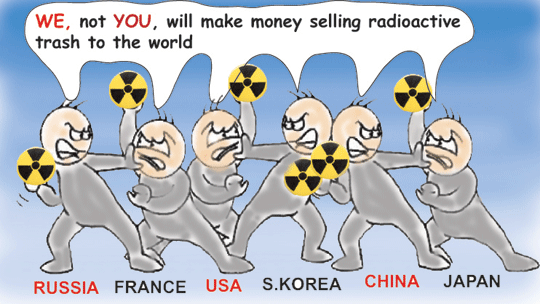 South Africa, France ink nuclear partnership, DW 10 Oct14 Only three weeks after partnering with Russia, South Africa has reached a similar nuclear agreement with France. The deals represent Pretoria’s renewed steps in building up the country’s nuclear energy program. outh Africa signed a nuclear power deal with France, the South African government announced Friday, as Pretoria aimed to expand its nuclear power to 9,600 MW.
President Jacob Zuma authorized “an agreement on cooperation in the development of peaceful uses of nuclear energy” with the French Republic, a statement from his office said.
The deal comes only three weeks after Africa’s second-largest economy reached a similar agreement with Russia, which will provide the country with eight nuclear reactors by 2023 in a $50 million (39.5-million-euro) contract.
But Russia has estimated the contract value to be more around tens of billions, as one reactor costs around $5 billion.
No further details on the deal with France were provided, and the circumstances surrounding the signing remain murky, according to local media reports……http://www.dw.de/south-africa-france-ink-nuclear-partnership/a-17987145
Will the 6000 Fukushima radioactive clean-up workers ever get the promised danger pay?

 Nuclear workers kept in dark on Fukushima hazard pay 25 CNBC Reuters 7 Oct 2014 Almost a year after Japan pledged to double hazard pay at the stricken Fukushima nuclear plant, workers are still in the dark about how much extra they are getting paid, if anything, for cleaning up the worst nuclear disaster since Chernobyl.
Under pressure to improve working conditions at Fukushima after a series of radioactive water leaks last year, Tokyo Electric Power Co President Naomi Hirose promised in November to double the hazard pay the utility allocates to its subcontractors for plant workers. That would have increased the amount each worker at the nuclear facility is supposed to earn to about $180 a day in hazard pay.
Only one of the more than three dozen workers interviewed by Reuters from July through September said he received the full hazard pay increase promised by Tepco. Some workers said they got nothing. In cases where payslips detailed a hazard allowance, the amounts ranged from $36 to about $90 a day – at best half of what Hirose promised.
In some instances, workers said they were told they would be paid a hazard bonus based on how much radiation they absorb – an incentive to take additional risks at a dangerous work site…….
Tepco still relies on some 800 mostly small contractors to provide workers for the cleanup after the tsunami that swamped the plant on March 11, 2011 sparked meltdowns at three reactors. Subcontractors provide almost all of the 6,000 workers now employed at the plant. Tokyo Electric employs only about 250 on its own payroll at the facility.
The workforce at Fukushima has almost doubled over the past year, mostly as part of an effort to protect groundwater from being contaminated and to store water that comes in contact with melted fuel in the reactor buildings.
Some of the workers who arrived recently at the plant have been building bunkers to store highly radioactive sludge, which is a by-product of the process whereby contaminated water is treated. Others are installing equipment to freeze a ring of earth around four reactors at Fukushima to keep water from reaching the melted cores, an unprecedented effort directed by Kajima and expected to cost nearly $300 million.
Kazumitsu Nawata, a professor in the University of Tokyo’s department of technology who has researched conditions inside Fukushima, said that if workers do not receive pay that is commensurate with the risks they are taking, they will ultimately look elsewhere for employment. If more experienced workers leave for safer jobs in Tokyo where constructionprojects are accelerating ahead of the 2020 Olympic Games, it will also increase the likelihood of accidents at the plant, Nawata said in an interview.
“Until now, we have relied heavily on the goodwill of workers. But it’s already been three years since the accident. This is no longer sustainable,” he said. http://www.cnbc.com/id/102068504#.
France’s Energy Dept ponders on costs of keeping old nuclear plants going: renewables may be cheaper
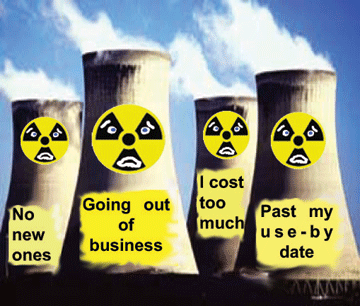
 France to weigh costs of maintaining older plants in nuclear policy http://in.reuters.com/article/2014/10/05/france-nuclear-idINL6N0S00F220141005 PARIS Sun Oct 5, 2014 Oct 5 (Reuters) – France’s energy minister said on Sunday that the cost of maintaining older reactors would be factored into any decision on the future size of its large and aging nuclear power fleet.
The government already plans to shut the Fessenheim plant on the German border as part of a pledge to bring down atomic energy to 50 percent of French power output by 2025 from the current 75 percent, the highest share in the world.
But it has skirted the issue of whether to extend the operating life of its 58 nuclear reactors, which state-owned utility would like to prolong from 40 years to up to 60 years.
“Investments in reactors at the oldest plants don’t last forever. You then have to re-invest and that is very expensive,” Energy Minister Segolene Royal told France 3 television.
“If it costs a lot more to carry out maintenance to make older plants secure, it would be better to build renewable energy installations,” she said.
France, like other European countries, faces rising costs to maintain a nuclear fleet with an average age of about 30 years. EDF has estimated that extending the life of the plants would cost 55 billion euros.
About half of its reactors are due to reach the current 40-year limit during the 2020s. French nuclear watchdog ASN has said it will give an initial opinion on the issue next year. Royal is steering through parliament an energy transition bill that introduces a cap on nuclear power production, which would force EDF to close an equivalent capacity when it launches the 1,600 megawatt Flamanville reactor, due in 2016.
She said this week the government could choose to close another site than Fessenheim but dismissed as “fanciful” a 5 billion euro estimate made by two parliamentarians for the cost of closing Fessenheim. (Reporting by Gus Trompiz and Michel Rose; editing by Jane Baird)
European Commission goes along with charade hiding costs of UK’s Hinkley C nuclear farce.
The European Commission, in signalling its intention to give the green light to the British Government’s Hinkley C nuclear power plant deal under the ‘state aid’ permission procedure has failed miserably to protect British consumers against the consequences of what must be the highly likely outcome of cost overruns in building the Hinkley C plant. Instead it has issued what must be seen as a smokescreen of ‘protection’ to British electricity consumers by asking the British Government to introduce rules clawing back profits made by EDF. See http://www.reuters.com/article/2014/10/03/eu-britain-edf-nuclear-idUKL6N0RY3FE20141003?irpc=932
 Observers might be forgiven for imagining that the 35 year contract for Hinkley C, underpinned by £10 billion of state loan guarantees paying higher premium prices (£92.50) than privately built onshore windfarms receive for only 15 year contracts, will give EDF and their Chinese partners big profits. However this impression is an artefact of the ludicrous propaganda perpetrated for many years that nuclear power stations are potentially profitable, competitive, operations. They are no such thing. Continue reading
Banks won’t finance nuclear facilities – the $squillion liability
Consumers Shoulder the Risks
According to Schneider, commercial banks no longer back reactor project financing, because it’s too risky. It is for this reason that the Asian Development Bank has never financed a nuclear facility.
“Without upfront customer financing no one in the U.S. will build a new reactor,” he said.
Nuclear Power Costs Billions More Than Promised By Conan Milner, Epoch Times | October 1, 2014“……..despite nuclear’s green reputation experts say it’s a bad deal. It requires a comparatively tiny amount of uranium to generate electricity, so most of the cost consumers pay for nuclear power comes from building the reactor. But the construction of new facilities often proves much more expensive than promised.
In a conference call on Sept. 19, Schneider pointed reporters to the European pressurized water reactors under construction in Finland and France. These projects are now estimated at $11 billion each, totaling about $7 billion over budget and over four times as much as the original estimates 10 years ago.
The 66 units under construction worldwide have a huge range in terms of delays. Eight units have been under construction for over 20 years, but others have a setback of only three years.
The longest delay is the Watts Bar project in Tennessee where construction began in 1972.The Tennessee Valley Authority currently predicts that the reactor will be online by December 2015 and cost as much as $4.5 billion—$2 billion more than projected in 2012. Continue reading
1 This Month





PLEASE OPPOSE HR 8255 AND S.3639 – bills would accelerate satellite deployment, with no environmental review or safeguards – https://ncstd5li.quorum.us/campaign/169331/
To see nuclear-related stories in greater depth and intensity – go to https://nuclearinformation.wordpress.com
-
Archives
- September 2026 (339)
- August 2026 (330)
- July 2026 (355)
- June 2026 (287)
- May 2026 (306)
- April 2026 (356)
- March 2026 (251)
- February 2026 (267)
- January 2026 (308)
- December 2025 (358)
- November 2025 (359)
- October 2025 (375)
-
Categories
- 1
- 1 NUCLEAR ISSUES
- business and costs
- climate change
- culture and arts
- ENERGY
- environment
- health
- history
- indigenous issues
- Legal
- marketing of nuclear
- media
- opposition to nuclear
- PERSONAL STORIES
- politics
- politics international
- Religion and ethics
- safety
- secrets,lies and civil liberties
- spinbuster
- technology
- Uranium
- wastes
- weapons and war
- Women
- 2 WORLD
- ACTION
- AFRICA
- Atrocities
- AUSTRALIA
- Christina's notes
- Christina's themes
- culture and arts
- Events
- Fuk 2022
- Fuk 2023
- Fukushima 2017
- Fukushima 2018
- fukushima 2019
- Fukushima 2020
- Fukushima 2021
- general
- global warming
- Humour (God we need it)
- Nuclear
- RARE EARTHS
- Reference
- resources – print
- Resources -audiovicual
- Weekly Newsletter
- World
- World Nuclear
- YouTube
-
RSS
Entries RSS
Comments RSS

