Financial settlement on the costs of closing San Onofre nuclear power plant
 $US1.4b settlement after nuclear closurehttps://au.finance.yahoo.com/news/us1-4b-settlement-nuclear-closure-005216557.html 21 Nov 14 Consumers will get refunds and credits of about $US1.4 billion, but also pay about $US3.3 billion, under a settlement involving the premature closure of the San Onofre nuclear power plant.
The vote by the California Public Utilities Commission was 5-0.
At issue has been who should take the financial hit for the plant’s demise – company shareholders or customers.
The settlement stems from negotiations among operator Southern California Edison, minority owner San Diego Gas & Electric Co. and consumer advocates. Critics argued that the deal short-changed ratepayers.
The payments will be made over the next decade.
The settlement “is reasonable in light of the whole record, consistent with law and in the public interest,” Commissioner Mike Florio said in a statement on Thursday.
San Onofre shut down for good last year after a long fight over whether it was safe to restart. It had been idle since January 2012, after a small radiation leak led to the discovery of unusual damage to hundreds of tubes inside virtually new steam generators.
A federal investigation after the 2012 leak concluded that a botched computer analysis resulted in generator design flaws that were largely to blame for the unprecedented wear in the tubing that carried radioactive water.
In gloomy economic situation nuclear giant AREVA “suspends” its financial outlook for 2015 and 2016.
 French Nuclear Giant Areva Says Future Is Uncertain, Prompting a Sell-Off NYT, By DAVID JOLLY and STANLEY REEDNOV. 19, 2014 PARIS — Areva, the French nuclear technology giant, has warned of an uncertain outlook for its business amid delays to important projects and sluggishness in the global atomic energy sector, sending its stock tumbling on Wednesday.
The company, which is about 87 percent state-owned, said late Tuesday that it was “suspending” its financial outlook for 2015 and 2016.
Areva cited cash flow problems related to its long-delayed nuclear plant project in Finland, on Olkiluoto Island, as well as Japan’s reluctance to restart reactors after the 2011 Fukushima disaster. The company noted “the still lackluster market” for providing services to existing nuclear plants, including in its crucial home market, which draws about three-quarters of its electricity from atomic power, the highest in the world………..
The company will burn through more than 400 million euros, or about $500 million, of cash this year, he said, and might need to raise as much as €2 billion in new capital to shore up its finances. Its share price fell about 16 percent on Wednesday. Compounding the shock was the fact that the company had reaffirmed its full-year profit and sales outlook on Oct. 31, even as it said revenue for the first nine months of 2014 fell more than 14 percent from a year earlier, to €5.6 billion………http://www.nytimes.com/2014/11/20/business/international/french-nuclear-giant-areva-says-future-is-uncertain-prompting-a-sell-off.html?_r=0
Delay after delay , and soaring coasts, for Britain’s new nuclear build plans
 How the UK’s nuclear new-build plans keep getting delayed 20 Nov 2014, The Carbon Brief Simon Evans When will the UK get a new generation of nuclear power plants? Doubts surfaced again today with the Times reporting a “secret government review” into French firm EDF’s plan to build a new plant at Hinkley Point in Somerset.
The review is costing tens of millions, the Times says, and is trying to establish whether EDF can complete the new plant by 2023 as it has promised.
The news follows an announcement from EDF that its Flamanville plant in Normandy is facing further delays. The project uses identical designs to the Hinkley scheme.
Flamanville was supposed to take five years to build and begin operating by 2012. Instead it will now take 10 years, and open in 2017. A third identical project at Olkiluoto in Finland is nearly a decade behind schedule.
New nuclear capacity is a key part of UK government plans for decarbonisation. So why is it proving so hard to predict when the UK’s first new nuclear plant for a generation will start operating?
Predicting the future
The Department for Energy and Climate Change (DECC) makes annual projections of the future of the UK’s energy and emissions. It has been publishing these projections for a number of years. We’ve trawled the data going back to 2007 to find out how DECC’s predictions about when we’ll get new nuclear have changed.
First, some history. ………..
It’s worth emphasising of course that the Hinkley Point reactors are not yet under construction. EDF had originally said it would finish building them in 2017, indeed chief executive Vincent de Rivaz said some people would be cooking their 2017 christmas dinner using new nuclear power.
De Rivaz now says the project will be finished in 2023. Preparatory groundwork has already started. Carbon Brief asked EDF when construction of the plant itself will begin and how long it will take to finish. EDF said that level of detail was not yet available.
The cost of UK new nuclear
It isn’t only the finish date that has changed for the UK’s new nuclear plans. The costs have also skyrocketed.
Back in 2008 the white paper on new nuclear in the UK suggested it would cost £2.8 billion to build a first of its kind 1.6 gigawatt plant, with a range of between £2 and £3.6 billion.
The government later said in 2013 that the the Hinkley C project of two 1.6 gigawatt reactors would cost £16 billion. When the European Commission gave the deal the green light in October it said the project would cost £24 billion……….. EDF has delayed its final decision on whether to build at Hinkley Point until after this review has given it the all-clear. Until then, it will not divulge detailed timelines for its plans. http://www.carbonbrief.org/blog/2014/11/how-the-uks-nuclear-new-build-plans-keep-getting-delayed/
The EPR nuclear reactor is a “rotten design that they should have given up on a long time ago”
French Nuclear Giant Areva Says Future Is Uncertain, Prompting a Sell-Off NYT, By DAVID JOLLY and STANLEY REEDNOV. 19, 2014 PARIS “……….The problems at Flamanville and Olkiluoto raise further questions about the future of the EPR reactor design that Areva and EDF are marketing around the world. All of the EPRs under construction including those being built at Taishan in China have run into delays. The giant power stations, for which the designs date to the early 1990s, were supposed to be safer and simpler than earlier nuclear plants, but they are proving fiendishly complex and expensive to build.
Mr. Thomas said the problems with the other EPRs around the world also raised doubts about whether two reactors of this type would be built at Hinkley Point in southwest England, as EDF planned. The European Union recently gave its approval to the project, which will cost at least 16 billion pounds, or $25.1 billion, but EDF still needs to put together an international consortium to finance and build it. http://www.nytimes.com/2014/11/20/business/international/french-nuclear-giant-areva-says-future-is-uncertain-prompting-a-sell-off.html?_r=0
EDF’s nuclear power plants Flamanville and Olkiluoto delayed yet again
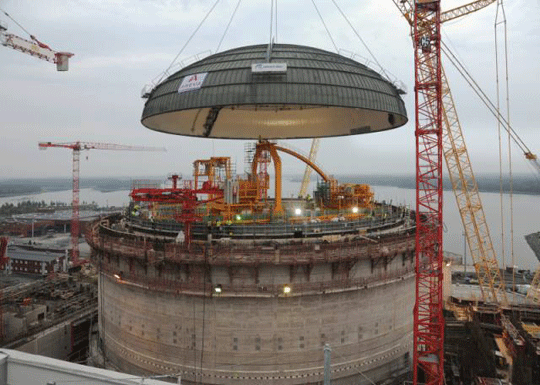 EDF says French nuclear reactor delayed another year to 2017 ,
* New one-year delay adds up to 10-year building period
* EDF says Areva unable to deliver key ingredients in time
* EDF still committed to EPR for UK Hinkley Point project (Adds EDF quote, background)
PARIS, Nov 18 (Reuters) – French utility EDF announced a new one-year delay for its Areva-designed EPR nuclear reactor in Flamanville, France, which it now expects to be connected to the grid in 2017, a decade after construction started.
EDF said the delay was due to Areva’s difficulties with ensuring a timely delivery of certain pieces of equipment, such as the lid and internal structure of the reactor vessel. It also said Areva had briefed it on a steam generator welding defect.
Construction on the Flamanville EPR reactor started in 2007 and it had initially been scheduled to be connected to the electricity grid in 2012, but it has been delayed repeatedly…….Four EPRs are under construction worldwide, one in France, one in Finland and two in China, but the Finnish and French projects have been plagued by billion euro cost overruns and multiyear delays.
Construction on the first EPR in Olkiluoto, Finland started in 2005 and it had originally been scheduled to go live in 2009, but it is now expected that will occurr in late 2018, almost a decade later than originally planned. Construction will have lasted 13 years, if it is not delayed again……..
Last month, European Union competition authorities gave the green light for state subsidies to EDF’s 16 billion pound project to build two EPR reactors in Hinkley Point C in southwest Britain, which are expected to start producing power from 2023……..http://in.reuters.com/article/2014/11/18/edf-nuclear-idINL6N0T85BN20141118
India being dudded by Westinghouse, GE and Areva on nuclear power program?
Globally, nuclear power is set to face increasing challenges due to its inability to compete with other energy sources in pricing. Another factor is how to manage the rising volumes of spent nuclear fuel in the absence of permanent disposal facilities. ……. nuclear power is in no position to lead the world out of the fossil fuel age.
 False promise of nuclear power, THE HINDU, BRAHMA CHELLANEY 19
Nov 14
“…….Westinghouse, GE and Areva also wish to shift the primary liability for any accident to the Indian taxpayer so that they have no downside risk but only profits to reap. If a Fukushima-type catastrophe were to strike India, it would seriously damage the Indian economy. A recent Osaka City University study has put Japan’s Fukushima-disaster bill at a whopping $105 billion.
To Dr. Singh’s discomfiture, three factors put a break on his reactor-import plans — the exorbitant price of French- and U.S.-origin reactors, the accident-liability issue, and grass-roots opposition to the planned multi-reactor complexes. Continue reading
Uranium the “dead cat” investment
Of all the problems confronting uranium, and a reason to stay clear, the biggest is the energy glut and the fact that most alternatives forms of power are easier to develop and require much less government scrutiny than nuclear power.
Uranium Is Hot, But Not For Investors, Forbes, Tim Treadgold, 18 Nov 14 At a time when most commodity prices are falling it is hard to ignore a metal outlier that has just had its best week in 18 years, but in the case of uranium ignorance could save you money.
Last week’s 14% rise in the price of the nuclear fuel took most observers by surprise though when
 analyzed it seems that the much of rise in the short-term price from $36.75 a pound to $42/lb was in a category called dead-cat bounce.
For anyone unfamiliar with market slang a dead-cat bounce is the height a cat rises off the footpath after falling 20 floors – it’s an irrelevant recovery, and the cat’s still dead………
even as Japan re-fuels its fleet of nuclear reactors, and China presses ahead with a major nuclear building program, there are four reasons to be cautious about the uranium outlook, and even more wary of uranium exploration and mining companies.
Firstly, there is a global energy glut with prices for oil, coal and gas depressed by an over-supply of all fossil fuels hitting a sluggish global economy.
Secondly, the uranium market is divided into three distinct categories of short, medium and long-term and what happened last week was a sharp price movement, in very thin trading, at the short end of the market with no price change, yet, in medium or long-term pricing.
Thirdly, there is no shortage of uranium in the world, and while squeeze points could develop, such as Russia withholding high-grade fuel in a tit-for-tat reaction to the sanctions slowing its economy, there is plenty of other material available.
Fourthly, most uranium mines still in the planning stage require a price of at least $60/lb to be profitable, or attract the finance to fund their development.
Other factors weigh on the uranium industry, including a long line of projects-in-waiting which were taken through to the planning stage a decade ago when the price hit $135/lb but cancelled when the price collapsed……..
Of all the problems confronting uranium, and a reason to stay clear, the biggest is the energy glut and the fact that most alternatives forms of power are easier to develop and require much less government scrutiny than nuclear power.
If the short-term price rises closer to the $60/lb mark it might be time to take uranium seriously, but only if the long-term price moves higher as well. http://www.forbes.com/sites/timtreadgold/2014/11/17/uranium-is-hot-but-not-for-investors/
Ponzi economics: endless growth in a finite ecology
Ponzi schemes are stable for a short while in their initial operations, but depend on unrestricted growth through finding ever-more new investors. Ponzis have to collapse because of their growth and they can’t exist without it.
To grow or not to grow
So it is with modern economics; growth is the central mantra, but no system dependent on finite resources can continue to grow forever.
 Modern economics count on Ponzi ecology ABC Science Capitalist economies suffer from
the lack of scope and accounting for all the environmental resources needed to make them work, argues Paul Willis. 5 Nov 14 Recently an ecologist friend of mine commented that modern capitalist economies are little more than elaborate Ponzi schemes, complicated frauds that can only end in their own spectacular collapse in direct proportion to their stratospheric success………
The problem with a Ponzi scheme is that it can only sustain paying profits in the initial stages, as long as an increasing number of new investors enter the scheme. Once there is a decline in the number of new investors, the profits cannot be paid to the older investors and the whole scheme comes undone with most investors losing their investment without seeing any profit………
Ecological flaws
Swedish energy company to dump brown coal, move to renewable energy
Europe energy giant to dump brown coal, focus on renewables, REneweconomy, By Petra Hannen on 4 November 2014 As Australia’s conservative governments and fossil fuel industry hail the future of coal, one of the biggest generators of brown coal in Europe, Vattenfall, is looking to exit from its huge brown coal generation portfolio in Germany, and focus instead on renewable energy.
State-owned Swedish energy giant Vattenfall will in the future concentrate on renewable energy. President and CEO Magnus Hall has announced that the company is considering a “new ownership structure” for its lignite division.
Vattenfall’s lignite operations in Germany’s Lusatian region have created more than 15,000 direct and indirect jobs in the area.
Sweden’s new left-of-center governing coalition, headed by Social Democratic Prime Minister Stefan Löfven and including the country’s Green Party, has made its plans for the state-owned energy company Vattenfall clear: The group’s future must lie in the development of renewable energy and not in coal and gas, the Social Democrats announced earlier this month in Stockholm.
The company’s board has now confirmed that it is fundamentally changing its corporate energy policy. “We have a clear strategy to improve our CO2 footprint and refocus our portfolio on renewable energy,” said Vattenfall CEO Magnus Hall on Thursday. To that end, the board has decided to review a new and lasting ownership structure for the group’s lignite division.
“We recognize the current and future significance of lignite for the local economy and the German energy policy,” Hall said. The German states of Brandenburg and Saxony are significant stakeholders in Vattenfall’s activities in the region of Lusatia (Lausitz), which stretches across both states. The company said it would remain in close dialogue with state leaders. Hall added that Vattenfall would hold on to its other business units in Germany………..http://reneweconomy.com.au/2014/vattenfall-focus-renewable-energy-preps-exit-lignite-business-17001
Nuclear power – the crippling cost factor
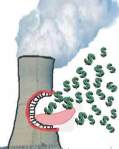 Nuclear power is expensive.http://gsihn.blogspot.com.au/
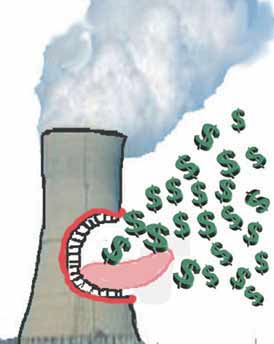
The energy source of nuclear power is limited just like fossil fuel. Uranium is an element used in nuclear reactor, and only few countries around the world have access to this resource. World Nuclear Association states that “about half of world production comes from just ten mines in six countries: Australia, Canada, Kazakhstan, Namibia, Niger and Russia” (“How Uranium Ore Is Made Into Nuclear Fuel” 1). Although the United States has quite large uranium resources, most of them are low to medium-grade. According to Physicians for Social Responsibilities, the United States signed the Continuing Resolution into law in September 2008 for Russian highly enriched uranium through 2020, and “the U.S. will continue to rely on Russia for a significant amount of uranium for commercial nuclear reactors” (“Dirty, Dangerous and Expensive: The Truth about Nuclear Power” 3). Since enriched uranium is critical and limited for global supply, price of uranium is expected to increase just like fossil fuel.
The estimates for construction and maintenance of a new nuclear plant are rising. Totty points out an expensive construction of a nuclear reactor, especially after several nuclear disasters around the world, addressing “FPL Group, of Juno Beach, Fla., estimates that two new reactors planned for southeast Florida would cost between $6 billion and $9 billion each” (4). Physicians for Social Responsibilities states that loan guarantees are “most important subsidy for the nuclear industry, and the nuclear industry is seeking over $100 billion in guarantees;” however, only $18.5 billion is authorized because “failure rate for nuclear projects is very high – well above 50 percent” (“Dirty, Dangerous and Expensive: The Truth about Nuclear Power” 3). If nuclear power receives public subsidies and leads to failure, taxpayers will be held responsible for the payouts, which is unbearable in free market (Rowell 2). Rowell further informs about the Finnish reactor subsidized by the French nuclear industry, which is under investigation by the Finnish nuclear safety regulator STUK due to cost overruns and delays (2). The prices of constructing and maintaining a nuclear power plant are increasing at exponential rates every year, and the nuclear energy is already inefficient both economically and politically.
Work Cited
“Dirty, Dangerous and Expensive: The Truth about Nuclear Power.” Physicians for Social Responsibility: United States Affiliate of International Physicians for the Prevention of Nuclear War. Web.
“How Uranium Ore Is Made Into Nuclear Fuel.” World Nuclear Association. Web.
Rowell, Alexis. “Ten Reasons Why New Nuclear Was a Mistake – Even Before Fukushima.”Transition Culture. Web. 15 March. 2011.
Totty, Michael. “The Case For and Against Nuclear Power.” The Wall Street Journal. Web. 30 June. 2008.
Failed laser uranium enrichment project adds to Cameco’s losses
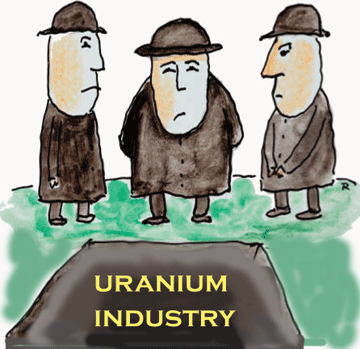 Uranium producer Cameco reports a third-quarter loss By Jim Brumm StarNewsOnline.com, November 3, 2014 “……..The Canadian uranium producer reported a third-quarter loss last week after writing off its $184 million investment in Global Laser, citing General Electric’s unexpected July cut in funding to “pace our investment in line with market.”
At the time Silex, the Australian owner of the laser technology, said GE responded “to worsening trading conditions in the global nuclear fuel markets, initially triggered by the events in Fukushima, Japan, in March 2011.”
“The market has declined more than 50 percent since” the Global Laser project started in 2007, GE spokesman Christopher White said in July without describing the measurement cited………
Cameco’s charge indicates a total Global Laser worth of $767 million and values GE’s 51 percent at $391 million. Hitachi, which owns the remaining 25 percent, hasn’t discussed a charge.
GE has declined to discuss the dollar value of the Global Laser charge it took against second-quarter earnings, but Nuclear Intelligence Weekly put the amount at $194 million. That would be 49.6 percent of the total value of GE’s Global Laser holdings as indicated by Cameco. http://www.starnewsonline.com/article/20141103/ARTICLES/141109942/-1/topic24?Title=Uranium-producer-Cameco-reports-a-third-quarter-loss-
China’s nuclear power programme has dubious economic future
 China’s Risky Nuclear Renaissance http://online.wsj.com/articles/heard-on-the-street-chinas-risky-nuclear-renaissance-1414508639 CGN Power’s Plan to Go Public Could Be Dicey By ABHEEK BHATTACHARYA Oct. 28, 2014
Nuclear energy: It’s risky stuff. Hence, there is often a heavy degree of government control over it—which makes it a doubly risky investment proposition.
Especially when that government is China’s.
A number of Chinese state-owned nuclear companies are going public these days. CGN Power, the country’s largest with 9.4 gigawatts of operating capacity, will likely offer $3 billion worth of new shares in Hong Kong next month, reports The Wall Street Journal. A small affiliate, CGN Meiya Power , raised $262 million in Hong Kong last month and has seen its shares rise by 20% since. Meanwhile, another top operator, China National Nuclear Power, also plans an initial public offering.
Once listed, these will be one of a handful of stocks globally, including the likes of Exelon of the U.S. and EDF of France, offering high or pure exposure to nuclear energy. And while much of the rest of the world is ambivalent about or hostile to nuclear energy, Beijing has big expansion plans. The Chinese government suspended new project approvals after Japan’s Fukushima accident in March 2011. But the need to diversify away from smog-causing coal has put its nuclear ambitions back on track. China now targets nearly tripling the nuclear capacity that’s up and running to 58 gigawatts by 2020. The IPOs will help fund that ambition.
The state’s involvement can cut both ways, though. CGN Power sells most of its output to state-run electricity grids at regulated tariffs. For power plants that began operating before 2013, these tariffs are tailored to yield a “reasonable” profit, according to CGN’s prospectus. Yet its net profit has fallen since 2011 because of either surging costs or weakening sales.
For newer plants, the tariff is supposed to be fixed—except when it isn’t. In a bid to avoid competition, these plants are required to cut tariffs if neighboring coal-fired power is cheaper. That’s quite likely as coal prices spiral downward. Energy prices are heavily regulated precisely because consumers are rather attached to light and heat. That makes them subject to political, as well as economic, forces.
In France, for example, shares in state-run EDF tanked 14% in June when the government scrapped a planned tariff increase. There’s even more reason to worry in China since governments could keep down power prices as a stimulus to troubled heavy industries. Growth prospects are high, which is likely one reason that CGN Meiya already trades at 10.9 times 2013 earnings before interest, tax, depreciation and amortization. That is far higher than EDF’s 4.8 times or Exelon’s 6.6 times.
Double-digit multiples are no doubt tempting for IPO bankers but look too much for a large nuclear generator carrying this much political risk. Problem is, CGN’s balance sheet means it needs a high multiple, or fast growth in profits, to make its IPO math work.
Net debt as of this March is a hefty 5.1 times 2013 Ebitda, and still high at four times even if related-party loans are excluded. And less than 10% of the IPO proceeds are currently earmarked for paying off borrowings. As if nuclear power wasn’t risky enough
TEPCO’s ¥130 billion pretax profit for year

Tepco projects ¥130 billion pretax profit for year KYODO Japan Times, OCT 25, 2014 Tokyo Electric Power Co., manager of the disaster-struck Fukushima No. 1 nuclear plant is expecting to log a group pretax profit of ¥130 billion for the business year through March 2015, even without restarting the giant Kashiwazaki-Kariwa plant or hiking rates again, sources familiar with the matter said Friday. … (subscribers only) http://www.japantimes.co.jp/news/2014/10/25/business/tepco-projects-%C2%A5130-billion-pretax-profit-for-year/#.VE6s1CLF8nk
USA keen to market nuclear reactors to Malaysia (or anyone?)
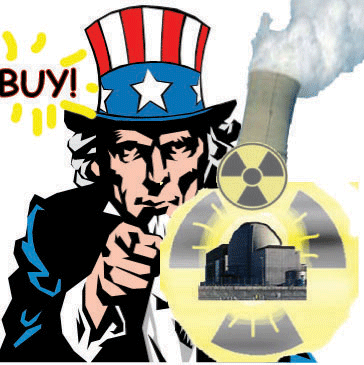 US: We’ll help build nuclear plant The Star 26 Oct KUALA LUMPUR: The United States is willing to help Malaysia should it decide to build a nuclear power plant, says American diplomat Laura E. Kennedy.
Kennedy, charge d’affaires at the Permanent Mission of the US to the International Organisations in Vienna, said her country had a long standing nuclear power industry with the right expertise………
The envoy, who is in the country to promote the peaceful use of nuclear energy, said Malaysians should be aware that nuclear technology could be beneficial in fields such as health and agriculture……http://www.thestar.com.my/News/Nation/2014/10/26/US-Well-help-build-nuclear-plant/
For US government, exporting nuclear technology is more important than public safety
US opposes pos t-Fukushima nuclear safety proposal http://rt.com/usa/199024-cns-nuclear-safety-proposal/
But while Reuters says the Swiss-led initiative is tentatively being backed by other European countries, the newswire alleges that energy officials in the US, Russia and Canada are all opposed to the measure, which would likely increase industry costs.
Although details of the proposed pact have not been made public, Bloomberg reported that it would involve rewriting “international standards to ensure nuclear operators not only prevent accidents but mitigate consequences if they occur, by installing costly new structures built to survive natural disasters.” In a report published on Thursday this week by Reuters, the newswire said that the proposed changes would not only apply up-to-date safety standards for new reactors, but also carry out back-fitting measures on sites that are already in operation.According to this week’s reports, however, some of the world’s top energy powers are opposed because, as Reuters’ Fredrick Dahl wrote, any changes to the CNS could take years to be installed if, of course, they are ratified by the dozens of nations involved. “You are trying to drop a Ferrari engine into a Volkswagen. If you want a new car, let’s go to the show room” and buy one, a senior but unnamed Department of State official said to Dahl.
But experts have previously said American facilities, in particular, are in need of upgrades, with a July 2014 report published by the National Academy of Science that said the US “should access their preparedness for severe nuclear accidents associated with offsite-scale disasters.” Additionally, the authors of that study wrote that America’s current approach to nuclear safety is “clearly inadequate for preventing core-melt accidents and mitigating their consequences,” yet newly-initiated upgrades in the US are being conducted on a scale hardly comparable to what’s occurring overseas: according to Bloomberg, Electricite de France SA is spending around $13 billion on implementing safety measures on its 59 reactors, whereas American utilities will spend only $3 billion on portable generators and cooling reserves for roughly 100 reactors.
Nevertheless, officials in Berne remain optimistic that the countries currently opposed to the proposed changes will come to an agreement that makes facilities around the world more secure.
“Switzerland, as the initiator of the proposal, will continue to collaborate with all delegations and do everything to find a solution that is acceptable to all of us,” Georg Schwarz, deputy director general of the Swiss nuclear-safety regulator, ENSI, wrote to Bloomberg Business Week.
Russian officials did not immediately respond to Bloomberg’s requests for comment, and neither BusinessWeek nor Reuters included remarks from Canada in their report.
1 This Month





PLEASE OPPOSE HR 8255 AND S.3639 – bills would accelerate satellite deployment, with no environmental review or safeguards – https://ncstd5li.quorum.us/campaign/169331/
To see nuclear-related stories in greater depth and intensity – go to https://nuclearinformation.wordpress.com
-
Archives
- September 2026 (339)
- August 2026 (330)
- July 2026 (355)
- June 2026 (287)
- May 2026 (306)
- April 2026 (356)
- March 2026 (251)
- February 2026 (267)
- January 2026 (308)
- December 2025 (358)
- November 2025 (359)
- October 2025 (375)
-
Categories
- 1
- 1 NUCLEAR ISSUES
- business and costs
- climate change
- culture and arts
- ENERGY
- environment
- health
- history
- indigenous issues
- Legal
- marketing of nuclear
- media
- opposition to nuclear
- PERSONAL STORIES
- politics
- politics international
- Religion and ethics
- safety
- secrets,lies and civil liberties
- spinbuster
- technology
- Uranium
- wastes
- weapons and war
- Women
- 2 WORLD
- ACTION
- AFRICA
- Atrocities
- AUSTRALIA
- Christina's notes
- Christina's themes
- culture and arts
- Events
- Fuk 2022
- Fuk 2023
- Fukushima 2017
- Fukushima 2018
- fukushima 2019
- Fukushima 2020
- Fukushima 2021
- general
- global warming
- Humour (God we need it)
- Nuclear
- RARE EARTHS
- Reference
- resources – print
- Resources -audiovicual
- Weekly Newsletter
- World
- World Nuclear
- YouTube
-
RSS
Entries RSS
Comments RSS

