Underage student employed for Fukushima radiation cleanup work
Tochigi firm warned for hiring high school student for decontamination work, Mainichi 25 Dec 14 NASU, Tochigi –– A construction company hired a high school student for work to decontaminate houses tainted with radiation from the Fukushima nuclear disaster, the Mainichi Shimbun has learned.
The Nasu Municipal Government revealed on Dec. 25 that a construction firm in the town employed a male high school student from outside the town as a part-timer for decontamination work in possible violation of the Labor Standard Act. The law prohibits engaging those under 18 for work that exposes individuals to harmful radiation. The Ministry of Health, Labor and Welfare has ruled that the legal ban applies to decontamination work.
The municipal government gave a verbal warning to the president of the construction company, while reporting the incident to a local labor standards inspection office in November.
According to town officials, the company hired a second-year high school student in August last year…….http://mainichi.jp/english/english/newsselect/news/20141225p2a00m0na002000c.html
TEPCO’s secrecy on worker injuries at Fukushima
TEPCO Not Disclosing Worker Injuries At Fukushima Daiichi SimplyInfo December 25th, 2014
Journalist Ryuichi Kino has documents a large number of injuries to workers in 2014 that TEPCO has not made public. The information was submitted to the Agency for Natural Resources and Energy. TEPCO’s excuse seemed to be, if the workers didn’t require an outside ambulance ride or helicopter, they were not going to disclose the injury. But some of these injuries were quite serious. Eighteen required repair of broken bones or sutures. There were also 32 cases of heat stroke, this can be quite serious and was the cause or contributor to the death of a number of workers in the first year of the disaster……..http://www.fukuleaks.org/web/?p=14246
The international battle to market nuclear technology to South Africa
 Geopolitics key in battle to gain SA’s nuclear nod, IOL Zambia, December 23 2014 By BloombergPaul Burkhardt and Franz Wild POLITICS may tip the balance as Russia’s Rosatom and France’s Areva prepare to battle it out for South Africa’s planned nuclear energy project that could cost $100 billion (R1.2 trillion).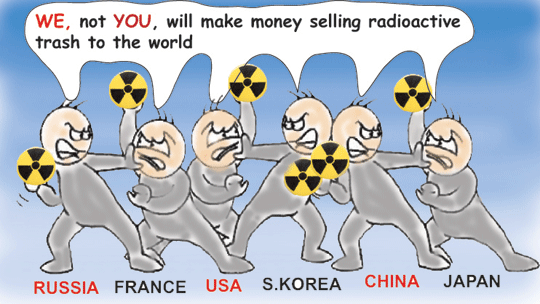
“Geopolitical and industrial relations between South Africa and the nuclear-vendor countries will play an important role,” Des Muller, the head of Johannesburg-based building company Group Five’s nuclear construction division, said last week. “It does with all major infrastructure projects and more so on nuclear infrastructures where reliance on nuclear safety and construction know-how is paramount.”
South Africa could pay as much as $100bn spread out over a period of 15 years for nuclear reactors to provide 9 600 megawatts of power, Muller said………
“The South African government has stressed that through the new build process we wish to revitalise a nuclear industry in South Africa with a view to long-term self-sufficiency,” Xolisa Mabhongo, the group executive corporate services at the Nuclear Energy Corporation of SA, or Necsa, said in response to questions………
Russia might already have a head-start as President Jacob Zuma fostered stronger economic co-operation with the country and China in a shift from his Western and Africa-leaning predecessor Thabo Mbeki, Robert Besseling, an analyst with IHS Country Risk, said.
The Soviet Union and then Russia historically kept close ties with the ruling ANC from the days in which it was battling against the apartheid regime. Under Zuma’s watch, South Africa was incorporated into the Brics alliance with Brazil, Russia, India and China.
“Considering the much stronger relationship between the Zuma presidency and the Russian government than under the previous South African administration, it looks much more likely that the expansion of the nuclear programme will be awarded to Russia,” Besseling said………http://www.iol.co.za/business/news/geopolitics-key-in-battle-to-gain-sa-s-nuclear-nod-1.1798374#.VJsqssA8
Uranium price down the gurgler again
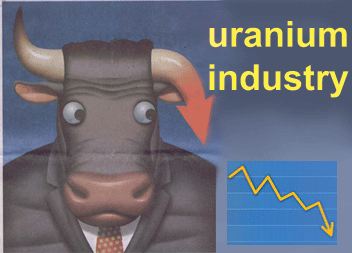 Uranium spot price sags to $36.50/lb in year-end trading lull Washington (Platts)–23 Dec2014
The uranium spot price was $36.50/lb U3O8 on Monday, down 75 cents from a week earlier, as slight volumes and a smattering of buyers seeking low-priced material continued the month’s trend toward lower prices, according to price reporting company TradeTech……..Since reaching $44/lb in mid-November — the highest level in nearly two years — the daily U3O8 spot price fell to $38/lb on November 21, according to TradeTech. The price rallied to $40.25/lb in late November, but has generally declined since. http://www.platts.com/latest-news/electric-power/washington/uranium-spot-price-sags-to-3650lb-in-year-end-21749093
USA government to give $12.5B in Loans for New Nuclear Power Projects!
 DoE Announces $12.5B in Loans for Advanced Nuclear, Energy Collective Katherine Tweed December 17, 2014 The U.S. Department of Energy issued a loan guarantee solicitation for $12.5 billion on Wednesday for innovative nuclear energy projects.
The solicitation comes on top of $8 billion for advanced fossil energy projects last December, $4 billion for renewables issued earlier this year and $6.5 billion for two nuclear reactors in February, the first new nuclear to be built in the U.S. in about 30 years……………
“DOE will look favorably on Eligible Projects that will have a catalytic effect on the commercial deployment of future Advanced Nuclear Energy Projects,” the solicitation states.
The first deadline for Part I applications is March 18, 2015, followed by rolling deadlines approximately every six months.http://theenergycollective.com/katherinetweed/2170051/doe-announces-125b-loans-advanced-nuclear
Toshiba about to sell portion of Westinghouse nuclear unit
Toshiba in talks to sell portion of Westinghouse nuclear unit http://www.power-eng.com/articles/2012/12/toshiba-in-talks-to-sell-westinghouse-nuclear-unit.html 12/27/2012Toshiba Corp. (NASDAQ: TOSBF) is currently in talks with three unnamed parties as it seeks to sell up to 16 percent of its stake in the Westinghouse Electric Co. nuclear power unit, the Wall Street Journal reports. The conglomerate is mulling three “very good offers,” Toshiba President Norio Sasaki said, and remains optimistic about its nuclear reactor business despite uncertainty about the future of nuclear power in Japan in the wake of Fukushima. Toshiba paid about $4.2 billion for 77 percent of Westinghouse six years ago and has since sold 10 percent of the company to Kazakhstan’s state-owned NAC Kazatomprom JSC. Toshiba will retain at least 51 percent ownership of the company, said Mr. Sasaki.
Waste fees for nuclear plant operates getting more costly- Sweden
 Sweden doubles waste fee for nuclear power plant operators http://www.reuters.com/article/2014/12/18/us-sweden-nuclear-idUSKBN0JW1YV20141218 Sweden’s government has decided to almost double a fee nuclear power plant operators pay to the nuclear waste fund, in order to help it cover the rising costs of decommissioning, the environment ministry said on Thursday.
Sweden’s state-owned utility Vattenfall [VATN.UL] operates Forsmark and Ringhals power plants, and Germany’s E.ON operates Oskarshamn plant. Finnish utility Fortum, which operates Loviisa power plant, also has stakes in Forsmark and Oskarshamn.
The nuclear industry will have to pay 0.04 Swedish crowns per kilowatt-hour from 2015-2017, up from 0.022 crowns today, the government decided. In 2013 the fees to the waste fund, a government authority, amounted to 2.5 billion Swedish crowns ($324.41 million). “Nuclear power must bear its own costs and the government’s decision to increase the nuclear waste fee makes this possible,” said Climate and Environment Minister Asa Romson.
Nuclear power has come under increased pressure in Sweden after general elections in September when the Social Democrats and the Green Party formed a minority cabinet. The coalition fell in a budget vote earlier this month, and a snap election is due in March.
The industry has warned that a combination of rising taxes and extra costs for new safety measures could lead to earlier shutdown of older plants, and potentially higher power prices.
(Reporting by Nerijus Adomaitis; Editing by Mark Trevelyan)
USA and other countries struggle to market their nuclear technology to China
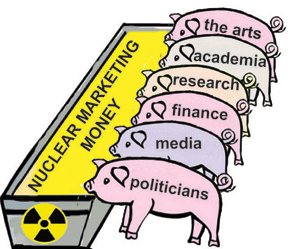
 China Wants its Nuclear Reactors ‘Made in China’ WSJ 16 Dec 14 When a unit of North Carolina’s Curtiss-Wright Corp. won a roughly $300 million deal in 2007 to supply components for new reactors in China, industry officials trumpeted China’s nuclear boom as good for U.S. business.
Today, Chinese companies are competing for that business—and foreign companies risk getting left out. Meanwhile, Curtiss-Wright’s contract is caught up in a legal dispute, while Chinese authorities blame the company in part for the delay of a landmark nuclear project. As the WSJ’s Brian Spegele reports:
U.S. and other foreign companies are now struggling to keep their hold in China, the industry’s biggest growth market and a rare bright spot more than three years after the Fukushima disaster in Japan put many of the world’s nuclear projects on hold. Yet China is increasingly turning to local companies to build crucial parts for multibillion-dollar nuclear projects, a result of Chinese industrial nationalism and frustration over U.S. supplier problems………http://blogs.wsj.com/chinarealtime/2014/12/16/china-wants-its-nuclear-reactors-made-in-china/
Vogtle nuclear power project running a year late, escalating the costs

 Watchdog: 1-year delay possible at Ga. nuke plant http://www.wrdw.com/home/headlines/Watchdog-1-year-delay-possible-at-Ga-nuke-plant-285994561.html Tuesday, Dec. 16, 2014
ATLANTA (AP) — A public watchdog says the construction of a nuclear power plant in Georgia is running a year late, a lag that could trigger big expenses.
Utility analyst Steven Roetger testified Tuesday that construction of two nuclear reactors at Plant Vogtle could run a year longer than expected. The first new reactor was supposed to be running by late 2017, followed by the second in late 2018.
Southern Co. subsidiary Georgia Power was originally authorized to spend $6.1 billion on its share of the project. However, the building schedule has already suffered delays and costs have increased. The latest company estimates put the cost at $6.7 billion.
That pricetag does not reflect the cost of additional delays or resolving ongoing litigation between the plant’s builders and owners.
Investment banks downgrading centralised energy, as decentralised solar and wind get cheaper

 Nuclear damages attempts to tackle climate change nuClear News Dec 14
Nuclear power – a very poor investment to address climate change, a waste of money

Recommended renewable energy stocks for investment in 2015
 3 Best Renewable Energy Stocks for 2015 Nasdaq By Motley Fool, December 14, 2014 We’re halfway through the 2010’s and renewable energy is no longer an uneconomical pipe dream conjured up by wishful thinkers. Wind energy, solar energy, and first-generation biofuels for blendstock applications are all competitive with incumbents in their respective markets — and the economics will only improve throughout the remainder of the decade. It may take
another several decades for each technology group to steal a substantial market share, but advances in wind turbines, rooftop solar, and efficient fuel production processes promise to add competition to fossil fuel projects. We’ve asked some of our top energy analysts which renewable energy stocks they’re eying for 2015. Here’s what they’re focusing on……..http://www.nasdaq.com/article/3-best-renewable-energy-stocks-for-2015-cm423026
Japan’s Fukushima Plant Cleanup Workers -their harsh and dangerous life
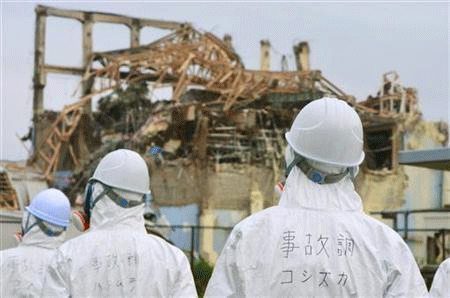 Japanese Nation Forgetting Fukushima Plant Cleanup Workers http://sputniknews.com/asia/20141210/1015704138.html As snap elections are nearing, the Fukushima Nuclear power plant workers are urging people to understand the harsh circumstances they work under, risking their life by exposing themselves to radiation every single day. MOSCOW, December 10 (Sputnik) – As elections are nearing in Japan, many of the people working toward the decommissioning of the crippled Fukushima No. 1 nuclear plant say they want voters to know about their harsh working conditions, insufficient pay and worries of radiation exposure, reports The Japan Times.
There are around 6,000 people a day working in the decommissioning process at the plant and it is expected to take 30 to 40 years to complete.
“I’m single, so I can somehow manage with the pay if I don’t go out to amuse myself, but I don’t think you can make a living if you have a family,” said a man in his fifties who has worked in the plant for three years. He has been eradicating debris and setting up tanks to store radioactive water, and is now in charge of removing contaminated water from the reactor building basements. He works for a third-tier subcontractor and makes a monthly salary of less than ¥200,000 ($1650 USD).
As The Japan Times reports, due to high radiation exposure, workers must wear heavy protective clothing and a mask that covers the whole face. It is difficult for them to work more than an hour and a half at a time. The workers start at around 5 a.m. because of the time it takes to get to the plant which is about 40 kilometers away, pass entrance checks and change clothing.
According to one worker his most recent monthly radiation dosage was 1.8 millisieverts. The law states that a nuclear worker’s radiation dosage should not exceed 100 millisieverts in five years and 50 millisieverts in a year. Since the reference mark in the plant is 20 millisieverts a year, the man’s dosage is nearing its limit.
“I feel that people are gradually forgetting about the nuclear accident,” he said. “From now, our work will become even harsher because we will have to go inside the reactor buildings, where the radiation level is even higher. I want people to recognize that there are such workplaces,” he told The Japan Times.
Malaysia now a world leader in producing solar energy equipment

 Solar Rises in Malaysia During Trade Wars Over Panels, NYT, By KEITH BRADSHERDEC. 11, 2014 KULIM, Malaysia — Tucked away in this former tin-mining town, past the small farms of banana trees and oil palms, is one of the solar industry’s best-kept secrets.
The six factories here with cavernous rooms up to one-third of a mile long constitute the production backbone of First Solar. Working alongside minivan-size robots adapted from car assembly plants and other industries, 3,700 employees produce five-sixths of the American company’s solar panels. Workers in Ohio make the rest.
The list of manufacturers is long. Panasonic of Japan has a solar panel factory a mile down the road. SunEdison makes wafers 60 miles away in Chemor. Hanwha Q Cells and SunPower have giant factories even farther south, while Solexel, a Silicon Valley start-up, is preparing to build an $810 million solar panel factory in stages.
Malaysia, a Southeast Asian nation with just 30 million people, is the biggest winner in the trade wars that have embroiled the solar sector. As Chinese companies have been hit with American tariffs and European quotas, Malaysia has increasingly attracted multinationals with its relatively low labor costs, lucrative tax breaks, warm relations with the West and abundance of English-speaking engineering talent.
Malaysia is now the world’s third-largest producer of solar equipment, trailing China by a wide margin but catching up rapidly with the European Union. And Malaysia’s role in the global solar trade is only likely to increase in the coming months if the American government broadens tariffs on panels made in China next Tuesday as expected……
The solar manufacturing boom in Malaysia has been almost invisible, a rarity in an industry known for heavily promoting even the smallest factory opening or new solar panel farm as progress toward cleaner energy……..
Trade wars have helped some American companies. SolarWorld, a big manufacturer that has led trade litigation against China, recently said that it was expanding capacity by 150 megawatts and adding 200 jobs at its main solar panel factory in Hillsboro, Ore. It partly pointed to the trade actions that had slowed the flood of Chinese imports.
But production in Malaysia, already triple the United States’ output, is rising faster. The latest project underway in Cyberjaya, Malaysia, is an 800-megawatt solar module factory for Hanwha Q Cells. First Solar is putting the finishing touches on a 100-megawatt factory here to supply the Japanese market.
Malaysia is a beneficiary of the complex interaction of global trade rules, economic competitiveness and environmental policies in the solar industry. Tariffs have had the most immediate effect………. http://www.nytimes.com/2014/12/12/business/energy-environment/solar-rises-in-malaysia-during-trade-wars-over-panels.html
Iran and other countries look forward to business boom when nuclear deal is achieved
 Anticipating Nuclear Deal and End to Sanctions, Iran Awaits a Business Boom, NYT By THOMAS ERDBRINK DEC. 12, 2014 “……….it is almost an article of faith in business circles that the latest extension is only the postponement of an inevitable thaw between Iran and the rest of the world…………
“The world needs this deal, we need this deal,” Ms. Moghimi said. “It will happen.”
Both moderates and conservatives have expressed concerns about the unchecked rise in expectations, among the public as well as elite business classes, that a deal will be cinched. They have been warning that the enthusiasm could turn to bitter disappointment if the negotiations, set to resume in Geneva next week, should fail, possibly touching off unrest or what some clerics call “another sedition,” a reference to the revolt that followed disputed presidential elections in 2009…….
The wave of optimism began with the election of a moderate president, Hassan Rouhani, who promised to mend Iran’s ties with the world. Mr. Rouhani continues to encourage that thinking, saying just last week that the “nuclear issue would be brought to its destination.” His foreign minister and chief nuclear negotiator, Mohammad Javad Zarif, promised after the most recent extension that a nuclear deal can happen “within weeks.”
The heightened expectations are not solely to be found among Iranians. The flow of foreign delegations to Iran continues at a steady pace, bringing eager businessmen who in conferences laud Iran’s unique geographical position, its stability and largely untapped market of middle-class consumers………http://www.nytimes.com/2014/12/13/world/middleeast/anticipating-nuclear-deal-and-end-to-sanctions-iran-awaits-a-business-boom.html
1 This Month





PLEASE OPPOSE HR 8255 AND S.3639 – bills would accelerate satellite deployment, with no environmental review or safeguards – https://ncstd5li.quorum.us/campaign/169331/
To see nuclear-related stories in greater depth and intensity – go to https://nuclearinformation.wordpress.com
-
Archives
- September 2026 (339)
- August 2026 (330)
- July 2026 (355)
- June 2026 (287)
- May 2026 (306)
- April 2026 (356)
- March 2026 (251)
- February 2026 (267)
- January 2026 (308)
- December 2025 (358)
- November 2025 (359)
- October 2025 (375)
-
Categories
- 1
- 1 NUCLEAR ISSUES
- business and costs
- climate change
- culture and arts
- ENERGY
- environment
- health
- history
- indigenous issues
- Legal
- marketing of nuclear
- media
- opposition to nuclear
- PERSONAL STORIES
- politics
- politics international
- Religion and ethics
- safety
- secrets,lies and civil liberties
- spinbuster
- technology
- Uranium
- wastes
- weapons and war
- Women
- 2 WORLD
- ACTION
- AFRICA
- Atrocities
- AUSTRALIA
- Christina's notes
- Christina's themes
- culture and arts
- Events
- Fuk 2022
- Fuk 2023
- Fukushima 2017
- Fukushima 2018
- fukushima 2019
- Fukushima 2020
- Fukushima 2021
- general
- global warming
- Humour (God we need it)
- Nuclear
- RARE EARTHS
- Reference
- resources – print
- Resources -audiovicual
- Weekly Newsletter
- World
- World Nuclear
- YouTube
-
RSS
Entries RSS
Comments RSS

