Top renewable energy investment trends for 2015

 UK watch: Tracking renewable energy investment trends, Renewable Energy Focus 05 January 2015 KATHARINE EARLEY As we head into 2015, Renewable Energy Focus contributor Katharine Earley speaks to Triodos Bank about investment trends, including crowd-funding, community-owned energy and businesses opting for on-site energy generation.
With renewable energy set to be one of the key winners to emerge from the EU’s new three-year, £250bn investment plan, 2015 could be a promising year for renewables. We caught up with ethical investment pioneer Triodos Bank to understand what trends it foresees for the year ahead.
“We could see some real strides forward for renewable energy in Europe, particularly if the EU’s investment plan focuses on grid infrastructure,” Matthew Clayton, executive director of Triodos Renewables, explained. “As we move from centralised power plants to smaller, distributed energy generation, government investment could really help to address this important systems issue. Coupled with private investment in energy efficiency and generation, such a move could lead to more rapid progress.”
For Triodos’ part, its renewables company, owned by some 5,000 shareholders, operates 11 onshore wind and hydroelectric projects across the UK with a capacity of 53MW, enough electricity to power 34,200 homes. Founded in 1994, the company has seen a 35% increase in shareholders and a 50% increase in generating capacity in the past three years. Its projects generated more than 100m kWh of clean electricity in 2013. Having already raised £2m from its latest share offer, it is now extending the offer until 30th January 2015.
So what does Clayton see as the reasons for this prosperity?
“Investor confidence has grown as the nature of the projects become more robust,” he explained. “The technology is proven and is also decreasing gradually in price. Interestingly, we’re seeing interest from a wide range of investors, from individuals through to institutional investors. And we want to make investing in renewables accessible – that’s why we’re inviting minimum investments of £50 through our current share offer………..
1. More projects will be developed to supply a business
“We’ll see more projects developed with a direct supply of renewable electricity to a business,” Bazin stated. “This helps the developer to achieve a better price for the power and reduces electricity losses during transmission. Meanwhile, the business purchasing the energy benefits from greater security of supply, lower cost compared to using major utilities and a boost to its efforts to reduce its environmental footprint.”
According to Bazin, this direct supply of electricity will be a key component of roof-mounted solar projects, which are high on the UK government’s agenda in 2015. This type of direct supply model also helps to raise awareness of the positive impact of renewable energy among building users, he confirms.
2. Community-owned energy will gather momentum
At least AREVA is selling some wind turbines, though not nuclear reactors
Iberdrola awards AREVA its largest renewable energy business to date January 6, 2015
Source: Iberdrola Iberdrola has signed with Areva its largest renewable energy contract to date, valued at approximately €620 million, for the supply of wind turbines to its Wikinger offshore project.
The French company will supply 70 M5000-135 5MW wind turbines, worth €550 million. For the first time, Iberdrola will be installing 5-MW turbines in a wind facility.
Under the terms of the contract, AREVA will also provide maintenance services, valued at €70 million, for a 5-year period which may be extended for another five years…..http://www.pennenergy.com/articles/pennenergy/2015/01/iberdrola-awards-areva-its-largest-renewable-energy-business-to-date.html
Nuclear company AREVA really in a state of bankruptcy, but tax-payers will bail it out

 AREVA goes from bad to worse, nuclear giant headed for bankruptcy http://sansdrapeauxnibanderoles.wordpress.com/ Sortir du Nulcleaire , France January 4 15 , Translation by Noel Wauchope The French group AREVA, world No. 1 nuclear power is bankrupt. Its shares collapsed: they have lost 55% since the beginning of the year. Already over-indebted, AREVA’s losses for 2014 would exceed € 1 billion
- Nuclear power has become too risky and too expensive, civil nuclear is no longer sold on the world market: AREVA has not delivered a reactor for 7 years.
- The sites of two EPR reactors in Finland and France drag on, their cost has tripled, now reaching 9 billion euro.But the Finns will not pay the additional costs and now require penalties. It’s a total financial fiasco.
- The delivery of nuclear fuel in Japan remains suspended because the reactors have remained closed there since the accident in Fukushima. This fuel export shortfall adds to the worsening finances of AREVA.
- After Fukushima, Siemens left AREVA to convert to renewable energy. They held a 20% stake in the group.
- The Uramin case in 2007: the acquisition of uranium mining in Niger, Central African Republic and Namibia, which soon proved unworkable. Between the purchase, retro-commissions and the unsuccessful operation, AREVA has accumulated € 3bn loss. The proposed remedies: the taxpayer on the front line
Economically, closure of Vermont Nuclear Plant points to the coming transformation of USA’s electricity system
 Even optimistic projections of the cost of building new nuclear reactors leaves them four times as costly as energy efficiency and twice as costly as wind and gas. Many analysts believe that solar power will be significantly less costly than nuclear in the next decade. Moreover, nuclear power never lives up to the optimistic cost projections of its boosters. Reactors under construction in the U.S. and Europe are way behind schedule and over budget.
 The problem with new reactor construction costs is well known, but the really stunning development is the problem that nuclear power has in terms of operating costs
the “dinosaurs” in the electricity sector have enough political clout to slow or prevent the change in the environment. Nuclear power is a major obstacle, demonstrated by its steadfast opposition to and an all-out attack on renewables and efficiency. Shuttering old, uneconomic reactors like Vermont Yankee is important not only because it removes an economic obstacle to change, but also because it shows the political will to transform America’s electricity system.
Why Closing Vermont Yankee Won’t Raise New England’s Power Bills Forbes Staff , Contributor Mark Cooper 31 Dec 14 Mr. Cooper is a senior fellow for economic analysis at Vermont Law School’s Institute for Energy and the Environment. Critics of the closing of the Vermont Yankee nuclear reactor have forecast a 40 percent jump in New England winter heating bills as a result of the shutdown. The facts suggest they have it wrong in more ways than one. Continue reading
Uranium company desperate to get funding
Uranium company struggles to find funding Nuclear industry feels sting from oil boom KRQE News, By Angela Ollison December 29, 2014, HOBBS, N.M. (KRQE) – An Idaho based company is struggling to find funding for a $125 million dollar uranium deconversion plant in southeastern New Mexico.
The president of International Isotopes told the Hobbs-News Sun that with oil prices falling and a surplus on the market, no one wants to invest in nuclear projects……..http://krqe.com/2014/12/29/uranium-company-struggles-to-find-funding/
Vermont Yankee has only half the $1.24B needed to get rid of the nuclear plant corpse
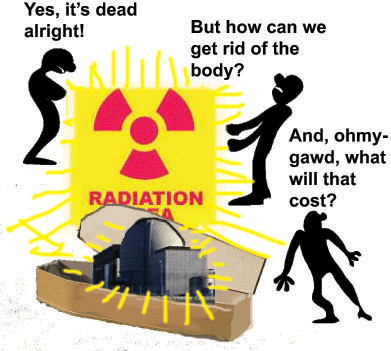 Nuclear plant predicts $1.24B decommissioning cost http://www.power-eng.com/articles/2014/12/nuclear-plant-predicts-1-24b-decommissioning-cost.html?cmpid=enl-poe-weekly-december-22-2014 12/22/2014 MONTPELIER, Vt. (AP) – The Vermont Yankee nuclear plant has made formal its prediction that decommissioning the reactor will cost $1.24 billion.
The plant currently has about half that amount saved up to dismantle the reactor and complete other tasks. It’s expected to be at least the early 2040s before the fund has grown enough to pay for full decommissioning.
Vermont Yankee owner Entergy Corp. announced in August of 2013 that it would shut down at the end of this year because the plant was no longer economical to operate.
Vermont looks to renewable energy – shuts down Vermont Yankee Nuclear Plant
The shutdown came just after noon as the Vermont Yankee plant completed its 30th operating cycle when workers inserted control rods into the reactor core and stopped the nuclear reaction process, the plant’s owner said………..
The plant will sit for decades while its radioactive components cool and its decommissioning fund grows. It’s expected to cost nearly $1.25bn to dismantle the plant, which likely won’t occur until the 2040s or later.
Vermont governor Peter Shumlin, who had pushed for the closing of the plant, said the closing is a positive step for the state.
“Today, thanks to investments in renewable energy such as solar, Vermont’s energy future is on a different, more sustainable path that is creating jobs, reducing energy costs for Vermonters and slowing climate change,” Shumlin said……..
Vermont Public Service Commissioner Chris Recchia said Monday the state hasn’t received power from the plant in almost three years. “We are moving full speed ahead with local, sustainable no-carbon renewable in Vermont.”
Marcia Blomberg, a spokeswoman for ISO New England, which manages the regional electric grid, said the loss of power from Vermont Yankee wouldn’t pose a problem, but the region faces long-term challenges from the loss of number of older power plants……..http://www.theguardian.com/world/2014/dec/29/vermont-shutters-nuclear-power-plant-yankee
USA Energy companies waking up to the renewable energy future
Another Wake-Up Call For Energy Companies CleanTechnica December 30th, 2014 by Tina Casey “…Electricity generated by solar, wind, or geothermal offers a more solid fiscal footing, since once the equipment is up and running the fuel is virtually free.
Consumers have been getting the message about prices as well as community benefits. According to the latest Pew energy poll (h/t to fuelfix.com), Americans favor alternative energy by a whopping 60 percent to 30 percent margin.
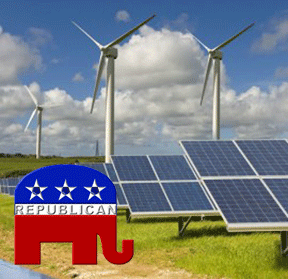 Speaking of Republicans, that figure includes self-identified Republicans, which is the only demographic group in the survey to favor fossil energy over renewables. Did I say Republicans too many times in this article?
Where was I? Oh, right. Utility companies such as Duke Energy have been taking that message to heart and are rapidly increasing their renewable energy portfolios, as chronicled endlessly here at CleanTechnica and our sister site PlanetSave.
As for energy extraction companies, earlier this week we made the point that energy is fungible. If you think of energy to the energy industry as mobility to the auto industry, you can see why the reality is that the transition to a more safe and sustainable business model can be painful, it is doable.
Some extraction companies are doing it faster than others. For example Chevron (yes, that Chevron) is heavily invested in solar energy, and Saudi Aramco is busily transitioning its host nation’s domestic energy profile into renewables.
On the other side of the coin, there are still plenty of fossil-invested companies that don’t seem to be interested in any kind of transition at all, and that have been aggressively lobbying against renewables.
That would be Koch Industries and Exxon, for starters. If you can think of some other examples, drop us a note in the comment thread.
Follow me on Twitter and Google+.
Keep up to date with all the hottest cleantech news by subscribing to our (free) cleantech newsletter, or keep an eye on sector-specific news by getting our (also free) solar energy newsletter, electric vehicle newsletter, or wind energy newsletter http://cleantechnica.com/2014/12/30/more-renewable-energy-for-the-us-navy/
Electricity Utilities must change their business model as distributed energy races ahead
Report: Distributed-Renewables Disruption Will Reduce Utility Revenues By Up To $123 Billion A Year By 2025 Clean Technica, December 29th, 2014 by James Ayre
The ongoing growth of distributed renewable energy generation throughout the US and Europe will see utility-company revenues reduced by as much as $123 billion a year by 2025, according to a new report from the consulting company Accenture.
That new report — titled the Digitally Enabled Grid report — clearly states that if the utilities wish to maintain a market share comparable to that of today, the companies will need to “fundamentally transform their business models.”………
As noted by the report, solar PV is actually already at grid parity in some parts of the US, the EU, and Australia. The expectation is that Japan will follow in that direction as well in a few years.
While the utility companies certainly have their work cut out for them, they aren’t facing extinction like some have predicted — according to de Miguel anyways. “While the ‘death spiral’, as commonly defined, is a myth, the demand disruption caused by the growing adoption of energy demand-disrupting technologies is a very real threat to utilities’ business models. And in addition to the financial pressure, this will cause significant operational challenges for utilities, increase technical stress on the grid and open the market to new competition for energy products and services.”
Given the growing number of executives at the utility companies that seem to be aware of the issues (see graph below), it seems pretty likely that some of the companies will institute major changes of some sort in the relatively near future………..
Those interested can find the full report here. http://cleantechnica.com/2014/12/29/report-distributed-renewables-disruption-will-reduce-utility-revenues-us123-billion-year-2025/
Japan: move to end compensation for Fukushima businesses
Ministry, TEPCO seek to end compensation for Fukushima businesses in Feb. 2016 Mainichi, 29 Dec 14 The government and Tokyo Electric Power Co. (TEPCO) have proposed to Fukushima Prefecture’s commerce and industry federation a plan to end nuclear disaster compensation for businesses in February 2016, it has been learned.
The Ministry of Economy, Trade and Industry and TEPCO presented the plan to the Fukushima Federation of Societies of Commerce and Industry on Dec. 25. The ministry and the utility told the federation that they plan to end compensation payments to all businesses, except for those in the agricultural, forestry and fisheries sectors, in February 2016. Ministry and utility officials explained that they would map out future policies after hearing claims from business owners.
The federation’s secretary-general, Hideki Endo, however, criticized the proposal.
“Fukushima business owners face different situations depending on their evacuation statuses and their business categories,” he said. “While we understand the need to draw the line somewhere, we cannot accept the end of compensation payments within a year and a few months from now when the nuclear disaster has still not been brought to a conclusion and there are no prospects that harmful rumors will end in the foreseeable future.”…….http://mainichi.jp/english/english/newsselect/news/20141227p2a00m0na007000c.html
France’s nuclear maintenance inadequate, costly: EDF shares slump
 France failing to keep up with nuclear reactor maintenance http://enformable.com/2014/09/france-failing-keep-nuclear-reactor-maintenance/ Lucas W Hixson Website According to the head of the French Nuclear Safety Authority, Electricite de France SA (EDF) – the largest generator of nuclear power in the world, is unable to keep up with maintenance needs at aging nuclear reactors in its fleet. The state-controlled EDF operates 58 nuclear reactors at 20 nuclear facilities and nearly 85% of its electrical production comes from nuclear energy.
After the Fukushima Daiichi nuclear disaster, EDF was forced to conduct repairs and safety improvements at its nuclear power stations, but according to Pierre-Franck Chevet, head of the Nuclear Safety Authority in France, “There are delays and complications and some could affect safety.”
EDF has estimated that it will need to spend at least $71 billion to improve safety at its nuclear power plants before 2025.
EDF shares have fallen as much as 4.2% since June 19th.
Pathetic selling effort by the nuclear industry carpet-baggers
The so-called luminaries attempting to sell (or should that be “shill”) Mad Maxatomstrom are lightweights like Robert Stone who, having made a bad propaganda documentary about nuclear energy sees himself as some kind of expert. Also on the list is Patrick Moore, the notorious paid proponent not only of nuclear but the chemical industry, (as in bring back DDT), the genetic engineering industry, and clear-cut logging. (How does any self-respecting reporter still dare to refer to him as an “environmentalist”?) And then there’s the blinkered Barry Brook who wrongly claimed that North Korea never signed the nuclear Non-Proliferation Treaty and buys the completely discredited IAEA-WHO death figure of 60 for the Chernobyl disaster.
The obvious conclusion is that Mad Maxatomstrom is another desperate, last-ditch attempt by the nuclear coven to cling on to a corner of the energy sector, at least in the mind’s eye if not in the actual marketplace
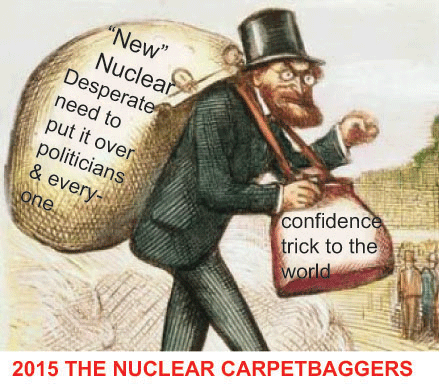
Except there won’t be much. Money that is. Because the Mad Maxatomstrom plan is to carpet-bag into Germany and try to sell them on nuclear energy and only nuclear energy. Yes, you read that right, Mad Maxatomstrom is Germany’s “first provider of 100 percent nuclear power.” (Okay, the company is actually called Maxatomstrom, but the business plan is so mad, who could resist?)
I say “carpet-bag” because notably all the “spokespeople” are anglo-saxon, most of them pulled from the Evangelical School of Nuclear Deniers. They are also all male and all white. Make of that what you choose.
It’s fitting that this new all-nuclear energy company was apparently launched by a member of Germany’s so-called Pirate Party (it has no members of Parliament.) When I first read the press release I thought it was a spoof. It’s also telling that the company could not find a single, prominent German spokesperson.
And I say “not much money” because there are so many other better and equally competitive, if not cheaper, electricity choices already in Germany, some of which are providers of 100% renewable energy. Germany-based anaylst Craig Norris ran the Maxatomstrom numbersand got “three different offers, each around 50 euros a month – an absolutely unremarkable outcome (it’s basically what I pay right now for 100 percent green power.)” So these pirates won’t really be doing so well in the plundering-the-German-people department.
Mad Maxatomstrom claims it already boasts 3,000 customers! Wow, that’s just a tenth of the amount of people still employed in Germany’s declining nuclear sector, and about 100th of the people employed in the growing renewable energy sector. The local Mom and Pop corner store probably does better. Continue reading
USA nuclear lobby getting desperate: demanding “strong government intervention”
 With US Nuclear in Decline, Scientists and Analysts Urge Support for Next-Generation Technologies, The Energy Collective, Stephen Lacey December 24, 2014 “……..The global nuclear industry is in steady decline. Since hitting a peak in 1996 at nearly 18 percent of global energy production, the industry’s share has dropped down to less than 11 percent.
Even with countries like China and India looking to boost their low-carbon energy supplies with nuclear, project developers around the world have faced long delays, cost overruns, and strong competition from natural gas and distributed resources, as well as policies designed to phase nuclear out entirely.
America is facing its own imminent decline in nuclear generation……….
A comprehensive federal plan, says IEA, is the only way to keep the industry relevant. ………..”The domestic nuclear industry is therefore at a critical juncture as a consequence of its declining economic competitiveness, and existing market mechanisms do not favor investment in high capital-intensive nuclear technology,” concluded the IEA.
Articulating that strategy will not be easy.
On a levelized-cost-of energy basis (an admittedly limited metric), distributed renewables are competing with nuclear plants, adding to the pain inflicted by low natural gas prices. Both free-market advocates and renewable energy proponents say new nuclear shouldn’t be built if it can’t compete in today’s market.
Cost overruns are also hurting the industry’s image. The first U.S. nuclear project to be built in 30 years, the Vogtle power plant in Georgia, is now $1.5 billion over budget and getting more expensive. Angry about rate increases caused by Vogtle, the Green Tea Party and environmental groups were able to force Georgia Power to support half a gigawatt of new solar in the state — much of it procured for 6.5 cents per kilowatt-hour.
Meanwhile, many environmentalists remain staunchly opposed to nuclear for traditional health and safety reasons……….
For nuclear to have any chance of succeeding, strong government intervention will be needed to fund more R&D and back loans for commercial-scale plants, say proponents…..
Russia keen to lock Jordan into long term contracts to buy nuclear reactors
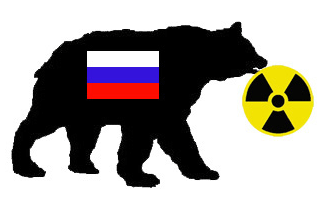 Russia approves draft deal to build nuclear plant in Jordan, Times of Israel 25 Dec 14 State-owned company Rosatom expected to finish construction of first 1,000-megawatt unit by 2024, second by 2026 Russian Prime Minister Dmitry Medvedev endorsed a draft Russia-Jordan agreement on the construction and operation of a nuclear plant in Jordan, the official website of the Kremlin said on Thursday…….
The state-owned company will form a joint venture with the Jordanian government, in which the Russian company will have 49.9 percent of the shares and Jordan will own 50.1%. The agreement will be financed by investments from both parties……
Only in renewable energy are jobs growing: in the power sector – job losses, especially in nuclear power
 Employment Drops in All Segments of the Power Sector—Except Renewables , Greentech Solar Jobs in solar power generation have increased by 201 percent since 2011. Julia Pyper December 24, 2014
The electric power sector lost more than 5,800 jobs over the last three years, with employment is taking a hit in nearly all energy sources except for renewables, according to the Energy Information Administration (EIA).
Non-hydro renewable electricity generation gained nearly 1,800 jobs over the period, largely in the solar sector.
Data compiled from the Bureau of Labor Statistics only reflects the jobs in electric power generation, and not the jobs associated with managing the grid. Jobs related to the construction of new facilities, processing or transportation of fuels, or behind-the-meter distributed generation installations and service were also excluded from the number set………….
recent coal plant closures caused a net decline of 1,750 fossil fuel power generation jobs since 2011. According to the EIA, the new natural gas plants are less labor-intensive than the older coal plants they’re replacing.
The nuclear industry, however, was the hardest hit. Jobs at nuclear power plants fell by 9 percent, which amounts to 4,900 positions, over the last three years.
The downward trend is on track to continue. Several U.S. nuclear power plants are slated for closure in the coming years and there are next to no plans to replace them. The International Energy Agency, a leading Washington think tank and group of conservation scientists recently made separate appeals for the U.S. to rethink its nuclear energy strategy.
Julia Pyper
Julia Pyper is a Senior Writer at Greentech Media covering utilities, grid issues, electric vehicles, the solar industry and energy storage. Find her on Twitter @JMPyper. http://www.greentechmedia.com/articles/read/employment-drops-in-all-segments-of-the-power-sector-except-renewables
1 This Month





PLEASE OPPOSE HR 8255 AND S.3639 – bills would accelerate satellite deployment, with no environmental review or safeguards – https://ncstd5li.quorum.us/campaign/169331/
To see nuclear-related stories in greater depth and intensity – go to https://nuclearinformation.wordpress.com
-
Archives
- September 2026 (339)
- August 2026 (330)
- July 2026 (355)
- June 2026 (287)
- May 2026 (306)
- April 2026 (356)
- March 2026 (251)
- February 2026 (267)
- January 2026 (308)
- December 2025 (358)
- November 2025 (359)
- October 2025 (375)
-
Categories
- 1
- 1 NUCLEAR ISSUES
- business and costs
- climate change
- culture and arts
- ENERGY
- environment
- health
- history
- indigenous issues
- Legal
- marketing of nuclear
- media
- opposition to nuclear
- PERSONAL STORIES
- politics
- politics international
- Religion and ethics
- safety
- secrets,lies and civil liberties
- spinbuster
- technology
- Uranium
- wastes
- weapons and war
- Women
- 2 WORLD
- ACTION
- AFRICA
- Atrocities
- AUSTRALIA
- Christina's notes
- Christina's themes
- culture and arts
- Events
- Fuk 2022
- Fuk 2023
- Fukushima 2017
- Fukushima 2018
- fukushima 2019
- Fukushima 2020
- Fukushima 2021
- general
- global warming
- Humour (God we need it)
- Nuclear
- RARE EARTHS
- Reference
- resources – print
- Resources -audiovicual
- Weekly Newsletter
- World
- World Nuclear
- YouTube
-
RSS
Entries RSS
Comments RSS

