USA’s nuclear salesmen happy with Barack Obama’s trade deal with China
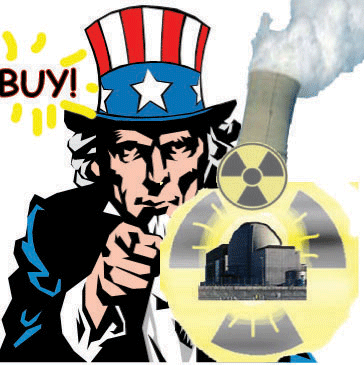 Barack Obama’s nuclear deal with China, quiet submarines and the South China Sea, SMH, May 11, 2015 Steven Mufson “……….The deal would allow Beijing to buy more US-designed reactors and pursue a facility or the technology to reprocess plutonium from spent fuel. China would also be able to buy reactor coolant technology that experts say could be adapted to make its submarines quieter and more difficult to detect.
The formal notice initially did not draw any headlines. Its unheralded release on April 21 reflected the administration’s anxiety that it might alarm members of Congress and non-proliferation experts who fear China’s growing naval power – and the possibility of nuclear technology falling into the hands of third parties with nefarious intentions.
Now, however, Congress is turning its attention to the agreement. The Senate Foreign Relations Committee is set to hear from five Obama officials in a closed-door meeting on Monday to weigh the commercial, political and security implications of extending the accord. The private session will permit discussion of a classified addendum from the Director of National Intelligence analysing China’s nuclear export control system and what Mr Obama’s notification called its “interactions with other countries of proliferation concern”.
The White House’s willingness to push ahead with the nuclear accord with Beijing illustrates the evolving relationship between the world’s two largest powers, which, while eyeing each other with mutual suspicion and competitiveness, also view each other as vital economic and strategic global partners. The Nuclear Energy Institute, an industry trade group, argues that the new agreement will clear the way for US companies to sell dozens of nuclear reactors to China, the biggest nuclear power market in the world………..http://www.smh.com.au/world/barack-obamas-nuclear-deal-with-china-quiet-submarines-and-the-south-china-sea-20150511-ggyl25.html
Weapons proliferation and other risks in USA’s marketing of nuclear technology to China
US nuclear deal with China raises proliferation concerns, Guardian Steven Mufson 12 May 15
Critics of Obama agreement are worried about Beijing’s growing naval power “……..The deal would allow Beijing to buy more US-designed reactors and pursue a facility or the technology to reprocess plutonium from spent fuel. China would also be able to buy reactor coolant technology that experts say could be adapted to make its submarines quieter and harder to detect.
The formal notice’s unheralded release on 21 April reflected the administration’s anxiety that it might alarm members of Congress and nonproliferation experts who fear China’s growing naval power – and the possibility of nuclear technology falling into the hands of third parties with nefarious intentions.
Now, however, Congress is turning its attention to the agreement. The Senate foreign relations committee was set to hear from five Obama officials in a closed-door meeting on Monday to weigh the commercial, political and security implications of extending the accord. The private session permitted discussion of a classified addendum from the director of national intelligence analysing China’s nuclear export control system and what Obama’s notification called its “interactions with other countries of proliferation concern”.
The White House’s willingness to push ahead with the nuclear accord with Beijing illustrates the evolving relationship between the world’s two largest powers, which, while eyeing each other with mutual suspicion and competitiveness, also view each other as vital economic and strategic global partners. The Nuclear Energy Institute, an industry trade group, argues that the agreement will clear the way for US companies to sell dozens of nuclear reactors to China, the biggest nuclear power market in the world……..
The US has bilateral 123 agreements with 22 countries, plus Taiwan, for the peaceful use of nuclear power. Some countries that do not have such agreements, including Saudi Arabia, Jordan and Malaysia, have expressed interest in clearing obstacles to building nuclear reactors…………..
In December 2006, Westinghouse Electric — majority-owned by Toshiba — signed an agreement to sell its AP1000 reactors to China. Four are under construction, six more are planned, and the company hopes to sell 30 others, according to an April report from the Congressional Research Service.
When it comes to nuclear weapons proliferation, China is in a different category from other 123 agreement nations. It first tested a nuclear weapon in 1964 and now has an arsenal of about 250 nuclear warheads. So US concerns have focused more on whether China has transferred technology to other countries.
“Concerns persist about Chinese willingness as well as ability to detect and prevent illicit transfers,” the CRS report said. “Missile proliferation from Chinese entities is a continuing concern.” The US wants China to refrain from selling missiles capable of carrying nuclear weapons, a payload of 499kg, as far as 305km. A State Department compliance report in 2014 said that Chinese entities continued to supply missile programmes in “countries of concern”.
China has a pilot plant engaged in reprocessing in Jiu Quan, a remote desert town in Gansu province. Satellite photos show that it is next to a former military reprocessing plant, according to Frank von Hippel, a Princeton University physics professor who specialises in nuclear arms control. There is not even any fencing between the sites, he says. “That’s been one of the hang-ups of the (reprocessing) deal” that China has been trying to negotiate with France for several years, von Hippel said.
Sokolski said the agreement proposed by Obama lacks a requirement for explicit, case-by-case US permission for a reprocessing project using American technology or material from US reactors. It gives consent in advance. And he fears that over the 30-year life of the new 123 agreement, China might want to compete with Russian and US arsenals and make more bombs, for which plutonium is the optimal material…………http://www.theguardian.com/us-news/2015/may/12/us-china-nuclear-deal-proliferation-concerns
Canadian review board knocks back Areva’s planned uranium mine as uneconomic
 Review board recommends against Areva Canada uranium mine http://ca.reuters.com/article/businessNews/idCAKBN0NW22H20150511 May 11, 201 By Rod Nickel WINNIPEG, Manitoba – A review board in the northern Canadian territory of Nunavut has recommended that Areva’s AREVA.PA planned uranium mine should not proceed, due to uncertainty about timing of the company’s plans to build the mine.
The Canadian Nuclear Safety Commission released the Nunavut Impact Review Board’s report on
Monday.The review board makes recommendations to Canadian federal ministers who are responsible for the decision.
Uranium prices have been weak since 2011’s Fukushima disaster in Japan, which caused that country to take its reactors off-line. The slump has led uranium producers to put some plans for new mines on hold.
The Nunavut review board considered the project’s social, economic and environmental impacts, but concluded that it could not adequately do this with no clear development schedule. The board said its recommendation, if adopted by Ottawa, does not mean that Areva could not apply again for approval.
Areva spokeswoman Veronique Loewen said the company was disappointed and is reviewing the report.The project involves two separate open-pit mine sites and a milling operation.
Malawi warned by World Bank to not re-open Paladin Australia’s uranium mine
 Malawi warned against reopening uranium mine http://www.ventures-africa.com/archives/62631 May 12, 2015 VENTURES AFRICA – The World Bank has warned Malawi against reopening its only uranium mine, saying the project should be put on hold until global prices improve.
Australia mining company, Paladin Energy, is developing Malawi’s only uranium mine, the Kayelekera uranium mine, in Karonga, northern Malawi. The project was initial suspended in 2014 because of the then unfavourable price climate, but there are indications that the company plans to resume operations in the coming months. “Whether or not the mine at Kayelekera eventually resumes operations will depend primarily on future prospects for global uranium prices, for which the immediate outlook is uncertain,” the World Bank told Malawi in its latest report.Uranium from mining is used almost entirely as fuel for nuclear power plants.
In 2013, Malawi was ranked as the third largest producer of uranium in Africa and tenth in the world. It is behind Namibia and Niger in Africa.
Last year, uranium global prices crashed to $36, from $51 per pound. This posed a major setback to Paladin Energy Africa, having invested heavily on the premise that prices will climb to $70. The Kayelekera uranium deposit was discovered by UK’s CEGB firm and a feasibility study was subsequently undertaken in the 1980s. Paladin acquired the deposit in 1997, accepted a Bankable Feasibility Study early in 2007, and, following environmental approval, undertook a $220 million development. The mine was opened in April 2009.
Paladin Energy (Africa) Ltd holds Paladin’s 85 percent interest following the Development Agreement with the Government of Malawi in control of the remaining 15 percent. Kayelekera production commenced in mid-2009, and in 2012 production reached 1103 tU, followed by 1134 tU in 2013.
AREVA’s nuclear options narrow in attempt to save thecompany
Indebted French nuclear company Areva sacks workers, negotiates with Paris, Financial Review, 10 May 15 French nuclear group’s options narrow; Talks with EDF and state over costs of shake-up by Michael Stothard
French nuclear group Areva is to cut 6,000 jobs over three years – 14 per cent of its global workforce – as options for a government-backed rescue package begin to narrow.
Areva, which reported a €4.8bn loss last year, said it was also lowering wages for surviving staff in an attempt to deliver the bulk of a €1bn cost reduction target.
However, the state-controlled group, which has seen its equity capital fall to nearly zero after four years of losses, is continuing to negotiate a more radical restructuring plan with EDF and the French government.
People close to the discussions said that these talks now focus on just two remaining options, and a final decision will be made in the coming months.
This deal, which could be valued at as much as €3bn, would result in the break-up of Areva, a company once regarded as one of the crown jewels of France’s nuclear industry. But, at the same time, it would limit the amount of cash the state has to contribute to Areva in a capital raising, which is expected to accompany such a deal.
Under a second, simpler, option – which people close to the talks say is preferred by the managements of Areva and EDF – only the smaller engineering business of Areva would be sold to EDF.
This would keep Areva relatively intact. But with EDF paying only between €300m and €1bn, it would necessitate a much bigger capital contribution from the cash-strapped French government to Areva.
To help mitigate the cost to the state of any capital raising, Areva will consider approaching its existing Chinese partners, according to people familiar with the plans………http://www.afr.com/news/world/indebted-french-nuclear-company-areva-sacks-workers-negotiates-with-paris-20150510-ggy6b0
Areva’s nuclear fuel reprocessing plant in La Hague in crisis- shunned by clients
 Crisis for Areva’s La Hague plant as clients shun nuclear, News Daily May 6, 2015 EMMANUEL JARRY FOR REUTERS BEAUMONT-HAGUE, France – Areva’s nuclear fuel reprocessing plant in La Hague needs to cut costs as its international customers disappear following the Fukushima disaster, and its sole remaining big customer, fellow state-owned French utility EDF, pressures it to cut prices.
Located at the westernmost tip of Normandy, La Hague reprocesses spent nuclear fuel for reuse in nuclear reactors and is a key part in Areva’s production chain, which spans uranium mining to fuel recycling.
Its valuation and outlook are crucial for the troubled French nuclear group, which is racing to find an equity parter after four years of losses have virtually wiped out its capital……….
One of the world’s biggest nuclear waste storage facilities, La Hague’s four pools hold the equivalent of about 50 reactor cores under four meters of water.
Protected by 1.5 meter thick anti-radiation concrete walls, employees in space suits cut up spent nuclear fuel rods, extract uranium and about one percent of plutonium, and melt the remaining waste into glass for eventual deep storage.
Areva says reprocessing reduces natural uranium needs by 25 percent but opponents say that separating plutonium from spent nuclear fuel increases the risk of nuclear proliferation.
The United States does not reprocess its nuclear fuel, but Britain has a large reprocessing plant in Sellafield. A planned recycling plant in Rokkasho, Japan – modeled on La Hague – has been plagued by problems and is years behind schedule.
Since the 2011 nuclear disaster in Fukushima, Areva’s reprocessing unit has lost nearly all of its international customers.
The company’s “back-end” sales – which include reprocessing, logistics and decommissioning – have fallen to 1.53 billion euros in 2014, 18 percent of Areva’s turnover, from 2 billion euros, 30 percent of nuclear revenue, in 2004.
EDF SQUEEZE
In the past decades, more than 32,000 tonnes of spent nuclear fuel has been reprocessed at La Hague, of which nearly 70 percent for EDF, 17 percent for German utilities, nine percent for Japanese utilities and the rest for Swiss, Belgian, Dutch and Italian clients.
This year, La Hague expects to treat 1,205 tonnes of spent fuel, of which just 25 tonnes will come from abroad. That leaves Areva with EDF virtually as its sole customer, and although both firms are state-owned – Areva 87 percent, EDF 85 percent – EDF has played hardball in contract negotiations.
La Hague extracts plutonium from used nuclear fuel, which it then sends to Areva’s Melox plant in southeast France, which produces MOX fuel – a mixture of plutonium and spent uranium – for 22 (soon 24) of EDF’s 58 reactors.
The arrival of new management at both companies since the start of the year has ended years of hostility between France’s two nuclear champions, but a 6.5 billion euro contract to treat and recycle 1,100 tonnes per year of EDF’s spent fuel for the 2013-2020 period has still not been signed…………http://newsdaily.com/2015/05/crisis-for-arevas-la-hague-plant-as-clients-shun-nuclear/
AREVA’s woes heralding a slippery global slope for the nuclear industry?
 French Nuclear Dynamo Stalls, NYT, By DAVID JOLLY and STANLEY REEDMAY 7, 2015 PARIS — For decades, France has been a been a living laboratory for atomic energy, getting nearly three-quarters of its electricity from nuclear power — a higher proportion by far than in any other country.
But in the last few years, the French dynamo has started to stall. New plants that were meant to showcase the industry’s most advanced technology are years behind schedule and billions of euros over budget. Worse, recently discovered problems at one site have raised new doubts about when, or even if, they will be completed……..
Alarmed by the French industry’s problems, the Socialist government of President François Hollande is expected soon to announce an industry overhaul. As the majority owner of the country’s two main nuclear companies — the reactor maker Areva and the big utility operator Électricité de France — the government will aim not only to put the companies on a firmer financial footing but to reorganize them in hopes of restoring the French industry’s role-model luster.
On Thursday, Areva took the first of those steps by announcing big cost-cutting plans. The move is likely to trim as many as 6,000 jobs from the company’s global work force of 45,000 — as many of 4,000 of those coming in France……….
With the French companies struggling, some nuclear experts see a slippery geopolitical slope. Continue reading
6,000 employees of failing nuclear giant AREVA are to lose their jobs
French nuclear group Areva to cut up to 6,000 jobs worldwide, Yahoo 7 News May 8, 2015,
Paris (AFP) – French nuclear group Areva, which incurred massive losses last year, announced Thursday it would cut up to 6,000 jobs worldwide as it seeks to slash its costs by a billion euros by 2017. he number of job cuts will be between 5,000 and 6,000 worldwide, said the group’s human resources director Francois Nogue.Between 3,000 and 4,000 of the job losses will be in France.
Areva had earlier said it planned to reduce its labour costs by around 15 percent in France and 18 percent internationally.
The group’s labour costs currently come to between 3.5 billion and 4.0 billion euros — an unsustainable level given that revenues are only about twice that, said Nogue………….https://au.news.yahoo.com/a/27700325/french-nuclear-group-areva-to-cut-up-to-6-000-jobs-worldwide/
Big nuclear company not interested in new nuclear power
Vattenfall: We are not interested in new nuclear power http://sverigesradio.se/sida/artikel.aspx?programid=2054&artikel=6156063 lördag 2 maj kl 15Vattenfall’s new President and CEO, Magnus Hall, a former lobbyist for the nuclear power industry, says it is no longer possible to build new nuclear power stations in Sweden, unless the state pays.

The business community in Sweden is no longer interested in building new nuclear power. At least not if it has to pay, thinks Magnus Hall. The ongoing nuclear projects in Finland and the UK have cracked all his calculations and the Vattenfall chief does not believe there is not sufficient profitability in new reactors without state support.
Magnus Hall, who was formerly chairman of Industrial Power, a lobby organization that wanted to build new nuclear power for electricity-intensive industries, has thus changed his position today.
“Yes, I have enough, actually, because I think it has become so clear that it is the state that dictates the terms for nuclear power. Therefore, the state also take responsibility for it, and it is also linked to the infrastructure of a country, says Hall to Swedish Radio News.
Last week, the Swedish state-owned energy company announced it will cut 1,000 jobs and close two of its reactors earlier than expected due to a fall in profits. Lower energy prices and lower production levels have affected Vattenfall’s results.
Boeing blacklisted by largest Nordic fund company over nuclear weapons making
Nordea blacklists Boeing over nuclear arms Madison Marriage , Ft.com , 5 May 15 Boeing has been blacklisted by the largest Nordic fund company over concerns that the civil and defence aerospace group is producing nuclear weapons.
Nordea Asset Management, which oversees €174bn of assets, told FTfm it added Boeing to its exclusion list in May due to the group’s involvement in producing components for replacement nuclear-armed Trident ballistic missile submarines in 2014.
The exclusion creates further problems for Boeing, which has already been blacklisted by the world’s largest sovereign wealth fund and a number Europe’s largest pension funds.
Sasja Beslik, head of corporate governance at Nordea, said: “Boeing is in the process of developing a new nuclear programme, [which means] we cannot engage with them. These companies will not change their business models, because [nuclear] is too lucrative.”…….
Nordea already excludes a handful of companies involved in manufacturing or supplying nuclear weapons, including UK groups BAE Systems andBabcock International and Areva of France………
The Norwegian Government Pension Fund, the world’s largest sovereign wealth fund, has blacklisted 10 companies involved in the production of nuclear weapons, including Boeing, since 2005.
PGGM, the second-largest Dutch pension fund manager, with €189bn of assets, has similarly excluded more than a dozen companies, including Boeing, over their involvement in nuclear arms since 2008………http://www.ft.com/intl/cms/s/0/ab38fee8-eff9-11e4-ab73-00144feab7de.html#axzz3ZJPY7ucS
Chinese nuclear companies keen to market reactors overseas
 Chinese Nuclear Firms Compete Abroad for Exports and for Market Share at Home, Energy Collective Two giant rival Chinese state-owned nuclear firms are pulling out the stops to achieve success with exports and increased market share of the restarted domestic reactor construction program. The so-called Hualong One, a 1000 MW PWR type reactor, is being hawked by both firms, but with significant enough design differences that potential customers worry about supply chain issues……..
Moving Inland from the Coast
Up to now China has been building its reactors at coastal sites. The reasons include the available seawater for cooling the units and the ability to deliver very large reactor components by barge. However, the China National Energy Administration is now looking at inland sites again. Following the Fukushima earthquake, the agency suspended consideration of new construction starts away from coastal regions.
The main issue was consideration of adequate cooling water supplies in an emergency. At issue is a 100% fail safe supply of water in regions which may have some areas which may have inadequate freshwater resources even without the demand of a new power plant………http://theenergycollective.com/dan-yurman/2223861/chinese-nuclear-firms-compete-abroad-exports-and-market-share-home
Business Academy condems nuclear power as economically not viable
Before rushing to endorse nuclear expansion, regulatory agencies and individual researchers should critically examine past performance and demand experimental proof for claims that the next generation of nuclear plants (should any ever be considered for construction) will be economically viable, climate-friendly, and accident-proof.
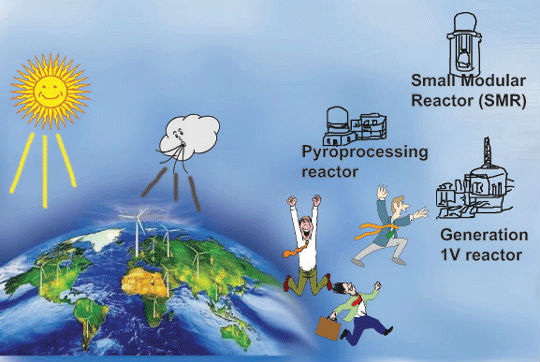
It is believed that next generation reactors will differ dramatically from current reactors in that they will replace active water cooling and multiple backup safety systems with “passive safety” designs. In fact, many nuclear advocates and news reports inaccurately describe the proposed new reactor designs, such as the pebble bed modular reactors, as “accident-proof” or “fail-safe.”
 Nuclear Power: Totally Unqualified to Combat Climate Change BY RINALDO S. BRUTOCO , WORDL BUSINESS ACADEMY SEPTEMBER 14, 2014 “………From a business perspective, private investors should be seen as the ultimate ”referees” on competing energy choices, using informed diligence and prudent criteria to determine which energy technologies can compete in the market with the best chance of generating revenues and profits. As Amory Lovins points out, the capital markets have already spoken. Private investors and project finance lenders have flatly rejected large base-load nuclear power plants and have enthusiastically embraced supply-side competitors, decentralized cogeneration, and renewables……… We believe the reason all sophisticated investors avoid nuclear investments isbecause no one has figured out how to build a reactor that doesn’t routinely emit toxic levels of radioactivity while still producing power economically, and because there is no safe disposal system known to humanity.
The commercial nuclear industry has been around for over half a century, so the prudent approach would be to look at the industry’s track record. Continue reading
Nuclear industry embarks on a public advertising campaign
 Nuclear power industry hopes for a new era, Standard Times James Osborne, Apr 25, 2015“…….With high-profile advocates like former Environmental Protection Agency administrator Christie Whitman on board, the industry is embarking on a very public campaign arguing nuclear must be part of any national energy plan. To accomplish that, it wants to examine amending power and licensing regulations to encourage nuclear and speed up construction.
the industry will face opposition. Nuclear remains a divisive issue among environmentalists. Some support it as a proven means to cut carbon emissions out of the nation’s power supply.
But there are many see its potential contamination risks as just too great to make it sensible……..http://www.gosanangelo.com/news/state/nuclearpowerda_54975979
10 reasons why the global nuclear industry is in crisis – theme for May 2015
 The global nuclear industry is sick, indeed, it is in palliative care. And here are 10 good reasons why:
1. Gloom overlies the nuclear lobby, fear of this question: the next nuclear catastrophe. Not IF it will happen, but WHEN and WHERE?
2. Aging, dangerous nuclear reactors that are too costly to make safe. .
3. “New nuclear” is a joke. The nuclear lobby will boast of so many “planned”, “proposed” reactors. But new ones actually being built? – just two and a half duds.
4 Discord and dissension in the nuclear camp. Nuclear countries cannot afford new reactors, so desperately compete to sell them to other countries.
Meanwhile nuclear companies battle it out to market their particular new gee-whiz nuclear reactor version.
5. Climate change affects nuclear reactors.
6. Nuclear weapons now out-dated. 21st Century conflict is all about smaller, targeted 
weapons, like the USA’s assassination drones. Pride and status are now the only motives for having nuclear weapons.
7. Decline in electricity use
8 Renewable energy, both centralised and small scale, is fast being developed, and widely popular (unlike nuclear).
9. Danger – whatever kind of nuclear facility – there is always the danger of accident or terrorism – they are a target for terrorists.
10 Public opinion. Worldwide – people just don’t like nuclear power.
Nuclear lobby pushing for corporate welfare and exports, through the Export-Import Bank

“Taxpayers should not be in the business of subsidizing risky loans or giving money to big businesses and foreign countries,” said Levi Russell, spokesman for Americans for Prosperity, a Tea Party-aligned group that, along with dozens of other conservative groups, is urging Congress to let Ex-Im expire.
Ex-Im fight goes nuclear, The Hill, 22 Apr 15 The nuclear power sector is emerging as one of the most vocal proponents of the Export-Import Bank, as debate intensifies over whether to reauthorize the increasingly controversial institution.
The Nuclear Energy Institute (NEI) is leading the charge to demonstrate to lawmakers that closing the bank would threaten the billions of dollars in economic activity and tens of thousands of jobs that come from exporting U.S. nuclear power technology and products.
The nuclear industry is also proving to be a top player among the big business groups that are doing the bulk of the lobbying on Ex-Im, which provides financing for U.S. companies to sell products and services to foreign customers.
Exports are essential to the nuclear industry, because a new reactor has not come online in the United States in nearly two decades and only five are under construction…….
The global market represents an important bounty for the U.S. industry. Continue reading
1 This Month




PLEASE OPPOSE HR 8255 AND S.3639 – bills would accelerate satellite deployment, with no environmental review or safeguards – https://ncstd5li.quorum.us/campaign/169331/
To see nuclear-related stories in greater depth and intensity – go to https://nuclearinformation.wordpress.com
-
Archives
- September 2026 (339)
- August 2026 (330)
- July 2026 (355)
- June 2026 (287)
- May 2026 (306)
- April 2026 (356)
- March 2026 (251)
- February 2026 (267)
- January 2026 (308)
- December 2025 (358)
- November 2025 (359)
- October 2025 (375)
-
Categories
- 1
- 1 NUCLEAR ISSUES
- business and costs
- climate change
- culture and arts
- ENERGY
- environment
- health
- history
- indigenous issues
- Legal
- marketing of nuclear
- media
- opposition to nuclear
- PERSONAL STORIES
- politics
- politics international
- Religion and ethics
- safety
- secrets,lies and civil liberties
- spinbuster
- technology
- Uranium
- wastes
- weapons and war
- Women
- 2 WORLD
- ACTION
- AFRICA
- Atrocities
- AUSTRALIA
- Christina's notes
- Christina's themes
- culture and arts
- Events
- Fuk 2022
- Fuk 2023
- Fukushima 2017
- Fukushima 2018
- fukushima 2019
- Fukushima 2020
- Fukushima 2021
- general
- global warming
- Humour (God we need it)
- Nuclear
- RARE EARTHS
- Reference
- resources – print
- Resources -audiovicual
- Weekly Newsletter
- World
- World Nuclear
- YouTube
-
RSS
Entries RSS
Comments RSS

