New private consortium to decommission nuclear power stations – will cut 1600 jobs
 Magnox nuclear decommissioning consortium to cut up to 1,600 jobs, Guardian, Terry Macalister, 22 May 15 Cavendish Fluor Partnership says plans reflect ‘stepdowns’ in work at nuclear plants around UK The new private consortium that recently won the £4.2bn management contract for the decommissioning of 12 Magnox nuclear power stations has revealed plans to cut up to 1,600 jobs. Cavendish Nuclear, a division of Babcock International, plus its US partner Fluor, said the cuts reflected “planned stepdowns in the work programme” at a number of atomic sites around the UK.
The move comes amid speculation that Babcock is preparing to demand millions of pounds of extra subsidies from the Nuclear Decommissioning Authority (NDA) on the grounds that the workload was much heavier than anticipated.
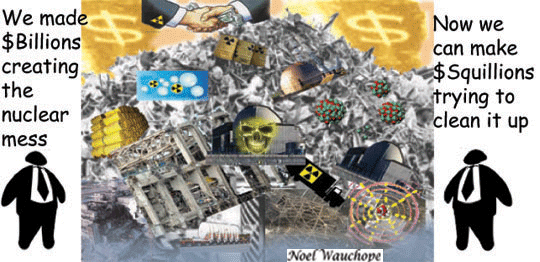
Unions expressed shock that staff, agency and contract workers would lose their jobs between now and September 2016, although the Cavendish Fluor Partnership said it would try to find some alternative posts. Eleven of the plants have already shut down and the remaining one in operation – Wylfa on Anglesey in North Wales – is due to stop generating power at the end of the year.
Problems with the decommissioning of the separate Sellafield site in Cumbria have recently led to the private consortium there which includes Amec and Areva of France – being thrown off the management contract.
The 12 nuclear power sites managed by the Cavendish consortium for Magnox include Berkeley, Gloucestershire; Bradwell, Essex; and Hinkley Point A in Somerset.
EDF last month announced plans to cut 400 construction jobs at the site of the planned new atomic plant of Hinkley Point C.
The reduction in workers comes amid continuing delays over a final investment decision on the £24.5bn project as negotiations with potential investors continue to move more slowly than expected. http://www.theguardian.com/business/2015/may/21/magnox-nuclear-decommissioning-consortium-cut-1600-jobs
Engie not willing to acquire troubled nuclear company AREVA
 Engie will not acquire struggling French nuclear group Areva, Ft.com 21 May 15 Michael Stothard in Paris Engie would consider working with struggling French nuclear group Areva on some business lines but is not looking for any full-blown acquisitions to help rescue the company, according to the chief executive of the utility.
“If we consider something, it would be in co-operation with Areva, not simply an acquisition of some assets,” Gérard Mestrallet told the Financial Times on the sidelines of a business and climate change conference in Paris
The comments come as the French government looks to elicit the aid of French companies to help rescue Areva, which reported a €4.8bn loss last year.
Areva, which is 87 per cent government-owned, has fallen victim to a slump in global demand for new reactors that followed the 2011 Fukushima disaster in Japan, as well as crippling cost overruns at key projects…….
Any deal between Areva and Engie would be likely to come alongside a much larger agreement with EDF, which earlier this week outlined its preference for a broad rescue package to acquire Areva NP, the division that designs, manufactures and maintains nuclear reactors.
“The more ambitious proposal from EDF will preserve the technical expertise of Areva’s reactor business and create the possibility of partnerships with outside groups from France or elsewhere,” said Jean-Bernard Lévy, EDF’s chief executive.
The more ambitious proposal from EDF will preserve the technical expertise of Areva’s reactor business and create the possibility of partnerships with outside groups from France or elsewhere– Jean-Bernard Lévy, EDF’s chief executive
Another option on the table would see EDF, which is 85 per cent state-owned, simply recruit 1,200 Areva engineers who specialise in nuclear safety. This would require a greater injection of capital in the group from the government, however.
It is ultimately up to Paris to decide between these two options. A decision could come as early as June ……….3.http://www.ft.com/intl/cms/s/0/3d592a50-ffb8-11e4-8c46-00144feabdc0.html#axzz3aoqg2DDh
Investors flee Nordic nuclear company Vattenfall
 Nuclear Shutdowns Are Leaving Vattenfall’s Bond Investors Cold , Bloomberg, Jesper Starn , 21 May 15 A jump in power prices hasn’t been able to lift Vattenfall AB bonds as investors worry the Swedish utility will write down more nuclear assets.
While Nordic power prices have risen from record lows after Vattenfall said it would close its two oldest reactors, yield spreads on the utility’s bonds are little changed. The closing plans instead directed attention to the poor Nordic market outlook for investors who had focused on Vattenfall’s woes in Germany, according to Ebba Lindahl, an SEB AB analyst.
“We see an increased risk of smaller cash flows from nuclear generation in the future and further write downs of assets that will not be fully compensated by the increase in power prices,” she said in a phone interview…….
A surge in renewable energy output in Nordic region, coupled with demand still below 2008-levels, has pushed power prices so low that the once-steady cash cow of nuclear production has become a liability.
The company is majority owner of seven reactors in Sweden and also owns thermal coal, lignite and gas units in Germany, which are poorly suited to the European Union’s aim for a transition to low-emission energy systems, according to Ingvar Mattsson, a senior analyst at Swedbank AB.
Vattenfall’s plans to close the two reactors early “reflects a tough market situation with low power prices, and thus a lower valuation of nuclear assets,” he said by phone. “Vattenfall is also obviously exposed to political risks in both Germany and Sweden.” http://www.bloomberg.com/news/articles/2015-05-20/nuclear-shutdowns-are-leaving-vattenfall-s-bond-investors-cold
Finland pulls out of building Olkiluoto 4 nuclear reactor
Finland cancels – is the EPR finished?, The Ecologist, Dr Jim Green & Oliver Tickell 15 May 15
This week Finland cancelled its option for a second European Pressurised Reactor as the existing EPR project sinks into a abyss of cost over-runs, delays and litigation, writes Jim Green. It now looks like the EPR is a failed technology and its owner, French nuclear giant Areva, is fast running out of both money and orders as its ‘hot prospects’ evaporate.
There’s been plenty of bad news recently for the European Pressurised Reactor (EPR) nuclear power station design.
And now there’s more. The Finnish electricity company TVO announced this week that it had cancelled plans to build a second EPR at Olkiluoto in western Finland because of delays and problems with the first EPR on the site currently being built by Areva and Siemens.
That plant, Olkiluoto 3, is running severely over time and budget. Construction began in 2005 and it is not expected to commence operating until 2018, nine years late.
The estimated cost has risen from €3.2 billion (US$3.6b) to €8.5 billion (US$9.5b). Areva has already made provision for a €2.7 billion (US$3.0b) writedown on the project, with further losses expected. FTVO and Areva / Siemens are locked ina €10 billion legal battleover the cost overruns.
Finland’s government had given TVO a deadline of 30th June to request a building permit for its planned Olkiluoto 4 plant. TVO said it would not pursue the project due to “the delay of the start-up of Olkiluoto 3 plant unit.”
It added: “In this situation it is impossible to make significant Olkiluoto 4 related decisions necessary for the construction license application.” Continue reading
Tough times ahead for the global nuclear industry
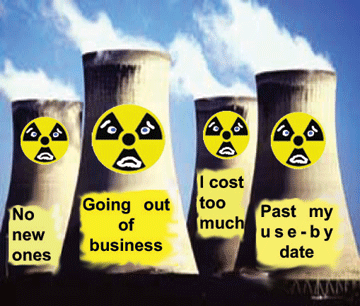 Survival of the fittest? World’s major nuclear builders are in for a long stretch in the red, Bellona, May 18, 2015 by Vladimir Slivyak, Translated by Maria Kaminskaya MOSCOW – Judging by the numerous reports on negotiations under way over new reactor construction projects, 2015 should be a pivotal year for nuclear power development across the world. The most vigorous efforts toward expanding their presence on the international markets are applied by the Russian Rosatom and France’s Areva. But all is not so rosy with both companies’ balance sheets. In free market conditions, without generous subsidies from state budget, the industry is as good as paralyzed, and it’s no wonder that its leaders are made of those with access to state coffers. Will the largest nuclear competitors find salvation in their governments’ support? Continue reading
Gloomy financial situation for AREVA in so many ways
Despite the guaranteed increased purchase price for Hinkley Point C’s power, however, investors are not in a hurry to jump on board with a project where Areva will not just build the reactors but is also to bring in funding in the amount of 10% of the project’s total cost. The problem is that last fall, the company admitted it was having serious economic difficulties, which may cause it to fail to deliver on the financial commitments in the Hinkley Point C project.
Areva’s economic troubles have to do with another project the company is pursuing: the highly problematic reactor construction at a new site in Olkiluoto, Finland.
Survival of the fittest? World’s major nuclear builders are in for a long stretch in the red, Bellona, May 18, 2015 by Vladimir Slivyak, Translated by Maria Kaminskaya MOSCOW
“………..The project considered to be the flagship for the French nuclear industry in Europe is the nuclear power plant Hinkley Point C in Great Britain, estimated at €24 billion. The project envisions building two reactors of the EPR – for “European Pressurized Reactor” – design in Somerset, in England’s southwest. No new reactor construction was previously undertaken in Great Britain for a period of many years, and, on account of nuclear energy’s less than perfect reputation from the economic point of view, such a large-scale endeavor in a country with a market economy seemed quite unlikely.
Yet, the project received both the British government’s approval and state guarantees on a fixed purchase price for the power the future plant will be generating. A favorable determination on the project was eventually also handed down by the European Commission, which had been looking into the legality of the state guarantees provided to Hinkley Point C. What the grievances against the project boil down to is that purchase of power from Hinkley Point C at a guaranteed price – one that is substantially higher than today’s energy prices – has too close a semblance to state subsidies, and the latter is prohibited in the EU. This was the reason why far from all the European ministers voted in favor of the project, and litigation is still expected on the matter: Austria, which has voiced its disagreement with the European Commission’s decision, intends to challenge it in court.
Despite the guaranteed increased purchase price for Hinkley Point C’s power, however, investors are not in a hurry to jump on board with a project where Areva will not just build the reactors but is also to bring in funding in the amount of 10% of the project’s total cost. Continue reading
Trying to cut costs, TEPCO to sell uranium stockpile
Tepco looking to sell some uranium stockpiles to cut costs Japan Times, 19 May 15 Tokyo Electric Power Co. is planning to sell part of its uranium stockpiles for nuclear power generation in the current business year to cut costs amid uncertainty over the restart of idled nuclear plants, a company document obtained by Kyodo News showed Monday.
Tepco has not consumed uranium since the 2011 nuclear crisis started at its Fukushima No. 1 complex that eventually resulted in all of Japan’s nuclear reactors being taken offline amid safety concerns. By reducing the stockpiles, the utility is seeking to slash costs for managing them as it faces funding difficulties stemming from the nuclear crisis.
According to the document, Tepco aims to reduce the amount of uranium to levels prior to the Fukushima disaster by the end of fiscal 2015 through March. The company estimated in the paper it can secure ¥12.3 billion ($103.13 million) by selling around half of the planned amount……..
Major utilities including Tepco procure uranium, which could be diverted to military use, under long-term contracts from overseas suppliers in Canada and elsewhere.
As of the end of March, Tepco had a total of 17,570 tons of uranium (tU), equivalent to the amount used at the Kashiwazaki-Kariwa plant for 10 years, compared with 16,805 tU at the time of the nuclear disaster in March 2011.
The amount would increase to 19,317 tU in fiscal 2015 if the company does not sell some of the stockpile.The utility will likely return it to the suppliers or pay for the costs of uranium enrichment in kind, while it will also consider terminating uranium purchase contracts and reducing purchase volumes to streamline its business, according to the document.
Japan Atomic Power Co. has also taken the rare step of selling some of its uranium, apparently to raise money to repay loans amid its faltering business conditions. http://www.japantimes.co.jp/news/2015/05/19/business/corporate-business/tepco-looking-sell-uranium-stockpiles-cut-costs/#.VVv7z7mqpHw
Uranium price takes another dive down
Uranium daily spot price down 35 cents from week ago to $35.65/lb Washington (Platts)–19 May2015
The uranium daily spot price was $35.65/lb U3O8 Monday, down 35 cents from a week ago, according to price publisher TradeTech.
The daily U3O8 spot price had held steady at $36/lb during four trading days, May 8-13, TradeTech reported. The spot price declined 25 cents on Thursday and by another 10 cents, to $35.65/lb, on Friday, according to TradeTech, which Monday reported it unchanged…….http://www.platts.com/latest-news/electric-power/washington/uranium-daily-spot-price-down-35-cents-from-week-21469982
A year of losses for Namibia’ Rossing uranium mine
Namibia’s Rossing Uranium revenue tumbled in 2014 – official, Star Africa May 19, 2015 The impact of lower prices and the lower production figures in 2014 has strained Rossing Uranium’s revenue, which declined by 19 per cent compared to the previous year, leading to a net loss after tax of N$91 million (about US$8 million), compared to N$32 million (about US$2.7 million) profit in 2013.
The company’s turnover in 2014 was N$2.4 billion (about US$201 million), down from N$2.9 billion (about US$243 million) in 2013.
Managing director Werner Duvenhage revealed in a statement issued to APA on Tuesday that 2014 was a tough year due to continued decline of uranium globally, putting substantial pressure on the business.
“The challenging times currently experienced in our industry are mainly because of global influences. It was a tough year because the uranium price continued to decline globally, putting substantial pressure on our business, with the average uranium spot market price at US$33 (N$333) per lbs, much lower than the US$38 (N$418)) per lbs average in 2013,â€� he explained……….
Unfortunately, the uranium price declined further during the first half of the year, leading to a management and board decision to curtail production and meet only contractual commitments, with the resulting curtailment production plan effective from August 2014,� he said.
“The 2011 tsunami in Japan and its impact on the Fukushima nuclear plant still continued to plague the uranium market in 2014, with excess supply causing a decline in market prices.
“Nuclear plants in Japan remained off-line for most of the year. Supply has increased over the three years since the Fukushima incident.
“This is a recipe for continued weak prices in the near term. Utilities are holding large stocks in all forms, which defer their need to buy for one to three years on averageâ€�……http://en.starafrica.com/news/namibias-rossing-uranium-revenue-tumbled-in-2014-official.html
Safety problems may mean the end for AREVA’s EPR nuclear reactor
the International Energy Agency’s World Economic Outlook 2014 report:
- that nuclear growth will be “concentrated in markets where electricity is supplied at regulated prices, utilities have state backing or governments act to facilitate private investment”;
- and that “nuclear power faces major challenges in competitive markets where there are significant market and regulatory risks.”.
Finland cancels Olkiluoto 4 nuclear reactor – is the EPR finished?, The Ecologist, Dr Jim Green & Oliver Tickell 15 May 15 A negative learning curve on steroids
“……What to make of the EPR saga? First, Areva is backing the wrong horse – the outcome of current political debates will result in a declining role for nuclear power in France, coupled to the growth of renewables.
A new report by ADEME, a French government agency under the Ministries of Ecology and Research, concludes that a 100% renewable electricity supply scenario is feasible in France. The report estimates that the electricity production cost would be €119 per megawatt-hour in 2050 in the all-renewables scenario, compared with a near-identical figure of €117 / MWh with a mix of 50% nuclear, 40% renewables, and 10% fossil fuels.
Areva has also backed the wrong-sized wrong horse: a giant reactor with a giant price-tag. That said, the backers of ‘small modular reactors‘ are having no more success than Areva.
Areva has backed the wrong-sized wrong horse at the wrong time – the Global Financial Crisis and its aftermath, stagnant energy demand, the liberalization of energy markets, the political fallout from the Fukushima disaster and other factors have dampened demand for new reactors and made it more difficult to secure finance (or government subsidies) for huge projects.
The EPR saga undermines the rhetoric of standardised, simplified reactors designs ushering in a new era of nuclear growth. It also shows that developing modified versions of conventional reactors (in this case pressurised water reactors) can be complicated and protracted and can end in failure.
How much more difficult will it be to develop radically new types of reactors? The French government’s Institute for Radiological Protection and Nuclear Safety has recently produced an important critique of Generation IV nuclear power concepts.
It states that there “is still much R&D to be done to develop the Generation IV nuclear reactors” and it is sceptical about the safety claims made for Generation IV concepts.
The EPR saga shows that even countries with extensive nuclear expertise and experience can mess things up. The EPR might have demonstrated the potential for mass production to drive down costs – but in reality it is demonstrating the opposite.
Even before the EPR fiasco, the large-scale, standardised French nuclear power program was subject to a negative economic learning curve – costs were increasing over time. The EPR represents a negative learning curve on steroids.
That point is emphasised by construction cost estimates of £16-24.5 billion (US$24.3-37.2b; €21.7-33.2b) for two planned EPRs (with combined capacity of 3.2 gigawatts) at Hinkley Point in the UK. In the mid- to late-2000s, the estimated construction cost for an EPR was £2 billion; current estimates are 4-6 times higher.
Private companies have pulled out of EPR projects in several countries (Italy, the US, the UK, etc.). Thus the EPR fiasco reinforces points made in the International Energy Agency’s World Economic Outlook 2014 report:
- that nuclear growth will be “concentrated in markets where electricity is supplied at regulated prices, utilities have state backing or governments act to facilitate private investment”;
- and that “nuclear power faces major challenges in competitive markets where there are significant market and regulatory risks.”…..http://www.theecologist.org/News/news_analysis/2859924/finland_cancels_olkiluoto_4_nuclear_reactor_is_the_epr_finished.html
Green bonds – a powerful way to develope green energy?
Green bonds, a fast-growing money game with the clout to develop clean energy, await an umpire, EE News, Benjamin Hulac, E&E reporter ClimateWire: Thursday, May 14, 2015
When he chaired the Federal Communications Commission from 1993 to 1997, Reed Hundt studied the swift expansion of the nation’s telecommunications system that made the United States among the most advanced nations in the field and sparked investment overseas.
Between 1996 and 2013, broadband companies invested more than $1.3 trillion in telecom infrastructure domestically, according to the broadband industry’s trade group.
About 32 percent of the world’s population — 84 percent and 21 percent of residents in developed and developing nations, respectively — now has mobile broadband connections, according to the United Nations.
Hundt believes the same experience could be repeated in developing clean energy to cope with global climate change.
Borrowed money paid for the communications boom, Hundt explained, speaking yesterday at an energy efficiency conference in Washington, D.C. He added that world leaders should apply the same method to fund the renewable energy market.
“Everything in communications has been purchased with debt,” he said, holding up an iPhone and describing how rapidly mobile phones have spread internationally.
The portion of the business world devoted to renewable energy resembles the telecom industry in the 1980s, said Hundt, now the CEO of the Coalition for Green Capital, a nonprofit working to drive renewable investment by creating so-called green banks.
“I think that we’re in the really early days,” he said during a panel talk on green bonds, adding that a “total, radical, disrupting overhaul” of the energy sector must be accomplished with a massive lending market and robust debt securitization…………..http://www.eenews.net/stories/1060018552
Nuclear corporation Exelon tries to stifle the competition from renewables
 Exelon’s Pepco Takeover Fuels Fear That Nuclear Will Trump Solar, Blomberg, by Mark Chediak & Jim Polson 14 May 15 Fear that Exelon Corp. could slow the growth of solar power in Maryland to protect its high-cost nuclear reactors is fueling a push to block its planned acquisition of Pepco Holdings Inc.
The debate pits the state’s top lawyer, who has urged regulators to reject the sale, against the nation’s biggest nuclear power plant owner. The Maryland Public Service Commission is scheduled to rule on the $6.8 billion merger Friday.
If approved, Exelon will supply more than 80 percent of the state’s utility customers, giving it extraordinary market clout to favor its aging nuclear fleet over renewables, Attorney General Brian E. Frosh has argued. Exelon, based in Chicago, has countered with a promise to develop 15 megawatts of solar power in the state, and to create a $19.8 million fund to encourage investment in rooftop solar and energy efficiency.
In Illinois, where three Exelon reactors are at risk of closing, the company has blamed the growing use of wind power for crimping revenue, and it supports a requirement that utilities buy some power from “low-carbon” plants that include nuclear reactors.
‘Transformative Opportunities’
“The evidence shows that Exelon intends to control the pace of development of distributed energy resources,” Frosh said in a filing with the commission. Solar and wind, “while threatening to Exelon’s central station merchant power plants, offer unprecedented and transformative opportunities for Maryland consumers.”…….http://www.bloomberg.com/news/articles/2015-05-15/exelon-s-pepco-takeover-fuels-fear-that-nuclear-will-trump-solar
Trans Pacific Partnership Versus The Environment
Here’s why. Continue reading
Things look crook for the uranium market – no respite in sight
Uranium prices have taken a turn for the worse due to a combination of factors that pulled the floor from underneath the commodity.
Back in November 2014, prices spiked from $28 per pound to $44 per pound. This was largely due to the sanctions imposed on Russia after the annexation of Crimea, thus portending a supply shortage.
But the price is currently close to $35 per pound. And technical indicators are pointing south once again……..
France was so confident in its atomic energy capabilities that, about 10 years ago, the French nuclear establishment made a bet on a new generation of reactors using European pressurize reactor (EPR) technology. These reactors were touted as the safest and most powerful ever made.
But, France isn’t living up to its promises. New plants that would ostensibly showcase the most cutting edge of nuclear energy prowess are years behind schedule and billions of euros over budget. Some are as much as three times more expensive than the original cost projections! At this point, many are questioning if they’ll ever be completed.
Plus, The New York Times reported on April 7 that one reactor, the Autorite de Surete Nucleaire, had discovered imperfections in the steel used by Areva (AREVA.PA) to make the caps of the main reactor vessel.
The caps contain the extreme heat, pressure, and radiation produced by nuclear fission. These same parts were used for a plant under construction in Taishan, China, which is being built in partnership with France……http://www.wallstreetdaily.com/2015/05/15/uranium-commodity-concerns/
Costs rise with more delays at Georgia Nuclear Plant
 Regulators: More Delays Possible for Georgia Nuclear Plant ATLANTA —abc news, May 13, 2015, By RAY HENRY Associated Press Regulators say there’s a “high probability” a nuclear plant under construction in Georgia will be delayed even longer than the three years already announced by its owners, according to an analysis obtained by The Associated Press.
Southern Co. subsidiary Georgia Power and its co-owners are building two more nuclear reactors at Plant Vogtle in eastern Georgia. A project using the same reactor design, Westinghouse Electric Co.’s AP1000, is underway at the Summer nuclear station in South Carolina, which has seen similar delays……..
Time is money in the nuclear power industry. The longer building a power plant takes, the more utility companies must pay in construction and borrowing costs. Ultimately, electric customers will pay for the plant’s costs unless regulators intervene. A single day of delay will cost Georgia Power roughly $2 million, according to estimates from regulators…….http://abcnews.go.com/US/wireStory/regulators-delays-georgia-nuclear-plant-31020059#.VVPN4Dd00rg.twitter
1 This Month




PLEASE OPPOSE HR 8255 AND S.3639 – bills would accelerate satellite deployment, with no environmental review or safeguards – https://ncstd5li.quorum.us/campaign/169331/
To see nuclear-related stories in greater depth and intensity – go to https://nuclearinformation.wordpress.com
-
Archives
- September 2026 (339)
- August 2026 (330)
- July 2026 (355)
- June 2026 (287)
- May 2026 (306)
- April 2026 (356)
- March 2026 (251)
- February 2026 (267)
- January 2026 (308)
- December 2025 (358)
- November 2025 (359)
- October 2025 (375)
-
Categories
- 1
- 1 NUCLEAR ISSUES
- business and costs
- climate change
- culture and arts
- ENERGY
- environment
- health
- history
- indigenous issues
- Legal
- marketing of nuclear
- media
- opposition to nuclear
- PERSONAL STORIES
- politics
- politics international
- Religion and ethics
- safety
- secrets,lies and civil liberties
- spinbuster
- technology
- Uranium
- wastes
- weapons and war
- Women
- 2 WORLD
- ACTION
- AFRICA
- Atrocities
- AUSTRALIA
- Christina's notes
- Christina's themes
- culture and arts
- Events
- Fuk 2022
- Fuk 2023
- Fukushima 2017
- Fukushima 2018
- fukushima 2019
- Fukushima 2020
- Fukushima 2021
- general
- global warming
- Humour (God we need it)
- Nuclear
- RARE EARTHS
- Reference
- resources – print
- Resources -audiovicual
- Weekly Newsletter
- World
- World Nuclear
- YouTube
-
RSS
Entries RSS
Comments RSS

