South Africa’s government continues in its historic underestimation of nuclear costs
 Government’s nuclear cost muddle http://www.bdlive.co.za/opinion/letters/2015/06/03/letter-governments-nuclear-cost-muddle Steve Thomas, Professor of Energy Policy, Public Services International Research Unit, University of Greenwich JUNE 03 2015, THE SOUTH AFRICAN NUCLEAR ENERGY CORPORATION’S XOLISA MABHONGO CLAIMS THAT “SOUTH AFRICAN PROFESSIONALS DID NOT MAKE FOOLISH ASSUMPTIONS, DO INACCURATE FINANCIAL CALCULATIONS AND GO INTO A CONSTRUCTION PLAN WITHOUT HAVING ACCURATE PROJECTIONS OF THE OUTCOME. THIS WOULD HAVE BEEN IRRESPONSIBLE” (NUCLEAR BUILD WILL POWER ECONOMIC GROWTH, MAY 29).
History suggests otherwise. When the pebble bed programme for SA to develop its own reactor design was announced in 1998, Eskom claimed a commercial reactor could be in operation by 2004 at a construction cost of less than $1,000 per kilowatt of capacity.
By 2010, commercial deployment of the pebble bed was estimated by Eskom to be 20 years away and the estimated cost of a demonstration plant had increased nearly 30-fold.
In 2006, a tender for new nuclear plants from the world market was launched with the expectation that a plant could be bought for $2,500/kW. The lowest bid was 150% more and the tender was abandoned in 2008 because it could not be financed.
Only two years later, a new attempt to order nuclear plants was launched with the publication of the first Integrated Resource Plan for the electricity industry. The prices bid in 2008 were ignored and it was assumed the cost would be only $3,500/kW. A year later, in 2011, the government had to admit this figure was far too low and revised it up to about $5,000/kW, still well below the prices bid in 2008 and below prevailing international price levels.
There are only two explanations for this continued gross underestimation of costs. Either the government is choosing to mislead the public about the actual costs, or it is far too gullible to the claims of nuclear sales people. Neither explanation reflects well on the government.
The government has promised that if the bid prices were higher than $6,500/kW, the tender would be abandoned. Given that prevailing prices in the world are now about $8,000/kW, if the government keeps its promise, the tender being launched this year is doomed to failure. It would be useful for Energy Minister Tina Joemat-Pettersson to confirm now whether the promise still applies and, if it does not, how much the state is prepared to pay.
Merger of AREVA and EDF, to save nuclear giant AREVA- French tax-payers to fork out
 France announces plan to merge nuclear reactor businesses of state-owned atomic energy giants, Star Tribune By GREG KELLER Associated Press JUNE 3, 2015 PARIS — French nuclear giants Areva and EDF will merge their reactor businesses in a joint venture controlled by EDF — a wide-ranging reshuffle of the country’s state-owned atomic energy industry.
French President Francois Hollande’s office announced the deal’s broad outlines Wednesday, saying final details would be negotiated by the two companies within a month.
The French government, which controls over 80 percent of both companies, will inject new capital “of the necessary amount” in Areva as part of the deal……
 Areva lost nearly 5 billion euros ($5.6 billion) last year after taking a massive loss on new reactor projects in France and Finland……..
Last month Areva announced a 1-billion-euro cost-cutting plan, which included the removal of up to 6,000 jobs.
Only five years ago Areva was seen as a French success story, led by swashbuckling CEO Lauvergeon as it rode the wave of the so-called “nuclear renaissance.”
The company’s fortunes collapsed after a series of failures, including massive cost-overruns and technical failings with its new generation reactor; a disastrous investment in a Nigerien uranium mine; and the aftereffects of a global rejection of nuclear power after Japan’s Fukushima reactor meltdown http://www.startribune.com/france-to-merge-areva-edf-nuclear-reactor-businesses/306008871/
Unlikely that South Africa could fund its secretive nuclear power project
Too soon’ to assess SA on funding nuclear BD Live BY CHARLOTTE MATHEWS, 03 JUNE 2015, MOSCOW — Assumptions could not yet be made about SA’s capacity to finance its planned 9,600MW of new nuclear power because a number of other issues needed to be decided first, said Kirill Komarov, Rosatom State Corporation’s first deputy general director for development and international business.
He was speaking on the sidelines of the Atomexpo 2015 conference on nuclear technology in Moscow this week, which has attracted 1,600 delegates from 48 countries. Although Rosatom has the major role, there are speakers and exhibitors from nuclear vendor countries including France, Russia and China……..
The South African government seeks a large nuclear procurement despite doubts about its affordability. The target is to have the first reactor in commission by 2023……..
Given SA’s other spending priorities and weak economic growth, it seemed unlikely it could fund this programme in full………Rosatom had arranged financing for nuclear stations it built in Belarus, Hungary and India,……. • Rosatom sponsored Charlotte Mathews’s visit to Russia http://www.bdlive.co.za/business/energy/2015/06/03/too-soon-to-assess-sa-on-funding-nuclear
Nothing happening in much vaunted nuclear deal between USA and India

 Little progress on nuclear deal after ‘breakthrough’ http://www.thehindu.com/news/international/little-progress-on-nuclear-deal-between-india-and-us-after-breakthrough/article7261405.ece NARAYAN LAKSHMAN 29 May 15 More than four months after Prime Minister Narendra Modi and U.S. President Barack Obama announced a “breakthrough understanding” to resolve a long-standing impasse in the bilateral civil nuclear energy agreement, forward movement has apparently ground to a standstill and neither the government nor the private sector here held out hope for a speedy resolution.
Responding to queries from The Hindu this week a State Department spokesperson said that there was “nothing new to announce on the civil nuclear deal at this time.”
Even as early as February, a top State Department official, Assistant Secretary for South and Central Asian Affairs Nisha Biswal, indicated that there may not be much more that the two governments could do to smooth the path for U.S. corporations to supply India with nuclear reactors. Ms. Biswal said that while Washington was “still in the process of taking what [India’s latest] top-line commitments were and trading paper to be able to find the more detailed understandings,” for the U.S. resolution of this “lingering challenge” hinged on the convergence between India’s 2010 Civil Liability for Nuclear Damage Act (CLND) and the 1963 CSC.
She emphasised that with the “breakthrough understanding” reached in January, “now it will be up to the companies to assess for themselves the business case scenarios and make their own decisions based on the commercial aspects – how to move forward.”
“Nothing happening” Continue reading
South Carolina nuclear company wants ratepayers to pay upfront for new nuclear units being built
 SCE&G wants to raise rates again to pay for nuclear units, Post & Courier, Warren L. Wise May 29 2015 South Carolina Electric & Gas Co. wants to raise electric rates an overall 2.78 percent to help pay for new nuclear units being built north of Columbia.
The Cayce-based utility, part of SCANA Corp., filed for the increase Friday with the S.C. Public Service Commission and the state Office of Regulatory Staff.
The $70 million-a-year request is part of a 10-year series of price hikes expected annually through 2018 to offset the $10 billion costs of building two units at V.C. Summer Nuclear Station in Fairfield County. The new units will come online at the end of the decade. SCE&G jointly owns the nuclear power plant with state-owned utility Santee Cooper of Moncks Corner…………
Commercial and industrial customers would also see their bills go up.
The rate hike would take effect in October if approved. SCE&G serves about 692,000 electric customers across South Carolina. About half are in the Charleston area.
Rates for SCE&G customers have jumped 14 times over the past seven years. Seven of those were connected to the nuclear units. http://www.postandcourier.com/article/20150529/PC05/150529222/sceg-wants-to-raise-rates-again-to-pay-for-nuclear-units
Russia to participate with India in building nuclear submarines?
 Russia’s Eyes Massive Nuclear Submarine Deal with India National Interest, 29 May 15 Russia may help India build nuclear submarines and stealth warships, according to Indian media reports.
Last week India’s Economic Times reported that the Indian conglomerate Reliance Infrastructure—which owns stakes in numerous Indian defense companies—is seeking Russian assistance for programs to locally produce nuclear submarines and other stealth warships. According to the report, top Reliance executives were in Moscow last week to meet with Russian defense officials about finding a partner for a joint venture between a Russian defense company and Pipavav Defence & Offshore Engineering, India’s largest defense shipyard, which Reliance has an 18 percent stake in. Specifically, Reliance is looking for a Russian partner with the “requisite technology expertise for manufacturing warships in India.”
As the Economic Times points out, the meetings come on the heels of India’s Cabinet Committee on Security (CCS) approving a plan for an Indian company to locally manufacture six nuclear submarines and seven stealth warships. The initial investment outlay for the project was set at Rs 1 trillion ($15.67 billion.)
Although the Russian government refused to specifically confirm the report, it did sound receptive to such a possibility…….http://nationalinterest.org/blog/the-buzz/russias-eyes-massive-nuclear-submarine-deal-india-12997
Investment funds likely to abandon fossil fuels, following Norwegian fund’s lead
Norway fund could trigger wave of large fossil fuel divestments, say experts,Guardian, Damian Carrington, 29 May 15 Other investors are likely to follow Norwegian fund’s move out of coal-based investments, due to its size as the world’s largest sovereign wealth fund Norway’s decision to dump all coal-focused investments from its $900bnsovereign wealth fund could unleash a wave of divestment from other large funds, according to investment experts. The fund, the largest in the world, is one of the top 10 investors in the global coal industry.
The move, agreed late on Wednesday, is one of the most significant victories to date for a fast-growing and UN-backed fossil-fuel divestment campaign. It will affect $9bn-$10bn (£5.8-£6.5bn) of coal-related investments, according to the Norwegian government.
“Investments in coal companies can have both a climate risk and a future financial risk,” said Svein Flaatten of the governing Conservative party, which made a cross-party agreement to implement the selling of coal investments.
A series of analyses have shown that the world’s existing reserves of fossil fuels are several times greater than can be burned while keeping the temperature below the 2C safety limit agreed by the world’s governments. Furthermore, authorities such as the World Bank and Bank of England have warned that fossil fuel reserves will be left worthless if the action needed to cut carbon emissions kicks in…….
Organisations that have cut or curbed coal investments recently include insurance giant Axa, the Church of England and Oxford University. The Guardian, which is running a campaign asking the world’s biggest health charities to divest, is owned by the Guardian Media Group, which announced it would divest its £800m fund from all fossil fuels in April. http://www.theguardian.com/environment/2015/may/28/norway-fund-could-trigger-wave-of-large-fossil-fuel-divestments-say-experts#comment-52997566
Nuclear Lobby’s convenient amnesia about the sorry history of Small Modular Reaactors (SMRs)
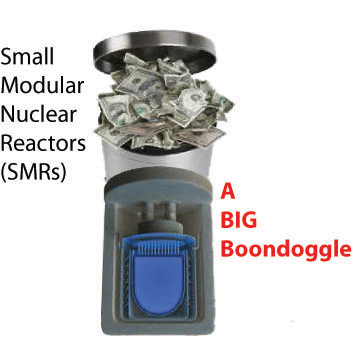 Small reactors, in fact, date back to the earliest days of atomic power, and this long history shouldn’t
be overlooked as vendors tout new generations of the technology. As the history makes clear, small nuclear reactors would be neither as cheap nor as easy to build and operate as their modern proponents are claiming they would be.
nothing in the history of small nuclear reactors suggests that they would be more economical than full-size ones. In fact, the record is pretty clear: Without exception, small reactors cost too much for the little electricity they produced, the result of both their low output and their poor performance.
In the end, as an analyst for General Electric pronounced in 1966, “Nuclear power is a big-plant business: it is most competitive in the large plant sizes.” And if large nuclear reactors are not competitive, it is unlikely that small reactors will do any better. Worse, attempts to make them cheaper might end up exacerbating nuclear power’s other problems: production of long-lived radioactive waste, linkage with nuclear weapons, and the occasional catastrophic accident
The Forgotten History of Small Nuclear Reactors Economics killed small nuclear power plants in the past—and probably will keep doing so, The Spectrum, By M.V. Ramana 27 Apr 2015 A tantalizing proposition has taken hold again in the nuclear industry: that small nuclear reactors have economic and other advantages over the standard-size ones being built today. The idea is that by reducing the substantial financial risk of a full-scale nuclear project, small reactors are the best option for kick-starting a much-discussed revival of nuclear power. Continue reading
South Africa’s nuclear company Eskom runs out of money for assessing environmental impact of nuclear energy
Eskom runs out of money for assessing environmental impact of nuclear energy SOUTH AFRICA enca.com 23 May 2015 JOHANNESBURG – Government says nuclear power in South Africa is going ahead. Earlier this week Energy Minister Tina Joematt-Peterson said that procurement deals would be signed with prospective partners by the end of 2015.
In the next ten years, government plans to introduce 9600MWs of nuclear energy.
But signing procurement deals is one half of the process. The other half of the process has stalled.
The second version of the environmental impact assessment (EIA) for the site proposed for Nuclear 1, at Thyspunt in the Eastern Cape is not complete.
During a question and answer session in Parliament in March Minister of Public Enterprises Lynne Brown in a written reply said that Eskom had run out of money to complete the report.
“It was put on hold during 2013/14 due to funding constraints in Eskom. In 2014, additional funds were approved and the finalisation of the Draft Environmental Impact Report (revision 2) was initiated,” noted the reply.
Eskom said this version of the report is due to be released to the public in May 2015 for comment but the Minister of Public Works says this has been put on hold due to the limited funding.
In the Nuclear Energy Policy of 2008, Eskom was designated as owner operator for nuclear plants in South Africa. The Department of Energy says this means that Eskom is responsible for applying and obtaining various permits including EIA and nuclear licenses.
Eskom has already spent R35 million on the report, which was funded by the income generated from tariffs.
“Eskom, in terms of the electricity regulations, is allowed to budget for and spend money on activities that are deemed prudent for the development of generation project,” noted the power utility in a statement.
However, in 2014 Eskom had to reprioritise its expenditure, “The funding of the EIA was cut in favour of other projects and activities deemed more essential in nature
Costs for the EIA’s specialist studies are now being managed on an individual study and activity level. Still outstanding is the biodiversity offset study, public participation meetings and some still need to go through the independent phase review.
Eskom says this final stage is vital, “This phase of independent review is necessary to ensure that all issues raised have been addressed in an independent and transparent manner.”
The Department Energy says even though it’s not directly involved in the EIA process it is watching Eskom’s progress on the issue……
- Others watching the process are the Thyspunt Alliance, a group opposing the development in the Eastern Cape.
Trudi Malan said they are working with their own experts to verify the findings of Eskom’s report, “The problem with the Eskom EIA is that their experts only spend three of four days on the site, when we actually need more information,” she said.
The first draft of the EIA was thrown out because incorrect methodology was used to do the assessment……..http://www.enca.com/south-africa/eskom-has-no-money-complete-environment-impact-assessment-nuclear-energy-project-site
Like Japan, South African govt is hiding the true costs of nuclear power
 Government hiding nuclear power plant costs: Earthlife Africa http://mybroadband.co.za/news/energy/127160-government-hiding-nuclear-power-plant-costs-earthlife-africa.html
Nuclear critic Earthlife Africa argues that South Africa’s new power plants are another arms deal scandal waiting to happen By Staff Writer – May 24, 2015 The South African government has done studies on what it would cost to build the planned 6 or 8 nuclear power stations, but it is not releasing the information (Also see: ANC wants to use people’s retirement savings to bail out Eskom).
This is according to nuclear critic and Earthlife Africa project co-ordinator Tristen Taylor, the Sunday Times reported.
Taylor was responding to comments from deputy director general of the Department of Energy, Zizamele Mbambo, who said that it would be premature for government to release figures at this stage, as prices were still being negotiated.
Mbambo’s comments were surprising, Taylor said, adding that government is not releasing the studies because it knows the nuclear power plants are going to cost a lot of money. Continue reading
Creative accounting by Japanese govt makes nuclear power LOOK cheap
The online magazine Business Journal recently explained the matter in bookkeeping terms. Kansai Electric and other power companies plan to decommission at least five superannuated reactors rather than apply for extensions because their respective output isn’t enough to pay for the government’s new safety measures, which cost about ¥10 billion per reactor. The problem is that once a reactor is shut down permanently, in addition to the cost of decommissioning, the company’s revenue for that plant drops to zero, thus hurting its bottom line even more and making it difficult to borrow money or issue bonds. Consequently, METI is thinking of changing the accounting system so that companies can spread this loss over 10 years, during which they can add a surcharge to every customer’s bill for decommissioning.
Obviously, when METI says nuclear is the cheapest form of energy, they’re not thinking about the user.
 Lowball nuclear pitch is fooling no one http://www.japantimes.co.jp/news/2015/05/23/national/media-national/lowball-nuclear-pitch-fooling-one/#.VWJCRtKqpHx BY PHILIP BRASOR Earlier this month, the Ministry of Economy, Trade and Industry (METI) announced the results of a review of energy production costs, which concluded that nuclear will remain the cheapest alternative for Japan over the next 15 years while pointing out that the calculations took into consideration the government’s new safety measures. By 2030, the cost of producing a kilowatt hour of electricity in a nuclear plant is expected to increase from ¥8.9 to ¥10.1. This estimate also incorporates the presumed savings resulting from those new safety measures, which, METI assumes, will reduce the “frequency” of reactor accidents.
In comparison, energy derived from coal will cost ¥12.9 per kilowatt hour and from LNG ¥13.4, though these figures are based on price increases predicted in 2011. More significantly, the cost of solar will rise from ¥12.4 to ¥16, and wind from ¥13.9 to ¥33.1. Geothermal comes in at ¥19.2. METI said these high costs will “affect development” of renewables, implying that there isn’t much of a future for them.
A few days later, Shukan Asahi ran an article assessing these calculations, pointing out that the figure of ¥10.1 per kW/hour for nuclear is, in the ministry’s statement, followed by the word ijō, meaning “at least,” while figures for other energy sources are not.
The Asahi suggests that METI is trying to assure deniability because it’s almost certain that nuclear-related costs will increase in the future. According to Kenichi Oshima, professor of environmental economics at Ritsumeikan University, the ¥9.1 trillion needed to clean up the crippled Fukushima No. 1 nuclear plant and pay compensation to locals affected by the accident was not factored into the estimate; nor was the cost of decommissioning not only Fukushima No. 1 but other reactors scheduled to go out of service in the next 15 years, and Tokyo Electric Power Co. hasn’t even set a budget for decommissioning Fukushima, a separate procedure from the cleanup. To put matters into perspective, the estimated amount of radioactive material at Fukushima that needs to be processed is equivalent to the amount of radioactive material that would need to be processed from the normal decommissioning of 54 nuclear reactors. Continue reading
Nuclear reactors to operate for 100 years? That’s what AREVA & Toshiba want
AREVA,Toshiba eye 100-year life cycle for nuclear plants John Downeynow, federal regulators allow up to 60 years of licensed energy production. But Gary Mignogna, CEO of Charlotte-based Areva Inc.(EPA:AREVA), says it’s time to consider a 100-year life cycle…..He noted that former Duke Energy CEO Jim Rogers had raised questions about whether plants could operate much beyond the 20-year extension the Nuclear Regulatory Commission offers after a plant’s 40-year initial license…….
Reverse engineering Ali Azad, chief executive of Toshiba (TYO:TOSBF) America Energy Systems, also based in Charlotte, says his organization is looking now at 80 years, at least, for existing plants. He says as you prepare to recondition existing plants for extended life, getting replacement parts becomes an issue. In some cases, the original equipment companies are no longer in business, for instance, he said.
So Toshiba is working on reverse engineering to fabricate replacement parts for older plants…..http://www.bizjournals.com/charlotte/blog/energy/2015/05/industry-eyes-100-year-life-cycle-for-nuclear.html
EDF makes an offer to AREVA
 Nuclear: EDF made an offer to over 2 billion euros in the … – Les Echos 23 May 15 As he announced, the president of EDF Jean Bernard Levy has sent this Friday to Areva executives Philippe Varin and Philippe Knoche, its proposal for the resumption of the activity of reactors Nuclear Group (Areva NP, formerly Framatome). Reportedly, this offer values the activities concerned just over € 2 billion, net of liabilities of the company. Specifically, the valuation is calculated on the basis of a multiple of 7.5 times EBITDA (EBITDA) activities occasions, recalculated according to the area concerned and restructurings that have been completed. “ This is an indicative offer, which must be followed by a period of due diligence before being adjusted to become a firm offer, possibly with conditions precedent ,” said a source close to the folder. “ At this point, the offer of EDF covers about a third of the financing needs of Areva, estimated at around 7 billion euros ,” continues the source.
During his public this week, Jean-Bernard Levy was very explicit. If the proposal EDF responds to a request of the State, its majority shareholder…..wseconomymarket.blogspot.com.au
Investors warned ; uranium market still in trouble
The uranium sector DUNDEE CAPITAL MARKETS The Globe and Mail , May. 21 2015 “…..We have concerns regarding negative impact to investor and utility/trader sentiment, which could manifest itself in the already thin spot uranium market. The two other news items might influence investor sentiment but essentially cancel each other out. Uranium stocks retreated yesterday, followed by the price.”
Lack of clarity on finances of Bjorn Lomborg’s Climate Action Delaying Centre
 It is unclear that Lomborg himself is a legitimate charity anywhere, but most of the money seems under his control. One might also wonder where income taxes are paid.
Perhaps with his new $4 million Australia Consensus Center (covered here, here, here) Bjorn Lomborg may pick a better site than a US shipping storefront, since he’ll receive much more taxpayer money, directly, courtesy of the Australian government. That does seem simpler
Bjorn Lomborg’s Copenhagen Consensus Center – Real Charity Or “Foreign Conduit”? DeSmogBlog By John Mashey • Sunday, April 26, 2015 Bjørn Lomborg is founder and president of the Copenhagen Consensus CenterUSA (CCC)), a tax-exempt 501(c)(3) “public charity” whose US physical presence is shown in the image: 262 Middlesex St, Lowell MA. Lomborg and the Copenhagen Consensus Center are known to DeSmog readers for efforts to downplay the importance of addressing climate change, a subset of climate science denialism that has infected the public debate across the English-speaking world.
Despite the name, it has not been based in Copenhagen since 2011. Deputy Director Roland Mathiasson remains there, but Lomborg moved to Prague in 2012. Workers seem mostly in Hungary, with a few in the US. The Board is Lomborg, Mathiasson, Scott Calahan (Ft Lauderdale) and Loretta Michaels (Washington, DC). Although some money is used for fundraising and PR in the US, much goes abroad to Mathiasson and Lomborg, who is said to travel 200 days a year.
The “real location” of CCC is unclear, and the Internal Revenue Service often cares about this with charities.
Copenhagen Consensus Center is a textbook example of what the IRS calls a “foreign conduit” and it frowns strongly on such things. It may also frown on governance and money flows like this, perhaps “inurement”:
From attached Form 990 summary, more than 60% went directly to Lomborg, travel and $853K promotion of his movie. According to Wikipedia it grossed $63K and the movie poster shows a picture of Lomborg, a light bulb and heading:
“A LIGHT BULB WON’T SOLVE GLOBAL WARMING
THIS GUY’S BRIGHT IDEAS MIGHT“
Even in a simple US charity, poor governance and obvious conflicts of interest are troublesome, but the foreign element invokes stringent extra rules. Legitimate US charities can send money to foreign charities, but from personal experience, even clearly reasonable cases like foreign universities require careful handling. It is unclear that Lomborg himself is a legitimate charity anywhere, but most of the money seems under his control. One might also wonder where income taxes are paid.
A foreign group’s creation of a US “shell” charity to gather US funds and funnel them abroad is the most obvious of “foreign conduits” in IRS parlance, #1 on its list of no-no’s. IRS revocation of 501(c)(3) status not only eliminates tax breaks for ordinary donors, but eliminates entirely crucial major gifts from private foundations like the Randolph Foundation, Ewing Marion Kauffman Foundation and the Paul E. Singer Foundation.
CCC seems to break many rules. Foreign citizen Lomborg is simultaneously CCC founder, president, and highest-paid employee. Most people are a little more subtle when trying to create conduits, as in this example, where the IRS determined someone was not eligible for 501(c)(3) status, despite various stratagems to obscure the relationships.
Perhaps with his new $4 million Australia Consensus Center (covered here, here, here) Bjorn Lomborg may pick a better site than a US shipping storefront, since he’ll receive much more taxpayer money, directly, courtesy of the Australian government. That does seem simpler…….http://www.desmogblog.com/2015/04/26/copenhagen-consensus-center-real-charity-foreign-conduit
1 This Month




PLEASE OPPOSE HR 8255 AND S.3639 – bills would accelerate satellite deployment, with no environmental review or safeguards – https://ncstd5li.quorum.us/campaign/169331/
To see nuclear-related stories in greater depth and intensity – go to https://nuclearinformation.wordpress.com
-
Archives
- September 2026 (339)
- August 2026 (330)
- July 2026 (355)
- June 2026 (287)
- May 2026 (306)
- April 2026 (356)
- March 2026 (251)
- February 2026 (267)
- January 2026 (308)
- December 2025 (358)
- November 2025 (359)
- October 2025 (375)
-
Categories
- 1
- 1 NUCLEAR ISSUES
- business and costs
- climate change
- culture and arts
- ENERGY
- environment
- health
- history
- indigenous issues
- Legal
- marketing of nuclear
- media
- opposition to nuclear
- PERSONAL STORIES
- politics
- politics international
- Religion and ethics
- safety
- secrets,lies and civil liberties
- spinbuster
- technology
- Uranium
- wastes
- weapons and war
- Women
- 2 WORLD
- ACTION
- AFRICA
- Atrocities
- AUSTRALIA
- Christina's notes
- Christina's themes
- culture and arts
- Events
- Fuk 2022
- Fuk 2023
- Fukushima 2017
- Fukushima 2018
- fukushima 2019
- Fukushima 2020
- Fukushima 2021
- general
- global warming
- Humour (God we need it)
- Nuclear
- RARE EARTHS
- Reference
- resources – print
- Resources -audiovicual
- Weekly Newsletter
- World
- World Nuclear
- YouTube
-
RSS
Entries RSS
Comments RSS

