Exelon dithers about closing uneconomic nuclear power plants in Illinois
EXELON DELAYS CLOSURE DECISION ON 2 ILLINOIS NUCLEAR PLANTS http://abc7chicago.com/business/exelon-delays-closure-decision-on-2-illinois-nuclear-plants/977661/ September 10, 2015 Exelon Corp. says it is delaying for one year its decision about whether to close nuclear plants in the Quad Cities and Byron.
Chicago-based Exelon owns Illinois’ 11 nuclear reactors. It has previously said its generating stations in the Quad Cities, Byron and Clinton were in danger of closing.
Exelon said Thursday that it plans to continue operating its Quad Cities nuclear power plant through at least May 2018 and the Byron plant will operate through May 2019. The company said the Clinton station remains “economically challenged” and could be closed if conditions don’t improve.
Exelon president and CEO Chris Crane called the decision a “short-term-reprieve.” He said policy reforms are needed to level the clean energy playing field and position Illinois to meet EPA carbon reduction rules.
German utility E.ON gives up plan to set up anew nuclear company, in view of new liability law proposed
E.ON Faces Massive Loss After Scrapping German Nuclear Spinoff
Utility said it would post a hefty net loss this year after booking billions of euros in impairments, WSJ, MONICA HOUSTON-WAESCH and FRIEDRICH GEIGER Sept. 10, 2015 BERLIN—E.ON SE will post a massive loss this year after ditching plans to unload its German nuclear operations into a new company, in a nod to government proposals to saddle utilities with liabilities related to nuclear energy.
E.ON expects to book impairment costs this quarter of as much as €9 billion ($10 billion), triggering a multibillion-euro loss. Its shares plunged to an all-time low on Thursday, dropping 6% to €9.09.
The German utility had planned to move its nuclear operations into Uniper, a company being established to operate conventional power, trading, exploration and production. The spinoff will proceed but without German nuclear activities, said E.ON, which also has Swedish nuclear operations……..
E.ON’s decision was prompted by government proposals for legal changes that would make utilities permanently liable for the costs of nuclear waste and plant decommissioning……..
E.ON now plans to bundle its German nuclear operations into an independent unit within E.ON. Its Swedish nuclear operations will be spun off into Uniper as planned……http://www.wsj.com/articles/e-on-drops-plan-to-spin-off-german-nuclear-plants-1441865094
European Pressurised nuclear Reactor (EPR) – litany of delays and cost overruns
French EPR reactor years behind schedule, billions over budget http://economictimes.indiatimes.com/news/international/business/french-epr-reactor-years-behind-schedule-billions-over-budget/articleshow/48785708.cms By Reuters | 3 Sep, 2015, PARIS: French state-controlled utility EDF on Thursday announced new delays and cost overruns for the Areva-designed 1650 megawatt European pressurised reactor (EPR) reactor it is building in Flamanville, Normandy.

The EPR is set to be the first of a new series of safer “next-generation” reactors to replace France’s ageing fleet of 58 nuclear reactors. The Flamanville reactor had been scheduled to start in 2012 and was scheduled to cost 3 billion euros.
A similar EPR reactor built by ArevaBSE 1.16 % in Finland, on which construction started in 2005 and was scheduled to start up in 2009, has suffered even longer delays. Two more EPRs are under construction in China and EDF plans to build two in Hinkley Point, Britain.
Below is a timeline of the Flamanville delays and cost overruns:
July 2005: EDF says it plans to build an EPR reactor at Flamanville, which is due to start operating in 2012. The cost is estimated at 3 billion euros.
In its 2005 annual report, EDF estimates the cost at 3.3 billion euros.
May 2006: EDF says construction should begin in 2007 and be completed in 2012.
December 2007: Work starts on the Flamanville ..
December 2008: EDF says EPR is due to cost 4 billion euros.
July 2010: EDF says start of Flamanville EPR is delayed until 2014. Construction costs now seen at 5 billion euros.
July 2011: EDF delays the completion of its Flamanville reactor by another two years to 2016. It expects costs to rise to 6 billion euros.
December 2012December 2012: EDF says stricter regulation in the wake of the Fukushima disaster will bring the total cost of the EPR to 8.5 billion euros. The start-up date is still expected for 2016.
July 2013: EDF installs the dome of Flamanville reactor.
November 2014: EDF said the Flamanville reactor will start up in 2017. It says the delay is due to Areva’s difficulties with ensuring a timely delivery of certain pieces of equipment.
April 2015: EDF says weak spots have been found in the steel of the Flamanville EPR. EDF starts a series of new tests on the EPR as construction work continues. Nuclear regulator says carbon concentrations have weakened the mechanical resilience of the steel and its ability to resist the spreading of cracks.September 3 2015: EDF said the Flamanville reactor will now start in 2018 and cost 10.5 billion euros.
Despite Sendai restart, the outlook for Japan’s #nuclear industry is poor

 Japan nuclear power outlook bleak despite first reactor restart, Yahoo News, 1 Sept 15, By Kentaro Hamada and Aaron Sheldrick TOKYO (Reuters) – The number of Japanese nuclear reactors likely to restart in the next few years has halved, hit by legal challenges and worries about meeting tougher safety standards imposed in the wake of the Fukushima disaster, a Reuters analysis shows…….
analysis shows that of the other 42 operable reactors remaining in the country, just seven are likely to be turned on in the next few years, down from the 14 predicted in a similar survey last year.
The findings are based on reactor inspection data from industry watchdog the Nuclear Regulation Authority, court rulings and interviews with local authorities, utilities and energy experts. They also show that nine reactors are unlikely to ever restart and that the fate of the remaining 26 looks uncertain.
“Four-and-a-half years after the events started unfolding at Fukushima Daiichi, the Japanese government, the nuclear utilities and the NRA have not succeeded in overcoming complete planning insecurity for investors. The outlook for restarts is as cloudy as ever,” said Mycle Schneider, an independent energy consultant in Paris…….
LEGAL WOES
Legal challenges from local residents have hit all atomic plants, with the country’s most nuclear-reliant utility Kansai Electric Power issued with court rulings preventing the restart of four reactors despite two of them already receiving NRA approval to switch on.
Kansai has appealed the judgments but the court cases may take years to resolve if the rulings are not overturned on the first appeal.
Tougher safety standards and stricter implementation of rules since Fukushima have also been hitting restarts. Japan Atomic Power has been battling a regulatory ruling that one of its reactors sits above an active fault, meaning it must be decommissioned.
And highlighting the pitfalls of rebooting the industry, Kyushu Electric was forced to slow the ramp up of power from its Sendai No. 1 reactor after it restarted around mid-August due to problems with pumping equipment. Engineers warn that firing up reactors that have been offline for prolonged periods could be fraught with such troubles……..http://news.yahoo.com/japan-nuclear-power-outlook-bleak-despite-first-reactor-013149457–finance.html
South Carolina electricity customers slugged for Over-Budget Nuclear Project
SCE&G Customers Paying for Over-Budget Nuclear Project Savannah Levins, WLTX September 2, 2015 COLUMBIA, SC (WLTX)– South Carolina Electric and Gas was approved to build two nuclear reactors back in 2009. The mission of the new devices: provide cleaner energy
The legislature, under the Baseload Review Act, agreed the company can increase customer bills every year to help pay for it. But now that the company is about a billion dollars over budget and years behind schedule, customers like environmental activist Tom Clements are getting frustrated.
“The rate payer, the customer, is saddled with 100% of the costs and all the risk of the project, and at the end of the day we don’t own anything,” he said. “We’ve paid for everything, we’ve taken all the risk, and we don’t own anything. But that;s courtesy of the legislature that passed what i think is an unjust law.”
On Wednesday, the Public Service Commission approved SCE&G’s request for an additional one billion in today’s dollars, and a four year extension to complete the project.
SCE&G Spokesperson Eric Boomhower says another customer rate increase of 2.8% is set to take effect in the end of October, and will continue to increase each year until the project is complete……..
Company representatives predict customers will continue to see annual increases averaging 2.2% until the project is completed.
That completion date, originally set at 2016, was pushed back on Wednesday to 2020. http://www.wltx.com/story/news/local/2015/09/02/sceg-customers-paying-over-budget-nuclear-project/71608720/
Yet more delay for New Hinkley Point nuclear power station
New Hinkley Point nuclear power station may be further delayed, Guardian, Terry Macalister, 4 Sept 15
France’s EDF gives no definite schedule for construction of £24.5bn plant, which still awaits firm’s final investment decision The planned new nuclear power station at Hinkley Point in Somerset has been hit by another setback, with its developer EDF admitting the project may be further delayed.
The news came as the French energy group said a more advanced sister project at Flamanville in Normandy would now not start operating until 2018, at a cost of €10bn (£7.3bn). It was originally slated to open in 2005 and cost €3bn.
No definite schedule has been given for power to be switched on at Hinkley, but it means the £24.5bn facility, which still awaits EDF’s formal go-ahead, may not be ready by 2023 – a date that has already been put back several times…….
The latest problem follows continued speculation that China General Nuclear Power Corp and China National Nuclear Corp were pushing the UK government for concessions before committing to a cash investment at Hinkley.
Critics have repeatedly told the government that it was foolish to rely on a new generation of nuclear power stations to meet Britain’s energy crunch, because such huge projects have a record of coming in late and over budget. http://www.theguardian.com/business/2015/sep/03/new-hinkley-point-nuclear-power-station-may-be-further-delayed
UK under pressure to buy nuclear reactors – from GE/Hitachi, Westinghouse/Toshiba and Areva/Mitsubishi
 Hitachi has made no secret of its motive for trying to export reactor technology saying it needed a fresh outlet for reactors after Tokyo shut down Japan’s nuclear plants
failure to agree a final deal between EDF Energy and the Government on Hinkley “threatens not only the first new nuclear power station for a generation, but potentially all those that will come in its wake,”
ABWRs – one of the least reliable reactors in the world nuClear news No.77, September 2015
Introduction – Anglesey: a victim of Abenomics? Exporting nuclear technology is a key element of Japanese Prime Minister Shinzo Abe’s economic strategy – “Abenomics”. Nuclear exports are seen as a way to rev up Japan’s long struggling economy, and tackle the persistent trade deficit made worse by the
need to import energy – especially Liquid Natural Gas – to replace reactors shutdown after Fukushima.
Japan’s top three nuclear engineering companies — Hitachi, Mitsubishi Heavy Industries and Toshiba — which had a combined profit in their energy and infrastructure businesses of about 242 billion yen ($3.14 billion) in the fiscal year 2010/11, were keener than ever to look overseas for business after Fukushima put the domestic nuclear industry on hold. Continue reading
Three Mile Island nuclear plant could be headed for premature closure.

 Three Mile Island nuclear plant being considered for closure? Lancaster online, AD CRABLE | Staff Writer, 26 Aug 15, Could the Three Mile Island nuclear plant be headed for premature closure? Last week, no one bought a year’s worth of TMI’s electricity at a key energy-buying auction held by PJM, the regional transmission organization that coordinates the movement of power in all or parts of 13 states and the District of Columbia.
The PJM Capacity Auction is not the only place TMI owner Exelon can sell the plant’s electricity, but it’s a key and profitable one. The results have led to speculation that Exelon may be considering closing TMI as it is considering doing at three of its nuclear plants in Illinois.
Asked if the plant was in a troubled financial situation, Ralph DeSantis, Exelon’s spokesman at TMI, issued this statement: “The fact that TMI did not clear the 2018-2019 auction makes it clear the plant’s economics are challenged……..
In Illinois, Exelon has threatened to close as many as three of its money-losing nuclear plants because of competition from natural gas and subsidized wind energy. Two of those three plants are in the PJM, as is TMI, and neither of the Illinois plants were competititive enough to sell electricity in the last auction in May 2014.
Exelon has sought support from Illinois legislators and one bill being considered would require the state’s utilities to buy 70 percent of their power from “low carbon” sources such as that generated by nuclear plants. The utilities could offset that cost by charging ratepayers with a surcharge of up to 2 percent.
Eric Epstein of the clean-energy group Three Mile Island Alert had this to say about TMI’s shutout at the capacity auction: “Single reactor sites like TMI are more vulnerable to closure since they are unprofitable and require government and ratepayer subsidies.
“Several developments this summer have weakened the nuclear industry and wrought havoc on Exelon’s corporate fortunes: EPA devalued nuclear’s role in combating carbon emissions, three Exleon plants, including TMI, did not clear PJM capacity auctions, and the DC Public Service Commission nixed the Exelon-Pepco merger.
“TMI’s shuttering creates long-term problems for the local community, and will intensify the shortfall in cleanup funding, and postpone the storage of high-level radioactive waste from spent fuel pools to dry casks.
owners of nuclear plants are hoping that the President Obama administration’s Clean Power Plan to cut back on sources of carbon dioxide, such as coal plants, will raise the value of nuclear plants.
Says DeSantis, “Exelon is continuing its ongoing work to educate policymakers and others about the fact that markets are failing to properly value nuclear power’s environmental and reliability benefits and the need to find solutions that will correct that.”In 2009, Exelon received a license extension from the U.S. Nuclear Regulatory Commission to continue operating TMI until 2034.
Exelon is the nation’s largest owner and operator of nuclear plants, with 22 reactors in 13 locations, including TMI and the Peach Bottom nuclear plant in York County…. http://lancasteronline.com/news/local/three-mile-island-nuclear-plant-being-considered-for-closure/article_b421e660-4c23-11e5-9906-57636793d31b.html
Money running low for uranium cleanup in Ohio
Mass layoff possible in Portsmouth uranium cleanup, Columbus Dispatch, By Kantele Franko ASSOCIATED PRESS • Friday August 28, 2015 Workers decontaminating and decommissioning a Cold War-era uranium plant in southern Ohio are again being notified about hundreds of potential layoffs because of an anticipated funding gap, a reprise of warnings they heard a year ago for the same reason…….
Those layoffs could occur around Oct. 22, but the project’s director and other leaders remain hopeful they’ll get funding needed to continue their current pace, which costs roughly $387 million annually, Wagner said.
Hundreds of layoffs were averted last year because Congress approved extra funding. This time, the situation is a bit different.
About 70 percent of the project’s funding comes from a program in which the government sells uranium, but the amount that can be bartered has been reduced for 2016, so project officials must hope the balance is made up through appropriations, Wagner said……..
U.S. Sen. Rob Portman said lawmakers will once again have to scramble to find funding. As he has repeatedly, the Ohio Republican called for adequate annual funding in the federal budget for the cleanup.
“It’s actually less expensive to the taxpayer over time to start moving to actual cleanup rather than almost maintaining the site, which is about all you can do with the low levels of funding,” Portman said Thursday in Columbus. “It may seem like it’s more money up front, but it’s actually billions of dollars less money over time — billions because they’re now pushing the cleanup really out to the 2050s.” http://www.dispatch.com/content/stories/local/2015/08/28/mass-layoff-possible-in-uranium-cleanup.html
Uncertainty over future costs of Vogtle Nuclear Station
 Budget on Georgia nuclear plant level, uncertainty remains, WT, By RAY HENRY – Associated Press – Friday, August 28, 2015 ATLANTA (AP) – Georgia Power reported Friday the cost to build a nuclear plant was holding steady, but there’s significant uncertainty whether those numbers will stick.
The Southern Co. subsidiary owns a 46 percent stake in two new reactors under construction at Plant Vogtle, near Augusta. The utility now expects to spend roughly $7.5 billion to finish the project, or about 22 percent more than originally expected. The budget released Friday declined slightly from the company’s last financial filing in February. If they hold, the level spending figures would be welcome news for investors and customers. By law, Georgia Power’s customers will ultimately pay for construction costs unless state regulators object and force losses onto shareholders. However, project watchdogs say multiple problems could still raise costs.
The nuclear plants under construction in Georgia and South Carolina were approved before natural gas prices plummeted. As it became cheaper to build gas-fired plants, major power companies scrubbed plans to build nuclear reactors nationwide. If it wants to grow, the nuclear industry must prove it can build without the construction delays and cost overruns common years ago.
So far, the proof is lacking. The companies designing and building the plant, Westinghouse Electric Co. and Chicago Bridge and Iron Co., announced a new construction schedule this year that pushed back the completion of the first reactor in Georgia to June 2019, followed by the second reactor a year later. That means the construction effort is now running about three years behind schedule.
Even that latest schedule has slipped by three months……..Utilities in South Carolina building an identical nuclear plant have run into similar delays and cost overruns. South Carolina Electric & Gas Co. reported this month that its share of costs had increased by roughly $1.1 billion. http://www.washingtontimes.com/news/2015/aug/28/budget-on-georgia-nuclear-plant-level-uncertainty-/
Radiation exposure to Fukushima workers and the community
 Fukushima today: A first-person account from the field and the conference table, Bulletin of the Atomic Scientists, 26 Aug 15 Subrata Ghoshroy “……….the building containing the failed reactors has radiation levels as high as 4,000 to 5,000 milliSieverts per hour (400,000 to 500,000 millirems per hour), making even the operation of robots difficult. In fact, two power company robots had to be abandoned while inside the depths of the plant. And some spots, such as inside the primary containment vessel, went as high as 9.7 Sieverts per hour (970,000 millirems per hour). In addition, it has not been possible to precisely locate the melted core. (Another conference speaker, Jun Tateno, who was a former research scientist with the Japanese Atomic Energy Research Institute, accused the government of suppressing voices from the scientific community that were critical of the safety of power plants. He said that we have reached a situation in which we do not even know how much plutonium is in the core.) In the meantime, huge amounts of water must be pumped in to keep the reactors cool; this liquid then mixes with ground water, contaminating it as a result.
The picture is not much better when it comes to the land. In an effort to decontaminate residential areas, radioactive soil is being dug up from approximately 1,000 sites. The government wants to consolidate this contaminated material in semi-permanent storage sites in the “difficult-to-return zones” in Futaba and Okuma towns. Local residents, meanwhile, fear that these could turn into permanent repositories of radioactive material……….
We were told that most workers did not wear dosimeters to record their cumulative radiation dose. There was good money to be made in decontamination work. They did not want to know.
But if one does the math, what the workers and their supervisors were ignoring—or were being told to ignore—could be significant. If a person spent one week working at this part of a supposedly safe parking area for 8 hours per day, then he or she would have been exposed to 40 microSieverts per day. And if that person was there for a 5-day workweek, then over the course of a single week that person would have been exposed to 200 microSieverts. In a year, that person could receive 10 milliSieverts, a significant dose. Of course, scientists are rightly cautious of such “anecdotal” evidence; our Geiger counter readings could have been off, or the machine calibrated incorrectly, or some other source of error introduced—though I doubt it because it had earlier read the background correctly. But the result of such quick and dirty, back-of-the-envelope calculations for what is supposedly a low-risk parking area, well away from the restricted hot zones, do give one pause—especially as the ongoing lack of dosimeters means that no one really knows a given individual’s cumulative dose. The amount of exposure to a thing that you cannot see, hear, smell, taste, or feel sneaks up on you. Even when you think you are safe, you are not.
If nothing else, the fact that a simple, random spot-check registered so highly is an eye-opener, and counter to what has been officially portrayed. ……..An important item seemed to lie further down in the article, which noted: “However, the health ministry said the number of workers surveyed is different from the total number of cleanup personnel reported by the Environment Ministry, which could mean the association failed to record radiation doses of all individuals working around the Fukushima plant.”
No wonder there has been public distrust and charges of a lack of clarity about the radiation clean-up operation, as can be seen in the title of a 2013 Guardian newspaper article: “Life as a Fukushima clean-up worker—radiation, exhaustion, public criticism.”Even when the approximately 7,000 workers involved in the clean-up do wear dosimeters, that is no guarantee of accuracy; there have been reports of a Tokyo Electric Power Company executive who tried to force clean-up workers to manipulate dosimeter readings to artificially low levels by covering their devices with lead shields………http://thebulletin.org/fukushima-today-first-person-account-field-and-conference-table8683#.Vd6Rj7YbwEs.twitter
France’s new nuclear power – not successful at home, so they might try to sell it off to Czech Republic
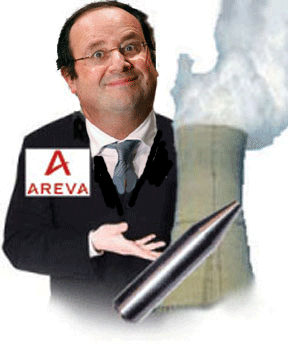 French foreign minister: EDF to consider participating in building new Czech nuclear reactors US News 23 Aug 15 PRAGUE (AP) — French Foreign Minister Laurent Fabius says his country’s company will consider participating in developing the Czech Republic’s nuclear program.
The Czech government has recently approved a long-term plan to increase the country’s nuclear power production. As part of the plan, the government wants to build one more reactor at the Temelin nuclear plant and another at the Dukovany plant, with an option to build yet another reactor at each plant…..Speaking to reporters after meeting Czech counterpart Lubomir Zaoralek on Sunday, Fabius said it will be state-controlled utility Electricite de France that will be part of a public tender to build the reactors. http://www.usnews.com/news/business/articles/2015/08/23/france-to-consider-helping-czech-nuclear-program
Escalating costs, expanding timelines, cast doubt on the future of modular nuclear construction
Fitch: ‘Failure’ of new nuke construction means fewer plants https://www.snl.com/InteractiveX/Article.aspx?cdid=A-33617164-10551 , Thursday, August 20, 2015 By Matthew Bandyk The troubled construction of new nuclear reactors in Georgia and South Carolina will likely chill the pursuit of more nuclear plants in the U.S., although recent actions by the U.S. EPA and the Department of Energy could improve the outlook over time, according to an analysis by Fitch Ratings.
As a result, there will be less new nuclear to replace the increasing number of retiring plants. Fitch said that the U.S. Energy Information Administration’s forecast of nuclear generation falling by 10,800 MW by 2020 might be too conservative if more plants retire due to local political pressure and the need for costly upgrades.
The nuclear projects at the Vogtle and V.C. Summer plants, the first new nuclear generation built in the U.S. in decades, use the Westinghouse Electric Co. LLC AP1000 reactor design, which promised to be cheaper and more efficient to build than past nuclear plants that saw spiraling cost overruns during construction. In particular, Westinghouse touted the “modern, modular” construction technique in which major plant components would be built off-site as modules, allowing pieces of the project to be completed in parallel and in turn speeding up construction.
But “the recent failure of modular construction to deliver lower prices and shorter timelines will likely keep a cap on U.S. nuclear development into the midterm,” Fitch analysts said in a statement Aug. 20. The Vogtle and Summer projects are each running about three years behind schedule and are now expected to cost a few billion dollars more than originally estimated.
The blame for much of the delays has been centered on subpar work on the modules at facilities like Chicago Bridge & Iron Co. N.V.‘s Lake Charles fabrication facility in Louisiana. CB&I has since shifted work to other facilities, and monitors of the Vogtle project recently reported that the module work has “improved significantly.” But the contractors continue to miss their own deadlines and there is still risk of more delays, the same monitors said.
In addition, four AP1000 reactors under construction in China are also seeing rising costs and delays, Fitch noted.
One of the best hopes for the U.S. nuclear industry comes from the EPA’s recently finalized Clean Power Plan, according to Fitch. The rule allows new nuclear plants and capacity uprates at existing plants to generate credits that states can use to reduce their CO2 emissions levels and comply with the rule. In addition, the DOE continues to try to lower the financing costs for the nuclear industry through loan guarantees. Last year the DOE said it is accepting applications from nuclear developers for $12.5 billion in loan guarantees.
Both the EPA and DOE efforts could “yield growth factors longer term,” Fitch said.
Nuclear plant Vogtle – another cost increase approved – now up to $2.97 billion
Georgia energy regulators approve 12th Plant Vogtle construction update http://www.bizjournals.com/atlanta/blog/capitol_vision/2015/08/georgia-energy-regulators-approve-12th-plant.html?utm_source=Sailthru&utm_medium=email&utm_campaign=Issue:%202015-08-19%20Utility%20Dive%20Newsletter&utm_term=Utility%20Dive
Commissioners voted unanimously to approve $169 million the utility reported spending on the project during the last half of last year. That brings Georgia Power’s cumulative construction and capital costs to date to $2.97 billion.
In approving the 12th semi-annual update Georgia Power has submitted to the PSC since the construction of two additional nuclear reactors at the plant south of Augusta, Ga., was authorized in 2009, the commission rejected requests from environmental and consumer advocacy groups concerned that a 39-month delay in the project’s scheduled completion is driving up customer costs.
Commissioner Stan Wise argued Atlanta-based Georgia Watch’s request that the PSC consider the costs of achieving the same additional electric generating capacity with wind and solar projects as an alternative to nuclear expansion was inappropriate.
“It’s not going to change anything we do at Vogtle,” he said. “Wind and solar are going to run their own course, like any product does.”
The commission voted in 2013 to postpone consideration of who should pay for cost overruns at Plant Vogtle – Georgia Power’s shareholders or its customers – until after the first of the two new nuclear reactors goes into service. Under a revised timetable Georgia Power submitted last winter, that won’t come until 2019.
Hinkley Point C Nuclear scam – UK tax-payers fund Chinese investors

 Tory privatisation scams (2): the Hinkley Point C nuclear payola guaranteed by UK taxpayers for Chinese investors http://www.michaelmeacher.info/weblog/2015/08/tory-privatisation-scams-2-the-hinkley-point-c-nuclear-payola-guaranteed-by-uk-taxpayers-for-chinese-investors/
Just how bad a deal this is is shown by the fact that Hinkley will provide just 3 gigawatts of capacity, yet for the same price gas-fired turbines could provide about 50 gigawatts, onshore wind 20 and offshore wind 10. The plant will not open till 2023 at the earliest, well past the date of the most acute energy shortage at the end of this decade. And it will cost as much as the combined bill for Crossrail, the London Olympics and the revamped Terminal 2 at Heathrow – beat that for the most expensive white elephant of modern times!
It’s an anachronistic behemoth from the bygone age of energy dinosaurs when the world is rapidly moving towards distributed power via renewable energy. It’s far too costly, and is it even needed? First there is the UK’s declining demand for power, currently falling at a rate of 1% a year as energy-saving measures steadily take effect. Then there is the expected threefold jump in the UK’s Interconnection capacity with continental Europe by 2022 which increases the ability to import cheaper supplies. And third there is the litany of setbacks in price overruns and huge delays that have afflicted Finland, France and China over EDF’s European Pressurised Reactor which is the same type as is planned for Hinkley Point.
However nothing distracts the Tory nose from a good old-fashioned financial fix behind the scenes, especially when in this case it plays to their abhorrence of UK State involvement in meeting a public need. So Cameron is off to Beijing in October to sign a final deal wit the Chinese president from which only Chinese investors will gain at UK taxpayer expense.
1 This Month




PLEASE OPPOSE HR 8255 AND S.3639 – bills would accelerate satellite deployment, with no environmental review or safeguards – https://ncstd5li.quorum.us/campaign/169331/
To see nuclear-related stories in greater depth and intensity – go to https://nuclearinformation.wordpress.com
-
Archives
- September 2026 (339)
- August 2026 (330)
- July 2026 (355)
- June 2026 (287)
- May 2026 (306)
- April 2026 (356)
- March 2026 (251)
- February 2026 (267)
- January 2026 (308)
- December 2025 (358)
- November 2025 (359)
- October 2025 (375)
-
Categories
- 1
- 1 NUCLEAR ISSUES
- business and costs
- climate change
- culture and arts
- ENERGY
- environment
- health
- history
- indigenous issues
- Legal
- marketing of nuclear
- media
- opposition to nuclear
- PERSONAL STORIES
- politics
- politics international
- Religion and ethics
- safety
- secrets,lies and civil liberties
- spinbuster
- technology
- Uranium
- wastes
- weapons and war
- Women
- 2 WORLD
- ACTION
- AFRICA
- Atrocities
- AUSTRALIA
- Christina's notes
- Christina's themes
- culture and arts
- Events
- Fuk 2022
- Fuk 2023
- Fukushima 2017
- Fukushima 2018
- fukushima 2019
- Fukushima 2020
- Fukushima 2021
- general
- global warming
- Humour (God we need it)
- Nuclear
- RARE EARTHS
- Reference
- resources – print
- Resources -audiovicual
- Weekly Newsletter
- World
- World Nuclear
- YouTube
-
RSS
Entries RSS
Comments RSS


